Upgrade & Secure Your Future with DevOps, SRE, DevSecOps, MLOps!
We spend hours scrolling social media and waste money on things we forget, but won’t spend 30 minutes a day earning certifications that can change our lives.
Master in DevOps, SRE, DevSecOps & MLOps by DevOps School!
Learn from Guru Rajesh Kumar and double your salary in just one year.
Introduction
Subscription Billing Platforms are specialized software solutions that help businesses manage recurring billing, subscription payments, invoicing, and revenue recognition. In a business environment, where subscription-based models dominate industries ranging from SaaS to streaming and e-commerce, these tools have become essential for managing complex pricing models, automating payment collections, and ensuring revenue compliance.
Real-world use cases include:
- Automating recurring billing cycles for SaaS companies.
- Managing multiple subscription tiers, add-ons, and promotional discounts.
- Handling automated renewals, upgrades, and cancellations.
- Generating invoices and sending reminders for payments.
- Analyzing subscription metrics such as churn, MRR (Monthly Recurring Revenue), and ARPU (Average Revenue Per User).
When evaluating subscription billing platforms, buyers should consider:
- Recurring billing and payment automation
- Support for multiple pricing models (tiered, usage-based, hybrid)
- Revenue recognition and compliance (ASC 606 / IFRS 15)
- Analytics and reporting dashboards
- Integration with CRM, ERP, and accounting systems
- Customer self-service portals
- Payment gateway and multi-currency support
- Security and compliance features
- Mobile accessibility for management
- Vendor support and community resources
Best for: SaaS companies, subscription-based businesses, finance teams, billing specialists, and mid-market to enterprise organizations managing recurring revenue.
Not ideal for: Businesses with one-time payment models or minimal recurring billing volume.
Key Trends in Subscription Billing Platforms
- AI-powered churn prediction: Identify subscribers likely to cancel to optimize retention strategies.
- Automated revenue recognition: Compliance with ASC 606 and IFRS 15 for accurate financial reporting.
- Multi-currency and global payment support: Enable global subscription operations seamlessly.
- Flexible pricing models: Support tiered, usage-based, freemium, and hybrid pricing.
- Integration with CRM and ERP: Ensure real-time financial and customer data synchronization.
- Self-service customer portals: Empower users to manage subscriptions, payments, and upgrades.
- Cloud-native deployments: Provide scalability, reliability, and remote access.
- Analytics and forecasting dashboards: Real-time insights into MRR, churn, and ARPU.
- Regulatory compliance automation: GDPR, SOC 2, and ISO 27001 adherence.
- Mobile-enabled management: Approvals, monitoring, and reporting on the go.
How We Selected These Tools (Methodology)
- Reviewed adoption across subscription-based businesses and industries.
- Assessed feature completeness for billing automation, revenue recognition, and analytics.
- Evaluated reliability, scalability, and performance under high transaction volume.
- Examined security and regulatory compliance features.
- Considered integration capabilities with ERP, CRM, and accounting systems.
- Evaluated suitability for SMB, mid-market, and enterprise organizations.
- Reviewed vendor support, onboarding, and training resources.
- Balanced enterprise-grade and SMB-friendly solutions to identify the top 10 platforms.
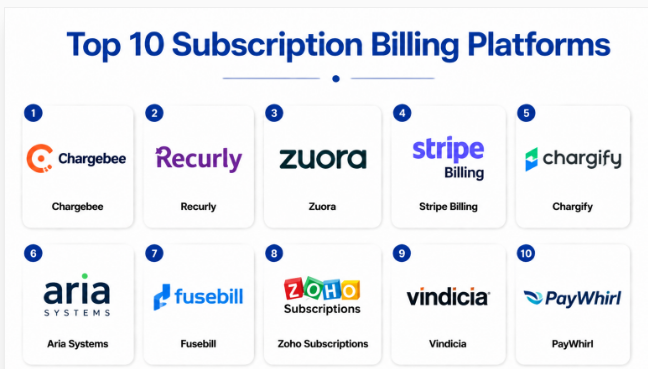
Top 10 Subscription Billing Platforms
#1 — Chargebee
Short description: Chargebee automates subscription billing, invoicing, and revenue recognition for SaaS, media, and e-commerce businesses. It supports complex pricing models and multi-currency transactions for global operations.
Key Features
- Automated recurring billing
- Flexible pricing and discount structures
- Revenue recognition compliance
- Multi-currency and tax handling
- Analytics dashboards for subscription metrics
- Customer self-service portal
Pros
- Streamlined subscription operations
- Robust analytics and forecasting
Cons
- Can be expensive for smaller businesses
- Advanced customization may require technical support
Platforms / Deployment
- Web / iOS / Android
- Cloud
Security & Compliance
- SOC 2, ISO 27001, GDPR
- Encryption, MFA, and RBAC
Integrations & Ecosystem
- CRM and accounting software
- Payment gateways
- API access for custom workflows
Support & Community
- Vendor support with onboarding
- Knowledge base and active community
#2 — Recurly
Short description: Recurly provides enterprise-grade subscription management, billing automation, and analytics to optimize recurring revenue. It is ideal for high-growth SaaS and media companies.
Key Features
- Automated recurring billing
- Revenue recognition compliance
- Flexible subscription models
- Dunning management and failed payment handling
- Analytics dashboards
- Multi-currency support
Pros
- Enterprise-grade reliability
- Detailed financial insights
Cons
- Premium pricing for small organizations
- Steeper learning curve
Platforms / Deployment
- Web / iOS / Android
- Cloud
Security & Compliance
- SOC 2, ISO 27001
- Encryption and MFA
Integrations & Ecosystem
- ERP and CRM integrations
- Payment processors
- API support
Support & Community
- Vendor support
- Documentation and onboarding resources
#3 — Zuora
Short description: Zuora automates subscription billing, revenue recognition, and financial reporting for enterprises. It is tailored for businesses with complex subscription models and global reach.
Key Features
- Recurring billing automation
- Revenue recognition and compliance
- Tiered and usage-based pricing
- Dunning and collections
- Advanced analytics dashboards
Pros
- Enterprise scalability
- Supports complex billing workflows
Cons
- Implementation complexity
- Costly for smaller companies
Platforms / Deployment
- Web / iOS / Android
- Cloud
Security & Compliance
- SOC 2, ISO 27001, GDPR
- Encryption and MFA
Integrations & Ecosystem
- ERP, CRM, and accounting software
- Payment gateway integrations
- API access
Support & Community
- Vendor support
- Active enterprise user community
#4 — Stripe Billing
Short description: Stripe Billing is part of Stripe’s payment ecosystem, providing subscription billing, invoicing, and revenue management for online businesses and SaaS platforms.
Key Features
- Automated recurring payments
- Flexible subscription pricing
- Revenue recognition tools
- Analytics and dashboards
- Multi-currency and tax handling
Pros
- Seamless integration with Stripe payments
- Scalable for online businesses
Cons
- Advanced revenue recognition requires additional setup
- Limited for non-Stripe payment ecosystems
Platforms / Deployment
- Web / iOS / Android
- Cloud
Security & Compliance
- PCI DSS, SOC 2
- Encryption and MFA
Integrations & Ecosystem
- Stripe ecosystem integrations
- ERP and CRM integration via APIs
Support & Community
- Vendor support
- Developer forums
#5 — Chargify
Short description: Chargify offers subscription management, recurring billing, and revenue analytics for SaaS and subscription-based businesses, emphasizing usage-based and hybrid pricing models.
Key Features
- Recurring billing automation
- Flexible pricing and plans
- Revenue recognition compliance
- Dunning management
- Analytics dashboards
Pros
- Easy-to-use interface
- Supports hybrid and usage-based models
Cons
- Advanced features require higher-tier plans
- Limited global payment options
Platforms / Deployment
- Web / iOS / Android
- Cloud
Security & Compliance
- SOC 2, ISO 27001
- Encryption and MFA
Integrations & Ecosystem
- CRM and accounting software
- Payment gateways
- API access
Support & Community
- Vendor support
- Online knowledge base
#6 — Aria Systems
Short description: Aria Systems provides enterprise subscription billing and revenue management, focusing on flexibility for complex subscription plans and global payment processing.
Key Features
- Automated billing and invoicing
- Revenue recognition and compliance
- Tiered, usage-based, and hybrid pricing
- Analytics dashboards
- Payment gateway integrations
Pros
- Highly configurable for enterprises
- Global payment support
Cons
- Implementation complexity
- Higher cost for SMBs
Platforms / Deployment
- Web / iOS / Android
- Cloud
Security & Compliance
- SOC 2, ISO 27001
- Encryption and MFA
Integrations & Ecosystem
- ERP and CRM integrations
- API access
Support & Community
- Vendor support
- Training resources
#7 — Fusebill
Short description: Fusebill provides subscription management, recurring billing, and revenue recognition automation for growing SaaS and subscription companies.
Key Features
- Automated subscription billing
- Revenue recognition and compliance
- Analytics dashboards
- Multi-currency support
- Customer self-service portal
Pros
- Easy to implement for mid-market
- Scalable for growing businesses
Cons
- Less feature-rich for enterprise complexity
- Limited global payment options
Platforms / Deployment
- Web / iOS / Android
- Cloud
Security & Compliance
- SOC 2, ISO 27001
- Encryption and MFA
Integrations & Ecosystem
- ERP, CRM, and accounting software
- Payment gateways
- API access
Support & Community
- Vendor support
- Knowledge base
#8 — Zoho Subscriptions
Short description: Zoho Subscriptions automates subscription billing, recurring payments, and invoicing for SMBs and mid-market companies seeking affordable and easy-to-use solutions.
Key Features
- Recurring billing automation
- Flexible pricing plans
- Invoice and payment reminders
- Analytics dashboards
- Multi-currency and tax handling
Pros
- Affordable for SMBs
- Simple interface
Cons
- Limited enterprise features
- Less advanced revenue recognition
Platforms / Deployment
- Web / iOS / Android
- Cloud
Security & Compliance
- SOC 2, GDPR
- Encryption and MFA
Integrations & Ecosystem
- Zoho ecosystem integrations
- Payment gateway support
- API access
Support & Community
- Vendor support
- Documentation and tutorials
#9 — Vindicia
Short description: Vindicia automates recurring billing, payments, and revenue recognition for large subscription-based enterprises, with emphasis on global scale and analytics.
Key Features
- Recurring billing automation
- Revenue recognition compliance
- Payment gateway integrations
- Analytics dashboards
- Customer self-service portal
Pros
- Supports large-scale enterprise subscriptions
- Advanced analytics
Cons
- Complex implementation
- High cost for SMBs
Platforms / Deployment
- Web / iOS / Android
- Cloud
Security & Compliance
- SOC 2, ISO 27001
- Encryption and MFA
Integrations & Ecosystem
- ERP, CRM, and payment systems
- API access
Support & Community
- Vendor support
- Enterprise knowledge base
#10 — PayWhirl
Short description: PayWhirl provides subscription billing, invoicing, and payment automation for small businesses and SaaS startups, offering simple recurring payment management.
Key Features
- Recurring billing automation
- Customer self-service portal
- Analytics dashboards
- Flexible pricing and plans
- Payment gateway integrations
Pros
- Easy setup for SMBs
- Affordable pricing
Cons
- Limited enterprise features
- Less robust analytics
Platforms / Deployment
- Web / iOS / Android
- Cloud
Security & Compliance
- Not publicly stated
Integrations & Ecosystem
- Shopify, WooCommerce, and ERP integrations
- Payment gateway support
- API access
Support & Community
- Vendor support
- Knowledge base
Comparison Table (Top 10)
| Tool Name | Best For | Platform(s) Supported | Deployment | Standout Feature | Public Rating |
|---|---|---|---|---|---|
| Chargebee | Mid-market & Enterprise | Web / iOS / Android | Cloud | Flexible subscription billing | N/A |
| Recurly | Mid-market & Enterprise | Web / iOS / Android | Cloud | AI-driven subscription optimization | N/A |
| Zuora | Enterprise | Web / iOS / Android | Cloud | Complex subscription revenue management | N/A |
| Stripe Billing | SMB & Mid-market | Web / iOS / Android | Cloud | Seamless payment integration | N/A |
| Chargify | Mid-market | Web / iOS / Android | Cloud | Usage-based & hybrid subscription models | N/A |
| Aria Systems | Enterprise | Web / iOS / Android | Cloud | Global subscription management | N/A |
| Fusebill | Mid-market | Web / iOS / Android | Cloud | Scalable recurring billing | N/A |
| Zoho Subscriptions | SMB & Mid-market | Web / iOS / Android | Cloud | Affordable & simple interface | N/A |
| Vindicia | Enterprise | Web / iOS / Android | Cloud | Large-scale subscription analytics | N/A |
| PayWhirl | SMB & Startups | Web / iOS / Android | Cloud | Easy recurring billing setup | N/A |
Evaluation & Scoring of Subscription Billing Tools
| Tool Name | Core (25%) | Ease (15%) | Integrations (15%) | Security (10%) | Performance (10%) | Support (10%) | Value (15%) | Weighted Total (0–10) |
|---|---|---|---|---|---|---|---|---|
| Chargebee | 9 | 8 | 8 | 8 | 9 | 8 | 8 | 8.4 |
| Recurly | 8 | 8 | 8 | 8 | 8 | 8 | 8 | 8.0 |
| Zuora | 9 | 7 | 8 | 8 | 9 | 8 | 8 | 8.3 |
| Stripe Billing | 8 | 9 | 8 | 8 | 8 | 8 | 8 | 8.1 |
| Chargify | 8 | 8 | 7 | 7 | 8 | 8 | 7 | 7.7 |
| Aria Systems | 9 | 7 | 8 | 8 | 9 | 8 | 8 | 8.3 |
| Fusebill | 8 | 8 | 7 | 7 | 8 | 8 | 7 | 7.7 |
| Zoho Subscriptions | 7 | 9 | 7 | 7 | 8 | 8 | 8 | 7.8 |
| Vindicia | 9 | 7 | 8 | 8 | 9 | 8 | 8 | 8.3 |
| PayWhirl | 7 | 9 | 7 | 7 | 8 | 8 | 7 | 7.7 |
Interpretation: Higher scores indicate stronger billing automation, integration capabilities, ease of use, and overall value. Comparative scoring helps businesses choose the best platform based on subscription complexity, transaction volume, and company size.
Which Subscription Billing Tool Is Right for You?
Solo / Freelancer
PayWhirl or Zoho Subscriptions provide simple and affordable subscription management for small teams.
SMB
Chargebee, Recurly, or Fusebill offer scalable billing automation, analytics, and compliance.
Mid-Market
Chargify, Stripe Billing, or Chargebee provide advanced pricing models, automation, and reporting dashboards.
Enterprise
Zuora, Aria Systems, or Vindicia provide full-featured subscription management, global support, and advanced analytics.
Budget vs Premium
Budget: Zoho Subscriptions, PayWhirl
Premium: Zuora, Aria Systems, Chargebee
Feature Depth vs Ease of Use
Advanced features: Zuora, Aria Systems
Ease of adoption: Stripe Billing, PayWhirl
Integrations & Scalability
Enterprise-grade platforms offer extensive ERP, CRM, and payment integrations; SMB-focused platforms prioritize ease of deployment.
Security & Compliance Needs
Look for SOC 2, ISO 27001, GDPR compliance, encryption, and MFA to ensure data security.
Frequently Asked Questions (FAQs)
1. What pricing models are common?
SaaS subscription, modular features, or enterprise licensing based on transaction volume and features.
2. How long does onboarding take?
SMBs can onboard in days; enterprises may require weeks for full configuration.
3. Can these platforms handle global subscriptions?
Yes, most platforms support multi-currency, taxes, and global payment methods.
4. Are these platforms suitable for startups?
Yes, PayWhirl and Zoho Subscriptions are designed for small businesses and startups.
5. How secure are subscription billing platforms?
Top solutions provide encryption, MFA, SOC 2, ISO 27001, and GDPR compliance.
6. Can these integrate with existing systems?
Yes, most have APIs and native integrations for ERP, CRM, and payment gateways.
7. What support is available?
Vendor support includes onboarding, email/phone assistance, knowledge base, and training.
8. Can these platforms handle complex pricing models?
Yes, enterprise solutions like Zuora and Aria support tiered, usage-based, and hybrid pricing.
9. How often are updates released?
Cloud-native platforms receive continuous updates; on-premises solutions follow scheduled releases.
10. Are analytics and reporting included?
Yes, dashboards provide real-time insights into subscription metrics, revenue, churn, and ARPU.
Conclusion
Selecting the right subscription billing platform depends on company size, subscription complexity, and integration requirements. Small teams benefit from PayWhirl or Zoho Subscriptions for affordability and ease of use. SMBs can leverage Chargebee, Recurly, or Fusebill for automation and analytics, while enterprises should consider Zuora, Aria Systems, or Vindicia for global operations, advanced pricing models, and AI-driven analytics. Organizations should shortlist platforms, run pilot programs, and validate integration, security, and scalability before full deployment.
