Upgrade & Secure Your Future with DevOps, SRE, DevSecOps, MLOps!
We spend hours scrolling social media and waste money on things we forget, but won’t spend 30 minutes a day earning certifications that can change our lives.
Master in DevOps, SRE, DevSecOps & MLOps by DevOps School!
Learn from Guru Rajesh Kumar and double your salary in just one year.
Introduction
Shipping Rate Management Tools help businesses calculate, compare, automate, and optimize shipping costs across carriers, delivery zones, package sizes, service levels, and sales channels. In simple terms, these tools help sellers answer one key question: “What is the best shipping option for this order?”
They matter more in because ecommerce brands, marketplaces, D2C companies, manufacturers, and logistics teams are under pressure to reduce delivery costs while still offering fast, transparent, and reliable shipping. Modern tools now include carrier rate comparison, automation rules, label printing, tracking, returns workflows, checkout rate logic, and integrations with ecommerce platforms, marketplaces, ERPs, OMS, and WMS systems. Multi-carrier platforms are especially useful for rate selection, label generation, tracking, and cost control across carriers.
Common use cases include:
- Comparing real-time carrier rates before label creation.
- Automating shipping rules by weight, location, service level, or order value.
- Offering accurate shipping options at checkout.
- Managing international shipping, duties, taxes, and customs documents.
- Tracking carrier performance and reducing manual shipping errors.
Buyers should evaluate:
- Carrier coverage
- Rate comparison capability
- Automation rules
- Ecommerce integrations
- API availability
- International shipping support
- Returns handling
- Reporting and analytics
- Security and user permissions
- Pricing predictability
Best for: ecommerce teams, D2C brands, marketplaces, fulfillment teams, warehouse operators, logistics managers, Shopify/WooCommerce/Amazon sellers, and growing SMBs handling regular shipping volume.
Not ideal for: very small sellers shipping only a few parcels manually each month, businesses using only one local courier with fixed pricing, or companies needing a full enterprise TMS instead of ecommerce-focused shipping software.
Key Trends in Shipping Rate Management Tools
- AI-assisted rate optimization: More platforms are moving toward smarter carrier selection based on price, speed, delivery history, and customer promise.
- Checkout-level transparency: Buyers expect accurate rates, delivery estimates, taxes, and duties before payment.
- Multi-carrier resilience: Brands are avoiding dependency on a single carrier by using multiple shipping partners.
- International shipping automation: Customs forms, duties, taxes, and cross-border rules are becoming more important for global sellers.
- API-first shipping workflows: Growing companies want shipping logic embedded into custom apps, storefronts, and internal systems.
- Returns experience matters: Shipping platforms are expanding into returns, exchanges, branded tracking, and customer notifications.
- Carrier performance analytics: Teams want to compare not only rates, but also delivery reliability and SLA performance.
- Warehouse and fulfillment integration: Shipping tools are becoming more connected with OMS, WMS, ERP, and inventory systems.
- Sustainability visibility: Some platforms are adding emissions visibility, delivery consolidation, and smarter routing options.
- Usage-based pricing: Many vendors now combine monthly plans, label fees, carrier rates, and volume-based pricing.
How We Selected These Tools
The tools below were selected using a practical buyer-focused methodology:
- Market recognition in ecommerce, logistics, and parcel shipping.
- Breadth of carrier support and rate comparison capability.
- Support for label printing, automation, tracking, and returns.
- Ecommerce platform and marketplace integration strength.
- Suitability for SMB, mid-market, and enterprise use cases.
- API and developer ecosystem availability.
- International shipping and customs support.
- Reporting, analytics, and operational visibility.
- Security posture and administrative controls where publicly known.
- Overall fit for shipping rate management, not only basic label printing.
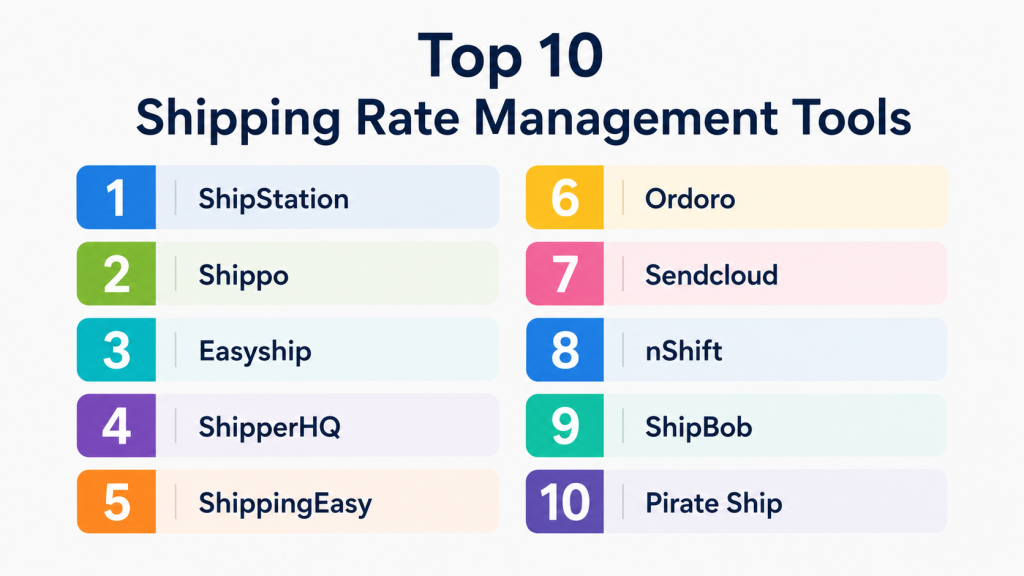
Top 10 Shipping Rate Management Tools
#1 — ShipStation
Short description:
ShipStation is a widely used shipping software platform for ecommerce sellers and fulfillment teams. It helps businesses import orders, compare rates, print shipping labels, automate fulfillment tasks, and manage multi-channel shipping from one dashboard. ShipStation is especially useful for sellers working across Shopify, Amazon, eBay, Walmart, and other marketplaces. Its strengths include automation rules, batch label printing, carrier discounts, and centralized order management. ShipStation publicly highlights rate comparison, label buying, carrier discounts, and fulfillment automation as core platform capabilities.
Key Features
- Multi-carrier rate comparison.
- Batch label printing and shipping automation.
- Order import from ecommerce stores and marketplaces.
- Discounted carrier rate access.
- Branded tracking and customer notifications.
- Returns management support.
- Reporting and shipping analytics.
Pros
- Strong fit for growing ecommerce sellers.
- Good automation features for repetitive shipping tasks.
- Broad marketplace and store integrations.
Cons
- Advanced workflows may require setup time.
- Pricing can increase with shipment volume and feature needs.
- Not always ideal for very complex enterprise logistics.
Platforms / Deployment
Web-based platform; Cloud deployment.
Security & Compliance
SSO/SAML, MFA, encryption, audit logs, RBAC, SOC 2, ISO 27001, GDPR, HIPAA: Not publicly stated.
Integrations & Ecosystem
ShipStation has a strong ecommerce ecosystem and is commonly used by multi-channel sellers.
- Shopify
- Amazon
- eBay
- Walmart
- WooCommerce
- Carrier and fulfillment integrations
Support & Community
Documentation, onboarding resources, and support options are available. Community strength is strong due to broad ecommerce adoption.
#2 — Shippo
Short description:
Shippo is a shipping platform focused on helping ecommerce businesses compare rates, create labels, track shipments, and connect shipping workflows through APIs. It is popular with startups, SMBs, and developers that want flexible carrier access and API-driven shipping. Shippo is useful for both dashboard-based users and businesses that want to build shipping into their own systems. It is commonly considered for businesses that need shipping rates, labels, tracking, and automation without heavy enterprise complexity. Shippo is frequently compared with other multi-carrier tools for ecommerce delivery operations.
Key Features
- Multi-carrier rate comparison.
- Shipping label creation.
- Tracking API and shipment updates.
- Address validation.
- Returns label support.
- Ecommerce platform integrations.
- Developer-friendly API options.
Pros
- Good for API-first shipping workflows.
- Useful for startups and growing ecommerce sellers.
- Flexible for both technical and non-technical teams.
Cons
- Advanced enterprise workflows may need customization.
- Carrier availability can vary by region.
- Some features may depend on plan or usage volume.
Platforms / Deployment
Web-based platform; Cloud deployment; API-based integration.
Security & Compliance
SSO/SAML, MFA, encryption, audit logs, RBAC, SOC 2, ISO 27001, GDPR, HIPAA: Not publicly stated.
Integrations & Ecosystem
Shippo works well for ecommerce, marketplaces, and custom applications.
- Shopify
- WooCommerce
- BigCommerce
- Marketplaces
- Carrier APIs
- Custom shipping workflows
Support & Community
Documentation and developer resources are available. Support varies by plan and usage level.
#3 — Easyship
Short description:
Easyship is a shipping platform designed for ecommerce brands that need domestic and international shipping support. It helps sellers compare courier rates, calculate shipping costs, manage duties and taxes, print labels, and offer delivery options at checkout. Easyship is often attractive for cross-border sellers because it focuses strongly on international shipping complexity. It supports businesses that want more visibility into rates, delivery times, taxes, and customer-facing shipping choices. Industry guides commonly position Easyship as a strong option for international sellers.
Key Features
- Multi-carrier rate comparison.
- International shipping tools.
- Duties and taxes visibility.
- Checkout shipping options.
- Label generation and tracking.
- Shipping rules and automation.
- Branded tracking experience.
Pros
- Strong for cross-border ecommerce.
- Helpful checkout rate and delivery visibility.
- Good option for global seller workflows.
Cons
- May be more than needed for domestic-only sellers.
- International shipping setup can require careful configuration.
- Pricing and carrier availability may vary by region.
Platforms / Deployment
Web-based platform; Cloud deployment.
Security & Compliance
SSO/SAML, MFA, encryption, audit logs, RBAC, SOC 2, ISO 27001, GDPR, HIPAA: Not publicly stated.
Integrations & Ecosystem
Easyship connects with ecommerce platforms, marketplaces, and carriers.
- Shopify
- WooCommerce
- Amazon
- eBay
- BigCommerce
- Carrier and courier networks
Support & Community
Documentation and onboarding resources are available. Support depth may vary by plan and customer segment.
#4 — ShipperHQ
Short description:
ShipperHQ is a shipping rate management platform focused on checkout shipping logic. It helps businesses control what shipping options customers see at checkout based on rules, rates, carriers, product types, customer groups, and delivery scenarios. It is especially useful for merchants with complex shipping needs, such as oversized items, LTL freight, multi-origin shipping, or custom rate rules. Unlike tools focused mainly on labels, ShipperHQ is more focused on checkout rate control and shipping experience configuration. It suits ecommerce teams that need advanced rate logic before the order is placed.
Key Features
- Advanced checkout shipping rules.
- Multi-carrier rate configuration.
- Dimensional and product-based shipping logic.
- LTL freight support.
- Multi-origin shipping support.
- Delivery date and time options.
- Ecommerce platform integrations.
Pros
- Strong for complex checkout shipping rules.
- Useful for merchants with heavy, oversized, or mixed product catalogs.
- Helps reduce undercharging or overcharging at checkout.
Cons
- Not a complete fulfillment platform by itself.
- Setup requires clear shipping rule planning.
- May be unnecessary for simple flat-rate shipping.
Platforms / Deployment
Web-based platform; Cloud deployment.
Security & Compliance
SSO/SAML, MFA, encryption, audit logs, RBAC, SOC 2, ISO 27001, GDPR, HIPAA: Not publicly stated.
Integrations & Ecosystem
ShipperHQ is commonly used with ecommerce platforms where checkout rate control is important.
- Shopify
- BigCommerce
- Adobe Commerce / Magento
- WooCommerce
- Carrier rate services
- Custom shipping logic
Support & Community
Documentation and onboarding support are available. Support is important because shipping rules can become complex.
#5 — ShippingEasy
Short description:
ShippingEasy is a shipping software platform for small and growing ecommerce sellers. It helps teams compare rates, print labels, automate shipping, manage orders, and communicate tracking updates to customers. It is often considered by SMB sellers that want a practical shipping dashboard without heavy enterprise complexity. ShippingEasy can also support customer marketing features, depending on usage needs. It is useful for teams that want affordable shipping workflow automation and better order handling.
Key Features
- Discounted postage and carrier rates.
- Label printing and batch processing.
- Shipping automation rules.
- Order management.
- Tracking notifications.
- Returns support.
- Ecommerce store integrations.
Pros
- Good fit for SMB ecommerce teams.
- User-friendly shipping workflow.
- Helps reduce manual label creation.
Cons
- May not fit complex enterprise shipping networks.
- Advanced features may depend on plan.
- International workflows may be less deep than specialist platforms.
Platforms / Deployment
Web-based platform; Cloud deployment.
Security & Compliance
SSO/SAML, MFA, encryption, audit logs, RBAC, SOC 2, ISO 27001, GDPR, HIPAA: Not publicly stated.
Integrations & Ecosystem
ShippingEasy connects with common ecommerce tools and marketplaces.
- Shopify
- WooCommerce
- Amazon
- eBay
- Walmart
- Carrier services
Support & Community
Documentation and customer support are available. Community awareness is strong among small ecommerce sellers.
#6 — Ordoro
Short description:
Ordoro combines shipping, inventory, and order management for ecommerce businesses. It is useful for sellers that need more than basic shipping labels and want inventory visibility, dropshipping support, and multi-channel order workflows. Ordoro can help businesses compare shipping rates, print labels, manage orders, and coordinate fulfillment processes. It fits growing sellers that want shipping connected with inventory and operational workflows. Ordoro is commonly discussed in multi-carrier shipping software contexts.
Key Features
- Multi-carrier shipping.
- Label printing.
- Inventory management.
- Order management.
- Dropshipping workflow support.
- Automation rules.
- Multi-channel ecommerce support.
Pros
- Useful when shipping and inventory must work together.
- Good fit for growing online sellers.
- Helps reduce operational tool fragmentation.
Cons
- More features may mean more setup effort.
- May be excessive for sellers needing only label printing.
- Pricing and feature access can vary by plan.
Platforms / Deployment
Web-based platform; Cloud deployment.
Security & Compliance
SSO/SAML, MFA, encryption, audit logs, RBAC, SOC 2, ISO 27001, GDPR, HIPAA: Not publicly stated.
Integrations & Ecosystem
Ordoro supports ecommerce, marketplace, and carrier workflows.
- Shopify
- Amazon
- eBay
- WooCommerce
- Carrier integrations
- Inventory and order workflows
Support & Community
Support and onboarding resources are available. Community strength is moderate compared with larger shipping platforms.
#7 — Sendcloud
Short description:
Sendcloud is a shipping platform popular with ecommerce businesses, especially in Europe. It supports checkout delivery options, label creation, tracking, returns, and carrier management. Sendcloud is useful for retailers that want to improve the post-purchase delivery experience and manage shipping from one place. It can help sellers automate repetitive shipping tasks and provide better customer communication. It is a strong option for European ecommerce brands needing local and cross-border carrier options.
Key Features
- Multi-carrier shipping.
- Checkout delivery options.
- Label printing.
- Tracking notifications.
- Returns portal support.
- Shipping automation rules.
- Ecommerce integrations.
Pros
- Strong fit for European ecommerce.
- Good customer-facing delivery and returns features.
- Useful for growing online stores.
Cons
- Regional carrier strength may vary outside Europe.
- Advanced automation may require plan upgrades.
- Enterprise use cases may need deeper evaluation.
Platforms / Deployment
Web-based platform; Cloud deployment.
Security & Compliance
SSO/SAML, MFA, encryption, audit logs, RBAC, SOC 2, ISO 27001, GDPR, HIPAA: Not publicly stated.
Integrations & Ecosystem
Sendcloud integrates with ecommerce platforms and shipping carriers.
- Shopify
- WooCommerce
- Magento / Adobe Commerce
- BigCommerce
- Marketplaces
- Carrier networks
Support & Community
Documentation and onboarding resources are available. Support strength may depend on region and plan.
#8 — nShift
Short description:
nShift is a delivery management platform for retailers, warehouses, and logistics-heavy businesses. It supports carrier management, shipping execution, tracking, returns, checkout delivery experience, and delivery analytics. nShift is better suited for mid-market and enterprise teams that need structured shipping operations across regions, carriers, and fulfillment locations. It is often relevant for companies with European or international delivery complexity. nShift describes multi-carrier shipping as a way to centralize rate selection, label creation, tracking, and reporting.
Key Features
- Multi-carrier delivery management.
- Checkout delivery options.
- Shipping execution workflows.
- Tracking and returns.
- Carrier performance visibility.
- Enterprise integration options.
- Delivery analytics and reporting.
Pros
- Strong fit for complex delivery operations.
- Useful for multi-country and multi-carrier logistics.
- Good for businesses needing structured governance.
Cons
- May be too complex for small sellers.
- Pricing is likely more enterprise-oriented.
- Implementation may require planning and integration support.
Platforms / Deployment
Web-based platform; Cloud deployment; Hybrid possibilities may vary by implementation.
Security & Compliance
SSO/SAML, MFA, encryption, audit logs, RBAC, SOC 2, ISO 27001, GDPR, HIPAA: Not publicly stated.
Integrations & Ecosystem
nShift is designed for broader delivery ecosystems.
- Ecommerce platforms
- ERP systems
- WMS systems
- OMS platforms
- Carrier networks
- Returns and tracking workflows
Support & Community
Enterprise onboarding and support are expected. Community visibility is stronger in logistics and European delivery management markets.
#9 — ShipBob
Short description:
ShipBob is a fulfillment platform rather than only a shipping rate management tool, but it is relevant because it helps ecommerce brands manage fulfillment, shipping, carrier selection, and delivery performance through a distributed fulfillment network. It is useful for D2C brands that want outsourced warehousing and shipping operations. ShipBob can help brands reduce manual fulfillment work and improve delivery coverage through fulfillment centers. It is best suited for companies that want logistics operations handled alongside shipping management.
Key Features
- Fulfillment center network.
- Shipping and carrier management.
- Order fulfillment automation.
- Inventory visibility.
- Ecommerce integrations.
- Delivery performance reporting.
- Returns support.
Pros
- Good for brands outsourcing fulfillment.
- Reduces internal warehouse workload.
- Useful for scaling D2C operations.
Cons
- Not ideal if you only need rate comparison software.
- Fulfillment model may not suit all businesses.
- Costs depend on storage, pick-pack, shipping, and volume factors.
Platforms / Deployment
Web-based platform; Cloud deployment; fulfillment network-based service.
Security & Compliance
SSO/SAML, MFA, encryption, audit logs, RBAC, SOC 2, ISO 27001, GDPR, HIPAA: Not publicly stated.
Integrations & Ecosystem
ShipBob connects fulfillment with ecommerce operations.
- Shopify
- BigCommerce
- WooCommerce
- Amazon
- Walmart
- Inventory and order tools
Support & Community
Onboarding and account support are available. Community strength is strong among D2C ecommerce brands.
#10 — Pirate Ship
Short description:
Pirate Ship is a simple shipping label and postage platform known for discounted shipping access and easy label creation. It is popular with small businesses, creators, Etsy sellers, and low-volume merchants that want a simple way to buy postage without complex software. Pirate Ship is not the deepest enterprise shipping rate management system, but it works well for businesses that need straightforward rate comparison and label printing. It is especially useful when simplicity and low software overhead matter more than advanced workflow automation.
Key Features
- Discounted postage access.
- Simple label creation.
- Basic rate comparison.
- Address book and shipping history.
- Batch label support.
- Tracking visibility.
- Simple web-based workflow.
Pros
- Easy to use for small sellers.
- Low operational complexity.
- Good for simple domestic shipping workflows.
Cons
- Limited enterprise workflow depth.
- Fewer advanced integrations than larger platforms.
- Not ideal for complex international or multi-warehouse operations.
Platforms / Deployment
Web-based platform; Cloud deployment.
Security & Compliance
SSO/SAML, MFA, encryption, audit logs, RBAC, SOC 2, ISO 27001, GDPR, HIPAA: Not publicly stated.
Integrations & Ecosystem
Pirate Ship is simpler than full shipping suites but can support small seller workflows.
- Ecommerce import options
- Carrier postage services
- Address management
- Tracking workflows
- Batch shipping
- Basic operational reporting
Support & Community
Support resources are available. Community awareness is strong among small sellers and creator-led businesses.
Comparison Table
| Tool Name | Best For | Platform(s) Supported | Deployment | Standout Feature | Public Rating |
|---|---|---|---|---|---|
| ShipStation | Multi-channel ecommerce sellers | Web | Cloud | Strong automation and batch shipping | N/A |
| Shippo | API-first shipping and SMB ecommerce | Web / API | Cloud | Flexible shipping API and rate comparison | N/A |
| Easyship | International ecommerce sellers | Web | Cloud | Cross-border rates, duties, and taxes support | N/A |
| ShipperHQ | Complex checkout shipping rules | Web | Cloud | Advanced checkout rate logic | N/A |
| ShippingEasy | Small ecommerce teams | Web | Cloud | Simple shipping automation | N/A |
| Ordoro | Shipping plus inventory workflows | Web | Cloud | Combined shipping and inventory management | N/A |
| Sendcloud | European ecommerce delivery | Web | Cloud | Checkout, tracking, and returns experience | N/A |
| nShift | Mid-market and enterprise delivery operations | Web | Cloud / Hybrid varies | Enterprise delivery management | N/A |
| ShipBob | Outsourced ecommerce fulfillment | Web | Cloud + fulfillment network | Fulfillment and shipping operations together | N/A |
| Pirate Ship | Small sellers and simple postage workflows | Web | Cloud | Simple discounted label creation | N/A |
Evaluation & Scoring of Shipping Rate Management Tools
| Tool Name | Core (25%) | Ease (15%) | Integrations (15%) | Security (10%) | Performance (10%) | Support (10%) | Value (15%) | Weighted Total |
|---|---|---|---|---|---|---|---|---|
| ShipStation | 9 | 8 | 9 | 7 | 8 | 8 | 8 | 8.25 |
| Shippo | 8 | 8 | 9 | 7 | 8 | 7 | 8 | 8.00 |
| Easyship | 8 | 8 | 8 | 7 | 8 | 7 | 8 | 7.85 |
| ShipperHQ | 9 | 7 | 8 | 7 | 8 | 8 | 7 | 7.95 |
| ShippingEasy | 7 | 9 | 8 | 7 | 8 | 8 | 8 | 7.85 |
| Ordoro | 8 | 7 | 8 | 7 | 8 | 7 | 7 | 7.55 |
| Sendcloud | 8 | 8 | 8 | 7 | 8 | 7 | 7 | 7.70 |
| nShift | 9 | 6 | 9 | 8 | 9 | 8 | 6 | 8.00 |
| ShipBob | 8 | 7 | 8 | 7 | 8 | 8 | 7 | 7.65 |
| Pirate Ship | 6 | 9 | 6 | 6 | 8 | 7 | 9 | 7.20 |
These scores are comparative, not absolute. A higher score does not mean the tool is best for every company. For example, Pirate Ship may score lower in enterprise features but can be excellent for small sellers. nShift may be powerful for enterprises but unnecessary for a small Shopify store. Always validate your own carrier mix, order volume, integrations, and support needs before deciding.
Which Shipping Rate Management Tool Is Right for You?
Solo / Freelancer
Solo sellers, creators, and small marketplace sellers usually need simplicity first. If you ship a small number of parcels, tools like Pirate Ship, ShippingEasy, or Shippo may be easier to manage than enterprise platforms.
Focus on:
- Low monthly cost
- Simple label printing
- Discounted postage
- Easy tracking
- Minimal setup time
SMB
SMBs need better automation, multi-channel order sync, and rate comparison. ShipStation, Shippo, ShippingEasy, and Easyship are strong options depending on whether the business ships domestically or internationally.
Focus on:
- Ecommerce platform integrations
- Batch label printing
- Automation rules
- Returns support
- Carrier discounts
Mid-Market
Mid-market companies often need stronger workflows across warehouses, stores, marketplaces, and fulfillment locations. ShipStation, ShipperHQ, Ordoro, Sendcloud, and Easyship can fit different scenarios.
Focus on:
- Advanced rules
- Multi-location shipping
- Checkout rate logic
- Reporting
- API flexibility
- Inventory and fulfillment connections
Enterprise
Enterprise teams need governance, reliability, permissions, reporting, carrier performance visibility, and deep integrations. nShift, ShipperHQ, and enterprise-ready configurations of platforms like ShipStation or Easyship may be worth evaluating.
Focus on:
- ERP, OMS, and WMS integrations
- Role-based access
- Auditability
- Multi-country support
- SLA and support model
- Custom workflows
Budget vs Premium
For budget-sensitive users, Pirate Ship, Shippo, and ShippingEasy are often easier starting points. For premium use cases, nShift, ShipperHQ, and advanced shipping suites are better when shipping complexity directly affects margin, customer experience, or compliance.
Feature Depth vs Ease of Use
If ease of use matters most, choose a simpler dashboard-first tool. If feature depth matters more, choose a platform with rule engines, API access, multi-carrier logic, checkout customization, and analytics.
Integrations & Scalability
Choose tools that integrate with your current systems and your future systems. A small seller may only need Shopify integration today, but a growing brand may later need ERP, WMS, OMS, marketplace, 3PL, and API connectivity.
Security & Compliance Needs
For companies with strict security requirements, ask vendors directly about SSO, MFA, encryption, RBAC, audit logs, data retention, SOC 2, ISO 27001, GDPR, and regional compliance. If these details are not public, do not assume they exist.
Frequently Asked Questions
1. What are Shipping Rate Management Tools?
Shipping Rate Management Tools help businesses compare carrier rates, select shipping services, print labels, automate shipping rules, and manage delivery costs. They are useful when shipping decisions affect profit, delivery speed, and customer satisfaction.
2. How do these tools reduce shipping costs?
They reduce costs by comparing carrier rates, applying automation rules, selecting better services, and reducing manual errors. Over time, reporting can also help teams identify expensive lanes, poor carrier performance, and better shipping strategies.
3. Are these tools only for ecommerce companies?
No. Ecommerce companies use them heavily, but wholesalers, manufacturers, subscription brands, fulfillment teams, and logistics teams can also benefit. Any business shipping parcels regularly can use shipping rate tools.
4. What pricing models are common?
Common pricing models include monthly subscriptions, shipment-based pricing, label fees, carrier postage costs, and quote-based enterprise pricing. Some tools also offer free or low-cost entry plans, but advanced features may require paid tiers.
5. How long does implementation usually take?
Simple tools can be configured quickly if you only need store connection and label printing. Complex setups involving multiple warehouses, carriers, checkout rules, ERP systems, or custom APIs require more planning and testing.
6. What is the biggest mistake buyers make?
The biggest mistake is choosing based only on low monthly pricing. Buyers should also evaluate carrier rates, automation depth, integration effort, support quality, returns handling, and how well the tool matches real shipping workflows.
7. Do these tools support international shipping?
Many tools support international shipping, but depth varies. For global shipping, look for customs forms, duties and taxes visibility, multi-currency support, international carrier access, and reliable tracking.
8. Are APIs important for shipping software?
APIs are important if you want to embed shipping into custom systems, automate label creation, connect internal tools, or build checkout and fulfillment workflows. Smaller sellers may not need APIs immediately.
9. Can I switch shipping tools later?
Yes, but switching requires planning. You may need to migrate carrier accounts, automation rules, templates, customer notifications, integrations, and reporting workflows. Run both tools in a pilot phase before fully switching.
10. What are alternatives to Shipping Rate Management Tools?
Alternatives include direct carrier portals, ecommerce platform shipping modules, 3PL fulfillment services, ERP shipping modules, or full transportation management systems. The best alternative depends on order volume, complexity, and internal resources.
Conclusion
Shipping Rate Management Tools are no longer just label-printing utilities. For modern ecommerce and logistics teams, they help control costs, improve delivery choices, reduce manual work, and create a better customer experience. The best tool depends on your business model, order volume, carrier mix, regions served, checkout complexity, and integration needs. A small seller may do well with a simple tool like Pirate Ship or ShippingEasy, while a growing ecommerce brand may need ShipStation, Shippo, Easyship, or ShipperHQ. Larger delivery operations may need nShift or a fulfillment-focused platform like ShipBob.
