Upgrade & Secure Your Future with DevOps, SRE, DevSecOps, MLOps!
We spend hours scrolling social media and waste money on things we forget, but won’t spend 30 minutes a day earning certifications that can change our lives.
Master in DevOps, SRE, DevSecOps & MLOps by DevOps School!
Learn from Guru Rajesh Kumar and double your salary in just one year.
Introduction
Hotel Revenue Management Systems help hotels decide the right room price, for the right guest, at the right time, through the right channel. In simple terms, these tools use booking data, demand signals, competitor rates, occupancy trends, and market behavior to recommend better pricing decisions.
They matter now because hotel demand changes quickly, guest booking behavior is less predictable, and manual pricing can cause lost revenue. Hotels need smarter rate updates, better forecasting, and stronger visibility across channels.
Common use cases include:
- Forecasting room demand.
- Recommending daily room rates.
- Monitoring competitor pricing.
- Optimizing occupancy and RevPAR.
- Managing pricing across room types and channels.
Buyers should evaluate:
- Forecasting accuracy
- Rate recommendation quality
- PMS and channel manager integrations
- Competitor rate shopping
- Automation controls
- Reporting dashboards
- Multi-property support
- Ease of use
- Revenue analytics
- Pricing and support model
Best for: hotels, resorts, boutique hotels, serviced apartments, hotel groups, revenue managers, general managers, asset managers, and owners who want better pricing decisions.
Not ideal for: very small properties with fixed pricing, businesses with low seasonal variation, or owners who only need a basic rate calendar.
Key Trends in Hotel Revenue Management Systems
- AI-driven pricing: Revenue systems are using machine learning to recommend rates based on demand, booking pace, market data, and historical patterns.
- Automation with human control: Hotels want automated pricing, but still need approval rules, overrides, and guardrails.
- Total revenue management: Hotels are moving beyond room revenue to include packages, upgrades, F&B, spa, parking, and ancillary revenue.
- Real-time demand signals: Modern systems increasingly use live booking pace, competitor movement, events, and cancellation trends.
- Stronger PMS integration: Accurate recommendations depend on clean data from PMS, channel managers, CRS, and booking engines.
- Multi-property revenue control: Hotel groups need portfolio-level visibility, benchmark reporting, and centralized pricing workflows.
- Segment-level forecasting: Hotels need separate views for corporate, leisure, group, OTA, direct, and wholesale business.
- Scenario planning: Revenue teams want to test pricing strategies before applying changes.
- Direct booking focus: RMS tools are increasingly used to balance OTA dependency and protect margins.
- Mobile and cloud access: Revenue managers need access to dashboards and decisions from anywhere.
How We Selected These Tools
The following tools were selected using practical hotel revenue management criteria:
- Recognition in hotel revenue management and hospitality technology.
- Strength of forecasting, pricing, and rate recommendation features.
- Fit for independent hotels, boutique properties, resorts, and hotel groups.
- PMS, CRS, channel manager, and rate shopper integration capability.
- Reporting quality for occupancy, ADR, RevPAR, pace, and segmentation.
- Support for automation, override controls, and pricing rules.
- Ease of use for revenue managers and general managers.
- Multi-property and enterprise scalability.
- Support and onboarding quality.
- Overall value for improving pricing decisions and revenue visibility.
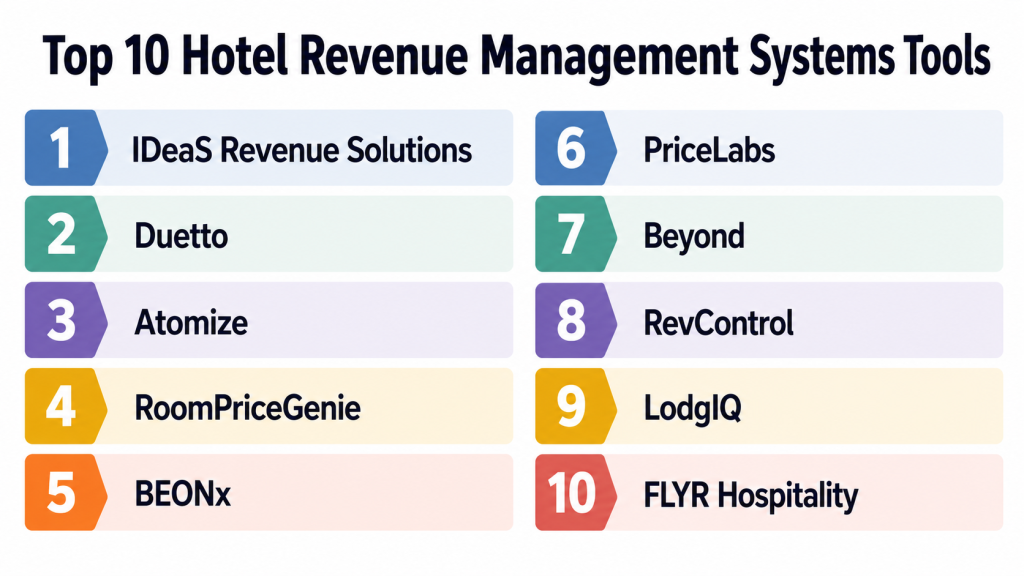
Top 10 Hotel Revenue Management Systems Tools
#1 — IDeaS Revenue Solutions
Short description:
IDeaS Revenue Solutions is a widely recognized hotel revenue management platform used by independent hotels, resorts, casinos, and large hotel groups. It helps revenue teams forecast demand, optimize rates, manage pricing strategies, and improve revenue performance. The platform is best suited for hotels that need advanced analytics, automation, and enterprise-level revenue controls. IDeaS is especially strong for complex properties with multiple segments, room types, and demand patterns. It is a strong choice for mature revenue management teams.
Key Features
- Demand forecasting.
- Automated rate recommendations.
- Revenue optimization analytics.
- Group and transient pricing support.
- Multi-property revenue management.
- Scenario and strategy controls.
- PMS and channel integration support.
Pros
- Strong enterprise revenue management depth.
- Good for complex hotels and large portfolios.
- Supports advanced forecasting and automation.
Cons
- May be too advanced for very small properties.
- Implementation and training require planning.
- Pricing may be enterprise-oriented.
Platforms / Deployment
Web-based platform; Cloud deployment.
Security & Compliance
SSO/SAML, MFA, encryption, audit logs, RBAC, SOC 2, ISO 27001, GDPR, HIPAA: Not publicly stated.
Integrations & Ecosystem
IDeaS connects with major hospitality systems and revenue workflows.
- PMS platforms
- CRS systems
- Channel managers
- Rate shoppers
- Business intelligence tools
- Hotel reporting systems
Support & Community
IDeaS provides onboarding, support, training, and revenue management resources. Community strength is high among enterprise hotels and revenue professionals.
#2 — Duetto
Short description:
Duetto is a cloud-based hotel revenue management system focused on pricing, forecasting, reporting, and revenue strategy. It helps hotels make pricing decisions using demand data, segmentation, booking pace, and market signals. Duetto is useful for independent hotels, casinos, resorts, and hotel groups that want flexible revenue tools. The platform is known for open pricing concepts and modern cloud workflows. It is a good fit for revenue teams that want strong visibility and control over pricing strategy.
Key Features
- Revenue forecasting.
- Open pricing support.
- Rate recommendations.
- Segmentation analytics.
- Group and transient demand insights.
- Multi-property reporting.
- Revenue strategy dashboards.
Pros
- Strong modern revenue management workflow.
- Good for flexible pricing strategies.
- Useful for hotels with complex demand patterns.
Cons
- Requires revenue management knowledge for best results.
- May be more than small properties need.
- Integration quality depends on property tech stack.
Platforms / Deployment
Web-based platform; Cloud deployment.
Security & Compliance
SSO/SAML, MFA, encryption, audit logs, RBAC, SOC 2, ISO 27001, GDPR, HIPAA: Not publicly stated.
Integrations & Ecosystem
Duetto connects with hotel systems used for pricing and distribution.
- PMS platforms
- CRS systems
- Channel managers
- Rate shopping tools
- BI systems
- Reporting dashboards
Support & Community
Support, onboarding, and training resources are available. Community strength is strong among hotel revenue teams.
#3 — Atomize
Short description:
Atomize is a revenue management system designed to automate hotel pricing decisions using real-time data and demand signals. It is useful for independent hotels, groups, and revenue teams that want pricing automation without excessive manual work. Atomize focuses on dynamic pricing, forecasting, automation, and competitive market signals. It can help hotels react faster to market changes and booking pace. The platform is a strong fit for teams looking for AI-assisted pricing recommendations.
Key Features
- Automated dynamic pricing.
- Demand forecasting.
- Real-time price recommendations.
- Competitor rate insights.
- Multi-property support.
- Revenue dashboards.
- PMS and channel integration support.
Pros
- Strong automation focus.
- Useful for lean revenue teams.
- Helps hotels react faster to demand changes.
Cons
- Automation rules need careful setup.
- Small properties may not need advanced pricing logic.
- Integration fit should be validated before purchase.
Platforms / Deployment
Web-based platform; Cloud deployment.
Security & Compliance
SSO/SAML, MFA, encryption, audit logs, RBAC, SOC 2, ISO 27001, GDPR, HIPAA: Not publicly stated.
Integrations & Ecosystem
Atomize supports hotel pricing and distribution workflows.
- PMS systems
- Channel managers
- Rate shoppers
- Booking engines
- Revenue dashboards
- Multi-property tools
Support & Community
Support and onboarding resources are available. Community strength is growing among cloud-first revenue teams.
#4 — RoomPriceGenie
Short description:
RoomPriceGenie is a revenue management system built mainly for small and independent hotels that want simple automated pricing. It helps properties generate rate recommendations based on demand, occupancy, booking pace, and market data. RoomPriceGenie is especially useful for hoteliers who do not have a full-time revenue manager. The platform focuses on ease of use and practical pricing guidance. It is a good fit for small hotels, inns, guesthouses, and boutique properties.
Key Features
- Automated rate recommendations.
- Simple pricing dashboard.
- Demand-based pricing.
- Competitor rate awareness.
- PMS integration support.
- Occupancy and pace insights.
- Easy-to-use revenue workflows.
Pros
- Good for independent hotels.
- Easier to use than complex enterprise RMS tools.
- Helpful for owners without dedicated revenue teams.
Cons
- May not fit complex enterprise revenue strategies.
- Advanced segmentation may be limited.
- Best value depends on clean PMS data.
Platforms / Deployment
Web-based platform; Cloud deployment.
Security & Compliance
SSO/SAML, MFA, encryption, audit logs, RBAC, SOC 2, ISO 27001, GDPR, HIPAA: Not publicly stated.
Integrations & Ecosystem
RoomPriceGenie supports small hotel revenue workflows.
- PMS platforms
- Channel managers
- Booking engines
- Rate data tools
- Hotel dashboards
- Pricing workflows
Support & Community
Support and onboarding resources are available. Community strength is good among independent hoteliers.
#5 — BEONx
Short description:
BEONx is a hotel revenue management platform focused on pricing, profitability, demand intelligence, and revenue strategy. It helps hotels make smarter rate decisions by combining market data, demand signals, and business intelligence. BEONx is useful for hotels and groups that want revenue management with a broader view of profit and market positioning. It can support properties looking to improve pricing discipline and revenue decisions. The platform is a good fit for mid-market and enterprise hospitality teams.
Key Features
- Demand forecasting.
- Pricing recommendations.
- Competitive market insights.
- Profitability-focused analytics.
- Multi-property support.
- Revenue dashboards.
- Integration with hospitality systems.
Pros
- Strong focus on strategic revenue decisions.
- Useful for hotel groups and revenue teams.
- Helps connect pricing with profitability thinking.
Cons
- May require revenue management maturity.
- Smaller properties may prefer simpler tools.
- Setup depends on data and integration quality.
Platforms / Deployment
Web-based platform; Cloud deployment.
Security & Compliance
SSO/SAML, MFA, encryption, audit logs, RBAC, SOC 2, ISO 27001, GDPR, HIPAA: Not publicly stated.
Integrations & Ecosystem
BEONx supports pricing, revenue, and hotel analytics workflows.
- PMS systems
- Channel managers
- Rate shoppers
- Revenue reporting
- BI tools
- Multi-property dashboards
Support & Community
Support and onboarding resources are available. Community strength is good among revenue-focused hospitality teams.
#6 — PriceLabs
Short description:
PriceLabs is a dynamic pricing and revenue management platform widely used by vacation rental operators, serviced apartments, short-term rentals, and alternative accommodation managers. It helps automate pricing based on demand, seasonality, market conditions, occupancy, and local events. PriceLabs is especially useful for property managers handling many units across multiple channels. While not a traditional hotel RMS for every hotel type, it is highly relevant for hospitality operators managing flexible inventory. It fits vacation rentals, aparthotels, and serviced apartment businesses.
Key Features
- Dynamic pricing.
- Occupancy-based pricing rules.
- Market data insights.
- Portfolio pricing controls.
- Minimum stay recommendations.
- Channel and PMS integrations.
- Custom pricing rules.
Pros
- Strong for vacation rentals and serviced apartments.
- Flexible pricing rules.
- Useful for portfolio-level revenue control.
Cons
- Not always ideal for traditional full-service hotels.
- Requires understanding of pricing rules.
- Over-automation without review can create pricing issues.
Platforms / Deployment
Web-based platform; Cloud deployment.
Security & Compliance
SSO/SAML, MFA, encryption, audit logs, RBAC, SOC 2, ISO 27001, GDPR, HIPAA: Not publicly stated.
Integrations & Ecosystem
PriceLabs connects with rental and hospitality tech stacks.
- PMS platforms
- Channel managers
- Vacation rental platforms
- Booking engines
- Portfolio dashboards
- Pricing calendars
Support & Community
Support, documentation, and learning resources are available. Community strength is high among short-term rental and serviced apartment operators.
#7 — Beyond
Short description:
Beyond is a revenue management and dynamic pricing platform used by vacation rental managers, short-term rental operators, and hospitality businesses. It helps automate nightly pricing, track market demand, manage revenue performance, and improve occupancy strategy. Beyond is especially useful for property managers who want pricing automation for alternative accommodation. It supports data-driven pricing decisions based on seasonality, demand, and local market trends. The platform fits vacation rental managers, small property portfolios, and short-term rental businesses.
Key Features
- Dynamic pricing automation.
- Market demand insights.
- Revenue dashboards.
- Occupancy and booking pace tracking.
- Portfolio performance visibility.
- Channel integration support.
- Pricing rule controls.
Pros
- Strong for short-term rental pricing.
- Easy for non-enterprise users to understand.
- Helps reduce manual price updates.
Cons
- Less suited to traditional hotel revenue workflows.
- Feature value depends on rental market data quality.
- Pricing model should be reviewed carefully.
Platforms / Deployment
Web-based platform; Cloud deployment.
Security & Compliance
SSO/SAML, MFA, encryption, audit logs, RBAC, SOC 2, ISO 27001, GDPR, HIPAA: Not publicly stated.
Integrations & Ecosystem
Beyond supports short-term rental revenue workflows.
- Vacation rental platforms
- PMS systems
- Channel managers
- Booking calendars
- Revenue dashboards
- Pricing automation tools
Support & Community
Support and educational resources are available. Community strength is strong among vacation rental revenue users.
#8 — RevControl
Short description:
RevControl is a hotel revenue management system designed for independent hotels and hotel groups that need pricing recommendations, demand insights, and forecasting tools. It helps revenue teams monitor occupancy, booking pace, competitor pricing, and future demand. RevControl is practical for hotels that want an accessible RMS without enterprise-level complexity. It supports data-led pricing decisions and rate strategy planning. The platform is a good fit for hotels moving from manual pricing toward structured revenue management.
Key Features
- Rate recommendations.
- Demand forecasting.
- Occupancy and pace tracking.
- Competitor pricing insights.
- Revenue dashboards.
- PMS integration support.
- Multi-property visibility.
Pros
- Good for independent hotels and small groups.
- Practical revenue management workflow.
- Helps reduce manual pricing guesswork.
Cons
- May not match the depth of enterprise RMS tools.
- Advanced automation may be limited.
- Integration coverage should be validated.
Platforms / Deployment
Web-based platform; Cloud deployment.
Security & Compliance
SSO/SAML, MFA, encryption, audit logs, RBAC, SOC 2, ISO 27001, GDPR, HIPAA: Not publicly stated.
Integrations & Ecosystem
RevControl supports hotel pricing and reporting workflows.
- PMS systems
- Rate shoppers
- Channel managers
- Booking engines
- Revenue dashboards
- Hotel reporting tools
Support & Community
Support and onboarding resources are available. Community strength is moderate among independent hotels and revenue users.
#9 — LodgIQ
Short description:
LodgIQ is a revenue management and business intelligence platform for hotels and hospitality groups. It helps hotels analyze demand, forecast performance, optimize pricing, and understand revenue trends. LodgIQ is useful for revenue managers who want data-driven insights and decision support. The platform can support both pricing strategy and broader performance analysis. It is a good fit for hotels that want revenue intelligence combined with actionable recommendations.
Key Features
- Demand forecasting.
- Rate recommendations.
- Revenue analytics.
- Business intelligence dashboards.
- Market data signals.
- PMS integration support.
- Portfolio performance visibility.
Pros
- Strong data and analytics focus.
- Useful for revenue teams needing decision support.
- Can support broader hotel performance visibility.
Cons
- May require revenue analytics knowledge.
- Small hotels may prefer simpler tools.
- Integration and data quality are important.
Platforms / Deployment
Web-based platform; Cloud deployment.
Security & Compliance
SSO/SAML, MFA, encryption, audit logs, RBAC, SOC 2, ISO 27001, GDPR, HIPAA: Not publicly stated.
Integrations & Ecosystem
LodgIQ connects with revenue and hotel data systems.
- PMS systems
- Channel managers
- Rate shoppers
- BI tools
- Revenue dashboards
- Multi-property reporting
Support & Community
Support and onboarding resources are available. Community strength is good among hotel revenue and analytics teams.
#10 — FLYR Hospitality
Short description:
FLYR Hospitality provides revenue optimization and commercial intelligence solutions for hotels and hospitality businesses. It helps revenue teams improve pricing, forecasting, and decision-making using data-driven models. The platform is useful for hotels and groups that want advanced commercial strategy support. FLYR Hospitality is especially relevant for organizations looking at revenue management as part of wider commercial optimization. It fits businesses with mature revenue, sales, and distribution workflows.
Key Features
- Revenue optimization.
- Forecasting and demand analysis.
- Pricing decision support.
- Commercial intelligence.
- Portfolio-level insights.
- Data integration support.
- Advanced analytics workflows.
Pros
- Strong commercial optimization focus.
- Useful for mature revenue organizations.
- Supports broader strategy beyond simple rate changes.
Cons
- May be too advanced for small properties.
- Implementation requires strong data alignment.
- Pricing and fit should be reviewed carefully.
Platforms / Deployment
Web-based platform; Cloud deployment.
Security & Compliance
SSO/SAML, MFA, encryption, audit logs, RBAC, SOC 2, ISO 27001, GDPR, HIPAA: Not publicly stated.
Integrations & Ecosystem
FLYR Hospitality supports advanced revenue and commercial workflows.
- PMS systems
- Revenue data platforms
- Channel systems
- Commercial dashboards
- Forecasting tools
- Portfolio reporting
Support & Community
Enterprise-style support and onboarding resources may be available. Community strength is stronger among advanced hospitality commercial teams.
Comparison Table
| Tool Name | Best For | Platform(s) Supported | Deployment | Standout Feature | Public Rating |
|---|---|---|---|---|---|
| IDeaS Revenue Solutions | Enterprise hotels and complex portfolios | Web | Cloud | Advanced revenue optimization | N/A |
| Duetto | Hotels using flexible pricing strategy | Web | Cloud | Open pricing and strategy dashboards | N/A |
| Atomize | Automated hotel pricing | Web | Cloud | Real-time dynamic pricing automation | N/A |
| RoomPriceGenie | Independent hotels | Web | Cloud | Simple automated pricing | N/A |
| BEONx | Profit-focused hotel revenue teams | Web | Cloud | Revenue and profitability intelligence | N/A |
| PriceLabs | Vacation rentals and serviced apartments | Web | Cloud | Dynamic pricing for flexible inventory | N/A |
| Beyond | Short-term rental operators | Web | Cloud | Automated rental pricing | N/A |
| RevControl | Independent hotels and small groups | Web | Cloud | Practical rate recommendations | N/A |
| LodgIQ | Revenue analytics teams | Web | Cloud | Revenue intelligence dashboards | N/A |
| FLYR Hospitality | Advanced commercial strategy teams | Web | Cloud | Commercial optimization intelligence | N/A |
Evaluation & Scoring of Hotel Revenue Management Systems
| Tool Name | Core (25%) | Ease (15%) | Integrations (15%) | Security (10%) | Performance (10%) | Support (10%) | Value (15%) | Weighted Total (0–10) |
|---|---|---|---|---|---|---|---|---|
| IDeaS Revenue Solutions | 10 | 7 | 9 | 8 | 9 | 9 | 7 | 8.50 |
| Duetto | 9 | 8 | 9 | 8 | 9 | 8 | 7 | 8.35 |
| Atomize | 9 | 8 | 8 | 7 | 8 | 8 | 8 | 8.15 |
| RoomPriceGenie | 7 | 9 | 8 | 7 | 8 | 8 | 9 | 8.00 |
| BEONx | 8 | 7 | 8 | 7 | 8 | 8 | 7 | 7.60 |
| PriceLabs | 8 | 8 | 9 | 7 | 8 | 8 | 9 | 8.15 |
| Beyond | 8 | 8 | 8 | 7 | 8 | 8 | 8 | 7.90 |
| RevControl | 7 | 8 | 7 | 7 | 8 | 7 | 8 | 7.45 |
| LodgIQ | 8 | 7 | 8 | 7 | 8 | 8 | 7 | 7.60 |
| FLYR Hospitality | 9 | 6 | 8 | 8 | 9 | 8 | 6 | 7.80 |
These scores are comparative and should not be treated as universal rankings. A small independent hotel may prefer RoomPriceGenie because ease of use matters more than enterprise depth. A large hotel group may need IDeaS, Duetto, or FLYR Hospitality. Vacation rental operators may find PriceLabs or Beyond more relevant than a traditional hotel RMS. Always evaluate based on property type, demand complexity, integration needs, and revenue team maturity.
Which Hotel Revenue Management System Tool Is Right for You?
Solo / Freelancer
Solo property owners, small guesthouse operators, and short-term rental hosts should prioritize simplicity and automated pricing guidance. RoomPriceGenie, PriceLabs, or Beyond may be good starting points depending on whether the property is a hotel, rental, or serviced apartment.
The goal should be to stop relying on fixed rates and start making demand-based pricing decisions without creating too much complexity.
SMB
Small and mid-sized hotels need practical pricing recommendations, PMS integration, competitor rate awareness, and easy dashboards. RoomPriceGenie, Atomize, RevControl, and BEONx are worth evaluating.
SMBs should focus on clean setup, simple automation, booking pace visibility, and pricing confidence.
Mid-Market
Mid-market hotels and growing hotel groups often need stronger forecasting, segmentation, multi-property reporting, and channel strategy. Duetto, Atomize, BEONx, LodgIQ, and IDeaS may be strong candidates.
At this stage, the RMS should support revenue strategy, not just daily rate changes.
Enterprise
Enterprise hotels, resorts, casinos, and large hospitality groups need advanced forecasting, portfolio analytics, automation rules, commercial strategy support, and strong integrations. IDeaS Revenue Solutions, Duetto, and FLYR Hospitality are strong enterprise-oriented options.
Enterprises should review governance, implementation support, integration architecture, data security, user permissions, and change management needs.
Budget vs Premium
Budget-friendly RMS tools are better for small properties that need basic automation and rate guidance. Premium systems are better when pricing complexity, segmentation, group business, multi-property reporting, and revenue impact are larger.
Do not compare only subscription price. Also consider revenue lift potential, reduced manual work, fewer pricing errors, and stronger occupancy strategy.
Feature Depth vs Ease of Use
Simple tools are easier to launch and manage. Deeper systems provide stronger forecasting, segmentation, automation, and portfolio control but require more training and revenue knowledge.
Choose ease of use if your team is small. Choose feature depth if your hotel has complex demand, multiple segments, and a mature revenue strategy.
Integrations & Scalability
Revenue management systems depend heavily on data. They should connect with PMS, CRS, channel manager, booking engine, rate shopper, BI tools, and sometimes accounting or commercial dashboards.
Before choosing a platform, confirm integration availability and test how cleanly data flows into pricing recommendations.
Security & Compliance Needs
RMS platforms may process booking data, pricing data, revenue history, guest segments, competitive intelligence, and property performance records. Security should be reviewed carefully.
Ask vendors about encryption, SSO, MFA, role-based access, audit logs, data retention, backups, and privacy controls. If details are not clearly confirmed, treat them as not publicly stated.
Frequently Asked Questions
1. What is a Hotel Revenue Management System?
A Hotel Revenue Management System is software that helps hotels forecast demand, recommend room rates, analyze occupancy, and improve revenue performance. It supports better pricing decisions using data instead of guesswork.
2. How is RMS different from PMS?
A PMS manages hotel operations like reservations, rooms, guests, and billing. An RMS analyzes demand and recommends pricing. The RMS usually needs PMS data to create accurate forecasts and rate recommendations.
3. What pricing models are common?
Common pricing models include monthly subscriptions, per-room pricing, per-property pricing, revenue-based pricing, setup fees, and enterprise custom pricing. Some tools may charge differently for add-ons or integrations.
4. How long does implementation take?
Small properties can implement simpler RMS tools faster if PMS data is clean. Larger hotels may need more time for integrations, data validation, user training, automation rules, and revenue strategy setup.
5. What are common mistakes when choosing an RMS?
Common mistakes include choosing a tool without PMS integration, ignoring staff training, over-automating too early, not checking forecast logic, and failing to align pricing recommendations with business strategy.
6. Can an RMS increase hotel revenue?
A good RMS can help improve revenue by recommending better prices, identifying demand changes, reducing underpricing, and improving occupancy strategy. Results still depend on data quality, market conditions, and execution.
7. Do small hotels need revenue management software?
Small hotels may benefit from simple RMS tools if they face seasonal demand, competitor pressure, OTA dependency, or frequent pricing changes. Fixed pricing can lead to missed revenue during high-demand periods.
8. Are revenue management systems secure?
Security varies by vendor. Hotels should ask about encryption, user permissions, MFA, SSO, audit logs, data backups, and privacy controls because RMS platforms process sensitive business and booking data.
9. Can I switch RMS tools later?
Yes, but switching requires planning. Hotels need to review data migration, PMS integrations, pricing rules, reporting history, and staff training. It is better to test the new RMS before fully replacing the old one.
10. What are alternatives to Hotel Revenue Management Systems?
Alternatives include spreadsheets, manual rate shopping, PMS reports, channel manager dashboards, basic pricing rules, consultant-led pricing, or revenue management outsourcing. Dedicated RMS tools are better when pricing complexity grows.
Conclusion
Hotel Revenue Management Systems help hotels make smarter pricing decisions, improve forecasting, protect revenue, and respond faster to market demand. The right platform depends on property size, market complexity, booking channels, PMS setup, revenue team skill level, and budget. Small hotels may prefer RoomPriceGenie, RevControl, or Atomize for simple automation. Vacation rental and serviced apartment operators may choose PriceLabs or Beyond. Larger hotels and groups may need IDeaS, Duetto, BEONx, LodgIQ, or FLYR Hospitality for advanced forecasting and commercial intelligence. There is no single best RMS for every property.
