Upgrade & Secure Your Future with DevOps, SRE, DevSecOps, MLOps!
We spend hours scrolling social media and waste money on things we forget, but won’t spend 30 minutes a day earning certifications that can change our lives.
Master in DevOps, SRE, DevSecOps & MLOps by DevOps School!
Learn from Guru Rajesh Kumar and double your salary in just one year.
Introduction
Maritime vessel management software helps shipping companies, vessel owners, fleet managers, ship operators, and marine service providers manage vessel operations from one structured platform. In simple terms, it helps teams track maintenance, safety, compliance, crew, procurement, dry-docking, inspections, documents, fuel, performance, and fleet operations more efficiently.
This software matters now because maritime operations are becoming more digital, regulated, data-driven, and cost-sensitive. Fleet owners must manage safety rules, environmental requirements, vessel uptime, crew efficiency, maintenance planning, spare parts, audits, and operational reporting across multiple ships and locations.
Common use cases include planned maintenance, vessel performance monitoring, document control, procurement, crew management, compliance tracking, inspection management, and fleet reporting.
Buyers should evaluate:
- Planned maintenance capability
- Fleet-wide visibility
- Compliance and audit management
- Procurement and inventory features
- Crew and document management
- Vessel performance analytics
- Mobile and offline access
- Integration with ERP and finance systems
- Security controls
- Vendor maritime experience
Best for: Ship owners, ship managers, technical managers, fleet operators, offshore operators, crewing agencies, marine procurement teams, compliance teams, and maritime enterprises managing multiple vessels.
Not ideal for: Very small operators with one or two simple vessels, companies that only need basic accounting software, or teams that do not require maritime-specific compliance, maintenance, and fleet operations workflows.
Key Trends in Maritime Vessel Management Software
- AI-assisted maintenance planning is becoming more useful as maritime companies look for ways to predict equipment issues, reduce downtime, and optimize maintenance schedules.
- Fleet performance analytics is now a major priority because fuel efficiency, emissions, voyage performance, and operational cost control are becoming key business concerns.
- Cloud-based fleet management is growing as ship managers want easier access across shore teams, vessel teams, technical departments, and global offices.
- Mobile and offline access is becoming essential because crew members often work in low-connectivity environments and still need to record inspections, maintenance tasks, and reports.
- Compliance automation is getting stronger as maritime companies handle safety management, environmental rules, audits, certificates, inspections, and regulatory reporting.
- Integration with ERP and finance systems is increasing because procurement, inventory, payroll, accounting, and vessel operations need connected data.
- Cybersecurity expectations are rising as vessels become more connected and maritime companies manage sensitive operational, crew, and commercial data.
- Document control is becoming more structured with digital certificates, manuals, audit evidence, inspection records, and controlled document workflows.
- Procurement and inventory optimization is gaining importance because spare parts delays and poor stock visibility can directly impact vessel uptime.
- Sustainability and emissions tracking are becoming part of vessel management as operators need better reporting for fuel use, carbon performance, and environmental compliance.
How We Selected These Tools
The tools in this list were selected using practical maritime software evaluation factors, including:
- Market recognition in vessel management, fleet operations, and maritime enterprise software
- Feature completeness across maintenance, compliance, procurement, crew, documents, and reporting
- Suitability for ship owners, ship managers, offshore operators, and fleet operators
- Ability to support multi-vessel and multi-office environments
- Maritime-specific workflows instead of generic asset management only
- Integration potential with ERP, finance, procurement, crewing, and reporting systems
- Vendor experience in shipping and marine operations
- Support for planned maintenance and technical management
- Practical fit for enterprise, mid-market, and smaller fleet operators
- Reliability, scalability, and operational usability signals
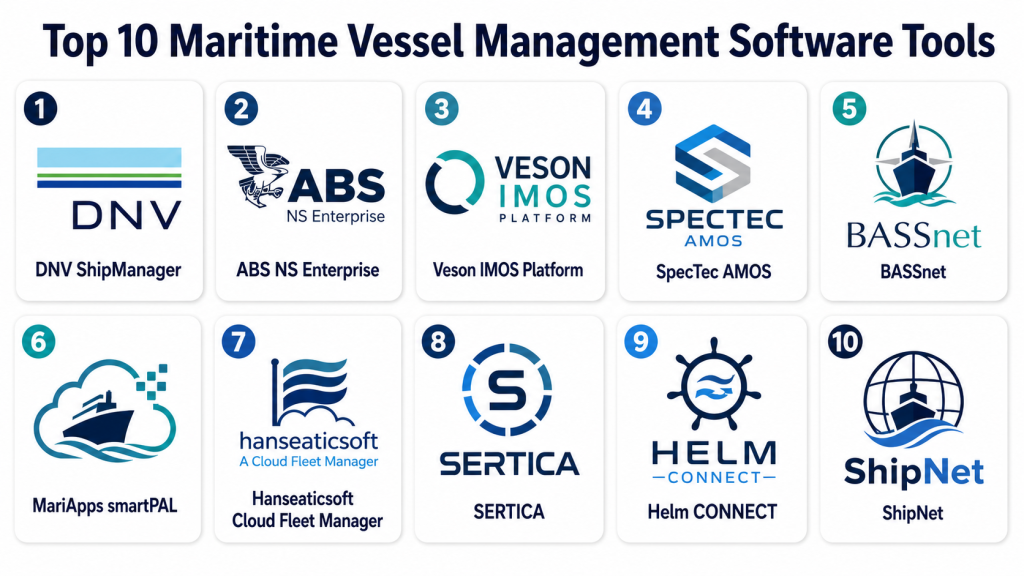
Top 10 Maritime Vessel Management Software Tools
1 — DNV ShipManager
Short description:
DNV ShipManager is a well-known maritime fleet management platform used by ship owners and ship managers to manage technical, operational, compliance, and safety workflows. It supports planned maintenance, procurement, QHSE, crew, hull integrity, and fleet reporting. The software is suitable for organizations that need strong maritime domain depth and structured vessel management processes. It is commonly considered by medium to large shipping companies with complex compliance and operational requirements. DNV ShipManager is especially useful for teams that want a mature platform built specifically for maritime operations.
Key Features
- Planned maintenance system
- QHSE and safety management
- Procurement and inventory workflows
- Crew management support
- Technical vessel management
- Fleet reporting and analytics
- Document and compliance tracking
Pros
- Strong maritime industry focus
- Suitable for complex fleet operations
- Broad module coverage for technical and compliance teams
Cons
- May require structured implementation planning
- Can be more than very small operators need
- Pricing is not publicly stated
Platforms / Deployment
Web / Windows / Cloud / Hybrid / Varies
Security & Compliance
SSO/SAML, MFA, encryption, audit logs, RBAC, SOC 2, ISO 27001, GDPR, HIPAA: Not publicly stated.
Integrations & Ecosystem
DNV ShipManager can support connected fleet workflows across maintenance, procurement, safety, crew, and reporting teams.
- ERP systems
- Procurement platforms
- Crewing systems
- Finance and accounting tools
- Vessel performance tools
- Reporting and analytics systems
Support & Community
DNV provides enterprise support, onboarding, and maritime domain expertise. Support levels, documentation access, and training usually depend on selected modules, fleet size, and customer agreement.
2 — ABS NS Enterprise
Short description:
ABS NS Enterprise is a maritime asset and fleet management solution designed for ship owners, operators, and marine asset managers. It supports maintenance, compliance, inventory, purchasing, risk management, and operational reporting. The platform is useful for companies that want structured control over vessel assets, equipment, inspections, and regulatory workflows. It is suitable for commercial shipping, offshore, government, and marine organizations. ABS NS Enterprise is a strong fit for teams that need asset reliability and compliance visibility across multiple vessels.
Key Features
- Asset and equipment management
- Planned maintenance workflows
- Inventory and purchasing support
- Compliance and inspection tracking
- Risk and reliability management
- Fleet reporting dashboards
- Document and certificate management
Pros
- Strong asset management capability
- Suitable for regulated maritime environments
- Good fit for complex fleet and equipment tracking
Cons
- May require configuration for company-specific workflows
- Implementation can be detailed for larger fleets
- Public security certification details are limited
Platforms / Deployment
Web / Cloud / Hybrid / Varies
Security & Compliance
SSO/SAML, MFA, encryption, audit logs, RBAC, SOC 2, ISO 27001, GDPR, HIPAA: Not publicly stated.
Integrations & Ecosystem
ABS NS Enterprise can connect vessel asset data with procurement, compliance, maintenance, and reporting workflows.
- ERP systems
- Purchasing tools
- Maintenance systems
- Inspection workflows
- Finance systems
- Analytics and reporting platforms
Support & Community
ABS provides maritime-focused support and professional services. Documentation, onboarding, and training depend on the deployment scope and customer contract.
3 — Veson IMOS Platform
Short description:
Veson IMOS Platform is widely used in maritime commercial operations, voyage management, chartering, freight, financial workflows, and fleet performance. While it is more commercially focused than purely technical management software, it plays a major role in vessel operations and maritime business management. It is suitable for ship owners, operators, commodity traders, and maritime businesses that need end-to-end visibility across voyages and commercial decisions. Veson IMOS helps teams manage voyage execution, contracts, emissions-related data, claims, and operational performance. It is best for companies that want strong commercial maritime control.
Key Features
- Voyage management
- Chartering and contract workflows
- Freight and claims management
- Operations and financial visibility
- Fleet performance insights
- Emissions and sustainability-related reporting support
- Integration with maritime business systems
Pros
- Strong commercial maritime operations platform
- Useful for voyage and chartering workflows
- Good fit for owners, operators, and trading organizations
Cons
- Not a pure technical maintenance platform
- May need integration with dedicated PMS tools
- Pricing is not publicly stated
Platforms / Deployment
Web / Cloud / Varies
Security & Compliance
SSO/SAML, MFA, encryption, audit logs, RBAC, SOC 2, ISO 27001, GDPR, HIPAA: Not publicly stated.
Integrations & Ecosystem
Veson IMOS works best when connected with finance, operations, trading, voyage, and reporting systems.
- ERP systems
- Finance and accounting tools
- Voyage reporting systems
- Market data tools
- Emissions reporting tools
- Business intelligence platforms
Support & Community
Veson provides vendor-led onboarding, training, and customer support. Support levels and implementation services depend on customer size, modules selected, and operational complexity.
4 — SpecTec AMOS
Short description:
SpecTec AMOS is a maritime software platform focused on maintenance, procurement, inventory, quality, safety, and fleet management. It is used by shipping companies and marine organizations that need structured control over vessel equipment, spare parts, work orders, and compliance processes. AMOS is especially relevant for technical managers and ship operators who want to manage maintenance and purchasing from a central platform. It can support both vessel-side and shore-side teams. The tool is practical for organizations that want a mature maritime PMS and technical management system.
Key Features
- Planned maintenance management
- Spare parts and inventory control
- Procurement and purchasing workflows
- Safety and quality management
- Technical fleet management
- Work order tracking
- Reporting and KPI monitoring
Pros
- Strong maintenance and procurement focus
- Suitable for technical ship management
- Supports vessel and shore workflows
Cons
- User experience should be reviewed during demo
- May require careful master data setup
- Public security details are not clearly stated
Platforms / Deployment
Web / Windows / Cloud / Hybrid / Varies
Security & Compliance
SSO/SAML, MFA, encryption, audit logs, RBAC, SOC 2, ISO 27001, GDPR, HIPAA: Not publicly stated.
Integrations & Ecosystem
AMOS can connect technical vessel management with inventory, purchasing, finance, and compliance workflows.
- ERP systems
- Procurement systems
- Finance tools
- Inventory systems
- Reporting tools
- Document management systems
Support & Community
SpecTec provides onboarding, training, and support services. Support quality and service levels may depend on region, implementation partner, and contract scope.
5 — BASSnet
Short description:
BASSnet is an integrated maritime software suite covering fleet management, maintenance, procurement, safety, risk, crew, and financial workflows. It is designed for ship owners and ship managers that need broad operational control across vessels and shore offices. BASSnet is suitable for companies that want a modular system with multiple maritime functions in one ecosystem. It helps technical, procurement, compliance, and crew teams work from shared data. The platform is useful for organizations that want to reduce disconnected systems and improve fleet-wide visibility.
Key Features
- Fleet management modules
- Planned maintenance system
- Procurement and inventory management
- Safety and risk management
- Crew management support
- Financial and operational reporting
- Document and compliance workflows
Pros
- Broad maritime module coverage
- Good fit for ship managers with multiple departments
- Supports integrated fleet operations
Cons
- May require phased implementation
- Broad functionality can increase setup complexity
- Security certifications are not publicly clear
Platforms / Deployment
Web / Cloud / Hybrid / Varies
Security & Compliance
SSO/SAML, MFA, encryption, audit logs, RBAC, SOC 2, ISO 27001, GDPR, HIPAA: Not publicly stated.
Integrations & Ecosystem
BASSnet works well where multiple maritime departments need connected workflows across fleet management, procurement, safety, and crew operations.
- ERP and finance systems
- Procurement platforms
- Crew systems
- Document management tools
- Reporting and BI tools
- Vessel communication systems
Support & Community
BASSnet provides vendor-led support, documentation, implementation, and training. Support tiers and onboarding approach depend on modules selected and customer agreement.
6 — MariApps smartPAL
Short description:
MariApps smartPAL is a maritime digital platform covering ship management, crew management, procurement, finance, QHSE, compliance, and analytics. It is built for shipping companies that want a modern and integrated maritime ERP-style system. The platform is suitable for owners, managers, operators, and marine service companies looking to connect vessel operations with back-office processes. It helps reduce manual work by bringing multiple maritime workflows into one ecosystem. smartPAL is a good option for companies that want broader digital transformation across fleet operations.
Key Features
- Ship management modules
- Crew management workflows
- Procurement and inventory support
- QHSE and compliance management
- Finance and accounting integration
- Analytics and dashboards
- Mobile and workflow automation support
Pros
- Broad maritime ERP-style coverage
- Useful for digital transformation programs
- Supports multiple departments and workflows
Cons
- Full implementation may require strong change management
- Can be broad for companies needing only maintenance software
- Public security certification details are limited
Platforms / Deployment
Web / Mobile / Cloud / Hybrid / Varies
Security & Compliance
SSO/SAML, MFA, encryption, audit logs, RBAC, SOC 2, ISO 27001, GDPR, HIPAA: Not publicly stated.
Integrations & Ecosystem
smartPAL is designed to connect operational, financial, crew, procurement, and compliance processes.
- Finance systems
- Procurement platforms
- Crew management systems
- QHSE tools
- Reporting and analytics platforms
- Mobile workflows
Support & Community
MariApps provides implementation, training, and customer support. Support availability depends on selected modules, deployment type, and customer agreement.
7 — Hanseaticsoft Cloud Fleet Manager
Short description:
Hanseaticsoft Cloud Fleet Manager is a cloud-based maritime fleet management platform focused on ship management, collaboration, reporting, crewing, procurement, and operational workflows. It is suitable for companies that want modern cloud access and easier collaboration between ship and shore teams. The platform is useful for ship managers, owners, and operators who want to move away from fragmented spreadsheets and legacy systems. It supports digital fleet management with modular capabilities. Cloud Fleet Manager is a strong option for companies that prefer a cloud-first approach.
Key Features
- Cloud-based fleet management
- Crew and personnel workflows
- Procurement and purchasing support
- Document management
- Vessel reporting
- Task and process management
- Shore and vessel collaboration tools
Pros
- Cloud-first and collaboration-friendly
- Useful for distributed maritime teams
- Modular approach for different needs
Cons
- Offline and vessel connectivity needs should be verified
- Advanced technical maintenance depth should be evaluated
- Public security certification details are not fully clear
Platforms / Deployment
Web / Cloud / Varies
Security & Compliance
SSO/SAML, MFA, encryption, audit logs, RBAC, SOC 2, ISO 27001, GDPR, HIPAA: Not publicly stated.
Integrations & Ecosystem
Cloud Fleet Manager supports connected workflows across ship management, crewing, procurement, reporting, and documentation.
- ERP tools
- Finance systems
- Procurement workflows
- Crew management systems
- Reporting platforms
- Document management tools
Support & Community
Hanseaticsoft provides vendor support, onboarding, documentation, and customer success services. Support levels vary based on subscription, modules, and implementation needs.
8 — SERTICA
Short description:
SERTICA is a maritime software platform focused on fleet management, maintenance, procurement, safety, performance, and vessel data. It is designed for ship owners and managers who want structured control over technical operations and operational improvement. The platform can help teams plan maintenance, manage spare parts, track compliance, and improve decision-making with fleet data. SERTICA is suitable for organizations that want practical vessel management features with performance visibility. It is useful for technical teams looking to improve reliability and reduce manual processes.
Key Features
- Planned maintenance management
- Procurement and inventory workflows
- Safety and compliance tracking
- Fleet performance data
- Work order management
- Vessel reporting
- Analytics and dashboards
Pros
- Strong technical management focus
- Good for maintenance and procurement workflows
- Supports operational visibility across fleets
Cons
- Buyers should validate integration depth
- Setup may require clean equipment and inventory data
- Public security details are limited
Platforms / Deployment
Web / Cloud / Hybrid / Varies
Security & Compliance
SSO/SAML, MFA, encryption, audit logs, RBAC, SOC 2, ISO 27001, GDPR, HIPAA: Not publicly stated.
Integrations & Ecosystem
SERTICA can connect vessel maintenance, procurement, fleet data, and reporting into practical management workflows.
- ERP systems
- Procurement tools
- Finance systems
- Reporting tools
- Vessel data systems
- Document management tools
Support & Community
SERTICA provides onboarding, training, and customer support. Documentation and support levels depend on implementation scope and customer agreement.
9 — Helm CONNECT
Short description:
Helm CONNECT is a maritime operations and maintenance platform commonly used by workboat, harbor, ferry, offshore, and marine operators. It helps teams manage maintenance, inspections, compliance, crew tasks, jobs, and vessel activity. The platform is especially useful for operators that need simple but effective vessel maintenance and operational tracking. It supports vessel-side and shore-side communication through digital workflows. Helm CONNECT is a good fit for smaller and mid-sized marine operators that need practical vessel management without heavy enterprise complexity.
Key Features
- Vessel maintenance management
- Inspection and compliance workflows
- Task and job tracking
- Crew and operations logs
- Mobile-friendly workflows
- Shore and vessel communication
- Reporting and activity tracking
Pros
- Practical and user-friendly for marine operators
- Good fit for workboats, ferries, and offshore support
- Supports maintenance and compliance workflows
Cons
- May not cover large enterprise shipping needs fully
- Commercial voyage management features may be limited
- Public security certification details are not clearly stated
Platforms / Deployment
Web / iOS / Android / Cloud / Varies
Security & Compliance
SSO/SAML, MFA, encryption, audit logs, RBAC, SOC 2, ISO 27001, GDPR, HIPAA: Not publicly stated.
Integrations & Ecosystem
Helm CONNECT fits well into practical marine operations where vessel tasks, maintenance, compliance, and crew activity need to be recorded and shared.
- Reporting tools
- Maintenance workflows
- Compliance records
- Crew activity logs
- Operations management systems
- Finance exports
Support & Community
Helm provides support, documentation, onboarding, and training resources. Support experience may depend on package, vessel count, and implementation requirements.
10 — ShipNet
Short description:
ShipNet is a maritime software platform covering ship management, finance, procurement, operations, and business workflows. It is suitable for ship owners and ship managers that need a connected system for commercial, technical, and financial operations. ShipNet can help companies improve visibility across fleet operations, accounting, purchasing, and management reporting. It is useful for organizations that want stronger control over both vessel operations and business processes. ShipNet is best suited for companies needing maritime-specific enterprise workflow support.
Key Features
- Ship management workflows
- Finance and accounting support
- Procurement and purchasing management
- Technical operations support
- Fleet reporting
- Business process management
- Maritime ERP-style capabilities
Pros
- Strong maritime business process coverage
- Useful for finance and operations alignment
- Suitable for ship owners and managers
Cons
- May be broader than pure maintenance needs
- Implementation scope can be significant
- Public security certification details are limited
Platforms / Deployment
Web / Cloud / Hybrid / Varies
Security & Compliance
SSO/SAML, MFA, encryption, audit logs, RBAC, SOC 2, ISO 27001, GDPR, HIPAA: Not publicly stated.
Integrations & Ecosystem
ShipNet works well where maritime operations need to connect with finance, procurement, technical management, and reporting.
- Finance and accounting systems
- Procurement workflows
- Technical management systems
- ERP tools
- Reporting platforms
- Document management systems
Support & Community
ShipNet provides vendor-led support, implementation, and training. Support levels depend on selected modules, customer size, and service agreement.
Comparison Table
| Tool Name | Best For | Platform(s) Supported | Deployment | Standout Feature | Public Rating |
|---|---|---|---|---|---|
| DNV ShipManager | Ship managers and complex fleets | Web / Windows / Varies | Cloud / Hybrid | Broad technical and compliance management | N/A |
| ABS NS Enterprise | Asset-heavy marine operations | Web / Varies | Cloud / Hybrid | Asset reliability and compliance tracking | N/A |
| Veson IMOS Platform | Commercial maritime operations | Web / Varies | Cloud | Voyage and chartering management | N/A |
| SpecTec AMOS | Technical ship management | Web / Windows / Varies | Cloud / Hybrid | Maintenance and procurement control | N/A |
| BASSnet | Integrated fleet management | Web / Varies | Cloud / Hybrid | Broad maritime module coverage | N/A |
| MariApps smartPAL | Maritime ERP-style transformation | Web / Mobile / Varies | Cloud / Hybrid | Connected ship, crew, finance, and QHSE workflows | N/A |
| Hanseaticsoft Cloud Fleet Manager | Cloud-first ship management | Web | Cloud | Shore and vessel collaboration | N/A |
| SERTICA | Maintenance and fleet performance | Web / Varies | Cloud / Hybrid | Technical management and fleet data visibility | N/A |
| Helm CONNECT | Workboats, ferries, and marine operators | Web / iOS / Android | Cloud | Practical vessel maintenance and inspections | N/A |
| ShipNet | Maritime business and fleet workflows | Web / Varies | Cloud / Hybrid | Finance, procurement, and ship management alignment | N/A |
Evaluation & Scoring of Maritime Vessel Management Software
| Tool Name | Core (25%) | Ease (15%) | Integrations (15%) | Security (10%) | Performance (10%) | Support (10%) | Value (15%) | Weighted Total (0–10) |
|---|---|---|---|---|---|---|---|---|
| DNV ShipManager | 9 | 7 | 8 | 7 | 8 | 9 | 7 | 8.05 |
| ABS NS Enterprise | 9 | 7 | 8 | 7 | 8 | 8 | 7 | 7.95 |
| Veson IMOS Platform | 9 | 8 | 9 | 7 | 9 | 8 | 7 | 8.30 |
| SpecTec AMOS | 8 | 7 | 8 | 6 | 8 | 8 | 8 | 7.65 |
| BASSnet | 8 | 7 | 8 | 6 | 8 | 8 | 8 | 7.65 |
| MariApps smartPAL | 9 | 8 | 8 | 7 | 8 | 8 | 8 | 8.10 |
| Hanseaticsoft Cloud Fleet Manager | 8 | 8 | 8 | 7 | 8 | 8 | 8 | 7.95 |
| SERTICA | 8 | 8 | 7 | 6 | 8 | 8 | 8 | 7.60 |
| Helm CONNECT | 7 | 9 | 7 | 6 | 8 | 8 | 9 | 7.75 |
| ShipNet | 8 | 7 | 8 | 6 | 8 | 8 | 8 | 7.65 |
The scores are comparative and should be used as a buying guide, not as a final decision. A high score does not mean the platform is best for every vessel operator. Large ship managers may value enterprise depth, while smaller operators may prefer ease of use and faster rollout. Security scores are conservative where public certification details are not clearly stated. Buyers should validate features, integrations, support, pricing, and deployment model directly with each vendor.
Which Maritime Vessel Management Software Tool Is Right for You?
Solo / Freelancer
Solo maritime consultants, independent technical advisors, and small marine contractors usually do not need a full enterprise vessel management suite. A lightweight platform or modular tool may be enough if the goal is to manage inspections, maintenance records, or simple reporting.
Helm CONNECT or Hanseaticsoft Cloud Fleet Manager may be practical options to evaluate when simplicity, cloud access, and operational visibility matter more than deep enterprise complexity.
SMB
Small and mid-sized marine operators need tools that are practical, easy to adopt, and strong enough to manage maintenance, compliance, inspections, and crew activity. They may not need a large enterprise maritime ERP from day one.
Helm CONNECT, SERTICA, Hanseaticsoft Cloud Fleet Manager, SpecTec AMOS, and BASSnet can be useful depending on fleet type, operating model, and required modules.
Mid-Market
Mid-market ship managers usually need stronger integration, better reporting, technical management depth, procurement control, and compliance workflows. They may manage multiple vessels, departments, and shore teams.
DNV ShipManager, ABS NS Enterprise, SpecTec AMOS, BASSnet, MariApps smartPAL, and SERTICA are good tools to evaluate for mid-market needs.
Enterprise
Large ship owners, ship managers, offshore companies, and maritime groups need scalability, structured workflows, reporting depth, global support, security controls, and integration with finance and ERP systems.
DNV ShipManager, ABS NS Enterprise, Veson IMOS Platform, MariApps smartPAL, ShipNet, and BASSnet are strong enterprise-level candidates depending on whether the main focus is technical management, commercial operations, or full maritime ERP.
Budget vs Premium
Budget-conscious buyers should avoid choosing a broad enterprise suite if they only need maintenance, inspections, and compliance tracking. A modular tool can reduce complexity and cost.
Premium buyers should focus on platforms with stronger integration, analytics, fleet-wide visibility, procurement control, and support for complex maritime operations.
Feature Depth vs Ease of Use
Feature-rich platforms like DNV ShipManager, ABS NS Enterprise, MariApps smartPAL, ShipNet, and BASSnet can support complex operations, but they may require more training and implementation effort.
Tools like Helm CONNECT and Hanseaticsoft Cloud Fleet Manager may be easier for teams that want faster adoption and simpler daily workflows.
Integrations & Scalability
Integration matters because vessel management software often connects with finance, procurement, ERP, crewing, payroll, reporting, performance monitoring, and document systems. Buyers should confirm API support, data export options, and integration services.
Scalability should be judged by vessel count, operating regions, department complexity, compliance requirements, user roles, data volume, and reporting needs.
Security & Compliance Needs
Maritime companies should evaluate security carefully because vessel management software may store sensitive operational, commercial, crew, and compliance data. Important controls include SSO, MFA, RBAC, audit logs, encryption, backup policies, and data hosting clarity.
If certifications or compliance details are not publicly available, buyers should ask vendors for security documentation, procurement questionnaires, and data protection details during evaluation.
Frequently Asked Questions
1. What is maritime vessel management software?
Maritime vessel management software helps ship owners and operators manage maintenance, compliance, procurement, documents, crew, inspections, and fleet operations. It gives shore and vessel teams a structured system for tracking daily and long-term vessel activities.
2. Who uses vessel management software?
It is used by ship owners, ship managers, fleet operators, offshore companies, ferry operators, workboat operators, technical managers, compliance teams, procurement teams, and marine operations departments.
3. How much does maritime vessel management software cost?
Pricing is usually not publicly stated because it depends on vessel count, selected modules, deployment type, user volume, integrations, support needs, and implementation scope. Most vendors provide custom quotes.
4. How long does implementation usually take?
Implementation depends on fleet size, data quality, modules selected, and integration needs. A simple rollout may be faster, while a large enterprise deployment may require data migration, training, workflow design, and phased adoption.
5. What are common mistakes when choosing vessel management software?
Common mistakes include choosing software only by price, ignoring vessel-side usability, underestimating data cleanup, skipping integration planning, and not involving technical, procurement, compliance, and crew teams early.
6. Can vessel management software work offline?
Some maritime tools support offline or low-connectivity workflows, but this varies by vendor and module. Buyers should confirm how the system works onboard vessels with unstable internet connectivity.
7. Does vessel management software support compliance and audits?
Yes, many tools support compliance tracking, certificates, inspections, safety records, QHSE workflows, and audit documentation. Buyers should verify whether the platform supports their specific regulatory and company requirements.
8. Can these tools integrate with finance and ERP systems?
Many maritime platforms can integrate with finance, procurement, ERP, payroll, and reporting systems. Integration depth varies, so buyers should confirm APIs, export formats, connector availability, and implementation support.
9. Is cloud-based vessel management software suitable for shipping companies?
Cloud-based software can be suitable when companies need global access, easier updates, collaboration, and lower infrastructure overhead. However, vessel connectivity, data security, offline access, and compliance requirements should be reviewed carefully.
10. What is the best alternative to vessel management software?
For very small operators, spreadsheets or generic asset management tools may work for a limited time. As fleets grow, maritime-specific software becomes more useful because it supports compliance, maintenance, procurement, documents, and fleet reporting in one system.
Conclusion
Maritime vessel management software helps shipping and marine companies improve maintenance planning, compliance control, procurement visibility, vessel reporting, crew coordination, and fleet performance. The best platform depends on vessel type, fleet size, operating model, budget, integration needs, and compliance expectations. DNV ShipManager, ABS NS Enterprise, MariApps smartPAL, BASSnet, ShipNet, and SpecTec AMOS are strong options for technical and enterprise fleet management, while Veson IMOS is powerful for commercial maritime operations. Helm CONNECT, SERTICA, and Hanseaticsoft Cloud Fleet Manager can be practical choices for operators that need focused, user-friendly, or cloud-first tools.
