Upgrade & Secure Your Future with DevOps, SRE, DevSecOps, MLOps!
We spend hours scrolling social media and waste money on things we forget, but won’t spend 30 minutes a day earning certifications that can change our lives.
Master in DevOps, SRE, DevSecOps & MLOps by DevOps School!
Learn from Guru Rajesh Kumar and double your salary in just one year.
Introduction
Rail operations management software helps rail operators, transit agencies, infrastructure managers, and freight companies plan, monitor, control, and improve daily rail operations. In simple words, it brings train scheduling, dispatching, crew planning, fleet visibility, asset monitoring, incident management, maintenance coordination, passenger information, and reporting into one structured digital environment.
Rail operations are becoming more complex because networks need better safety, punctuality, capacity planning, energy efficiency, and real-time decision-making. Modern rail teams must handle delays, disruptions, infrastructure constraints, crew availability, rolling stock usage, maintenance windows, and passenger service expectations with fewer manual errors.
Common use cases include train control support, timetable planning, crew scheduling, disruption management, asset monitoring, maintenance planning, passenger information updates, freight movement planning, and performance reporting.
Buyers should evaluate:
- Real-time operations visibility
- Dispatching and control support
- Timetable and schedule planning
- Crew and workforce planning
- Rolling stock and asset management
- Maintenance integration
- Safety and compliance support
- Integration with signaling, ERP, and passenger systems
- Analytics and reporting
- Scalability across routes, depots, and networks
Best for: Rail operators, metro systems, freight railroads, passenger rail companies, public transport authorities, infrastructure managers, control centers, operations teams, maintenance teams, and planning departments.
Not ideal for: Very small rail-related businesses that only need basic task tracking, companies without complex rail operations, or teams looking only for simple maintenance software without dispatching, scheduling, or network operations needs.
Key Trends in Rail Operations Management Software
- AI-assisted rail operations are becoming more practical as operators look for better delay prediction, disruption response, capacity planning, and asset performance forecasting.
- Real-time network visibility is now essential because rail operators need faster decisions during delays, equipment issues, signal problems, weather events, and passenger demand changes.
- Predictive maintenance is becoming a core requirement as rail companies try to reduce failures, improve asset life, and avoid expensive service disruptions.
- Integrated control centers are gaining importance because train movement, passenger information, crew, rolling stock, and infrastructure status need to be managed together.
- Cloud and hybrid deployment models are growing as rail organizations look for flexibility, easier upgrades, and better access across distributed teams.
- Cybersecurity expectations are increasing because rail operations involve critical infrastructure, operational technology, passenger data, and connected systems.
- Open APIs and interoperability are becoming more important as operators connect legacy systems, signaling platforms, ERP tools, mobile apps, and passenger systems.
- Energy and sustainability analytics are becoming more visible as rail operators track energy use, carbon performance, timetable efficiency, and rolling stock utilization.
- Passenger experience is becoming part of operations management because delays, platform changes, and disruptions must be communicated quickly and accurately.
- Digital twins and simulation tools are gaining interest for capacity planning, infrastructure modeling, timetable testing, and operational scenario analysis.
How We Selected These Tools
The tools in this list were selected using practical rail technology evaluation logic, including:
- Recognition in rail operations, transit management, dispatching, fleet, asset, or crew planning markets
- Feature depth across scheduling, operations control, maintenance, workforce, and reporting
- Suitability for passenger rail, metro, freight rail, infrastructure managers, and public transit agencies
- Ability to support complex rail-specific workflows instead of generic operations management only
- Integration potential with signaling, ERP, maintenance, passenger information, and workforce systems
- Scalability across routes, depots, rolling stock, stations, and operating regions
- Vendor experience in transport, rail, or critical infrastructure environments
- Support for real-time operations and disruption management
- Practical fit for enterprise, mid-market, and specialized rail operators
- Reliability, security, and support considerations where publicly understood or vendor-verifiable
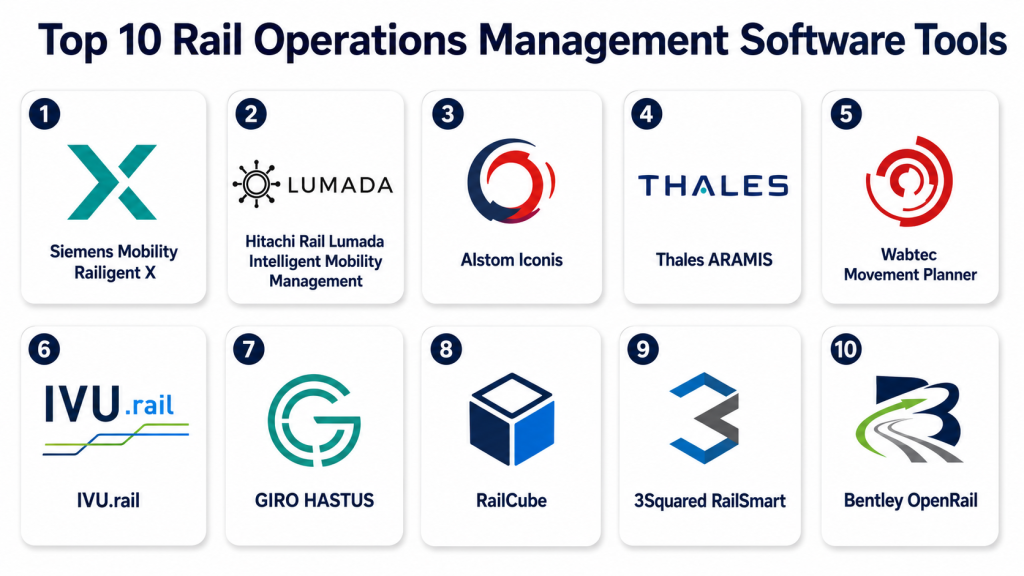
Top 10 Rail Operations Management Software Tools
1 — Siemens Mobility Railigent X
Short description:
Siemens Mobility Railigent X is a digital rail platform designed to support asset performance, operations optimization, maintenance insights, and rail data analytics. It is suitable for rail operators and infrastructure managers that need better visibility into rolling stock, infrastructure, and operational performance. The platform helps teams use rail data to support predictive maintenance, reliability improvements, and operational decision-making. It is especially useful for organizations managing complex fleets and infrastructure assets. Railigent X is best suited for larger operators looking for data-driven rail performance improvement.
Key Features
- Rail asset performance monitoring
- Predictive maintenance support
- Fleet and infrastructure data analytics
- Operational performance insights
- Condition-based monitoring
- Integration with rail systems and data sources
- Dashboard and reporting capabilities
Pros
- Strong rail technology and engineering background
- Useful for predictive maintenance and asset performance
- Suitable for large and complex rail environments
Cons
- May be more suitable for mature rail organizations
- Implementation can require strong data readiness
- Pricing is not publicly stated
Platforms / Deployment
Web / Cloud / Hybrid / Varies
Security & Compliance
SSO/SAML, MFA, encryption, audit logs, RBAC, SOC 2, ISO 27001, GDPR, HIPAA: Not publicly stated.
Integrations & Ecosystem
Siemens Mobility Railigent X is designed to connect rail asset data, maintenance workflows, and operational systems for better fleet and infrastructure visibility.
- Rolling stock systems
- Infrastructure monitoring tools
- Maintenance systems
- IoT and sensor platforms
- Reporting and analytics tools
- Enterprise systems
Support & Community
Siemens Mobility provides enterprise-level rail support, consulting, implementation, and technical services. Support levels depend on project size, deployment scope, and customer agreement.
2 — Hitachi Rail Lumada Intelligent Mobility Management
Short description:
Hitachi Rail Lumada Intelligent Mobility Management supports digital rail operations, mobility management, asset insights, and data-driven decision-making. It is built for rail and transit organizations that want connected operations across infrastructure, rolling stock, passenger movement, and service performance. The platform can help operators improve service reliability, maintenance planning, and operational coordination. It is useful for organizations that want to modernize rail operations through analytics and connected data. Hitachi Rail is a strong fit for complex passenger rail and urban mobility environments.
Key Features
- Mobility and rail operations intelligence
- Asset performance insights
- Real-time data integration
- Service reliability analytics
- Operational monitoring
- Maintenance decision support
- Mobility ecosystem integration
Pros
- Strong fit for modern rail and mobility operations
- Useful for connected data and analytics
- Good for operators focused on service reliability
Cons
- May require integration with multiple existing systems
- Best value depends on digital maturity
- Public pricing and detailed security certifications are not clearly stated
Platforms / Deployment
Web / Cloud / Hybrid / Varies
Security & Compliance
SSO/SAML, MFA, encryption, audit logs, RBAC, SOC 2, ISO 27001, GDPR, HIPAA: Not publicly stated.
Integrations & Ecosystem
Hitachi Rail Lumada can connect rail operations data with asset systems, mobility platforms, monitoring tools, and reporting environments.
- Rail operations systems
- Asset management platforms
- Passenger information systems
- IoT and sensor data
- Maintenance systems
- Analytics platforms
Support & Community
Hitachi Rail provides enterprise support, implementation services, and rail-domain consulting. Support structure depends on contract type, region, and solution scope.
3 — Alstom Iconis
Short description:
Alstom Iconis is a rail control and operations management solution used for traffic supervision, control center operations, and rail network management. It supports operators that need real-time control, incident visibility, and coordinated decision-making across rail networks. The platform is suitable for metros, mainline rail, and transit networks that require high operational reliability. Iconis helps control centers monitor service status, manage events, and support operational continuity. It is best for rail operators looking for advanced supervision and control capabilities.
Key Features
- Rail traffic supervision
- Control center operations support
- Real-time network monitoring
- Incident and event management
- Service regulation support
- Integration with signaling and operations systems
- Operational dashboards and alerts
Pros
- Strong control center and supervision focus
- Suitable for metro and rail network operations
- Supports real-time operational decision-making
Cons
- May be complex for smaller operators
- Deployment depends heavily on rail network architecture
- Pricing is not publicly stated
Platforms / Deployment
Web / Windows / Hybrid / Varies
Security & Compliance
SSO/SAML, MFA, encryption, audit logs, RBAC, SOC 2, ISO 27001, GDPR, HIPAA: Not publicly stated.
Integrations & Ecosystem
Alstom Iconis is designed to work with signaling, supervision, and rail operations systems in control center environments.
- Signaling systems
- Train control systems
- Passenger information systems
- Incident management tools
- Operational reporting platforms
- Infrastructure monitoring systems
Support & Community
Alstom provides enterprise rail support, implementation, maintenance, and technical services. Support levels depend on project scope, network size, and service agreement.
4 — Thales ARAMIS
Short description:
Thales ARAMIS is a rail traffic management and operations control solution used to manage train movements, network capacity, and traffic supervision. It is designed for infrastructure managers and rail operators that need reliable dispatching, traffic control, and operational coordination. The platform supports complex rail networks where punctuality, safety, and capacity utilization are important. ARAMIS helps operators manage real-time traffic conditions and operational disruptions. It is best suited for organizations that need advanced rail traffic management capability.
Key Features
- Rail traffic management
- Train movement supervision
- Dispatching and control support
- Capacity and timetable coordination
- Disruption management
- Real-time operational visibility
- Integration with signaling and control systems
Pros
- Strong traffic management capability
- Suitable for infrastructure managers and large operators
- Supports real-time rail operations control
Cons
- Implementation can be complex
- Best suited for sophisticated rail environments
- Public security certification details are not clearly stated
Platforms / Deployment
Web / Windows / Hybrid / Varies
Security & Compliance
SSO/SAML, MFA, encryption, audit logs, RBAC, SOC 2, ISO 27001, GDPR, HIPAA: Not publicly stated.
Integrations & Ecosystem
Thales ARAMIS integrates with traffic control, signaling, dispatching, and rail network management environments.
- Signaling systems
- Train control platforms
- Timetable systems
- Control center tools
- Infrastructure monitoring systems
- Reporting platforms
Support & Community
Thales provides enterprise-grade rail support, implementation services, and long-term technical assistance. Support terms depend on project requirements and operating environment.
5 — Wabtec Movement Planner
Short description:
Wabtec Movement Planner is a rail operations planning and optimization solution focused on train movement, network efficiency, and dispatch support. It is especially relevant for freight railroads and large rail networks where train flow, congestion, and asset utilization are major concerns. The software helps operators improve route planning, movement sequencing, and operational performance. It supports decision-making for dispatchers and operations teams managing busy corridors. Wabtec Movement Planner is a strong fit for railroads that need better network fluidity and movement optimization.
Key Features
- Train movement planning
- Dispatch decision support
- Network optimization
- Route and congestion management
- Operational performance insights
- Rail traffic coordination
- Integration with rail control systems
Pros
- Strong fit for freight and network optimization
- Helps improve train flow and asset utilization
- Useful for complex rail corridors
Cons
- May not cover all passenger operations needs
- Best value depends on integration with dispatch systems
- Pricing is not publicly stated
Platforms / Deployment
Web / Windows / Cloud / Hybrid / Varies
Security & Compliance
SSO/SAML, MFA, encryption, audit logs, RBAC, SOC 2, ISO 27001, GDPR, HIPAA: Not publicly stated.
Integrations & Ecosystem
Wabtec Movement Planner connects with dispatching, rail network control, train management, and operational reporting systems.
- Dispatch systems
- Train control systems
- Rail network planning tools
- Asset management platforms
- Reporting and analytics tools
- Freight operations systems
Support & Community
Wabtec provides rail-focused enterprise support and technical services. Support levels depend on project type, rail network complexity, and customer agreement.
6 — IVU.rail
Short description:
IVU.rail is a rail planning and operations platform designed for public transport, rail operators, and transit agencies. It supports timetable planning, vehicle scheduling, crew scheduling, dispatching, and operational control. The platform is useful for passenger transport organizations that need integrated planning and real-time operations workflows. IVU.rail helps connect planning teams, control centers, and workforce management processes. It is best suited for rail and public transport operators focused on efficient service planning and daily operations.
Key Features
- Timetable planning
- Vehicle and rolling stock scheduling
- Crew scheduling
- Dispatching support
- Real-time operations management
- Passenger transport planning
- Reporting and performance monitoring
Pros
- Strong fit for passenger rail and public transport
- Integrated planning and operations workflows
- Useful for crew, vehicle, and timetable coordination
Cons
- May be less focused on heavy freight rail operations
- Implementation requires accurate planning data
- Public security details are not clearly stated
Platforms / Deployment
Web / Windows / Cloud / Hybrid / Varies
Security & Compliance
SSO/SAML, MFA, encryption, audit logs, RBAC, SOC 2, ISO 27001, GDPR, HIPAA: Not publicly stated.
Integrations & Ecosystem
IVU.rail supports connected workflows across passenger transport planning, operations, crew, and vehicle management.
- Passenger information systems
- Ticketing systems
- Crew management tools
- Vehicle scheduling systems
- Operations control systems
- Reporting platforms
Support & Community
IVU provides implementation support, training, documentation, and customer services. Support levels depend on modules selected and contract scope.
7 — GIRO HASTUS
Short description:
GIRO HASTUS is a widely recognized scheduling and operations planning platform for public transport, including rail, bus, tram, and metro networks. It supports timetabling, vehicle scheduling, crew scheduling, rostering, and operational planning. The software is useful for transit agencies that need to optimize services, labor, vehicles, and daily operations. HASTUS is especially strong where workforce scheduling and service planning are closely connected. It is best suited for public transit operators managing complex service networks.
Key Features
- Timetable and service planning
- Vehicle scheduling
- Crew scheduling and rostering
- Run cutting and duty planning
- Operations planning support
- Workforce optimization
- Reporting and planning analytics
Pros
- Strong workforce and service planning depth
- Suitable for public transport agencies
- Useful for complex scheduling environments
Cons
- May require specialist planning knowledge
- Not a pure rail traffic control platform
- Pricing and security certifications are not publicly stated
Platforms / Deployment
Windows / Web / Cloud / Hybrid / Varies
Security & Compliance
SSO/SAML, MFA, encryption, audit logs, RBAC, SOC 2, ISO 27001, GDPR, HIPAA: Not publicly stated.
Integrations & Ecosystem
HASTUS integrates with public transport systems where schedules, crew, vehicles, and operational data must be connected.
- Passenger information systems
- Payroll systems
- HR systems
- CAD/AVL systems
- Operations planning tools
- Reporting platforms
Support & Community
GIRO provides specialized support, implementation, training, and planning services. Support quality depends on selected modules, agency size, and contract terms.
8 — RailCube
Short description:
RailCube is a rail operations software platform designed for rail freight operators, leasing companies, and rail logistics businesses. It supports planning, operations, fleet management, wagon management, invoicing, and operational administration. The platform is useful for operators that need practical visibility into trains, wagons, contracts, orders, and rail movements. RailCube is especially relevant for freight rail companies that want to reduce spreadsheets and centralize daily operations. It is a strong option for small and mid-sized rail freight businesses.
Key Features
- Rail freight operations management
- Wagon and fleet tracking
- Order and contract management
- Train planning support
- Invoicing and administration
- Operational reporting
- Customer and logistics workflows
Pros
- Practical fit for rail freight operators
- Helps replace spreadsheet-heavy workflows
- Useful for operations and administration together
Cons
- May not be suitable for large traffic control environments
- Passenger rail features may be limited
- Public security details are not clearly stated
Platforms / Deployment
Web / Cloud / Varies
Security & Compliance
SSO/SAML, MFA, encryption, audit logs, RBAC, SOC 2, ISO 27001, GDPR, HIPAA: Not publicly stated.
Integrations & Ecosystem
RailCube connects rail freight planning, fleet visibility, contract workflows, and billing processes.
- Accounting systems
- Customer management tools
- Fleet data systems
- Logistics platforms
- Reporting tools
- Operational administration systems
Support & Community
RailCube provides vendor-led support, onboarding, and product assistance. Support availability depends on subscription level, customer size, and implementation scope.
9 — 3Squared RailSmart
Short description:
3Squared RailSmart is a rail software suite focused on workforce management, safety, competency, operational communication, and digital rail processes. It is useful for rail companies that need better control over staff readiness, compliance tasks, safety workflows, and operational records. RailSmart helps reduce paper-based processes and improve visibility across teams. It is suitable for rail operators, contractors, and infrastructure service providers. The platform is best for organizations looking to digitalize workforce and safety operations.
Key Features
- Workforce management
- Competency and training tracking
- Safety and compliance workflows
- Digital forms and records
- Operational communication support
- Staff availability and rostering support
- Reporting and audit readiness
Pros
- Strong fit for workforce and safety processes
- Helps reduce paper-based rail workflows
- Useful for rail contractors and operators
Cons
- Not a full traffic management system
- May need integration with wider operations platforms
- Public security certification details are not clearly stated
Platforms / Deployment
Web / Mobile / Cloud / Varies
Security & Compliance
SSO/SAML, MFA, encryption, audit logs, RBAC, SOC 2, ISO 27001, GDPR, HIPAA: Not publicly stated.
Integrations & Ecosystem
RailSmart is useful when workforce, safety, competency, and operational records must connect with broader rail business systems.
- HR systems
- Training platforms
- Safety management systems
- Rostering tools
- Reporting platforms
- Document management systems
Support & Community
3Squared provides onboarding, customer support, documentation, and rail-sector implementation guidance. Support levels depend on product scope and customer agreement.
10 — Bentley OpenRail
Short description:
Bentley OpenRail is a rail design, asset, infrastructure, and digital engineering platform used by rail owners, infrastructure managers, engineering teams, and operators. While it is not a traditional dispatching platform, it supports rail operations management through infrastructure data, asset visibility, digital twins, and lifecycle planning. The platform is useful for organizations managing track, stations, corridors, and rail infrastructure projects. OpenRail helps connect engineering, asset, and operational planning. It is best suited for infrastructure-heavy rail organizations focused on long-term network performance.
Key Features
- Rail infrastructure modeling
- Digital twin support
- Asset lifecycle management
- Track and corridor design data
- Infrastructure planning
- Project and engineering collaboration
- Integration with asset and operations workflows
Pros
- Strong for infrastructure and asset-heavy rail environments
- Useful for digital twin and engineering data workflows
- Supports long-term rail network planning
Cons
- Not a complete train dispatching or crew scheduling platform
- May require integration with operations systems
- Can be more engineering-focused than operations-focused
Platforms / Deployment
Web / Windows / Cloud / Hybrid / Varies
Security & Compliance
SSO/SAML, MFA, encryption, audit logs, RBAC, SOC 2, ISO 27001, GDPR, HIPAA: Not publicly stated.
Integrations & Ecosystem
Bentley OpenRail works best where rail infrastructure, asset data, digital twins, and planning systems need to support operational decisions.
- Asset management systems
- GIS platforms
- Engineering design tools
- Project management systems
- Infrastructure monitoring systems
- Reporting and analytics tools
Support & Community
Bentley provides enterprise support, documentation, training, and implementation services. Support availability depends on subscription, product scope, and customer agreement.
Comparison Table
| Tool Name | Best For | Platform(s) Supported | Deployment | Standout Feature | Public Rating |
|---|---|---|---|---|---|
| Siemens Mobility Railigent X | Asset performance and rail analytics | Web / Varies | Cloud / Hybrid | Predictive maintenance and rail data insights | N/A |
| Hitachi Rail Lumada Intelligent Mobility Management | Connected rail and mobility operations | Web / Varies | Cloud / Hybrid | Mobility intelligence and service reliability | N/A |
| Alstom Iconis | Control centers and traffic supervision | Web / Windows / Varies | Hybrid / Varies | Real-time rail supervision | N/A |
| Thales ARAMIS | Rail traffic management and dispatching | Web / Windows / Varies | Hybrid / Varies | Train movement and traffic control | N/A |
| Wabtec Movement Planner | Freight rail and network optimization | Web / Windows / Varies | Cloud / Hybrid | Train movement planning | N/A |
| IVU.rail | Passenger rail and public transport planning | Web / Windows / Varies | Cloud / Hybrid | Timetable, vehicle, and crew planning | N/A |
| GIRO HASTUS | Transit scheduling and workforce planning | Windows / Web / Varies | Cloud / Hybrid | Crew and service scheduling depth | N/A |
| RailCube | Rail freight operators | Web | Cloud | Freight operations and wagon management | N/A |
| 3Squared RailSmart | Workforce, safety, and competency management | Web / Mobile | Cloud | Rail workforce compliance workflows | N/A |
| Bentley OpenRail | Rail infrastructure and digital twins | Web / Windows / Varies | Cloud / Hybrid | Infrastructure and asset lifecycle planning | N/A |
Evaluation & Scoring of Rail Operations Management Software
| Tool Name | Core (25%) | Ease (15%) | Integrations (15%) | Security (10%) | Performance (10%) | Support (10%) | Value (15%) | Weighted Total (0–10) |
|---|---|---|---|---|---|---|---|---|
| Siemens Mobility Railigent X | 9 | 7 | 9 | 7 | 9 | 9 | 7 | 8.35 |
| Hitachi Rail Lumada Intelligent Mobility Management | 9 | 7 | 9 | 7 | 9 | 8 | 7 | 8.25 |
| Alstom Iconis | 9 | 7 | 9 | 7 | 9 | 9 | 7 | 8.35 |
| Thales ARAMIS | 9 | 7 | 9 | 7 | 9 | 8 | 7 | 8.25 |
| Wabtec Movement Planner | 8 | 7 | 8 | 7 | 9 | 8 | 8 | 7.95 |
| IVU.rail | 8 | 8 | 8 | 6 | 8 | 8 | 8 | 7.80 |
| GIRO HASTUS | 8 | 8 | 8 | 6 | 8 | 8 | 8 | 7.80 |
| RailCube | 7 | 8 | 7 | 6 | 8 | 7 | 9 | 7.45 |
| 3Squared RailSmart | 7 | 8 | 7 | 6 | 8 | 8 | 8 | 7.40 |
| Bentley OpenRail | 8 | 7 | 9 | 7 | 8 | 9 | 7 | 7.95 |
These scores are comparative and should be used as a shortlist guide, not a final buying decision. A higher score does not mean the tool is best for every rail organization. Control center teams may prioritize traffic management, while freight operators may prioritize wagon tracking and movement planning. Infrastructure managers may value asset lifecycle visibility more than crew scheduling. Buyers should validate integrations, deployment model, cybersecurity controls, support scope, and real-world workflow fit before final selection.
Which Rail Operations Management Software Tool Is Right for You?
Solo / Freelancer
Solo rail consultants, independent transport planners, and small advisory teams usually do not need a full enterprise rail operations platform. They may need tools for planning support, infrastructure modeling, reporting, or lightweight operational analysis.
Bentley OpenRail may be useful for infrastructure-focused consultants, while RailCube or 3Squared RailSmart may be relevant for smaller rail business workflows. The key is to avoid buying a large control center solution when the actual need is reporting, planning, or compliance documentation.
SMB
Small and mid-sized rail operators need practical software that improves daily operations without creating unnecessary complexity. RailCube is a strong option for freight-focused rail businesses, while 3Squared RailSmart can help with workforce, competency, and safety workflows. IVU.rail or GIRO HASTUS may be useful for smaller passenger transport operators with scheduling complexity.
SMBs should focus on:
- Ease of use
- Fast adoption
- Clear operational workflows
- Affordable support model
- Basic integration options
- Reporting and compliance visibility
Mid-Market
Mid-market rail operators usually need stronger scheduling, workforce planning, service planning, asset visibility, and performance reporting. IVU.rail, GIRO HASTUS, Wabtec Movement Planner, RailCube, 3Squared RailSmart, and Bentley OpenRail can be suitable depending on operational focus.
Mid-market buyers should evaluate:
- Crew and vehicle planning
- Disruption handling
- Asset and infrastructure data
- Operations reporting
- Integration with existing systems
- Scalability across routes and depots
Enterprise
Enterprise rail operators, national rail networks, metro systems, and infrastructure managers need highly scalable platforms with strong reliability, integration, control, and security considerations. Siemens Mobility Railigent X, Hitachi Rail Lumada, Alstom Iconis, Thales ARAMIS, Wabtec Movement Planner, and Bentley OpenRail are strong candidates depending on the use case.
Enterprise teams should prioritize:
- Real-time operations control
- Network-wide scalability
- Cybersecurity review
- Integration with signaling and control systems
- Predictive maintenance
- Service performance analytics
- Vendor implementation experience
Budget vs Premium
Budget-focused buyers should look for tools that solve their most painful operational problem first. RailCube, 3Squared RailSmart, IVU.rail, or GIRO HASTUS may be more practical depending on whether the need is freight operations, workforce compliance, or passenger service planning.
Premium buyers should consider Siemens Mobility, Hitachi Rail, Alstom, Thales, Wabtec, or Bentley when the priority is enterprise-level control, asset intelligence, network optimization, or infrastructure lifecycle management.
Feature Depth vs Ease of Use
Feature-rich platforms provide stronger control, analytics, and scalability but may require deeper implementation. Alstom Iconis, Thales ARAMIS, Siemens Railigent X, and Hitachi Lumada are better suited for mature organizations with complex networks.
For ease of adoption, RailCube, 3Squared RailSmart, IVU.rail, and GIRO HASTUS may be easier to evaluate for specific use cases like freight administration, workforce workflows, or service scheduling.
Integrations & Scalability
Rail operations software must often connect with signaling systems, passenger information systems, HR platforms, payroll tools, ERP systems, GIS platforms, maintenance software, and reporting tools. Integration is one of the most important evaluation areas.
Scalability should be judged by:
- Number of routes
- Number of trains
- Number of depots
- Passenger or freight volume
- Crew size
- Infrastructure complexity
- Real-time control requirements
- Reporting and compliance needs
Security & Compliance Needs
Rail operations software may support critical infrastructure, safety workflows, staff data, operational records, and passenger-impacting systems. Buyers should carefully review security controls before purchase.
Important questions include:
- Does the tool support SSO and MFA?
- Are audit logs available?
- Can roles and permissions be controlled?
- How is data encrypted?
- Where is data hosted?
- What backup and recovery processes exist?
- How does the vendor support operational resilience?
- What compliance documentation can the vendor provide?
If security certifications are not publicly stated, buyers should request documentation directly from the vendor.
Frequently Asked Questions
1. What is rail operations management software?
Rail operations management software helps rail companies plan, monitor, and control train services, staff, assets, infrastructure, and operational workflows. It can support scheduling, dispatching, maintenance, workforce management, reporting, and service reliability.
2. Who uses rail operations management software?
It is used by passenger rail operators, metro systems, freight railroads, public transport agencies, infrastructure managers, maintenance teams, dispatchers, control centers, planners, and workforce managers.
3. How much does rail operations management software cost?
Pricing is usually not publicly stated because costs depend on modules, network size, number of users, deployment model, integrations, implementation services, and support requirements. Most enterprise vendors provide custom pricing.
4. How long does implementation take?
Implementation time depends on the size of the rail network, data quality, system integrations, user training needs, and operational complexity. A small deployment may be faster, while a large control center or enterprise rollout may require phased implementation.
5. What are common mistakes when selecting rail operations software?
Common mistakes include choosing software without mapping workflows, ignoring legacy system integration, underestimating training needs, not involving operations teams early, and failing to test real disruption scenarios before purchase.
6. Can rail operations software help reduce delays?
Yes, many platforms can support delay reduction by improving visibility, planning, dispatching, maintenance coordination, and disruption response. However, results depend on data quality, operating discipline, infrastructure condition, and integration with real-time systems.
7. Is rail operations software only for large rail networks?
No. Large networks may need advanced traffic management and analytics, but smaller rail operators can benefit from tools for workforce management, freight operations, maintenance planning, compliance tracking, and reporting.
8. Can these tools integrate with signaling systems?
Some advanced rail traffic and control platforms can integrate with signaling and train control systems, but this depends on the vendor, rail architecture, safety requirements, and project scope. Buyers should validate integration capability carefully.
9. Are cloud-based rail operations platforms safe?
Cloud-based platforms can be suitable when they include strong security, access control, encryption, audit logs, and reliable hosting. For critical rail operations, buyers should review cybersecurity, resilience, data hosting, and compliance requirements carefully.
10. What is the best alternative to rail operations management software?
For very small teams, spreadsheets or generic project management tools may work temporarily. However, rail-specific software becomes more valuable when operations involve trains, crew, assets, infrastructure, safety workflows, service planning, and real-time decisions.
Conclusion
Rail operations management software helps rail organizations improve service reliability, operational visibility, asset performance, workforce planning, and disruption response. The best platform depends on the type of rail operation, network size, budget, integration needs, security expectations, and operational maturity. Siemens Mobility Railigent X, Hitachi Rail Lumada, Alstom Iconis, Thales ARAMIS, and Wabtec Movement Planner are strong options for enterprise rail operations and network control. IVU.rail and GIRO HASTUS are practical choices for passenger transport planning and scheduling. RailCube, 3Squared RailSmart, and Bentley OpenRail fit more specialized needs such as freight operations, workforce compliance, and infrastructure lifecycle planning. A smart is to shortlist two or three tools, map your operating workflows, test real scenarios, validate integrations, review security controls, and run a pilot before making a final decision.
