Upgrade & Secure Your Future with DevOps, SRE, DevSecOps, MLOps!
We spend hours scrolling social media and waste money on things we forget, but won’t spend 30 minutes a day earning certifications that can change our lives.
Master in DevOps, SRE, DevSecOps & MLOps by DevOps School!
Learn from Guru Rajesh Kumar and double your salary in just one year.
Introduction
Logistics visibility platforms help companies track shipments, monitor carrier performance, predict delays, manage exceptions, and give customers real-time updates across road, ocean, air, rail, and last-mile delivery networks. In simple terms, these tools help supply chain teams answer one important question: Where is my shipment, and what should I do next?
These platforms matter now because logistics teams are dealing with tighter delivery promises, global disruption, customer pressure, carrier fragmentation, compliance needs, and rising transportation costs. Modern visibility platforms combine tracking data, carrier integrations, telematics, predictive ETA, exception alerts, analytics, and workflow automation. Leading industry references commonly compare platforms such as project44, FourKites, Shippeo, Transporeon Visibility Hub, Overhaul, GoComet, FarEye, and Descartes MacroPoint in this category.
Real-world use cases include real-time freight tracking, predictive delivery updates, cold-chain monitoring, carrier performance analysis, customer shipment notifications, exception management, detention tracking, and supply chain risk control.
Buyers should evaluate tracking accuracy, carrier network coverage, multimodal support, predictive ETA quality, integration strength, ease of onboarding, analytics, security, exception workflows, scalability, and support quality.
Best for: Shippers, manufacturers, retailers, 3PLs, freight forwarders, logistics teams, supply chain leaders, transportation managers, e-commerce companies, and enterprises managing complex delivery networks.
Not ideal for: Very small businesses with only a few monthly shipments, companies that only need basic courier tracking, or teams that already use a simple TMS and do not require real-time visibility, predictive alerts, or customer-facing tracking.
Key Trends in Logistics Visibility Platforms
- AI-powered predictive ETA: Visibility platforms are moving beyond simple tracking and using AI-driven models to predict delays, arrival times, route risks, and exception probability.
- Multimodal visibility: Buyers now expect visibility across road, rail, ocean, air, parcel, intermodal, and last-mile logistics instead of only truckload tracking.
- Control tower approach: Companies want one dashboard to monitor shipments, inventory movement, carrier performance, exceptions, and customer delivery promises.
- Carrier network expansion: The value of a visibility platform depends heavily on how many carriers, telematics providers, ELDs, ocean carriers, airlines, and logistics partners it can connect with.
- Exception-first workflows: Modern logistics teams do not want to watch every shipment manually. They want alerts when something needs action, such as delay risk, temperature breach, route deviation, or missed appointment.
- Customer-facing tracking: Shippers increasingly use branded tracking portals and automated notifications to reduce “Where is my order?” calls.
- Risk and compliance visibility: High-value, pharmaceutical, food, retail, and regulated shipments need better monitoring, chain-of-custody visibility, and incident documentation.
- API-first integrations: Visibility platforms must connect with TMS, ERP, WMS, OMS, CRM, carrier systems, telematics platforms, IoT sensors, and analytics tools.
- Sustainability analytics: More companies want shipment visibility platforms to help measure transportation emissions, reduce empty miles, and improve route efficiency.
- Data quality governance: Since visibility depends on many data sources, buyers are paying more attention to data freshness, accuracy, normalization, and exception handling.
How We Selected These Tools
The logistics visibility market includes real-time transportation visibility platforms, supply chain control towers, sensor-based visibility tools, last-mile visibility platforms, and multimodal shipment tracking solutions. The tools below were selected using practical buyer-focused criteria.
- Recognition in real-time transportation visibility and supply chain visibility markets
- Shipment tracking depth across modes and regions
- Carrier, telematics, IoT, and logistics partner connectivity
- Predictive ETA, alerts, and exception management capabilities
- Fit for shippers, retailers, manufacturers, 3PLs, forwarders, and enterprise supply chains
- Integration strength with TMS, ERP, WMS, OMS, and carrier systems
- Reliability and performance suitability for high-volume logistics operations
- Security posture signals and enterprise access-control expectations
- Support for customer notifications, analytics, and operational dashboards
- Practical value across enterprise, mid-market, and growing logistics teams
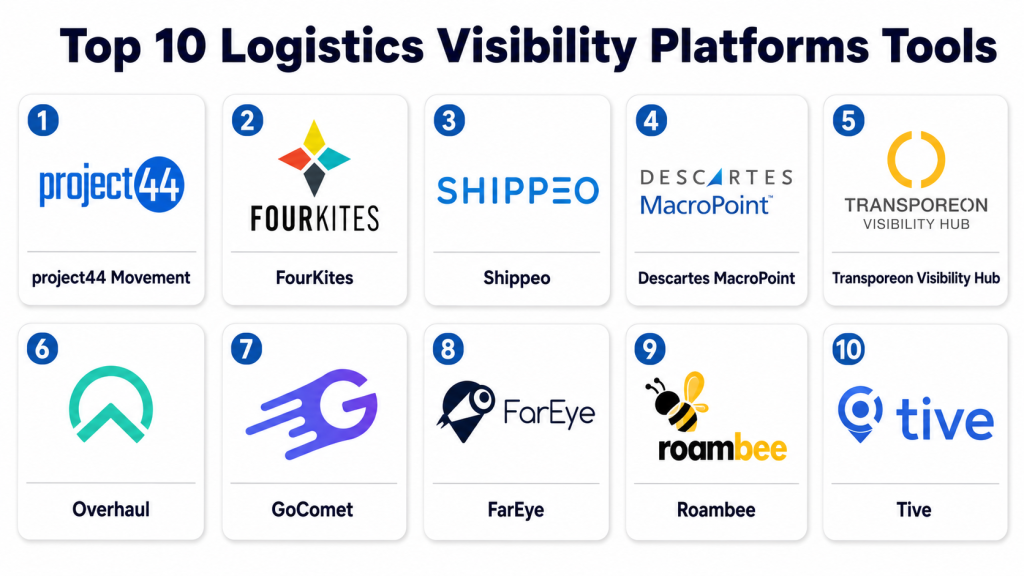
Top 10 Logistics Visibility Platforms Tools
#1 — project44 Movement
Short description:
project44 Movement is a logistics visibility platform focused on global supply chain execution, real-time shipment visibility, predictive insights, and transportation network connectivity. It helps shippers, logistics providers, retailers, and manufacturers track freight across multiple modes and geographies. The platform is especially useful for companies that need broad visibility across complex transportation networks, carrier partners, and customer delivery workflows. It is best suited for enterprise and mid-market teams that need scalable visibility, analytics, and supply chain decision support.
Key Features
- Real-time shipment visibility
- Multimodal transportation tracking
- Predictive ETA and exception insights
- Carrier and logistics partner connectivity
- Supply chain execution dashboards
- Customer-facing visibility workflows
- API and enterprise integration support
Pros
- Strong fit for large and complex logistics networks
- Broad visibility and decision-support positioning
- Useful for global shippers and enterprise supply chains
Cons
- May be more complex than small teams need
- Implementation depends on carrier and system integrations
- Pricing is not publicly stated
Platforms / Deployment
Web / Cloud / API-enabled platform
Security & Compliance
Security details should be confirmed directly with the vendor. Buyers should ask about SSO, MFA, RBAC, encryption, audit logs, API security, data retention, and compliance documentation.
SOC 2, ISO 27001, GDPR, HIPAA: Not publicly stated.
Integrations & Ecosystem
project44 is designed for connected logistics networks where data must flow from carriers, telematics systems, enterprise systems, and customer-facing tools.
- TMS systems
- ERP platforms
- Carrier systems
- Telematics providers
- Ocean and air freight data sources
- Analytics and control tower systems
Support & Community
project44 provides enterprise support, onboarding, implementation services, and customer success resources. Support depth depends on customer size, contract scope, and integration complexity.
#2 — FourKites
Short description:
FourKites is a supply chain visibility platform that helps companies track shipments, manage exceptions, improve collaboration, and analyze transportation performance. It is widely associated with real-time freight visibility and supply chain visibility workflows. The platform supports logistics teams that need shipment tracking, predictive insights, carrier collaboration, and customer visibility. FourKites is best suited for shippers, retailers, manufacturers, and logistics teams that want a connected view of movement across their supply chain.
Key Features
- Real-time freight tracking
- Predictive ETA and delay alerts
- Supply chain visibility dashboards
- Carrier collaboration workflows
- Yard and facility visibility capabilities
- Customer notification support
- Analytics for logistics performance
Pros
- Strong visibility platform for shippers and enterprise logistics teams
- Useful for reducing manual check calls and improving exception response
- Good fit for companies needing collaborative transportation visibility
Cons
- Full value depends on carrier participation and data quality
- May require integration planning for complex environments
- Pricing is not publicly stated
Platforms / Deployment
Web / Cloud / API-enabled platform
Security & Compliance
Security information should be confirmed directly with the vendor. Buyers should review SSO, MFA, RBAC, encryption, audit logs, data privacy, and compliance documentation.
SOC 2, ISO 27001, GDPR, HIPAA: Not publicly stated.
Integrations & Ecosystem
FourKites fits into logistics ecosystems where shipment status, carrier data, and customer updates must work together.
- TMS platforms
- ERP systems
- Carrier networks
- Telematics and ELD systems
- Yard and facility tools
- Customer-facing shipment portals
Support & Community
FourKites provides onboarding, support, documentation, and customer success services. Community strength is mainly enterprise customer and logistics-industry focused.
#3 — Shippeo
Short description:
Shippeo is a real-time transportation visibility platform focused on shipment tracking, predictive ETA, carrier connectivity, and transportation performance analytics. It helps supply chain teams monitor shipments across modes and improve decision-making through better visibility. Shippeo is useful for manufacturers, retailers, logistics service providers, and enterprises that need accurate ETAs, exception alerts, and transport collaboration. It is especially relevant for companies operating across European and global logistics networks.
Key Features
- Real-time transportation visibility
- Predictive ETA capabilities
- Carrier and telematics integrations
- Multimodal shipment tracking
- Exception alerts and workflow support
- Transport performance analytics
- Customer and partner visibility sharing
Pros
- Strong predictive ETA and transport visibility positioning
- Useful for reducing manual tracking work
- Good fit for enterprises with complex transportation networks
Cons
- Value depends on connected carriers and data quality
- Implementation can require process alignment
- Pricing is not publicly stated
Platforms / Deployment
Web / Cloud / API-enabled platform
Security & Compliance
Security and compliance details should be checked directly with Shippeo. Buyers should ask about SSO, MFA, RBAC, encryption, audit logs, API controls, and data protection.
SOC 2, ISO 27001, GDPR, HIPAA: Not publicly stated.
Integrations & Ecosystem
Shippeo is strongest when integrated with transport systems, carrier networks, and operational dashboards.
- TMS systems
- ERP platforms
- Carrier systems
- Telematics providers
- Customer portals
- Analytics and reporting tools
Support & Community
Shippeo provides vendor-led support, onboarding, customer success, and implementation assistance. Support quality depends on deployment scale and integration complexity.
#4 — Descartes MacroPoint
Short description:
Descartes MacroPoint is a real-time freight visibility platform designed for shippers, brokers, logistics providers, and transportation teams that need shipment tracking, predictive visibility, and exception management. It helps users monitor freight movement, automate status updates, reduce manual check calls, and improve customer communication. Descartes MacroPoint is often evaluated in the real-time transportation visibility category and is a practical fit for companies managing truckload and multimodal freight visibility.
Key Features
- Real-time freight visibility
- Carrier connectivity and tracking workflows
- Predictive ETA and exception alerts
- Automated shipment status updates
- Detention and delay visibility
- Broker, shipper, and 3PL use cases
- Integration with transportation systems
Pros
- Practical for freight visibility and transportation monitoring
- Helps reduce manual check calls and shipment uncertainty
- Good fit for brokers, shippers, and logistics-intensive businesses
Cons
- Some advanced capabilities may depend on integrations
- Public pricing details are not available
- Best value requires consistent carrier participation
Platforms / Deployment
Web / Cloud / API-enabled platform
Security & Compliance
Security details should be validated directly with the vendor. Buyers should request information about access control, encryption, audit logs, API security, user roles, and compliance documentation.
SOC 2, ISO 27001, GDPR, HIPAA: Not publicly stated.
Integrations & Ecosystem
Descartes MacroPoint works well in transportation environments that need carrier tracking, freight visibility, and automated status updates.
- TMS systems
- Carrier networks
- Telematics devices
- ELD systems
- Brokerage platforms
- Reporting and analytics tools
Support & Community
Descartes provides vendor support, implementation services, and customer resources. Support depth may vary by selected products, contract scope, and deployment complexity.
#5 — Transporeon Visibility Hub
Short description:
Transporeon Visibility Hub is a transportation visibility solution connected to the broader Transporeon transportation management ecosystem. It helps shippers and carriers improve shipment visibility, transport collaboration, appointment planning, and freight execution. The platform is suitable for companies that want visibility integrated with transportation procurement, dock scheduling, carrier collaboration, and execution workflows. It is especially useful for European and global shippers that need connected transportation operations.
Key Features
- Real-time transportation visibility
- Carrier collaboration tools
- Shipment tracking and status updates
- Transport execution ecosystem support
- Dock scheduling and appointment-related workflows
- Predictive shipment visibility
- Analytics for transportation performance
Pros
- Strong fit for companies using broader Transporeon workflows
- Useful for combining visibility with transport execution
- Good option for shipper-carrier collaboration
Cons
- May be less attractive if a company only wants standalone tracking
- Full value depends on ecosystem adoption
- Pricing is not publicly stated
Platforms / Deployment
Web / Cloud / API-enabled platform
Security & Compliance
Security and compliance details should be confirmed directly with the vendor. Buyers should evaluate authentication, RBAC, encryption, audit logs, API security, and data privacy documentation.
SOC 2, ISO 27001, GDPR, HIPAA: Not publicly stated.
Integrations & Ecosystem
Transporeon Visibility Hub is designed to work within transportation execution and carrier collaboration workflows.
- TMS systems
- Carrier systems
- Dock scheduling tools
- Freight procurement workflows
- Telematics providers
- Reporting and analytics tools
Support & Community
Transporeon provides enterprise support, onboarding, and transportation-focused customer services. Support quality depends on contract scope and selected platform modules.
#6 — Overhaul
Short description:
Overhaul is a supply chain visibility and risk management platform focused on shipment monitoring, security, compliance, and exception response. It is especially relevant for high-value, temperature-sensitive, pharmaceutical, technology, and regulated shipments where visibility alone is not enough. Overhaul helps companies monitor shipment conditions, detect risk, manage incidents, and improve supply chain protection. It is best suited for organizations that need visibility combined with logistics risk management.
Key Features
- Shipment visibility and monitoring
- Risk management workflows
- High-value cargo protection
- Temperature and condition monitoring support
- Exception and incident management
- Compliance-focused shipment oversight
- Analytics for supply chain risk
Pros
- Strong fit for sensitive and high-value shipments
- Useful for combining visibility with risk control
- Good option for regulated logistics environments
Cons
- May be more specialized than general freight visibility tools
- Not every company needs advanced risk-management features
- Pricing is not publicly stated
Platforms / Deployment
Web / Cloud / Sensor and integration-enabled platform
Security & Compliance
Security details should be reviewed directly with the vendor. Buyers should validate access control, encryption, audit logs, chain-of-custody documentation, and compliance support.
SOC 2, ISO 27001, GDPR, HIPAA: Not publicly stated.
Integrations & Ecosystem
Overhaul is strongest where shipment visibility must connect with risk, condition monitoring, and incident workflows.
- IoT and sensor devices
- Carrier and logistics systems
- TMS platforms
- Security operations workflows
- Compliance documentation tools
- Customer reporting dashboards
Support & Community
Overhaul provides vendor-led support, implementation services, and risk-management expertise. Support expectations should be reviewed for response times, monitoring workflows, and incident handling.
#7 — GoComet
Short description:
GoComet is a logistics platform that supports shipment visibility, freight procurement, document management, analytics, and supply chain collaboration. It is suitable for businesses that want visibility along with practical freight workflow tools. GoComet is often considered by teams looking for a user-friendly platform to track shipments, manage freight operations, automate communication, and improve logistics decision-making. It can be a good fit for mid-market and growing global trade teams.
Key Features
- Shipment tracking and visibility
- Freight procurement support
- Document management workflows
- Analytics and reporting
- Vendor and carrier collaboration
- Automated communication tools
- Supply chain decision support
Pros
- Good fit for teams wanting visibility plus freight workflow support
- Useful for improving operational transparency
- Practical for mid-market logistics and global trade teams
Cons
- May not match the deepest enterprise networks of larger visibility vendors
- Feature depth may vary by selected module
- Pricing is not publicly stated
Platforms / Deployment
Web / Cloud / API-enabled platform
Security & Compliance
Security information should be confirmed directly with the vendor. Buyers should ask about SSO, MFA, RBAC, encryption, audit logs, API security, and data protection.
SOC 2, ISO 27001, GDPR, HIPAA: Not publicly stated.
Integrations & Ecosystem
GoComet fits logistics teams that need visibility connected with procurement, documents, and collaboration.
- ERP systems
- TMS platforms
- Carrier systems
- Freight procurement workflows
- Document repositories
- Analytics tools
Support & Community
GoComet provides customer support, onboarding, and implementation assistance. Buyers should review training, help resources, support channels, and integration guidance.
#8 — FarEye
Short description:
FarEye is a delivery and logistics experience platform focused on last-mile delivery visibility, route optimization, customer communication, and delivery orchestration. It is especially useful for retailers, e-commerce companies, parcel delivery teams, and logistics providers that need better visibility into final-mile operations. FarEye helps businesses improve delivery tracking, customer updates, proof of delivery, exception management, and operational performance. It is best suited for companies where customer delivery experience is a major priority.
Key Features
- Last-mile delivery visibility
- Route planning and optimization
- Customer communication workflows
- Proof of delivery support
- Exception management
- Delivery performance analytics
- Driver and delivery operations tools
Pros
- Strong fit for last-mile and customer delivery visibility
- Useful for improving delivery experience and reducing support calls
- Good option for retailers and e-commerce logistics teams
Cons
- Not primarily focused on deep ocean or long-haul freight visibility
- May require operational change for delivery teams
- Pricing is not publicly stated
Platforms / Deployment
Web / Cloud / Mobile support may vary by implementation
Security & Compliance
Security details should be confirmed directly with the vendor. Buyers should validate authentication, role-based access, encryption, audit logs, data privacy, and compliance support.
SOC 2, ISO 27001, GDPR, HIPAA: Not publicly stated.
Integrations & Ecosystem
FarEye is most valuable when connected with customer order, delivery, and transport systems.
- OMS systems
- TMS platforms
- ERP systems
- Driver apps
- Customer notification tools
- Delivery analytics platforms
Support & Community
FarEye provides vendor support, onboarding, documentation, and implementation services. Support quality may depend on delivery network complexity and selected modules.
#9 — Roambee
Short description:
Roambee is a real-time supply chain visibility platform that uses sensor-based monitoring, shipment intelligence, and analytics to track goods, assets, and conditions. It is useful for companies that need visibility beyond location, including temperature, humidity, shock, tampering, dwell time, and condition monitoring. Roambee is especially relevant for cold chain, pharmaceuticals, food, electronics, automotive, and high-value logistics. It is best for teams that need physical-world shipment visibility using IoT-driven data.
Key Features
- Sensor-based shipment visibility
- Location and condition monitoring
- Cold-chain and temperature visibility
- Asset and inventory movement tracking
- Risk and exception alerts
- Analytics for logistics performance
- IoT-enabled supply chain intelligence
Pros
- Strong fit for condition-sensitive shipments
- Useful for cold chain and high-value cargo monitoring
- Provides visibility beyond standard shipment status
Cons
- Sensor-based deployments can add operational complexity
- May be more than basic freight tracking teams need
- Pricing is not publicly stated
Platforms / Deployment
Web / Cloud / IoT and sensor-enabled platform
Security & Compliance
Security details should be validated directly with the vendor. Buyers should review device security, data encryption, access control, audit logs, API security, and compliance support.
SOC 2, ISO 27001, GDPR, HIPAA: Not publicly stated.
Integrations & Ecosystem
Roambee works best where physical shipment data must connect with enterprise logistics and control tower systems.
- IoT devices
- TMS systems
- ERP platforms
- Warehouse systems
- Cold-chain monitoring workflows
- Analytics platforms
Support & Community
Roambee provides vendor-led support, implementation help, and logistics visibility expertise. Buyers should evaluate device onboarding, monitoring support, and service-level expectations.
#10 — Tive
Short description:
Tive is a shipment visibility platform focused on real-time tracking and condition monitoring using IoT devices and cloud-based visibility software. It helps companies track location, temperature, humidity, shock, light exposure, and other shipment conditions. Tive is best suited for businesses that ship sensitive goods and need live monitoring during transit. It is especially useful for cold chain, pharmaceuticals, food, electronics, and high-value cargo where exceptions must be detected quickly.
Key Features
- Real-time shipment tracking
- Temperature and condition monitoring
- IoT tracker support
- Route and location visibility
- Alerts for shipment exceptions
- Cloud-based visibility dashboard
- Support for sensitive and high-value shipments
Pros
- Strong fit for shipment condition monitoring
- Useful for cold chain and sensitive cargo logistics
- Helps teams act quickly on route or condition exceptions
Cons
- Device-based visibility may require extra operational handling
- Not a complete TMS replacement
- Pricing is not publicly stated
Platforms / Deployment
Web / Cloud / IoT device-enabled platform
Security & Compliance
Security details should be confirmed directly with the vendor. Buyers should ask about data encryption, user permissions, device data protection, audit logs, and compliance documentation.
SOC 2, ISO 27001, GDPR, HIPAA: Not publicly stated.
Integrations & Ecosystem
Tive is designed for visibility workflows where device-based tracking data needs to support logistics decisions.
- IoT tracking devices
- TMS platforms
- ERP systems
- Cold-chain workflows
- Customer dashboards
- Analytics and alerting systems
Support & Community
Tive provides vendor-led support, onboarding, device guidance, and customer service. Buyers should review device management processes, support response expectations, and implementation resources.
Comparison Table
| Tool Name | Best For | Platform(s) Supported | Deployment | Standout Feature | Public Rating |
|---|---|---|---|---|---|
| project44 Movement | Enterprise multimodal logistics visibility | Web | Cloud | Global shipment visibility and supply chain execution | N/A |
| FourKites | Real-time supply chain visibility | Web | Cloud | Freight visibility with predictive insights and collaboration | N/A |
| Shippeo | Predictive transport visibility | Web | Cloud | Predictive ETA and carrier connectivity | N/A |
| Descartes MacroPoint | Freight visibility for shippers, brokers, and 3PLs | Web | Cloud | Real-time freight tracking and exception management | N/A |
| Transporeon Visibility Hub | Transportation execution visibility | Web | Cloud | Visibility connected with carrier collaboration | N/A |
| Overhaul | Shipment visibility with risk management | Web | Cloud | High-value and sensitive cargo protection | N/A |
| GoComet | Freight visibility and logistics workflow automation | Web | Cloud | Shipment tracking with procurement and documents | N/A |
| FarEye | Last-mile delivery visibility | Web / Mobile varies | Cloud | Delivery experience and route visibility | N/A |
| Roambee | IoT-based supply chain visibility | Web / IoT devices | Cloud | Condition monitoring for goods and assets | N/A |
| Tive | Real-time condition-based shipment monitoring | Web / IoT devices | Cloud | Sensor-based tracking for sensitive shipments | N/A |
Evaluation & Scoring of Logistics Visibility Platforms
| Tool Name | Core (25%) | Ease (15%) | Integrations (15%) | Security (10%) | Performance (10%) | Support (10%) | Value (15%) | Weighted Total (0–10) |
|---|---|---|---|---|---|---|---|---|
| project44 Movement | 9 | 7 | 9 | 8 | 9 | 8 | 7 | 8.20 |
| FourKites | 9 | 8 | 9 | 8 | 9 | 8 | 8 | 8.50 |
| Shippeo | 9 | 8 | 8 | 7 | 8 | 8 | 8 | 8.10 |
| Descartes MacroPoint | 8 | 8 | 8 | 7 | 8 | 8 | 8 | 7.95 |
| Transporeon Visibility Hub | 8 | 8 | 8 | 7 | 8 | 8 | 8 | 7.95 |
| Overhaul | 8 | 7 | 8 | 8 | 8 | 8 | 7 | 7.70 |
| GoComet | 8 | 8 | 7 | 7 | 8 | 7 | 8 | 7.65 |
| FarEye | 8 | 8 | 7 | 7 | 8 | 7 | 8 | 7.65 |
| Roambee | 8 | 7 | 7 | 7 | 8 | 7 | 7 | 7.35 |
| Tive | 7 | 8 | 7 | 7 | 8 | 7 | 8 | 7.45 |
These scores are comparative and should be used as a shortlist guide, not as a final buying decision. A high score does not automatically mean the tool is best for every company. Freight-heavy enterprises may prioritize multimodal carrier networks, while cold-chain companies may prioritize IoT condition monitoring. Buyers should validate demos, carrier coverage, integration fit, data accuracy, security documentation, and support terms before selection.
Which Logistics Visibility Platform Tool Is Right for You?
Solo / Freelancer
A solo logistics consultant, freight advisor, or supply chain analyst usually does not need a full enterprise visibility platform for personal use. However, understanding project44, FourKites, Shippeo, Descartes MacroPoint, GoComet, and FarEye can help when advising clients.
For consulting, the most important focus areas are shipment visibility gaps, carrier onboarding, data accuracy, exception workflows, customer communication, and integration readiness.
SMB
Small and medium businesses should focus on ease of use, fast onboarding, shipment tracking, customer notifications, and practical integrations. GoComet, Descartes MacroPoint, FarEye, Tive, and Roambee may be easier to evaluate depending on shipment type.
SMBs should avoid overbuying. A business with limited shipments may not need a complex control tower. The best starting point is a platform that solves immediate visibility problems without creating heavy administrative work.
Mid-Market
Mid-market companies usually need stronger carrier connectivity, better analytics, predictive ETA, exception alerts, and integration with TMS or ERP systems. Shippeo, FourKites, Descartes MacroPoint, Transporeon Visibility Hub, GoComet, and FarEye can be strong options.
This segment should focus on implementation planning. Visibility only works when shipment data, carrier feeds, internal systems, and user workflows are properly connected.
Enterprise
Enterprise shippers, retailers, manufacturers, and 3PLs need broad visibility across modes, regions, carriers, customers, and facilities. project44, FourKites, Shippeo, Transporeon Visibility Hub, Descartes MacroPoint, and Overhaul are strong candidates depending on business requirements.
Enterprise buyers should evaluate global carrier coverage, multimodal visibility, API maturity, data governance, cybersecurity, role management, performance at scale, and customer-facing visibility capabilities.
Budget vs Premium
Budget-conscious teams should start with essential shipment tracking, exception alerts, and customer notifications. GoComet, Descartes MacroPoint, FarEye, Tive, or Roambee may be practical depending on shipment type and region.
Premium buyers should invest in broader networks, predictive analytics, control tower dashboards, advanced integrations, and enterprise support. project44, FourKites, Shippeo, Transporeon, and Overhaul are stronger options when complexity is high.
Feature Depth vs Ease of Use
Feature-rich platforms provide deeper analytics, broader integrations, and stronger control tower functionality, but they may require more setup and governance. project44, FourKites, Shippeo, and Transporeon are better for teams with mature logistics processes.
Ease-focused teams should prioritize simple dashboards, quick carrier onboarding, automated notifications, and clear exception workflows. GoComet, FarEye, Tive, and Roambee may be easier to evaluate for focused use cases.
Integrations & Scalability
A logistics visibility platform should connect with TMS, ERP, WMS, OMS, carrier systems, telematics, ELDs, IoT devices, customer portals, and analytics tools. Integration quality is one of the most important buying factors.
For scalability, buyers should evaluate API limits, carrier network depth, data refresh speed, uptime, support for multiple geographies, user roles, and ability to handle high shipment volume.
Security & Compliance Needs
Visibility platforms handle shipment data, customer details, carrier information, commercial movement data, and sometimes sensitive product conditions. Security should be part of early vendor evaluation.
Buyers should ask about SSO, MFA, RBAC, audit logs, encryption, API security, data retention, data residency, device security, backup, disaster recovery, and incident response. If certifications are not publicly stated, request official documentation.
Frequently Asked Questions
1. What is a logistics visibility platform?
A logistics visibility platform is software that helps companies track shipments, monitor transportation activity, predict delays, and manage exceptions. It gives logistics teams a real-time view of where shipments are and what actions may be needed.
2. How is logistics visibility software different from a TMS?
A TMS helps plan, execute, and manage transportation operations, while visibility software focuses on tracking, ETA prediction, alerts, and shipment status. Many companies use both together for better planning and execution.
3. How much does logistics visibility software cost?
Pricing varies based on shipment volume, modes, carrier connections, features, regions, users, integrations, and support level. Most enterprise vendors do not publish fixed pricing, so buyers usually need a custom quote.
4. What are the most important features to compare?
Important features include real-time tracking, predictive ETA, carrier network coverage, multimodal support, exception alerts, customer notifications, analytics, API access, TMS integration, security controls, and support quality.
5. Can logistics visibility platforms reduce delays?
They cannot remove every delay, but they help teams detect risks earlier and respond faster. Better visibility can improve communication, reduce manual check calls, support rerouting decisions, and improve customer updates.
6. What is predictive ETA in logistics visibility?
Predictive ETA estimates when a shipment is likely to arrive based on location data, route conditions, carrier movement, historical patterns, and delay signals. It helps teams act before a shipment becomes late.
7. Do these platforms support ocean, air, rail, and road freight?
Many leading platforms support multiple modes, but coverage varies by vendor, region, carrier network, and integration depth. Buyers should validate mode coverage during the demo and proof-of-concept stage.
8. What mistakes should buyers avoid?
Common mistakes include choosing based only on brand name, ignoring carrier onboarding, underestimating integration work, failing to clean shipment data, skipping user training, and not defining exception workflows before rollout.
9. Are logistics visibility platforms secure?
They can be secure when vendors provide strong authentication, encryption, role permissions, audit logs, and API security. Buyers should request security documentation and confirm how shipment and customer data is protected.
10. Can small businesses use logistics visibility platforms?
Yes, small businesses can use visibility platforms, but they should choose a practical tool that matches shipment volume and budget. A focused tracking and notification solution may be enough before adopting a full control tower.
Conclusion
Logistics visibility platforms are now important tools for companies that want better shipment tracking, faster exception response, stronger customer communication, and more reliable transportation performance. The best platform depends on shipment volume, transport modes, carrier network, region, customer expectations, integration needs, and budget. Enterprise shippers may need platforms with broad multimodal visibility, predictive analytics, and strong integrations. Mid-market teams may prefer practical visibility tools with good onboarding and clear dashboards. Cold-chain and high-value cargo teams may need sensor-based platforms such as Roambee or Tive.
