Upgrade & Secure Your Future with DevOps, SRE, DevSecOps, MLOps!
We spend hours scrolling social media and waste money on things we forget, but won’t spend 30 minutes a day earning certifications that can change our lives.
Master in DevOps, SRE, DevSecOps & MLOps by DevOps School!
Learn from Guru Rajesh Kumar and double your salary in just one year.
Introduction
Demand planning tools help businesses forecast future customer demand so they can make better decisions about inventory, production, purchasing, staffing, distribution, and sales planning. In simple words, these tools help companies answer one important question: how much product or service demand should we expect, and when?
Demand planning matters more now because businesses face changing customer behavior, supply chain delays, inflation pressure, seasonal shifts, e-commerce growth, promotion spikes, and unpredictable market demand. A strong demand planning platform helps reduce stockouts, avoid overstock, improve forecast accuracy, support sales and operations planning, and improve cash flow.
Common use cases include sales forecasting, inventory planning, demand sensing, promotion planning, supply chain planning, category forecasting, new product forecasting, and executive scenario planning.
Buyers should evaluate:
- Forecasting accuracy
- AI and machine learning capability
- ERP and data integrations
- Scenario planning
- Collaboration features
- Inventory planning support
- Ease of use
- Scalability
- Reporting and dashboards
- Vendor support and implementation quality
Best for: Supply chain teams, demand planners, inventory managers, finance teams, retail planners, manufacturers, distributors, CPG companies, e-commerce businesses, and enterprise planning teams.
Not ideal for: Very small businesses with simple inventory needs, companies with limited historical sales data, or teams that only need basic spreadsheet forecasting without advanced planning workflows.
Key Trends in Demand Planning Tools
- AI-based forecasting is becoming standard as companies move beyond spreadsheet-based demand planning and use machine learning to detect demand patterns faster.
- Demand sensing is gaining importance because businesses want to respond to short-term signals like promotions, weather, social trends, seasonality, and market disruptions.
- Integrated business planning is replacing isolated forecasting because demand planning now needs to connect sales, finance, supply chain, procurement, and operations.
- Scenario planning is becoming critical as companies need to test “what-if” situations before making inventory, production, or purchasing decisions.
- Cloud-based planning platforms are growing because teams need real-time collaboration, faster updates, and easier access across regions.
- Retail and e-commerce demand planning is becoming more granular with forecasting at SKU, store, channel, region, and customer segment levels.
- External data integration is increasing as companies bring in market signals, competitor activity, economic indicators, weather data, and customer behavior data.
- Automation is helping planners focus on exceptions instead of manually reviewing every forecast line.
- Sustainability and waste reduction are influencing planning because better demand forecasts can reduce excess stock, expired goods, emergency shipments, and unnecessary production.
- Security and governance expectations are rising as planning platforms manage sensitive sales, customer, inventory, supplier, and financial data.
How We Selected These Tools
The tools in this list were selected using practical demand planning software evaluation factors, including:
- Market recognition in demand planning, supply chain planning, and integrated business planning
- Feature completeness across forecasting, demand sensing, scenario planning, and collaboration
- Suitability for retail, manufacturing, distribution, CPG, e-commerce, and enterprise planning teams
- Ability to support both short-term demand signals and long-term planning cycles
- Integration potential with ERP, CRM, WMS, TMS, POS, finance, and BI systems
- Scalability across products, regions, sales channels, and business units
- Strength of AI, machine learning, and statistical forecasting capabilities
- Practical usability for planners, executives, finance teams, and operations teams
- Vendor maturity and implementation ecosystem
- Fit across enterprise, mid-market, and growing businesses
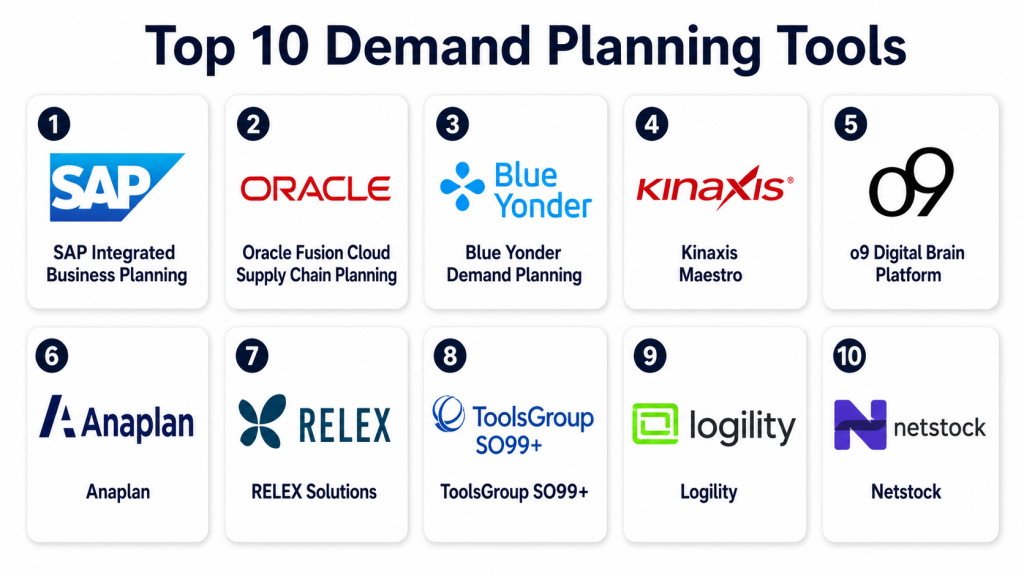
Top 10 Demand Planning Tools
1 — SAP Integrated Business Planning
Short description:
SAP Integrated Business Planning is an enterprise planning platform designed for demand planning, supply planning, inventory optimization, and sales and operations planning. It is especially useful for large organizations already using SAP ERP or SAP supply chain systems. The platform helps teams create forecasts, align demand with supply, and run planning scenarios across departments. It supports complex global planning environments with large data volumes. SAP IBP is best for enterprises that need connected planning across supply chain, finance, sales, and operations.
Key Features
- Demand forecasting and demand sensing
- Sales and operations planning support
- Inventory optimization
- Supply planning and response planning
- Scenario modeling
- Collaboration across business teams
- Integration with SAP ecosystem
Pros
- Strong enterprise planning depth
- Good fit for SAP-based organizations
- Supports end-to-end supply chain planning
Cons
- Can be complex for smaller teams
- Implementation may require strong SAP expertise
- Pricing is not publicly stated
Platforms / Deployment
Web / Cloud / Hybrid / Varies
Security & Compliance
SSO/SAML, MFA, encryption, audit logs, RBAC, SOC 2, ISO 27001, GDPR, HIPAA: Not publicly stated.
Integrations & Ecosystem
SAP IBP works best when connected with ERP, supply chain, finance, and sales systems for complete planning visibility.
- SAP ERP and SAP S/4HANA
- Data warehouse systems
- BI and analytics tools
- CRM systems
- Procurement platforms
- Supply chain execution systems
Support & Community
SAP provides enterprise support, documentation, implementation partners, training, and customer success services. Support quality depends on license type, partner involvement, and implementation scope.
2 — Oracle Fusion Cloud Supply Chain Planning
Short description:
Oracle Fusion Cloud Supply Chain Planning helps businesses manage demand planning, supply planning, sales and operations planning, inventory planning, and production planning. It is designed for organizations that want a cloud-based planning system connected with Oracle ERP and business applications. The platform supports forecasting, scenario planning, and cross-functional collaboration. It is suitable for enterprises with complex supply chains, multiple regions, and large planning datasets. Oracle is a strong option for companies already using Oracle Cloud applications.
Key Features
- Demand management
- Supply planning
- Sales and operations planning
- Inventory optimization
- Predictive analytics
- Scenario planning
- Oracle ecosystem integration
Pros
- Strong cloud-based enterprise planning platform
- Good fit for Oracle ERP customers
- Supports end-to-end supply chain planning
Cons
- May require implementation support
- Best value comes within Oracle ecosystem
- Pricing is not publicly stated
Platforms / Deployment
Web / Cloud
Security & Compliance
SSO/SAML, MFA, encryption, audit logs, RBAC, SOC 2, ISO 27001, GDPR, HIPAA: Not publicly stated.
Integrations & Ecosystem
Oracle Supply Chain Planning connects well with Oracle applications and broader enterprise systems.
- Oracle ERP Cloud
- Oracle SCM Cloud
- Finance systems
- Procurement platforms
- BI tools
- External data sources
Support & Community
Oracle provides enterprise support, documentation, training, partner services, and customer success resources. Support levels depend on subscription and implementation model.
3 — Blue Yonder Demand Planning
Short description:
Blue Yonder Demand Planning is built for companies that need advanced forecasting, demand sensing, AI-driven planning, and supply chain optimization. It supports retailers, manufacturers, CPG companies, and distribution businesses managing large product portfolios. The platform helps planners improve forecast accuracy, manage exceptions, and align demand with inventory and supply. It is useful for businesses facing high demand variability and multi-channel complexity. Blue Yonder is best for companies that need advanced planning intelligence and supply chain depth.
Key Features
- AI and machine learning forecasting
- Demand sensing
- Exception-based planning
- Scenario modeling
- Inventory planning support
- Multi-channel demand planning
- Supply chain planning integration
Pros
- Strong AI-based planning capability
- Good fit for retail, CPG, and complex supply chains
- Helps planners focus on exceptions
Cons
- May require advanced planning maturity
- Implementation can be detailed
- Pricing is not publicly stated
Platforms / Deployment
Web / Cloud / Hybrid / Varies
Security & Compliance
SSO/SAML, MFA, encryption, audit logs, RBAC, SOC 2, ISO 27001, GDPR, HIPAA: Not publicly stated.
Integrations & Ecosystem
Blue Yonder connects demand planning with inventory, supply chain, retail, and operational planning systems.
- ERP systems
- WMS and TMS platforms
- Retail POS systems
- Inventory systems
- BI platforms
- External demand signal sources
Support & Community
Blue Yonder provides enterprise implementation, training, documentation, customer support, and consulting services. Support depends on selected products and contract scope.
4 — Kinaxis Maestro
Short description:
Kinaxis Maestro is a supply chain planning platform designed for concurrent planning, demand planning, supply planning, and scenario analysis. It helps companies understand demand changes and their impact across supply, inventory, capacity, and financial plans. The platform is suitable for manufacturers, life sciences companies, automotive businesses, electronics companies, and global supply chain teams. It is strong for organizations that need fast planning decisions across connected functions. Kinaxis is best for companies that want demand planning connected with real-time supply chain response.
Key Features
- Demand planning
- Concurrent planning
- Demand sensing
- Scenario analysis
- Supply chain risk visibility
- Collaboration workflows
- AI and advanced analytics support
Pros
- Strong for fast scenario planning
- Useful for complex global supply chains
- Connects demand planning with supply impact
Cons
- May be more advanced than small businesses need
- Requires strong data and process readiness
- Pricing is not publicly stated
Platforms / Deployment
Web / Cloud / Varies
Security & Compliance
SSO/SAML, MFA, encryption, audit logs, RBAC, SOC 2, ISO 27001, GDPR, HIPAA: Not publicly stated.
Integrations & Ecosystem
Kinaxis integrates with enterprise planning, ERP, supply chain, and analytics environments.
- ERP systems
- Supply planning systems
- Inventory platforms
- Data warehouses
- BI tools
- External signal data sources
Support & Community
Kinaxis provides enterprise support, onboarding, customer education, and implementation services. Support levels depend on contract scope and deployment complexity.
5 — o9 Digital Brain Platform
Short description:
o9 Digital Brain Platform is an AI-driven planning platform that supports demand planning, supply planning, integrated business planning, revenue growth planning, and scenario modeling. It is designed for enterprises that want to connect planning decisions across commercial, supply chain, finance, and operations teams. The platform uses data modeling and AI to help teams understand demand drivers and plan more effectively. It is suitable for CPG, retail, manufacturing, and large global businesses. o9 is best for organizations that want a modern, highly connected planning environment.
Key Features
- AI-driven demand forecasting
- Integrated business planning
- Scenario planning
- Demand sensing
- Revenue and commercial planning
- Knowledge graph-style planning model
- Cross-functional collaboration
Pros
- Strong connected planning approach
- Useful for complex enterprise planning
- Supports AI-based insights and scenario modeling
Cons
- Requires strong implementation planning
- May be too broad for simple demand forecasting
- Pricing is not publicly stated
Platforms / Deployment
Web / Cloud / Varies
Security & Compliance
SSO/SAML, MFA, encryption, audit logs, RBAC, SOC 2, ISO 27001, GDPR, HIPAA: Not publicly stated.
Integrations & Ecosystem
o9 connects demand planning with enterprise data, commercial planning, supply chain systems, and analytics.
- ERP systems
- CRM platforms
- Retail and POS data
- Supply chain systems
- Finance tools
- Data lakes and BI platforms
Support & Community
o9 provides enterprise onboarding, implementation support, documentation, and customer success resources. Support levels depend on project scope and customer agreement.
6 — Anaplan
Short description:
Anaplan is a connected planning platform used for demand planning, financial planning, workforce planning, sales planning, and supply chain planning. It is useful for companies that want flexible planning models across departments. Demand planning teams can use Anaplan to build forecasts, align assumptions, connect finance and operations, and run scenario-based planning. The platform is especially valuable when planning needs are cross-functional and customized. Anaplan is best for organizations that need flexible modeling rather than only a prebuilt demand planning tool.
Key Features
- Connected planning models
- Demand forecasting workflows
- Scenario planning
- Sales and operations planning
- Financial and supply chain alignment
- Custom planning applications
- Collaboration and workflow management
Pros
- Highly flexible planning model
- Strong for cross-functional collaboration
- Useful beyond demand planning alone
Cons
- Requires model-building expertise
- Not always as preconfigured as specialist tools
- Pricing is not publicly stated
Platforms / Deployment
Web / Cloud
Security & Compliance
SSO/SAML, MFA, encryption, audit logs, RBAC, SOC 2, ISO 27001, GDPR, HIPAA: Not publicly stated.
Integrations & Ecosystem
Anaplan connects planning data across finance, sales, supply chain, HR, and operations teams.
- ERP systems
- CRM systems
- Data warehouses
- BI platforms
- Finance tools
- Supply chain systems
Support & Community
Anaplan provides training, documentation, implementation partners, and customer support. Its broader planning community is stronger than many niche planning platforms.
7 — RELEX Solutions
Short description:
RELEX Solutions is a retail and supply chain planning platform focused on demand forecasting, replenishment, workforce planning, inventory optimization, and retail operations. It is especially strong for retailers, grocery businesses, wholesalers, and consumer goods companies that need accurate demand forecasts across stores, products, and channels. The platform helps reduce stockouts, control waste, improve availability, and automate replenishment decisions. RELEX is useful for businesses managing high SKU complexity and fast-changing customer demand. It is best for retail-focused demand and inventory planning.
Key Features
- Demand forecasting
- Automated replenishment
- Inventory optimization
- Promotion forecasting
- Retail planning support
- Fresh food and waste reduction planning
- Workforce planning support
Pros
- Strong for retail and grocery demand planning
- Useful for inventory and replenishment automation
- Helps reduce waste and stockouts
Cons
- May be less suitable for non-retail industries
- Implementation depends on good product and store data
- Pricing is not publicly stated
Platforms / Deployment
Web / Cloud / Varies
Security & Compliance
SSO/SAML, MFA, encryption, audit logs, RBAC, SOC 2, ISO 27001, GDPR, HIPAA: Not publicly stated.
Integrations & Ecosystem
RELEX connects demand forecasting with replenishment, retail operations, workforce, and inventory systems.
- ERP systems
- POS systems
- Inventory platforms
- Retail planning tools
- Workforce systems
- BI and reporting tools
Support & Community
RELEX provides implementation support, training, customer success, and retail planning expertise. Support depends on deployment size, region, and selected modules.
8 — ToolsGroup SO99+
Short description:
ToolsGroup SO99+ is a demand planning and supply chain optimization platform focused on forecasting, inventory optimization, service level planning, and replenishment. It is useful for companies that want to improve forecast accuracy while balancing inventory investment and customer service levels. The platform supports demand uncertainty, intermittent demand, and complex product portfolios. It is suitable for distributors, manufacturers, retailers, and service parts businesses. ToolsGroup is best for organizations that need demand planning connected with inventory optimization.
Key Features
- Demand forecasting
- Inventory optimization
- Service level planning
- Replenishment planning
- Demand uncertainty modeling
- Multi-echelon inventory support
- Exception-based planning
Pros
- Strong inventory and service level optimization
- Useful for complex and intermittent demand
- Good fit for distribution and manufacturing
Cons
- May require planning expertise to configure well
- User experience should be evaluated during demo
- Pricing is not publicly stated
Platforms / Deployment
Web / Cloud / Hybrid / Varies
Security & Compliance
SSO/SAML, MFA, encryption, audit logs, RBAC, SOC 2, ISO 27001, GDPR, HIPAA: Not publicly stated.
Integrations & Ecosystem
ToolsGroup connects demand planning with inventory, replenishment, ERP, and supply chain execution systems.
- ERP systems
- Inventory management platforms
- WMS systems
- Procurement systems
- BI tools
- Supply chain planning tools
Support & Community
ToolsGroup provides implementation support, documentation, training, and customer services. Support levels depend on modules, region, and customer agreement.
9 — Logility
Short description:
Logility is a supply chain planning platform that supports demand planning, inventory optimization, supply planning, lifecycle planning, and integrated business planning. It is designed for companies that need better visibility across demand, inventory, supply, and financial planning. The platform is useful for retail, consumer goods, manufacturing, distribution, and apparel businesses. Logility helps planners improve forecast quality, collaborate across functions, and manage exceptions. It is best for businesses that want a balanced supply chain planning suite with demand planning depth.
Key Features
- Demand planning
- Inventory optimization
- Supply planning
- Lifecycle planning
- Sales and operations planning
- Exception management
- Analytics and reporting
Pros
- Balanced demand and supply planning features
- Useful across multiple industries
- Strong fit for planning teams moving beyond spreadsheets
Cons
- Implementation effort depends on process complexity
- Advanced use may require training
- Pricing is not publicly stated
Platforms / Deployment
Web / Cloud / Hybrid / Varies
Security & Compliance
SSO/SAML, MFA, encryption, audit logs, RBAC, SOC 2, ISO 27001, GDPR, HIPAA: Not publicly stated.
Integrations & Ecosystem
Logility connects planning workflows with ERP, inventory, supply chain, and analytics systems.
- ERP systems
- WMS platforms
- Inventory tools
- Finance systems
- BI platforms
- Supplier and customer data sources
Support & Community
Logility provides vendor-led support, onboarding, documentation, and planning expertise. Support levels depend on customer size and implementation scope.
10 — Netstock
Short description:
Netstock is a demand planning and inventory planning platform designed mainly for small and mid-sized businesses that need better forecasting and stock control without heavy enterprise complexity. It helps businesses identify stock risks, create demand forecasts, manage inventory investment, and improve service levels. The platform is useful for distributors, wholesalers, manufacturers, and inventory-heavy businesses that have outgrown spreadsheets. Netstock is especially practical for teams that need quick visibility into excess stock, stockouts, and replenishment needs. It is best for SMB and mid-market companies looking for faster adoption.
Key Features
- Demand forecasting
- Inventory optimization
- Replenishment planning
- Stockout and excess stock alerts
- Supplier planning support
- Planning dashboards
- ERP integration support
Pros
- Good fit for SMB and mid-market businesses
- Easier to adopt than many enterprise platforms
- Strong inventory visibility and planning alerts
Cons
- May not match enterprise suite depth
- Advanced scenario planning may be limited compared with larger tools
- Pricing is not publicly stated
Platforms / Deployment
Web / Cloud / Varies
Security & Compliance
SSO/SAML, MFA, encryption, audit logs, RBAC, SOC 2, ISO 27001, GDPR, HIPAA: Not publicly stated.
Integrations & Ecosystem
Netstock connects demand planning with ERP and inventory systems to help businesses make better replenishment decisions.
- ERP systems
- Inventory management tools
- Supplier data
- Sales history data
- Reporting dashboards
- Purchasing workflows
Support & Community
Netstock provides onboarding, support, training, and implementation assistance. Support is generally focused on helping SMB and mid-market customers improve inventory planning adoption.
Comparison Table
| Tool Name | Best For | Platform(s) Supported | Deployment | Standout Feature | Public Rating |
|---|---|---|---|---|---|
| SAP Integrated Business Planning | Large enterprises using SAP ecosystem | Web | Cloud / Hybrid | End-to-end integrated business planning | N/A |
| Oracle Fusion Cloud Supply Chain Planning | Oracle-based enterprises | Web | Cloud | Cloud-based demand and supply planning | N/A |
| Blue Yonder Demand Planning | Retail, CPG, and complex supply chains | Web | Cloud / Hybrid | AI-based demand forecasting and sensing | N/A |
| Kinaxis Maestro | Fast scenario planning and supply chain response | Web | Cloud | Concurrent planning across demand and supply | N/A |
| o9 Digital Brain Platform | Enterprise AI-driven planning | Web | Cloud | Connected planning and AI scenario modeling | N/A |
| Anaplan | Cross-functional planning teams | Web | Cloud | Flexible connected planning models | N/A |
| RELEX Solutions | Retail and grocery demand planning | Web | Cloud | Retail forecasting and replenishment automation | N/A |
| ToolsGroup SO99+ | Inventory-heavy businesses | Web | Cloud / Hybrid | Demand uncertainty and inventory optimization | N/A |
| Logility | Mid-market and enterprise supply chain planning | Web | Cloud / Hybrid | Balanced demand, inventory, and supply planning | N/A |
| Netstock | SMB and mid-market inventory planning | Web | Cloud | Practical forecasting and stock visibility | N/A |
Evaluation & Scoring of Demand Planning Tools
| Tool Name | Core (25%) | Ease (15%) | Integrations (15%) | Security (10%) | Performance (10%) | Support (10%) | Value (15%) | Weighted Total (0–10) |
|---|---|---|---|---|---|---|---|---|
| SAP Integrated Business Planning | 10 | 7 | 10 | 7 | 9 | 9 | 7 | 8.65 |
| Oracle Fusion Cloud Supply Chain Planning | 9 | 7 | 9 | 7 | 9 | 8 | 7 | 8.25 |
| Blue Yonder Demand Planning | 9 | 7 | 9 | 7 | 9 | 8 | 7 | 8.25 |
| Kinaxis Maestro | 9 | 8 | 9 | 7 | 9 | 8 | 8 | 8.55 |
| o9 Digital Brain Platform | 9 | 7 | 9 | 7 | 9 | 8 | 7 | 8.25 |
| Anaplan | 8 | 8 | 9 | 7 | 8 | 8 | 8 | 8.10 |
| RELEX Solutions | 9 | 8 | 8 | 7 | 9 | 8 | 8 | 8.35 |
| ToolsGroup SO99+ | 8 | 7 | 8 | 6 | 8 | 8 | 8 | 7.65 |
| Logility | 8 | 8 | 8 | 6 | 8 | 8 | 8 | 7.80 |
| Netstock | 7 | 9 | 7 | 6 | 8 | 8 | 9 | 7.75 |
These scores are comparative and should be used as a shortlist guide, not a final buying decision. A higher score does not automatically mean the tool is best for every company. Enterprise teams may value integration depth and advanced planning, while SMBs may value simplicity and faster adoption. Security scores are conservative where public certification details are not clearly stated. Buyers should validate integrations, implementation effort, data requirements, and support quality before purchase.
Which Demand Planning Tool Is Right for You?
Solo / Freelancer
Solo consultants, independent planners, and small advisory teams usually do not need a heavy enterprise demand planning suite. Their needs are often focused on forecast modeling, reporting, analysis, and client planning support.
Anaplan may be useful for consultants who build custom planning models, while Netstock may be useful when supporting SMB inventory planning. For very small projects, a spreadsheet-based model may still be enough if the data volume is limited.
SMB
Small and mid-sized businesses need tools that are practical, easy to adopt, and strong enough to replace spreadsheet-heavy forecasting. They usually need stock visibility, sales forecasting, replenishment support, and clear planning dashboards.
Netstock, Logility, ToolsGroup, and RELEX may be good options depending on the industry. SMB buyers should focus on ease of use, ERP integration, inventory alerts, forecasting accuracy, and support quality.
Mid-Market
Mid-market companies usually need stronger forecasting, better collaboration, inventory optimization, and integration with ERP, sales, finance, and supply chain systems. These companies may have multiple warehouses, channels, regions, and product categories.
Kinaxis, Anaplan, Logility, ToolsGroup, RELEX, and Blue Yonder can be suitable depending on planning complexity. Mid-market teams should evaluate scenario planning, forecasting automation, exception management, and data integration depth.
Enterprise
Large enterprises need scalable demand planning that connects global sales, supply chain, finance, procurement, manufacturing, and inventory decisions. They often require advanced AI, scenario planning, security controls, governance, and integration with large ERP environments.
SAP IBP, Oracle Supply Chain Planning, Blue Yonder, Kinaxis, o9, and Anaplan are strong enterprise options. Enterprise buyers should prioritize scalability, governance, global planning models, implementation partner availability, and long-term platform fit.
Budget vs Premium
Budget-focused buyers should avoid choosing a complex enterprise platform if their main pain is basic inventory visibility or forecast automation. Netstock, Logility, or ToolsGroup may be more practical depending on business size.
Premium buyers should consider SAP IBP, Oracle, Blue Yonder, Kinaxis, o9, or Anaplan when they need enterprise planning depth, global scalability, advanced analytics, and cross-functional collaboration.
Feature Depth vs Ease of Use
Feature-rich tools provide more planning power but often require more implementation effort. SAP IBP, Oracle, Blue Yonder, Kinaxis, and o9 are strong for complex planning environments.
For easier adoption, Netstock, RELEX, Logility, and Anaplan may be more approachable depending on the team’s skills and planning needs.
Integrations & Scalability
Demand planning tools must connect with ERP, CRM, POS, WMS, TMS, finance, inventory, procurement, and analytics systems. Integration should be reviewed early because poor data flow can reduce forecast quality.
Scalability should be judged by:
- Number of SKUs
- Number of locations
- Number of sales channels
- Forecast frequency
- Data volume
- User roles
- Regions and currencies
- Planning hierarchy complexity
Security & Compliance Needs
Demand planning platforms may store sensitive sales, inventory, customer, supplier, and financial data. Buyers should review security before selection.
Important questions include:
- Does the tool support SSO and MFA?
- Are audit logs available?
- Can roles and permissions be controlled?
- Is data encrypted?
- Where is data hosted?
- What backup and recovery processes exist?
- Can the vendor provide security documentation?
- How does the tool manage data governance?
If security certifications are not publicly stated, buyers should request documentation directly from the vendor.
Frequently Asked Questions
1. What are demand planning tools?
Demand planning tools help businesses forecast future demand using sales history, market signals, seasonality, promotions, and planning assumptions. They support better decisions for inventory, production, purchasing, and supply chain operations.
2. Who uses demand planning software?
Demand planning software is used by demand planners, supply chain managers, inventory teams, finance teams, sales operations, procurement teams, manufacturers, retailers, distributors, and e-commerce companies.
3. How much does demand planning software cost?
Pricing is usually not publicly stated because it depends on business size, number of users, modules, integrations, data volume, implementation services, and support requirements. Most enterprise vendors provide custom quotes.
4. How long does implementation usually take?
Implementation depends on data quality, ERP integration, planning complexity, number of users, and business process maturity. Smaller deployments can be faster, while enterprise rollouts may require phased implementation and change management.
5. What are common mistakes when choosing a demand planning tool?
Common mistakes include choosing software without cleaning data, ignoring ERP integration, relying only on AI without planner review, skipping user training, and not defining clear forecast accuracy goals before implementation.
6. Can demand planning tools improve forecast accuracy?
Yes, demand planning tools can improve forecast accuracy by using statistical models, machine learning, historical sales, external signals, and planner collaboration. Results depend on data quality, process discipline, and proper adoption.
7. Do these tools replace demand planners?
No, they usually do not replace demand planners. They reduce manual work, highlight exceptions, and improve forecast quality, but human planners are still needed for business judgment, promotions, market context, and scenario decisions.
8. Can demand planning software integrate with ERP systems?
Yes, most demand planning tools support ERP integration, but integration depth varies. Buyers should confirm supported ERP systems, API options, data refresh frequency, master data requirements, and implementation support.
9. Is cloud-based demand planning software safe?
Cloud-based demand planning software can be safe when it includes strong access control, encryption, audit logs, backup processes, and secure hosting. Buyers should request security documentation from vendors before final selection.
10. What is the best alternative to demand planning software?
For very small businesses, spreadsheets may work temporarily. However, as product count, sales channels, inventory complexity, and planning frequency grow, dedicated demand planning software becomes more reliable and scalable.
Conclusion
Demand planning tools help businesses forecast demand more accurately, reduce stockouts, avoid excess inventory, improve supply chain coordination, and make better financial decisions. The best platform depends on company size, industry, planning maturity, data quality, integration needs, and budget. SAP IBP, Oracle, Blue Yonder, Kinaxis, and o9 are strong choices for large enterprises with complex supply chains. Anaplan is valuable for flexible connected planning, while RELEX, ToolsGroup, Logility, and Netstock can be practical for retail, inventory-heavy, mid-market, and SMB use cases. A smart is to shortlist two or three tools, test them with real demand data, validate ERP integrations, review security controls, and run a pilot before making the final decision.
