Upgrade & Secure Your Future with DevOps, SRE, DevSecOps, MLOps!
We spend hours scrolling social media and waste money on things we forget, but won’t spend 30 minutes a day earning certifications that can change our lives.
Master in DevOps, SRE, DevSecOps & MLOps by DevOps School!
Learn from Guru Rajesh Kumar and double your salary in just one year.
Introduction
Sourcing & RFX platforms help procurement teams manage supplier selection, competitive bidding, proposal collection, quote comparison, e-auctions, and sourcing decisions in one structured system. In simple words, these tools help companies ask suppliers for information, proposals, or pricing, compare responses fairly, and choose the right supplier based on cost, quality, risk, compliance, and business value.
These platforms matter more now because procurement teams are under pressure to reduce costs, improve supplier transparency, manage risk, control compliance, and make sourcing decisions faster. Manual email-based sourcing often creates confusion, missing documents, inconsistent supplier responses, and weak audit trails.
Common use cases include RFIs, RFPs, RFQs, supplier prequalification, reverse auctions, category sourcing, bid comparison, vendor evaluation, contract handoff, and procurement approvals.
Buyers should evaluate:
- RFI, RFP, and RFQ workflow depth
- Supplier portal experience
- E-auction capability
- Bid comparison and scoring tools
- Approval workflows
- Contract and procurement integrations
- Supplier risk and compliance features
- Reporting and audit trails
- Ease of use for suppliers and buyers
- Scalability across categories and regions
Best for: Procurement teams, sourcing managers, category managers, supply chain leaders, vendor management teams, finance teams, public procurement teams, manufacturing companies, retailers, healthcare organizations, financial institutions, and enterprises with recurring sourcing events.
Not ideal for: Very small businesses with only a few suppliers, teams that source rarely, or companies that only need basic purchase order processing without competitive bidding, supplier evaluation, or sourcing governance.
Key Trends in Sourcing & RFX Platforms
- AI-assisted sourcing is becoming more practical as platforms help teams draft RFP questions, summarize supplier responses, identify risk signals, and recommend evaluation criteria.
- Supplier collaboration is becoming more structured because sourcing teams need cleaner communication, centralized Q&A, controlled document sharing, and better supplier participation.
- E-auctions are being used more strategically for categories where pricing competition, transparency, and quick negotiation cycles can create measurable savings.
- Risk-aware sourcing is becoming essential as procurement teams evaluate not only price but also supplier stability, compliance, cybersecurity, delivery risk, ESG, and regional exposure.
- Integrated source-to-pay platforms are growing because companies want sourcing data to flow into contracts, supplier management, purchase orders, invoices, and spend analytics.
- Cloud-based sourcing is now the default choice for many teams because it supports global suppliers, distributed procurement teams, faster rollouts, and easier collaboration.
- Auditability and compliance are becoming bigger buying factors especially for public sector, healthcare, financial services, manufacturing, and regulated procurement environments.
- Scenario-based bid evaluation is increasing as teams compare suppliers by total cost, risk, service levels, contract terms, sustainability, and long-term value.
- Supplier diversity and ESG criteria are being added to RFX events as organizations need better tracking of responsible sourcing and supplier inclusion goals.
- Integration with ERP, contracts, and supplier management systems is critical because sourcing decisions should not remain isolated from downstream procurement execution.
How We Selected These Tools
The tools in this list were selected using practical sourcing and procurement software evaluation factors, including:
- Market recognition in sourcing, RFX, procurement, and source-to-pay software
- Feature completeness across RFIs, RFPs, RFQs, e-auctions, supplier evaluation, and award workflows
- Suitability for enterprise, mid-market, public procurement, and category sourcing teams
- Ability to support supplier collaboration, controlled Q&A, bid comparison, and scoring
- Integration potential with ERP, contract lifecycle management, supplier management, finance, and procurement systems
- Strength of workflow automation, approvals, audit trails, and governance
- Practical support for sourcing templates, event libraries, and repeatable procurement processes
- Vendor maturity and procurement domain experience
- Scalability across regions, categories, suppliers, and business units
- Fit for industries such as manufacturing, retail, healthcare, government, logistics, financial services, and technology
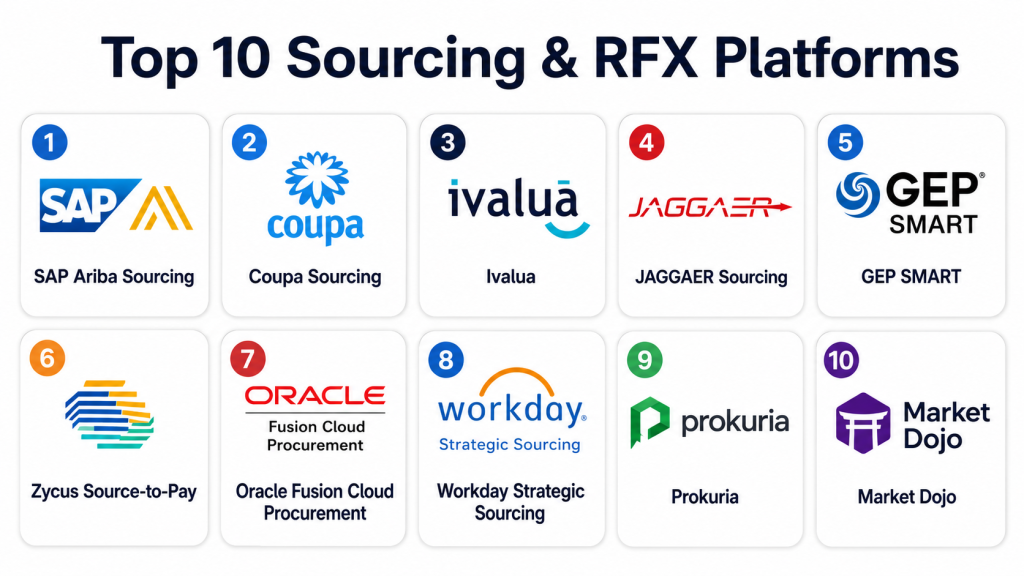
Top 10 Sourcing & RFX Platforms
1 — SAP Ariba Sourcing
Short description:
SAP Ariba Sourcing is an enterprise sourcing platform designed to help procurement teams manage RFIs, RFPs, RFQs, auctions, supplier collaboration, and sourcing decisions. It is especially useful for large organizations already using SAP systems or SAP Ariba procurement workflows. The platform supports structured sourcing events, supplier responses, bid evaluation, and award management. It helps procurement teams improve transparency, governance, and supplier competition. SAP Ariba Sourcing is best for enterprises that need sourcing connected with supplier management, contracts, procurement, and spend visibility.
Key Features
- RFI, RFP, and RFQ event management
- E-auction and competitive bidding support
- Supplier collaboration portal
- Bid comparison and scoring
- Sourcing templates and workflows
- Integration with SAP procurement ecosystem
- Audit trails and approval workflows
Pros
- Strong enterprise sourcing and procurement ecosystem
- Good fit for large SAP-based organizations
- Supports structured, repeatable sourcing processes
Cons
- Can be complex for smaller businesses
- Implementation may require SAP expertise
- Pricing is not publicly stated
Platforms / Deployment
Web / Cloud / Hybrid / Varies
Security & Compliance
SSO/SAML, MFA, encryption, audit logs, RBAC, SOC 2, ISO 27001, GDPR, HIPAA: Not publicly stated.
Integrations & Ecosystem
SAP Ariba Sourcing works best when connected with SAP procurement, supplier management, contract management, and ERP systems.
- SAP ERP and SAP S/4HANA
- SAP Ariba Supplier Management
- SAP Ariba Contracts
- Procurement and invoicing systems
- Spend analytics tools
- Supplier risk platforms
Support & Community
SAP provides enterprise support, implementation partners, documentation, training, and customer success resources. Support quality depends on license type, deployment scope, and partner involvement.
2 — Coupa Sourcing
Short description:
Coupa Sourcing is part of Coupa’s broader business spend management platform and supports sourcing events, RFX workflows, auctions, supplier collaboration, and award decisions. It is useful for procurement teams that want sourcing connected with spend management, contracts, procurement, and supplier data. The platform helps teams run structured sourcing events and compare supplier responses more efficiently. Coupa Sourcing is suitable for mid-market and enterprise organizations. It is best for companies that want sourcing to connect directly with procurement execution and spend visibility.
Key Features
- RFI, RFP, and RFQ management
- Auction and negotiation workflows
- Supplier response collection
- Bid comparison and evaluation
- Event templates and approval workflows
- Spend management integration
- Supplier collaboration tools
Pros
- Strong connection with spend management workflows
- Useful for sourcing automation and visibility
- Good fit for procurement teams using Coupa ecosystem
Cons
- Best value comes within the Coupa platform
- Advanced customization may require support
- Pricing is not publicly stated
Platforms / Deployment
Web / Cloud / Varies
Security & Compliance
SSO/SAML, MFA, encryption, audit logs, RBAC, SOC 2, ISO 27001, GDPR, HIPAA: Not publicly stated.
Integrations & Ecosystem
Coupa Sourcing connects sourcing activity with supplier management, contracts, procurement, finance, and analytics.
- ERP systems
- Coupa procurement modules
- Contract lifecycle tools
- Supplier management systems
- Finance and AP systems
- Spend analytics platforms
Support & Community
Coupa provides onboarding, documentation, support services, training, and implementation partner resources. Support levels depend on subscription and customer agreement.
3 — Ivalua
Short description:
Ivalua is a source-to-pay platform with strong sourcing and RFX capabilities across supplier selection, sourcing events, auctions, supplier collaboration, contracts, procurement, and spend analytics. It is designed for organizations that need flexible and configurable sourcing workflows. The platform supports complex category sourcing, supplier evaluation, compliance checks, and award decisions. Ivalua is suitable for mid-market and enterprise procurement teams. It is best for organizations that want sourcing, supplier management, contracts, and procurement in one connected platform.
Key Features
- RFI, RFP, and RFQ workflows
- Supplier evaluation and scoring
- E-auction support
- Contract and sourcing integration
- Supplier collaboration portal
- Workflow automation
- Spend and category analytics
Pros
- Strong source-to-pay coverage
- Flexible configuration for complex sourcing needs
- Good supplier lifecycle and sourcing connection
Cons
- Configuration may require skilled implementation
- Can be broad for teams needing only simple RFX
- Pricing is not publicly stated
Platforms / Deployment
Web / Cloud / Varies
Security & Compliance
SSO/SAML, MFA, encryption, audit logs, RBAC, SOC 2, ISO 27001, GDPR, HIPAA: Not publicly stated.
Integrations & Ecosystem
Ivalua integrates sourcing with supplier management, contracts, procurement, invoicing, analytics, and ERP systems.
- ERP systems
- Contract management tools
- Supplier management systems
- Finance and AP platforms
- Risk and compliance data sources
- BI and reporting tools
Support & Community
Ivalua provides implementation support, customer success, documentation, training, and partner services. Support depends on project size, customer agreement, and selected modules.
4 — JAGGAER Sourcing
Short description:
JAGGAER Sourcing supports strategic sourcing, RFX events, supplier collaboration, auctions, category management, and procurement governance. It is suitable for organizations that manage complex sourcing categories, regulated procurement workflows, and supplier evaluation processes. The platform is used by procurement teams in industries such as manufacturing, education, healthcare, public sector, and life sciences. It helps teams standardize sourcing activity and improve transparency across supplier selection. JAGGAER Sourcing is best for organizations that need sourcing depth within a broader procurement suite.
Key Features
- RFI, RFP, and RFQ event management
- E-auction capabilities
- Supplier collaboration workflows
- Category sourcing support
- Supplier scoring and evaluation
- Approval and governance workflows
- Integration with procurement and supplier management modules
Pros
- Strong fit for complex and regulated sourcing environments
- Useful for category-based sourcing teams
- Supports supplier collaboration and governance
Cons
- May require process design before rollout
- User experience depends on configuration
- Pricing is not publicly stated
Platforms / Deployment
Web / Cloud / Varies
Security & Compliance
SSO/SAML, MFA, encryption, audit logs, RBAC, SOC 2, ISO 27001, GDPR, HIPAA: Not publicly stated.
Integrations & Ecosystem
JAGGAER connects sourcing with supplier management, contracts, procurement, analytics, and ERP environments.
- ERP systems
- Supplier management modules
- Contract lifecycle platforms
- Finance and AP systems
- Spend analytics tools
- Risk and compliance data sources
Support & Community
JAGGAER provides enterprise support, implementation services, training, documentation, and customer success resources. Support depends on selected modules and contract scope.
5 — GEP SMART
Short description:
GEP SMART is a unified source-to-pay platform that includes sourcing, RFX management, auctions, supplier management, contracts, procurement, and spend analytics. It helps procurement teams run competitive sourcing events, collect supplier responses, compare bids, and connect awards with downstream procurement workflows. The platform is suitable for mid-market and enterprise organizations looking to improve procurement maturity. It is especially useful when sourcing needs to work closely with supplier data, spend visibility, and contract management. GEP SMART is best for teams seeking a unified procurement transformation platform.
Key Features
- RFI, RFP, and RFQ management
- E-auction support
- Supplier collaboration
- Bid comparison and scoring
- Source-to-pay workflow integration
- Spend analytics
- Contract and procurement handoff
Pros
- Unified sourcing and procurement workflow
- Strong for procurement transformation programs
- Useful for connecting sourcing with spend analytics
Cons
- May be broad for teams needing only lightweight RFX
- Implementation planning is important
- Pricing is not publicly stated
Platforms / Deployment
Web / Cloud / Varies
Security & Compliance
SSO/SAML, MFA, encryption, audit logs, RBAC, SOC 2, ISO 27001, GDPR, HIPAA: Not publicly stated.
Integrations & Ecosystem
GEP SMART connects sourcing events with supplier management, procurement, contracts, finance, and reporting systems.
- ERP systems
- Contract management tools
- Supplier management systems
- Finance and AP platforms
- Spend analytics systems
- Reporting dashboards
Support & Community
GEP provides implementation services, procurement consulting, support, training, and customer success resources. Support levels depend on customer needs and engagement scope.
6 — Zycus Source-to-Pay
Short description:
Zycus Source-to-Pay includes sourcing and RFX capabilities along with supplier management, contract management, procurement, and spend analytics. It helps teams create sourcing events, invite suppliers, collect responses, evaluate bids, manage approvals, and track sourcing outcomes. Zycus is suitable for procurement teams that want structured sourcing workflows with broader procurement automation. It can be useful for mid-sized and large organizations looking to improve sourcing transparency. Zycus is best for teams that need RFX tools connected with supplier and spend data.
Key Features
- RFX event management
- Supplier response collection
- E-auction support
- Bid comparison and scoring
- Supplier and contract integration
- Workflow automation
- Spend analytics
Pros
- Good fit for procurement automation
- Supports structured sourcing and evaluation
- Connects sourcing with supplier and contract workflows
Cons
- Best value comes within Zycus ecosystem
- Advanced setup may need implementation assistance
- Pricing is not publicly stated
Platforms / Deployment
Web / Cloud / Varies
Security & Compliance
SSO/SAML, MFA, encryption, audit logs, RBAC, SOC 2, ISO 27001, GDPR, HIPAA: Not publicly stated.
Integrations & Ecosystem
Zycus connects RFX workflows with procurement, supplier management, contracts, finance, and analytics.
- ERP systems
- Zycus supplier management
- Contract lifecycle tools
- Spend analytics platforms
- Finance and AP systems
- Supplier risk data sources
Support & Community
Zycus provides onboarding, support, training, documentation, and customer success resources. Support depends on modules selected and implementation complexity.
7 — Oracle Fusion Cloud Procurement
Short description:
Oracle Fusion Cloud Procurement supports sourcing, supplier negotiation, supplier qualification, purchasing, contracts, and procurement analytics within Oracle’s enterprise cloud ecosystem. It is a strong option for organizations already using Oracle ERP or Oracle Cloud business applications. The platform helps procurement teams manage sourcing events, supplier responses, negotiation rounds, and award decisions. It is suitable for enterprises that need sourcing connected with finance, procurement, supplier records, and approvals. Oracle Fusion Cloud Procurement is best for Oracle-centered procurement environments.
Key Features
- Sourcing event management
- Supplier negotiation workflows
- Supplier qualification support
- Purchasing and procurement integration
- Contract and approval workflows
- Supplier collaboration
- Oracle ERP and analytics connection
Pros
- Strong fit for Oracle-based enterprises
- Connects sourcing with finance and procurement
- Scalable for large organizations
Cons
- Best value depends on Oracle ecosystem fit
- Implementation may require Oracle expertise
- Pricing is not publicly stated
Platforms / Deployment
Web / Cloud
Security & Compliance
SSO/SAML, MFA, encryption, audit logs, RBAC, SOC 2, ISO 27001, GDPR, HIPAA: Not publicly stated.
Integrations & Ecosystem
Oracle Fusion Cloud Procurement connects sourcing with Oracle ERP, supplier management, finance, purchasing, and analytics.
- Oracle ERP Cloud
- Oracle Procurement Cloud
- Finance systems
- Supplier management workflows
- Contract management tools
- Analytics platforms
Support & Community
Oracle provides enterprise support, documentation, training, implementation partners, and customer resources. Support depends on subscription and service agreement.
8 — Workday Strategic Sourcing
Short description:
Workday Strategic Sourcing helps procurement teams manage sourcing projects, RFPs, supplier collaboration, stakeholder reviews, approvals, and sourcing decisions. It is useful for organizations that want a modern sourcing experience connected with Workday’s broader business platform. The platform helps teams improve sourcing visibility, standardize supplier engagement, and collaborate with internal stakeholders. It is especially useful for services procurement, indirect sourcing, and project-based sourcing events. Workday Strategic Sourcing is best for organizations already using or considering Workday for finance and procurement workflows.
Key Features
- RFP and sourcing project management
- Supplier collaboration
- Stakeholder review workflows
- Proposal comparison
- Contract and procurement handoff
- Approval workflows
- Workday ecosystem connection
Pros
- Clean sourcing collaboration experience
- Good fit for Workday customers
- Useful for indirect and services sourcing
Cons
- May not be as deep in complex auction-heavy sourcing
- Best value depends on Workday ecosystem fit
- Pricing is not publicly stated
Platforms / Deployment
Web / Cloud / Varies
Security & Compliance
SSO/SAML, MFA, encryption, audit logs, RBAC, SOC 2, ISO 27001, GDPR, HIPAA: Not publicly stated.
Integrations & Ecosystem
Workday Strategic Sourcing connects sourcing with finance, procurement, contract workflows, supplier collaboration, and approvals.
- Workday Financial Management
- Procurement systems
- Contract tools
- Supplier data workflows
- Approval workflows
- Reporting dashboards
Support & Community
Workday provides customer support, documentation, training, implementation partners, and customer resources. Support depends on subscription and deployment scope.
9 — Prokuria
Short description:
Prokuria is a sourcing and procurement platform focused on RFQs, RFPs, e-auctions, supplier management, and procurement automation. It is suitable for small and mid-sized companies that want easier sourcing workflows without heavy enterprise complexity. The platform helps teams create sourcing events, invite suppliers, compare quotes, and manage competitive bidding. Prokuria is useful for teams moving away from email and spreadsheet-based sourcing. It is best for organizations that need practical RFX and auction tools with faster adoption.
Key Features
- RFQ and RFP management
- E-auction support
- Supplier management
- Quote comparison
- Procurement workflow automation
- Supplier communication
- Reporting and sourcing visibility
Pros
- Practical for SMB and mid-market sourcing teams
- Easier adoption than many enterprise suites
- Useful for RFQs and e-auctions
Cons
- May not match enterprise platform depth
- Advanced integrations may vary
- Public security certification details are limited
Platforms / Deployment
Web / Cloud / Varies
Security & Compliance
SSO/SAML, MFA, encryption, audit logs, RBAC, SOC 2, ISO 27001, GDPR, HIPAA: Not publicly stated.
Integrations & Ecosystem
Prokuria connects sourcing workflows with supplier data, procurement activity, and reporting needs.
- Supplier databases
- Procurement workflows
- ERP exports or integrations
- Reporting tools
- Contract workflows
- Finance systems
Support & Community
Prokuria provides vendor support, onboarding resources, and product guidance. Support levels depend on subscription plan and customer requirements.
10 — Market Dojo
Short description:
Market Dojo is a sourcing and e-auction platform designed to help procurement teams run RFQs, RFPs, auctions, supplier onboarding, and sourcing events. It is especially useful for teams that want a practical and accessible sourcing tool without the complexity of large enterprise suites. The platform supports competitive bidding, supplier response management, and sourcing project control. Market Dojo is suitable for procurement teams in mid-sized companies, large businesses, and consulting-led sourcing projects. It is best for organizations that need flexible sourcing and auction capability with faster setup.
Key Features
- RFX event management
- E-auction support
- Supplier onboarding tools
- Bid comparison
- Sourcing project workflows
- Supplier communication
- Reporting and event tracking
Pros
- Practical and focused sourcing platform
- Good fit for e-auctions and competitive bidding
- Easier to adopt than many full-suite platforms
Cons
- May need integration with separate procurement or ERP tools
- Not a full source-to-pay suite by default
- Pricing details may vary by package
Platforms / Deployment
Web / Cloud / Varies
Security & Compliance
SSO/SAML, MFA, encryption, audit logs, RBAC, SOC 2, ISO 27001, GDPR, HIPAA: Not publicly stated.
Integrations & Ecosystem
Market Dojo supports sourcing events and can fit alongside procurement, supplier, and reporting systems.
- Supplier databases
- Procurement systems
- ERP tools
- Contract workflows
- Reporting dashboards
- Consulting sourcing workflows
Support & Community
Market Dojo provides onboarding, training, customer support, and sourcing guidance. Support depends on plan type, usage model, and customer requirements.
Comparison Table
| Tool Name | Best For | Platform(s) Supported | Deployment | Standout Feature | Public Rating |
|---|---|---|---|---|---|
| SAP Ariba Sourcing | Large SAP-based enterprises | Web / Varies | Cloud / Hybrid | Enterprise sourcing connected with SAP procurement | N/A |
| Coupa Sourcing | Spend management and sourcing teams | Web | Cloud | Sourcing connected with spend visibility | N/A |
| Ivalua | Configurable source-to-pay sourcing | Web | Cloud | Flexible sourcing and supplier lifecycle workflows | N/A |
| JAGGAER Sourcing | Regulated and complex sourcing environments | Web | Cloud | Category sourcing and supplier governance | N/A |
| GEP SMART | Unified source-to-pay procurement | Web | Cloud | Sourcing connected with procurement transformation | N/A |
| Zycus Source-to-Pay | Procurement automation and RFX workflows | Web | Cloud | Structured RFX and supplier evaluation | N/A |
| Oracle Fusion Cloud Procurement | Oracle-based procurement teams | Web | Cloud | Sourcing connected with Oracle ERP | N/A |
| Workday Strategic Sourcing | Workday users and indirect sourcing teams | Web | Cloud | Collaborative sourcing project workflows | N/A |
| Prokuria | SMB and mid-market sourcing teams | Web | Cloud | Practical RFQ and e-auction workflows | N/A |
| Market Dojo | Flexible RFX and auction needs | Web | Cloud | Accessible e-auction and sourcing events | N/A |
Evaluation & Scoring of Sourcing & RFX Platforms
| Tool Name | Core (25%) | Ease (15%) | Integrations (15%) | Security (10%) | Performance (10%) | Support (10%) | Value (15%) | Weighted Total (0–10) |
|---|---|---|---|---|---|---|---|---|
| SAP Ariba Sourcing | 10 | 7 | 10 | 7 | 9 | 9 | 7 | 8.65 |
| Coupa Sourcing | 9 | 8 | 9 | 7 | 9 | 8 | 8 | 8.50 |
| Ivalua | 9 | 7 | 9 | 7 | 9 | 8 | 8 | 8.35 |
| JAGGAER Sourcing | 9 | 7 | 8 | 7 | 8 | 8 | 8 | 8.05 |
| GEP SMART | 9 | 8 | 8 | 7 | 8 | 8 | 8 | 8.15 |
| Zycus Source-to-Pay | 8 | 8 | 8 | 6 | 8 | 8 | 8 | 7.80 |
| Oracle Fusion Cloud Procurement | 9 | 7 | 9 | 7 | 9 | 8 | 7 | 8.25 |
| Workday Strategic Sourcing | 8 | 9 | 8 | 7 | 8 | 8 | 8 | 8.10 |
| Prokuria | 7 | 9 | 7 | 6 | 8 | 7 | 9 | 7.60 |
| Market Dojo | 8 | 9 | 7 | 6 | 8 | 8 | 9 | 7.95 |
These scores are comparative and should be used as a shortlist guide, not as a final buying decision. Enterprise buyers may prioritize ecosystem depth, governance, and integrations, while smaller teams may value ease of use and faster adoption. Security scores are conservative where public certification details are not clearly stated. Buyers should validate supplier usability, ERP integrations, approval workflows, auction depth, and support quality before choosing.
Which Sourcing & RFX Platform Is Right for You?
Solo / Freelancer
Solo procurement consultants, sourcing advisors, and independent category specialists usually do not need a large enterprise sourcing suite for personal use. They often need a tool that can help run supplier events, compare bids, and produce clear client-facing sourcing reports.
Market Dojo and Prokuria can be practical options for consultants who need flexible RFX or e-auction capability without heavy implementation. Workday Strategic Sourcing may be relevant when working with clients already using Workday. For very small projects, structured templates may work, but software becomes useful when supplier responses, scoring, and audit trails matter.
SMB
Small and mid-sized businesses usually need simple RFX workflows, supplier invitations, quote comparison, approval tracking, and basic procurement visibility. They may not need a full enterprise source-to-pay platform from the beginning.
Prokuria, Market Dojo, Zycus, Workday Strategic Sourcing, and GEP SMART may be good options depending on sourcing complexity. SMB buyers should focus on ease of use, supplier experience, setup speed, transparent workflows, and practical reporting.
Mid-Market
Mid-market companies often need stronger sourcing governance, category workflows, supplier scoring, e-auctions, contract handoff, and procurement integrations. They may manage multiple business units, approval processes, and supplier categories.
Coupa, Ivalua, JAGGAER, GEP SMART, Zycus, and Workday Strategic Sourcing can be suitable depending on whether the team needs full source-to-pay coverage or focused sourcing project management. Mid-market teams should evaluate scalability, workflow automation, supplier portal quality, and integration depth.
Enterprise
Large enterprises need scalable sourcing platforms that support global procurement, complex category management, approval governance, supplier collaboration, risk visibility, and integration with ERP, contracts, supplier management, and finance systems.
SAP Ariba, Coupa, Ivalua, JAGGAER, GEP SMART, Oracle Fusion Cloud Procurement, and Zycus are strong enterprise candidates. Enterprise buyers should prioritize data governance, role-based access, global supplier workflows, event templates, audit trails, and long-term platform strategy.
Budget vs Premium
Budget-focused buyers should avoid buying a large source-to-pay suite if their main need is only RFQs or simple e-auctions. Prokuria and Market Dojo can be practical choices for focused sourcing workflows.
Premium buyers should evaluate SAP Ariba, Coupa, Ivalua, Oracle, JAGGAER, and GEP SMART when they need full sourcing governance, enterprise integrations, supplier lifecycle connection, and advanced procurement control.
Feature Depth vs Ease of Use
Feature-rich platforms offer more power but usually require stronger implementation planning. SAP Ariba, Coupa, Ivalua, Oracle, JAGGAER, and GEP SMART are strong for complex procurement environments.
Market Dojo, Prokuria, Workday Strategic Sourcing, and Zycus may be easier to adopt depending on team size and existing systems. The best choice depends on whether your team needs advanced sourcing control or faster day-to-day usability.
Integrations & Scalability
Sourcing platforms usually need to connect with ERP, supplier management, contract lifecycle management, procurement, finance, AP, analytics, and risk systems. Integration should be reviewed before purchase, not after rollout.
Scalability should be evaluated by:
- Number of sourcing events
- Number of suppliers
- Number of business units
- Category complexity
- Approval workflow depth
- Auction requirements
- Contract handoff needs
- Supplier portal adoption
- Audit and compliance needs
Security & Compliance Needs
Sourcing platforms may store supplier bids, pricing, contracts, business requirements, financial documents, supplier information, and confidential commercial data. Security review is important before final selection.
Important questions include:
- Does the platform support SSO and MFA?
- Are role-based permissions available?
- Does it keep audit trails?
- Is supplier data encrypted?
- Can suppliers access only the correct event data?
- Where is data hosted?
- What backup and recovery processes exist?
- Can the vendor provide security documentation?
If security certifications are not publicly stated, buyers should request official documentation directly from the vendor.
Frequently Asked Questions
1. What is a Sourcing & RFX platform?
A Sourcing & RFX platform helps procurement teams run RFIs, RFPs, RFQs, auctions, supplier evaluations, and award decisions. It replaces manual email-based sourcing with structured workflows, supplier portals, scoring, and audit trails.
2. What is the difference between RFI, RFP, and RFQ?
An RFI collects supplier information, an RFP asks suppliers for detailed proposals, and an RFQ focuses mainly on pricing or quotation details. Many sourcing platforms support all three workflows in one system.
3. Who uses Sourcing & RFX software?
These platforms are used by procurement teams, sourcing managers, category managers, finance teams, supplier management teams, public procurement teams, and business stakeholders involved in supplier selection.
4. How much does Sourcing & RFX software cost?
Pricing is usually not publicly stated because it depends on number of users, sourcing events, supplier volume, modules, integrations, support level, and implementation scope. Most vendors provide custom quotes.
5. How long does implementation usually take?
Implementation depends on process complexity, supplier data quality, integrations, approval workflows, and training needs. A focused tool may be deployed faster, while enterprise source-to-pay platforms often require phased rollout.
6. What are common mistakes when choosing an RFX platform?
Common mistakes include focusing only on price, ignoring supplier usability, skipping ERP integration planning, not standardizing evaluation criteria, and failing to define approval workflows before implementation.
7. Can sourcing platforms support e-auctions?
Yes, many sourcing platforms support e-auctions or reverse auctions. However, auction depth varies by vendor, so buyers should test bidding rules, supplier experience, event controls, and reporting before selection.
8. Can these tools integrate with ERP and procurement systems?
Yes, many sourcing platforms can integrate with ERP, procurement, contract, supplier management, finance, and analytics systems. Buyers should confirm API options, data sync rules, and implementation support.
9. Are cloud-based sourcing platforms secure?
Cloud-based sourcing platforms can be secure when they include access controls, encryption, audit logs, role-based permissions, secure hosting, and identity management. Buyers should request security documentation before final selection.
10. What is the best alternative to sourcing software?
For very small teams, spreadsheets and email templates may work temporarily. However, dedicated sourcing software becomes more reliable when supplier volume, bid complexity, approvals, audit requirements, and sourcing frequency increase.
Conclusion
Sourcing & RFX platforms help procurement teams run better supplier events, collect structured proposals, compare bids fairly, manage approvals, improve auditability, and connect sourcing decisions with contracts and procurement workflows. The best platform depends on company size, sourcing maturity, supplier volume, category complexity, budget, integrations, and governance needs. SAP Ariba, Coupa, Ivalua, Oracle, JAGGAER, and GEP SMART are strong choices for enterprise procurement teams. Zycus, Workday Strategic Sourcing, Prokuria, and Market Dojo can be practical options for focused sourcing, SMB needs, mid-market adoption, or faster RFX execution. A smart next step is to shortlist two or three platforms, test a real sourcing event, invite sample suppliers, validate scoring and approval workflows, review integrations, check security controls, and run a pilot before making the final buying decision.
