Upgrade & Secure Your Future with DevOps, SRE, DevSecOps, MLOps!
We spend hours scrolling social media and waste money on things we forget, but won’t spend 30 minutes a day earning certifications that can change our lives.
Master in DevOps, SRE, DevSecOps & MLOps by DevOps School!
Learn from Guru Rajesh Kumar and double your salary in just one year.
Introduction
IP Management software helps companies, law firms, inventors, legal teams, and IP departments manage patents, trademarks, designs, copyrights, filings, renewals, deadlines, documents, invention disclosures, and portfolio performance from one structured system. In simple words, it helps teams protect and organize intellectual property without missing important dates, documents, fees, or legal actions.
This software matters now because IP portfolios are becoming larger, more global, more expensive to maintain, and more connected to business strategy. Companies need better visibility into patent families, trademark registrations, office actions, renewal deadlines, licensing opportunities, competitive activity, and legal spend.
Common use cases include patent docketing, trademark portfolio management, invention intake, renewal tracking, annuity management, IP document storage, legal deadline management, competitive patent monitoring, and portfolio analytics.
Buyers should evaluate:
- Patent and trademark docketing depth
- Renewal and annuity tracking
- Invention disclosure workflows
- Document and correspondence management
- IP portfolio analytics
- Global jurisdiction support
- Law firm collaboration
- Integrations with finance and document systems
- Security and access control
- Vendor IP domain expertise
Best for: Corporate IP departments, patent attorneys, trademark attorneys, law firms, R&D teams, legal operations teams, universities, technology companies, pharmaceutical companies, manufacturing companies, startups with growing IP portfolios, and enterprises managing patents or trademarks across jurisdictions.
Not ideal for: Very small businesses with only one or two filings, teams that only need basic document storage, or companies that do not actively manage patents, trademarks, renewals, licensing, or IP-related deadlines.
Key Trends in IP Management Software
- AI-assisted invention review is becoming more useful as companies look for faster ways to classify invention disclosures, identify prior-art risk signals, and route ideas to the right reviewers.
- Patent and trademark portfolio analytics are becoming strategic because legal teams now need to show business value, not just manage filings and deadlines.
- Global docketing automation is becoming essential as companies manage office actions, renewals, prosecution deadlines, annuities, and trademark deadlines across multiple jurisdictions.
- IP cost control is a bigger priority because patent maintenance fees, trademark renewals, outside counsel costs, and portfolio management expenses can grow quickly.
- Integration with R&D and legal operations is increasing as IP teams connect invention intake, product roadmaps, contracts, finance, and document management systems.
- Trademark watching and brand protection are becoming more important as digital marketplaces, social media, domain names, and global commerce increase infringement risks.
- Cloud-based IP management is gaining adoption because distributed legal, R&D, and outside counsel teams need secure access from different locations.
- Data quality and portfolio cleanup are becoming major projects because duplicate records, old filings, missing ownership details, and inconsistent matter data reduce decision-making confidence.
- Security expectations are rising because IP platforms store sensitive inventions, confidential patent drafts, legal strategy, licensing information, and competitive business data.
- Decision-ready dashboards are replacing static reports as legal leaders need portfolio health, renewal cost forecasts, filing trends, matter status, and risk visibility in real time.
How We Selected These Tools
The tools in this list were selected using practical IP management software evaluation factors, including:
- Recognition in patent, trademark, docketing, annuity, and IP portfolio management markets
- Feature completeness across patents, trademarks, renewals, documents, deadlines, and workflows
- Suitability for corporate IP teams, law firms, universities, and growing companies
- Ability to support global IP portfolios and jurisdiction-specific workflows
- Strength of docketing, reminders, correspondence, and deadline management
- Support for invention disclosure, portfolio analytics, trademark management, and IP operations
- Integration potential with document management, finance, ERP, legal operations, and research systems
- Usability for attorneys, paralegals, IP managers, inventors, and legal operations teams
- Vendor maturity and experience in IP lifecycle management
- Fit across enterprise, mid-market, SMB, law firm, and innovation-driven environments
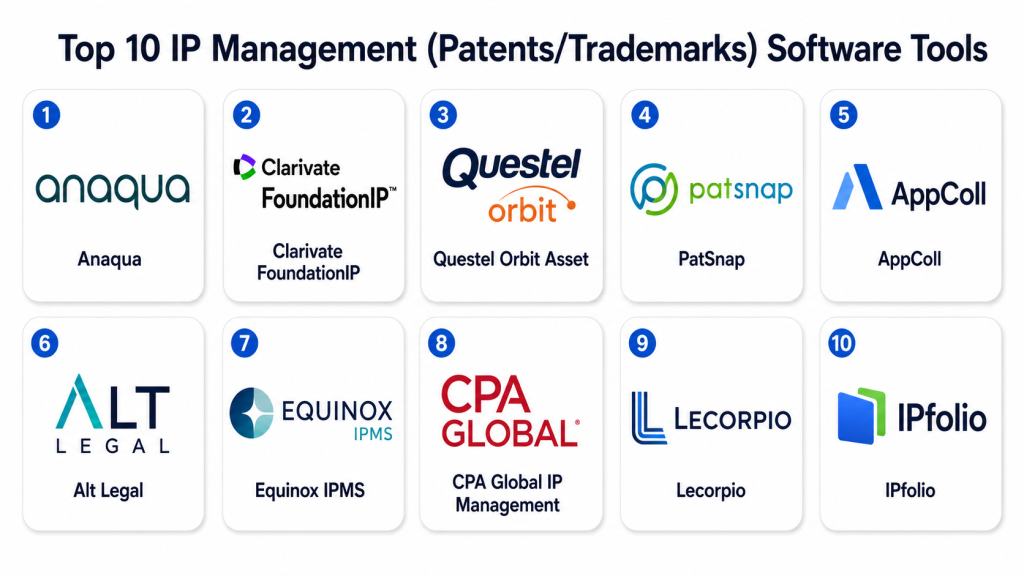
Top 10 IP Management (Patents/Trademarks) Software Tools
1 — Anaqua
Short description:
Anaqua is an enterprise IP management platform designed for corporate IP departments, law firms, and organizations managing complex patent and trademark portfolios. It supports invention disclosure, docketing, portfolio management, renewals, analytics, budgeting, and collaboration. The platform is suitable for large IP teams that need structured control across global jurisdictions, outside counsel, and internal stakeholders. Anaqua helps teams connect IP operations with business strategy and portfolio value. It is best for organizations that need deep IP lifecycle management and enterprise-grade portfolio visibility.
Key Features
- Patent and trademark portfolio management
- IP docketing and deadline tracking
- Invention disclosure workflows
- Renewal and annuity management support
- IP analytics and portfolio reporting
- Outside counsel collaboration
- Budgeting and legal spend visibility
Pros
- Strong enterprise IP lifecycle coverage
- Suitable for complex patent and trademark portfolios
- Useful for analytics-driven IP strategy
Cons
- May be more than small teams need
- Implementation can require process and data cleanup
- Pricing is not publicly stated
Platforms / Deployment
Web / Cloud / Hybrid / Varies
Security & Compliance
SSO/SAML, MFA, encryption, audit logs, RBAC, SOC 2, ISO 27001, GDPR, HIPAA: Not publicly stated.
Integrations & Ecosystem
Anaqua works well in enterprise IP environments where patents, trademarks, legal operations, finance, and outside counsel workflows need to connect.
- Document management systems
- Finance and billing systems
- Patent data sources
- Trademark monitoring tools
- Legal operations platforms
- Reporting and analytics systems
Support & Community
Anaqua provides enterprise support, implementation services, onboarding, training, and IP domain expertise. Support levels depend on customer size, modules selected, and contract scope.
2 — Clarivate FoundationIP
Short description:
Clarivate FoundationIP is an IP management platform designed for patent and trademark docketing, portfolio management, document management, and IP operations. It is used by corporate legal teams and law firms that need reliable IP matter tracking and workflow control. The platform helps teams manage deadlines, filings, correspondence, annuities, documents, and portfolio data. FoundationIP is especially useful for organizations that need structured docketing and integration with broader IP intelligence resources. It is best for IP teams managing active patent and trademark portfolios across multiple jurisdictions.
Key Features
- Patent and trademark docketing
- IP matter and portfolio management
- Deadline and task tracking
- Document and correspondence management
- Annuity and renewal workflow support
- Reporting and dashboard tools
- Integration with IP data and intelligence resources
Pros
- Strong IP docketing and portfolio workflow support
- Useful for corporate IP teams and law firms
- Good fit for complex IP operations
Cons
- May require setup and data migration planning
- Advanced workflows can take time to configure
- Pricing is not publicly stated
Platforms / Deployment
Web / Cloud / Varies
Security & Compliance
SSO/SAML, MFA, encryption, audit logs, RBAC, SOC 2, ISO 27001, GDPR, HIPAA: Not publicly stated.
Integrations & Ecosystem
FoundationIP can connect IP docketing and portfolio workflows with document, data, finance, and legal operations systems.
- IP intelligence platforms
- Document management systems
- Finance and billing tools
- Patent and trademark data sources
- Law firm collaboration workflows
- Reporting platforms
Support & Community
Clarivate provides support, onboarding, training, documentation, and professional services. Support availability depends on implementation scope and subscription agreement.
3 — Questel Orbit Asset
Short description:
Questel Orbit Asset is an IP management solution focused on patent and trademark portfolio management, docketing, renewals, invention management, and IP analytics. It is suitable for corporate IP departments, law firms, research-driven companies, and organizations that need global IP management workflows. The platform helps teams manage IP assets from idea capture through filing, prosecution, renewal, and portfolio review. It is especially useful for organizations that want IP management connected with search, analytics, and IP services. Questel Orbit Asset is best for teams seeking portfolio control and IP intelligence in one ecosystem.
Key Features
- Patent and trademark management
- Docketing and deadline tracking
- Invention disclosure workflows
- Renewal and annuity support
- IP portfolio analytics
- Document and correspondence management
- Integration with IP search and analytics tools
Pros
- Strong IP ecosystem with search and analytics connection
- Suitable for patent-heavy and trademark portfolios
- Useful for global IP operations
Cons
- May require onboarding for complex workflows
- Best value depends on selected Questel modules
- Pricing is not publicly stated
Platforms / Deployment
Web / Cloud / Varies
Security & Compliance
SSO/SAML, MFA, encryption, audit logs, RBAC, SOC 2, ISO 27001, GDPR, HIPAA: Not publicly stated.
Integrations & Ecosystem
Questel Orbit Asset can connect portfolio management with IP search, analytics, renewals, and legal workflows.
- Patent search platforms
- Trademark databases
- IP analytics tools
- Document systems
- Finance and billing systems
- Renewal service workflows
Support & Community
Questel provides customer support, onboarding, training, and IP services. Support levels depend on subscription, selected modules, and service requirements.
4 — PatSnap
Short description:
PatSnap is an innovation intelligence and IP management platform used by companies, R&D teams, legal teams, and strategy groups to analyze patents, technologies, competitors, and innovation landscapes. While it is widely known for patent analytics and innovation intelligence, it also supports IP portfolio visibility and decision-making. The platform is useful for teams that want to connect IP research with product strategy and competitive intelligence. PatSnap helps identify technology trends, patent activity, white spaces, and risk signals. It is best for innovation-led companies that need IP insights beyond basic docketing.
Key Features
- Patent search and analytics
- Technology landscape analysis
- Competitive IP intelligence
- Portfolio insights
- R&D and innovation strategy support
- Collaboration and reporting tools
- AI-assisted patent intelligence workflows
Pros
- Strong patent analytics and innovation intelligence
- Useful for R&D and strategy teams
- Helps connect IP data with business decisions
Cons
- Not always a full replacement for dedicated docketing software
- Best fit depends on analytics and intelligence needs
- Pricing is not publicly stated
Platforms / Deployment
Web / Cloud / Varies
Security & Compliance
SSO/SAML, MFA, encryption, audit logs, RBAC, SOC 2, ISO 27001, GDPR, HIPAA: Not publicly stated.
Integrations & Ecosystem
PatSnap fits workflows where patent intelligence, competitive research, and innovation strategy need to connect.
- Patent databases
- R&D workflows
- Competitive intelligence systems
- Reporting tools
- Innovation management platforms
- Legal and IP strategy workflows
Support & Community
PatSnap provides onboarding, customer support, training, and product education. Support may vary by subscription, team size, and modules selected.
5 — AppColl
Short description:
AppColl is cloud-based IP management software used by patent attorneys, trademark attorneys, law firms, and small to mid-sized IP teams. It supports docketing, patent and trademark matter management, document storage, invoicing, and workflow tracking. The platform is especially useful for smaller IP law firms and companies that need practical IP management without large enterprise complexity. AppColl helps teams manage deadlines, tasks, filings, and client matters in one place. It is best for IP professionals seeking a focused and accessible IP docketing and management solution.
Key Features
- Patent and trademark docketing
- Matter and task management
- Deadline tracking
- Document storage
- Billing and invoice support
- Client and contact management
- Reporting and reminders
Pros
- Practical for small and mid-sized IP teams
- Easier to adopt than large enterprise systems
- Good fit for IP law firms and patent practitioners
Cons
- May not match enterprise portfolio analytics depth
- Advanced integrations may be limited
- Public security certification details are not clearly stated
Platforms / Deployment
Web / Cloud / Varies
Security & Compliance
SSO/SAML, MFA, encryption, audit logs, RBAC, SOC 2, ISO 27001, GDPR, HIPAA: Not publicly stated.
Integrations & Ecosystem
AppColl supports IP docketing and matter workflows for law firms and corporate IP teams that need practical daily management.
- Document storage systems
- Billing workflows
- Email workflows
- Patent and trademark matter data
- Client management tools
- Reporting exports
Support & Community
AppColl provides customer support, onboarding help, documentation, and product guidance. Support is generally suited to small and mid-sized IP teams.
6 — Alt Legal
Short description:
Alt Legal is IP docketing software focused on trademark, patent, and IP deadline management for law firms and legal teams. It is known for automation around IP docketing, reminders, status updates, and trademark workflows. The platform is especially useful for firms and companies that want to reduce manual docketing work and improve deadline visibility. Alt Legal helps IP professionals manage filings, renewals, office actions, and client matters with cleaner workflows. It is best for trademark-heavy teams, boutique IP firms, and legal teams needing automated docketing support.
Key Features
- Trademark and patent docketing
- Automated deadline tracking
- Status monitoring workflows
- Renewal and office action reminders
- Matter and client management
- Document and communication support
- Reporting and deadline dashboards
Pros
- Strong docketing automation focus
- Useful for trademark-heavy practices
- Practical for boutique IP firms and lean legal teams
Cons
- May not provide full enterprise IP portfolio analytics
- Large global portfolios should validate scalability
- Pricing is not publicly stated
Platforms / Deployment
Web / Cloud / Varies
Security & Compliance
SSO/SAML, MFA, encryption, audit logs, RBAC, SOC 2, ISO 27001, GDPR, HIPAA: Not publicly stated.
Integrations & Ecosystem
Alt Legal fits IP docketing workflows where deadlines, status updates, and reminders are central.
- Trademark office data workflows
- Patent and trademark matter systems
- Email and calendar tools
- Document management tools
- Client communication workflows
- Reporting dashboards
Support & Community
Alt Legal provides onboarding, customer support, training resources, and product guidance. Support is generally focused on helping legal teams improve docketing accuracy and workflow adoption.
7 — Equinox IPMS
Short description:
Equinox IPMS is IP management software designed for law firms, corporate IP teams, and IP professionals managing patents, trademarks, designs, deadlines, renewals, and documents. It supports docketing, case management, task tracking, correspondence, reporting, and client workflows. The platform is useful for teams that need a structured IP system for daily operations and portfolio visibility. Equinox IPMS is especially suitable for IP law firms and corporate teams that want a cloud-based system with configurable workflows. It is best for organizations needing a focused IP management platform across multiple IP rights.
Key Features
- Patent, trademark, and design management
- Docketing and deadline tracking
- Task and workflow management
- Document and correspondence storage
- Renewal tracking
- Client and contact management
- Reporting and portfolio dashboards
Pros
- Broad support for different IP rights
- Useful for law firms and corporate IP teams
- Configurable IP workflow management
Cons
- Advanced analytics depth should be tested
- Integrations may vary by customer setup
- Public security details are not clearly stated
Platforms / Deployment
Web / Cloud / Varies
Security & Compliance
SSO/SAML, MFA, encryption, audit logs, RBAC, SOC 2, ISO 27001, GDPR, HIPAA: Not publicly stated.
Integrations & Ecosystem
Equinox IPMS can support IP operations across docketing, documents, clients, renewals, and reporting workflows.
- Document management systems
- Email and calendar tools
- IP office data workflows
- Billing systems
- Client management systems
- Reporting tools
Support & Community
Equinox provides onboarding, training, customer support, and product documentation. Support levels may depend on firm size, selected modules, and implementation scope.
8 — CPA Global IP Management
Short description:
CPA Global IP Management, now part of the broader Clarivate IP ecosystem, supports IP portfolio management, renewals, docketing, legal operations, and IP services. It is suitable for organizations that manage global patents and trademarks and need structured support for renewals, annuities, and portfolio administration. The platform is useful for corporate IP teams and law firms that want IP management connected with service support and portfolio operations. It helps teams manage deadlines, documents, and renewal-related workflows. It is best for organizations with significant global IP maintenance needs.
Key Features
- Patent and trademark portfolio management
- Renewal and annuity support
- IP docketing workflows
- Document and matter management
- Portfolio reporting
- IP service workflow support
- Global IP administration support
Pros
- Strong IP renewal and portfolio administration focus
- Useful for global IP portfolios
- Connects software with IP services ecosystem
Cons
- May be more suitable for larger portfolios
- Exact platform experience may depend on selected services
- Pricing is not publicly stated
Platforms / Deployment
Web / Cloud / Varies
Security & Compliance
SSO/SAML, MFA, encryption, audit logs, RBAC, SOC 2, ISO 27001, GDPR, HIPAA: Not publicly stated.
Integrations & Ecosystem
CPA Global IP Management fits organizations that need IP software connected with annuities, renewals, portfolio administration, and global IP services.
- IP renewal workflows
- Patent and trademark data
- Document systems
- Finance and billing systems
- Legal operations workflows
- Reporting platforms
Support & Community
Clarivate provides IP support, services, onboarding, documentation, and customer assistance. Support depends on modules, services, and customer agreement.
9 — Lecorpio
Short description:
Lecorpio is an IP management platform focused on corporate IP operations, invention disclosure, patent portfolio management, docketing, and collaboration. It is designed for in-house IP teams that need to manage innovation pipelines, patent matters, legal workflows, and portfolio decisions. The platform helps connect inventors, legal teams, outside counsel, and business stakeholders. Lecorpio is useful for companies that need structured invention capture and patent lifecycle visibility. It is best for corporate IP teams managing active invention and patent programs.
Key Features
- Invention disclosure management
- Patent portfolio management
- Docketing and matter workflows
- Collaboration with inventors and counsel
- Document and task tracking
- Portfolio reporting
- Legal operations visibility
Pros
- Strong fit for corporate invention programs
- Useful for in-house patent teams
- Helps connect inventors and legal stakeholders
Cons
- May be less focused on small law firm needs
- Trademark-heavy teams should validate feature depth
- Public security certification details are limited
Platforms / Deployment
Web / Cloud / Varies
Security & Compliance
SSO/SAML, MFA, encryption, audit logs, RBAC, SOC 2, ISO 27001, GDPR, HIPAA: Not publicly stated.
Integrations & Ecosystem
Lecorpio supports IP operations where invention intake, patents, documents, legal tasks, and stakeholder collaboration need to connect.
- Invention disclosure workflows
- Document management systems
- Outside counsel collaboration
- Finance and legal operations tools
- Patent data systems
- Reporting dashboards
Support & Community
Lecorpio provides customer support, implementation resources, onboarding, and IP workflow guidance. Support depends on deployment scope and customer agreement.
10 — IPfolio
Short description:
IPfolio is an IP management platform built on the Salesforce ecosystem and designed for companies managing patents, trademarks, contracts, licenses, and IP portfolios. It is useful for organizations that want IP operations connected with business processes, workflows, and reporting. The platform supports invention disclosures, docketing, portfolio tracking, documents, and collaboration. IPfolio is especially relevant for companies already using Salesforce or wanting configurable workflow automation. It is best for corporate IP teams that need flexible IP operations and business system alignment.
Key Features
- Patent and trademark portfolio management
- Invention disclosure workflows
- IP docketing and deadlines
- Document and matter tracking
- Licensing and agreement visibility
- Workflow automation
- Salesforce ecosystem alignment
Pros
- Strong fit for Salesforce-oriented organizations
- Flexible workflow and reporting capabilities
- Useful for corporate IP operations
Cons
- Best value depends on Salesforce ecosystem fit
- May require configuration expertise
- Pricing is not publicly stated
Platforms / Deployment
Web / Cloud / Varies
Security & Compliance
SSO/SAML, MFA, encryption, audit logs, RBAC, SOC 2, ISO 27001, GDPR, HIPAA: Not publicly stated.
Integrations & Ecosystem
IPfolio works well where IP workflows need to connect with Salesforce-based business processes and reporting.
- Salesforce ecosystem
- Document management systems
- Legal operations tools
- Finance workflows
- Invention disclosure systems
- Reporting and dashboard tools
Support & Community
IPfolio support and implementation resources depend on vendor engagement, configuration needs, and Salesforce ecosystem support. Support levels should be confirmed during evaluation.
Comparison Table
| Tool Name | Best For | Platform(s) Supported | Deployment | Standout Feature | Public Rating |
|---|---|---|---|---|---|
| Anaqua | Enterprise IP lifecycle management | Web / Varies | Cloud / Hybrid | Deep patent, trademark, analytics, and portfolio control | N/A |
| Clarivate FoundationIP | Corporate and law firm IP docketing | Web / Varies | Cloud | Structured IP docketing and portfolio management | N/A |
| Questel Orbit Asset | IP portfolio management with analytics ecosystem | Web / Varies | Cloud | IP management connected with search and analytics | N/A |
| PatSnap | Patent analytics and innovation intelligence | Web / Varies | Cloud | Technology landscape and competitive patent insights | N/A |
| AppColl | Small and mid-sized IP law firms | Web / Varies | Cloud | Practical patent and trademark docketing | N/A |
| Alt Legal | Trademark-heavy teams and docketing automation | Web / Varies | Cloud | Automated IP docketing and deadline tracking | N/A |
| Equinox IPMS | Law firms and corporate IP teams | Web / Varies | Cloud | Configurable patent, trademark, and design workflows | N/A |
| CPA Global IP Management | Global IP renewals and portfolio administration | Web / Varies | Cloud | Renewal and annuity workflow support | N/A |
| Lecorpio | Corporate invention and patent programs | Web / Varies | Cloud | Invention disclosure and in-house IP workflows | N/A |
| IPfolio | Salesforce-aligned corporate IP operations | Web / Varies | Cloud | IP workflows connected with Salesforce ecosystem | N/A |
Evaluation & Scoring of IP Management Software
| Tool Name | Core (25%) | Ease (15%) | Integrations (15%) | Security (10%) | Performance (10%) | Support (10%) | Value (15%) | Weighted Total (0–10) |
|---|---|---|---|---|---|---|---|---|
| Anaqua | 10 | 7 | 9 | 7 | 9 | 9 | 7 | 8.50 |
| Clarivate FoundationIP | 9 | 7 | 9 | 7 | 9 | 9 | 7 | 8.25 |
| Questel Orbit Asset | 9 | 8 | 9 | 7 | 9 | 8 | 8 | 8.50 |
| PatSnap | 8 | 9 | 8 | 7 | 9 | 8 | 8 | 8.20 |
| AppColl | 7 | 9 | 7 | 6 | 8 | 8 | 9 | 7.65 |
| Alt Legal | 8 | 9 | 7 | 6 | 8 | 8 | 8 | 7.80 |
| Equinox IPMS | 8 | 8 | 7 | 6 | 8 | 8 | 8 | 7.60 |
| CPA Global IP Management | 9 | 7 | 8 | 7 | 8 | 9 | 7 | 8.00 |
| Lecorpio | 8 | 7 | 8 | 6 | 8 | 8 | 7 | 7.45 |
| IPfolio | 8 | 7 | 9 | 7 | 8 | 8 | 7 | 7.80 |
These scores are comparative and should be used as a shortlist guide, not as a final buying decision. A higher score does not automatically mean the software is best for every IP team. Enterprise teams may value portfolio analytics and integrations, while small IP firms may value ease of use and docketing simplicity. Security scores are conservative where public certification details are not clearly stated. Buyers should validate global jurisdiction coverage, docketing rules, renewal workflows, integrations, and data migration support before choosing.
Which IP Management Software Tool Is Right for You?
Solo / Freelancer
Solo patent attorneys, trademark attorneys, IP consultants, and independent legal professionals usually need reliable docketing, reminders, document storage, and client matter tracking without heavy enterprise complexity. They may not need full analytics, large-scale portfolio dashboards, or advanced integration projects.
AppColl, Alt Legal, and Equinox IPMS can be practical choices for solo IP professionals. PatSnap may be useful when patent analytics and innovation intelligence are more important than docketing. Solo users should prioritize ease of use, deadline accuracy, affordability, and reliable reminders.
SMB
Small and mid-sized businesses need IP software that helps manage growing portfolios without overwhelming legal or R&D teams. These companies may need invention intake, trademark renewals, patent deadlines, outside counsel collaboration, and basic reporting.
AppColl, Alt Legal, Equinox IPMS, PatSnap, and Questel Orbit Asset may be suitable depending on whether the main need is docketing, analytics, or broader IP portfolio management. SMB buyers should focus on fast setup, clean workflows, and easy collaboration with outside counsel.
Mid-Market
Mid-market companies usually need stronger portfolio visibility, invention disclosure workflows, law firm collaboration, renewal forecasting, and analytics. They often manage multiple patent families, trademarks, jurisdictions, and internal stakeholders.
Questel Orbit Asset, Clarivate FoundationIP, Anaqua, PatSnap, Lecorpio, and IPfolio can be strong options depending on portfolio complexity and ecosystem needs. Mid-market buyers should evaluate reporting depth, data migration support, workflow configuration, and integration with document and finance tools.
Enterprise
Large enterprises, global legal departments, pharmaceutical companies, manufacturing companies, universities, and technology companies need scalable IP management with strong security, global portfolio support, analytics, invention workflows, renewals, legal spend visibility, and outside counsel collaboration.
Anaqua, Clarivate FoundationIP, Questel Orbit Asset, CPA Global IP Management, IPfolio, and Lecorpio are strong enterprise candidates. Enterprise buyers should prioritize jurisdiction coverage, role-based access, data governance, analytics, integration strategy, and long-term vendor support.
Budget vs Premium
Budget-focused buyers should avoid purchasing a large enterprise IP platform if they only need docketing, reminders, and basic matter tracking. AppColl, Alt Legal, and Equinox IPMS may be more practical depending on portfolio size.
Premium buyers should consider Anaqua, Clarivate FoundationIP, Questel Orbit Asset, CPA Global IP Management, IPfolio, or PatSnap when they need global portfolio analytics, invention management, renewal forecasting, outside counsel collaboration, and strategic IP intelligence.
Feature Depth vs Ease of Use
Feature-rich platforms provide stronger portfolio control, analytics, and enterprise governance, but they usually require more implementation planning. Anaqua, FoundationIP, Questel Orbit Asset, CPA Global IP Management, and IPfolio are better suited for mature IP teams.
For easier adoption, AppColl, Alt Legal, Equinox IPMS, and PatSnap may be more approachable depending on use case. The best choice depends on whether your team needs daily docketing simplicity or enterprise IP strategy depth.
Integrations & Scalability
IP management software often needs to connect with document management, finance, legal operations, R&D systems, patent databases, trademark monitoring tools, renewals services, outside counsel platforms, and reporting systems. Integration should be reviewed before migration.
Scalability should be evaluated by:
- Number of patents
- Number of trademarks
- Number of jurisdictions
- Number of inventors
- Outside counsel collaboration needs
- Docketing complexity
- Renewal volume
- Document volume
- Analytics requirements
- Data migration complexity
Security & Compliance Needs
IP management platforms may store confidential inventions, patent drafts, legal strategies, trademark filings, ownership records, licensing details, and sensitive commercial information. Security review is essential.
Important questions include:
- Does the platform support SSO and MFA?
- Are role-based permissions available?
- Are audit logs available?
- Is data encrypted?
- Can outside counsel access be restricted?
- Where is data hosted?
- How are confidential invention disclosures protected?
- Can the vendor provide security documentation?
If security certifications are not publicly stated, buyers should request official documentation directly from the vendor.
Frequently Asked Questions
1. What is IP Management software?
IP Management software helps organizations manage patents, trademarks, designs, renewals, invention disclosures, documents, deadlines, and portfolio reporting. It creates a structured system for protecting and tracking intellectual property assets.
2. Who uses IP Management software?
IP Management software is used by patent attorneys, trademark attorneys, corporate IP teams, law firms, universities, R&D departments, inventors, legal operations teams, and companies with active IP portfolios.
3. How much does IP Management software cost?
Pricing is usually not publicly stated because it depends on number of users, portfolio size, modules, jurisdictions, integrations, data migration, support level, and implementation scope. Most vendors provide custom pricing.
4. How long does implementation usually take?
Implementation depends on portfolio size, data quality, docketing complexity, document migration, integrations, and workflow requirements. Smaller teams may deploy faster, while enterprise migrations can require phased rollout and detailed validation.
5. What are common mistakes when choosing IP software?
Common mistakes include choosing software without cleaning IP data, ignoring docketing accuracy, underestimating migration effort, not testing renewal workflows, and failing to involve attorneys, paralegals, inventors, and outside counsel early.
6. Can IP software manage both patents and trademarks?
Yes, many IP management platforms support both patents and trademarks. However, feature depth varies, so buyers should test patent docketing, trademark renewals, office action workflows, jurisdiction coverage, and reporting before purchase.
7. Does IP software support invention disclosures?
Many platforms support invention disclosure workflows that allow inventors to submit ideas for review. These workflows often include review stages, approvals, legal evaluation, documentation, and conversion into patent matters.
8. Can IP management tools help reduce missed deadlines?
Yes, strong IP management platforms can reduce missed deadlines through docketing rules, reminders, task assignments, renewal alerts, office action tracking, and reporting dashboards. Accurate data setup is still critical.
9. Is cloud-based IP management software secure?
Cloud-based IP software can be secure when it includes encryption, access controls, MFA, role-based permissions, audit logs, backup processes, and strong data protection policies. Buyers should request security documentation before selection.
10. What is the best alternative to IP management software?
For very small portfolios, spreadsheets or basic legal matter tools may work temporarily. However, dedicated IP software becomes important when portfolios grow, deadlines multiply, renewals become complex, and global jurisdiction tracking is required.
Conclusion
IP Management software helps legal, R&D, and business teams manage patents, trademarks, invention disclosures, renewals, documents, deadlines, and portfolio strategy with more control and visibility. The best platform depends on portfolio size, jurisdiction complexity, budget, docketing needs, analytics requirements, integrations, and security expectations. Anaqua, Clarivate FoundationIP, Questel Orbit Asset, CPA Global IP Management, Lecorpio, and IPfolio are strong options for enterprise and corporate IP teams. AppColl, Alt Legal, and Equinox IPMS can be practical for smaller IP teams and law firms, while PatSnap is valuable for patent analytics and innovation intelligence. A smart is to shortlist two or three tools, test real patent and trademark workflows, validate docketing rules, review security controls, confirm migration support, and run a pilot before making the final decision.
