Upgrade & Secure Your Future with DevOps, SRE, DevSecOps, MLOps!
We spend hours scrolling social media and waste money on things we forget, but won’t spend 30 minutes a day earning certifications that can change our lives.
Master in DevOps, SRE, DevSecOps & MLOps by DevOps School!
Learn from Guru Rajesh Kumar and double your salary in just one year.
Introduction
Algorithmic Trading Platforms (ATPs) are specialized software tools that automate trading strategies using pre-defined rules and mathematical models. These platforms execute trades at high speed and volume, enabling financial institutions, hedge funds, and individual traders to maximize efficiency and minimize human error.
In , the demand for ATPs is growing due to increased market volatility, higher trading volumes, and the integration of AI and machine learning for predictive analytics. Modern platforms now support multi-asset trading, real-time market data, and adaptive algorithms to optimize performance.
Use cases include:
- High-frequency trading in equities, derivatives, and FX markets
- Institutional portfolio rebalancing and risk management
- Hedge fund strategy automation and backtesting
- Retail algorithmic trading for systematic investment strategies
- Market making and liquidity provision
Key evaluation criteria:
- Multi-asset support and market coverage
- Real-time data feed and execution speed
- Backtesting and simulation capabilities
- Integration with brokers, exchanges, and trading APIs
- Risk management and monitoring tools
- Predictive analytics and AI integration
- Customizable algorithm frameworks
- Regulatory compliance and reporting
- Ease of use and deployment
- Security and access control
Best for: Hedge funds, investment banks, high-frequency trading firms, and active retail traders seeking automated trading strategies.
Not ideal for: Small traders or organizations with limited trading volume or those who do not require algorithmic automation.
Key Trends in Algorithmic Trading Platforms
- AI and machine learning for predictive strategy optimization
- Real-time streaming market data with low-latency execution
- Multi-asset and cross-market support
- Cloud-native and hybrid deployments for scalability
- Automated risk management and compliance monitoring
- Backtesting and scenario simulation across historical datasets
- Integration with broker APIs and exchange platforms
- Predictive analytics dashboards and KPI monitoring
- Automated alerts and anomaly detection
- Adaptive algorithms capable of self-tuning based on market conditions
How We Selected These Tools (Methodology)
- Market adoption and mindshare among trading firms and hedge funds
- Feature completeness including real-time execution, backtesting, and analytics
- Performance and reliability under high-frequency trading conditions
- Security posture and regulatory compliance (SOC 2, ISO 27001, GDPR)
- Integration with brokers, exchanges, and financial data sources
- Suitability across retail, mid-market, and enterprise trading use cases
- AI and predictive analytics capabilities
- Ease of onboarding and user interface quality
- Support tiers, community engagement, and documentation
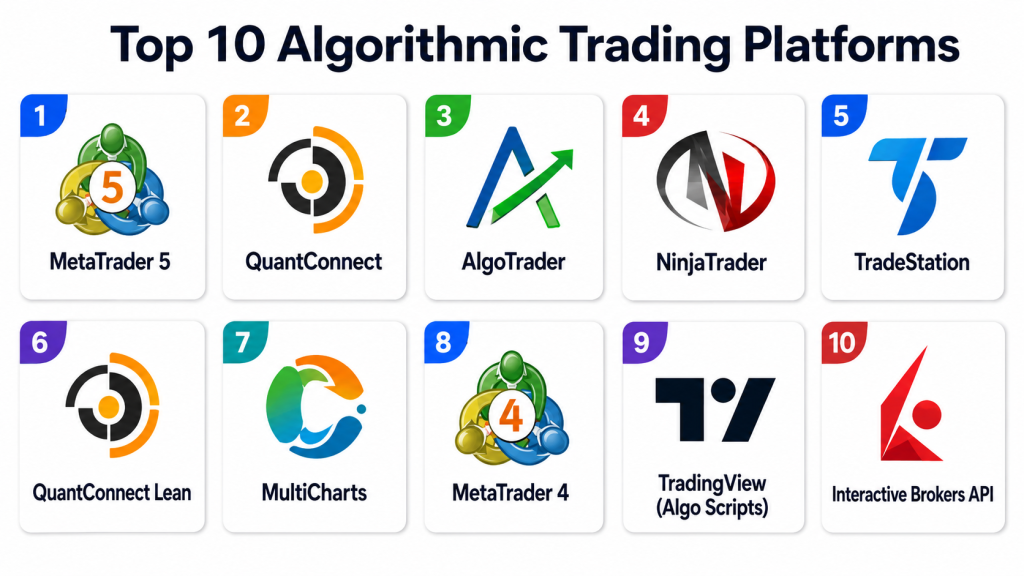
Top 10 Algorithmic Trading Platforms
#1 — MetaTrader 5
Short description :
MetaTrader 5 (MT5) is a widely used trading platform for retail and professional traders. It supports algorithmic trading using Expert Advisors (EAs), offering multi-asset trading and advanced charting tools.
Key Features
- Multi-asset trading (Forex, stocks, futures, CFDs)
- Automated trading via Expert Advisors
- Advanced charting and technical analysis tools
- Real-time market data and alerts
- Strategy backtesting and optimization
- Custom indicators and scripting via MQL5
Pros
- User-friendly for retail traders
- Large community and extensive documentation
Cons
- Limited institutional-grade features
- Execution speed dependent on broker infrastructure
Platforms / Deployment
- Windows, macOS, Web, iOS, Android
- Cloud/Local
Security & Compliance
- Data encryption and secure login
- Broker-dependent compliance
Integrations & Ecosystem
- Broker APIs for execution
- Third-party indicators and plugins
- Custom strategy development via MQL5
Support & Community
- Extensive community forums
- Documentation and tutorials
- Broker-provided support
#2 — QuantConnect
Short description :
QuantConnect is an open-source algorithmic trading platform offering cloud-based backtesting, live trading, and strategy development. It is used by professional quants and retail developers.
Key Features
- Cloud-based backtesting engine
- Supports equities, Forex, options, futures, and crypto
- Lean algorithm framework for C# and Python
- Live trading across multiple brokerages
- Data library with historical market data
- Predictive analytics and custom metrics
Pros
- Flexible and developer-friendly
- Supports multiple asset classes
Cons
- Requires programming knowledge
- Limited built-in GUI for non-developers
Platforms / Deployment
- Web, Cloud
- Hybrid (API integration for live trading)
Security & Compliance
- SOC 2, ISO 27001
- MFA, encrypted data storage
Integrations & Ecosystem
- Broker integrations: Interactive Brokers, GDAX, FXCM
- Data feeds for equities, FX, crypto
- API for custom strategy deployment
Support & Community
- Active developer community
- Documentation and code samples
- Support via community and email
#3 — AlgoTrader
Short description :
AlgoTrader is an institutional-grade platform for automated quantitative trading. It supports multi-asset algorithmic trading, backtesting, and risk management for hedge funds and asset managers.
Key Features
- Multi-asset trading support
- Advanced backtesting engine
- Risk management and compliance monitoring
- Predictive analytics for strategy optimization
- Integration with market data and execution venues
- Automated execution and reporting
Pros
- Enterprise-grade scalability
- Strong risk and compliance modules
Cons
- Higher cost for smaller firms
- Requires technical expertise
Platforms / Deployment
- Web, Windows, Linux
- Cloud / Hybrid
Security & Compliance
- SOC 2, ISO 27001
- Encryption, MFA
Integrations & Ecosystem
- Market data feeds: Bloomberg, Reuters
- Broker APIs for live execution
- Portfolio management systems
Support & Community
- Enterprise onboarding
- Documentation and tutorials
- Professional support teams
#4 — NinjaTrader
Short description :
NinjaTrader provides advanced charting, market analysis, and automated trading for futures, Forex, and equities. It is popular among active traders and small hedge funds.
Key Features
- Strategy development and automation
- Real-time charting and technical analysis
- Backtesting and optimization engine
- Market data streaming and alerts
- Multi-broker support
- Custom indicators and scripts
Pros
- User-friendly GUI for traders
- Strong backtesting capabilities
Cons
- Limited institutional support
- Some features require paid licenses
Platforms / Deployment
- Windows, Web
- Cloud/Local
Security & Compliance
- Encryption, secure login
- Broker-dependent compliance
Integrations & Ecosystem
- Supported brokers: Interactive Brokers, TD Ameritrade
- Custom plugins and indicators
- API for strategy integration
Support & Community
- Documentation and training webinars
- Active trader community
- Broker-provided support
#5 — TradeStation
Short description:
TradeStation offers advanced trading analytics, automated strategy development, and market data access for equities, options, and futures. It targets active traders and professional quants.
Key Features
- Real-time market data
- Automated trading with EasyLanguage scripts
- Multi-asset trading
- Backtesting and optimization
- Risk management tools
- Custom dashboards and alerts
Pros
- Strong analytical tools
- Comprehensive trading features
Cons
- Desktop-centric design
- Learning curve for EasyLanguage scripting
Platforms / Deployment
- Windows, Web, iOS, Android
- Cloud / Local
Security & Compliance
- SOC 2
- MFA, encrypted data
Integrations & Ecosystem
- Broker APIs for equities, options, futures
- Market data subscriptions
- Custom plugin support
Support & Community
- Documentation and guides
- Dedicated support team
- Active trading forums
#6 — QuantConnect Lean
Short description:
Lean by QuantConnect is an open-source algorithmic trading engine allowing developers to backtest, optimize, and deploy strategies across multiple brokers and asset classes.
Key Features
- Multi-asset backtesting
- Cloud-based execution
- Python and C# strategy framework
- Broker integration for live trading
- Historical and real-time data
- AI and ML integration
Pros
- Open-source flexibility
- Supports multiple programming languages
Cons
- Developer-focused, not GUI-driven
- Requires coding knowledge
Platforms / Deployment
- Web, Cloud
- Hybrid
Security & Compliance
- SOC 2
- Encryption, MFA
Integrations & Ecosystem
- Broker APIs: Interactive Brokers, GDAX
- Market data feeds
- API for live deployment
Support & Community
- Developer community
- Documentation and code samples
- Community support forums
#7 — MultiCharts
Short description:
MultiCharts is a professional trading platform for automated strategies, advanced charting, and multi-broker support, popular among retail and semi-professional traders.
Key Features
- Advanced charting and technical analysis
- Automated trading with EasyLanguage support
- Backtesting and optimization
- Real-time market data
- Multi-broker integration
- Custom indicators
Pros
- Flexible strategy design
- Multi-broker support
Cons
- Requires programming knowledge
- Higher cost for advanced modules
Platforms / Deployment
- Windows
- Local / Cloud
Security & Compliance
- Encryption, MFA
- Broker compliance dependent
Integrations & Ecosystem
- Supported brokers
- Data feeds
- Custom scripts
Support & Community
- Documentation and tutorials
- Support via vendor and community
- Active user forums
#8 — MetaTrader 4
Short description:
MetaTrader 4 (MT4) is a popular retail trading platform supporting Forex and CFD algorithmic trading via Expert Advisors (EAs).
Key Features
- Automated trading via EAs
- Real-time market data
- Technical indicators and charting
- Backtesting capabilities
- Alerts and notifications
- Multi-currency support
Pros
- Widely used and well-documented
- Easy to start for retail traders
Cons
- Limited to Forex and CFDs
- Fewer institutional features
Platforms / Deployment
- Windows, Web, iOS, Android
- Cloud / Local
Security & Compliance
- Encryption
- Broker-dependent compliance
Integrations & Ecosystem
- Broker APIs
- Third-party EAs
- Plugins and indicators
Support & Community
- Large community and documentation
- Broker support
- User forums
#9 — TradingView (Algo Scripts)
Short description:
TradingView offers a platform for technical analysis and algorithmic trading using Pine Script. It supports equities, crypto, and Forex markets.
Key Features
- Charting and technical analysis
- Automated strategies via Pine Script
- Multi-market data feeds
- Alerts and notifications
- Backtesting
- Custom dashboards
Pros
- User-friendly GUI
- Multi-market support
Cons
- Limited backtesting depth
- Pine Script learning curve
Platforms / Deployment
- Web, iOS, Android
- Cloud
Security & Compliance
- SOC 2
- Encryption
Integrations & Ecosystem
- Broker APIs
- Data feeds
- Community scripts
Support & Community
- Documentation
- Support via forums and tutorials
- Developer community
#10 — Interactive Brokers API
Short description:
Interactive Brokers API allows professional traders and firms to execute automated trading strategies across multiple asset classes using REST, FIX, and proprietary APIs.
Key Features
- Multi-asset trading
- Real-time market data
- Custom algorithm execution
- Risk management tools
- Historical data and backtesting
- Integration with third-party platforms
Pros
- Comprehensive market access
- Flexible API options
Cons
- Requires programming knowledge
- Enterprise-focused
Platforms / Deployment
- Windows, Linux, Web
- Cloud / Local
Security & Compliance
- SOC 2, ISO 27001
- MFA, encrypted data
Integrations & Ecosystem
- Market data feeds
- Third-party analytics
- Portfolio management systems
Support & Community
- Documentation and tutorials
- Enterprise support
- Developer forums
Comparison Table (Top 10)
| Tool Name | Best For | Platform(s) Supported | Deployment | Standout Feature | Public Rating |
|---|---|---|---|---|---|
| MetaTrader 5 | Retail & active traders | Windows, macOS, Web, iOS, Android | Cloud/Local | Expert Advisors automation | N/A |
| QuantConnect | Professional quants | Web | Cloud/Hybrid | Lean algorithm framework | N/A |
| AlgoTrader | Hedge funds & institutions | Web, Windows, Linux | Cloud/Hybrid | Multi-asset backtesting | N/A |
| NinjaTrader | Active traders | Windows, Web | Cloud/Local | Advanced charting & automation | N/A |
| TradeStation | Retail & professional | Windows, Web, iOS, Android | Cloud/Local | EasyLanguage scripting | N/A |
| QuantConnect Lean | Developers & quants | Web | Cloud/Hybrid | Open-source algorithm engine | N/A |
| MultiCharts | Retail & semi-pro traders | Windows | Local/Cloud | Multi-broker support | N/A |
| MetaTrader 4 | Forex & CFD traders | Windows, Web, iOS, Android | Cloud/Local | EAs for Forex | N/A |
| TradingView | Retail & crypto traders | Web, iOS, Android | Cloud | Pine Script automation | N/A |
| Interactive Brokers API | Pro traders & firms | Windows, Linux, Web | Cloud/Local | Multi-asset API access | N/A |
Evaluation & Scoring of Algorithmic Trading Platforms
| Tool Name | Core (25%) | Ease (15%) | Integrations (15%) | Security (10%) | Performance (10%) | Support (10%) | Value (15%) | Weighted Total (0–10) |
|---|---|---|---|---|---|---|---|---|
| MetaTrader 5 | 8 | 9 | 7 | 8 | 8 | 8 | 9 | 8.3 |
| QuantConnect | 9 | 7 | 9 | 9 | 9 | 7 | 8 | 8.5 |
| AlgoTrader | 9 | 7 | 9 | 9 | 9 | 7 | 7 | 8.2 |
| NinjaTrader | 8 | 8 | 7 | 8 | 8 | 7 | 8 | 7.9 |
| TradeStation | 8 | 8 | 7 | 8 | 8 | 7 | 8 | 8.0 |
| QuantConnect Lean | 9 | 7 | 9 | 9 | 9 | 7 | 8 | 8.5 |
| MultiCharts | 8 | 7 | 7 | 8 | 8 | 7 | 8 | 7.8 |
| MetaTrader 4 | 7 | 9 | 7 | 7 | 7 | 8 | 9 | 7.9 |
| TradingView | 7 | 9 | 7 | 7 | 7 | 7 | 8 | 7.7 |
| Interactive Brokers API | 9 | 7 | 9 | 9 | 9 | 7 | 8 | 8.5 |
Interpretation: Weighted totals provide comparative insights across core features, integrations, ease of use, security, performance, support, and value. Higher scores indicate stronger institutional readiness.
Which Algorithmic Trading Platform Is Right for You?
Solo / Freelancer
- MetaTrader 5, MetaTrader 4, TradingView for retail-focused automated trading
SMB
- NinjaTrader, TradeStation for structured automation and backtesting
Mid-Market
- QuantConnect, QuantConnect Lean for customizable algorithmic strategies
Enterprise
- AlgoTrader, Interactive Brokers API for multi-asset, high-frequency, institutional trading
Budget vs Premium
- Budget: MetaTrader, TradingView
- Premium: AlgoTrader, Interactive Brokers, QuantConnect
Feature Depth vs Ease of Use
- Retail traders prioritize GUI and prebuilt scripts; enterprises prioritize full API flexibility and backtesting depth
Integrations & Scalability
- Ensure broker APIs, market data feeds, and ERP/portfolio integration; cloud deployment ensures scalable execution
Security & Compliance Needs
- SOC 2, ISO 27001, MFA, encrypted data critical for institutional trading
Frequently Asked Questions (FAQs)
1. What is an algorithmic trading platform?
A platform that automates trading using pre-defined rules, algorithms, and AI for efficient market execution.
2. How is pricing structured?
Subscription or license-based, often tiered by asset coverage, execution speed, and institutional features.
3. Can I backtest strategies?
Yes, all top ATPs provide backtesting against historical and simulated market data.
4. Are these platforms secure?
Yes, enterprise-grade solutions comply with SOC 2, ISO 27001, encryption, and MFA.
5. Do they support multiple asset classes?
Yes, equities, derivatives, Forex, crypto, and futures are supported depending on the platform.
6. Is programming knowledge required?
Some platforms (QuantConnect, Interactive Brokers API) require programming; GUI-based platforms (MetaTrader, NinjaTrader) are more user-friendly.
7. Can I integrate with brokers?
Yes, most provide API integrations with brokers and trading venues.
8. How fast is trade execution?
Enterprise ATPs are optimized for low-latency execution; retail platforms depend on broker infrastructure.
9. Can I use predictive analytics?
AI-powered platforms provide predictive modeling for market trends and risk management.
10. Common implementation mistakes?
Neglecting API integration, insufficient backtesting, and improper risk monitoring reduce effectiveness.
Conclusion
Algorithmic Trading Platforms are essential for automating market strategies, managing risk, and leveraging predictive analytics. Retail traders may benefit from MT4/MT5 and TradingView, mid-market firms from QuantConnect and NinjaTrader, and enterprises from AlgoTrader and Interactive Brokers API. Shortlist platforms, validate integrations, ensure compliance, and leverage backtesting to optimize trading performance.
