Upgrade & Secure Your Future with DevOps, SRE, DevSecOps, MLOps!
We spend hours scrolling social media and waste money on things we forget, but won’t spend 30 minutes a day earning certifications that can change our lives.
Master in DevOps, SRE, DevSecOps & MLOps by DevOps School!
Learn from Guru Rajesh Kumar and double your salary in just one year.
Introduction
The demand for DevOps professionals has transformed from a luxury into a core business necessity. As organizations pivot toward digital-first strategies, the ability to automate infrastructure, manage complex Kubernetes clusters, and secure cloud environments has become a gold standard for technical talent.
Companies are not just looking for “operators”; they are hunting for engineers who can bridge the gap between development cycles and production reliability. This shift explains why the best DevOps salary packages are increasingly reserved for those who treat infrastructure as code and prioritize system scalability.
However, a high salary in this field is rarely an accident. It is the result of aligning your technical toolkit with high-value market demands. Whether you are a beginner looking to break into the cloud space or a professional aiming to pivot into a senior SRE role, your earning potential is tied to how effectively you can solve complex scalability and security challenges.
In this guide, we will break down the realistic paths to maximizing your DevOps career, focusing on the skills, certifications, and strategic decisions that lead to top-tier compensation.
Why DevOps Salaries Are Growing
DevOps salaries are on an upward trajectory because the complexity of modern software delivery is increasing faster than the supply of qualified talent.
- Cloud Complexity: Transitioning from legacy on-premise servers to multi-cloud environments (AWS, Azure, GCP) requires deep architectural knowledge.
- Kubernetes Proliferation: As container orchestration becomes the standard for microservices, engineers who can manage Kubernetes at scale are in short supply.
- Automation Demand: Business leaders now demand faster deployment cycles, making CI/CD and Infrastructure as Code (IaC) skills critical.
- Shift to DevSecOps: Security can no longer be an afterthought. Integrating security into the automated pipeline is a premium skill set.
- Reliability Focus: With downtime costing businesses thousands per minute, Site Reliability Engineering (SRE) has emerged as a high-stakes, high-reward career path.
Factors Affecting DevOps Salary
It is important to understand that salary is not determined by job title alone. Several variables dictate your market value:
- Depth of Cloud Expertise: Knowing how to launch an instance is entry-level. Knowing how to design a cost-optimized, secure, multi-region architecture is senior-level.
- Infrastructure as Code (IaC): Proficiency in tools like Terraform or Pulumi significantly boosts your value compared to those who rely on manual console configurations.
- Industry Type: Finance, healthcare, and high-growth SaaS companies typically offer more competitive compensation packages than smaller retail or non-tech sectors.
- Operational Resilience: Your ability to handle incident management and automated recovery is a direct lever for salary negotiation.
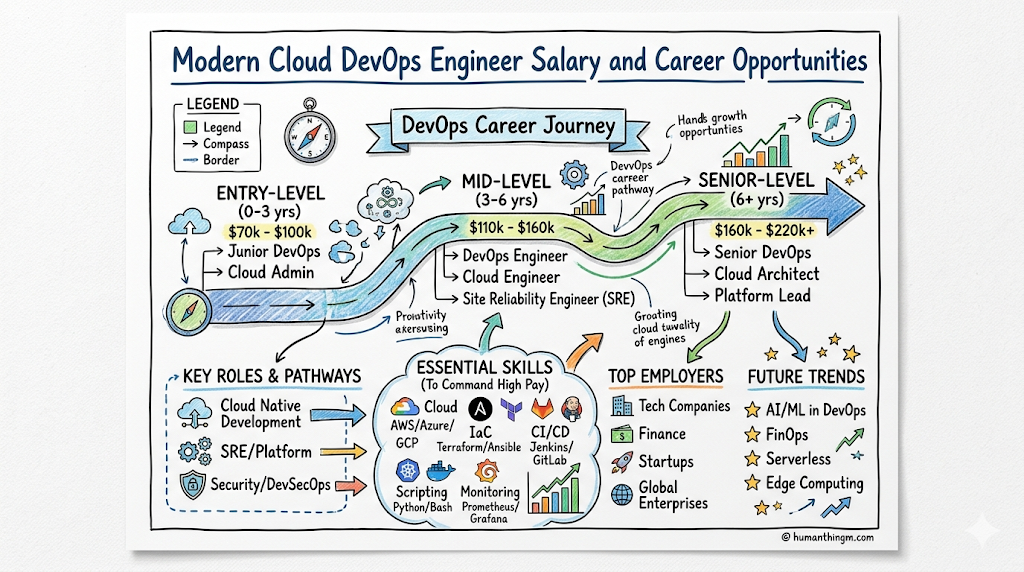
DevOps Salary by Experience Level
Fresher DevOps Engineer
Entry-level roles focus on basic CI/CD pipeline maintenance, monitoring, and Linux administration. At this stage, your salary reflects your ability to learn quickly and support senior engineers. The primary goal here is to build a foundation in scripting and cloud basics.
Mid-Level DevOps Engineer
With 3–5 years of experience, a mid-level engineer should be comfortable managing production-grade Kubernetes clusters and writing complex IaC templates. At this level, you aren’t just following instructions; you are improving processes and reducing operational friction.
Senior DevOps Engineer
Senior professionals focus on high-level architecture, cost management, and mentoring. They are responsible for the overall design of the system, ensuring security compliance, and maintaining high availability across global deployments.
DevOps Salary by Role
- Cloud DevOps Engineer: Focuses on cloud-native deployments and scaling.
- Kubernetes Engineer: A specialized role centered on container orchestration and cluster management.
- Site Reliability Engineer (SRE): Focuses on system uptime, error budgets, and performance metrics.
- DevSecOps Engineer: Bridges the gap between security and development, focusing on automated vulnerability scanning.
- Platform Engineer: Builds internal tools and self-service platforms for development teams to improve developer experience.
DevOps Salary by Country
Salaries vary based on local economic conditions and the density of tech companies. While the United States remains at the top for raw numbers, regions like Germany, Australia, and Singapore offer highly competitive salaries relative to their cost of living and strong demand for cloud-native talent. In India, the market for DevOps is expanding rapidly, with top-tier product companies offering premium compensation for specialized expertise in SRE and Kubernetes.
DevOps Salary by Cloud Platform
- AWS: As the market leader, AWS experience remains the most common entry point, but it is also the most competitive.
- Azure: High demand in enterprise environments and large corporations migrating from legacy Windows-based infrastructure.
- Google Cloud (GCP): Highly sought after for its advanced data and Kubernetes (GKE) capabilities, often commanding premium rates.
Highest-Paying DevOps Skills
The highest-paid engineers differentiate themselves through niche technical expertise:
- Advanced Kubernetes: Beyond basic deployment, this includes networking, security, and cluster-wide optimization.
- GitOps: Implementing Git-based workflows for infrastructure state management.
- Observability: Proficiency with tools like Prometheus, Grafana, and ELK to monitor and debug complex systems.
- FinOps: The ability to optimize cloud spend, a skill that is increasingly valued by leadership teams.
Certifications That Increase Salary
Certifications serve as a signal of proficiency and a structured path to learning. They are most effective when paired with hands-on projects:
- Certified Kubernetes Administrator (CKA): Highly respected for validating hands-on troubleshooting and cluster management.
- Professional Cloud DevOps Engineer (AWS/Azure/GCP): Demonstrates broad platform knowledge.
- Terraform Associate: Validates your ability to handle Infrastructure as Code at scale.
DevOps Salary Comparison Table
| Role | Primary Focus | Skill Demand | Career Growth Potential |
| DevOps Engineer | CI/CD & Automation | Moderate | High |
| Kubernetes Engineer | Orchestration | High | Very High |
| SRE | Reliability & Uptime | Very High | Exceptional |
| Platform Engineer | Developer Experience | High | High |
| DevSecOps | Security Pipelines | High | Very High |
Career Roadmap for Higher Salary
- Beginner Stage: Master Linux, Networking, Git, and basic cloud service provisioning.
- Intermediate Stage: Gain mastery in CI/CD automation, Docker, and Kubernetes fundamentals.
- Advanced Stage: Focus on system design, SRE practices, and multi-cloud architecture.
- Specialized Stage: Deepen expertise in FinOps, MLOps, or advanced security automation.
Real-World Career Scenarios
- The Sysadmin Transition: A traditional administrator learns Terraform and Kubernetes, effectively doubling their earning potential by moving into Cloud Engineering.
- The Developer Pivot: A backend developer masters containerization and pipeline management, becoming a valuable asset as a DevSecOps engineer.
Common Mistakes Affecting Salary Growth
- Ignoring Fundamentals: Skipping Linux or networking basics leads to a “ceiling” in troubleshooting capability.
- Certification Collecting: Having badges without building projects does not impress hiring managers.
- Staying Static: Failing to keep up with tool updates (e.g., migrating from old manual scripts to modern GitOps).
Hands-On Skills Employers Want
Employers want to see projects that demonstrate:
- A fully functional CI/CD pipeline.
- Kubernetes clusters deployed with automated scaling.
- Infrastructure managed entirely through Terraform/IaC.
- Real-world incident management strategies.
FAQs
What is the average DevOps engineer salary?
Salary varies significantly by region, company size, and specific skill set. It generally reflects the demand for specialized cloud and automation capabilities.
Which DevOps role pays the highest salary?
Roles that involve high-stakes reliability (SRE) or complex platform architecture generally command the highest compensation.
Is Kubernetes good for salary growth?
Yes, Kubernetes is currently one of the most critical and well-compensated skills in the cloud-native ecosystem.
Which cloud platform pays the highest salary?
All major platforms (AWS, Azure, GCP) offer high salaries; however, deep expertise in any one platform often pays better than superficial knowledge of many.
Do DevOps certifications increase salary?
Certifications can help with career advancement and salary negotiation, especially when they are accompanied by clear evidence of practical application.
Is AWS or Azure better for DevOps careers?
Both have massive market shares. Your choice should depend on the specific industry you wish to enter and the prevalence of that cloud provider in that space.
Which DevOps skill is most in demand?
Automation skills, specifically through Infrastructure as Code and Kubernetes orchestration, are consistently ranked as the most in-demand capabilities.
Is DevOps a high-paying career?
It is considered a high-paying career path because it requires a unique blend of development and operations skills that are essential to modern business operations.
Can beginners get high DevOps salaries?
Beginners start at a standard baseline, but rapid skill acquisition in high-demand areas like cloud automation can lead to fast salary progression.
How long does it take to become a high-paid DevOps engineer?
The timeline depends on how quickly you acquire practical skills through hands-on projects, typically occurring as you move from junior to intermediate/senior levels.
Final Recommendation
To reach the top of the salary bracket, do not treat your career as a checklist of technologies. Treat it as a continuous process of solving business problems through automation and reliable architecture. Focus on building projects that demonstrate your ability to manage infrastructure at scale, and prioritize deep learning in Kubernetes and cloud-native workflows. The highest-paid engineers are not those who just know the tools, but those who understand how to make the entire software lifecycle faster, safer, and more reliable.
