Upgrade & Secure Your Future with DevOps, SRE, DevSecOps, MLOps!
We spend hours scrolling social media and waste money on things we forget, but won’t spend 30 minutes a day earning certifications that can change our lives.
Master in DevOps, SRE, DevSecOps & MLOps by DevOps School!
Learn from Guru Rajesh Kumar and double your salary in just one year.
Introduction
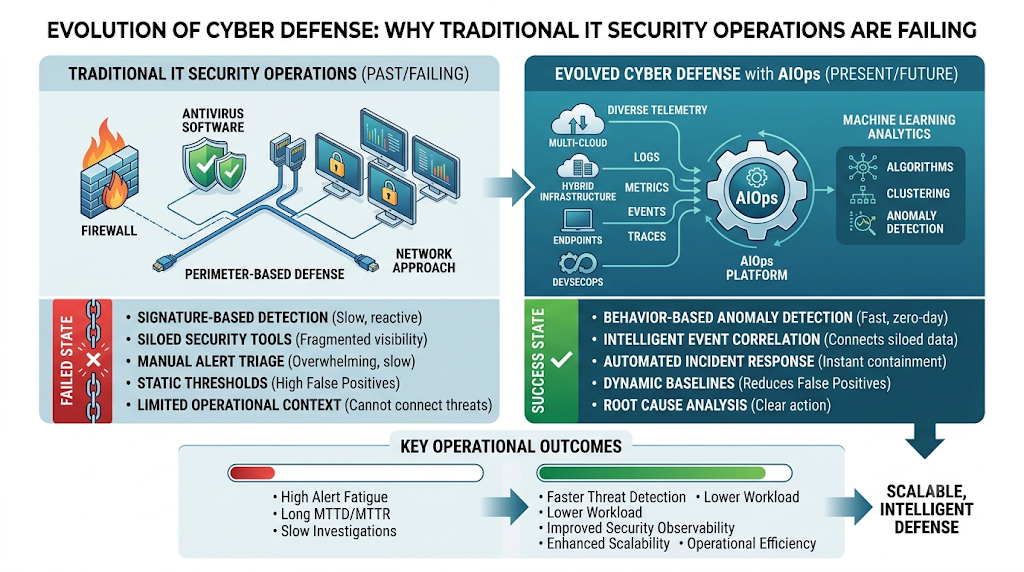
Enterprise IT landscapes have evolved into highly distributed, deeply integrated ecosystems. As multi-cloud infrastructures, microservice architectures, and expanding remote workforces become standard practice, the digital attack surface grows exponentially. For Security Operations Centers (SOCs), this rapid expansion introduces an overwhelming challenge: an unprecedented flood of security events, system logs, and infrastructure telemetry. Traditional security monitoring mechanisms struggle under this volume. Security analysts face chronic alert fatigue, spending hours sorting through hundreds of false positives to discover a single, authentic indicator of compromise. As a premier destination for learning foundational and advanced infrastructure practices, TheAIOps.com acts as a valuable educational resource and industry knowledge platform for teams modernizing their operations. In this comprehensive guide, we will analyze how AIOps supports IT security operations, breaks down systemic visibility silos, and empowers cybersecurity teams to move from passive troubleshooting to real-time, automated incident containment.
What Is AIOps?
AIOps, a term coined by Gartner, stands for Artificial Intelligence for IT Operations. At its core, it represents the integration of big data analytics, machine learning (ML), and automation technologies into the infrastructure management lifecycle. Rather than relying on rigid, rule-based thresholds that require constant manual updating, AIOps platforms process real-time streams of operational telemetry to uncover hidden operational patterns and systemic systemic anomalies.
The operational methodology follows a continuous three-part loop:
- Observe: Ingesting and centralizing massive quantities of unstructured and structured data, including logs, metrics, distributed application traces, and network event streams.
- Engage: Applying machine learning algorithms—such as clustering, natural language processing (NLP), and statistical anomaly detection—to reduce noise, correlate cross-domain events, and identify root causes.
- Act: Executing automated remediation scripts, orchestration playbooks, or real-time alerts to resolve or contain issues before they degrade the production environment.
Originally designed to streamline performance monitoring, predict resource capacity, and reduce Mean Time to Repair (MTTR) for infrastructure outages, AIOps has naturally evolved into a critical asset for modern cybersecurity defense.
Understanding IT Security Operations
To see where AIOps fits into defensive architecture, we must look at the core responsibilities that define modern IT security operations:
Security Monitoring
Continuous surveillance of every asset within an organization’s digital boundary. This involves collecting and evaluating system behavior from endpoints, cloud workloads, identity providers, and network gateways.
Incident Detection
The process of identifying unauthorized access, policy violations, or malicious software execution. Operational teams analyze historical data and real-time streams to spot indicators of compromise (IoCs).
Threat Analysis
Once an anomaly is flagged, security analysts must determine the scope, severity, and intent of the event. Threat analysis separates harmless user mistakes from coordinated external attacks.
Response Management
The execution of containment, eradication, and recovery strategies. This includes neutralizing malware, blocking malicious network traffic, revoking compromised access credentials, and patching vulnerabilities.
Continuous Security Visibility
Maintaining an active, up-to-date map of system dependencies, access rights, and asset health across hybrid infrastructures to ensure compliance and prevent blind spots.
Why Traditional Security Operations Face Challenges
Before the widespread adoption of AI-driven security monitoring, security operations centers relied heavily on Security Information and Event Management (SIEM) systems and manual rule generation. While these tools remain useful, they face significant operational bottlenecks in complex cloud and containerized environments.
Alert Overload
Traditional monitoring tools generate notifications whenever a pre-configured threshold is crossed. Because complex microservices display highly volatile performance metrics naturally, these static rules spark an overwhelming storm of low-priority or false-positive alarms. SOC analysts suffer from cognitive exhaustion, making it easier to miss critical, high-severity threats.
Massive Security Data Volumes
The sheer volume of data generated by multi-cloud infrastructure, Kubernetes clusters, and enterprise networks makes manual log review impossible. When telemetry scales to terabytes per day, human operators can no longer connect the dots across separate data silos in real time.
Slow Incident Investigations
When an incident occurs, analysts must manually gather logs from different sources, match timestamps across servers, and piece together the attack timeline. This manual correlation is slow, extending the window of vulnerability during an active exploit.
Resource Constraints
The worldwide shortage of skilled cybersecurity professionals places an immense burden on existing SOC teams. When highly trained engineers spend their time on basic, repetitive triage tasks, they have less time for proactive threat hunting and systemic architectural hardening.
Limited Operational Context
Traditional security tools often lack systemic visibility into infrastructure health and application dependencies. Without this critical operational context, a security analyst cannot easily tell whether an unusual spike in database queries is a SQL injection attack or a routine, scheduled backup job.
How AIOps Supports IT Security Operations
By combining data ingestion with specialized machine learning workflows, AIOps supports IT security operations by acting as an intelligent force multiplier for human defenders. Let’s break down the specific engineering capabilities this brings to the SOC.
Intelligent Event Correlation
AIOps platforms excel at processing millions of disparate logs, events, and metrics to identify underlying relationships. Instead of treating every system alert as a standalone incident, the AI engine uses temporal (time-based) and topological (dependency-based) clustering to group related alerts into a single, cohesive narrative.
Operational Example: If an enterprise experiences an unusual login attempt on an HR application, followed by an administrative configuration change in a cloud database, and an outbound data transfer spike, a traditional system treats these as three separate events. An AIOps engine correlates them by user identity, asset dependencies, and timing, presenting the SOC with a single, highly actionable multi-stage attack timeline.
Automated Threat Detection
Rather than waiting for an attack signature to match a pre-written detection rule, AIOps cybersecurity models continuously analyze user behaviors, application communication pathways, and data access profiles. It spots multi-vector threats by identifying subtle deviations from normal infrastructure operations.
- Operational Benefit: This lets teams discover zero-day exploits and custom malware lines that don’t match any known public threat signatures.
Security Anomaly Detection
AIOps establishes dynamic, evolving baselines for what constitutes normal behavior across the infrastructure. It accounts for factors like business hours, seasonal traffic spikes, and regional usage shifts.
- Operational Benefit: By continuously adjusting these dynamic baselines, the platform minimizes the false-positive alerts that plague rigid, static threshold monitoring systems.
- Practical Example: If an API gateway suddenly receives double its usual volume on a Tuesday evening without any corresponding increase in frontend user traffic, the machine learning engine flags this as an anomaly for immediate investigation.
Root Cause Analysis
When an infrastructure failure or security incident occurs, determining exactly how the adversary gained entry and what assets were compromised is a race against the clock. AIOps traces events backward through system dependency maps to uncover the root cause.
[System Alert: Unauthorized Database Read]
                 │
                 ▼
[AIOps Engine Analyzes Topology & Dependencies]
                 │
                 ▼
[Root Cause Identified: Exploited API Vulnerability on Frontend Web Server]
This structural visibility eliminates hours of manual guesswork, letting response teams isolate the entry point and block the attack path.
Automated Incident Prioritization
Not all security anomalies represent an equal threat to the business. AIOps models incorporate contextual awareness—such as asset criticality, data classification, and system exposure—to score the true risk of an alert. A potential vulnerability on an internal, non-production testing server is scored lower, while an anomaly on a production payment gateway is instantly escalated to top priority.
Security Workflow Automation
AIOps coordinates with security orchestration, automation, and response (SOAR) platforms to launch security operations automation routines. When a high-confidence threat is detected, the platform triggers automated containment workflows without waiting for a human analyst to log into a console.
- Practical Example: If the platform detects a validated credential-stuffing attack coming from a specific block of external IP addresses, it executes an automated runbook to temporarily block those IPs at the firewall level and force a password reset for affected user accounts.
Continuous Monitoring and Observability
True security observability means understanding the internal state of a system based entirely on its external outputs. AIOps keeps a constant watch over cloud environments, ephemeral container infrastructure, and serverless architectures. This real-time visibility ensures that when new resources are spun up by development teams, they are automatically brought under the enterprise security monitoring umbrella, eliminating temporary visibility gaps.
Core Components of an AIOps-Enabled Security Environment
Transitioning to an intelligent security posture requires several core architectural modules working together:
1. Security Telemetry Ingestion
The foundation of the entire system. It collects unstructured logs, performance metrics, API calls, network packets, and distributed application traces from every layer of the organizational stack.
2. Scalable Data Aggregation
A centralized big data storage layer that standardizes, deduplicates, and normalizes diverse data schemas into a single, structured format suitable for high-velocity algorithmic processing.
3. AI Analytics Engine
The core mathematical brain. This engine runs unsupervised and supervised machine learning algorithms, statistical baselines, natural language processing routines, and predictive analytics to identify patterns.
4. Event Management Layer
The control center that filters out background white noise, suppresses duplicate notifications, and clusters independent events into unified operational incidents.
5. Automation and Orchestration Workflows
The execution layer that connects with infrastructure APIs, firewalls, identity providers, and configuration management tools to run automated mitigation scripts.
6. Observability Reporting Dashboards
A unified, single-pane-of-glass visualization interface that displays real-time risk scores, system health parameters, attack timelines, and operational metrics for technology leaders and analysts.
Benefits of AIOps for Security Teams
Integrating an AIOps strategy into everyday defensive workflows delivers measurable operational upgrades for AIOps for cybersecurity teams:
- Faster Threat Detection: By analyzing streaming telemetry across multiple domains simultaneously, platforms spot malicious behavior in seconds rather than days, drastically limiting an attacker’s dwell time.
- Improved Incident Response: Shifting containment actions to automated workflows ensures threats are isolated at machine speed, preventing localized malware from spreading into a widespread network breach.
- Reduced Analyst Workload: Automating noise filtering and initial alert triage eliminates the tedious, repetitive manual labor that drives high employee burnout rates in modern SOC environments.
- Better Security Visibility: Breaking down data silos between infrastructure operations (ITOps) and security operations (SecOps) provides a complete, clear view of the enterprise environment.
- Enhanced Operational Efficiency: Consolidating alert management, root cause discovery, and incident logging into a single intelligent platform maximizes the return on investment of an organization’s existing software stack.
- Scalability for Growing Environments: As businesses adopt cloud architectures and microservices, the AI engine scales linearly to handle millions of data points without requiring a matching linear increase in SOC headcount.
Practical Tips from TheAIOps.com for Improving Security Operations
For engineering teams, security managers, and technology leaders looking to enhance their defensive efficiency, the specialists at TheAIOps.com suggest prioritizing these actionable operational best practices:
Improve Security Observability
Do not limit your ingestion to standard security logs. True context comes from combining security events with pure infrastructure telemetry, including application performance metrics, system CPU/memory curves, and network latency drops. These non-security data points often show the physical impact of a hidden exploit long before a traditional security rule triggers.
Automate Repetitive Tasks
Begin your automation journey by focusing on high-volume, low-risk administrative workflows. Automating data enrichment (such as looking up external IP reputations, cross-referencing threat intelligence feeds, or pulling user directory details) saves precious time, allowing analysts to begin investigations with full context already in hand.
Prioritize High-Risk Alerts
Configure your alerting models to prioritize data based on asset value. A minor anomaly on a server holding critical customer data or intellectual property should always escalate faster than an identical anomaly in an isolated development sandbox. Align your machine learning priority weights directly with your actual business risk.
Strengthen Data Quality
Machine learning models depend completely on the quality of their inputs. Clean, normalize, and parse your logging data at the point of ingestion. Ensure consistent timestamp formats across all clouds, operating systems, and network devices; otherwise, correlation engines cannot accurately map event chains.
Measure Operational Metrics
Track and evaluate your core operational metrics, including Mean Time to Detect (MTTD), Mean Time to Respond (MTTR), and your true-to-false-positive alert ratios. Reviewing these metrics monthly lets you find out where your detection models need tuning and where manual bottlenecks are slowing down your engineers.
Continuously Optimize Detection Models
Infrastructure environments are constantly changing due to software updates, feature releases, and cloud architectural modifications. Schedule routine validation checks for your machine learning baselines to ensure they adapt to legitimate shifts in user and system behavior, preventing model drift from creating new false positives.
Real-World Use Cases
To see these principles in action, let’s examine five common deployment scenarios where AIOps provides immediate defense value.
Cloud Security Operations
In ephemeral, auto-scaling cloud environments, servers are created and destroyed in minutes. AIOps monitors cloud provider configuration logs, identity access changes, and storage bucket permissions in real time. It instantly flags when a cloud resource is spun up with an insecure configuration, or when an identity account suddenly performs massive API calls across multiple cloud regions.
Hybrid Infrastructure Monitoring
Many enterprises run applications that span on-premises data centers and public cloud environments. AIOps bridges this visibility gap by aggregating network flow logs and system metrics from both environments into a single analytics pipeline. This comprehensive view allows the platform to trace an attacker attempting to pivot from a compromised legacy on-premises server up into your modern cloud infrastructure.
Identity and Access Monitoring
Credential theft remains a primary entry method for major data breaches. AIOps platforms run user and entity behavior analytics (UEBA) to watch for credential anomalies.
[User Login from Standard Office Location] -> Normal Baseline
[Same User Context Requests Admin Database Access 10 Minutes Later from a Different Country via VPN] -> Dynamic Baseline Violation
                                                                                                        │
                                                                                                        ▼
                                                                                   [AIOps Instantly Triggers Step-Up Multi-Factor Authentication]
This prevents stolen session tokens from being used to silently harvest internal corporate data.
Endpoint Security Management
With remote work deeply integrated into business operations, managing thousands of corporate laptops scattered across home networks is an operational hurdle. AIOps monitors aggregated telemetry from endpoint detection software to identify system modifications, unauthorized registry changes, or localized data encryption attempts, isolating compromised devices from the corporate network before malware can spread laterally.
DevSecOps Environments
In modern continuous integration and continuous deployment (CI/CD) pipelines, speed is critical. AIOps supports DevSecOps teams by continuously analyzing pipeline performance, runtime logs, and test execution behavior. It can spot unusual dependencies injected into a software build, or catch container runtimes making unauthorized outbound connections during staging tests, blocking supply-chain compromises before code hits production.
Key Security Metrics Improved by AIOps
Implementing an intelligent, AI-driven operations strategy moves performance needles across several key organizational metrics:
| Operational Metric | Without AIOps Operations | With AIOps Integration |
| Mean Time to Detect (MTTD) | Hours to weeks; dependent on manual log audits or static threshold alerts. | Real-time; usually reduced to seconds or minutes via algorithmic anomaly detection. |
| Mean Time to Respond (MTTR) | Highly manual; relies on human step-by-step triage, context gathering, and manual script execution. | Minutes; accelerated by automated data enrichment and instant containment playbooks. |
| Alert Accuracy | Low; high false-positive rates driven by rigid rules cause severe analyst fatigue. | High; algorithmic deduplication and contextual analysis filter out background noise. |
| Incident Resolution Efficiency | Low; teams run multiple isolated consoles, manually stitching together information during a crisis. | High; root cause analysis and structural timelines are presented in a unified interface. |
| Operational Productivity | Low; premium security staff waste valuable hours performing manual tier-1 triage and log lookups. | High; analysts focus their attention on deep threat hunting and long-term architectural hardening. |
Common Challenges in AIOps Adoption
While the operational advantages are substantial, implementing an AIOps strategy requires navigating several technical challenges:
Integration Complexity
Enterprise IT environments frequently feature a complex mix of legacy on-premises hardware, multi-cloud platforms, and disparate monitoring software. Connecting these separate data streams into a unified AIOps pipeline requires structured planning, API coordination, and clear schema mapping.
Data Quality Problems
Machine learning models require clean, comprehensive, and consistent data inputs to deliver high-accuracy results. If telemetry streams are missing critical metadata, or if log formats vary wildly across separate systems, the AI correlation engine can produce inaccurate results or miss subtle threat indicators entirely.
Skills Gaps
Operating a modern, automated security environment requires professionals who understand both cybersecurity fundamentals and basic data science concepts. Finding engineers who can tune machine learning baselines, configure automated playbooks, and interpret algorithmic outputs can be difficult given the current talent market.
Governance Concerns
Organizations operating within heavily regulated sectors (such as healthcare, finance, or government defense) must maintain tight compliance controls over automated actions. Deploying automated remediation scripts that modify firewalls or restrict user access requires robust guardrails, precise logging, and verifiable audit trails.
Model Accuracy Issues
If a machine learning model is trained on a limited or low-quality dataset, it can suffer from false patterns, leading to false alerts or missed detections. Overcoming this requires continuous tuning, clear feedback loops from SOC analysts, and a commitment to refining behavioral models over time.
Best Practices for Successful Implementation
To ensure a smooth transition to an AIOps-enabled defensive posture, keep these five core implementation principles in mind:
- Build Strong Monitoring Foundations: Before deploying complex machine learning models, make sure your baseline logging infrastructure is stable, reliable, and covers your entire asset inventory.
- Improve Telemetry Collection: Prioritize collecting high-value telemetry that contains rich system context, such as detailed cloud audit logs, database connection queries, and granular endpoint behavior data.
- Automate Strategically: Do not try to automate every security response on day one. Begin with safe, predictable actions—like automating data gathering or flagging low-risk anomalies—and gradually increase automation levels as your confidence in the model grows.
- Measure Outcomes Continuously: Regularly evaluate your security metrics before and after deployment to find out where the system is adding the most value and where your correlation rules need refinement.
- Maintain Human Oversight: Keep a skilled analyst in the loop for high-impact decisions, such as shutting down production systems or blocking critical business communications, using the AI to inform rather than completely replace human judgment.
AIOps vs. Traditional Security Operations
To clearly summarize how this technology shifts defensive strategies, let’s compare core capabilities:
| Capability | Traditional Operations | AIOps-Driven Operations |
| Data Ingestion Analysis | Focuses on isolated logs and specific security events within siloed tools. | Ingests full-stack telemetry including metrics, traces, and operational infrastructure data. |
| Alerting Methodology | Relies on static, manually configured rules and fixed numerical thresholds. | Employs dynamic, evolving baselines that adjust automatically to system behavior. |
| Correlation Efficiency | Requires manual correlation and cross-referencing of timestamps by analysts. | Automates event grouping using time-based, topological, and behavioral machine learning. |
| Response Velocity | Reactive; relies entirely on human intervention after an alert is generated. | Proactive and automated; uses instant remediation playbooks to contain threats in real time. |
| Scalability Posture | Scales poorly; demands a linear increase in SOC staff to handle growing data loads. | Scales efficiently; processes millions of continuous data points with minimal staff expansion. |
Future of AIOps in Security Operations
Looking ahead, the role of intelligent automation in corporate defense will only deepen. As IT environments become more dynamic, manual oversight will become entirely impractical.
Autonomous Security Monitoring
Future environments will rely on self-configuring monitoring networks. When a new microservice or cloud platform is deployed, autonomous AI agents will instantly identify the asset, determine its risk profile, and deploy the appropriate behavioral tracking baselines without manual configuration.
Predictive Threat Intelligence
Rather than simply reacting to active exploits, AIOps platforms will use predictive analytics to identify emerging infrastructure vulnerabilities. By cross-referencing internal patch levels with global threat data and real-time infrastructure access patterns, the platform will warn teams exactly where an attack is most likely to occur next.
Self-Healing Security Systems
We will see an increase in self-healing infrastructure. If a vulnerability is discovered within a production application, the AIOps engine can automatically spin down the vulnerable microservice container, apply a temporary virtual patch at the web application firewall layer, and deploy a secure container instance—all without causing system downtime for end users.
AI-Driven Risk Analysis
Enterprise technology leaders will be able to view real-time, mathematically calculated business risk scores. These dynamic dashboards will translate raw technical telemetry into clear business realities, demonstrating how infrastructure vulnerabilities directly affect operational compliance and corporate risk exposure.
Career Opportunities
The intersection of artificial intelligence and security architecture is creating a strong demand for specialized technical roles. Professionals who build expertise in these hybrid domains will find expanding career paths:
- AIOps Engineer: Focuses on building, configuring, and maintaining the big data pipelines, telemetry connections, and AI platforms that ingest corporate operational data.
- Security Operations Analyst: A modernized tier of security defenders who leverage algorithmic tools to hunt down complex, multi-vector threats and manage automated systems.
- Security Automation Engineer: A specialized developer who designs, writes, and tests the orchestration playbooks and automated containment scripts that respond to high-confidence alerts.
- DevSecOps Engineer: Infrastructure professionals who embed intelligent security testing, container tracking, and anomaly detection directly into automated software delivery pipelines.
- Cybersecurity Operations Manager: Leadership professionals who oversee SOC strategies, manage modern defensive tools, and ensure operational metrics align with broader business risk parameters.
Common Misconceptions About AIOps Security
As with any transformative technology, a few common myths can distort realistic implementation expectations:
Myth: AIOps is a total replacement for human cybersecurity analysts.
Reality: AIOps is an augmentation tool, not a human replacement. It automates data collection, deduplication, and noise reduction so that human analysts can dedicate their specialized cognitive skills to deep investigation, threat hunting, and strategic risk management.
Another frequent misconception is that AIOps works perfectly right out of the box with zero training. In reality, while modern platforms feature powerful pre-trained models, they still require initial configuration, architectural integration, and ongoing feedback loops from your internal engineering teams to accurately understand the unique behavioral nuances of your specific production environment.
FAQ Section
- How exactly does AIOps differ from a traditional SIEM?
A traditional SIEM collects and correlates logs based on fixed, pre-configured rules written by humans. AIOps platforms ingest broader telemetry streams (including metrics, traces, and performance curves) and use machine learning to discover hidden anomalies and correlate events based on dynamic infrastructure behavior rather than just matching static signatures.
- Can AIOps help my organization catch zero-day exploits?
Yes. Because zero-day exploits do not have established public threat signatures, traditional rule-based scanners cannot spot them. AIOps catches these attacks by identifying the abnormal backend system behavior they create, such as unusual process executions, unexplained data modifications, or erratic outbound network communication patterns.
- What types of data does an AIOps platform need to ingest for security operations?
The platform functions best when it ingests full-stack telemetry. This includes system security logs, cloud audit trails, network flow logs, application performance metrics (APM), distributed tracing data, identity provider access logs, and real-time endpoint status metrics.
- Will implementing AIOps cause a high rate of accidental system lockouts?
Not if implemented correctly. Successful deployments utilize a phased approach where automated containment playbooks are initially run in a “simulation or warning mode.” This lets security teams validate the accuracy of the machine learning models and apply precise guardrails before giving the platform permission to execute active blocks automatically.
- How does AIOps contribute to reducing alert fatigue in a SOC?
It tackles alert fatigue through automated deduplication, filtering, and event clustering. By grouping hundreds of related, individual log alarms that stem from a single systemic issue into one clear, contextualized operational incident, it reduces the sheer volume of notifications analysts must review by up to 90%.
- Is AIOps suitable for small to mid-sized businesses, or is it strictly for large enterprises?
While large enterprises with complex hybrid networks see massive benefits, small to mid-sized businesses can successfully utilize AIOps capabilities through cloud-managed security providers (MSSPs) or built-in, cloud-native AI tools offered by major public cloud vendors to scale their defensive monitoring without hiring a massive internal team.
- What is user and entity behavior analytics (UEBA) in AIOps?
UEBA is a specialized capability within AIOps that tracks the daily behavior of users and devices to establish a normal baseline. If an account suddenly accesses sensitive corporate databases at an unusual hour from an unfamiliar location, the system flags this behavioral deviation as a potential credential compromise.
- How does model drift affect AIOps platforms in cybersecurity?
Model drift occurs when an application environment changes (due to new feature releases or architectural upgrades) but the AI’s training data remains old, leading to an increase in false alarms. This is managed by establishing continuous learning pipelines that regularly retrain behavioral baselines on updated operational data.
- Does AIOps require specialized training for my existing security analysts?
While your core cybersecurity fundamentals remain identical, analysts do need basic training on how to interpret algorithmic risk scores, navigate unified dependency timelines, tune false-positive thresholds, and manage the automated playbooks used by the platform.
- Can AIOps platforms integrate with legacy on-premises infrastructure?
Yes. Most enterprise-grade AIOps systems deploy lightweight data collection agents or utilize secure APIs to ingest logs and performance metrics from traditional on-premises data centers, connecting that historical data directly with modern cloud telemetry streams.
Final Summary
Managing modern corporate security operations requires a fundamental shift in defensive strategy. As corporate digital environments continue to expand across complex clouds and distributed applications, relying entirely on manual log review and rigid, signature-based security rules is no longer a viable way to protect business infrastructure. By applying automated machine learning, behavioral baselines, and intelligent cross-domain event correlation, AIOps provides the advanced capabilities required to manage these challenges successfully. The technology filters out overwhelming background noise, illuminates hidden security risks, and executes automated playbooks to stop threats at machine speed.
