Upgrade & Secure Your Future with DevOps, SRE, DevSecOps, MLOps!
We spend hours scrolling social media and waste money on things we forget, but won’t spend 30 minutes a day earning certifications that can change our lives.
Master in DevOps, SRE, DevSecOps & MLOps by DevOps School!
Learn from Guru Rajesh Kumar and double your salary in just one year.
Introduction
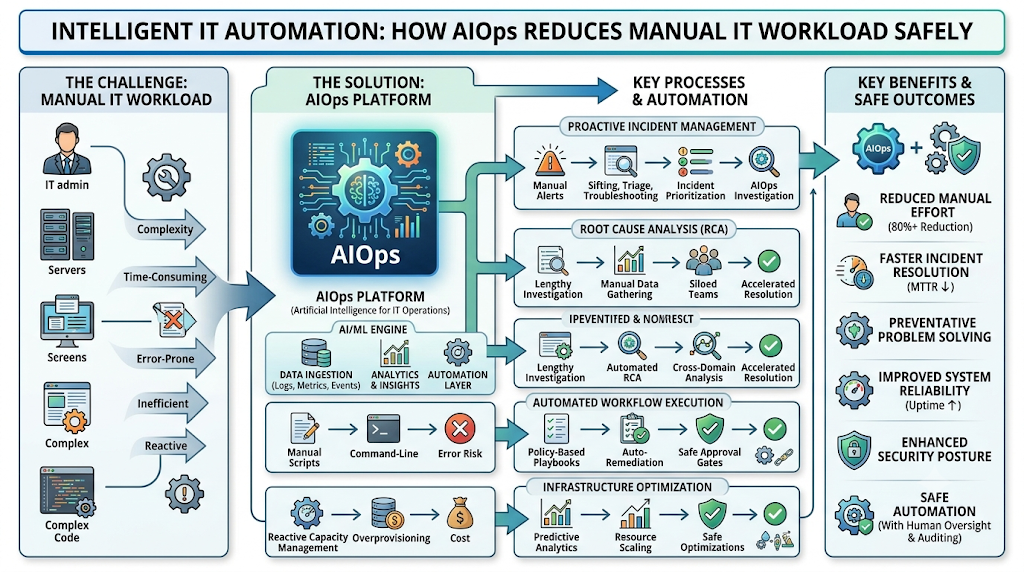
Modern enterprise IT environments have grown exponentially complex. The shift toward cloud-native architectures, microservices, and multi-cloud infrastructure has created an overwhelming ecosystem of active tracking points. Every second, systems generate thousands of alerts, log metrics, and data packets. This mountain of operational data creates major bottlenecks for human engineering teams. Manual workflows struggle to keep pace with modern data volumes, leading directly to alert fatigue, missed high-priority incidents, and severe burnout across core operations teams. Artificial Intelligence for IT Operations (AIOps) provides a definitive solution to this complexity. By utilizing advanced machine learning, automated incident management, and algorithmic filtering, AIOps processes data streams at machine speed, freeing engineering teams from grueling manual labor. For teams aiming to master this operational evolution, TheAIOps.com serves as an educational learning resource. The platform breaks down multi-layered observability, data parsing, and AI-powered monitoring concepts into clear, structured knowledge.
What Is AIOps?
Featured Snippet Definition:
AIOps (Artificial Intelligence for IT Operations) refers to the strategic integration of big data, machine learning, and advanced analytics into IT operations management software to automatically ingest, correlate, analyze, and resolve infrastructure issues in real time.
The core objectives of an enterprise AIOps deployment are straightforward: ingest massive volumes of disparate operations data, parse noise from genuine signals, and trigger automated scripts to handle repeating infrastructure tasks.
AI supports IT operations by converting passive, static monitoring tools into active, intelligent analytical hubs. Instead of waiting for a human engineer to configure strict alerting thresholds, machine learning models continuously study system behavioral baselines to accurately flag true operational anomalies.
As cloud-scale environments expand past human cognitive capacity, intelligent IT automation becomes a foundational business necessity. Algorithmic management ensures your engineering resources focus heavily on innovation rather than sorting through repetitive, low-value infrastructure noise.
Common Sources of Manual IT Work
       ┌──────────────────────────────┐
       │   Legacy Systems Data Pile   │
       └──────────────┬───────────────┘
                      ▼
 ┌──────────────────────────────────────────┐
 │ Alert Fatigue  │ Sifting Log Trails       │
 ├────────────────┼──────────────────────────┤
 │ Manual RCA     │ Broken Runbook Actions   │
 └────────────────┴──────────────────────────┘
Alert Monitoring
Engineers regularly find themselves buried under thousands of duplicate monitoring alerts daily. Spending hours reviewing near-identical notifications to verify if a server spike requires actual intervention drains operational momentum and dulls analytical focus.
Log Analysis
When an application behaves erratically, engineers must manually scour gigabytes of raw textual log entries across distributed machine clusters. Locating a specific timestamped error code within nested system paths resembles looking for a needle in a haystack.
Incident Investigation
When a core business service drops, teams immediately establish emergency bridge calls. Multiple engineers must manually cross-examine performance metrics across databases, applications, and networks, attempting to deduce where the breakage originated.
Root Cause Analysis (RCA)
Determining exactly why an underlying component failed usually involves hours of review, post-mortem write-ups, and manual verification of past structural deployments, which postpones permanent system remediation.
Performance Monitoring
Legacy monitoring configurations force teams to manually adjust alert limits for memory consumption, database queries, and network bandwidth, leaving systems vulnerable to unpredictable runtime changes.
Routine System Maintenance
Tasks such as cleaning disk drives, rotating encryption keys, restarting stuck background daemons, and patching security frameworks regularly occupy valuable hours when managed through manual human checklists.
How AIOps Reduces Manual IT Workload
Intelligent Alert Correlation
Consider an e-commerce platform where a database failure triggers thousands of secondary connectivity errors across microservices. Instead of burying engineers under a mountain of separate notifications, AIOps groups related events into a single, comprehensive incident dossier, immediately reducing alert noise by up to 90%.
Automated Anomaly Detection
Instead of relying on rigid, hardcoded performance thresholds, AIOps software tracks live application behaviors over time. If a memory utilization metric climbs unexpectedly at midnight on a Tuesday, the system flags the issue instantly, pinpointing quiet structural failures before they trigger an official outage.
AI-Assisted Root Cause Analysis
During an unexpected service disruption, an AIOps workflow engine automatically traces data relationships across infrastructure paths. It isolates the specific point of failure—such as a buggy, newly deployed microservice change—allowing engineering teams to confidently bypass hours of tedious troubleshooting.
Predictive Incident Detection
By continuously evaluating historic log signatures, storage capacities, and compute loads, predictive analytics engines can forecast an upcoming resource exhaustion incident hours before it occurs. This foresight gives infrastructure teams plenty of time to address systemic failures gracefully during regular business hours.
Workflow Automation
When a critical system error surfaces, AIOps goes far beyond simply sending an alert. It communicates with IT process automation frameworks to trigger specific runbook scripts. For example, if an internal disk fills up unexpectedly, the platform automatically purges temporary caches without requiring human intervention.
Automated Reporting
Compiling complex availability data, cluster utilization summaries, and incident timeline post-mortems can consume days of management time. AIOps platforms automatically compile these systemic metrics into clear executive dashboards, providing stakeholder visibility instantly.
Self-Healing Operations
By combining intelligent anomaly detection with precise automated runbooks, enterprise AIOps realizes true self-healing operations. The AI independently spots service degradations, discovers the root issue, and executes a targeted software restart, restoring normal performance parameters before an end user ever notices a delay.
TheAIOps.com Approach to Reducing Manual IT Workload
Automating Operational Tasks
True enterprise efficiency starts by completely removing human intervention from repetitive, low-risk operational activities. By employing pre-tested automation blueprints, organizations allow their monitoring systems to resolve routine maintenance tasks instantly, keeping engineering focus aimed at strategic architecture.
Improving Infrastructure Visibility
Scattered monitoring tools create fragmented visibility. Modern telemetry requires a single, unified observability lens that spans hybrid and multi-cloud environments, ensuring that cross-system data points are parsed, mapped, and structured into clear, visual dependency trees.
Reducing Alert Fatigue
To safeguard engineer morale, alerting systems must filter out harmless background noise. By implementing algorithmic event deduplication, teams ensure that engineering notifications are reserved exclusively for actionable incidents that directly impact user experiences.
Increasing Operational Efficiency
Efficiency improves dramatically when teams transition away from chaotic, firefighting models toward orderly, automated workflows. Streamlining operational intake paths ensures incident resolution timelines are measured in seconds rather than hours.
Building Intelligent IT Operations
Constructing intelligent operations requires a continuous feedback loop between human expertise and machine intelligence. As engineers validate automated root-cause suggestions, the underlying AI models grow smarter, laying down a highly reliable framework for autonomous digital systems.
Benefits of AIOps Automation
- Reduced Manual Effort: Eliminates repetitive, low-value system checks, returning valuable development hours back to your core engineering teams.
- Faster Incident Resolution: Drastically reduces remediation timelines by pinpointing the precise technical root cause of an outage within seconds.
- Improved Service Availability: Predictive anomaly detection surface minor resource issues before they manifest into major customer-facing downtime.
- Lower Operational Costs: Minimizes the financial waste associated with prolonged outages, manual diagnostics, and excessive tool duplication.
- Better Resource Utilization: Maximizes your compute footprint by using machine learning models to adjust server provisioning based on actual performance data.
- Enhanced Customer Experience: Consistent application availability and fast load times protect brand reputation and customer trust.
Real-World Industry Applications
Banking and Financial Services
Financial transaction networks handle immense request volumes every single second. AIOps platforms continuously analyze transaction logs to instantly catch processing delays or minor API deviations, keeping online banking portals secure and constantly operational.
Healthcare
Hospital networks and digital record systems cannot tolerate operational downtime. AIOps tools continuously track healthcare databases and medical telemetry platforms, keeping vital provider portals online around the clock.
Telecommunications
Telecom operators use AIOps workflow automation to oversee massive, distributed cellular networks and fiber backbones. The AI isolates noisy cellular tower equipment and automatically reroutes data traffic around hardware faults to prevent dropped calls.
Cloud Service Providers
Hyperscale infrastructure platforms use machine learning models to track server room temperatures, balance compute loads across data clusters, and predict impending hardware failures, swapping storage components smoothly with zero service interruption.
E-Commerce
During major shopping holidays, global e-commerce systems face unprecedented spikes in user checkouts. AIOps-powered monitoring scales cloud resources outward dynamically, tracking payment gateway performance to prevent abandoned shopping carts.
Manufacturing
Industrial smart factories integrate AIOps to monitor peripheral server nodes controlling factory robotics. The system identifies data packet drops along conveyor belts early, keeping manufacturing production lines running continuously.
Manual IT Operations vs. AIOps-Driven Operations
| Feature | Manual IT Operations | AIOps-Driven Operations |
| Alert Analysis | Manual, prone to oversights and alert fatigue | AI-assisted, automatically deduplicated and grouped |
| Incident Detection | Reactive, waiting for systems to fail completely | Predictive, tracking anomaly signs before outages happen |
| Root Cause Analysis | Time-consuming cross-team triage bridges | Automated insights generated by data mapping engines |
| Workflow Execution | Manual command execution and manual runbooks | Automated playbooks triggered by algorithmic signals |
| Operational Efficiency | Moderate, limited by human tracking speed | High, driving rapid incident resolution 24/7 |
Common Challenges and Practical Solutions
Legacy Infrastructure
Outdated, on-premise monolithic applications frequently lack modern telemetry outputs, making data collection difficult.
Solution: Introduce lightweight open-source data collectors or monitoring agents alongside your legacy environments, funneling raw logs into an central analytics hub before launching full AIOps integrations.
Data Quality
Machine learning models depend heavily on clean input data; disorganized, unstructured logs can skew correlation models.
Solution: Enforce strict data formatting and standardized labeling across your development pipelines, ensuring logs arrive at your AIOps platform clean and well-structured.
Tool Integration
Enterprises often use dozens of separate monitoring systems, creating siloed data pockets that resist centralization.
Solution: Map out your monitoring footprint and prioritize an open ecosystem approach, utilizing modern webhooks and standardized APIs to bridge your current platforms together.
Skills Gap
Traditional system administrators may feel overwhelmed by advanced statistical concepts, data modeling, and modern machine learning platforms.
Solution: Invest in intuitive, no-code AIOps tools and run internal workshops to help operations teams comfortably shift from manual monitoring into automated fleet management.
Organizational Change
Teams accustomed to manual validation methods may initially resist allowing an automated engine to execute self-healing scripts.
Solution: Start your automation journey in “read-only” mode, allowing the AI to recommend fixes while human operators retain final manual approval until confidence is thoroughly established.
Best Practices for Transitioning to AIOps
- Centralize operational data first: Consolidate your logs, system metrics, and network traces into a single, unified observability lake before activating AI tools.
- Automate repetitive workflows gradually: Start by automating low-risk, frequent manual actions like cleanups and service restarts before building complex end-to-end automations.
- Continuously improve AI models: Regularly review and tune your alert grouping rules to match seasonal traffic patterns and new architecture changes.
- Integrate observability tools across layers: Connect your application, network, and database layers into the AIOps platform to construct complete dependency maps.
- Measure operational improvements regularly: Keep close tabs on key performance indicators to clearly demonstrate your automation return on investment to stakeholders.
Key Performance Metrics to Track
┌────────────────────────────────────────────────────────┐
│               CORE MONITORING METRICS                  │
├───────────────────────────┬────────────────────────────┤
│  Mean Time to Detect      │  Mean Time to Resolve      │
├───────────────────────────┼────────────────────────────┤
│  Alert Reduction Rate     │  Automation Success Rate   │
├───────────────────────────┼────────────────────────────┤
│  Total Incident Volume    │  Global Service Uptime     │
└───────────────────────────┴────────────────────────────┘
- Mean Time to Detect (MTTD): The average duration it takes for your platform to surface a hidden systemic anomaly.
- Mean Time to Resolve (MTTR): The average time required to correct an issue and return a degraded service to normal performance parameters.
- Alert Reduction Rate: The percentage of raw monitoring noise filtered out via algorithmic event correlation.
- Automation Success Rate: The proportion of triggered runbooks that successfully resolve a system fault without human assistance.
- Incident Volume: The absolute count of escalated service tickets requiring manual engineer intervention.
- Service Availability: The overall percentage of system uptime, confirming your applications remain consistently available to your end users.
Career Opportunities in Modern IT Operations
As modern enterprises replace legacy workflows with automated operations, specialized roles continue to expand across the tech industry:
- AIOps Engineer: Focuses on designing, training, and maintaining machine learning pipelines dedicated to enterprise infrastructure telemetry.
- Site Reliability Engineer (SRE): Uses software engineering principles to automate system administration, infrastructure scaling, and incident management.
- Cloud Operations Engineer: Overlooks multi-cloud resource health, ensuring server architectures adjust dynamically to demand spikes.
- Infrastructure Engineer: Manages the baseline compute, network fabric, and storage frameworks supporting modern enterprise applications.
- Observability Engineer: Designs metrics data pipelines, distributed tracing paths, and centralized visualization layers across complex platforms.
- Enterprise Automation Specialist: Builds out automated runbooks and IT process integrations to eliminate manual steps from operational workflows.
Future of AIOps Automation
Autonomous IT Operations
The future points toward completely hands-off IT operations management. Autonomous cloud networks will constantly monitor their own performance metrics, adjust server resources, and resolve application bugs completely independent of human guidance.
AI-Driven Observability
Future monitoring systems will completely eliminate manual dashboard configuration. Advanced observability engines will dynamically adjust their own telemetry collection speeds, gathering deep tracking data during complex incident windows and scaling back down during calm periods.
Self-Healing Infrastructure
Infrastructure will grow entirely resilient against standard component breakdowns. When a server node displays early degradation patterns, underlying software architectures will migrate workloads and replace components seamlessly with zero application downtime.
Hyperautomation
Enterprises will combine AIOps with broader automated development workflows. This continuous integration loop will see AI systems catch runtime bugs, draft patch code, run regression tests, and deploy verified fixes back to production instantly.
Intelligent Enterprise Operations
AIOps tools will connect directly with high-level business software. By mapping technical performance against live business metrics, the system can prioritize application resource boosts for high-revenue business transactions during unexpected load spikes.
Common Misconceptions
AIOps Eliminates IT Jobs
Automation shifts technical responsibilities rather than eliminating human teams. While AI absorbs repetitive alerting noise, enterprises still rely heavily on engineers to architect complex platforms, supervise automated models, and handle creative engineering design.
Automation Solves Every Operational Problem
Software tools only follow the data patterns and architectural frameworks they are provided. If your underlying network design is inherently unstable, adding an AI monitoring tool will not fix the underlying engineering flaw.
AIOps Is Only for Large Enterprises
While massive corporations benefit immensely from AI diagnostics, smaller organizations can leverage accessible SaaS AIOps tools to manage lean, modern application stacks without hiring massive, round-the-clock infrastructure teams.
AI Works Without Human Oversight
An AIOps platform is not a magical, set-it-and-forget-it black box. Machine learning models require steady input verification, strategic tuning, and clear architectural parameters defined by seasoned engineering professionals to operate safely.
FAQ Section
- How does AIOps distinctively reduce a team’s daily alert fatigue?
AIOps automatically ingests thousands of individual monitoring alerts, strips away duplicate notifications, and groups related entries into a single actionable incident case based on shared timestamps and infrastructure paths.
- Can AIOps tools fix system bugs without human engineers?
Yes, for known infrastructure tasks. When connected to IT process automation platforms, AIOps can trigger automated runbook scripts to clear out memory caches, scale server nodes, or restart stuck processes independently.
- What is the technical difference between standard monitoring and AIOps?
Traditional monitoring tools simply display system data and sound alarms based on static thresholds. AIOps actively analyzes that data using machine learning to detect anomalies, correlate events, and uncover root causes.
- Will implementing AIOps require rewriting our current application code?
No. AIOps tools integrate cleanly at the operations layer by collecting existing system logs, open telemetry signals, and network tracking data via standardized APIs and open-source data agents.
- What exactly is automated event correlation?
It is the algorithmic process of analyzing separate data points across different software layers and grouping matching events together so engineers only receive a single, contextual alert during an issue.
- How does predictive analytics prevent system downtime?
By continuously evaluating historic consumption trends and log signatures, allowing the system to flag an impending disk or memory failure hours before it causes a user-facing slowdown.
- Is a data lake mandatory before setting up an AIOps solution?
Having a centralized data repo is highly recommended, as machine learning models require comprehensive log, trace, and metric data to establish accurate behavioral baselines across your environment.
- What types of machine learning models run inside AIOps software?
AIOps uses a mixture of unsupervised clustering models for alert grouping, time-series regression for anomaly detection, and natural language processing (NLP) to parse raw system log files.
- Can AIOps platforms monitor multi-cloud systems like AWS and Azure at the same time?
Yes. Enterprise AIOps platforms are designed to ingest divergent telemetry streams from multiple public cloud providers and on-premise servers into a single dashboard.
- Where should our operations team begin learning about AIOps architectures?
Educational hubs like TheAIOps.com provide excellent technical overviews, practical design patterns, and deployment best practices to help engineering teams transition smoothly into intelligent IT automation.
Final Summary
Embracing automated operations through an enterprise AIOps strategy has become an essential requirement for managing modern, high-velocity cloud systems. By applying algorithmic event correlation, proactive anomaly detection, and automated root cause analysis, organizations dramatically minimize operational noise while safeguarding their engineering resources from burnout. Transitioning away from reactive firefighting models allows technology teams to address systemic bottlenecks with software-driven precision. For engineers, architects, and IT leaders eager to navigate this transformation, platforms like TheAIOps.com supply the foundational educational knowledge needed to build smart systems. Melding machine intelligence with human engineering oversight ensures your business systems remain consistently stable, highly available, and perfectly optimized for future growth.
