Upgrade & Secure Your Future with DevOps, SRE, DevSecOps, MLOps!
We spend hours scrolling social media and waste money on things we forget, but won’t spend 30 minutes a day earning certifications that can change our lives.
Master in DevOps, SRE, DevSecOps & MLOps by DevOps School!
Learn from Guru Rajesh Kumar and double your salary in just one year.
Introduction
Modern business runs on software. To keep up with customer demands, companies must constantly update their applications, fix security vulnerabilities, and upgrade their infrastructure. However, as organizations transition to complex hybrid cloud environments, managing these updates becomes incredibly difficult. A single minor software tweak can unintentionally trigger a massive system outage, impacting thousands of users and costing millions of dollars. For a long time, IT departments relied on manual reviews to approve updates. Today, the sheer speed and scale of modern technology make manual oversight too slow and error-prone. This is where Artificial Intelligence (AI) and IT Operations Analytics change the game. By introducing machine learning and intelligent automation into the lifecycle, companies can spot hidden risks before code goes live. This article explores how AI enhances IT change management, helping organizations deploy updates faster while protecting their systems from unexpected downtime. For more foundational reading on modern IT strategies, you can visit the educational resources at TheAIOps.com.
What Is IT Change Management?
IT Change Management is a structured process within IT Service Management (ITSM) designed to ensure that modifications to an organization’s technology infrastructure are made with minimal disruption to live services. Whether an engineer is updating a database, deploying a new app feature, or replacing hardware, it qualifies as an IT change.
The core objectives of change management include:
- Minimizing Risks: Preventing updates from breaking other interconnected systems.
- Ensuring Stability: Maintaining high uptime for applications and infrastructure.
- Providing Clear Visibility: Tracking who made a change, why they made it, and what systems were affected.
- Standardizing Workflows: Establishing repeatable steps for proposing, testing, and implementing updates.
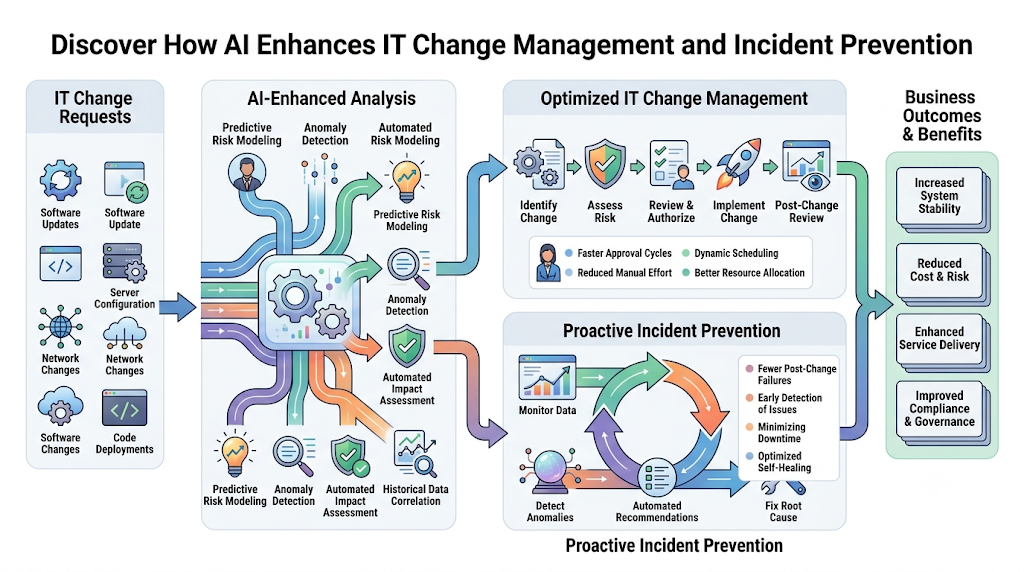
The standard lifecycle of a change typically flows through several stages: creation, evaluation, approval, implementation, and post-change review. In traditional ITSM, these steps rely heavily on human checkboxes. Because changes happen constantly in today’s digital world, maintaining this lifecycle manually can stall innovation and cause major bottlenecks.
What Is AI in IT Operations?
AI in IT Operations, commonly known as AIOps, is the practice of using data science and machine learning to automate and improve how an organization manages its technology environment. Instead of relying on engineers to manually scan millions of log files, AIOps platforms ingest vast streams of data to find patterns and anomalies automatically.
AIOps brings together three core technical pillars:
- Machine Learning (ML): Algorithms that look at historical IT data to learn what “normal” system behavior looks like.
- Predictive Analytics: Math models that analyze past behavior to forecast future performance trends or potential failures.
- Intelligent Automation: Software scripts that execute fixes, route alerts, or trigger system actions without human intervention.
AIOps does not replace ITSM; instead, it supercharges it. While ITSM provides the structured processes and rules for managing IT services, AIOps provides the real-time data, speed, and analytical brainpower needed to make those processes work efficiently at scale.
Why AI Is Transforming IT Change Management
Traditional change management is reactive and slow. Teams often spend hours sitting in meetings trying to guess if a software update will cause issues. AI transforms this paradigm by introducing proactive, data-driven insights into every phase of the update cycle.
- Faster Risk Assessment: AI can review a proposed change and cross-reference it with thousands of historical deployments in seconds, identifying hidden risks instantly.
- Better Impact Analysis: Software architectures are highly interconnected. AI maps out these dependencies, showing engineers exactly which downstream applications might break if a specific server is updated.
- Predictive Failure Detection: By analyzing past patterns, AI can flag an upcoming update as a high failure risk, warning teams before any code is deployed.
- Automated Approvals for Low-Risk Changes: Routine, low-risk updates (like standard patches) can be fast-tracked automatically by AI, freeing up human workers to focus on complex projects.
- Continuous Monitoring: AI monitors system health during and immediately after a deployment, catching minor glitches before they grow into full-blown customer outages.
- Reduced Downtime: By accurately predicting issues and accelerating response times, AI dramatically slashes the time a business spends dealing with broken systems.
How AI Enhances IT Change Management
Implementing AI within the change management process follows a logical, step-by-step workflow that transforms how IT teams operate.
Step 1: Collecting Operational Data
The AI platform continuously gathers data from across the entire enterprise. This includes code repository logs, historical tickets, real-time performance metrics, server logs, and employee communication channels.
Step 2: Analyzing Historical Changes
The machine learning models look back at months or years of past deployments. The AI learns which specific types of updates succeeded, which ones failed, and what the system conditions were during those moments.
Step 3: Predicting Change Risks
When an engineer schedules a new update, the AI evaluates it against historical patterns. It assigns a change risk score based on factors like code complexity, the engineer’s past success rate with similar updates, and current system load.
Step 4: Impact Analysis
The AI builds a live map of the company’s infrastructure dependencies. It simulates the update to see how data flows will shift, alerting the team if a change to an underlying database will accidentally slow down a customer-facing app.
Step 5: Intelligent Approval Support
The Change Advisory Board (CAB) receives data-driven recommendations from the AI. Instead of guessing, the board looks at clear risk scores and evidence, allowing them to make fast, confident approval decisions.
Step 6: Deployment Monitoring
As the change is pushed live, the AI scans live performance metrics. It looks for subtle anomalies—like a slight rise in memory usage or a minor spike in error rates—that a human operator might miss.
Step 7: Automated Rollback
If the AI detects that a newly deployed update is causing system health to degrade, it can instantly trigger an automated rollback script. This removes the broken update and restores the previous, stable version of the application within seconds.
Step 8: Continuous Learning and Optimization
Once the deployment cycle ends, the AI stores the results. Whether the update succeeded or failed, the system uses that outcome to train its algorithms, making its future risk predictions even more accurate.
Core AI Capabilities Used in Change Management
To understand how AI enhances IT change management, it helps to break down the specific underlying technologies that drive these systems.
- Machine Learning: The foundation that allows software to learn from historical data patterns without being explicitly programmed.
- Event Correlation: The ability to group thousands of scattered IT alerts into a single, understandable incident, preventing teams from becoming overwhelmed by alert noise.
- Anomaly Detection: A capability where the AI flags any system behavior that deviates from the established baseline, such as an unusual spike in database traffic after an update.
- Predictive Analytics: Software math that uses historical data trends to predict future failures, such as calculating the likelihood that a server will run out of storage space next week.
- Root Cause Analysis: Algorithms that trace a system error back to its exact point of origin, helping engineers find out why a change caused an issue.
- Intelligent Alerting: Systems that filter out unimportant notifications and only alert the specific engineering teams who need to act.
- Automation: Pre-written software instructions that execute repetitive tasks, like spinning up testing environments or running system checks.
- Observability: Deep, end-to-end visibility into a system’s internal state based on the data it generates, allowing the AI to understand the full health of the infrastructure.
Real-World Case Studies
To see how AI enhances IT change management in practice, let us review six representative enterprise scenarios across major industries.
Case Study 1: The Banking Sector
- Business Challenge: A multinational retail bank needed to update its digital banking apps frequently to stay competitive, but strict financial regulations required zero downtime.
- Existing Change Management Problem: The bank’s manual Change Advisory Board took up to two weeks to review and approve simple software updates, causing severe delays in launching new features.
- AI or AIOps Solution: The bank deployed an AIOps platform that integrated with their existing ITSM ticketing system to automate risk scoring.
- Implementation Approach: The platform analyzed three years of historical change tickets to build a predictive risk engine, which automatically evaluated all incoming change requests.
- Measurable Business Outcome: Automated risk scoring allowed the bank to auto-approve 65% of low-risk changes instantly, reducing the average change approval time from two weeks down to just two hours.
- Key Lessons Learned: Historical ticket data is highly valuable; cleaning up past ticket records allows AI models to deliver accurate risk predictions quickly.
Case Study 2: The Healthcare Industry
- Business Challenge: A large hospital network managed critical electronic health record (EHR) systems that doctors relied on during surgeries and patient care.
- Existing Change Management Problem: Software updates to secondary hospital applications occasionally broke the primary EHR system due to hidden software dependencies, threatening patient safety.
- AI or AIOps Solution: The network implemented an AI-driven dependency mapping and impact analysis tool.
- Implementation Approach: The tool actively tracked data traffic across the hospital’s hybrid cloud infrastructure to map out exactly how different applications connected to each other.
- Measurable Business Outcome: The hospital network achieved incident prevention by catching 90% of unintended app dependencies prior to deployment, ensuring zero downtime for critical patient systems during updates.
- Key Lessons Learned: Visualizing complex app relationships using AI protects critical, life-saving systems from accidental human oversight.
Case Study 3: Cloud Services Provider
- Business Challenge: A global cloud infrastructure firm had to push out thousands of microservice updates every single day across millions of virtual servers.
- Existing Change Management Problem: When an automated update failed, human engineers took too long to find the root cause, resulting in SLA penalties and customer complaints.
- AI or AIOps Solution: An automated system anomaly detection engine combined with an automated rollback framework.
- Implementation Approach: The cloud firm built an AI pipeline that monitored server health metrics in real-time during every single microservice deployment.
- Measurable Business Outcome: The system automatically identified bad updates and triggered an automated rollback within 45 seconds of deployment, reducing the average duration of bad updates by 95%.
- Key Lessons Learned: In high-speed cloud environments, human reaction times are too slow; automated remediation is necessary to maintain performance standards.
Case Study 4: Telecommunications Enterprise
- Business Challenge: A mobile network operator needed to upgrade cellular tower software configurations to prepare for increased network demands.
- Existing Change Management Problem: Network updates frequently caused unexpected localized service drops, leading to massive spikes in customer support call volumes.
- AI or AIOps Solution: A predictive analytics engine designed to forecast network performance during planned maintenance windows.
- Implementation Approach: The AI model evaluated past network behavior during weather events, holidays, and previous maintenance updates to predict optimal upgrade schedules.
- Measurable Business Outcome: The operator reduced failed network changes by 40% and scheduled all high-risk changes during perfectly optimized, low-traffic time slots.
- Key Lessons Learned: Contextual data—like time of day and regional user traffic patterns—is vital for selecting safe change implementation windows.
Case Study 5: E-commerce Platform
- Business Challenge: An online retail giant needed to continuously update its checkout application features to maximize sales conversions during major shopping holidays.
- Existing Change Management Problem: High alert noise during major updates confused engineers, making it hard to tell if a post-update drop in sales was caused by a software bug or normal customer behavior shifts.
- AI or AIOps Solution: An AI event correlation and intelligent alerting system.
- Implementation Approach: The system filtered out thousands of minor background system alerts and grouped related system symptoms into single, actionable dashboard notifications.
- Measurable Business Outcome: The engineering team reduced alert noise by 80%, allowing them to run root cause analysis on real bugs significantly faster and protect peak revenue periods.
- Key Lessons Learned: Eliminating background data noise helps developers focus on fixing actual code errors before they impact the bottom line.
Case Study 6: Manufacturing Sector
- Business Challenge: An automotive manufacturer utilized smart factory robotics that relied on regular software and firmware updates to stay efficient.
- Existing Change Management Problem: Bad firmware deployments occasionally brought assembly lines to a complete halt, costing the company hundreds of thousands of dollars per hour.
- AI or AIOps Solution: A continuous monitoring and predictive machine learning model deployed directly at the factory edge.
- Implementation Approach: The AI established behavioral baselines for physical factory robots, tracking metrics like electrical draw and processing latency right after firmware updates.
- Measurable Business Outcome: The manufacturer prevented major factory floor shutdowns by identifying anomalous robotic behavior within minutes of an update, safely containing issues before assembly lines were impacted.
- Key Lessons Learned: AI change management extends beyond software code; it is highly effective at protecting physical industrial systems and IoT hardware.
Benefits of AI in IT Change Management
Bringing artificial intelligence into your IT workflows yields widespread organizational advantages.
- Reduced Failed Changes: Predictive insights allow teams to fix problematic update scripts long before they reach live environments.
- Faster Deployments: Automation speeds up risk analysis, meaning software upgrades can move through the approval pipeline in hours rather than weeks.
- Better Compliance: AI automatically logs every single action, step, and metric during a change, providing an indisputable, tamper-proof audit trail for regulatory compliance.
- Improved Service Availability: Faster root cause analysis and rapid rollbacks keep user-facing systems online, preserving the company’s brand reputation.
- Lower Operational Costs: IT teams spend less time troubleshooting broken updates and firefighting incidents, allowing them to focus on productive development tasks.
- Higher Customer Satisfaction: When apps work flawlessly without frequent maintenance outages, customers enjoy a smooth, reliable digital experience.
- Better Decision-Making: Business leaders and tech managers can base their strategic IT infrastructure choices on real-world, data-driven analytical insights.
Common Challenges
While the benefits are clear, organizations must navigate several obstacles when integrating AI into their change management workflows.
- Data Quality Issues: AI models require large volumes of clean, well-formatted historical data to learn effectively. If an enterprise has sloppy, incomplete ITSM tickets, the AI’s risk predictions will be highly inaccurate.
- Legacy Infrastructure: Older, monolithic software systems often lack the modern data outputs and APIs needed to feed real-time information into an AIOps platform.
- AI Model Accuracy: In rare instances, AI models can experience “hallucinations” or generate false positives, incorrectly flagging safe changes as high-risk or missing actual software bugs.
- Integration Complexity: Connecting modern AI platforms to highly fragmented enterprise IT toolsets can require significant engineering time and custom development work.
- Skills Gap: Traditional change managers and IT staff may lack the data science and automation training required to interpret AI data and manage machine learning tools effectively.
- Governance and Compliance: In highly regulated industries, fully turning over system change decisions to an automated algorithm can create tricky legal, security, and internal compliance issues.
Best Practices
To successfully adopt AI within your change management processes, consider these practical recommendations:
- Start Small: Do not try to automate your entire enterprise infrastructure overnight. Begin by applying AI risk analysis to a single, non-critical application or a specific development team.
- Clean Your Historical Data: Before turning on machine learning models, spend time cleaning up your historic ITSM databases, filling in missing fields, and standardizing ticket notes.
- Keep Humans in the Loop: Use AI as an advisory tool first. Let the software provide risk scores and recommendations, but keep human engineers in charge of the final approvals until you gain complete trust in the system.
- Invest in Continuous Training: Regularly retrain your AI models with fresh operational data so they can adapt smoothly as your software applications and business goals evolve.
- Foster Collaboration: Bring your development (DevOps), security, and operations teams together early in the deployment process to ensure the AI tool addresses everyone’s needs.
Future Trends
The technology powering IT operations continues to advance rapidly. Over the next few years, we can expect to see several exciting trends change the landscape:
- Generative AI for Change Planning: Future systems will use advanced language models to automatically write step-by-step implementation procedures and fallback scripts based on standard developer requests.
- Autonomous Change Management: Systems will evolve from providing recommendations to entirely self-directed operations, where the AI safely schedules, tests, deploys, and checks updates all on its own.
- AI-Assisted CAB Decisions: Virtual AI assistants will participate in change board meetings, answering live questions from human managers and providing instant data lookups.
- Self-Healing Infrastructure: If a software change causes a system problem, the AI will not just roll back the update—it will automatically patch the underlying code bug on the fly.
- Intelligent Digital Twins: Companies will use AI to create complete virtual replicas of their entire live IT network, allowing them to test complex updates in a safe simulation before touching real production servers.
- Predictive Compliance: AI software will scan upcoming software update packages in real time to ensure they comply with global data laws like GDPR or HIPAA before the code is even compiled.
Traditional IT Change Management vs. AI-Enhanced Change Management
| Feature | Traditional Approach | AI-Enhanced Approach | Business Impact |
| Risk Assessment | Manual reviews based on human memory and opinions. | Automated analytics processing historical data patterns. | Faster, highly accurate risk identification. |
| Approval Workflows | Slow, scheduled weekly Change Advisory Board meetings. | Instant, automated approvals for known low-risk updates. | Faster feature delivery and eliminated bottlenecks. |
| Dependency Mapping | Static documentation spreadsheets that quickly go out of date. | Dynamic, live infrastructure tracking across environments. | Fewer unexpected downstream application breaks. |
| Incident Response | Manual troubleshooting sessions by stressed engineering teams. | Automated anomaly detection and instant root cause analysis. | Drastically reduced system downtime and repair times. |
| Rollback Execution | Manual execution of recovery scripts by on-call engineers. | Automated rollback triggered instantly by system health drops. | Immediate protection against bad software updates. |
AI Technologies Supporting IT Change Management
| AI Capability | Purpose | Business Benefit | Example Use Case |
| Machine Learning | Learns historical patterns from past IT ticket data. | Minimizes the recurrence of known operational mistakes. | Grouping past changes to identify repeat failures. |
| Predictive Analytics | Forecasts potential errors before updates go live. | Allows teams to proactively fix issues early. | Flagging an upcoming server update as a high failure risk. |
| Anomaly Detection | Monitors real-time metrics for weird system behaviors. | Catches minor software bugs before they impact users. | Spotting a minor memory leak right after code deployment. |
| Event Correlation | Bundles thousands of scattered alerts into single events. | Reduces tool alert noise for engineering staff. | Condensing 500 server errors into one clear master issue. |
| Automation Engine | Runs system tasks and configurations without human effort. | Eliminates manual errors and accelerates task delivery. | Instantly pulling back a bad update to restore service. |
FAQs
What is the main role of AI in IT change management?
AI analyzes historical deployment data, maps application dependencies, and detects real-time system anomalies to make software updates faster, safer, and highly predictable.
Can AI completely replace human Change Advisory Boards (CAB)?
No. AI serves as an intelligent advisor that handles tedious data analysis and minor approvals, allowing human managers to focus on complex, high-risk strategic decisions.
What is the difference between ITSM and AIOps?
ITSM outlines the structured policies, rules, and workflows for managing corporate technology services, while AIOps provides the real-time data science, machine learning, and automation to power those workflows.
How does AI help prevent system downtime during updates?
AI constantly monitors live metrics during deployments, identifying minor performance drops early and triggering automated rollbacks to remove broken updates before users notice.
What data does an AI change management tool need to work?
The system processes historical IT ticket logs, real-time performance metrics, application code repositories, server configuration records, and platform communication logs.
Is AI change management suitable for small businesses?
While highly valuable for large enterprises dealing with massive scale, smaller businesses with complex cloud infrastructure or rapid update cycles can also benefit from basic AI risk tools.
What is an automated rollback?
An automated rollback is a pre-written software script triggered by AI that instantly removes a newly deployed, malfunctioning update and restores the system to its last stable version.
How does AI reduce alert noise for engineering teams?
Through event correlation, AI analyzes thousands of minor, scattered system notifications, filtering out the background noise and grouping related symptoms into a single actionable alert.
What is the biggest challenge when deploying AI in change management?
Poor data quality is the biggest obstacle. If an organization’s historical IT tickets are sloppy or incomplete, the AI’s predictive models will struggle to generate accurate risk assessments.
How does predictive analytics improve change scheduling?
Predictive analytics evaluates historical traffic, seasonal spikes, and past maintenance windows to recommend the absolute safest times to implement high-risk system updates.
Conclusion
Integrating artificial intelligence into IT change management marks a major shift from reactive firefighting to proactive, intelligent operations. By leveraging machine learning, predictive analytics, and automated rollbacks, enterprises can confidently accelerate their software delivery cycles while safeguarding system stability. However, technology alone is not a magic fix. A successful transition to AI-enhanced processes relies on a balanced combination of high-quality operational data, strong internal governance frameworks, and continuous model optimization. When organizations pair smart automation tools with trained, collaborative engineering teams, they turn IT change management into a powerful engine for reliable, long-term business growth.
