Upgrade & Secure Your Future with DevOps, SRE, DevSecOps, MLOps!
We spend hours scrolling social media and waste money on things we forget, but won’t spend 30 minutes a day earning certifications that can change our lives.
Master in DevOps, SRE, DevSecOps & MLOps by DevOps School!
Learn from Guru Rajesh Kumar and double your salary in just one year.
Introduction
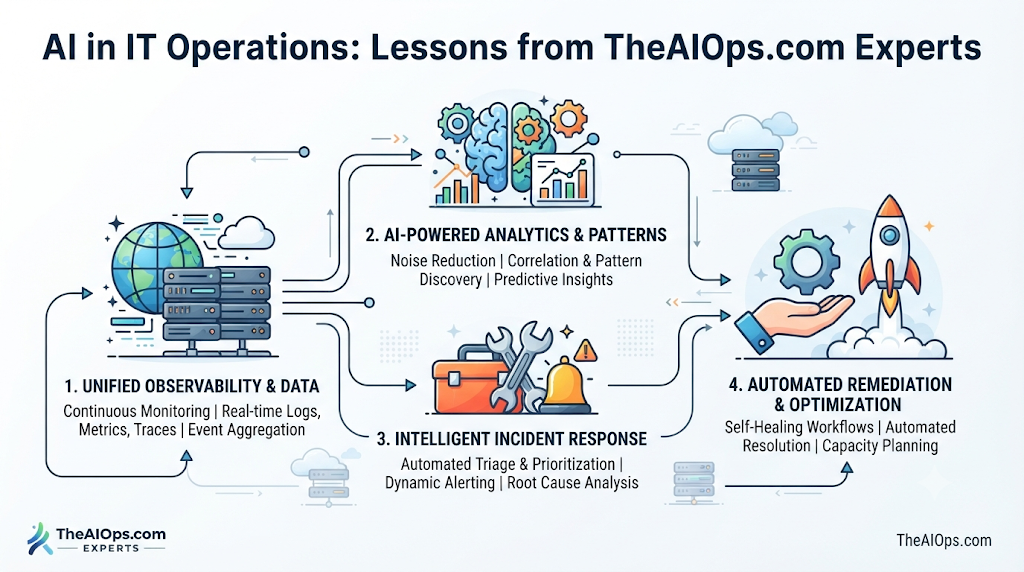
Modern enterprise IT systems are growing at an exponential rate. With the rapid migration to hybrid cloud architectures, microservices, containerization using Kubernetes, and multi-cloud deployments, managing infrastructure using traditional, manual IT operations methods is no longer sustainable. Systems generate terabytes of logs, metrics, traces, and operational events every single day. For IT operations teams, system administrators, DevOps engineers, and Site Reliability Engineers (SREs), this surge in data often leads to server downtime, alert fatigue, and reactive firefighting. This operational challenge is where Artificial Intelligence for IT Operations (AIOps) becomes essential. AIOps applies machine learning (ML), big data analytics, natural language processing (NLP), and intelligent automation to collect, correlate, and analyze operational data in real time. s. At TheAIOps.com, our educational platform delivers expert-driven frameworks, practical architecture patterns, and actionable insights to help technology professionals master AI-driven IT operations.
What is AI in IT Operations?
AI in IT Operations (AIOps) represents the convergence of artificial intelligence, machine learning, big data analytics, and operational automation to manage modern IT environments intelligently. Coined by Gartner, AIOps bridges the gap between massive operational data streams and timely human decision-making.
Instead of relying on human operators to manually configure static thresholds or comb through server logs during an outage, AIOps ingestion pipelines aggregate data across multi-cloud environments, network layers, application stacks, and IT Service Management (ITSM) systems.
+-----------------------------------------------------------------------+
|                       AIOps Data Pipeline                             |
+-----------------------------------------------------------------------+
| DATA SOURCES   : Logs | Metrics | Traces | Events | ITSM Tickets      |
| INGESTION      : Real-Time Stream Ingestion & Data Normalization     |
| AI/ML ENGINE   : Anomaly Detection | Event Correlation | Predictive Analytics |
| ACTION LAYER   : Self-Healing Automation | Incident Alerting | ITSM Sync |
+-----------------------------------------------------------------------+
An enterprise AIOps platform handles three core functional tasks:
- Observe: Ingests and normalizes continuous streams of structured and unstructured telemetry data (metrics, logs, traces, events) across hybrid infrastructures.
- Engage: Uses unsupervised and supervised machine learning models to detect anomalies, eliminate redundant alerts, and pinpoint the probable root cause of complex failures.
- Act: Executes automated remediation workflows, updates service desk tickets, or triggers dynamic capacity adjustments through infrastructure-as-code automation.
Evolution from Traditional IT Operations to AIOps
IT operations models have evolved considerably over the past two decades. Understanding this transition highlights why traditional monitoring tools fail in microservice and multi-cloud environments.
+---------------------------------------------------------------------+
|                  Evolution of IT Operations                         |
+---------------------------------------------------------------------+
| Traditional IT Ops  --->  DevOps & SRE  --->  AIOps-Driven Ops     |
| Static Servers            Cloud & Containers   Hybrid & Multi-Cloud |
| Manual Scripts            CI/CD Pipelines      Intelligent Automation|
| Reactive Fixing           Continuous Monitoring Predictive Prevention|
+---------------------------------------------------------------------+
- Traditional IT Operations: Relied on monolithic architectures, static server configurations, and manual monitoring tools. Operators set static performance thresholds (e.g., alert if CPU usage exceeds 80%). When thresholds were breached, engineers manually parsed log files to trace the issue.
- DevOps & Early SRE Practices: Accelerated software deployment through Continuous Integration and Continuous Deployment (CI/CD) pipelines, infrastructure automation, and dynamic cloud services. While velocity increased, the volume and complexity of telemetry data grew beyond human scale, resulting in fragmented visibility across disparate tools.
- AIOps-Driven IT Operations: Introduces continuous context and algorithmic intelligence. Instead of alerting on isolated metrics, AI models evaluate dynamic baselines, correlate cross-domain signals, predict failures ahead of time, and execute self-healing actions with minimal human friction.
Strategic Comparison: Traditional IT Operations vs. AIOps
| Operational Dimension | Traditional IT Operations | AIOps-Driven IT Operations |
| Data Handling | Siloed metric collection with limited log retention | Unified ingestion of metrics, logs, traces, and events in real time |
| Threshold Management | Static, manually configured threshold triggers | Dynamic baselines learned through machine learning algorithms |
| Problem Resolution | Reactive firefighting after user-facing outages occur | Proactive anomaly detection and automated self-healing workflows |
| Alert Volume | High noise level resulting in severe engineer alert fatigue | Algorithmic event deduplication and noise reduction up to 90% |
| Root Cause Analysis | Manual log searching across multiple disparate tools | Algorithmic topology mapping and instant causal link analysis |
| Operational Goal | Keep systems online through manual maintenance | Enable continuous delivery, zero downtime, and autonomous ops |
Why AI is Transforming Modern IT Operations
Modern infrastructure scale renders human-only system supervision insufficient. A single cloud-native e-commerce application deployed across Kubernetes clusters can process millions of API requests per minute, generating millions of telemetry signals.
+-----------------------------------------------------------------------+
|                    Key Drivers for AIOps Adoption                     |
+-----------------------------------------------------------------------+
| Microservice Complexity | Multi-Cloud Sprawl | Data Volume Explosion |
+-----------------------------------------------------------------------+
                                  |
                                  v
+-----------------------------------------------------------------------+
|                    AIOps Value Transformation                         |
+-----------------------------------------------------------------------+
| Noise Reduction  -->  Causal Identification  -->  Automated Healing  |
+-----------------------------------------------------------------------+
AI transforms modern IT operations through three key capabilities:
1. Managing Data Complexity at Scale
Human operators cannot process millions of logs per second across heterogeneous cloud environments. AI algorithms ingest and process vast volumes of structured and unstructured telemetry data continuously, uncovering hidden patterns and dependencies that human eyes would miss.
2. Eliminating Siloed Monitoring
Enterprise organizations often use separate tools for network monitoring, APM (Application Performance Monitoring), database tracking, and cloud security. AIOps acts as a central neural network, aggregating disparate telemetry channels into a single source of truth.
3. Transitioning from Reactive to Predictive Operations
Traditional monitoring warns you after a database has crashed. AIOps identifies subtle memory leaks, unusual query latencies, and resource consumption trends hours before an outage occurs, allowing SREs to fix issues proactively.
Understanding the AIOps Lifecycle
Implementing AI in IT operations requires a continuous, structured lifecycle. Experts at TheAIOps.com break this lifecycle down into five distinct, repeatable phases:
+-----------------------------------------------------------------------+
|                        The AIOps Lifecycle                            |
+-----------------------------------------------------------------------+
|  [1. Ingest]  -->  [2. Clean]  -->  [3. Analyze]                      |
|                                             |                         |
|  [5. Adapt]   <--  [4. Automate] <----------+                         |
+-----------------------------------------------------------------------+
1.1. Multi-Source Telemetry Ingestion:
Ingest data across all infrastructure tiers—including system logs, time-series metrics, distributed tracing spans, network packet captures, and ITSM ticketing histories.
2.2. Data Normalization and Noise Reduction:
Clean, structure, and deduplicate raw log messages and metric records. Group identical or related alert notifications to reduce operational noise.
3.3. Pattern Recognition and Anomaly Detection:
Apply unsupervised machine learning models to establish dynamic baselines of normal operational behavior. Flag statistical anomalies in real time without reliant manual configuration.
4.4. Automated Action and Orchestration:
Trigger automated remediation scripts, scale compute resources, restart degraded pods, or route contextual incident insights directly to on-call engineering teams.
5.5. Continuous Model Training and Feedback Loops:
Incorporate operational feedback from incident outcomes, ticket resolutions, and engineer actions to continuously train and refine the accuracy of underlying AI models.
Key Lessons from TheAIOps.com Experts
Through real-world deployments and engineering research, experts at TheAIOps.com have identified core principles for successful AIOps adoption:
AI-Powered Monitoring and Observability
Traditional monitoring asks “is the server up?” Observability asks “why is the system behaving this way?” AI-driven observability integrates MELT (Metrics, Events, Logs, and Traces) into a contextual model. Rather than viewing isolated CPU spikes, engineers view how a spike correlates with a microservice latency regression downstream.
Intelligent Event Correlation
When a core database cluster slows down, hundreds of downstream microservices may trigger alerts simultaneously. AIOps algorithms evaluate dependency topology graphs to correlate these related alerts into a single actionable incident, eliminating noise and keeping on-call engineers focused on the root problem.
+-----------------------------------------------------------------------+
|                    Intelligent Event Correlation                      |
+-----------------------------------------------------------------------+
| 500 Disparate System Alerts                                           |
| (Database Latency, Pod Restarts, API Gateway Timeouts)                |
|                                 |                                     |
|                                 v                                     |
|                   AIOps ML Correlation Engine                         |
|                                 |                                     |
|                                 v                                     |
| 1 Actionable Incident Ticket with Topology Context & Root Cause       |
+-----------------------------------------------------------------------+
Predictive Analytics for Proactive Issue Detection
By analyzing historical telemetry using time-series forecasting models (such as ARIMA or LSTM neural networks), AIOps platforms identify impending capacity bottlenecks, disk space depletion, and memory exhaustion well before critical failure limits are breached.
AI-Based Root Cause Analysis (RCA)
Finding the root cause of an outage manually can take hours of multi-team collaboration. AI-based RCA uses causality graphs and change-impact analysis to scan configuration updates, recent code deployments, and infrastructure modifications, instantly highlighting the specific change that triggered the failure.
Automated Incident Detection and Response
Mean Time to Detect (MTTD) and Mean Time to Resolve (MTTR) are vital engineering metrics. AIOps platforms automate incident routing, enrich alerts with real-time logs, and trigger automated runbooks, reducing MTTR from hours to minutes.
Self-Healing Infrastructure
Self-healing systems execute predefined, validated corrective actions autonomously. When an AIOps agent detects a deadlocked application thread or a memory-leaking container, it can safely cycle the instance, clear cache allocations, or adjust load balancer configurations without requiring manual intervention.
+-----------------------------------------------------------------------+
|                     Self-Healing Workflow Pattern                     |
+-----------------------------------------------------------------------+
| [Anomaly Detected] --> [Match Known Pattern] --> [Execute Runbook]    |
|                                                         |             |
| [System Restored]  <-- [Validate Metric Health] <-------+             |
+-----------------------------------------------------------------------+
Capacity Planning with AI
Static capacity allocation leads either to wasted infrastructure spend or under-provisioned application crashes during traffic surges. AIOps models predict traffic patterns, business growth cycles, and seasonal demand variations, enabling precise autoscaling and cost optimization across cloud environments.
AI in Hybrid and Multi-Cloud Operations
Managing resources across AWS, Azure, Google Cloud Platform (GCP), and on-premises datacenters creates operational blind spots. AIOps abstracts cloud platform boundaries, delivering unified observability and policy enforcement across hybrid environments.
Integrating AI with ITSM, DevOps, and SRE Practices
AIOps works alongside established operational frameworks, boosting their effectiveness across IT environments.
+-----------------------------------------------------------------------+
|                    AIOps Integration Ecosystem                        |
+-----------------------------------------------------------------------+
|        DevOps         |          SRE          |         ITSM          |
|  (Faster Releases &   |   (SLO Tracking &     |   (Auto Ticket Sync & |
|  Automated Telemetry) |   Error Budgets)      |   Incident Routing)   |
|                       |                       |                       |
|                       +-----------+-----------+                       |
|                                   |                                   |
|                                   v                                   |
|                       AIOps Intelligence Core                         |
+-----------------------------------------------------------------------+
- IT Service Management (ITSM): Integrates with platforms like ServiceNow or Jira Service Management. AIOps automatically generates, updates, categorizes, and closes tickets based on real-time incident resolution data, keeping service desk records aligned with live system health.
- DevOps Pipelines: Enhances CI/CD workflows by providing automated feedback loops during blue/green deployments or canary releases. If an AI model detects anomalous error spikes during a deployment, it can automatically trigger a pipeline rollback.
- Site Reliability Engineering (SRE): Helps SRE teams track Service Level Indicators (SLIs) and protect Service Level Objectives (SLOs). By predicting when an error budget is exhausting prematurely, AIOps alerts engineers before contractual Service Level Agreements (SLAs) are breached.
Popular AIOps Platforms and Tools
Selecting the right platform depends on your environment’s architectural maturity, cloud provider ecosystem, and operational requirements.
| Platform | Core Features | Primary Use Cases | Key Business Benefits |
| Datadog AIOps | Watchdog ML engine, log anomaly detection, APM tracing, automated root cause analysis. | Cloud-native microservices, container tracking, full-stack observability. | Rapid deployment, unified dashboarding, automated alert noise filtering. |
| Dynatrace | Davis AI causal engine, automatic topology discovery, full-stack dependency mapping. | Large enterprise cloud migrations, complex hybrid deployments, APM. | Precise root cause identification, minimal configuration overhead. |
| Splunk ITSI | Predictive service analytics, machine data analytics, event correlation, custom ML workflows. | Enterprise security operations, deep log analytics, hybrid datacenter tracking. | Unmatched log aggregation scale, customizable security/ops reporting. |
| ServiceNow AIOps | ITSM integration, Predictive Intelligence, automated service mapping, event management. | Enterprise service desk automation, IT service operations management (ITOM). | Streamlined ticket routing, clear business service health visibility. |
| IBM Cloud Pak for AIOps | Multi-source event correlation, automated runbook invocation, natural language summaries. | Hybrid multi-cloud management, large-scale enterprise automation. | Reduced mean time to repair, cross-cloud governance. |
Real-World Enterprise Use Cases
Case Study 1: Global E-Commerce Retailer Eliminates Black Friday Outages
- Challenge: During peak shopping events, thousands of simultaneous microservice alerts flooded on-call engineers, making it difficult to locate critical database connection bottlenecks.
- AIOps Solution: The engineering team deployed an AIOps platform to correlate real-time telemetry across Kubernetes clusters.
- Result: The system reduced alert noise by 88%, auto-scaled payment gateway pod allocations before latency degraded, and maintained 100% platform availability throughout peak sales periods.
Case Study 2: Banking Institution Automates Self-Healing for Core Services
- Challenge: Recurring memory leak anomalies in legacy banking application instances required manual midnight restarts by on-call engineers.
- AIOps Solution: The infrastructure team configured predictive anomaly detection paired with automated execution runbooks.
- Result: The platform detected memory consumption anomalies hours before crashes occurred, automatically cycling degraded services gracefully and cutting nighttime support calls by 92%.
Business Benefits of AI in IT Operations
Adopting AIOps delivers clear financial and operational returns across modern technology organizations:
+-----------------------------------------------------------------------+
|                    Business Impact Metrics of AIOps                   |
+-----------------------------------------------------------------------+
| [Downtime Reduction]  --> 50% - 80% Faster MTTR                       |
| [Noise Reduction]     --> Up to 90% Fewer False Positive Alerts       |
| [Cost Efficiency]     --> Reduced Over-Provisioning & Burnout         |
| [Agility & Velocity]  --> Accelerated CI/CD Release Cadence           |
+-----------------------------------------------------------------------+
- Downtime Minimization: Reduces Mean Time to Detect (MTTD) and Mean Time to Repair (MTTR) by up to 80%, protecting revenue and SLA commitments.
- Significant Noise Reduction: Filters out false positives and groups related alerts, allowing engineers to focus on real system threats.
- Optimized Operational Costs: Reduces over-provisioned cloud infrastructure spend through predictive autoscaling.
- Mitigated Team Burnout: Automating repetitive level-1 troubleshooting tasks prevents on-call fatigue, improving team productivity and engineer retention.
Common Challenges and How to Overcome Them
While the benefits of AIOps are substantial, deployment efforts can run into common hurdles:
- Data Silos and Poor Data Quality: AI algorithms depend on clean, comprehensive inputs (“garbage in, garbage out”).
- Solution: Standardize log schemas, centralize telemetry ingestion pipelines, and clean input data before passing it to ML training engines.
- Resistance to Automation: Engineering teams may hesitate to grant automated agents control over production infrastructure repairs.
- Solution: Implement a progressive automation strategy. Start with human-in-the-loop approvals, validate runbook safety over time, and gradually transition to full autonomy as confidence grows.
- Skills and Expertise Gap: Teams may lack experience in data engineering, machine learning pipelines, and advanced observability techniques.
- Solution: Invest in structured training, industry certification programs, and educational resources like TheAIOps.com.
Best Practices Recommended by Industry Experts
- Start Small and Focus on High-Value Use Cases: Avoid attempting to automate all infrastructure on day one. Begin by automating high-frequency, low-risk pain points like log alert deduplication or disk cleanup.
- Prioritize Data Normalization and Schema Consistency: Ensure uniform logging formats (e.g., JSON structure, standardized timestamps) across all microservices.
- Build Dynamic Topology Maps: Feed service configuration, network routing, and application dependency data into your AIOps tool to support accurate root cause analysis.
- Maintain Human Oversight During Initial Rollouts: Keep human approvals in place for high-impact corrective actions until self-healing runbooks achieve proven accuracy.
- Establish Clear Operational Metrics: Track MTTD, MTTR, false-positive reduction rates, and self-healing success rates to quantify return on investment over time.
Common Mistakes Organizations Should Avoid
- Treating AIOps as a Magic Plug-and-Play Solution: AIOps is not a simple software patch; it requires clean data, configured workflows, and ongoing operational tuning.
- Over-Automating Without Proper Guardrails: Executing untested automated scripts in production without rate-limiting or rollback safeguards can aggravate outages.
- Neglecting Organizational Culture: Deploying AIOps tools without retraining SRE and DevOps teams leads to low adoption and unused software licenses.
- Ignoring Data Privacy and Security: Telemetry pipelines often contain sensitive customer data or credentials. Ensure proper data masking, encryption, and compliance controls are active within ingestion paths.
Skills Required to Build a Career in AIOps
As AI restructures IT operations, technology professionals must update their skill sets to remain competitive:
+-----------------------------------------------------------------------+
|                    Core Skillset Matrix for AIOps                     |
+-----------------------------------------------------------------------+
| Operational Foundations | Data & AI Competencies | Engineering Skills |
| - Linux Administration  | - Machine Learning     | - Python & Go      |
| - Kubernetes & Docker   | - Time-Series Analysis | - Terraform & Ansible|
| - SRE & ITSM Principles | - PromQL & Log Analytics| - API Integrations |
+-----------------------------------------------------------------------+
- Core Linux & Cloud Systems Engineering: Strong knowledge of Linux OS internals, network protocols, Kubernetes orchestration, and multi-cloud architectures.
- Observability Engineering: Expertise in configuring tracing frameworks (OpenTelemetry), log aggregators, and metrics engines (Prometheus, Datadog).
- Applied Machine Learning & Data Literacy: Familiarity with data modeling, anomaly detection techniques, and time-series forecasting.
- Automation & Infrastructure as Code (IaC): Proficiency in Python, Go, Bash, Ansible, and Terraform to build self-healing runbooks and automated pipelines.
- SRE & ITSM Frameworks: Solid understanding of incident response, SLO management, and service operations standards.
Future Trends in AI-Driven IT Operations
+-----------------------------------------------------------------------+
|                   Next-Gen Trends Shaping AIOps                        |
+-----------------------------------------------------------------------+
| [Generative AI & LLM Assistants] --> Plain English Querying           |
| [Agentic Autonomous Remediation] --> Self-Correcting Architecture     |
| [OpenTelemetry Standardization]  --> Vendor-Neutral Observability     |
| [FinOps & AIOps Convergence]    --> Predictive Cloud Cost Control    |
+-----------------------------------------------------------------------+
1. Generative AI and LLM Copilots
Large Language Models (LLMs) are redefining operational interfaces. SREs can query infrastructure in natural language (e.g., “Summarize the deployment changes that triggered latency spikes in the checkout service in the last hour”) and receive contextual answers alongside suggested fixes.
2. Autonomous Agentic AI Workflows
Next-generation AIOps is moving beyond simple script triggers toward autonomous agentic workflows. AI agents evaluate dynamic environments, plan multi-step troubleshooting paths, test remediation options safely, and patch complex infrastructure issues with minimal supervision.
3. OpenTelemetry Standardization
The industry-wide adoption of OpenTelemetry ensures standardized, vendor-neutral collection of metrics, logs, and traces, making AIOps implementations simpler and eliminating platform lock-in.
4. Convergence of FinOps and AIOps
Future AIOps solutions will balance system performance against real-time operational costs, automatically adjusting cloud workloads to deliver ideal reliability at the lowest possible price point.
Frequently Asked Questions
What is the main difference between traditional monitoring and AIOps?
Traditional monitoring checks whether specific components are active using static thresholds, often producing noisy alerts. AIOps uses machine learning to aggregate multi-source data, establish dynamic baselines, predict failures, correlate related alerts, and trigger automated self-healing responses.
Can AIOps completely replace human IT engineers?
No. AIOps acts as an intelligent assistant that automates repetitive tasks, filters alert noise, and accelerates root cause analysis. Human engineering expertise remains critical for high-level architectural decisions, strategic planning, complex problem solving, and managing edge-case outages.
How does AIOps improve incident management?
AIOps streamlines incident management by deduplicating redundant alerts, grouping related telemetry events into a single ticket, automatically identifying the probable root cause, and executing automated runbooks to speed up remediation.
Is AIOps only suitable for large enterprise organizations?
While large enterprises with complex, hybrid environments gain significant value from alert noise reduction, medium-sized businesses running containerized or cloud-native microservices also benefit from AIOps capabilities to manage systems efficiently with lean teams.
What types of data are needed for an effective AIOps platform?
AIOps platforms require access to MELT telemetry data: Metrics (performance indicators), Events (system notifications), Logs (application and infrastructure event records), and Traces (end-to-end request journeys), along with historical ITSM ticketing data.
How does AIOps reduce alert fatigue for SREs and DevOps teams?
AIOps uses machine learning algorithms to group hundreds of simultaneous alerts linked to a single underlying failure into a single contextual notification, reducing false positives and alert volume by up to 90%.
What role does Machine Learning play in AIOps?
Machine learning models analyze historical telemetry to learn “normal” operational behavior, detect real-time anomalies, identify recurring failure patterns, and forecast future resource capacity needs accurately.
How do I start implementing AIOps in an existing IT environment?
Start by unifying telemetry ingestion paths and cleaning incoming operational data. Apply AI tools first for event deduplication and noise reduction, then gradually introduce automated root cause analysis and human-approved remediation runbooks.
How long does it take to see measurable results from an AIOps rollout?
Basic event correlation, alert noise reduction, and centralized visibility typically deliver measurable results within 30 to 60 days. Advanced predictive analytics and self-healing automation mature over 3 to 6 months as algorithms learn system behaviors.
Why should technology professionals use educational resources from TheAIOps.com?
TheAIOps.com delivers practical, vendor-neutral educational content, architectural patterns, career roadmaps, and expert insights designed to help engineers and technology leaders implement modern AIOps strategies successfully.
Conclusion
Artificial Intelligence for IT Operations is no longer an emerging concept—it is a core requirement for managing modern, enterprise-scale digital infrastructure. By shifting operational practices from reactive firefighting to proactive anomaly detection and automated self-healing, AIOps enables technology teams to maintain high availability, accelerate incident resolution, and support continuous business growth. Mastering AIOps requires a clear understanding of data pipelines, observability architectures, machine learning models, and automated orchestration. Following the lessons, strategies, and best practices shared by experts at TheAIOps.com gives organizations a reliable framework to reduce operational complexity, eliminate downtime, and build modern, resilient IT operations.
