Upgrade & Secure Your Future with DevOps, SRE, DevSecOps, MLOps!
We spend hours scrolling social media and waste money on things we forget, but won’t spend 30 minutes a day earning certifications that can change our lives.
Master in DevOps, SRE, DevSecOps & MLOps by DevOps School!
Learn from Guru Rajesh Kumar and double your salary in just one year.
Introduction
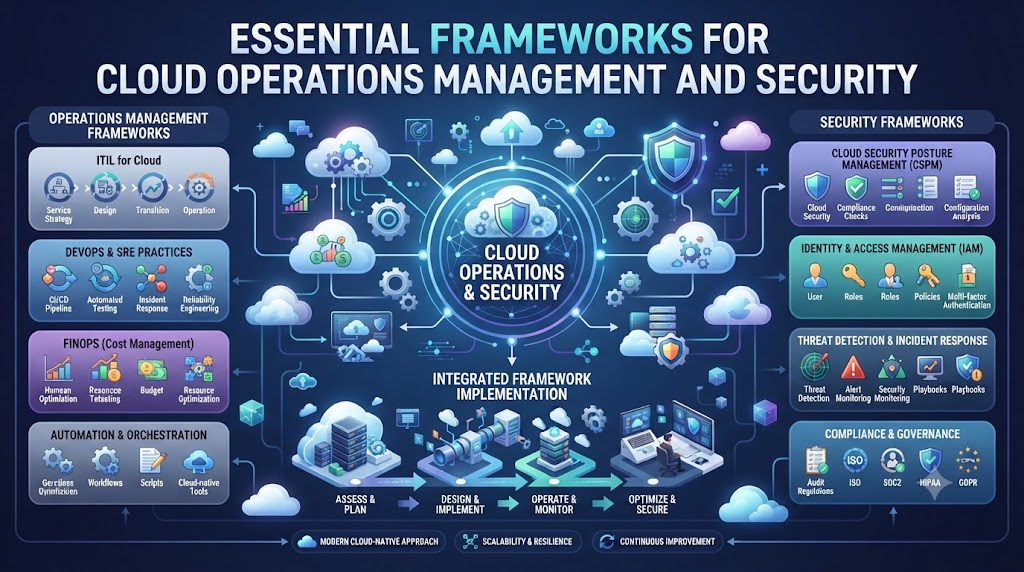
Modern technology enterprises frequently watch infrastructure invoices outpace overall business revenue when engineering teams launch cloud environments without rigorous programmatic controls. Manual resource provisioning and ad-hoc configuration updates introduce human errors, inconsistent environments, and prolonged recovery times during unexpected outages. To build resilient digital platforms, modern engineering teams rely heavily on cloud infrastructure automation. This foundational discipline eliminates repetitive operational toil, enforces absolute consistency across distributed environments, and accelerates software delivery pipelines. Mastering cloud infrastructure automation empowers SREs and platform engineers to maintain absolute control over growing resource footprints. To explore broader methodologies for streamlining workflows, visit CloudOpsNow. This article examines core architectural concepts, operational workflows, major hyperscaler approaches, and practical implementation strategies to transform your infrastructure lifecycle.
2. What Is Cloud Infrastructure Automation?
Cloud infrastructure automation is the practice of provisioning, configuring, scaling, and managing cloud resources using code and programmatic workflows rather than manual console clicks. Its primary purpose is to establish predictable, repeatable, and version-controlled infrastructure environments that scale seamlessly alongside modern applications. Core concepts involve defining infrastructure state declaratively, treating server configurations like application code, and orchestrating deployment pipelines automatically.
Within the broader scope of CloudOps, infrastructure automation bridges the gap between software development and infrastructure operations. Engineering teams adopt it to eliminate configuration drift—a phenomenon where manually modified environments slowly diverge from approved design standards. Organizations scaling distributed microservices or multi-cloud footprints benefit immensely, as programmatic control ensures uniform security posture and strict governance across every deployed resource cluster.
3. How Does Cloud Infrastructure Automation Work?
The technical workflow behind infrastructure automation relies on a continuous loop of declaration, state verification, and automated execution. Understanding this lifecycle ensures reliable infrastructure operations at scale.
- Declarative Definition: Engineers write infrastructure configurations using domain-specific languages or markup files that define the desired target state of computing, networking, and storage resources.
- Version Control Integration: Configuration files are committed to centralized version control repositories, enabling peer reviews, pull requests, and comprehensive audit trails for every infrastructure change.
- Plan and Validate Execution: Automation engines compare the desired state declared in code against the actual live state of the cloud provider to generate a precise execution plan.
- Programmatic Provisioning: The orchestration engine calls cloud provider APIs to provision compute instances, database clusters, and virtual private clouds securely and efficiently.
- Continuous Configuration Management: Post-provisioning tools apply operating system configurations, security patches, and application dependencies automatically.
- Observability Integration: Monitoring and logging agents attach to newly provisioned resources instantly, feeding real-time telemetry back to centralized dashboards.
4. Core Components of Cloud Infrastructure Automation
Infrastructure as Code (IaC)
Infrastructure as Code serves as the foundational bedrock of modern automation. By defining resources declaratively using tools like Terraform or OpenTofu, teams maintain complete parity between development, staging, and production environments.
Policy as Code
Policy engines evaluate infrastructure configurations against security benchmarks and compliance mandates prior to deployment. This mechanism blocks misconfigurations, open security groups, and unauthorized resource types automatically before they reach production.
Continuous Integration and Continuous Deployment (CI/CD)
CI/CD pipelines automate the testing, validation, and promotion of infrastructure code changes. Automated testing suites scan templates for vulnerabilities, execute dry runs, and deploy verified changes without human intervention.
5. Role of AWS, Azure, and GCP
Major hyperscalers provide native automation frameworks alongside robust APIs that integrate smoothly with cloud-agnostic tools.
In Amazon Web Services (AWS), native automation relies heavily on AWS CloudFormation and AWS Systems Manager for configuration orchestration. Microsoft Azure utilizes Azure Resource Manager (ARM) templates and Bicep files to streamline native resource deployments. Google Cloud Platform (GCP) leverages Google Cloud Deployment Manager and robust gcloud CLI automation scripts.
While native tools excel within single-cloud boundaries, modern enterprises managing distributed footprints often favor cloud-agnostic tools like Terraform. Cloud-agnostic platforms abstract provider-specific APIs into unified workflows, enabling seamless multi cloud management across AWS, Azure, and GCP from a single control plane.
6. Cloud Operations and Automation Considerations
Integrating automation into daily cloud operations requires a cultural shift toward platform engineering. Rather than treating infrastructure as static hardware, teams manage environments as dynamic software artifacts.
Effective automation relies on modular, reusable infrastructure modules that enforce organizational standards out-of-the-box. When combined with automated scaling groups and event-driven serverless triggers, operational teams can scale compute capacity dynamically in response to incoming user traffic. Automated remediation workflows can intercept common runtime faults, restarting unresponsive services or cycling unhealthy nodes before customer experience degrades.
7. Monitoring, Observability, and Reliability
Automated infrastructure is only as resilient as the observability framework tracking its health. Modern cloud monitoring strategies decouple infrastructure provisioning from runtime telemetry collection.
Engineering teams establish strict Service Level Indicators (SLIs) and Service Level Objectives (SLOs) to measure system availability and response latency. Metrics, structured logs, and distributed traces are ingested into centralized observability platforms. When automated deployments alter infrastructure topologies, tracing tools map dependencies dynamically, ensuring that incident response teams can isolate root causes rapidly during high-severity production outages.
8. Security and Governance
Security must be embedded directly into the automation lifecycle, a practice commonly referred to as Shift-Left security.
Identity and Access Management (IAM) policies must enforce the principle of least privilege, ensuring that automation service accounts hold strictly scoped permissions. Secrets management tools inject database credentials and API tokens dynamically at runtime, preventing plaintext secrets from leaking into version control repositories. Automated audit logging records every API call executed by provisioning engines, maintaining compliance readiness for regulatory frameworks.
9. Best Practices
- Adopt a Modular Architecture: Break large infrastructure codebases into reusable, self-contained modules to reduce duplication and simplify maintenance across teams.
- Mandate Code Reviews: Treat infrastructure pull requests with the same rigor as application code reviews to catch architectural flaws early.
- Enforce Remote State Management: Store infrastructure state files in secure, encrypted remote backends with state locking enabled to prevent concurrent conflicting updates.
- Implement Automated Testing: Utilize static analysis tools and policy linters to scan code for security vulnerabilities prior to deployment execution.
- Never Bypass the Pipeline: Prohibit manual changes in production cloud consoles to ensure that code remains the single source of truth.
- Design for Immutable Infrastructure: Replace outdated servers rather than patching them in place, guaranteeing predictable and clean environment states.
- Perform Regular Disaster Recovery Drills: Test your automated recovery workflows periodically to validate restoration time objectives under simulated failure conditions.
10. Common Mistakes
- Hardcoding Sensitive Variables: Embedding database passwords or access keys directly into configuration files compromises environment security immediately.
- Neglecting State File Drift: Failing to synchronize remote state files leads to conflicting updates and orphaned cloud resources.
- Over-Complicating Modules: Building monolithic automation scripts that attempt to provision entire enterprise footprints in a single execution loop.
- Skipping Dry-Run Validations: Applying infrastructure updates directly without reviewing execution plans often results in unintended resource deletions.
- Ignoring Resource Tagging Standards: Failing to enforce consistent tagging rules makes cost attribution and resource ownership difficult to trace.
11. Real-World Use Cases
- Multi-Region Disaster Recovery: Replicating entire application stacks across distinct geographic regions automatically to guarantee business continuity during regional cloud outages.
- Ephemeral Development Environments: Provisioning temporary, isolated staging environments for developers on-demand and tearing them down automatically after code reviews.
- Automated Compliance Auditing: Scanning live cloud infrastructure continuously against regulatory benchmarks and generating automated remediation scripts for non-compliant resources.
12. Challenges and Limitations
- Steep Learning Curve: Writing robust automation code requires specialized programming skills that traditional IT administrators may lack.
- Tool Sprawl and Complexity: Managing an expanding ecosystem of tools can introduce integration friction and overhead.
- Blast Radius Risks: A poorly tested script can propagate destructive changes across entire production environments within seconds.
- Drift Management Overhead: Reconciling manual console fixes with automated codebases demands rigorous operational discipline.
13. Step-by-Step Implementation Guide
- Assess Current Environment: Catalog existing cloud resources, identify manual operational bottlenecks, and map out resource dependencies.
- Define Governance Standards: Establish naming conventions, tagging policies, and security guardrails before writing code.
- Select Tooling Stack: Choose appropriate IaC, CI/CD, and policy enforcement tools that align with engineering capabilities.
- Build Core Modules: Write modular, reusable infrastructure templates for foundational components like networking and identity management.
- Establish CI/CD Pipelines: Configure automated build, test, and deployment pipelines with integrated security scanning.
- Migrate Non-Production First: Deploy automation workflows in sandbox or staging environments to validate reliability before touching production.
- Train Operations Teams: Educate engineers on troubleshooting automation pipelines and interpreting execution error logs.
14. Future of Cloud Infrastructure Automation
The evolution of cloud infrastructure automation points toward intelligent, AI-assisted operations and autonomous platform engineering. Generative AI tools assist engineers in writing and optimizing complex configuration templates, while machine learning models predict resource bottlenecks before they impact performance. Policy-driven automation will continue to mature, enabling self-healing architectures that resolve infrastructure anomalies autonomously without human intervention.
Frequently Asked Questions
- What is cloud infrastructure automation?
Cloud infrastructure automation is the method of provisioning and managing cloud resources using code and automated pipelines instead of manual processes.
- How does Infrastructure as Code improve reliability?
IaC ensures consistent environment setups, reducing human configuration errors and preventing drift between development and production stages.
- Can automation handle multi-cloud environments?
Yes, cloud-agnostic automation tools use unified configuration languages to manage resources across AWS, Azure, and GCP efficiently.
- What is the difference between monitoring and observability?
Monitoring tells you whether a system is working, while observability helps you understand why a system is failing by analyzing internal telemetry.
- Why is remote state management important in Terraform?
Remote state storage secures infrastructure metadata and prevents concurrent modifications from conflicting across team members.
- How does policy as code enhance security?
It evaluates infrastructure configurations against security benchmarks automatically before deployment, blocking non-compliant resources.
- Does automation eliminate all operational work?
No, automation reduces repetitive toil, allowing engineers to focus on architecture, optimization, and reliability engineering.
- What are the risks of poorly written automation scripts?
A flawed script can propagate configuration errors or accidental resource deletions across entire environments rapidly.
- How do cloud providers support automation?
Major cloud providers offer native APIs, command-line interfaces, and template engines to facilitate programmatic resource management.
- What is immutable infrastructure?
Immutable infrastructure involves replacing modified servers with fresh, pre-configured instances rather than patching them in place.
Conclusion
Mastering cloud infrastructure automation is essential for organizations striving to build resilient, scalable, and secure cloud environments. By replacing manual console operations with rigorous code-driven workflows, engineering teams minimize human error, accelerate delivery cycles, and optimize overall cloud operations management. Embracing disciplined automation practices empowers teams to scale infrastructure confidently while maintaining absolute control over reliability and governance.
