Upgrade & Secure Your Future with DevOps, SRE, DevSecOps, MLOps!
We spend hours scrolling social media and waste money on things we forget, but won’t spend 30 minutes a day earning certifications that can change our lives.
Master in DevOps, SRE, DevSecOps & MLOps by DevOps School!
Learn from Guru Rajesh Kumar and double your salary in just one year.
Introduction
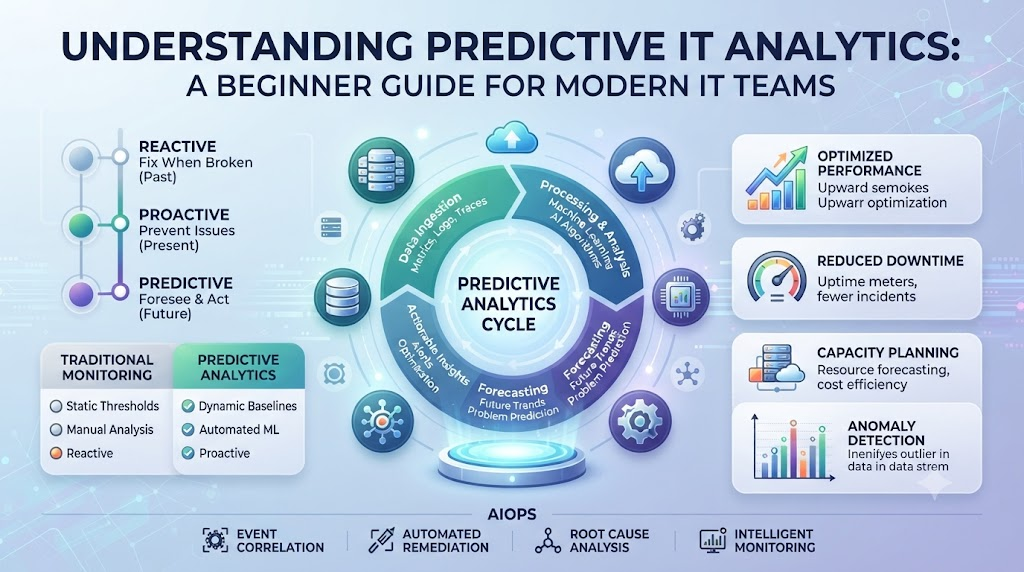
Traditional IT operations often resemble driving a car while only looking in the rearview mirror. IT teams frequently wait until a system error becomes visible on a dashboard, an alert floods the notification channel, or users submit support tickets complaining about downtime. This reactive firefighting mode forces engineers to spend hours diagnosing root causes after the damage is already done. Predictive IT analytics offers a shift away from this constant cycle by examining data patterns to identify possible future issues earlier. Instead of waiting for a storage volume to become completely full, a predictive system can analyze the daily growth trend and warn engineers that available capacity may become insufficient in the coming days. While predictive analytics cannot foresee every unexpected failure with 100% certainty, it provides valuable early warnings that help operations teams move from reactive problem-solving to proactive prevention. For broader perspectives on how these frameworks are structured, you can explore introductory resources like AIOps for Beginners on Medium.
What Is Predictive IT Analytics?
Predictive IT analytics involves analyzing historical data, current telemetry, usage trends, and system behavior to estimate what may happen in the future. Rather than simply telling you what happened five minutes ago, predictive analytics uses computational models to highlight emerging risks.
This approach supports several key operational tasks, including capacity planning, performance monitoring, incident prediction, and availability management. However, it is important to view predictive analytics as a decision-support capability rather than infallible fortune-telling. It estimates probabilities based on data trends, helping engineers prepare for potential challenges before they escalate.
What Is AIOps?
Artificial Intelligence for IT Operations, commonly known as AIOps, refers to the application of artificial intelligence, machine learning, analytics, and automation to modern IT environments. AIOps platforms combine operational data from diverse monitoring tools and use advanced algorithms to discover patterns, detect anomalies, and uncover relationships among disparate events.
The relationship between the two concepts is straightforward: AIOps represents the broader framework of intelligent IT operations, while predictive analytics acts as one specialized and powerful capability within that overarching approach. They are closely linked, but predictive analytics specifically focuses on forecasting future behavior rather than managing all aspects of IT operations.
Why Predictive Analytics Matters for IT Teams
Purely reactive IT operations create significant friction for engineering organizations. Teams often struggle with alert fatigue, unexpected outages, capacity bottlenecks, performance degradation, and repeated incidents that require manual investigation.
Predictive analytics matters because it helps teams spot subtle trend changes before they turn into critical failures. By complementing traditional monitoring dashboards with forward-looking insights, organizations can prioritize maintenance work, optimize resource allocation, and reduce the frequency of emergency firefighting.
How Predictive IT Analytics Works
Predictive IT analytics follows a structured workflow that transforms raw data into actionable operational insights.
Step 1: Collect Data
Systems gather telemetry from various sources, including metrics, logs, traces, events, alerts, incident history, and capacity records.
Step 2: Prepare Data
The system cleans, normalizes, and organizes historical records, removing duplicate entries and structuring inputs for analysis.
Step 3: Identify Patterns
Algorithms analyze time-series data and historical logs to recognize recurring patterns, cyclical demands, and performance baselines.
Step 4: Generate Forecasts
Models use recognized trends to estimate how metrics like CPU utilization, memory usage, or network traffic will behave in the future.
Step 5: Produce a Risk Signal
If a forecast suggests a metric will cross operational limits, the system generates a risk signal or warning indicator.
Step 6: Human Review
Engineers examine the predictive signal within the proper operational context, evaluating whether action is truly necessary.
Step 7: Take Action
Teams investigate the underlying cause or trigger approved automation workflows to prevent the predicted issue.
Role of Historical Data
Historical data forms the foundation of any predictive model. By examining previous incidents, resource usage trends, application performance logs, traffic patterns, and seasonal demand cycles, predictive systems learn how infrastructure behaved during past events.
However, historical data has inherent limitations. Past behavior does not guarantee future results. A major architectural change, a new software release, an unexpected traffic spike, or a sudden shift in user behavior can make old historical patterns much less reliable.
Role of Real-Time Telemetry
While historical records provide context, real-time telemetry keeps predictive systems grounded in the present. Monitoring live metrics such as CPU load, memory consumption, network latency, error rates, and request volumes allows analytics engines to evaluate current health. Predictive IT analytics becomes significantly more effective when historical trends are combined with accurate, up-to-the-minute operational data.
Anomaly Detection vs. Prediction
Understanding the distinction between anomaly detection and prediction is essential for any IT professional exploring AIOps.
- Anomaly Detection asks: “Is something unusual happening right now?”
- Predictive Analytics asks: “Based on available data, what may happen next?”
For example, if a server’s memory usage suddenly spikes far above normal, anomaly detection identifies that unusual behavior in the present. Predictive analytics takes that observation further, analyzing the rate of increase to estimate whether the server is heading toward a capacity exhaustion event in the hours ahead. Note that an anomaly does not always guarantee an incident will occur.
Dynamic Baselines
A baseline represents the normal, expected behavior of an IT system. Traditional monitoring often relies on static thresholds, such as triggering an alert whenever CPU utilization exceeds 85%. However, a server might legitimately run at 90% CPU every weekday during peak business hours.
Dynamic baselines adapt automatically to changing conditions, accounting for time of day, day of the week, and recurring traffic patterns. This approach dramatically reduces false alarms by understanding what constitutes normal behavior for a specific time window.
Event Correlation
Modern cloud-native environments generate thousands of alerts every single day, often burying engineers in noise. A single underlying database slowdown might trigger API latency warnings, downstream timeout errors, and multiple application alerts.
Event correlation connects these related signals, grouping symptoms together to reveal the core operational story. AIOps platforms use event correlation to reduce fragmented alert streams and provide teams with clear context regarding how different components interact.
Machine Learning in Predictive IT Analytics
Machine learning powers the pattern recognition, time-series analysis, classification, and forecasting engine behind predictive IT analytics. Instead of requiring engineers to write hardcoded rules for every possible failure scenario, machine learning algorithms learn from operational data automatically.
The choice of model depends heavily on data volume, system behavior, prediction objectives, and business requirements. No single algorithm works best for every IT environment, which is why platforms often combine multiple analytical techniques.
Common Use Cases
Predictive Capacity Planning
Historical resource consumption data helps organizations estimate future storage, compute, and memory requirements well in advance of shortages.
Performance Prediction
Observing trends in latency, request rates, or database query times helps teams spot performance degradation before users notice slowdowns.
Incident Prediction
Combining historical incident records with current telemetry helps teams identify conditions that frequently precede major outages.
Infrastructure Health
Continuous trend analysis can identify gradual shifts in system behavior that indicate hardware wear or software degradation.
Cloud Resource Optimization
Organizations analyze usage patterns to make informed decisions about scaling cloud resources up or down efficiently.
Practical Beginner Example
Imagine a growing web application running on a virtual server where memory usage increases steadily every single day.
- Monitoring tools collect memory consumption metrics continuously.
- Historical data reveals a gradual upward trend over the past two weeks.
- Predictive analytics analyzes this trend and extends the trajectory forward.
- The system estimates that available memory capacity will be exhausted within 48 hours.
- A proactive warning is generated on the operations dashboard.
- An engineer reviews the alert and investigates a memory leak in a recent service deployment.
- The development team patches the code before the application crashes.
This illustrative example demonstrates how predictive insights give teams time to resolve issues gracefully.
Benefits of Predictive IT Analytics
- Earlier awareness of emerging operational risks and capacity constraints.
- Better capacity planning based on actual consumption trends rather than guesswork.
- Reduced reactive firefighting and fewer emergency pages for engineering staff.
- Improved operational visibility across complex cloud-native architectures.
- Better prioritization of maintenance tasks and engineering projects.
- Reduced alert noise when integrated with effective event correlation.
Limitations and Challenges
Predictive IT analytics is not a silver bullet. Organizations often encounter several practical challenges:
- Poor-quality data, missing telemetry, or incomplete incident histories reduce model accuracy.
- False positives and false negatives can occasionally occur, requiring fine-tuning.
- Rapidly changing infrastructure and model drift can make historical predictions less accurate if models are not updated.
- Overreliance on automated predictions can lead to complacency if engineers stop exercising critical judgment.
Value depends heavily on data quality, continuous feedback loops, and proper workflow integration rather than treating AIOps as a magic system that eliminates human operators.
Best Practices for Beginners
- Start by focusing on one clear, manageable operational problem rather than trying to predict everything at once.
- Improve basic observability and data collection before implementing advanced machine learning models.
- Maintain clean historical incident records and reliable metric pipelines.
- Establish meaningful dynamic baselines that account for normal business cycles.
- Validate predictions against real-world outcomes to measure accuracy over time.
- Track false positives and adjust sensitivity thresholds accordingly.
- Keep human review at the center of important operational decisions.
Future of Predictive IT Analytics
The field of IT operations continues to evolve rapidly. Current capabilities focus on time-series forecasting and anomaly detection. Emerging capabilities include AI-assisted observability and smarter event correlation. Future possibilities point toward more context-aware predictive systems and tighter integration between human expertise and automated operations.
Predictive analytics will continue to serve as a vital decision-support layer, helping organizations manage increasingly complex digital infrastructure.
FAQs
- What is predictive IT analytics?Predictive IT analytics is the practice of using historical data, current telemetry, and machine learning to estimate future system behavior, identify potential risks, and help IT teams take proactive action.
- How does predictive analytics work in AIOps?It collects operational data, prepares the data, identifies behavioral patterns, generates forecasts, and produces risk signals that help engineers address problems before they cause outages.
- What data is used for predictive IT analytics?Common inputs include performance metrics, system logs, distributed traces, events, alerts, incident history, and capacity utilization records.
- What is the difference between anomaly detection and prediction?Anomaly detection identifies unusual behavior happening in the present, while predictive analytics uses data trends to estimate what might happen in the future.
- How does machine learning support predictive IT operations?Machine learning automates pattern recognition, time-series analysis, and trend forecasting without requiring engineers to manually configure hardcoded rules for every scenario.
- What are dynamic baselines in AIOps?Dynamic baselines represent expected system behavior that adapts automatically over time, accounting for recurring patterns like business hours or weekend traffic drops.
- Can predictive analytics prevent every IT incident?No. Predictive analytics provides probabilistic forecasts and early warnings, not guaranteed predictions, meaning it cannot foresee every unexpected failure or zero-day event.
- How does predictive analytics help with capacity planning?By analyzing historical resource consumption trends, it helps organizations estimate future storage, memory, and compute requirements before shortages occur.
- What are the main challenges of predictive IT analytics?Key challenges include poor data quality, missing telemetry, model drift, false positives, and the risk of overreliance on automated forecasts without human review.
- Do beginners need machine learning knowledge to understand predictive IT analytics?No. Beginners can understand the core concepts by focusing on how historical data, current telemetry, and trends are used to anticipate operational risks.
Conclusion
Predictive IT analytics transforms how organizations approach infrastructure management by leveraging historical data and real-time telemetry to anticipate future challenges. Through anomaly detection, forecasting, dynamic baselines, event correlation, and machine learning, IT teams can transition from constant firefighting to proactive operations. While predictive analytics provides valuable early warnings, it remains a decision-support capability rather than a guaranteed prediction system. Data quality, contextual understanding, and human engineering judgment remain essential for turning predictive insights into reliable operational success.
