Upgrade & Secure Your Future with DevOps, SRE, DevSecOps, MLOps!
We spend hours scrolling social media and waste money on things we forget, but won’t spend 30 minutes a day earning certifications that can change our lives.
Master in DevOps, SRE, DevSecOps & MLOps by DevOps School!
Learn from Guru Rajesh Kumar and double your salary in just one year.
Introduction
Modern cloud data platforms offer elastic compute, decoupled storage, and boundless scalability, but this elasticity introduces serious financial liabilities. Without operational discipline, unchecked transformation models, runaway recursive queries, unpartitioned table scans, and unmonitored backfills turn cloud warehouse invoices into corporate budget crises. Scaling data capabilities cannot rely on throwing expensive compute clusters at inefficient pipelines. Understanding what is DataOps through the combined lens of FinOps and systems optimization provides the framework needed to balance agility with cost control. DataOps bridges the gap between infrastructure spend and operational delivery, treating cloud compute and storage as finite, quantifiable resources that must be automated, tested, and monitored with precision. This guide explores how to build resilient, cost-effective data pipelines without sacrificing release speed or data quality. You will examine resource-conscious CI/CD design, automated query cost gates, lightweight validation testing, and runtime telemetry. Whether you are optimizing infrastructure spend or preparing for advanced technical roles at DataOpsSchool.com, these architectural strategies show how to deliver high-performance data operations within sustainable financial boundaries.
Reframing Cloud Economics: What Is DataOps to a FinOps Engineer?
To cloud financial architects and engineering leaders, what is DataOps beyond an automation framework? It is the operational discipline that aligns data lifecycle management, continuous software testing, and infrastructure automation directly with cloud cost efficiency and unit economics.
In traditional on-premises data warehouses, costs were fixed. Hardware was purchased upfront, and an inefficient batch query meant that an execution job ran for several hours longer during the night. In modern cloud platforms, compute and storage operate on dynamic consumption models. An inefficient, unoptimized query that scans terabytes of unpartitioned data multiple times a day actively drains enterprise operating capital every time it runs.
DataOps incorporates cost awareness directly into the software development lifecycle. Rather than treating cloud billing as an accounting review conducted weeks after an invoice arrives, a cost-conscious DataOps framework implements automated query cost analysis, ephemeral development sandboxes, intelligent resource pruning, and strict runtime timeouts directly into daily development workflows.
The Hidden Cost Drivers in Unregulated Data Systems
Without automated operational guardrails, data architectures generate massive financial and compute waste:
- Unconstrained Staging and CI Replications: Testing changes against complete petabyte-scale production datasets replicates massive physical storage and compute consumption for simple pull request validations.
- Redundant Transformation Re-runs: Orchestrators scheduled on blunt time-based cron jobs recompute unchanged historical partitions repeatedly rather than using incremental processing models.
- Runaway Query Traps: Analytical queries missing cluster keys or partition filters execute full-table scans across years of historical event streams, consuming hundreds of warehouse credits in minutes.
- Accumulation of Orphaned Storage Blocks: Ingestion failures, failed staging copies, and discarded ad-hoc analytical scratch tables remain active in cloud storage buckets, accruing unmonitored storage costs month after month.
- Expensive Emergency Backfills: When silent data bugs corrupt production reporting tables, engineers must spin up oversized clusters to reprocess months of historical partitions under emergency conditions, wasting valuable compute budgets.
Implementing a structured DataOps methodology converts these runaway expenses into transparent, predictable, and defensible operations.
The Resource-Efficient Data Lifecycle: Optimization at Every Stage
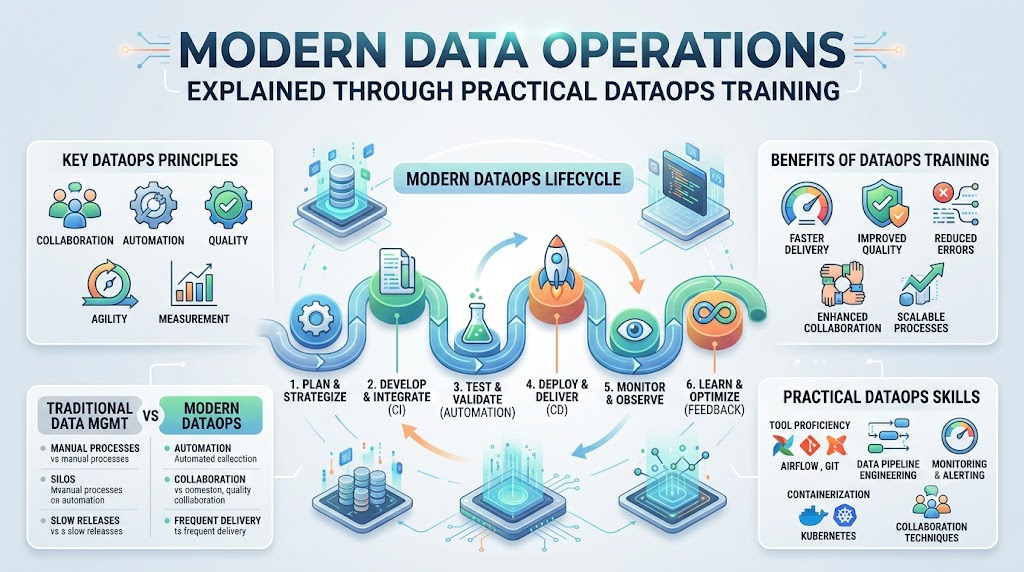
A cost-optimized DataOps architecture embeds efficiency, storage pruning, and compute controls throughout the data delivery lifecycle.
Source Ingestion → Compact Landing Storage → Incremental Modeling → Lightweight Automated Gates → Zero-Copy Deployment → Cost Observability
1. Ingestion and Compact Landing Storage
Data extracted from operational databases, external APIs, and streaming queues lands within cloud storage in optimized, columnar formats. Ingestion pipelines enforce compression algorithms and partition schemas immediately, ensuring that raw storage costs remain minimal while downstream scans read only required blocks.
2. Incremental Modeling and Transformation
Transformations replace expensive daily truncate-and-reload patterns with deterministic incremental models. By capturing watermarks and utilizing append-only change streams, transformations compute only new or updated records, drastically decreasing runtime duration and virtual warehouse credit consumption.
3. Lightweight Automated Quality Gates
Quality validation suites execute against targeted subsets, sampled tables, or zero-copy clones. Running assertions on structured samples verifies logical invariants without requiring full table scans, keeping CI testing lightweight and affordable.
4. Zero-Copy Promotion and Deployment
Continuous delivery pipelines deploy models using database metadata operations. By using virtual cloning and atomic view pointer swaps, changes are promoted into production namespaces instantly without duplicating physical storage blocks or incurring re-computation costs.
5. Continuous Cost and Performance Observability
Monitoring agents track not only job completion and row counts but also compute credits consumed per pipeline run, cost per query, and storage growth velocity. This operational telemetry alerts engineers whenever a newly deployed model breaches defined resource consumption baselines.
Architectural Pillars of Cost-Efficient DataOps
Continuous Integration and Deployment (CI/CD) with Cost Boundaries
A central requirement of resource-conscious DataOps is preventing continuous integration workflows from inflating cloud warehouse costs. Engineers must validate their code in realistic environments without scanning complete production datasets during every pull request.
[Developer Branch Commit]
           │
           ▼
[Static Syntax Linting & Dry-Run Cost Estimation]
           │
           ▼
[Ephemeral Environment Spin-Up (Zero-Copy Metadata Clone)]
           │
           ▼
[Incremental Transformation Testing (Sampled / Partition-Bounded)]
           │
           ▼
[Assertion Suites & Contract Validation]
           │
           ▼
[Approval, Atomic Production Swap & Ephemeral Teardown]
Advanced teams utilize zero-copy cloning features native to modern cloud warehouses. When a pull request opens, the CI platform generates a temporary schema that references production storage blocks without copying underlying data. Transformation tests run against this clone or target limited partition ranges, validating query logic thoroughly while capping compute expenditures.
Defensive, Multi-Tiered Testing Strategies
Validating data quality should protect revenue without generating massive compute bills. A balanced DataOps testing strategy operates across distinct cost tiers:
- In-Memory Logic Unit Tests: Uses mock datasets in local or containerized environments to test custom SQL functions, string parsing, and mathematical calculations without touching cloud warehouse compute.
- Schema Contract Tests: Verifies that incoming ingestion schemas match operational specifications before running any downstream warehouse transformation compute.
- Partition-Bounded Invariant Tests: Executes uniqueness, null checks, and referential integrity assertions solely against newly arrived partitions rather than scanning historical multi-year tables.
- Statistical Distribution Monitors: Analyzes column metadata and storage table profiles rather than running expensive compute-heavy aggregations over entire raw datasets.
SQL
-- Resource-efficient assertion: Validating data quality across the latest partition only
SELECT
    transaction_id,
    customer_id,
    transaction_amount_usd
FROM {{ ref('fct_daily_transactions') }}
WHERE partition_date = CURRENT_DATE()
  AND (transaction_amount_usd <= 0 OR customer_id IS NULL);
-- Partition-bounding keeps compute costs low during automated CI/CD checks
Observability: Merging Data Health with Unit Economics
Traditional operations monitoring focuses purely on pipeline execution times and server uptime. Cost-conscious data observability correlates pipeline execution status with cloud billing metrics:
- Cost-per-Pipeline Tracking: Measures the exact warehouse credits and storage costs consumed by specific data models, identifying expensive transformation nodes that require query optimization.
- Execution Duration and Warehouse Spikes: Flags queries that suddenly double their execution runtimes or exceed memory limits, catching Cartesian product bugs before they recur daily.
- Data Freshness SLAs: Ensures that compute clusters auto-suspend immediately after pipelines complete, preventing idle virtual warehouses from burning credits while waiting for scheduled tasks.
- Storage Footprint and Pruning Monitoring: Monitors the growth of intermediate tables, failed temporary staging areas, and time-travel storage states, enforcing automated retention and cleanup policies.
Architectural Trade-Offs in Cost-Optimized DataOps
| Architectural Dimension | Unregulated Data Platform | Cost-Optimized DataOps Framework | Engineering & Economic Trade-Offs |
|---|---|---|---|
| Data Transformations | Full daily table reloads (truncate/load) | Deterministic incremental modeling | Higher initial model engineering complexity; drastically reduces daily compute expenditure. |
| CI/CD Validation | Testing models over complete raw datasets | Testing via zero-copy clones and sampled data | Requires advanced CI configuration; prevents massive testing compute invoices. |
| Testing Regimes | Expensive full-table analytical queries | Partition-bounded assertions and metadata checks | Limits check scopes to new partitions; delivers high defect detection at minimal compute cost. |
| Workspace Strategy | Persistent, duplicate developer databases | Ephemeral schemas created and destroyed via CI | Demands automated scripting; eliminates duplicate storage costs and developer collisions. |
| Infrastructure Sizing | Oversized clusters provisioned permanently | Auto-scaling compute managed by IaC (Terraform) | Requires cloud infrastructure expertise; aligns compute spend strictly with workload demands. |
Practical Engineering Scenario: Mitigating the Runaway Transformation Model
Consider an enterprise data engineering team maintaining an attribution model that joins multi-million-row ad impressions with web events. In an undisciplined environment, an engineer updates the transformation SQL to incorporate a new join condition. The model lacks partition bounds and uses an inefficient cross-join. Merged directly to production, the job triggers every hour, running for 45 minutes on a large virtual warehouse and incurring thousands of dollars in unintended cloud spend over a single weekend.
Under a cost-conscious DataOps operating model, multiple guardrails prevent this disaster:
- Pre-Merge Cost Estimation: The engineer opens a pull request. The CI runner executes a dry-run compilation against the cloud warehouse, evaluating query plans and estimated bytes scanned.
- Ephemeral Testing on Clones: The CI runner spins up an ephemeral schema using zero-copy metadata cloning and runs the transformation model strictly against the trailing three days of partition data.
- Automated Resource Assertion: The CI pipeline checks query execution metrics within the isolated test environment. An automated gate flags that the updated join logic increased scanned byte volumes by 600 percent, automatically blocking the pull request.
- Model Optimization: The engineer identifies the missing partition filter, adjusts the join logic to use window functions over indexed keys, and re-submits the code.
- Safe Production Promotion: The optimized query passes execution and cost checks, merges cleanly into the main repository, and deploys atomically without spiking the cloud infrastructure budget.
Component Technologies in a Cost-Efficient DataOps Stack
Modern DataOps relies on purpose-built tooling to balance automation, testing, and financial efficiency:
Workflow Orchestration and Scheduling
- Apache Airflow: Provides mature Python DAG orchestration, allowing engineering teams to design fine-grained dependencies, automated retry schedules, and auto-suspending task workers.
- Dagster: Focuses on software-defined assets and declarative dependencies, enabling engineers to track asset partitions, manage materialization costs, and eliminate redundant processing.
- Prefect: Delivers code-first workflow coordination with dynamic task allocation, state inspection, and lightweight container orchestration that scales down to zero when idle.
Transformation and Modeling Layer
- dbt (data build tool): Standardizes SQL transformations into modular, version-controlled software assets, natively supporting incremental materializations, partition filtering, and automated assertion testing.
Automated Testing and Contract Validation
- Great Expectations: An open-source Python validation library that allows teams to build declarative assertion suites, ensuring data payloads adhere to expectations without manual checks.
- Soda: A lightweight assertion framework providing human-readable configuration files to monitor data quality and schema compliance with minimal query overhead.
Cloud Data Platforms and Lakehouses
- Snowflake, Databricks, BigQuery, and AWS Redshift: Elastic cloud engines that decouple storage and compute, providing auto-suspending virtual warehouses, zero-copy cloning, and dynamic query acceleration.
Declarative Infrastructure Configuration
- Terraform: Automates the lifecycle of virtual warehouses, storage buckets, autoscaling parameters, and IAM policies through declarative code, preventing unmonitored infrastructure sprawl.
Implementation Challenges and Practical Solutions
Adopting a resource-efficient DataOps model presents distinct operational hurdles:
- Balancing Test Coverage with Compute Budgets: Teams often assume that thorough testing requires scanning massive datasets during every build, making managers reluctant to approve CI testing.
- Solution: Adopt smart sampling strategies and metadata-only checks. Validate logic using deterministic fixtures, and restrict integration assertions strictly to the latest partition data.
- Managing Incremental Complexity: Designing incremental data models requires handling late-arriving records, deduping updates, and managing out-of-order events, which is more complex than simple full reloads.
- Solution: Standardize on robust incremental frameworks that automatically manage merging and deduplication logic based on unique surrogate keys and update watermarks.
- Preventing Alert Fatigue from Cost Monitors: Generating notifications for every minor dollar fluctuation creates alert fatigue among engineers.
- Solution: Focus alerting on anomalous rate-of-change metrics. Set notifications to trigger when a pipeline’s resource consumption breaches standard deviations rather than fixed dollar limits.
Common Anti-Patterns in Data Platform Economics
- Scaling Compute to Mask Poor Query Design: Upgrading virtual warehouse cluster sizes to resolve sluggish pipeline execution rather than optimizing underlying SQL joins, partitioning, and cluster keys.
- Ignoring Pipeline Idempotency: Allowing ingestion pipelines to append data without validating uniqueness keys, leading to duplicate records that require expensive historical backfill re-runs to clean up.
- Retaining Unpruned Ephemeral Environments: Failing to automate teardown scripts for CI testing schemas, resulting in hundreds of unused development schemas cluttering analytical warehouses.
- Running High-Frequency Runs for Low-Value Metrics: Executing batch transformation pipelines every ten minutes for executive dashboards that stakeholders inspect only once a week.
Delivering Business and Economic ROI
Adopting a cost-conscious DataOps framework yields tangible financial and operational returns:
- Predictable, Controllable Cloud Invoices: Automated query cost guardrails and incremental transformations prevent compute spikes and eliminate surprise cloud warehouse bills.
- Faster Incident Remediation Times: Deep operational observability and automated lineage graphs allow engineers to diagnose pipeline failures and trace downstream dependencies in minutes.
- Higher Engineering Velocity: Ephemeral testing environments and automated CI validation allow teams to ship pipeline improvements continuously without fearing performance regressions.
- Sustainable Platform Scalability: Ensuring that data pipelines scale linearly with business growth rather than exponentially with unmanaged compute waste.
Skills and Career Relevance in Modern Data Operations
The integration of FinOps principles with data engineering has created a specialized, high-demand operational career track. Core competencies required for modern professionals include:
- Cost-Conscious Modeling and Scripting: Proficiency in modern SQL optimization, incremental modeling patterns, Python scripting, and modular code architecture.
- CI/CD Pipeline Engineering: Understanding automation platforms like GitHub Actions or GitLab CI, containerized workflows (Docker), and automated artifact deployment.
- Cloud Architecture and IaC: Familiarity with AWS, Azure, or GCP infrastructure, paired with declarative tools like Terraform.
- Orchestration and Observability: Deep understanding of DAG design patterns, task dependencies, state handling, and metric telemetry collection.
For professionals evaluating formal career development, pursuing a Certified DataOps Engineer or Certified DataOps Architect path provides structured validation of these competencies. Structured DataOps training curricula, tutorials, and certification courses help bridge the gap between traditional data warehousing and modern, automated platform engineering. When internal teams face significant modernization hurdles, organizations also frequently rely on specialized DataOps consulting and professional services to architect resilient deployment workflows.
Practical Tips
- Enforce Incremental Materializations: Replace full table truncate-and-reload patterns with incremental processing models to minimize warehouse compute time and storage scans.
- Bound CI Tests by Partition: Restrict automated integration tests in CI pipelines to small partition slices or sampled datasets to keep testing compute costs negligible.
- Implement Strict Idempotency: Ensure that running any pipeline stage multiple times over the same input data produces identical end states, avoiding duplicate row injections and costly backfills.
- Automate Workspace Teardowns: Ensure CI/CD deployment pipelines automatically drop ephemeral testing schemas after test runs complete.
- Align Pipeline Cadence with Business Value: Avoid running expensive high-frequency batch jobs for metrics that business stakeholders evaluate infrequently.
FAQs
What is DataOps?
DataOps is an operational discipline that applies software engineering best practices, CI/CD automation, agile workflows, and continuous monitoring to data platforms. It ensures data pipelines deliver reliable, high-quality, and compliant data products to downstream business consumers with minimal manual intervention.
How does DataOps help control cloud data warehouse costs?
DataOps reduces cloud expenditure by enforcing automated CI testing on zero-copy clones, preventing expensive full-table scans during development. It emphasizes incremental transformation modeling, monitors query performance variations, and ensures computing clusters automatically suspend when workloads complete.
Why does DataOps treat data environments differently than traditional application software?
Standard application systems are primarily stateless, meaning bugs can be resolved by rolling back application container versions. Data platforms are stateful systems; an erroneous transformation query permanently alters warehouse tables, requiring complex, manual backfills to restore historical accuracy.
How does DataOps improve data quality?
DataOps integrates automated programmatic testing into every phase of the pipeline. It validates schemas at ingestion, checks referential integrity during transformation, and asserts statistical properties before datasets are promoted to production reporting layers.
What is an ephemeral testing environment in DataOps?
An ephemeral environment is a temporary, isolated schema created automatically by a CI/CD pipeline during a code pull request. By utilizing metadata-only or zero-copy database clones, engineers test updated pipeline models against realistic production data structures without modifying live production tables or incurring large storage costs.
What are the primary tools used in a DataOps architecture?
Core DataOps tooling includes workflow orchestrators like Apache Airflow, Dagster, and Prefect; transformation frameworks like dbt; automated testing tools like Great Expectations and Soda; scalable cloud data warehouses like Snowflake, BigQuery, and Databricks; and CI/CD engines like GitHub Actions.
What is the difference between pipeline monitoring and data observability?
Pipeline monitoring tracks binary infrastructure metrics, such as whether a job succeeded, its execution duration, and CPU memory utilization. Data observability evaluates the internal health of the data payload flowing through those pipelines, monitoring data freshness, volume variations, schema drift, and lineage dependencies.
How can engineering teams handle breaking upstream schema drift?
Teams enforce explicit data contracts and automated schema checks at the ingestion boundary. When an upstream application service alters or drops a column without warning, the ingestion layer quarantines breaking records into isolated dead-letter tables rather than allowing corrupt data to propagate downstream.
What is covered in DataOps training and certification?
Comprehensive training covers data pipeline automation, CI/CD design patterns, automated testing frameworks, workflow orchestration, data observability, and declarative infrastructure management. Professional pathways like Certified DataOps Engineer and Certified DataOps Architect validate an engineer’s ability to design scalable, production-grade data architectures.
When should an enterprise engage DataOps consulting services?
Organizations typically seek specialized consulting when modernizing legacy data warehouses, untangling brittle data pipelines, dealing with persistent data quality incidents, or migrating toward cloud lakehouses. External DataOps architects help design standardized CI/CD patterns, governance models, and robust testing architectures efficiently.
Conclusion
Understanding what is DataOps from a resource and financial optimization perspective proves that engineering velocity and fiscal discipline are complementary goals. Building a modern data platform requires more than provisioning high-performance cloud compute; it demands establishing automated testing, isolated development environments, version-controlled transformations, and comprehensive observability across every workload. When engineering teams implement automated CI/CD checks, design incremental models, and monitor compute resource usage alongside pipeline health, cloud data platforms become predictable, scalable corporate assets. As data volumes expand and economic scrutiny intensifies, adopting disciplined DataOps practices guarantees that data delivery remains resilient, cost-effective, and production-grade. To advance your technical expertise or guide your organization through modern platform adoption, explore the specialized resources, tutorials, and certification pathways available at DataOpsSchool.com.
