Upgrade & Secure Your Future with DevOps, SRE, DevSecOps, MLOps!
We spend hours scrolling social media and waste money on things we forget, but won’t spend 30 minutes a day earning certifications that can change our lives.
Master in DevOps, SRE, DevSecOps & MLOps by DevOps School!
Learn from Guru Rajesh Kumar and double your salary in just one year.
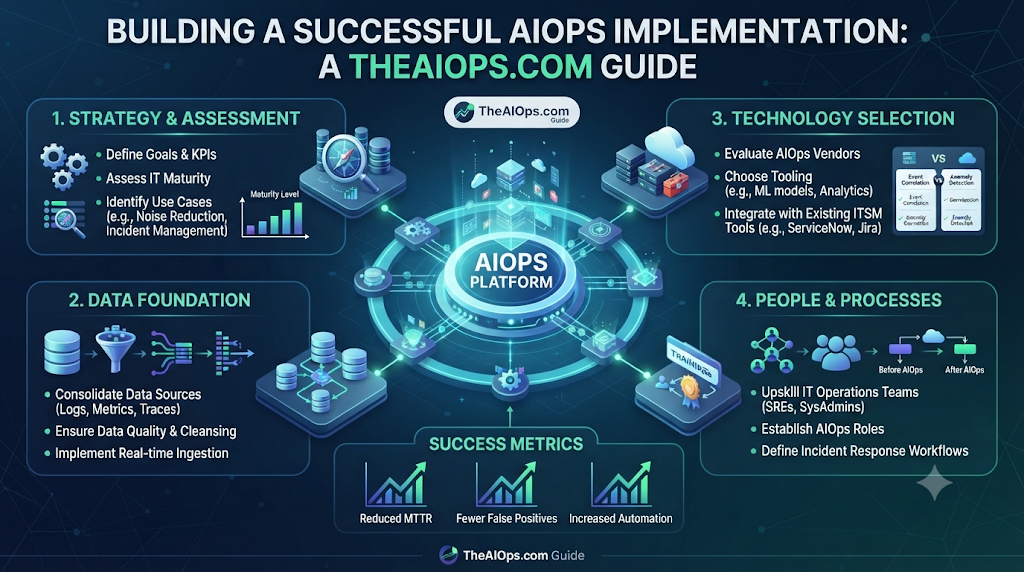
Artificial Intelligence for IT Operations (AIOps) has shifted from an experimental enterprise strategy to a core operational necessity. Modern digital environments generate massive streams of telemetry data—metrics, logs, traces, and events—that overwhelm traditional rule-based monitoring tools. Organizations often adopt AIOps to reduce alert fatigue, accelerate root cause analysis (RCA), and automate incident remediation. However, deploying machine learning algorithms across complex IT infrastructures introduces unique organizational and technical hurdles.
Successful implementation requires more than purchasing an enterprise software platform; it demands clean data pipelines, cross-functional collaboration, and disciplined, incremental adoption. This guide outlines how to design, execute, and scale an AIOps implementation strategy that delivers measurable business value without drowning teams in false positives or unmanageable complexity.
Understanding AIOps and Its Core Components
AIOps combines big data analytics and machine learning to automate operational workflows. Traditional IT monitoring relies on static thresholds and predetermined rules (e.g., “Alert if CPU usage exceeds 90% for 5 minutes”). These static rules fail in dynamic, cloud-native environments where baseline behaviors shift constantly.
An effective AIOps architecture integrates several core capabilities:
- Data Ingestion and Aggregation: Collecting telemetry from disparate sources, including cloud providers, container orchestration platforms, application performance monitoring (APM) tools, and network hardware.
- Machine Learning and Pattern Recognition: Applying statistical models and neural networks to establish dynamic baselines, cluster related alerts, and detect anomalies that deviate from normal operational patterns.
- Noise Reduction and Correlation: Grouping thousands of individual alerts stemming from a single underlying infrastructure failure into a single, cohesive incident ticket.
- Automation and Remediation: Triggering automated scripts, webhook actions, or runbooks to resolve known issues without human intervention.
Phase 1: Assessment, Scope Definition, and Data Readiness
The most common failure mode in AIOps initiatives is attempting to ingest all organizational data simultaneously without a clear operational objective.
Defining the Business Problem
Begin by identifying a specific, high-friction pain point. Avoid vague goals like “improve monitoring.” Instead, focus on concrete metrics:
- Reducing Mean Time to Resolution (MTTR) for Tier-2 database incidents.
- Cutting false-positive alert volume during peak traffic hours.
- Automating the remediation of routine disk-space exhaustion tickets.
Auditing Data Quality
Machine learning models are entirely dependent on the quality of their training data. Ingesting siloed, unstructured, or incomplete logs will result in inaccurate anomaly detection. Before selecting a vendor or building custom models, evaluate your telemetry pipeline:
- Standardization: Are timestamps synchronized across all sources (NTP)? Do log formats follow consistent schemas (e.g., JSON)?
- Completeness: Are critical applications lacking distributed tracing or metric coverage?
- Accessibility: Can security and compliance teams approve the centralization of this telemetry into an analytical data lake or AIOps platform?
Phase 2: Selecting Tools and Designing the Architecture
Once the scope and data baselines are established, design an architecture that integrates smoothly with existing incident management and observability tooling.
Build vs. Buy Considerations
Most enterprises opt for commercial AIOps platforms or specialized modules within existing observability suites due to the heavy maintenance overhead of custom-built machine learning pipelines. When evaluating solutions, prioritize:
- API Extensibility: Can the platform ingest data from custom internal tooling and export webhooks to your incident response systems (e.g., PagerDuty, Jira, ServiceNow)?
- Model Transparency: Avoid “black box” solutions where operators cannot understand why an anomaly was flagged. Explainable AI (XAI) features are essential for building trust with on-call engineers.
- Scalability: Ensure the ingestion pipeline can scale horizontally during high-volume traffic spikes or cascading system failures.
Phase 3: Phased Rollout and Integration
Deploying AIOps should follow a crawl-walk-run methodology to prevent operator fatigue and model distrust.
[Phase 1: Pilot & Observation]
       ↓ (Validate models against historical data)
[Phase 2: Advisory Mode]
       ↓ (Surface recommendations to engineers without auto-action)
[Phase 3: Automated Remediation]
       ↓ (Execute trusted runbooks automatically)
[Phase 4: Continuous Optimization]
Step 1: The Controlled Pilot
Select a single, non-mission-critical application or microservice cluster for initial deployment. Ingest its logs, metrics, and tracing data into the evaluation platform.
Step 2: Advisory Mode (Human-in-the-Loop)
Configure the AIOps platform to suggest root causes and group alerts, but do not enable automated remediation. Allow on-call engineers to evaluate the accuracy of the model’s anomaly detection and alert clustering. Track false-positive rates diligently during this phase.
Step 3: Threshold Tuning and Feedback Loops
Engineers must provide feedback to the model (e.g., marking an alert as a false positive). This feedback loop trains the algorithm to adjust its sensitivity and ignore recurring, benign anomalies such as scheduled batch jobs.
Step 4: Gradual Automation
Once confidence in the model’s accuracy exceeds acceptable thresholds (typically 95%+ precision on clustered incidents), introduce automated runbooks for low-risk, repetitive tasks, such as restarting microservices or clearing temporary cache directories.
Measuring Success and Key Performance Indicators (KPIs)
To justify ongoing investment in AIOps, establish clear baselines before deployment and track performance improvements continuously:
- Noise Reduction Ratio: The percentage reduction in raw alerts versus consolidated incidents delivered to on-call engineers.
- Mean Time to Detect (MTTD): How quickly anomalies are surfaced compared to legacy static threshold alerts.
- Mean Time to Resolution (MTTR): The drop in duration required to resolve incidents, driven by accurate root-cause suggestions.
- Automation Success Rate: The percentage of automated remediation actions executed without requiring human intervention or causing secondary regressions.
Risks, Failure Modes, and How to Avoid Them
Even well-planned AIOps implementations encounter operational roadblocks. Anticipate and mitigate these common failure modes:
- Alert Fatigue Shift: If an AIOps tool is misconfigured, it may generate new types of meta-alerts that engineers ignore just like traditional monitoring spam. Mitigation: Continuously audit anomaly thresholds and tune out noisy telemetry sources.
- Data Drift: Applications change rapidly through continuous deployment. A machine learning model trained on last quarter’s traffic patterns may misinterpret new, legitimate feature releases as anomalies. Mitigation: Implement continuous model retraining pipelines that adapt to seasonal and architectural changes.
- Loss of Operational Expertise: Relying entirely on automated diagnosis can atrophy junior engineers’ troubleshooting skills. Mitigation: Use AIOps diagnostic summaries as educational tools during post-mortems rather than hiding the underlying telemetry data.
Frequently Asked Questions
Q1. What is the primary difference between traditional monitoring and AIOps? Traditional monitoring relies on static thresholds and human-defined rules to trigger alerts when metrics cross fixed limits. AIOps utilizes big data and machine learning to dynamically establish baselines, correlate multiple data streams, detect complex anomalies, and automate remediation workflows.
Q2. Do we need to replace our existing monitoring tools to implement AIOps? No. AIOps platforms are designed to ingest data from your existing APM, log management, and cloud infrastructure tools via APIs and collectors. They act as an intelligence layer sitting on top of your current observability stack.
Q3. How long does it typically take to see ROI from an AIOps implementation? Most organizations see initial value in alert noise reduction within 30 to 60 days of deploying a pilot. Measurable improvements in MTTR and automated remediation generally materialize within 3 to 6 months after tuning models and establishing feedback loops.
Q4. What level of data cleanliness is required before starting AIOps? While data does not need to be pristine, basic standardization is mandatory. Timestamps must be synchronized across systems via NTP, log formats should be parsed consistently (ideally using structured JSON), and core infrastructure must have adequate metric coverage.
Q5. How do we prevent AIOps models from generating false positives? False positives are minimized by implementing a feedback loop where engineers tag incorrect or irrelevant alerts. This feedback trains the machine learning model to adjust its sensitivity, account for scheduled maintenance windows, and filter out known benign anomalies.
Q6. Should we build a custom AIOps model or buy a commercial platform? Unless your organization has a dedicated machine learning engineering team with deep expertise in time-series anomaly detection and significant infrastructure resources, commercial AIOps platforms offer faster time-to-value, lower maintenance overhead, and pre-built integrations.
Q7. What is the “human-in-the-loop” phase in AIOps adoption? It is an operational stage where the AIOps platform analyzes data and suggests root causes or incident groupings, but human engineers retain final authority to execute fixes. This phase is critical for validating model accuracy and building trust before enabling full automation.
Q8. Can AIOps completely eliminate human intervention in incident response? No. While AIOps can successfully automate the remediation of routine, well-understood operational issues, complex or novel system failures still require human judgment, architectural insight, and creative problem-solving.
Q9. How does AIOps handle security and data privacy concerns? AIOps platforms process sensitive operational telemetry, which often includes user identifiers or proprietary code logs. Organizations must ensure that data in transit and at rest is encrypted, role-based access controls (RBAC) are strictly enforced, and vendor compliance aligns with internal security policies.
Q10. What are the first steps an organization should take to begin their AIOps journey? Start by identifying one specific, painful operational bottleneck—such as excessive alert noise during deployment windows. Audit the data quality for that specific service, define clear success metrics, and run a limited pilot focusing exclusively on that use case before expanding enterprise-wide.
Conclusion
Implementing AIOps successfully requires treating machine learning models as operational team members that require training, tuning, and oversight. By starting with a focused scope, ensuring data quality, and maintaining human-in-the-loop validation during early phases, organizations can cut through alert noise and build a resilient, automated IT operation.
