Upgrade & Secure Your Future with DevOps, SRE, DevSecOps, MLOps!
We spend hours scrolling social media and waste money on things we forget, but won’t spend 30 minutes a day earning certifications that can change our lives.
Master in DevOps, SRE, DevSecOps & MLOps by DevOps School!
Learn from Guru Rajesh Kumar and double your salary in just one year.
Introduction
Building Energy Management Systems, commonly called BEMS, help organizations monitor, control, and optimize how energy is used inside buildings. In simple words, a BEMS connects with systems like HVAC, lighting, meters, sensors, equipment, and building controls so facility teams can reduce waste, improve comfort, track performance, and lower operating costs.
BEMS matters now because energy prices, sustainability targets, carbon reporting, smart building expectations, and operational efficiency are becoming major priorities for building owners and facility teams. Instead of only checking utility bills after the month ends, modern BEMS platforms help teams see energy usage in real time, detect inefficiencies, automate schedules, and improve equipment performance.
Common use cases include HVAC optimization, lighting control, energy monitoring, peak demand management, fault detection, sustainability reporting, equipment scheduling, and multi-site building performance tracking.
Buyers should evaluate integration with building systems, analytics depth, automation, reporting, cybersecurity, scalability, mobile access, vendor support, deployment model, cost, and ease of use.
Best for: Facility managers, energy managers, sustainability teams, building owners, real estate operators, hospitals, universities, hotels, manufacturing facilities, retail chains, airports, and enterprises managing energy-intensive buildings.
Not ideal for: Very small offices with limited energy usage, buildings without connected equipment or metering, or teams that only need basic utility bill tracking instead of real-time energy control and optimization.
Key Trends in Building Energy Management Systems
- AI-driven energy optimization is becoming more important as buildings need smarter control of HVAC, lighting, occupancy, and equipment schedules.
- Predictive analytics is helping facility teams detect abnormal energy usage, equipment inefficiency, and maintenance risks before they become expensive problems.
- IoT-based building monitoring is expanding as sensors, smart meters, thermostats, and connected equipment provide more real-time operational data.
- Carbon and sustainability reporting is becoming a key requirement because organizations want better visibility into emissions, utility usage, and environmental performance.
- Cloud-based energy dashboards are becoming common for multi-site operators that need centralized monitoring across buildings, campuses, or portfolios.
- Occupancy-based energy control is growing as hybrid workplaces, variable foot traffic, and changing building usage patterns make fixed schedules less efficient.
- Open protocols and interoperability are becoming more important because buyers want BEMS platforms that can connect with existing HVAC, lighting, meters, and building automation systems.
- Cybersecurity expectations are rising because connected building systems can create operational and data security risks if not properly protected.
- Energy performance contracting and outcome-based models are becoming more relevant where buyers want measurable savings, not just software dashboards.
- Integration with facility management and maintenance systems is increasing so energy insights can lead directly to work orders, inspections, repairs, and asset improvements.
How We Selected These Tools
- We selected platforms that are widely recognized in building automation, building energy management, smart building operations, and facility energy optimization.
- We considered feature completeness across energy monitoring, HVAC control, fault detection, analytics, reporting, dashboards, and automation.
- We included enterprise-grade platforms as well as focused energy optimization tools for different building sizes and operational needs.
- We considered integration potential with HVAC systems, meters, sensors, IoT devices, building automation systems, and facility management platforms.
- We reviewed fit across industries such as commercial real estate, healthcare, education, hospitality, manufacturing, retail, and public infrastructure.
- We considered usability because BEMS users may include facility managers, technicians, energy analysts, sustainability teams, and executives.
- We looked for platforms that support multi-site monitoring, portfolio-level reporting, and operational scalability.
- We considered security posture signals such as role-based access, authentication options, audit visibility, and enterprise controls where confidently known.
- We avoided guessing public ratings, pricing, certifications, or compliance details where they are not clearly available.
- We treated scoring as a practical comparison model based on buyer-fit criteria, not as an official market ranking.
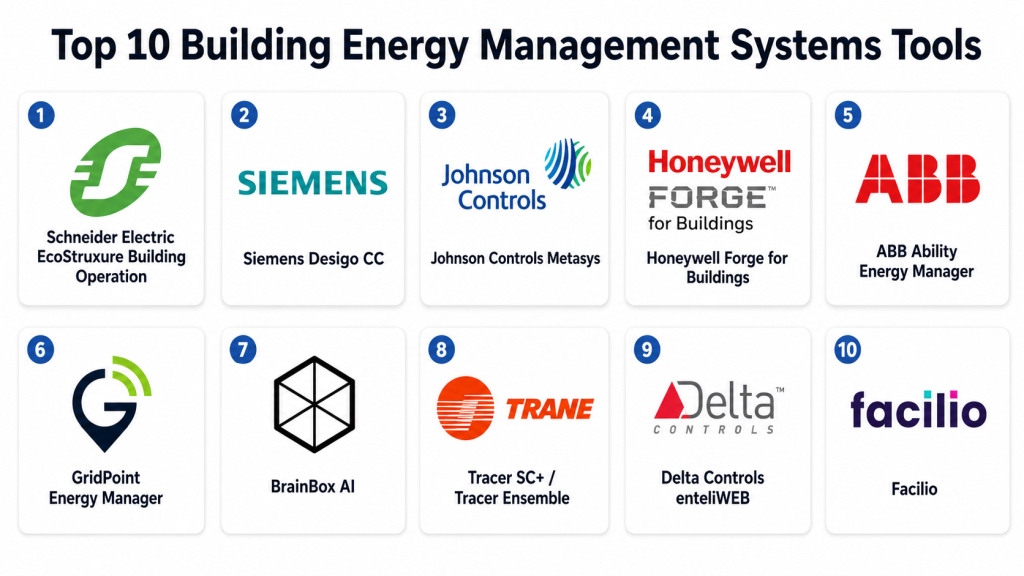
Top 10 Building Energy Management Systems Tools
#1 — Schneider Electric EcoStruxure Building Operation
Short description:
Schneider Electric EcoStruxure Building Operation is a building management and energy optimization platform designed for smart, connected, and efficient buildings. It helps facility teams monitor HVAC, lighting, power, meters, alarms, and building systems from a centralized environment. The platform is suitable for commercial buildings, healthcare, education, industrial facilities, data centers, and large real estate portfolios. It is especially useful for organizations that want energy control, operational visibility, and building automation in one ecosystem. EcoStruxure is a strong fit for teams already using Schneider Electric building and power infrastructure.
Key Features
- Centralized building monitoring and control
- HVAC and lighting system optimization
- Energy usage tracking and dashboards
- Alarm, event, and equipment monitoring
- Integration with meters, sensors, and building systems
- Scalable architecture for large buildings and portfolios
- Support for building automation and operational analytics
Pros
- Strong enterprise-grade building automation ecosystem
- Good fit for complex and energy-intensive buildings
- Useful for connecting energy, power, and building operations
Cons
- May require expert implementation and system integration
- Can be more complex than basic energy dashboard tools
- Best value often comes when used with compatible building infrastructure
Platforms / Deployment
Web / Windows / Mobile access may vary
Cloud / Hybrid / On-premise options may vary
Security & Compliance
Enterprise security controls, role-based access, and secure building system practices may be available depending on deployment and configuration. Specific certifications such as SOC 2, ISO 27001, GDPR, or HIPAA should be verified directly with the vendor.
Integrations & Ecosystem
EcoStruxure works well in connected building environments where energy, HVAC, lighting, power, and automation data need to operate together.
- Schneider Electric power and building systems
- HVAC and lighting controls
- Energy meters and sensors
- Building automation protocols
- Facility and operational dashboards
- API and integration options may vary
Support & Community
Schneider Electric provides documentation, partner support, implementation services, professional services, and enterprise support options. Community strength is mainly ecosystem and partner-led.
#2 — Siemens Desigo CC
Short description:
Siemens Desigo CC is an integrated building management platform that supports building automation, energy efficiency, comfort, safety, and operational visibility. It helps facility teams monitor and control HVAC, lighting, energy, fire safety, security, and other building systems depending on configuration. Desigo CC is suitable for commercial buildings, airports, hospitals, campuses, public infrastructure, and large facilities. It is a strong option for organizations that need centralized control of complex building environments. The platform is best suited for buildings where energy management is closely connected with automation, safety, and facility performance.
Key Features
- Integrated building management and automation
- HVAC, lighting, and energy control
- Alarm and event management
- Multi-system monitoring
- Energy performance visibility
- Scalable architecture for complex facilities
- Support for building operations and comfort management
Pros
- Strong fit for large and complex building environments
- Useful for combining energy, comfort, safety, and automation
- Suitable for enterprise and campus-style deployments
Cons
- May require specialist setup and integration
- More advanced than what small buildings may need
- Cost and implementation effort can be significant
Platforms / Deployment
Web / Windows / Mobile access may vary
On-premise / Hybrid / Cloud options may vary
Security & Compliance
Role-based access and enterprise security controls may be available depending on setup. Specific certifications such as SOC 2, ISO 27001, GDPR, or HIPAA should be verified directly with Siemens or implementation partners.
Integrations & Ecosystem
Desigo CC is designed for buildings where multiple systems must work together under one operational view.
- Siemens building automation systems
- HVAC and lighting controls
- Fire and security systems depending on configuration
- Energy meters and sensors
- Building protocols and gateways
- Reporting and operational dashboards
Support & Community
Siemens provides documentation, certified partners, implementation support, training, and enterprise service options. Community support is mainly vendor and partner-driven.
#3 — Johnson Controls Metasys
Short description:
Johnson Controls Metasys is a building automation and management platform used to improve building performance, comfort, energy visibility, and operational control. It helps facility teams monitor and control HVAC, equipment, alarms, schedules, and building conditions. Metasys is suitable for commercial buildings, hospitals, campuses, schools, public buildings, and complex facilities. It is especially useful where energy management is tied closely to building automation and operational uptime. The platform supports scalable building management for both individual facilities and larger portfolios.
Key Features
- Building automation and control
- HVAC monitoring and optimization
- Energy usage visibility
- Alarm and event management
- Equipment scheduling and control
- Scalable system architecture
- Operational dashboards and reporting
Pros
- Strong building automation heritage
- Good fit for facilities with HVAC and comfort optimization needs
- Useful for energy oversight and daily building operations
Cons
- May require integration support for best results
- Advanced use cases can depend on building infrastructure
- Not always the simplest option for small facilities
Platforms / Deployment
Web / Windows / Mobile access may vary
On-premise / Hybrid / Cloud options may vary
Security & Compliance
Security features such as user permissions and access controls may be available depending on deployment. Specific certifications such as SOC 2, ISO 27001, GDPR, or HIPAA should be verified directly.
Integrations & Ecosystem
Metasys fits environments where building automation, HVAC, energy monitoring, and facility operations need to connect.
- Johnson Controls building systems
- HVAC and equipment controls
- Energy metering systems
- Building automation protocols
- Facility dashboards
- Service and maintenance workflows may vary
Support & Community
Johnson Controls provides partner support, service teams, documentation, training, and implementation help. Support strength often depends on regional partner availability and service agreements.
#4 — Honeywell Forge for Buildings
Short description:
Honeywell Forge for Buildings is a connected building and operational performance platform designed to help organizations improve building efficiency, comfort, sustainability, and asset performance. It brings together building data, analytics, energy insights, and operational workflows. The platform is suitable for commercial real estate, airports, hospitals, campuses, industrial facilities, and large enterprises. It is especially useful for organizations that want data-driven building optimization across multiple sites. Honeywell Forge is a strong fit where energy management connects with occupant experience, asset performance, and operational control.
Key Features
- Building performance monitoring
- Energy optimization insights
- Connected building analytics
- Asset and equipment visibility
- Operational dashboards
- Sustainability and efficiency reporting
- Multi-site building performance tracking
Pros
- Strong fit for enterprise connected building programs
- Useful for energy, comfort, and operational performance visibility
- Good for multi-site and portfolio-level building monitoring
Cons
- May require integration with existing building systems
- Not ideal for teams needing only basic energy bill tracking
- Advanced outcomes depend on data quality and connected infrastructure
Platforms / Deployment
Web / Mobile access may vary
Cloud / Hybrid options may vary
Security & Compliance
Enterprise access controls and security practices may be available. Specific certifications such as SOC 2, ISO 27001, GDPR, or HIPAA should be confirmed directly with the vendor.
Integrations & Ecosystem
Honeywell Forge connects building data, operational systems, and analytics to support smarter energy and facility decisions.
- Honeywell building systems
- HVAC and automation systems
- Energy meters and sensors
- Asset and equipment data
- Enterprise dashboards
- APIs and integrations may vary
Support & Community
Honeywell provides enterprise support, implementation services, partner resources, documentation, and ongoing service options. Community strength is mainly enterprise and vendor-led.
#5 — ABB Ability Energy Manager
Short description:
ABB Ability Energy Manager is an energy monitoring and management solution that helps organizations track energy consumption, improve efficiency, and manage electrical infrastructure performance. It is useful for commercial buildings, industrial sites, utilities, campuses, and energy-intensive facilities. The platform supports visibility into energy usage, electrical assets, consumption patterns, and performance indicators. It works well for organizations that want to monitor energy data and take action on inefficiencies. ABB Ability Energy Manager is especially relevant where electrical distribution, metering, and energy performance are central priorities.
Key Features
- Energy consumption monitoring
- Electrical system visibility
- Energy performance dashboards
- Meter and device data collection
- Alerts and anomaly visibility
- Reporting for energy management
- Support for efficiency and sustainability initiatives
Pros
- Strong fit for electrical energy monitoring
- Useful for industrial and commercial energy visibility
- Good option for organizations using ABB electrical infrastructure
Cons
- May need integration planning for broader building automation
- Less focused on workplace comfort than full BMS platforms
- Best value depends on connected meters and electrical systems
Platforms / Deployment
Web / Mobile access may vary
Cloud / Hybrid options may vary
Security & Compliance
Security features may include user access controls and enterprise system protections depending on configuration. Specific certifications such as SOC 2, ISO 27001, GDPR, or HIPAA should be verified directly.
Integrations & Ecosystem
ABB Ability Energy Manager works best where energy metering, electrical infrastructure, and performance monitoring need to be connected.
- ABB electrical systems
- Smart meters and sensors
- Energy dashboards
- Electrical distribution equipment
- Reporting tools
- API and integration options may vary
Support & Community
ABB provides documentation, partner support, technical services, implementation guidance, and enterprise support options. Community strength is mainly industrial and partner ecosystem based.
#6 — GridPoint Energy Manager
Short description:
GridPoint Energy Manager is an energy management platform focused on helping businesses control, monitor, and optimize energy usage across distributed sites. It is especially useful for restaurants, retail chains, convenience stores, commercial buildings, and multi-site operators. The platform helps teams manage HVAC schedules, monitor energy consumption, identify savings opportunities, and improve operational efficiency. It is a strong fit for businesses that need centralized energy control across many small or medium-sized locations. GridPoint is useful where energy savings, remote visibility, and site-level control are priorities.
Key Features
- Energy monitoring and reporting
- HVAC schedule control
- Site-level energy optimization
- Multi-location dashboards
- Alerts and performance insights
- Remote equipment visibility
- Utility usage and savings analysis
Pros
- Strong fit for distributed commercial sites
- Useful for restaurants, retail, and multi-location businesses
- Helps central teams monitor energy across many locations
Cons
- May not be ideal for complex large-building automation needs
- Value depends on connected equipment and site coverage
- Advanced integration needs should be checked early
Platforms / Deployment
Web / Mobile access may vary
Cloud
Security & Compliance
User access controls and secure platform practices may be available. Specific certifications such as SOC 2, ISO 27001, GDPR, or HIPAA are not publicly stated unless confirmed directly.
Integrations & Ecosystem
GridPoint fits multi-site environments where HVAC, energy usage, site controls, and reporting need centralized visibility.
- HVAC controls
- Smart meters and energy data
- Multi-site dashboards
- Utility data workflows
- Alerts and operational reporting
- Integration options may vary
Support & Community
GridPoint provides customer support, implementation services, energy expertise, documentation, and account support. Community strength is more customer and service-led than open community-based.
#7 — BrainBox AI
Short description:
BrainBox AI is an AI-focused building optimization platform that helps commercial buildings reduce energy waste and improve HVAC performance. It uses building data and machine learning to make smarter operational decisions for heating, cooling, and energy efficiency. The platform is suitable for commercial real estate, offices, hotels, retail buildings, airports, and large facilities. BrainBox AI is especially useful for organizations that want AI-based optimization without fully replacing existing building systems. It is a strong option for teams focused on energy savings, decarbonization, and autonomous HVAC optimization.
Key Features
- AI-based HVAC optimization
- Energy efficiency insights
- Predictive control recommendations
- Building performance monitoring
- Integration with existing building systems
- Carbon and sustainability support
- Automated optimization workflows
Pros
- Strong focus on AI-driven energy optimization
- Can work with existing building automation systems
- Useful for reducing energy waste in commercial buildings
Cons
- Results depend on data availability and building system compatibility
- May not replace a full building management system
- Best suited for buildings with meaningful HVAC energy usage
Platforms / Deployment
Web / Cloud
Mobile access: Varies / N/A
Security & Compliance
Security controls may be available depending on deployment and customer setup. Specific certifications such as SOC 2, ISO 27001, GDPR, or HIPAA should be verified directly.
Integrations & Ecosystem
BrainBox AI is designed to connect with existing building systems and use operational data for energy optimization.
- Building automation systems
- HVAC control systems
- Sensor and meter data
- Building performance dashboards
- Sustainability reporting workflows
- Integration options may vary by building
Support & Community
BrainBox AI provides vendor-led support, implementation guidance, onboarding assistance, and customer success resources. Community strength is more product and industry focused than broad open community-led.
#8 — Trane Tracer SC+ / Tracer Ensemble
Short description:
Trane Tracer solutions help facility teams manage building systems, improve energy performance, control HVAC equipment, and monitor building operations. These platforms are especially relevant for buildings using Trane HVAC infrastructure but can also support broader building automation needs depending on configuration. They are suitable for commercial buildings, schools, hospitals, offices, and multi-building facilities. Trane solutions are useful where HVAC efficiency, comfort, scheduling, and equipment performance are key priorities. They work best when building teams want integrated control with strong HVAC expertise.
Key Features
- HVAC system control and monitoring
- Building automation workflows
- Energy performance visibility
- Scheduling and occupancy-based control
- Equipment alarms and diagnostics
- Multi-building operational visibility
- Reporting and system performance insights
Pros
- Strong HVAC and building control expertise
- Good fit for buildings using Trane equipment
- Useful for comfort, scheduling, and energy optimization
Cons
- Best value may depend on Trane ecosystem alignment
- Broader integration needs should be checked carefully
- May require skilled building automation support
Platforms / Deployment
Web / Local access / Mobile access may vary
On-premise / Cloud / Hybrid options may vary
Security & Compliance
Access control and system security features may be available depending on configuration. Specific certifications such as SOC 2, ISO 27001, GDPR, or HIPAA should be verified directly.
Integrations & Ecosystem
Trane Tracer solutions fit building environments where HVAC controls, energy monitoring, equipment scheduling, and comfort management are central.
- Trane HVAC equipment
- Building automation systems
- Energy meters and sensors
- Scheduling and occupancy workflows
- Facility dashboards
- Integration options may vary by setup
Support & Community
Trane provides documentation, technical support, field services, partner support, and building automation expertise. Support strength often depends on local service availability and customer agreement.
#9 — Delta Controls enteliWEB
Short description:
Delta Controls enteliWEB is a web-based building management platform that helps teams monitor and control building systems, energy usage, alarms, schedules, and operational data. It is suitable for commercial buildings, campuses, healthcare facilities, education, and multi-site operations. The platform is useful for teams that need building automation visibility through a modern web interface. It supports energy-related monitoring, system control, and operational reporting. Delta Controls is a strong fit for organizations that want flexible building automation and control across connected environments.
Key Features
- Web-based building management
- Energy usage visibility
- HVAC and equipment control
- Alarm and event monitoring
- Scheduling and trend data
- Multi-site operational dashboards
- Support for connected building automation
Pros
- Web-based interface for building operations
- Good fit for building automation and energy visibility
- Useful for multi-building control environments
Cons
- May require professional integration and setup
- Best value depends on connected Delta Controls ecosystem
- Advanced energy analytics may depend on configuration
Platforms / Deployment
Web / Mobile access may vary
Cloud / On-premise / Hybrid options may vary
Security & Compliance
User permissions and access controls may be available. Specific certifications such as SOC 2, ISO 27001, GDPR, or HIPAA should be verified directly.
Integrations & Ecosystem
enteliWEB is built for building automation environments where control, monitoring, trends, alarms, and energy data need to be visible in one system.
- Delta Controls systems
- HVAC and building controls
- Energy meters and sensors
- Alarm and event systems
- Trend and reporting data
- Integration options may vary
Support & Community
Delta Controls provides documentation, partner support, implementation services, training, and technical support. Community strength is mainly partner and building automation ecosystem based.
#10 — Facilio
Short description:
Facilio is a connected facilities and building operations platform that helps organizations manage energy performance, asset operations, maintenance, and portfolio visibility. It is suitable for commercial real estate, facility service providers, property operators, enterprises, and multi-site building portfolios. Facilio connects operational workflows with building data so teams can detect inefficiencies, improve response, and manage energy-related tasks. It is useful for teams that want energy management to connect with facility operations and maintenance execution. The platform works well for organizations moving toward smart building and data-driven portfolio operations.
Key Features
- Connected building operations
- Energy performance visibility
- Asset and maintenance workflows
- Portfolio-level dashboards
- IoT and building data integration potential
- Service and vendor workflows
- Analytics for operational improvement
Pros
- Strong fit for connected facility operations
- Useful for linking energy insights with maintenance tasks
- Good for multi-site and portfolio-level visibility
Cons
- Full value depends on integration with building systems
- May be more advanced than basic energy tracking tools
- Data quality and process maturity affect results
Platforms / Deployment
Web / Mobile access
Cloud
Security & Compliance
Enterprise access controls and administrative governance may be available. Specific certifications such as SOC 2, ISO 27001, GDPR, or HIPAA should be confirmed directly.
Integrations & Ecosystem
Facilio is designed to bring building data, facility operations, energy insights, and maintenance workflows together.
- Building management systems
- IoT sensors and meter data
- Asset and maintenance platforms
- Energy and utility data
- Vendor and service workflows
- API and connector options may vary
Support & Community
Facilio provides onboarding, vendor-led support, customer success resources, implementation guidance, and documentation. Community strength is mostly product and industry focused.
Comparison Table
| Tool Name | Best For | Platform(s) Supported | Deployment | Standout Feature | Public Rating |
|---|---|---|---|---|---|
| Schneider Electric EcoStruxure Building Operation | Enterprise buildings and connected energy operations | Web / Windows / Mobile varies | Cloud / Hybrid / On-premise varies | Integrated building and energy ecosystem | N/A |
| Siemens Desigo CC | Complex buildings and campuses | Web / Windows / Mobile varies | On-premise / Hybrid / Cloud varies | Integrated building automation and energy control | N/A |
| Johnson Controls Metasys | HVAC-focused building automation | Web / Windows / Mobile varies | On-premise / Hybrid / Cloud varies | Scalable building automation and energy oversight | N/A |
| Honeywell Forge for Buildings | Enterprise connected building operations | Web / Mobile varies | Cloud / Hybrid varies | Building performance and operational analytics | N/A |
| ABB Ability Energy Manager | Electrical energy monitoring and efficiency | Web / Mobile varies | Cloud / Hybrid varies | Electrical infrastructure energy visibility | N/A |
| GridPoint Energy Manager | Multi-site retail and commercial locations | Web / Mobile varies | Cloud | Distributed site energy control | N/A |
| BrainBox AI | AI-based HVAC energy optimization | Web | Cloud | Autonomous HVAC optimization | N/A |
| Trane Tracer SC+ / Tracer Ensemble | HVAC and building control environments | Web / Local / Mobile varies | On-premise / Cloud / Hybrid varies | HVAC control and energy performance | N/A |
| Delta Controls enteliWEB | Web-based building automation | Web / Mobile varies | Cloud / On-premise / Hybrid varies | Web-based BMS and energy visibility | N/A |
| Facilio | Connected facility and energy operations | Web / Mobile | Cloud | Energy insights linked with facility workflows | N/A |
Evaluation & Scoring of Building Energy Management Systems
| Tool Name | Core (25%) | Ease (15%) | Integrations (15%) | Security (10%) | Performance (10%) | Support (10%) | Value (15%) | Weighted Total (0–10) |
|---|---|---|---|---|---|---|---|---|
| Schneider Electric EcoStruxure Building Operation | 9 | 7 | 9 | 8 | 9 | 8 | 7 | 8.20 |
| Siemens Desigo CC | 9 | 7 | 9 | 8 | 9 | 8 | 7 | 8.20 |
| Johnson Controls Metasys | 9 | 7 | 8 | 8 | 9 | 8 | 7 | 8.05 |
| Honeywell Forge for Buildings | 8 | 8 | 8 | 8 | 8 | 8 | 7 | 7.90 |
| ABB Ability Energy Manager | 8 | 8 | 8 | 7 | 8 | 8 | 8 | 7.85 |
| GridPoint Energy Manager | 8 | 8 | 7 | 7 | 8 | 8 | 8 | 7.75 |
| BrainBox AI | 8 | 8 | 7 | 7 | 8 | 7 | 8 | 7.65 |
| Trane Tracer SC+ / Tracer Ensemble | 8 | 7 | 8 | 7 | 8 | 8 | 7 | 7.60 |
| Delta Controls enteliWEB | 8 | 8 | 8 | 7 | 8 | 8 | 7 | 7.75 |
| Facilio | 8 | 8 | 8 | 7 | 8 | 8 | 8 | 7.90 |
The scoring is comparative and should be used as a practical buyer guide, not as an official rating. Enterprise building automation platforms usually score higher in integration depth and control capabilities. AI-focused and cloud-focused platforms may score higher in usability, optimization workflows, and faster portfolio visibility. Buyers should adjust the scores based on building size, existing infrastructure, energy goals, integration needs, budget, and internal technical capability.
Which Building Energy Management System Tool Is Right for You?
Solo / Freelancer
Solo consultants, independent energy auditors, and small building advisors may not need a full enterprise BEMS unless they manage complex client portfolios. In many cases, simple energy analytics, meter dashboards, or cloud-based monitoring tools may be enough.
Good options include GridPoint Energy Manager for distributed small sites, BrainBox AI for HVAC optimization projects, and Facilio where energy work connects with facility operations. The main priority should be easy reporting, clear dashboards, and low implementation burden.
SMB
Small and medium-sized businesses usually need energy visibility, HVAC schedule control, utility cost reduction, and basic alerts without heavy technical complexity. They may not have a large facility engineering team, so ease of use and vendor support matter.
Good options include GridPoint Energy Manager, ABB Ability Energy Manager, Facilio, BrainBox AI, and Trane Tracer solutions where HVAC control is central. SMBs should avoid overbuying if they only need usage tracking and basic optimization.
Mid-Market
Mid-market organizations often manage multiple buildings, higher energy costs, more equipment, and stronger sustainability goals. They may need dashboards, automation, reporting, alerts, and integration with maintenance systems.
Good options include Johnson Controls Metasys, Honeywell Forge for Buildings, ABB Ability Energy Manager, Facilio, Delta Controls enteliWEB, and Trane Tracer solutions. Mid-market buyers should evaluate integration with existing equipment before selecting a platform.
Enterprise
Enterprises need scalable energy control, multi-site visibility, strong integration, cybersecurity review, portfolio reporting, and long-term sustainability support. They may also need advanced building automation, compliance documentation, and executive dashboards.
Good options include Schneider Electric EcoStruxure Building Operation, Siemens Desigo CC, Johnson Controls Metasys, Honeywell Forge for Buildings, and Facilio. Enterprise buyers should involve facility engineering, IT, sustainability, procurement, and security teams early.
Budget vs Premium
Budget-conscious buyers should focus on clear energy savings, easy deployment, and fast visibility. GridPoint, Facilio, BrainBox AI, and ABB Ability Energy Manager may be practical depending on building type and integration needs.
Premium buyers with complex buildings and large portfolios may prefer Schneider Electric EcoStruxure, Siemens Desigo CC, Johnson Controls Metasys, or Honeywell Forge. These platforms can provide deeper automation and enterprise-grade control but may require more implementation effort.
Feature Depth vs Ease of Use
If you need full building control across HVAC, lighting, meters, alarms, and equipment, choose a strong building automation platform such as Schneider Electric EcoStruxure, Siemens Desigo CC, Johnson Controls Metasys, or Delta Controls enteliWEB.
If you need easier energy insights, optimization, and portfolio dashboards, consider Facilio, GridPoint, ABB Ability Energy Manager, Honeywell Forge, or BrainBox AI.
Integrations & Scalability
BEMS value depends heavily on integrations. A tool must connect with HVAC systems, meters, sensors, building automation systems, IoT devices, utility data, and sometimes facility management software.
Large buildings and enterprises should prioritize open protocols, API availability, vendor ecosystem strength, and long-term scalability. Smaller teams should focus on the integrations they truly need rather than buying a platform with unnecessary complexity.
Security & Compliance Needs
Connected building systems can affect comfort, operations, safety, and energy cost, so cybersecurity matters. Buyers should ask about SSO, MFA, role-based access, audit logs, encryption, network architecture, data hosting, and remote access controls.
Do not assume SOC 2, ISO 27001, GDPR, HIPAA, or other certifications unless the vendor clearly confirms them. Security review should happen before purchase, not after deployment.
Frequently Asked Questions
1. What is a Building Energy Management System?
A Building Energy Management System helps monitor, control, and optimize energy usage inside buildings. It usually connects with HVAC, lighting, meters, sensors, and building automation systems to improve efficiency and reduce waste.
2. How is BEMS different from BMS?
A BMS manages broader building systems such as HVAC, lighting, security, fire systems, alarms, and controls. A BEMS focuses more specifically on energy performance, energy monitoring, efficiency, and optimization.
3. How much does a BEMS cost?
Pricing varies based on building size, number of systems, meters, integrations, licenses, hardware, implementation, and support. Enterprise platforms usually require custom pricing, while focused energy platforms may have more flexible models.
4. How long does BEMS implementation take?
Implementation depends on building complexity, existing controls, meter availability, integrations, data quality, and reporting needs. Simple monitoring setups may be faster, while enterprise automation projects may require detailed planning.
5. What are the common mistakes when choosing a BEMS?
Common mistakes include ignoring existing building infrastructure, underestimating integration effort, focusing only on dashboards, skipping cybersecurity review, and not defining clear energy-saving goals before implementation.
6. Can BEMS reduce energy bills?
Yes, a BEMS can help reduce energy bills by improving schedules, detecting waste, optimizing HVAC, monitoring peak demand, and identifying inefficient equipment. Actual savings depend on building condition, usage patterns, and operational discipline.
7. Is AI important in modern BEMS platforms?
AI can be useful for detecting anomalies, optimizing HVAC, predicting energy demand, and recommending efficiency improvements. However, AI is most valuable when building data is reliable and systems are properly connected.
8. What integrations should I look for?
Important integrations include HVAC controls, lighting systems, smart meters, IoT sensors, building automation systems, utility data, maintenance software, reporting tools, and sustainability platforms.
9. Is BEMS suitable for small buildings?
It depends on energy usage and operational complexity. Small buildings with low energy costs may only need basic monitoring, while small sites with heavy HVAC usage or many locations may benefit from cloud-based energy management.
10. Can BEMS support multiple buildings?
Yes, many BEMS platforms support multi-site dashboards, portfolio reporting, centralized alerts, and remote monitoring. Buyers should check whether the platform can manage location-level permissions, benchmarking, and portfolio analytics.
Conclusion
Building Energy Management Systems are becoming important for organizations that want lower energy costs, better building performance, stronger sustainability reporting, and smarter facility operations. The best platform depends on building size, existing infrastructure, energy goals, technical maturity, and budget. Schneider Electric EcoStruxure, Siemens Desigo CC, and Johnson Controls Metasys are strong for enterprise building automation and energy control. Honeywell Forge, ABB Ability Energy Manager, Facilio, and GridPoint are practical for connected operations and portfolio energy visibility. BrainBox AI is useful for AI-based HVAC optimization, while Trane and Delta Controls are strong where building automation and HVAC control are central.
