Upgrade & Secure Your Future with DevOps, SRE, DevSecOps, MLOps!
We spend hours scrolling social media and waste money on things we forget, but won’t spend 30 minutes a day earning certifications that can change our lives.
Master in DevOps, SRE, DevSecOps & MLOps by DevOps School!
Learn from Guru Rajesh Kumar and double your salary in just one year.
Introduction
Incident reporting safety tools help organizations record, investigate, track, and resolve workplace incidents, near misses, hazards, injuries, environmental events, property damage, and unsafe conditions. In simple words, these tools help safety teams move from paper forms and scattered emails to a structured digital process where every incident can be reported, assigned, investigated, corrected, and reviewed.
Incident reporting matters because organizations need faster response, better safety visibility, stronger compliance records, and fewer repeated incidents. A good platform helps teams capture evidence, identify root causes, assign corrective actions, track deadlines, generate reports, and improve safety culture.
Common use cases include injury reporting, near-miss reporting, hazard observation, safety inspections, corrective action tracking, environmental incident reporting, contractor incident management, and audit preparation.
Buyers should evaluate mobile reporting, offline access, workflow automation, root cause analysis, corrective actions, analytics, compliance reporting, integrations, ease of use, security, scalability, and support quality.
Best for: EHS teams, safety managers, operations leaders, manufacturing plants, construction companies, logistics teams, energy companies, healthcare facilities, warehouses, field service teams, and enterprises with workplace safety obligations.
Not ideal for: Very small teams with only occasional safety events, businesses that only need a simple checklist app, or organizations without defined safety processes and incident ownership.
Key Trends in Incident Reporting Safety Tools
- Mobile-first incident reporting: Employees and frontline teams increasingly need to report incidents, hazards, and near misses directly from mobile devices with photos, notes, location data, and attachments.
- Near-miss culture improvement: Companies are focusing more on near-miss and hazard reporting because early reporting helps prevent serious injuries and repeated unsafe conditions.
- AI-assisted classification: Some platforms are adding smarter categorization, severity suggestions, duplicate detection, and trend detection to help safety teams prioritize incidents faster.
- Workflow automation: Incident reporting tools now automate notifications, investigation steps, approvals, corrective action assignments, and escalation reminders.
- Root cause and corrective action tracking: Safety teams want systems that go beyond incident logs and help identify why incidents happened and how to prevent recurrence.
- Integrated EHS platforms: Incident reporting is increasingly connected with audits, inspections, risk assessments, permits, training, compliance, contractor safety, and environmental reporting.
- Real-time dashboards: Leaders want live views of injury trends, open actions, high-risk locations, repeat hazards, incident severity, and reporting rates.
- Offline field access: Construction, mining, oil and gas, logistics, and field service teams often need reporting tools that work even when internet access is weak.
- Contractor and visitor safety: Organizations are extending incident reporting to contractors, temporary workers, third-party vendors, and site visitors.
- Security and audit readiness: Safety incident records may include sensitive employee, medical, legal, operational, and compliance data, so access control and audit trails are critical.
How We Selected These Tools
The incident reporting safety software market includes EHS suites, mobile inspection platforms, compliance management systems, workplace safety platforms, and enterprise risk tools. The tools below were selected using practical EHS and safety operations criteria.
- Recognition in EHS, safety management, and incident reporting markets
- Strength of incident reporting, investigation, and corrective action workflows
- Mobile and frontline reporting capabilities
- Support for hazards, near misses, injuries, environmental events, and property damage
- Root cause analysis, CAPA, and workflow automation features
- Fit for SMB, mid-market, enterprise, and high-risk industries
- Reporting, dashboards, compliance tracking, and audit readiness
- Integration readiness with HR, ERP, training, maintenance, and BI systems
- Security posture signals and access-control expectations
- Vendor support, onboarding resources, and scalability
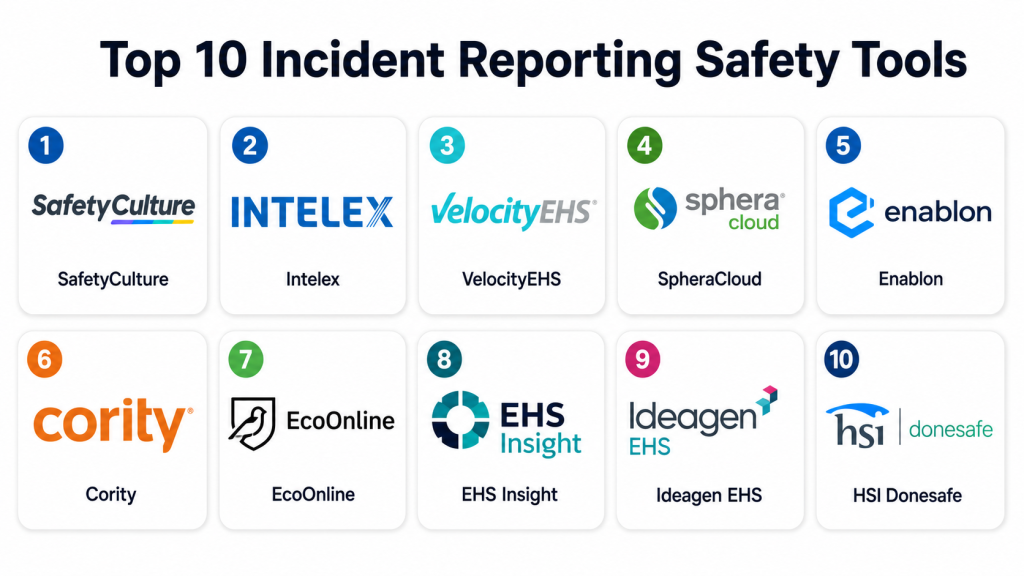
Top 10 Incident Reporting Safety Tools
#1 — SafetyCulture
Short description:
SafetyCulture is a mobile-first operations and safety platform that helps teams report incidents, complete inspections, track issues, assign corrective actions, and improve frontline visibility. It is especially useful for organizations that need fast reporting from field teams, warehouses, job sites, and distributed locations. The platform supports checklists, audits, observations, incident reports, analytics, and team communication. It is best suited for companies that want a practical, easy-to-adopt safety reporting tool with strong mobile usability.
Key Features
- Mobile incident and hazard reporting
- Safety inspections and digital checklists
- Corrective action assignment and tracking
- Photo, note, and evidence capture
- Analytics and reporting dashboards
- Team communication and issue tracking
- Templates for audits, inspections, and safety workflows
Pros
- Strong mobile experience for frontline workers
- Easy to start with inspections and incident reporting
- Good fit for distributed teams and field operations
Cons
- Advanced enterprise EHS governance may require higher plans or integrations
- Complex regulatory workflows may need configuration
- Pricing varies by plan and usage
Platforms / Deployment
Web / Cloud / iOS / Android
Security & Compliance
Security details should be confirmed directly with the vendor. Buyers should ask about SSO, MFA, RBAC, encryption, audit logs, data retention, and compliance documentation.
SOC 2, ISO 27001, GDPR, HIPAA: Not publicly stated for every implementation.
Integrations & Ecosystem
SafetyCulture works well for organizations that want incident reporting connected with inspections, audits, corrective actions, and operations workflows.
- Business intelligence tools
- Communication platforms
- HR systems
- Workflow automation tools
- Maintenance systems
- Reporting dashboards
Support & Community
SafetyCulture provides support resources, help documentation, onboarding guidance, templates, and customer assistance. Support depth depends on plan, team size, and deployment complexity.
#2 — Intelex
Short description:
Intelex is an EHS and quality management platform that supports incident reporting, investigations, audits, compliance, training, environmental management, and corrective actions. It is designed for organizations that need structured safety processes, enterprise reporting, and configurable workflows. Intelex is especially useful for manufacturing, energy, chemicals, logistics, and regulated industries. It is best suited for mid-market and enterprise teams that need incident management as part of a broader EHS program.
Key Features
- Incident reporting and investigation
- Root cause analysis workflows
- Corrective and preventive action tracking
- EHS compliance management
- Audit and inspection support
- Dashboards and analytics
- Configurable workflows and forms
Pros
- Strong fit for enterprise EHS management
- Useful for structured investigations and CAPA tracking
- Good option for safety, quality, and compliance teams
Cons
- May require implementation planning and configuration
- More complex than simple incident reporting apps
- Pricing is not publicly stated
Platforms / Deployment
Web / Cloud / Mobile access may vary
Security & Compliance
Security details should be validated directly with the vendor. Buyers should ask about SSO, MFA, RBAC, encryption, audit logs, data privacy, and compliance documentation.
SOC 2, ISO 27001, GDPR, HIPAA: Not publicly stated.
Integrations & Ecosystem
Intelex fits organizations that need incident reporting connected with EHS, quality, compliance, audit, and operational data.
- HR systems
- ERP platforms
- Business intelligence tools
- Training systems
- Maintenance systems
- Compliance reporting tools
Support & Community
Intelex provides enterprise support, onboarding, implementation assistance, training resources, and customer success services. Support quality depends on deployment size and selected modules.
#3 — VelocityEHS
Short description:
VelocityEHS is an EHS management platform that supports incident management, chemical management, environmental compliance, health and safety workflows, risk management, and reporting. Its incident reporting capabilities help organizations capture safety events, investigate causes, assign corrective actions, and monitor performance trends. It is especially useful for companies that need safety reporting connected with broader EHS compliance. It is best suited for organizations in manufacturing, healthcare, education, energy, chemicals, and industrial operations.
Key Features
- Incident reporting and investigation
- Corrective action tracking
- EHS dashboards and analytics
- Chemical and safety management modules
- Risk and compliance workflows
- Training and document support
- Mobile and web-based reporting options
Pros
- Strong EHS platform coverage
- Useful for connecting safety incidents with compliance workflows
- Good fit for organizations with chemical, environmental, or health and safety needs
Cons
- Module selection can affect total capability
- Some workflows may require configuration
- Pricing is not publicly stated
Platforms / Deployment
Web / Cloud / Mobile access may vary
Security & Compliance
Security details should be confirmed directly with the vendor. Buyers should ask about SSO, MFA, RBAC, encryption, audit logs, data protection, and compliance documentation.
SOC 2, ISO 27001, GDPR, HIPAA: Not publicly stated.
Integrations & Ecosystem
VelocityEHS works well when incident reporting needs to connect with broader safety, chemical, environmental, and compliance systems.
- HR systems
- Training platforms
- ERP systems
- Chemical inventory tools
- Compliance reporting systems
- Analytics dashboards
Support & Community
VelocityEHS provides customer support, implementation resources, training guidance, and EHS expertise. Support depth depends on modules, business size, and deployment scope.
#4 — SpheraCloud
Short description:
SpheraCloud is an enterprise EHS, risk, operational safety, and sustainability platform used by organizations that need strong safety, environmental, risk, and compliance management. Its incident management capabilities help teams report events, investigate causes, manage corrective actions, and analyze trends. It is especially useful for high-risk and asset-intensive industries such as chemicals, energy, manufacturing, oil and gas, and industrial operations. It is best suited for enterprises that need incident reporting connected with operational risk and sustainability management.
Key Features
- Incident and event management
- Root cause investigation support
- Corrective action workflows
- Operational risk management
- EHS and sustainability modules
- Enterprise dashboards and analytics
- Compliance and audit support
Pros
- Strong fit for high-risk enterprise environments
- Useful for connecting incidents with risk and EHS programs
- Good option for large industrial organizations
Cons
- May be too advanced for small teams
- Implementation can require significant planning
- Pricing is not publicly stated
Platforms / Deployment
Web / Cloud / Enterprise deployment
Security & Compliance
Security details should be validated directly with the vendor. Buyers should review SSO, MFA, RBAC, encryption, audit logs, data privacy, and compliance documentation.
SOC 2, ISO 27001, GDPR, HIPAA: Not publicly stated.
Integrations & Ecosystem
SpheraCloud is designed for enterprise environments where safety events connect with risk, compliance, sustainability, and operational systems.
- ERP platforms
- Risk management systems
- Environmental reporting tools
- Maintenance systems
- Business intelligence platforms
- Compliance management workflows
Support & Community
Sphera provides enterprise support, implementation services, customer success, training resources, and industry-specific expertise. Support needs depend on deployment complexity and selected modules.
#5 — Enablon
Short description:
Enablon is an enterprise EHS, risk, sustainability, and compliance platform that supports incident reporting, audits, risk assessments, action tracking, environmental workflows, and operational performance management. It is built for organizations that need mature EHS governance across multiple sites, regions, and business units. Enablon is especially useful for enterprises with complex compliance, safety, risk, and sustainability needs. It is best suited for large organizations that require scalable incident reporting and advanced EHS management.
Key Features
- Incident reporting and investigation
- EHS risk and compliance management
- Corrective action tracking
- Audit and inspection workflows
- Sustainability and environmental modules
- Enterprise reporting dashboards
- Multi-site and global program support
Pros
- Strong enterprise EHS and risk platform
- Suitable for complex global safety programs
- Useful for connecting incident reporting with compliance and sustainability
Cons
- May be too complex for smaller organizations
- Implementation requires process maturity and governance
- Pricing is not publicly stated
Platforms / Deployment
Web / Cloud / Enterprise deployment
Security & Compliance
Security details should be confirmed directly with the vendor. Buyers should ask about SSO, MFA, RBAC, encryption, audit logs, privacy controls, and compliance documentation.
SOC 2, ISO 27001, GDPR, HIPAA: Not publicly stated.
Integrations & Ecosystem
Enablon fits large organizations that need EHS and risk data connected across many systems and stakeholders.
- ERP systems
- HR platforms
- Risk management tools
- Maintenance systems
- Environmental reporting systems
- Analytics and BI platforms
Support & Community
Enablon provides enterprise support, implementation assistance, customer success, and partner services. Support depth depends on project size, selected modules, and global rollout scope.
#6 — Cority
Short description:
Cority is an EHS and occupational health platform that helps organizations manage incident reporting, health and safety workflows, audits, compliance, environmental management, and employee health programs. It is especially useful for companies that want safety incident reporting connected with occupational health and broader EHS processes. Cority supports incident capture, investigations, corrective actions, analytics, and regulatory reporting needs. It is best suited for mid-market and enterprise organizations with mature EHS and employee health requirements.
Key Features
- Incident reporting and investigation
- Occupational health management
- Corrective action tracking
- Audit and inspection support
- Environmental and safety compliance workflows
- Analytics and reporting dashboards
- Multi-site EHS program support
Pros
- Strong fit for occupational health and safety programs
- Useful for connecting incidents with employee health workflows
- Good option for regulated and multi-site organizations
Cons
- May require implementation support for advanced workflows
- Smaller teams may not need the full platform
- Pricing is not publicly stated
Platforms / Deployment
Web / Cloud / Mobile access may vary
Security & Compliance
Security details should be confirmed directly with the vendor. Buyers should validate SSO, MFA, RBAC, encryption, audit logs, privacy controls, and compliance documentation.
SOC 2, ISO 27001, GDPR, HIPAA: Not publicly stated.
Integrations & Ecosystem
Cority connects safety, health, environmental, and compliance workflows for organizations that need unified EHS data.
- HR systems
- Occupational health systems
- ERP platforms
- Training systems
- Environmental reporting tools
- BI and analytics platforms
Support & Community
Cority provides support, customer success, implementation help, and EHS expertise. Support requirements depend on the number of sites, selected modules, and health or safety program complexity.
#7 — EcoOnline
Short description:
EcoOnline is an EHS and chemical safety platform that supports incident reporting, risk management, audits, inspections, chemical management, and compliance workflows. It is useful for organizations that want to improve safety reporting and connect incident management with broader workplace safety processes. EcoOnline is especially relevant for businesses managing chemical risk, environmental health, and operational safety. It is best suited for companies that need practical EHS tools with strong safety and compliance visibility.
Key Features
- Incident and near-miss reporting
- Corrective action tracking
- Risk assessment support
- Audit and inspection workflows
- Chemical safety management
- EHS dashboards and reporting
- Mobile-friendly safety workflows
Pros
- Good fit for EHS and chemical safety needs
- Useful for practical incident and risk workflows
- Supports safety teams that need better visibility and reporting
Cons
- Feature depth may depend on selected modules
- Enterprise customization should be validated
- Pricing is not publicly stated
Platforms / Deployment
Web / Cloud / Mobile access may vary
Security & Compliance
Security information should be validated directly with the vendor. Buyers should ask about access controls, encryption, MFA, audit logs, data protection, and compliance documentation.
SOC 2, ISO 27001, GDPR, HIPAA: Not publicly stated.
Integrations & Ecosystem
EcoOnline works well in safety programs where incident reporting connects with chemical safety, inspections, risk, and compliance data.
- HR systems
- Training platforms
- Chemical management tools
- Inspection workflows
- Compliance reporting systems
- Analytics dashboards
Support & Community
EcoOnline provides customer support, onboarding resources, EHS guidance, and training assistance. Support quality depends on region, modules, and deployment size.
#8 — EHS Insight
Short description:
EHS Insight is an EHS software platform that supports incident management, audits, inspections, corrective actions, training, environmental management, risk assessments, and compliance reporting. It is useful for organizations that want configurable EHS workflows without overly heavy enterprise complexity. EHS Insight helps safety teams report incidents, investigate root causes, assign actions, and monitor trends. It is best suited for mid-sized and enterprise teams that need practical safety management across multiple locations.
Key Features
- Incident reporting and investigation
- Corrective action management
- Audits and inspections
- Risk assessment workflows
- Training and compliance tracking
- Environmental management support
- Dashboards and analytics
Pros
- Broad EHS functionality in one platform
- Useful for incident reporting plus audits and corrective actions
- Good fit for multi-site safety programs
Cons
- Configuration may be needed for complex workflows
- Buyers should validate mobile and offline needs
- Pricing is not publicly stated
Platforms / Deployment
Web / Cloud / Mobile access may vary
Security & Compliance
Security details should be confirmed directly with the vendor. Buyers should review SSO, MFA, RBAC, encryption, audit logs, backup, and compliance documentation.
SOC 2, ISO 27001, GDPR, HIPAA: Not publicly stated.
Integrations & Ecosystem
EHS Insight fits organizations that need incident data connected with audits, inspections, training, risk, and compliance workflows.
- HR systems
- Training systems
- ERP platforms
- Maintenance systems
- Reporting tools
- Compliance workflows
Support & Community
EHS Insight provides customer support, onboarding resources, training materials, and implementation help. Support depth depends on modules and rollout complexity.
#9 — Ideagen EHS
Short description:
Ideagen EHS is an environment, health, and safety management platform that supports incident management, audits, risk assessments, compliance obligations, corrective actions, and reporting. It is suitable for organizations that need structured EHS governance and safety performance visibility. The platform helps teams report incidents, manage investigations, track actions, and prepare for audits. It is best suited for organizations with regulated operations, safety obligations, and multi-site reporting needs.
Key Features
- Incident management workflows
- Audit and inspection management
- Risk assessment support
- Corrective action tracking
- Compliance obligation management
- Dashboards and reporting
- Multi-site EHS visibility
Pros
- Good fit for structured EHS governance
- Useful for incident, audit, and risk workflows
- Supports compliance-focused safety teams
Cons
- Product fit may vary by region and selected modules
- Implementation planning may be needed for larger deployments
- Pricing is not publicly stated
Platforms / Deployment
Web / Cloud / Varies by implementation
Security & Compliance
Security details should be confirmed directly with the vendor. Buyers should ask about authentication, RBAC, encryption, audit logs, data protection, and compliance documentation.
SOC 2, ISO 27001, GDPR, HIPAA: Not publicly stated.
Integrations & Ecosystem
Ideagen EHS can support organizations where incident reporting needs to connect with EHS governance, risk, audit, and compliance systems.
- HR systems
- Audit workflows
- Risk management tools
- Compliance reporting systems
- Training systems
- Analytics platforms
Support & Community
Ideagen provides vendor support, onboarding assistance, documentation, and implementation services. Support depth depends on selected products and deployment needs.
#10 — HSI Donesafe
Short description:
HSI Donesafe is an EHS management platform that supports incident reporting, safety observations, audits, inspections, risk management, compliance tracking, and corrective actions. It is designed to help organizations digitize safety workflows and improve visibility across locations. Donesafe is especially useful for teams that need configurable EHS forms, mobile reporting, dashboards, and action tracking. It is best suited for organizations that want flexible safety workflows with practical EHS management capabilities.
Key Features
- Incident and hazard reporting
- Safety observations and inspections
- Corrective action tracking
- Risk and compliance workflows
- Configurable forms and dashboards
- Mobile-friendly reporting
- Multi-site safety visibility
Pros
- Flexible platform for safety workflow digitization
- Useful for incident reporting and action tracking
- Good fit for organizations needing configurable EHS forms
Cons
- Advanced configuration may require planning
- Buyers should validate fit for complex enterprise requirements
- Pricing is not publicly stated
Platforms / Deployment
Web / Cloud / Mobile access may vary
Security & Compliance
Security details should be validated directly with the vendor. Buyers should ask about SSO, MFA, RBAC, encryption, audit logs, privacy controls, and compliance documentation.
SOC 2, ISO 27001, GDPR, HIPAA: Not publicly stated.
Integrations & Ecosystem
HSI Donesafe works well when safety data needs to connect with training, risk, compliance, and operational systems.
- HR platforms
- Training systems
- Compliance workflows
- Risk management tools
- Reporting dashboards
- Operational systems
Support & Community
HSI provides support, onboarding assistance, training resources, and EHS expertise. Support quality depends on selected modules, implementation scope, and internal admin ownership.
Comparison Table
| Tool Name | Best For | Platform(s) Supported | Deployment | Standout Feature | Public Rating |
|---|---|---|---|---|---|
| SafetyCulture | Frontline incident reporting and inspections | Web / iOS / Android | Cloud | Mobile-first reporting and corrective actions | N/A |
| Intelex | Enterprise EHS and structured safety workflows | Web / Mobile varies | Cloud | Incident management with EHS compliance workflows | N/A |
| VelocityEHS | Safety, chemical, and EHS compliance programs | Web / Mobile varies | Cloud | Broad EHS platform with incident and compliance tools | N/A |
| SpheraCloud | High-risk enterprise EHS and operational risk | Web | Cloud | Incident management connected with operational risk | N/A |
| Enablon | Global enterprise EHS and sustainability programs | Web | Cloud | Scalable EHS, risk, and compliance management | N/A |
| Cority | Occupational health and safety management | Web / Mobile varies | Cloud | Incident reporting connected with employee health workflows | N/A |
| EcoOnline | EHS and chemical safety programs | Web / Mobile varies | Cloud | Incident reporting with chemical and risk management | N/A |
| EHS Insight | Multi-site EHS incident and audit workflows | Web / Mobile varies | Cloud | Practical EHS suite with corrective actions | N/A |
| Ideagen EHS | Structured EHS governance and compliance | Web | Cloud / Varies | Incident, audit, risk, and compliance workflows | N/A |
| HSI Donesafe | Configurable safety workflows | Web / Mobile varies | Cloud | Flexible forms, dashboards, and action tracking | N/A |
Evaluation & Scoring of Incident Reporting Safety Tools
| Tool Name | Core (25%) | Ease (15%) | Integrations (15%) | Security (10%) | Performance (10%) | Support (10%) | Value (15%) | Weighted Total (0–10) |
|---|---|---|---|---|---|---|---|---|
| SafetyCulture | 8 | 9 | 8 | 7 | 8 | 8 | 9 | 8.20 |
| Intelex | 9 | 7 | 8 | 8 | 8 | 8 | 7 | 7.95 |
| VelocityEHS | 9 | 8 | 8 | 8 | 8 | 8 | 8 | 8.25 |
| SpheraCloud | 9 | 7 | 8 | 8 | 9 | 8 | 7 | 8.10 |
| Enablon | 9 | 7 | 9 | 8 | 9 | 8 | 7 | 8.25 |
| Cority | 9 | 8 | 8 | 8 | 8 | 8 | 8 | 8.25 |
| EcoOnline | 8 | 8 | 7 | 7 | 8 | 8 | 8 | 7.75 |
| EHS Insight | 8 | 8 | 7 | 7 | 8 | 8 | 8 | 7.75 |
| Ideagen EHS | 8 | 7 | 7 | 7 | 8 | 8 | 7 | 7.45 |
| HSI Donesafe | 8 | 8 | 7 | 7 | 8 | 8 | 8 | 7.75 |
These scores are comparative and should be used as a shortlist guide. A frontline-heavy organization may prioritize SafetyCulture or HSI Donesafe for mobile reporting and ease of use. A large enterprise may prefer Enablon, SpheraCloud, Intelex, Cority, or VelocityEHS for broader EHS governance. Buyers should validate workflow fit, offline access, corrective action tracking, reporting, integrations, security documentation, and support quality before selecting a platform.
Which Incident Reporting Safety Tool Is Right for You?
Solo / Freelancer
A solo safety consultant, independent auditor, or field safety advisor usually needs simple incident capture, inspection checklists, photo evidence, corrective actions, and exportable reports. SafetyCulture, EHS Insight, EcoOnline, or HSI Donesafe may be practical depending on project needs.
For solo users, ease of use matters more than deep enterprise governance. The tool should help capture accurate field data quickly, organize findings, and share reports with clients or site managers.
SMB
Small and medium businesses should focus on mobile reporting, simple forms, corrective actions, notifications, and basic dashboards. SafetyCulture, EcoOnline, EHS Insight, HSI Donesafe, and VelocityEHS can be practical options depending on industry.
SMBs should avoid buying a complex EHS suite before defining their incident categories, reporting process, investigation responsibilities, and corrective action workflow. A simple system that employees actually use is better than a powerful platform that creates friction.
Mid-Market
Mid-market organizations usually need stronger investigation workflows, root cause analysis, CAPA tracking, multi-site dashboards, compliance reports, and integrations with HR or training systems. Intelex, VelocityEHS, Cority, EcoOnline, EHS Insight, and HSI Donesafe can be strong options.
This segment should focus on standardizing safety terminology, severity levels, incident types, action ownership, and reporting metrics across departments and locations.
Enterprise
Large enterprises need scalable incident reporting with global workflows, configurable forms, audit trails, role-based access, regulatory reporting, root cause analysis, dashboards, and integration with enterprise systems. Enablon, SpheraCloud, Intelex, Cority, and VelocityEHS are strong enterprise candidates.
Enterprise buyers should evaluate multi-region support, language needs, governance controls, data privacy, offline access, role permissions, EHS modules, and long-term vendor support.
Budget vs Premium
Budget-conscious teams should begin with core workflows: incident reporting, hazard reporting, corrective actions, reminders, and basic analytics. SafetyCulture, EHS Insight, EcoOnline, and HSI Donesafe may be easier starting points.
Premium buyers should invest in enterprise EHS suites with deeper governance, regulatory reporting, risk management, audits, training, environmental workflows, contractor safety, and advanced analytics. Enablon, SpheraCloud, Intelex, Cority, and VelocityEHS are stronger options for complex environments.
Feature Depth vs Ease of Use
Feature-rich platforms offer more control, reporting, workflows, and compliance coverage, but they may require more implementation effort. Enablon, SpheraCloud, Intelex, Cority, and VelocityEHS are better for mature EHS teams.
Ease-focused teams may prefer SafetyCulture, EHS Insight, EcoOnline, or HSI Donesafe. User adoption is critical because incident reporting only works when employees are willing and able to report events quickly.
Integrations & Scalability
Incident reporting tools should connect with HR systems, training platforms, ERP tools, maintenance systems, business intelligence platforms, document management systems, and compliance systems. Integration helps safety data become part of operational decision-making.
For scalability, buyers should evaluate configurable forms, user permissions, site hierarchy, offline access, API support, language support, reporting structure, and performance across many locations.
Security & Compliance Needs
Incident reporting platforms may store sensitive employee information, injury records, witness statements, photos, medical-related details, legal notes, and compliance records. Security should be reviewed before rollout.
Buyers should ask vendors about SSO, MFA, RBAC, encryption, audit logs, data retention, data residency, backup, disaster recovery, privacy controls, API security, and incident response. If certifications are not publicly stated, request official documentation.
Frequently Asked Questions
1. What is an incident reporting safety tool?
An incident reporting safety tool is software that helps organizations record, investigate, track, and resolve workplace incidents, hazards, near misses, injuries, and unsafe conditions. It replaces paper forms and scattered emails with a structured digital workflow.
2. How is incident reporting software different from an inspection app?
An inspection app is mainly used to check conditions, complete checklists, and identify issues. Incident reporting software focuses on capturing events after they happen, investigating causes, assigning corrective actions, and tracking resolution.
3. How much does incident reporting software cost?
Pricing varies based on users, sites, modules, mobile access, integrations, support, and enterprise features. Many vendors do not publish fixed pricing for every use case, so buyers often need a custom quote.
4. What features are most important in safety incident reporting tools?
Important features include mobile reporting, photo capture, offline access, incident categories, root cause analysis, corrective actions, workflow automation, notifications, dashboards, audit trails, reporting, and user permissions.
5. Can incident reporting tools reduce workplace injuries?
They can help reduce injuries by improving hazard visibility, near-miss reporting, root cause analysis, and corrective action follow-up. However, software must be supported by strong safety culture, leadership commitment, and employee participation.
6. What is a near-miss report?
A near-miss report records an event that could have caused injury, damage, or loss but did not. Tracking near misses helps organizations identify unsafe conditions before they lead to serious incidents.
7. What mistakes should buyers avoid?
Common mistakes include choosing a tool that frontline workers do not use, ignoring offline needs, failing to define incident categories, not assigning action owners, skipping training, and not reviewing incident trends regularly.
8. Are incident reporting tools secure?
They can be secure when vendors provide authentication, encryption, role-based access, audit logs, backup, and data protection controls. Buyers should request security documentation because safety reports may contain sensitive employee and legal information.
9. Can small businesses use incident reporting tools?
Yes, small businesses can use simple incident reporting tools to capture hazards, injuries, and corrective actions. They should choose a platform that is easy to use and does not require heavy administration.
10. Do these tools support corrective actions?
Most strong incident reporting tools support corrective actions, action owners, due dates, reminders, and closure tracking. This is important because recording an incident is not enough; organizations must also prevent recurrence.
Conclusion
Incident reporting safety tools help organizations improve workplace safety by capturing incidents, hazards, and near misses in a structured and trackable way. The right platform depends on company size, industry risk, workforce type, mobile needs, reporting requirements, and compliance maturity. Frontline-heavy teams may prefer SafetyCulture, HSI Donesafe, EcoOnline, or EHS Insight for easy reporting and action tracking. Larger or highly regulated organizations may prefer Intelex, VelocityEHS, SpheraCloud, Enablon, or Cority for broader EHS governance, root cause analysis, compliance reporting, and multi-site visibility.
