Upgrade & Secure Your Future with DevOps, SRE, DevSecOps, MLOps!
We spend hours scrolling social media and waste money on things we forget, but won’t spend 30 minutes a day earning certifications that can change our lives.
Master in DevOps, SRE, DevSecOps & MLOps by DevOps School!
Learn from Guru Rajesh Kumar and double your salary in just one year.
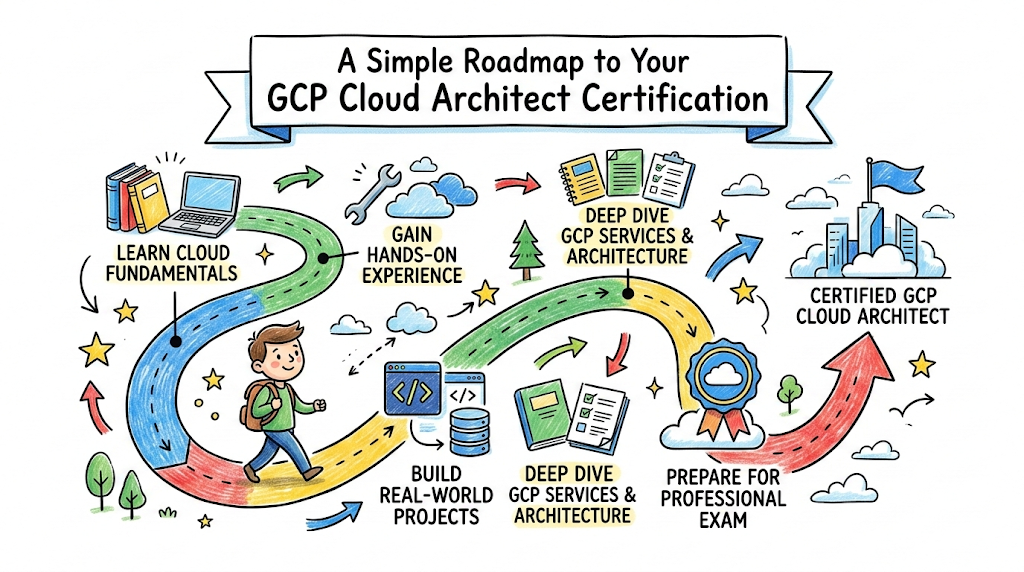
Introduction
Moving your infrastructure to the cloud is not just about changing where your servers sit; it is a complete shift in how you design, build, and manage systems for the future. Among the various cloud platforms, Google Cloud Platform (GCP) has carved out a massive space, especially for organizations that value data, scalability, and open-source integration. If you are looking to prove your expertise in this domain, the GCP Professional Cloud Architect certification is the gold standard that industry leaders look for. It doesn’t just test if you know which button to click in the console; it tests if you can design robust, secure, and dynamic solutions that solve real-world business problems. In this guide, we will break down everything you need to know to master this certification and move your career forward. We will look at the paths you can take, the skills you will need, and the best ways to prepare for the challenges ahead.
The Landscape of Google Cloud Certifications
Google Cloud Certification Overview
| Track | Level | Who it’s for | Prerequisites | Skills Covered | Recommended Order |
| Cloud Digital Leader | Foundational | Decision makers, Sales, Marketing | None | Basic cloud concepts, GCP services | 1st (Optional) |
| Associate Cloud Engineer | Associate | Hands-on Engineers, Admins | 6+ months experience | Deploying apps, monitoring, managing enterprise solutions | 2nd |
| Professional Cloud Architect | Professional | Solutions Architects, Senior Engineers | 3+ years industry experience | Designing for scale, security, compliance, and reliability | 3rd |
| Professional Data Engineer | Professional | Data Scientists, Data Analysts | 3+ years experience | Big data, Machine Learning, Data processing | 4th (Specialized) |
| Professional Cloud Security Engineer | Professional | Security Ops, Compliance Officers | 3+ years experience | Identity management, Network security, Data protection | 4th (Specialized) |
Focus: GCP Professional Cloud Architect
This certification is designed for those who want to be the bridge between complex business requirements and modern technical implementation. It requires a high-level view of how different components like compute, storage, and networking work together to create a seamless user experience. As an architect, your job is to ensure that the system is not only functional but also cost-effective and secure from the ground up.
What it is
The GCP Professional Cloud Architect certification validates your ability to design, develop, and manage robust, secure, and highly available solutions. It focuses on using Google Cloud technologies to meet business objectives while ensuring operational excellence across the entire stack. You will be tested on your ability to handle complex migrations and optimize existing cloud setups for better performance.
Who should take it
This is ideal for experienced Software Engineers, Solutions Architects, and Cloud Leads who are responsible for high-level design decisions. If you are the person people turn to when a system needs to handle millions of users without breaking, this is the right certification for you. It is also highly beneficial for technical managers who need to understand the architectural trade-offs between different cloud services.
Skills you’ll gain
- Architectural Design: You will learn how to design complex cloud solution architectures that are both scalable and resilient to failures.
- Infrastructure Management: You will gain the ability to manage and provision cloud solution infrastructure using automated tools and best practices.
- Security & Compliance: You will master the art of designing for security, compliance, and legal requirements to keep data safe and follow regulations.
- Process Optimization: You will learn to analyze and optimize technical and business processes to improve efficiency and reduce waste in the development cycle.
Real-world projects you should be able to do
- Legacy Migration: Successfully moving a monolithic on-premise application to a microservices architecture on Google Kubernetes Engine (GKE) without downtime.
- Disaster Recovery: Setting up multi-region failover systems and automated backups to ensure 99.99% availability even during major regional outages.
- Cost Optimization: Redesigning data pipelines to use BigQuery and Cloud Storage efficiently to significantly reduce monthly cloud spend for your organization.
- Security Hardening: Implementing Shared VPCs, private clusters, and fine-grained IAM roles to secure a multi-tenant environment against external and internal threats.
Preparation Plan
7–14 Days (The “Quick Refresh” for Experts)
This path is for those who are already working daily on GCP and just need to align their knowledge with the exam format. You should spend the first three days deep-diving into the official case studies like Earthy or Mountkirk Games. The remaining time should be spent on networking concepts and taking at least three full-length practice exams to find any small gaps in your logic.
30 Days (The “Standard Path”)
This is the most common path for engineers who have cloud experience but need to learn the specific Google way of doing things. Dedicate the first two weeks to mastering core services like Compute Engine, GKE, and all the storage options. Use the third week for networking and security, and leave the final week for case study analysis and refining your test-taking speed with mock exams.
60 Days (The “Comprehensive Learning” for Beginners)
If you are moving from another cloud or are new to architecture, you need plenty of hands-on time in the GCP console. Spend the first month building small projects, setting up VPCs, and deploying containers to understand the workflow. In the second month, pivot toward the professional mindset by focusing on “why” a service is chosen over another, and then follow the 30-day plan to polish your knowledge.
Common Mistakes
- Ignoring Case Studies: A large chunk of the exam is based on specific business scenarios, and if you don’t know the case studies, you will lose easy points.
- Focusing only on the Console: The exam often tests your knowledge of CLI commands and automation, so ignoring the command line is a major risk.
- Overlooking Soft Skills: Designing for “Business Requirements” is just as important as technical skills, so don’t ignore the business logic behind the tech.
- Forgetting Hybrid Cloud: Many forget that GCP must often interact with existing on-premise data centers, which is a key part of the architect’s role.
Best next certification after this
Once you have mastered Architecture, the Professional Cloud Security Engineer or Professional Cloud DevOps Engineer certifications are the most logical next steps. These allow you to deepen your technical moat in specific areas that are in high demand across the industry. By combining architecture with security or DevOps, you become a much more versatile and valuable leader in any engineering organization.
Why Choose DevOpsSchool?
When you are aiming for a professional-level certification, the quality of your training can make or break your success. DevOpsSchool stands out because they don’t just teach you how to pass a test; they teach you how to do the job. Their programs are built around the idea that true learning comes from doing, which is why their courses are packed with real-world scenarios and hands-on labs. Their trainers are industry veterans who bring decades of experience to the table, ensuring that you hear about the mistakes to avoid and the best practices that actually work in production. With a strong focus on community and long-term career growth, choosing DevOpsSchool means you are joining a network of professionals who are committed to staying at the top of their game. They provide the structure, the tools, and the mentorship needed to turn a complex subject into a manageable and rewarding career milestone.
Choose Your Path: 6 Specialized Learning Tracks
1. DevOps
This track focuses on the automation of the software delivery lifecycle to ensure code moves from a developer’s laptop to production smoothly. You will learn to use CI/CD tools, Jenkins, and Google Cloud Build to create fast, reliable, and repeatable deployment pipelines. It is the perfect path for those who love making processes more efficient and reducing the time it takes to ship new features.
2. DevSecOps
Security is no longer a separate task that happens at the end of a project; it must be integrated into every step of the process. This path focuses on building security into the heart of your pipelines, using tools for container scanning, automated compliance, and identity management. It is ideal for engineers who want to ensure that speed never comes at the cost of safety and data protection.
3. SRE (Site Reliability Engineering)
This is the “Google way” of handling operations, where you use software engineering practices to solve complex operational problems. You will learn how to use metrics like Service Level Indicators (SLIs) and Service Level Objectives (SLOs) to manage system health and reliability. It is a highly technical path for those who enjoy building systems that are self-healing and highly resilient to failure.
4. AIOps/MLOps
For those who want to use the power of AI to improve how systems are managed, this path is the future of cloud operations. You will learn to build pipelines that automatically detect anomalies, predict failures, and deploy Machine Learning models using tools like Vertex AI. It is a perfect fit for engineers who are excited about the intersection of data science and system administration.
5. DataOps
Data is the lifeblood of modern companies, and this path focuses on ensuring that data is clean, available, and ready for analysis at all times. You will master tools like Dataflow, Dataproc, and Pub/Sub to build real-time data processing pipelines that can handle massive scale. It is the best route for those who want to specialize in the infrastructure that powers big data and business intelligence.
6. FinOps
As cloud environments grow, costs can easily spiral out of control if they are not managed carefully by someone who understands the tech and the budget. This path bridges the gap between finance and engineering, focusing on visibility, optimization, and accountability for cloud spending. It is a critical role for anyone who wants to ensure that their organization is getting the maximum value out of every dollar spent on GCP.
Role → Recommended Certifications
| If your role is… | You should take these Certifications |
| DevOps Engineer | Associate Cloud Engineer -> Professional Cloud DevOps Engineer |
| SRE | Associate Cloud Engineer -> Professional Cloud Architect |
| Platform Engineer | Professional Cloud Architect -> Professional Cloud Network Engineer |
| Cloud Engineer | Associate Cloud Engineer -> Professional Cloud Architect |
| Security Engineer | Professional Cloud Security Engineer -> Professional Cloud Architect |
| Data Engineer | Professional Data Engineer -> Professional Cloud Database Engineer |
| FinOps Practitioner | Cloud Digital Leader -> Professional Cloud Architect |
| Engineering Manager | Cloud Digital Leader -> Professional Cloud Architect |
Top Institutions for Training and Certification
- DevOpsSchool: This is a top-tier platform known for its deep technical training and lab-based curriculum. They focus on giving you the skills needed for real-world implementation, making them a favorite for engineers aiming for high-level certifications. Their trainers are experts who provide personalized guidance to help you master the GCP ecosystem.
- Cotocus: Cotocus specializes in intensive, bootcamp-style training that is designed to get you ready for the exam in a short amount of time. They emphasize hands-on labs and real-time project scenarios, which is great for busy professionals who need to learn quickly. Their approach is very practical and focuses on the most critical exam topics.
- Scmgalaxy: This institution is a community-driven platform that offers a wealth of resources for SCM, DevOps, and Cloud engineering. They provide detailed study guides and community support that is particularly helpful for engineers in India and across the globe. It is an excellent place to find peer support and updated learning materials.
- BestDevOps: Focused specifically on the DevOps and Cloud landscape, this institution is highly rated for the clarity of its training modules. They provide excellent practice materials and mock exams that closely mimic the actual GCP Architect test. Their training is structured to build your confidence through repeated practice and clear explanations.
- devsecopsschool.com: A specialized platform that focuses on the intersection of security and development within the cloud. They offer deep dives into GCP security features and how to architect systems that are secure by design.
- sreschool.com: This school is dedicated to the principles of Site Reliability Engineering, teaching you how to apply Google’s SRE model to your own cloud infrastructure. It is the go-to place for learning about SLIs, SLOs, and error budgets.
- aiopsschool.com: For those looking to integrate artificial intelligence into their operations, this institution provides specialized courses on AIOps and MLOps. You will learn how to use GCP’s AI tools to automate and optimize cloud management.
- dataopsschool.com: This institution focuses on the data lifecycle, teaching you how to architect robust data pipelines and storage solutions on GCP. It is perfect for aspiring Data Engineers and Architects.
- finopsschool.com: As cost management becomes a priority, this school teaches you the framework of FinOps. You will learn how to manage cloud financials and drive accountability across engineering teams.
FAQs: GCP Professional Cloud Architect
1. How difficult is the GCP Professional Cloud Architect exam?
It is widely considered one of the most challenging certifications in the cloud industry because it doesn’t just ask about services; it asks for architectural solutions. You must be able to think like a designer and a business leader at the same time to succeed.
2. How much time does it take to prepare for someone with experience?
If you are already working with cloud technologies, you can expect to spend 30 to 60 days of focused study. This includes time for reading documentation, practicing in the console, and analyzing the mandatory case studies.
3. Are there any strict prerequisites for taking the exam?
There are no formal prerequisites required by Google, meaning you can take it whenever you feel ready. However, having at least three years of industry experience and one year on GCP will make your journey much easier.
4. In what order should I take my GCP certifications?
The most logical sequence is starting with the Associate Cloud Engineer to get the basics down, followed by the Professional Cloud Architect. After that, you can choose a specialty like Security or Data based on your interests.
5. Is this certification still valuable for my career?
Yes, as more companies move to complex multi-cloud and hybrid environments, the demand for certified architects is growing rapidly. It is a clear signal to employers that you have the skills to lead large-scale digital transformations.
6. What is the passing score for the Professional Cloud Architect test?
Google does not publish an exact passing percentage for their professional exams. The result is simply given as “Pass” or “Fail,” and you will usually find out your status immediately after finishing the session.
7. Does the certification expire, and how do I renew it?
GCP Professional certifications are valid for two years from the date you pass. To keep your status active, you will need to retake the exam every two years to prove you are up to date with the latest changes.
8. How does this compare to certifications from AWS or Azure?
While all are prestigious, the GCP Architect exam is often noted for being more “scenario-heavy.” It focuses more on deep technical implementation, containerization with Kubernetes, and high-level data handling than its competitors.
9. Can I take the exam online from my home?
Yes, Google provides the option for both onsite testing at a local center and online proctored exams. If you take it at home, you will need a quiet space and a reliable internet connection to ensure there are no interruptions.
10. What kind of salary growth can a certified architect expect?
While it depends on your location and experience, many professionals see a 20% to 30% increase in their compensation. The certification opens doors to senior roles that come with significantly higher pay scales and better benefits.
11. Are the case studies still a major part of the exam?
Yes, the case studies are a permanent and vital part of the Professional Cloud Architect exam. You must study the business and technical requirements of each provided case study before you sit for the test.
12. What happens if I don’t pass on my first attempt?
If you don’t pass, you can retake the exam after 14 days. If you fail a second time, you must wait 60 days, and a third failure requires a one-year wait, so it is best to be fully prepared before your first try.
Common Questions: GCP Professional Cloud Architect
1. Is the GCP Professional Cloud Architect exam harder than other cloud certifications?
In the industry, this is often ranked as one of the most difficult certifications because it is not just about memorizing services. While other exams might ask you how to configure a database, Google asks you to choose the right architecture based on a complex business scenario. You have to prove you can think like a designer who balances cost, speed, and security simultaneously.
2. How much hands-on experience do I really need before attempting the test?
Google officially recommends at least three years of industry experience, with one year specifically spent working on the Google Cloud Platform. While you can pass by studying theory and documentation, having real-world experience with the gcloud command line and the GCP console makes the scenario-based questions much easier to navigate.
3. What is the significance of the case studies in the exam?
The case studies (like Mountkirk Games or Dress4Win) are fixed scenarios provided by Google that appear in about 25-30% of the exam questions. You are expected to know their current architecture, their pain points, and their business goals by heart. If you don’t study these thoroughly beforehand, you will waste valuable time reading the long descriptions during the actual exam.
4. How does this certification impact my career growth and salary?
Being a certified Professional Cloud Architect puts you in a high-demand bracket globally, especially as more enterprises migrate to GCP for data and AI needs. Professionally, it shifts your role from “someone who executes” to “someone who designs,” which typically comes with a significant salary hike—often 20% to 30%—and more leadership opportunities.
5. Can I skip the Associate Cloud Engineer and go straight to Professional?
Yes, there is no technical “blocker” preventing you from taking the Professional exam first. However, the Associate exam builds a very strong foundation in the day-to-day operations of GCP. If you are already a senior engineer with years of experience in other clouds like AWS or Azure, you can likely skip the Associate level and dive straight into the Architect track.
6. What are the most important technical areas to focus on during study?
You should prioritize Identity and Access Management (IAM), Networking (VPC, Shared VPC, Interconnect), and the different Compute options (GKE vs. App Engine vs. Cloud Functions). Understanding when to use Cloud Spanner versus Bigtable or Cloud SQL is also a very frequent topic that requires a deep understanding of data consistency and scale.
7. How long is the certification valid, and what is the renewal process?
The certification is valid for two years from the date you pass the exam. To keep your credentials active, you must retake the current version of the exam within the 60-day window before your certification expires. This ensures that you are staying up-to-date with Google’s rapidly evolving suite of cloud services and best practices.
8. Are there any prerequisites or specific tools I should learn?
There are no formal prerequisites to sign up, but you should be comfortable with basic Linux administration and containerization (Docker and Kubernetes). Learning how to use the Pricing Calculator and the Google Cloud Architecture Framework is also essential for answering questions related to cost optimization and operational excellence.
Testimonials
“I had been working as a senior engineer for years but felt like I was missing the ‘big picture’ of cloud design. The training at DevOpsSchool helped me connect all the dots between networking, security, and scalability. I passed on my first try and landed a Lead Architect role just two months later.” — Ananya S.
“The hands-on labs were a total game-changer for me during my preparation. Instead of just reading about GKE and VPCs, I was actually building them and breaking them in a safe environment. It gave me the confidence I needed to handle the difficult scenario questions on the actual exam.” — Rohan M.
“Navigating the GCP landscape was overwhelming until I found a clear roadmap that made sense for my career. The transition from a Software Engineer to a Cloud Architect was smooth because the mentors focused on ‘why’ we make certain choices. I highly recommend this path to anyone looking to level up.” — Vikram K.
Next Steps: Where to go from here?
Earning your Professional Cloud Architect badge is a massive milestone, but in the tech world, the learning never truly stops. Depending on where you want to go next, you should consider one of these three paths to keep your skills sharp and your career moving forward.
- Same Track (Deep Dive): You can choose to become the ultimate GCP authority by looking into the Professional Cloud Network Engineer or Cloud Security Engineer tracks. These allow you to master the most complex parts of the platform that even many architects find difficult.
- Cross-Track (Broaden Horizons): Explore the Professional Data Engineer certification to understand how to build modern, AI-driven applications. This is a great choice if you want to work on the cutting edge of big data and machine learning projects.
- Leadership (Management): If you are moving toward a management role, focus on the Cloud Digital Leader or transition into an Engineering Manager position. Your architectural background will give you the technical credibility needed to lead large teams through massive digital shifts.
Conclusion
The journey to becoming a Google Cloud Professional Cloud Architect is demanding, but it is undoubtedly one of the most rewarding paths a technical professional can take. It forces you to move beyond simple coding and start understanding the deep business and technical “why” behind every architectural decision. Whether you are based in India or working for a global firm, this certification sets you apart as a leader who can navigate the complexities of modern cloud infrastructure. As you move forward, remember to start small, build often, and always stay curious about how the cloud is evolving. The tools will change, but the principles of good architecture remain the same. The cloud is waiting for you to build something great—good luck on your journey!
