Upgrade & Secure Your Future with DevOps, SRE, DevSecOps, MLOps!
We spend hours scrolling social media and waste money on things we forget, but won’t spend 30 minutes a day earning certifications that can change our lives.
Master in DevOps, SRE, DevSecOps & MLOps by DevOps School!
Learn from Guru Rajesh Kumar and double your salary in just one year.
Introduction
Core banking systems are the backbone of modern financial institutions, providing centralized platforms for managing accounts, transactions, loans, deposits, and customer information. They enable banks and financial institutions to process daily operations efficiently and maintain consistent, real-time data across multiple branches or digital channels.
In , core banking systems are increasingly critical as banks adopt digital-first strategies, integrate AI for predictive analytics, and comply with evolving regulatory standards. Modern systems enable faster decision-making, improved customer experiences, and secure handling of financial operations.
Real-world use cases include:
- Retail banks managing deposits, withdrawals, and account services.
- Corporate banks providing treasury, lending, and trade finance solutions.
- Neobanks and fintechs launching digital-first banking products.
- Payment providers managing transaction processing and reconciliation.
- Financial institutions integrating AI-driven risk and fraud analytics.
Key evaluation criteria for buyers:
- Core banking functionality (accounts, loans, deposits)
- Scalability and performance
- Integration with third-party fintech and ERP systems
- Security and regulatory compliance (SOC 2, ISO 27001, GDPR)
- AI and automation capabilities
- User interface and ease of onboarding
- Mobile and online banking features
- Deployment flexibility (cloud, hybrid, on-premises)
- Analytics and reporting capabilities
- Customer support and training resources
Best for: Banks, financial institutions, fintechs, neobanks, and enterprises managing large-scale financial operations.
Not ideal for: Small organizations with limited banking needs or companies seeking only offline accounting solutions.
Key Trends in Core Banking Systems
- AI-driven analytics for risk assessment and fraud detection
- Real-time transaction processing and reconciliation
- Cloud-native deployment for scalability and resilience
- Open banking APIs enabling third-party service integration
- Blockchain and distributed ledger technologies for secure settlements
- Automated compliance monitoring and reporting
- Omnichannel digital banking for web and mobile platforms
- Subscription and usage-based pricing models replacing traditional licensing
- Enhanced customer personalization through AI and predictive insights
- Integration with fintech ecosystems for lending, payments, and treasury
How We Selected These Tools (Methodology)
- Evaluated global market adoption and mindshare among retail and corporate banks
- Assessed the completeness of core banking functionality
- Reviewed system reliability, uptime, and performance metrics
- Verified security standards and regulatory compliance
- Examined integration potential with ERP, CRM, and payment systems
- Considered suitability across business sizes and geographies
- Analyzed AI, automation, and workflow optimization capabilities
- Evaluated ease of use and user interface design
- Factored in customer support, training, and community resources
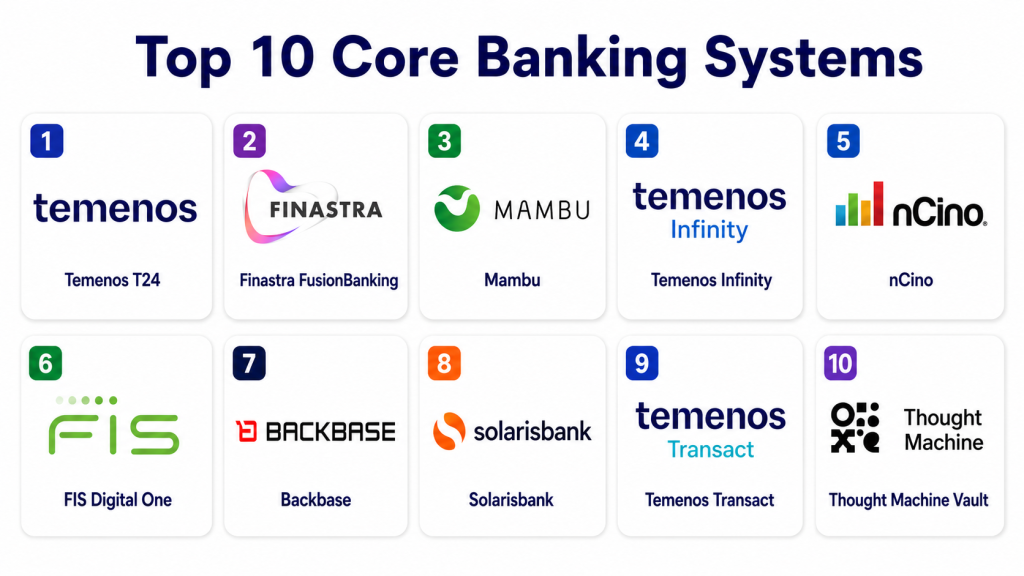
Top 10 Core Banking Systems
#1 — Temenos T24
Short description :
Temenos T24 is a global core banking platform used by retail, corporate, and private banks. It provides end-to-end banking services including account management, loans, payments, and real-time analytics, supporting both physical and digital channels.
Key Features
- Core banking modules for deposits, loans, and payments
- Real-time transaction processing
- API-first design for fintech integrations
- AI-powered analytics and risk assessment
- Multi-currency and multi-country support
- Regulatory compliance dashboards
Pros
- Highly scalable for global banks
- Comprehensive analytics and reporting
Cons
- Complexity may require extensive training
- Premium pricing
Platforms / Deployment
- Web / Windows / macOS / Linux
- Cloud / Hybrid
Security & Compliance
- SOC 2, ISO 27001, GDPR
- MFA, encryption, SSO
Integrations & Ecosystem
- ERP and CRM integrations
- Payment networks and fintech APIs
- Custom workflow and analytics connectors
Support & Community
- Enterprise support teams
- Training programs and documentation
- Active user community
#2 — Finastra FusionBanking
Short description :
Finastra FusionBanking provides real-time banking, payments, and lending solutions. Its cloud-native architecture supports retail, corporate, and investment banks with automation and analytics.
Key Features
- Real-time payments and settlements
- Lending and credit management
- Regulatory compliance automation
- Digital channels and mobile banking
- API-enabled ecosystem
- Analytics dashboards
Pros
- Strong enterprise functionality
- Cloud-native for scalability
Cons
- Training needed for complex workflows
- Higher cost for smaller banks
Platforms / Deployment
- Web / Windows / macOS
- Cloud / Hybrid
Security & Compliance
- SOC 2, ISO 27001, GDPR
- MFA, encryption, audit logs
Integrations & Ecosystem
- ERP and CRM system integrations
- Payment network connections
- API workflows for custom apps
Support & Community
- Enterprise support tiers
- Documentation and onboarding
- User forums
#3 — Mambu
Short description :
Mambu is a cloud-native, composable banking platform designed for fintechs, neobanks, and banks. It offers lending, deposits, payments, and full account management with API-first design for rapid deployment.
Key Features
- Digital account management
- Lending and credit scoring
- Payment processing
- API-first architecture for composable banking
- Analytics and reporting dashboards
- Compliance modules
Pros
- Fast deployment
- Flexible for fintech startups
Cons
- Enterprise-scale features limited
- Some integrations require technical expertise
Platforms / Deployment
- Web / iOS / Android
- Cloud
Security & Compliance
- SOC 2, ISO 27001
- MFA, encryption
Integrations & Ecosystem
- Payment gateways and processors
- ERP and CRM integrations
- Open API for third-party apps
Support & Community
- Online documentation
- Developer community
- Enterprise support tiers
#4 — Temenos Infinity
Short description:
Temenos Infinity focuses on digital engagement and omnichannel customer experiences. It complements core banking systems with AI-driven personalization, mobile apps, and dashboards.
Key Features
- Omnichannel digital banking
- AI-powered personalization
- Mobile and web banking
- Customer analytics dashboards
- API integrations with fintech ecosystem
- Compliance monitoring
Pros
- Improves customer engagement
- AI-driven insights
Cons
- Dependent on existing core banking
- Enterprise pricing
Platforms / Deployment
- Web / iOS / Android
- Cloud
Security & Compliance
- SOC 2, ISO 27001, GDPR
- MFA, encryption
Integrations & Ecosystem
- Core banking APIs
- Payment and lending integrations
- CRM connectors
Support & Community
- Documentation and onboarding
- Enterprise support services
- Online community
#5 — nCino
Short description :
nCino offers a cloud-based banking OS with commercial lending, treasury management, and workflow automation for banks and financial institutions.
Key Features
- Commercial lending management
- Treasury and cash management
- Workflow automation
- Analytics dashboards
- Compliance tools
- API integrations
Pros
- Strong lending and treasury capabilities
- Cloud-native and scalable
Cons
- Primarily for commercial banking
- Learning curve for new users
Platforms / Deployment
- Web / iOS / Android
- Cloud
Security & Compliance
- SOC 2, ISO 27001, GDPR
- MFA, encryption
Integrations & Ecosystem
- ERP and CRM APIs
- Banking payment networks
- Workflow automation
Support & Community
- Enterprise support
- Documentation and training
- Customer success managers
#6 — FIS Digital One
Short description :
FIS Digital One delivers digital banking services including payments, lending, and mobile banking for retail and corporate banks.
Key Features
- Mobile and web banking
- Payments and settlements
- Lending management
- Analytics dashboards
- Compliance and risk management
Pros
- Retail banking focus
- Scalable cloud deployment
Cons
- Enterprise cost high
- Requires training
Platforms / Deployment
- Web / iOS / Android
- Cloud / Hybrid
Security & Compliance
- SOC 2, ISO 27001, GDPR
- MFA, encryption
Integrations & Ecosystem
- Banking APIs
- ERP/CRM connectors
- Payment networks
Support & Community
- Enterprise support
- Documentation and onboarding
- Community forums
#7 — Backbase
Short description :
Backbase offers digital banking engagement with omnichannel support and AI-based personalization.
Key Features
- Digital account opening
- Mobile and web banking
- AI-driven insights
- Workflow automation
- API integrations
- Analytics dashboards
Pros
- Enhances customer experience
- Omnichannel capabilities
Cons
- Requires core banking integration
- Enterprise cost
Platforms / Deployment
- Web / iOS / Android
- Cloud
Security & Compliance
- SOC 2, ISO 27001
- MFA, encryption
Integrations & Ecosystem
- Core banking APIs
- Payment and lending integrations
- CRM connectors
Support & Community
- Enterprise support
- Documentation and training
- Online community
#8 — Solarisbank
Short description :
Solarisbank is a Banking-as-a-Service platform providing API-first digital banking, payments, and lending for fintechs and enterprises.
Key Features
- Digital accounts and payments
- Lending and credit services
- Compliance monitoring
- Analytics dashboards
- API-first architecture
Pros
- Rapid fintech integration
- Cloud-native deployment
Cons
- Limited full banking capabilities
- B2B focused
Platforms / Deployment
- Web / iOS / Android
- Cloud
Security & Compliance
- SOC 2, ISO 27001, GDPR
- MFA, encryption
Integrations & Ecosystem
- Fintech APIs
- ERP and CRM connectors
- Payment network integration
Support & Community
- Developer support
- Documentation and sandbox
- API tutorials
#9 — Temenos Transact
Short description :
Temenos Transact is a core banking solution for retail, corporate, and private banks, supporting real-time processing and global operations.
Key Features
- Core banking modules
- Payments and settlement
- Lending management
- Compliance dashboards
- Analytics and reporting
- API integrations
Pros
- Enterprise-grade solution
- Global adoption
Cons
- Complex for smaller banks
- Premium cost
Platforms / Deployment
- Web / Windows / macOS / Linux
- Cloud / Hybrid
Security & Compliance
- SOC 2, ISO 27001, GDPR
- MFA, encryption
Integrations & Ecosystem
- ERP, CRM, payment networks
- API for third-party apps
- Fintech connectors
Support & Community
- Enterprise support tiers
- Documentation and training
- User forums
#10 — Thought Machine Vault
Short description :
Thought Machine Vault is a cloud-native core banking platform offering real-time processing, smart contracts, and API-first architecture.
Key Features
- Real-time core banking
- Payments and lending
- Smart contract automation
- Compliance and risk management
- API-first design
- Analytics dashboards
Pros
- Real-time processing
- Modern cloud-native architecture
Cons
- Enterprise pricing
- Requires technical expertise
Platforms / Deployment
- Web / iOS / Android
- Cloud
Security & Compliance
- SOC 2, ISO 27001, GDPR
- MFA, encryption
Integrations & Ecosystem
- ERP and CRM APIs
- Payment network integration
- Developer-friendly SDK
Support & Community
- Enterprise support
- Documentation and training
- Developer community
Comparison Table (Top 10)
| Tool Name | Best For | Platform(s) Supported | Deployment | Standout Feature | Public Rating |
|---|---|---|---|---|---|
| Temenos T24 | Global banks | Web / Windows / macOS / Linux | Cloud / Hybrid | End-to-end core banking | N/A |
| Finastra FusionBanking | Banks & corporates | Web / Windows / macOS | Cloud / Hybrid | Real-time payments | N/A |
| Mambu | Fintechs, SMEs | Web / iOS / Android | Cloud | Composable banking | N/A |
| Temenos Infinity | Banks | Web / iOS / Android | Cloud | Digital engagement & AI | N/A |
| nCino | Commercial banks | Web / iOS / Android | Cloud | Lending & treasury management | N/A |
| FIS Digital One | Retail & corporate | Web / iOS / Android | Cloud / Hybrid | Payments & lending | N/A |
| Backbase | Banks | Web / iOS / Android | Cloud | Customer engagement | N/A |
| Solarisbank | Fintechs / B2B | Web / iOS / Android | Cloud | API-first banking | N/A |
| Temenos Transact | Banks | Web / Windows / macOS / Linux | Cloud / Hybrid | Core banking modules | N/A |
| Thought Machine Vault | Banks & fintechs | Web / iOS / Android | Cloud | Real-time core & smart contracts | N/A |
Evaluation & Scoring of Core Banking Systems
| Tool Name | Core (25%) | Ease (15%) | Integrations (15%) | Security (10%) | Performance (10%) | Support (10%) | Value (15%) | Weighted Total (0–10) |
|---|---|---|---|---|---|---|---|---|
| Temenos T24 | 9 | 7 | 8 | 9 | 9 | 8 | 7 | 8.5 |
| Finastra | 8 | 7 | 7 | 8 | 8 | 8 | 7 | 7.9 |
| Mambu | 7 | 8 | 6 | 8 | 7 | 7 | 8 | 7.4 |
| Temenos Infinity | 8 | 7 | 7 | 8 | 7 | 7 | 7 | 7.7 |
| nCino | 8 | 7 | 7 | 8 | 8 | 7 | 7 | 7.8 |
| FIS Digital One | 8 | 7 | 7 | 8 | 8 | 7 | 7 | 7.8 |
| Backbase | 7 | 8 | 6 | 8 | 7 | 7 | 7 | 7.3 |
| Solarisbank | 7 | 8 | 6 | 8 | 7 | 7 | 7 | 7.3 |
| Temenos Transact | 9 | 6 | 8 | 9 | 8 | 7 | 7 | 8.1 |
| Thought Machine Vault | 9 | 6 | 8 | 9 | 8 | 7 | 7 | 8.1 |
Interpretation: Weighted totals provide a comparative overview of core features, usability, integrations, security, performance, support, and value. Selection should be aligned with organizational size, complexity, and digital transformation goals.
Which Core Banking System Is Right for You?
Solo / Freelancer
- Mambu or Solarisbank for flexible, cloud-native, and API-first banking solutions.
SMB
- Mambu or Backbase for efficient, scalable, and digital-first banking services.
Mid-Market
- Finastra, nCino, or FIS Digital One for robust banking and lending management.
Enterprise
- Temenos T24, Temenos Transact, Temenos Infinity, or Thought Machine Vault for large-scale, AI-powered, and real-time banking operations.
Budget vs Premium
- Fintechs and SMBs may choose Mambu or Solarisbank for affordability; enterprises benefit from Temenos or Thought Machine Vault for comprehensive features.
Feature Depth vs Ease of Use
- Enterprise solutions offer extensive functionality but require training; fintech-focused platforms prioritize simplicity and rapid deployment.
Integrations & Scalability
- Verify API availability, ERP/CRM connectivity, and cloud deployment for long-term scalability.
Security & Compliance Needs
- SOC 2, ISO 27001, GDPR, MFA, and encryption are critical for enterprise-grade banking operations.
Frequently Asked Questions (FAQs)
1. What is a core banking system?
A core banking system centralizes banking operations, managing accounts, loans, deposits, payments, and customer data in real-time across multiple branches or digital channels.
2. What pricing models exist for core banking platforms?
Subscription-based, usage-based, or tiered enterprise plans, depending on the platform size, transactions, and feature set.
3. How long does onboarding take?
Small fintechs can onboard in hours, while enterprise deployments may require weeks for integration, testing, and compliance setup.
4. Are these platforms secure?
Yes, top platforms comply with SOC 2, ISO 27001, GDPR, and utilize encryption, MFA, and audit logs for secure banking operations.
5. Can these platforms integrate with other systems?
Most provide API connectivity for ERP, CRM, payment networks, and third-party fintech services.
6. Which platforms are best for fintech startups?
Mambu and Solarisbank provide API-first, composable banking services for fintechs and SMEs.
7. Do these platforms support real-time payments?
Yes, platforms like Finastra, Thought Machine Vault, and Temenos T24 support real-time payment processing.
8. How is compliance ensured?
Core banking systems include automated compliance checks, reporting dashboards, and workflow alerts for regulatory standards.
9. Are mobile banking apps included?
Yes, nearly all platforms offer mobile and web interfaces for both customers and employees.
10. What are common mistakes during implementation?
Common mistakes include selecting overly complex systems for small organizations, neglecting integration testing, and underestimating training and change management needs.
Conclusion
Core banking systems are essential for modern financial institutions seeking efficiency, security, and customer-centric services. SMBs may prioritize simplicity and cost-effectiveness, while enterprises require scalability, AI-driven insights, and real-time processing. Shortlist platforms, test integrations, and validate compliance and security to ensure the chosen system aligns with operational needs and digital transformation goals.
