Upgrade & Secure Your Future with DevOps, SRE, DevSecOps, MLOps!
We spend hours scrolling social media and waste money on things we forget, but won’t spend 30 minutes a day earning certifications that can change our lives.
Master in DevOps, SRE, DevSecOps & MLOps by DevOps School!
Learn from Guru Rajesh Kumar and double your salary in just one year.
Introduction
The global demand for lightning-fast deployment cycles, bulletproof cloud automation, and highly resilient systems is exploding. As enterprise companies aggressively transition to microservices, serverless architectures, and cloud-native environments, the old barriers between writing code and managing infrastructure are completely disappearing. This shift makes top-tier DevOps engineers, site reliability engineers (SREs), and platform experts the most valued assets in tech. Best DevOps Certification are an absolute superpower, but their value depends entirely on how they fit into a broader, aggressive learning strategy. A digital certificate might help your resume slip past an automated HR tracking system, but it will not save you during a live technical interview if you cannot confidently troubleshoot a broken production cluster. A high-impact DevOps learning path prioritizes deep conceptual understanding alongside relentless, hands-on production application. This guide cuts directly through the marketing hype to analyze the industry’s most valuable certifications. We look past the exam blueprints to show you exactly how these credentials translate to day-to-day engineering victories, helping you build a roadmap that gets you hired and promoted.
Why DevOps Certifications Matter
In a high-stakes production environment, a single misconfigured deployment pipeline or insecure container image can trigger massive downtime, bleed thousands of dollars, or expose sensitive customer data. Because the stakes are so high, engineering leaders need ironclad assurance that you understand the systemic, downstream impacts of every single line of code you commit.
While raw hands-on experience is always king, structured industry certifications provide a massive professional advantage:
- Aggressive, Structured Learning: Instead of bouncing randomly between disjointed internet tutorials, preparing for an elite certification gives you a comprehensive, battle-tested curriculum. It forces you to master critical adjacent topics—like IAM policies, advanced networking, and compliance auditing—that you might otherwise skip.
- Instant Market Credibility: For professionals pivoting from software development, QA testing, or traditional system administration, high-quality credentials offer objective, undeniable proof of baseline competence to hiring managers.
- Mastery of Modern Engineering Patterns: Top-tier certification blueprints are regularly updated to reflect real-world engineering demands. Studying for these exams forces you to work directly with cloud-native design patterns, immutable infrastructure, and declarative configuration.
- Unfair Competitive Advantage: A certification alone won’t land you a job offer, but it acts as an absolute filter-breaker. It signals drive, consistency, and professional discipline, instantly moving your resume to the top of the pile during competitive hiring rounds.
Who Should Read This Guide
This blueprint is designed for tech professionals who are ready to build a verifiable, highly practical roadmap for modern cloud roles:
- Ambitious Freshers & Graduates: Individuals looking for a clear, no-nonsense entry point into automation, cloud systems, and continuous delivery pipelines.
- Software Developers: Engineers who want to smash through organizational silos, understand exactly where their code runs, and master containerization and deployment mechanics.
- Linux & Linux System Administrators: Operations veterans determined to move away from manual server provisioning and embrace the world of Infrastructure as Code (IaC) and automated configuration management.
- Cloud Engineers: Infrastructure specialists aiming to deepen their automation, scale orchestration, and maximize continuous delivery performance across major cloud ecosystems.
- Security Professionals: Engineers focused on shifting security left by embedding automated vulnerability scanning, access control, and secrets management into the deployment engine.
Types of DevOps Certifications
To dominate this space, you must balance your technical portfolio across distinct domains. Specializing too early makes you a one-dimensional engineer, while generalizing too much prevents you from mastering critical delivery tools.
┌────────────────────────────────────────────────────────┐
│               Advanced / Specialized                   │
│          (DevSecOps, SRE, GitOps, AIOps)               │
└───────────────────────────┬────────────────────────────┘
                            │
┌───────────────────────────▼────────────────────────────┐
│                Cloud-Specific DevOps                   │
│              (AWS Professional, Azure Expert)           │
└───────────────────────────┬────────────────────────────┘
                            │
┌───────────────────────────▼────────────────────────────┐
│                Core Tool-Based Certs                   │
│             (Kubernetes CKA, Terraform)                │
└───────────────────────────┬────────────────────────────┘
                            │
┌───────────────────────────▼────────────────────────────┐
│                Foundational Concepts                   │
│              (Linux, Git, DevOps Basics)               │
└────────────────────────────────────────────────────────┘
Foundation Certifications
These credentials focus heavily on organizational culture, high-level terminology, and the core philosophies of continuous integration and continuous delivery. They are a great starting point for non-technical project managers, product owners, or absolute beginners who need to understand the cultural mechanics of modern software delivery before touching a command line.
Tool-Based Certifications
Modern automation is built on open-source tools. Tool-specific certifications focus entirely on proving you can manage these technologies across any cloud or local environment. Key domains include:
- Containerization & Orchestration: Docker, Kubernetes (CKA/CKAD).
- Infrastructure as Code (IaC): HashiCorp Terraform.
- Continuous Integration & Version Control: Git platforms, Jenkins, and modern automation runners.
Cloud DevOps Certifications
The absolute heavyweights of cloud infrastructure. Major vendors offer specialized tracks that validate your ability to build, scale, and secure infrastructure specifically within their ecosystems, combining cloud-native architecture with proprietary deployment suites.
DevSecOps Certifications
Security is no longer an afterthought. DevSecOps credentials prove you can natively inject automated vulnerability assessment, live container image scanning, secure secrets rotation, and automated compliance auditing directly into high-speed production pipelines.
SRE & Platform Engineering Certifications
These tracks shift focus entirely to post-deployment infrastructure health. They emphasize maintaining system availability, site reliability engineering metrics, deep logging infrastructure, real-time observability dashboards, and automated incident response patterns.
Best DevOps Certifications at a Glance
Here is the rewritten DevOps Certification comparison table featuring your exact required structure.
All certification names are sourced directly from the provided directory, mapping out the precise target audience, technical levels, core focuses, difficulty metrics, recommended modern infrastructure roles, and embedded resource links.
Comprehensive DevOps Certification Breakdown Table
| Certification | Best For | Level | Main Focus | Difficulty | Recommended Role | Link |
| DevOps Certified Professional (DCP) | Entry-level engineering & foundational cross-functional upskilling | Foundation | Core software development lifecycle (SDLC) bridges, collaboration fundamentals, and initial multi-tool pipelines | Medium | Junior DevOps Engineer | DCP Curriculum |
| DevSecOps Certified Professional (DSOCP) | Advanced pipeline security automation & proactive vulnerability posture | Advanced | Left-shifted compliance, secure CI/CD engine configurations, and real-time dependency scanning audits | High | DevSecOps Specialist / Security Architect | DSOCP Curriculum |
| Site Reliability Engineering (SRE) Certified Professional | Production uptime engineering, platform stability, & error budget designs | Advanced | Distributed operations telemetry, automated recovery logic, and service-level objectives (SLOs) | High | Site Reliability Engineer (SRE) | SRE Curriculum |
| Master in DevOps Engineering (MDE) | Holistic platform design and architectural leadership track | Advanced | Comprehensive enterprise pipeline automation, end-to-end delivery metrics, and multi-cloud scaling blueprints | High | Lead Platform Engineer / DevOps Architect | MDE Curriculum |
| Master in Azure DevOps | Dedicated corporate engineering teams leveraging the complete Microsoft cloud stack | Advanced | Full pipeline architecture execution spanning foundational, administrator, and expert tracks (AZ-900, AZ-104, AZ-400) | High | Cloud Solutions Engineer | Azure Track |
| AWS Certified DevOps Professional | Scalable multi-account corporate systems operational management | Advanced | Complex configuration management, managed infrastructure scale-out rules, and centralized cloud governance | High | AWS Infrastructure Specialist | AWS Track |
| Master in Python Programming | Automation scripting, platform customization, & structural programming extensions | Intermediate | Backend infrastructure automation scripts, system tooling APIs, and programmatic infrastructure management | Medium | Automation Scripting Specialist | Python Track |
| HashiCorp Certified Terraform Associate | Infrastructure provisioning standardization & declarative cloud environments | Intermediate | Declarative infrastructure as code (IaC) configuration files, remote state file management, and clean modular designs | Medium | Cloud Automation Engineer | Terraform Track |
| Certified Kubernetes Administrator (CKA) | Large-scale container management, microservices routing, & orchestration setups | Advanced | Hands-on bare-metal clustering operations, component failure recovery, and runtime workload scheduling pods | High | Kubernetes Administrator / Container Engineer | CKA Track |
| Docker Certified Associate (DCA) | Local infrastructure containerization, runtime isolation, & isolated execution environments | Intermediate | Local container runtime structures, isolated layer configurations, and multi-stage container build optimization | Medium | Systems Administrator / Deployment Specialist | DCA Track |
| Envoy ISTIO Certification Training | Advanced application proxy networks & complex microservices communication setups | Advanced | Microservices service mesh configurations, secure mutual TLS encryption parameters, and granular tracing metrics | High | Service Mesh Architect | Service Mesh Track |
| MLOps Certification Training Course | Data engineering pipelines and automated artificial intelligence model delivery | Advanced | Continuous integration configurations for machine learning loops, model deployment monitoring, and automated model promotions | High | MLOps Engineer / Data Infrastructure Architect | MLOps Track |
| Google Cloud Professional Cloud DevOps Engineer | Highly automated data architectures using native platform systems | Advanced | Google Cloud Engine orchestration methodologies and SRE optimization matrices | High | GCP Cloud Engineer | GCP Track |
| GitOps Certified Professional (GOCP) | Declarative system controls and code-driven reconciliation models | Advanced | Infrastructure state reconciliation engines and continuous environment adjustments driven purely from Git branches | High | GitOps Engineer / Modern Platform Architect | GitOps Track |
| Prometheus with Grafana | Unified operations visibility and structural monitoring architecture | Intermediate | Query execution parameters, centralized log aggregations, and performance visualization metrics panels | Medium | Monitoring & Observability Specialist | Observability Track |
Detailed Certification Deep Dive
1. Certified Kubernetes Administrator (CKA)
What It Is
The CKA is a performance-based exam designed by The Linux Foundation and the Cloud Native Computing Foundation (CNCF). Forget multiple-choice options; this exam drops you directly into a live Linux terminal and forces you to configure, manage, and fix real Kubernetes clusters under intense time constraints.
Who Should Take It
System administrators, cloud engineers, and DevOps professionals who want to prove they can deploy and manage enterprise container workloads at scale.
Best Career Fit
- Kubernetes Engineer
- DevOps Engineer
- Platform Engineer
- Site Reliability Engineer (SRE)
Difficulty Level
Intermediate to Advanced. You must possess fluid command-line navigation and sharp troubleshooting skills.
Career Scope
Kubernetes is the undisputed operating system of modern cloud infrastructure. Holding a CKA tells the engineering world that you possess elite, practical, battle-tested terminal skills—making it a highly respected credential in tech.
Skills You Will Learn
- Provisioning, building, and configuring highly secure Kubernetes clusters.
- Diagnosing and repairing broken node communications and core DNS failures.
- Configuring persistent application storage arrays and secure network ingress.
- Executing smooth application rollouts, live upgrades, and secrets handling.
- Aggregating cluster metrics and building deep logging infrastructure.
Tools Covered
kubectlcommand-line enginekubeadmcluster provisioning system- Container runtimes (containerd)
- etcd database backup and restore routines
Exam Details
- Format: Hands-on, practical lab environment via terminal.
- Duration: 2 Hours.
- Validity: 3 Years.
Study Roadmap
- Own the Linux Terminal: Master SSH navigation, systemd management, vim text editing, and standard bash debugging utilities.
- Master Local Containers: Learn how container layers are built, isolated, networked, and optimized locally.
- Take a Practical CKA Course: Complete structured, lab-heavy courses focused on cluster configuration.
- Simulate the Pressure: Run through the official Killer.sh simulator exercises to build muscle memory for the exam’s time limits.
Real-World Use Cases
When a massive microservice architecture experiences an unexpected traffic surge and worker nodes begin to crash, a CKA-certified engineer connects via the CLI, instantly inspects live cluster metrics, diagnoses the network policy bottleneck, adjusts the resource allocations, and drops in an ingress fix to restore production health.
[User Request] ──> [Ingress Controller] ──> [Service Mesh] ──> [Pods (Worker Nodes)]
                                                                    │
                                   [Fix Resource Limits / Restarts] ◄─ [CKA Engineer via CLI]
Pros & Cons
- Pros: Performance-based framework proves undeniable engineering skills; completely vendor-agnostic; massive industry respect.
- Cons: Very steep learning curve for absolute beginners; terminal-only interface can be stressful if you rely on graphical dashboards.
Best Recommendation
An absolute non-negotiable credential for engineers focused on cloud-native infrastructure. Skip it if you haven’t mastered basic Linux commands or container principles.
2. AWS Certified DevOps Engineer – Professional
What It Is
An advanced, scenario-driven professional examination validating your ability to automate, scale, and govern complex distributed software delivery networks inside the Amazon Web Services ecosystem.
Who Should Take It
Experienced cloud specialists who have spent significant time actively managing production infrastructure and multi-account configurations on AWS.
Best Career Fit
- AWS Cloud DevOps Engineer
- Cloud Infrastructure Architect
- Release Automation Engineer
Difficulty Level
Advanced. Requires a comprehensive understanding of automated fallback architecture, distributed governance, and platform scaling.
Career Scope
As global enterprises scale their cloud footprints, the demand for engineers who can securely organize multi-account environments and build self-healing pipelines remains sky-high.
Skills You Will Learn
- Architecting continuous integration and delivery loops across multiple AWS regions and accounts.
- Deploying high-availability patterns (blue/green, canary) with instant automated rollback policies.
- Implementing rigid security guardrails, configuration tracking, and access governance.
- Setting up centralized logging environments, application monitoring, and event-driven self-healing infrastructure.
- Designing automated data replication and multi-region disaster recovery models.
Tools Covered
- AWS CloudFormation & AWS Cloud Development Kit (CDK)
- AWS CodePipeline, CodeBuild, and CodeDeploy
- Amazon ECS / EKS (Elastic Kubernetes Service)
- AWS Systems Manager & AWS Config
- Amazon CloudWatch & AWS X-Ray
Exam Details
- Format: Complex, situational multiple-choice and multiple-response questions.
- Duration: 180 Minutes.
- Validity: 3 Years.
Study Roadmap
- Secure Your Foundation: Earn either the AWS Developer or SysOps Associate first to master core platform concepts.
- Write the Cloud: Build complex cloud layouts exclusively using programmatic automation templates rather than the graphical console.
- Study Architectural Standards: Read official cloud architecture whitepapers focusing on scale, high availability, and multi-account security.
- Deconstruct Scenario Questions: Use high-quality practice exams to master identifying the most cost-effective and operationally efficient design choice.
Real-World Use Cases
A financial processing application demands zero-downtime micro-deployments multiple times per day. An AWS DevOps Professional constructs a multi-stage automated pipeline that spins up parallel staging infrastructure, executes traffic shifting via weighted routing, continuously checks error metrics, and triggers a rollback if anomalous behavior is detected.
Pros & Cons
- Pros: Elite professional reputation; validates high-level architectural decision-making; excellent coverage of corporate cloud governance.
- Cons: Strictly locked to the AWS product catalog; text-heavy, complex exam scenarios require intense focus and reading speed.
Best Recommendation
The ultimate choice for cloud engineers operating heavily within AWS environments. Beginners must tackle intermediate associate tracks before attempting this exam.
3. HashiCorp Certified: Terraform Associate
What It Is
A foundational to intermediate multiple-choice certification that validates your mastery of declarative Infrastructure as Code (IaC) principles using HashiCorp Terraform.
Who Should Take It
Engineers determined to stop manually configuring servers inside cloud consoles and start defining their infrastructure using clean, repeatable, version-controlled configuration files.
Best Career Fit
- DevOps Engineer
- Cloud Engineer
- Automation Engineer
- Platform Engineer
Difficulty Level
Beginner to Intermediate. Highly accessible if you understand basic cloud resources.
Career Scope
Terraform is the global standard for cloud provisioning. Because it works natively across AWS, Azure, Google Cloud, and on-premises virtualization environments, this certification provides massive career flexibility across modern multi-cloud engineering teams.
Skills You Will Learn
- Writing clear, modular code using HashiCorp Configuration Language (HCL).
- Managing state files safely to prevent resource drift or deployment conflicts.
- Building reusable infrastructure modules to standardize resources across your team.
- Leveraging lookups, built-in functions, and dynamic blocks for flexible code layouts.
- Structuring automated collaborative deployment workflows using remote backends.
Tools Covered
- Terraform CLI core engine
- HCL Syntax frameworks
- Remote state backends (S3, Azure Blob, HashiCorp Consul)
- Terraform Public and Private Registries
Exam Details
- Format: Multiple choice, multiple select, and fill-in-the-blank syntax questions.
- Duration: 60 Minutes.
- Validity: 2 Years.
Study Roadmap
- Deploy Locally: Install the Terraform CLI on your local machine, hook it up to a free-tier cloud provider account, and launch real resources.
- Follow the Official Documentation: Walk through the structured learning guides on the HashiCorp Developer platform.
- Build Real Infrastructure Blocks: Write code to deploy a complete network array, secure it with firewall rules, scale instances, and clean it up using
terraform destroy. - Deconstruct State Tracking: Study exactly how changes in your code alter the underlying tracking file.
Real-World Use Cases
An enterprise tech team needs to duplicate a highly complex staging environment into an entirely separate cloud region for user acceptance testing. Instead of clicking through a cloud console for days, a Terraform engineer alters an environment variable, runs the plan, and provisions the identical infrastructure stack in minutes.
Pros & Cons
- Pros: Complete platform agility; highly practical; excellent, clean entry point into modern automation paradigms.
- Cons: Short validity lifecycle (2 years); strictly focused on resource provisioning rather than complete application deployment lifecycles.
Best Recommendation
An absolute must-have asset for any infrastructure engineer looking to replace manual sysadmin tasks with automated code. Highly valuable across every single major cloud ecosystem.
DevOps Certification Comparison Table
| Feature | Certified Kubernetes Administrator (CKA) | AWS Certified DevOps Engineer – Pro | HashiCorp Certified: Terraform Associate |
| Primary Focus | Container Orchestration & Fleet Management | AWS Cloud Automation & Lifecycle Governance | Multi-Cloud Infrastructure as Code (IaC) |
| Exam Delivery | Live hands-on command-line terminal | Multiple-choice scenario questions | Multiple-choice & syntax verification |
| Vendor Lock-In | None (Open-source standard) | High (AWS specific ecosystem) | None (Multi-cloud applicable) |
| Prerequisites | None (Strong Linux skills expected) | None (Associate level recommended) | None (Basic cloud concepts helpful) |
| Industry Demand | Exceptional (Cloud-native standard) | High (Enterprise AWS organizations) | High (Cross-platform automation standard) |
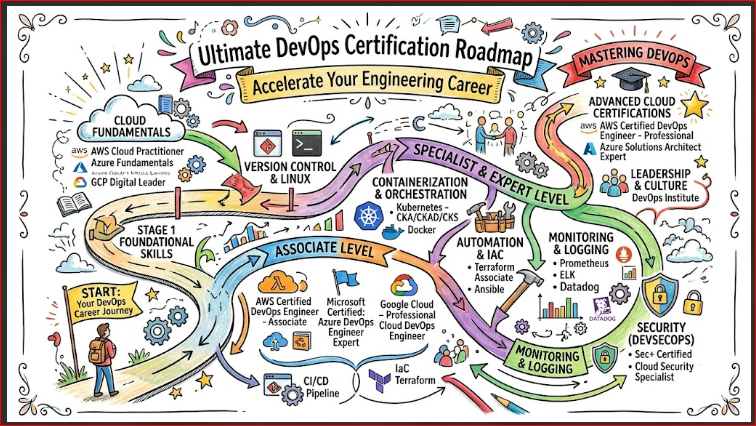
DevOps Certification Roadmap
Building a lucrative, long-term DevOps career requires a calculated, step-by-step approach. Crashing into advanced container orchestration systems before understanding file permissions or networking setups will quickly lead to burnout.
[Phase 1: Core Fundamentals] ──> [Phase 2: Foundations & IaC] ──> [Phase 3: Deep Orchestration] ──> [Phase 4: Advanced Specialization]
  - Linux Administration           - Cloud Practitioner/Fund.      - Kubernetes CKA                - DevSecOps / SRE
  - Git / Version Control          - Terraform Associate           - Cloud DevOps Pro / Expert     - GitOps / Platform Eng.
Phase 1: Core Systems Fundamentals (No Certifications Needed)
Before investing in exam vouchers, master the underlying environment. You must become completely fluent with:
- Linux System Administration: Command execution, file access permissions, process handling, storage mounting, and log digging.
- Networking Mechanics: IP routing tables, DNS propagation, subnets, open ports, and local firewalls.
- Version Control: Fundamental Git workflows (branching, merging, resolving merge conflicts, and managing pull requests).
Phase 2: Foundational Concepts & Infrastructure as Code
With your systems foundation locked down, step directly into cloud structures and declarative automation:
- Cloud Infrastructure Basics: Learn how major cloud providers handle compute and storage by taking foundational tracks like AWS Cloud Practitioner or Azure Fundamentals.
- Infrastructure as Code (IaC): Prepare for the HashiCorp Certified: Terraform Associate exam to learn how to represent infrastructure entirely as code.
Phase 3: Container Orchestration & Cloud DevOps Architecture
At this stage, pivot directly to scalability, microservices, and enterprise automation engines:
- Container Fundamentals: Learn how to build lean images, isolate container networking, and persist container storage locally.
- Deep Fleet Orchestration: Secure your Certified Kubernetes Administrator (CKA) to prove your live terminal debugging power.
- Advanced Cloud DevOps: Earn an advanced role credential, such as the AWS Certified DevOps Engineer – Professional or Microsoft Certified: DevOps Engineer Expert, to master automated enterprise pipelines.
Phase 4: Advanced Specialization
Once you have mastered general deployment architectures, focus your skills on specialized, high-value tracks:
- DevSecOps Track: Integrate container vulnerability scanners, automated static analysis, and automated secrets rotation into active pipelines.
- SRE Track: Deploy log aggregation arrays, configure high-fidelity application tracing, and build real-time observability dashboards.
Recommended Certification Path by Role
Align your certification path directly with your current technical background and immediate career goals:
The DevOps Beginner / Changer Path
If you are breaking into tech or moving from a non-technical role, lock down concepts before racing into complex tools:
- Linux Terminal Fundamentals (Hands-on configuration practice)
- DevOps Foundation or AWS Cloud Practitioner (To master cloud vocabulary and deployment theory)
- HashiCorp Certified: Terraform Associate (Your very first practical, code-driven automation credential)
The SysAdmin-to-Cloud Transition Path
If you have years of experience handling physical servers or virtual systems and want to shift to cloud automation:
- AWS Certified SysOps Administrator – Associate or Azure Administrator Associate
- HashiCorp Certified: Terraform Associate (To replace manual tasks with clean infrastructure code)
- Certified Kubernetes Administrator (CKA) (To move into modern container environments)
The Developer-to-DevOps Path
If you are a programmer looking to break out of application logic and master product delivery pipelines:
- AWS Certified Developer – Associate or Azure Developer Associate
- Certified Kubernetes Application Developer (CKAD) (Tailored for containerizing applications)
- HashiCorp Certified: Terraform Associate
Real-World Career Scenarios
Scenario A: The Career Transitioner
An IT support technician spent years handling physical desktop tickets and manually assigning static IP addresses. Realizing the industry was shifting rapidly toward automated code, they dedicated their evenings to learning Linux utilities, Git version control, and declarative Terraform models.
By passing the Terraform Associate exam and building a clean GitHub repository of cloud-native deployment patterns, they proved their practical skills, cleared automated HR screeners, and landed an entry-level cloud automation role without prior cloud job history.
Scenario B: Resolving Production Downtime
During a high-traffic promotional flash sale, an enterprise e-commerce storefront suddenly suffered severe database timeout errors. The software developers who wrote the application could not identify a code defect, and the traditional operations team could only confirm that server memory was heavily saturated.
A DevOps engineer, leverage skills built through the CKA and advanced cloud tracks, jumped into the terminal, analyzed the active container logs, spotted a misconfigured connection pooling parameter inside the Kubernetes deployment manifest, updated the live config map, and executed a rolling update—restoring the live store in minutes without taking the entire site offline.
Common Mistakes to Avoid
- Tackling Kubernetes Too Early: Kubernetes is a highly complex orchestration environment designed for large container fleets. Attempting to master it before you understand basic networking, Linux system processes, or simple local Docker runtimes will quickly lead to massive frustration.
- Collecting Certifications with Empty Code Portfolios: Displaying five advanced cloud badges on your resume but having an empty public GitHub account is a massive red flag for hiring managers. Match every digital credential with a public code repository showcasing original, working project implementations.
- Ignoring Fundamentals for Trendy Tools: Tools come and go; core systems engineering principles endure. Focus your energy on mastering underlying architectural concepts—like declarative state management and secure access control—rather than simply memorizing the terminal flags of a newly hyped tool.
- Relying on Exam Answer Dumps: Memorizing exam dumps might help you get a certificate, but it leaves you completely helpless during a live production incident. Relying on shortcuts destroys your professional reputation and leaves you highly vulnerable during practical technical interviews.
Hands-On Projects to Build Your Portfolio
To turn your certifications into real job offers, build, test, and document these projects inside a public repository:
[Code Push to Git] ──> [GitHub Actions / Jenkins] ──> [Docker Security Scan] ──> [Deploy to Kubernetes Cluster]
                                                                                            │
                                   [Prometheus Alerts & Grafana Logs] ◄─────────────────────┘
- Automated Multi-Tier Network Deployment: Build a reusable Terraform module that provisions an isolated cloud network array, registers auto-scaling instance pools, enforces strict firewall rules, and serves a secure test web application.
- Hardened CI/CD Vulnerability Pipeline: Create an automated continuous integration pipeline using GitHub Actions or Jenkins that triggers on a code push, builds a lean container image, runs an active vulnerability scan, and signs the verified artifact.
- Self-Healing GitOps Kubernetes Workflow: Set up a local Kubernetes cluster using tools like Minikube. Implement a GitOps continuous delivery system (such as ArgoCD) that monitors a configuration Git repository and automatically matches cluster states to your code changes without manual intervention.
- Centralized Cluster Observability Engine: Deploy a containerized microservice alongside Prometheus and Grafana. Build a custom performance dashboard tracking memory consumption, traffic spikes, and error rates, configuring automated alerts to ping your team when thresholds break.
Tools and Free Learning Resources
- Interactive Linux Training: Use platforms like LinuxJourney.com to master terminal navigation, system configurations, and permission tracking.
- Browser-Based Container Testing: Leverage Play with Docker and Play with Kubernetes for free, browser-based sandbox environments without installing local engines.
- Official Documentation Engines: Treat the documentation portals at kubernetes.io/docs and developer.hashicorp.com as your absolute primary study guides. They provide the most accurate, up-to-date production patterns.
- Cloud Tier Free Sandboxes: Create free tiers on AWS, Azure, or Google Cloud. Set up real-time billing alarms immediately so you can build and destroy infrastructure without encountering unexpected charges.
How to Choose the Right DevOps Certification
To maximize your training budget and career growth, select your next certification using objective, realistic criteria:
- Be Honest About Your Current Skills: If you cannot navigate a Linux filesystem or explain basic routing rules, step away from complex orchestration engines. Lock down your core system fundamentals first.
- Analyze Your Target Job Market: Search local job listings and target enterprises. If your dream companies run entirely on Microsoft infrastructure, prioritize an Azure DevOps track over an AWS path.
- Align with Near-Term Team Projects: If your current team is actively planning a migration to microservices, diving into the CKA will immediately pay dividends in your day-to-day role.
- Budget Your Time and Money Wisely: Highly technical, practical exams require deep preparation. Pick one certification at a time and dedicate 2 to 3 months of regular, focused study to truly absorb the material.
Frequently Asked Questions (FAQs)
1.Which DevOps certification is best for beginners?
The HashiCorp Certified: Terraform Associate is an exceptional entry-level technical credential. It teaches you foundational automation paradigms without requiring years of prior cloud architecture experience. If you need a completely non-technical introduction to the cultural framework, start with the DevOps Foundation path.
2. Is Kubernetes certification worth it?
Yes, absolutely. The Certified Kubernetes Administrator (CKA) is one of the most respected credentials in the infrastructure space. Because it is completely performance-based, it proves to hiring managers that you can confidently debug real-world issues in a live terminal, carrying far more weight than typical multiple-choice tests.
3. Which cloud certification is best for DevOps?
The right choice depends on your target market. Globally, AWS maintains the largest cloud market share, making the AWS Certified DevOps Engineer – Professional an incredibly valuable asset for general job hunts. However, for enterprise environments built on Microsoft systems, the Microsoft Certified: DevOps Engineer Expert track is equally powerful.
4. Is Terraform certification useful?
Yes, it is highly useful. Because Terraform is platform-agnostic, the certification proves you can manage infrastructure across AWS, Azure, Google Cloud, and on-premises environments. This flexibility makes it a highly valuable asset for modern multi-cloud teams.
5. Do DevOps engineers need coding?
Yes, baseline coding literacy is essential. While you do not need to build complex enterprise software applications from scratch, you must be comfortable writing automated scripts (using Bash or Python) and defining infrastructure via configuration files (written in YAML, JSON, or HCL).
6. How long does DevOps certification preparation take?
For intermediate engineers already working with cloud platforms, preparing for the CKA or an AWS Professional exam typically requires 6 to 12 weeks of consistent study. For absolute beginners building up from systems fundamentals, expect a realistic timeline of 6 to 9 months of hands-on practice.
7. Is Docker certification worth it?
While mastering containerization is absolutely mandatory, specific Docker certifications carry less market weight today. Modern engineering teams prioritize comprehensive orchestration credentials like the CKA, which covers core container runtimes alongside broader cluster administration.
8. Which certification is best for SRE roles?
The Certified Kubernetes Administrator (CKA) is an exceptional choice for SRE roles because it focuses heavily on cluster debugging, networking configurations, and workload reliability. Pairing it with training on observability frameworks like Prometheus provides a powerful site reliability skill set.
9. Which DevOps certification has highest salary value?
Advanced credentials like the AWS Certified DevOps Engineer – Professional and the Certified Kubernetes Administrator (CKA) tend to command the highest market premiums. However, remember that the high compensation is tied to the complex, real-world troubleshooting skills verified by these exams, not just the certificate itself.
10. Should beginners start with Kubernetes?
No, beginners should avoid starting with Kubernetes. It is far better to build a solid foundation first by mastering Linux system administration, basic networking, and local Docker containers before trying to manage distributed clusters.
11. Is DevOps certification enough to get a job?
No. A certification gets your resume past initial automated screening filters, but it will not clear a technical interview on its own. To secure a job offer, you must back up your credentials with a public GitHub portfolio of working infrastructure projects and demonstrate strong live troubleshooting skills.
12. Which DevOps certification roadmap is best?
The most effective roadmap starts with Linux and Git fundamentals, moves into infrastructure automation with the Terraform Associate, and advances to container orchestration with the CKA. Finish your path by earning a professional-level cloud DevOps certification tailored to your chosen ecosystem (AWS or Azure).
Final Recommendation
Never treat certifications as a simple checklist or a collection of digital badges. A resume packed with certifications but lacking hands-on project experience raises immediate flags during technical interviews.
If you are just starting out, focus on mastering the Linux command line, Git, and basic cloud networking. Once your fundamentals are solid, use the HashiCorp Certified: Terraform Associate to learn automation, and follow it up with the Certified Kubernetes Administrator (CKA) to master container environments. Choose certifications that match your daily engineering work, and always validate your knowledge by building and sharing real, working projects.
