Upgrade & Secure Your Future with DevOps, SRE, DevSecOps, MLOps!
We spend hours scrolling social media and waste money on things we forget, but won’t spend 30 minutes a day earning certifications that can change our lives.
Master in DevOps, SRE, DevSecOps & MLOps by DevOps School!
Learn from Guru Rajesh Kumar and double your salary in just one year.
Introduction
Customer Success Platforms help companies manage, support, and grow customer relationships after the sale. These platforms give customer success teams a clear view of customer health, product usage, onboarding progress, renewals, support risks, expansion opportunities, and account engagement.
In simple words, a customer success platform helps businesses understand which customers are happy, which customers may churn, and which customers need attention. It brings customer data from CRM, product analytics, support tools, billing systems, and communication platforms into one place.
Common use cases include customer onboarding, health scoring, churn risk tracking, renewal management, customer journey mapping, account planning, product adoption analysis, and expansion opportunity identification.
Buyers should evaluate:
- Customer health scoring
- Account and lifecycle management
- Product usage tracking
- Renewal and churn risk workflows
- Customer segmentation
- Playbooks and automation
- CRM and support tool integrations
- Reporting and dashboards
- Security and access controls
- Pricing, scalability, and implementation effort
Best for: SaaS companies, subscription businesses, customer success teams, account managers, revenue leaders, support leaders, onboarding teams, and companies focused on retention, renewals, product adoption, and customer growth.
Not ideal for: very small teams with only a few customers and simple relationship tracking needs. In such cases, a CRM, spreadsheet, project board, or helpdesk may be enough until customer volume and complexity increase.
Key Trends in Customer Success Platforms
- AI-assisted customer health insights: Platforms are using AI to summarize customer activity, detect churn signals, recommend next actions, and help customer success managers prioritize accounts.
- Revenue-focused customer success: Customer success is moving closer to revenue operations, renewals, expansion, and account growth. Platforms now need to support retention and upsell workflows.
- Product usage intelligence: Teams want deeper visibility into how customers use features, where adoption is low, and which accounts are not getting value.
- Automation of playbooks: Customer success teams are using automated playbooks for onboarding, renewal reminders, risk escalation, QBR preparation, and customer outreach.
- Digital customer success: Many companies are scaling customer success with self-service journeys, automated emails, in-app guidance, customer education, and health-based engagement.
- Integration with revenue systems: Customer success platforms now need to connect with CRM, billing, support, product analytics, data warehouses, communication tools, and business intelligence platforms.
- Customer journey orchestration: Teams are mapping full customer journeys from onboarding to adoption, renewal, expansion, and advocacy.
- Stronger executive reporting: Leaders want dashboards that show retention risk, expansion pipeline, customer health, onboarding progress, and customer success team performance.
- Customer segmentation: Companies are building different success motions for enterprise accounts, mid-market customers, SMBs, self-service users, and strategic accounts.
- Privacy and governance: Since customer success platforms hold sensitive customer data, buyers expect access controls, audit logs, encryption, identity integrations, and clear data handling practices.
How We Selected These Tools
The top Customer Success Platforms in this guide were selected using a practical evaluation model focused on retention, adoption, account visibility, and customer lifecycle management. The selection considered:
- Market adoption and recognition among customer success and revenue teams
- Feature completeness across health scoring, playbooks, renewals, dashboards, and automation
- Fit for SaaS, subscription, enterprise, SMB, and product-led businesses
- Ease of use for customer success managers, account managers, and leadership teams
- Integration ecosystem with CRM, support, billing, product analytics, and communication tools
- Reporting depth for churn risk, retention, account health, and expansion opportunities
- Security posture signals such as access controls, permissions, privacy, and auditability
- Scalability for different customer segments and account models
- Workflow flexibility for onboarding, adoption, renewals, and advocacy
- Practical trade-offs such as pricing, implementation effort, and data readiness
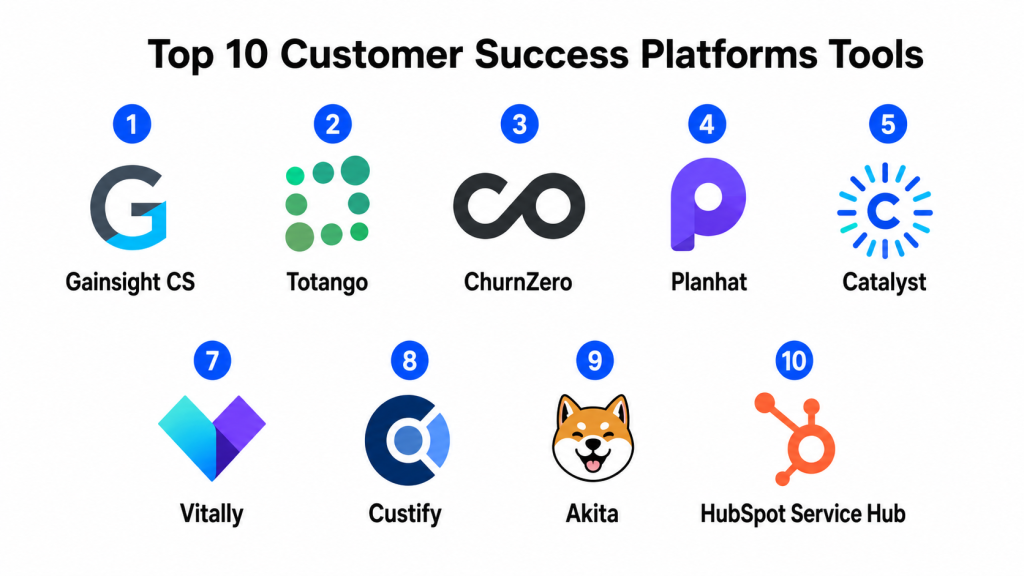
Top 10 Customer Success Platforms Tools
#1 — Gainsight CS
Short description: Gainsight CS is an enterprise-grade customer success platform designed to help companies manage customer health, renewals, adoption, playbooks, and account engagement. It is widely used by SaaS and subscription businesses with mature customer success operations.
Key Features
- Customer health scoring
- Account and relationship management
- Customer journey orchestration
- Playbooks and success plans
- Renewal and churn risk tracking
- Product usage and adoption insights
- Executive dashboards and reporting
Pros
- Strong fit for enterprise customer success teams.
- Deep customer health and lifecycle management capabilities.
- Useful for complex retention, renewal, and expansion workflows.
Cons
- Implementation can be complex for smaller teams.
- Requires strong data quality to deliver full value.
- May be expensive for early-stage businesses.
Platforms / Deployment
Web
Cloud
Security & Compliance
Supports common enterprise security expectations such as SSO, role-based access, permissions, audit-related controls, and data protection features. Specific compliance details should be validated during procurement.
Integrations & Ecosystem
Gainsight CS is designed to connect customer success data with revenue, product, support, and business systems.
- CRM platforms
- Support systems
- Product analytics tools
- Billing and subscription platforms
- Data warehouses
- Communication and workflow tools
Support & Community
Gainsight provides customer support, implementation resources, documentation, training, professional services, and a strong customer success community. It is one of the most recognized ecosystems in this category.
#2 — Totango
Short description: Totango is a customer success platform focused on customer health, lifecycle management, segmentation, playbooks, and retention workflows. It is useful for companies that want structured success programs with flexible customer journey management.
Key Features
- Customer health scoring
- Customer segmentation
- SuccessBLOC-style playbooks and programs
- Lifecycle and journey tracking
- Churn risk identification
- Account dashboards
- Automation and task management
Pros
- Strong customer journey and segmentation capabilities.
- Useful for scaling customer success programs.
- Flexible for different customer success motions.
Cons
- Setup requires clear customer success process design.
- Data integration quality impacts reporting accuracy.
- Some teams may need training to use advanced workflows well.
Platforms / Deployment
Web
Cloud
Security & Compliance
Supports common security features such as access controls, user permissions, and data protection. Specific compliance details should be confirmed with the vendor.
Integrations & Ecosystem
Totango connects with common revenue, support, product, and customer data systems to provide account visibility.
- CRM systems
- Support platforms
- Product usage tools
- Data platforms
- Communication tools
- Workflow automation systems
Support & Community
Totango provides support resources, documentation, onboarding guidance, and customer success best-practice materials. It is suitable for teams that want structured journey-based customer success.
#3 — ChurnZero
Short description: ChurnZero is a customer success platform built for subscription businesses that need customer health tracking, product usage visibility, automation, alerts, and churn prevention workflows. It is especially useful for SaaS teams focused on retention.
Key Features
- Customer health scores
- Product usage tracking
- Churn risk alerts
- Customer journeys and playbooks
- Automated customer communication
- Renewal and account management workflows
- Dashboards and reporting
Pros
- Strong focus on churn prevention and customer retention.
- Good for SaaS companies that rely on product usage signals.
- Practical automation for customer success teams.
Cons
- Best value depends on good product and account data.
- May require setup effort for health scoring and journeys.
- Smaller teams may need time to adopt structured workflows.
Platforms / Deployment
Web
Cloud
Security & Compliance
Supports common access control, data protection, and customer data management features. Specific compliance details should be validated during procurement.
Integrations & Ecosystem
ChurnZero integrates with CRM, support, product usage, communication, and data systems to support customer health and engagement workflows.
- CRM platforms
- Product analytics tools
- Support systems
- Communication tools
- Billing systems
- Customer data workflows
Support & Community
ChurnZero offers documentation, support, onboarding resources, customer success guidance, and practical enablement materials for SaaS customer success teams.
#4 — Planhat
Short description: Planhat is a customer success and customer platform that helps teams manage accounts, customer health, revenue, product usage, and lifecycle workflows. It is suitable for growing SaaS and B2B companies that want flexible customer success operations.
Key Features
- Customer health and account management
- Revenue and renewal visibility
- Product usage data tracking
- Customer lifecycle workflows
- Automation and task management
- Dashboards and reporting
- CRM and data integrations
Pros
- Flexible and modern customer success experience.
- Good balance of account management, health scoring, and revenue visibility.
- Useful for scaling teams that want configurable workflows.
Cons
- Requires clean customer data for strong insights.
- Advanced setup may need planning.
- Some enterprise requirements should be validated before purchase.
Platforms / Deployment
Web
Cloud
Security & Compliance
Supports common security expectations such as user permissions, access controls, and secure customer data handling. Specific compliance details should be confirmed during vendor review.
Integrations & Ecosystem
Planhat connects with revenue, support, product, and data systems to create a fuller customer view.
- CRM systems
- Support tools
- Product analytics platforms
- Billing systems
- Data warehouses
- Communication tools
Support & Community
Planhat provides documentation, support resources, onboarding guidance, and customer success enablement. It has strong relevance for SaaS teams seeking flexible customer data and success workflows.
#5 — Catalyst
Short description: Catalyst is a customer success platform designed to help teams manage customer health, workflows, renewals, and account visibility. It is useful for customer success teams that want a modern interface and strong CRM-connected workflows.
Key Features
- Customer health tracking
- Account management dashboards
- Renewal and risk workflows
- Playbooks and task automation
- CRM data synchronization
- Customer segmentation
- Reporting and insights
Pros
- Clean interface for customer success teams.
- Strong fit for teams that rely heavily on CRM data.
- Useful for managing renewals, risks, and account workflows.
Cons
- Best results require strong CRM hygiene.
- May be less suitable for teams without defined customer success processes.
- Advanced product usage workflows should be validated.
Platforms / Deployment
Web
Cloud
Security & Compliance
Supports common security and access control features. Specific compliance details are not publicly stated for every package and should be validated during procurement.
Integrations & Ecosystem
Catalyst is often used with CRM-centered customer success workflows and connects with tools that help customer success managers manage account data and actions.
- CRM platforms
- Support systems
- Communication tools
- Product usage workflows
- Revenue operations tools
- Reporting systems
Support & Community
Catalyst provides documentation, support resources, onboarding assistance, and customer success guidance. It is useful for teams that want a modern customer success operating layer.
#6 — ClientSuccess
Short description: ClientSuccess is a customer success platform built for account management, customer health, renewals, engagement tracking, and success planning. It is suitable for B2B companies that want structured customer success workflows without unnecessary complexity.
Key Features
- Customer health management
- Success planning
- Renewal tracking
- Engagement and activity tracking
- Account dashboards
- Risk and opportunity visibility
- Reporting and team workflows
Pros
- Practical for customer success teams focused on account visibility.
- Useful for tracking renewals and customer relationships.
- Easier to adopt than some heavier enterprise platforms.
Cons
- May not match the depth of larger enterprise systems.
- Product usage analytics may require integrations.
- Advanced automation needs should be reviewed before purchase.
Platforms / Deployment
Web
Cloud
Security & Compliance
Supports common access control and customer data protection features. Specific compliance details should be verified during vendor evaluation.
Integrations & Ecosystem
ClientSuccess connects customer success workflows with CRM, support, and business systems.
- CRM tools
- Support platforms
- Communication systems
- Customer data workflows
- Billing and renewal tracking
- Reporting tools
Support & Community
ClientSuccess provides onboarding support, documentation, customer success resources, and practical guidance for account-based customer success teams.
#7 — Vitally
Short description: Vitally is a customer success platform focused on customer health, collaboration, automation, and product-led customer success workflows. It is useful for SaaS teams that want customer data visibility and flexible success operations.
Key Features
- Customer health scoring
- Account dashboards
- Product usage visibility
- Automation and workflows
- Collaboration tools
- Customer segmentation
- Reporting and analytics
Pros
- Strong fit for product-led and SaaS customer success teams.
- Flexible workflows for different customer segments.
- Useful for customer data visibility and team collaboration.
Cons
- Requires strong data integration for best results.
- Setup may take planning for health scoring and automation.
- Some enterprise governance needs should be validated.
Platforms / Deployment
Web
Cloud
Security & Compliance
Supports common cloud security expectations such as access controls, user permissions, and data protection. Specific compliance details should be confirmed with the vendor.
Integrations & Ecosystem
Vitally connects with product, CRM, support, and communication systems to help teams manage customer success with real usage and account data.
- CRM systems
- Product analytics tools
- Support platforms
- Communication tools
- Data warehouses
- Workflow automation tools
Support & Community
Vitally provides documentation, support resources, onboarding guidance, and customer success best-practice materials. It is commonly used by SaaS teams managing product-led customer engagement.
#8 — Custify
Short description: Custify is a customer success platform designed for SaaS businesses that need customer health monitoring, onboarding tracking, churn prevention, and account management. It is useful for growing teams that want a practical success platform without heavy complexity.
Key Features
- Customer health scoring
- Onboarding tracking
- Churn risk alerts
- Customer lifecycle management
- Task and activity management
- Customer segmentation
- Reporting dashboards
Pros
- Good fit for SaaS teams focused on churn reduction.
- Practical onboarding and health tracking workflows.
- Easier to adopt than some enterprise-heavy platforms.
Cons
- May not provide the same depth as larger enterprise platforms.
- Advanced analytics and custom workflows should be validated.
- Best results depend on proper customer data setup.
Platforms / Deployment
Web
Cloud
Security & Compliance
Supports common security practices such as permissions and data protection. Specific compliance details should be validated during procurement.
Integrations & Ecosystem
Custify connects with common SaaS business systems to help teams monitor customer health and engagement.
- CRM platforms
- Support systems
- Product usage tools
- Billing systems
- Communication tools
- Customer data workflows
Support & Community
Custify provides customer support, onboarding help, documentation, and practical customer success guidance. It is suitable for SaaS companies building structured retention workflows.
#9 — Akita
Short description: Akita is a customer success platform focused on customer health, usage tracking, lifecycle management, segmentation, and churn prevention. It is suitable for SaaS businesses that need visibility into customer risk and engagement.
Key Features
- Customer health scoring
- Product usage tracking
- Account segmentation
- Customer lifecycle monitoring
- Risk alerts
- Customer success workflows
- Dashboards and reports
Pros
- Useful for SaaS companies monitoring churn risk.
- Supports customer segmentation and health tracking.
- Practical for teams wanting a clearer customer success view.
Cons
- May require integrations to unlock full value.
- Smaller teams may need time to define health score logic.
- Advanced enterprise workflows should be validated.
Platforms / Deployment
Web
Cloud
Security & Compliance
Supports common access and data protection features. Specific compliance details are not publicly stated for every package and should be verified.
Integrations & Ecosystem
Akita integrates with customer-facing and business systems to help success teams understand account behavior.
- CRM tools
- Support platforms
- Product analytics systems
- Billing tools
- Communication platforms
- Customer data systems
Support & Community
Akita provides documentation, support resources, and onboarding help. It is useful for SaaS teams that want practical customer health and lifecycle visibility.
#10 — HubSpot Service Hub
Short description: HubSpot Service Hub is a customer service and success platform that supports ticketing, customer feedback, knowledge base, automation, customer portals, and service reporting. It is useful for companies already using HubSpot for CRM, marketing, or sales.
Key Features
- Ticketing and service workflows
- Customer feedback surveys
- Knowledge base tools
- Customer portal support
- Automation and workflows
- Service reporting dashboards
- CRM-connected customer records
Pros
- Strong fit for teams already using HubSpot.
- Combines customer service, CRM, and success workflows.
- Easier to adopt for SMB and mid-market teams.
Cons
- May not match dedicated customer success platforms for deep health scoring.
- Advanced success operations may require multiple HubSpot modules.
- Best value depends on HubSpot ecosystem adoption.
Platforms / Deployment
Web / iOS / Android
Cloud
Security & Compliance
Supports common platform security features such as access controls, user permissions, identity options, and data protection settings. Specific compliance details depend on plan and configuration.
Integrations & Ecosystem
HubSpot Service Hub works strongly within the HubSpot ecosystem and also connects with many business tools through marketplace and workflow integrations.
- HubSpot CRM
- Marketing and sales tools
- Support and ticketing workflows
- Communication platforms
- Automation workflows
- Reporting dashboards
Support & Community
HubSpot provides documentation, academy-style learning resources, customer support, onboarding options, and a large user community. It is especially strong for SMB and mid-market teams already using HubSpot.
Comparison Table
| Tool Name | Best For | Platform(s) Supported | Deployment | Standout Feature | Public Rating |
|---|---|---|---|---|---|
| Gainsight CS | Enterprise customer success operations | Web | Cloud | Advanced health scoring and lifecycle management | N/A |
| Totango | Customer journey and segmentation workflows | Web | Cloud | Success programs and lifecycle orchestration | N/A |
| ChurnZero | SaaS churn prevention and product usage tracking | Web | Cloud | Churn risk alerts and usage-based success workflows | N/A |
| Planhat | Flexible customer success and revenue visibility | Web | Cloud | Customer data, health, and revenue management | N/A |
| Catalyst | CRM-connected customer success teams | Web | Cloud | Account workflows and renewal visibility | N/A |
| ClientSuccess | Account-based customer success management | Web | Cloud | Success planning and renewal tracking | N/A |
| Vitally | Product-led SaaS customer success | Web | Cloud | Product usage visibility and automation | N/A |
| Custify | Growing SaaS teams focused on retention | Web | Cloud | Onboarding and customer health tracking | N/A |
| Akita | SaaS customer health and lifecycle monitoring | Web | Cloud | Usage-based customer risk tracking | N/A |
| HubSpot Service Hub | SMB and mid-market service-success workflows | Web, iOS, Android | Cloud | CRM-connected service and customer workflows | N/A |
Evaluation & Scoring of Customer Success Platforms
| Tool Name | Core (25%) | Ease (15%) | Integrations (15%) | Security (10%) | Performance (10%) | Support (10%) | Value (15%) | Weighted Total (0–10) |
|---|---|---|---|---|---|---|---|---|
| Gainsight CS | 9.5 | 7.5 | 9.2 | 9.0 | 8.8 | 8.8 | 7.5 | 8.63 |
| Totango | 8.8 | 8.0 | 8.5 | 8.3 | 8.5 | 8.3 | 8.0 | 8.39 |
| ChurnZero | 8.8 | 8.2 | 8.5 | 8.2 | 8.5 | 8.3 | 8.1 | 8.42 |
| Planhat | 8.7 | 8.4 | 8.5 | 8.3 | 8.5 | 8.2 | 8.0 | 8.39 |
| Catalyst | 8.4 | 8.5 | 8.4 | 8.0 | 8.3 | 8.0 | 8.0 | 8.25 |
| ClientSuccess | 8.0 | 8.5 | 8.0 | 7.8 | 8.2 | 8.0 | 8.3 | 8.14 |
| Vitally | 8.5 | 8.4 | 8.5 | 8.0 | 8.4 | 8.0 | 8.2 | 8.35 |
| Custify | 8.0 | 8.4 | 7.8 | 7.8 | 8.0 | 8.0 | 8.4 | 8.08 |
| Akita | 7.8 | 8.2 | 7.8 | 7.7 | 8.0 | 7.8 | 8.3 | 7.96 |
| HubSpot Service Hub | 8.2 | 8.8 | 9.0 | 8.5 | 8.5 | 8.8 | 8.5 | 8.62 |
These scores are comparative and should be used as a shortlisting guide. A higher score does not mean the tool is the best choice for every company. Gainsight may be strong for enterprise customer success, while HubSpot Service Hub may be more practical for teams already using HubSpot. Buyers should validate customer data readiness, integration needs, health scoring logic, security controls, and team adoption before selecting a platform.
Which Customer Success Platform Tool Is Right for You?
Solo / Freelancer
Solo professionals usually do not need a dedicated customer success platform unless they manage many recurring clients or subscription accounts. A CRM, spreadsheet, project board, or task management tool may be enough for simple client follow-ups.
If a solo consultant needs more structure, HubSpot Service Hub or a lightweight CRM-based workflow may be a better starting point than a full customer success platform.
SMB
Small and medium businesses should focus on ease of use, customer visibility, onboarding tracking, simple health scores, and affordable pricing. HubSpot Service Hub, Custify, ClientSuccess, Akita, and Vitally can be practical options depending on customer volume and data maturity.
If the company already uses HubSpot, HubSpot Service Hub may be the easiest to adopt. If the business is SaaS-focused and wants churn tracking, Custify, Akita, or Vitally may be more suitable.
Mid-Market
Mid-market companies usually need stronger account dashboards, automated playbooks, product usage tracking, renewals, customer segmentation, and reporting. ChurnZero, Planhat, Totango, Catalyst, Vitally, and ClientSuccess are strong options.
If churn prevention is the main goal, ChurnZero is worth evaluating. If flexible customer data and revenue visibility matter, Planhat can be a strong option. If CRM-connected workflows are important, Catalyst may fit well.
Enterprise
Enterprise customer success teams need deep health scoring, advanced workflows, governance, executive dashboards, data integration, segmentation, and large-account management. Gainsight CS, Totango, Planhat, ChurnZero, and HubSpot Service Hub can be considered depending on the broader tech stack.
Gainsight CS is strong for mature enterprise customer success operations. Totango is useful for journey-based programs. HubSpot Service Hub is practical when service, CRM, marketing, and sales workflows are already centralized in HubSpot.
Budget vs Premium
Budget-conscious teams should consider tools that are simpler to adopt and focused on the most important customer success workflows. HubSpot Service Hub, Custify, Akita, and ClientSuccess can be practical depending on team needs.
Premium buyers should evaluate Gainsight CS, Totango, Planhat, ChurnZero, and Catalyst if they need advanced health scoring, automation, integrations, and customer lifecycle orchestration.
Feature Depth vs Ease of Use
Gainsight CS, Totango, Planhat, and ChurnZero provide deeper customer success capabilities but may require more planning and configuration. HubSpot Service Hub, Custify, Akita, and ClientSuccess may be easier for smaller teams to adopt.
The right choice depends on maturity. A team with unclear processes should not start with the most complex platform. A large team with complex accounts should avoid tools that cannot support advanced workflows.
Integrations & Scalability
Customer success platforms become more valuable when they connect with CRM, support tools, product analytics, billing, data warehouses, communication systems, and business intelligence platforms. Good integrations help teams see the full customer picture.
Before buying, teams should map the data they need: contract value, renewal date, support tickets, feature usage, onboarding tasks, NPS, product adoption, and account owner details.
Security & Compliance Needs
Customer success platforms store sensitive customer data such as account health, product usage, renewal risk, contacts, communication notes, support history, and revenue information. Buyers should review access controls, encryption, SSO, audit logs, data retention, and permission settings.
For larger or regulated organizations, security, legal, IT, revenue operations, and customer success leaders should review the platform before rollout.
Frequently Asked Questions
1. What is a Customer Success Platform?
A Customer Success Platform helps companies track customer health, onboarding progress, product adoption, churn risk, renewals, and account engagement. It gives customer success teams one place to manage customer relationships after the sale.
2. Who uses customer success platforms?
Customer success managers, account managers, revenue leaders, onboarding teams, support leaders, product teams, and executives use these platforms to improve retention, renewals, and customer value.
3. How is a customer success platform different from a CRM?
A CRM mainly tracks sales, contacts, opportunities, and revenue pipeline. A customer success platform focuses on post-sale customer health, adoption, churn risk, renewals, and success workflows.
4. How much do customer success platforms cost?
Pricing varies by vendor, number of users, customer volume, modules, integrations, and support level. Some platforms use custom pricing, while others may offer package-based pricing.
5. What is customer health scoring?
Customer health scoring is a method of measuring account condition using signals such as product usage, support tickets, renewal status, engagement, feedback, and relationship strength. It helps teams identify risk and opportunity.
6. What are common implementation mistakes?
Common mistakes include poor data quality, unclear health score logic, weak CRM integration, too many playbooks, lack of customer segmentation, and not training customer success managers properly.
7. Can customer success platforms reduce churn?
They can help reduce churn by identifying risk early, automating follow-ups, tracking adoption, and improving account visibility. However, the platform only works if the team acts on the insights.
8. Do customer success platforms integrate with product analytics tools?
Yes, many platforms integrate with product usage and analytics tools. This helps teams see whether customers are actively using important features and getting value from the product.
9. Which platform is best for SaaS companies?
Gainsight CS, ChurnZero, Planhat, Totango, Vitally, Custify, and Akita are strong options for SaaS companies. The best choice depends on company size, data maturity, customer segments, and retention strategy.
10. Which platform is best for SMBs?
HubSpot Service Hub, Custify, ClientSuccess, Akita, and Vitally can be practical for SMBs. SMBs should focus on simple workflows, easy adoption, clear dashboards, and affordable pricing.
Conclusion
Customer Success Platforms help businesses manage customer relationships, reduce churn risk, improve product adoption, track renewals, and identify expansion opportunities. The best platform depends on customer base size, subscription model, data maturity, team structure, integration needs, and retention strategy.Gainsight CS is strong for mature enterprise customer success teams, while ChurnZero, Totango, Planhat, Catalyst, and Vitally are practical for SaaS and mid-market customer success operations. Custify, Akita, ClientSuccess, and HubSpot Service Hub can be useful for smaller teams or companies looking for simpler adoption. There is no single best platform for everyone. A smart next step is to shortlist two or three tools, run a pilot with real account data, validate integrations, review security settings, and confirm whether customer success managers can use the platform consistently in daily workflows.
