Upgrade & Secure Your Future with DevOps, SRE, DevSecOps, MLOps!
We spend hours scrolling social media and waste money on things we forget, but won’t spend 30 minutes a day earning certifications that can change our lives.
Master in DevOps, SRE, DevSecOps & MLOps by DevOps School!
Learn from Guru Rajesh Kumar and double your salary in just one year.
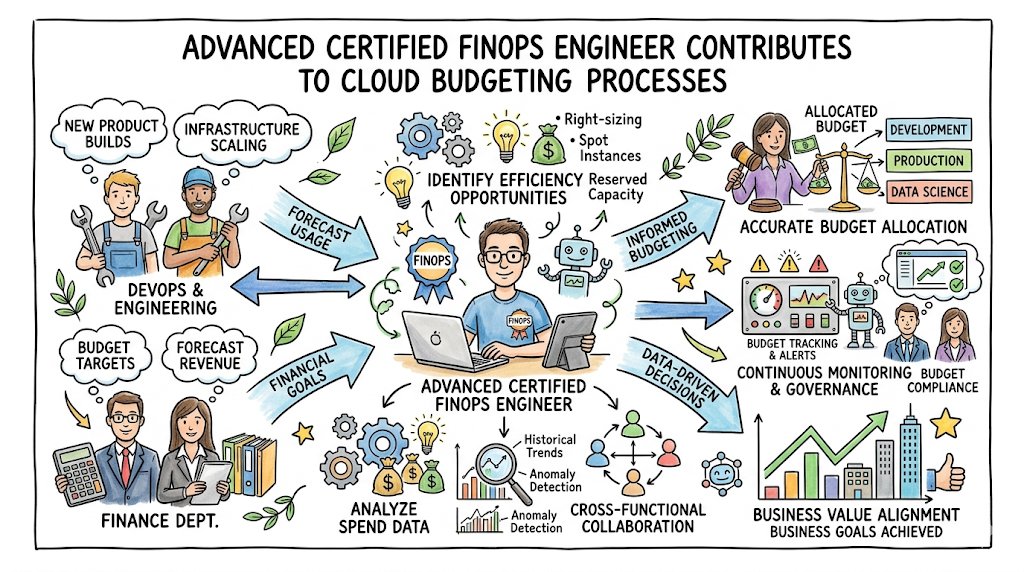
The cloud has changed how we build and pay for technology. For many years, companies focused only on moving fast. Now, they focus on moving fast while spending wisely. This is where the Certified FinOps Engineer comes into play. This guide is for engineers and managers who want to lead this change. In the worlds of DevOps and platform engineering, cost is now a technical requirement. This roadmap helps you understand the career impact and how to start your journey at Finopsschool. By mastering these skills, you can help your company grow without wasting money on unused resources.
What is the Certified FinOps Engineer?
The Certified FinOps Engineer is a professional title that shows you know how to manage cloud costs technically. It is not just about looking at bills or spreadsheets. It is about understanding how code and architecture affect the company’s bank account. This certification exists because cloud environments are always changing. Traditional ways of managing money do not work when a developer can start a thousand servers with one click.
This program focuses on real-world engineering. It teaches you how to build systems that are efficient from the start. It aligns perfectly with modern ways of working, like Infrastructure as Code and automated scaling. In a real production environment, an engineer who understands FinOps can save a company millions of dollars. This certification proves you have the skills to handle those high-stakes responsibilities.
Who Should Pursue Certified FinOps Engineer?
This path is best for people already working in cloud roles. If you are a DevOps engineer, an SRE, or a platform engineer, this is for you. These roles are responsible for the infrastructure, so they have the most power to control costs. Cloud engineers who work daily with AWS, Azure, or Google Cloud will find this information very useful. It turns a “cloud admin” into a “strategic engineer” who understands the business side of technology.
It is also great for engineering managers and team leads. Even if you don’t write code every day, you need to know how to guide your team toward cost-efficient designs. Security and data professionals can also benefit. For example, data engineers often deal with high storage costs. This certification helps them manage those expenses. Whether you are in India or working for a global firm, these skills are in high demand across the world.
Why Certified FinOps Engineer is Valuable and Beyond
The demand for these skills is higher than ever. Most big companies have moved to the cloud, but many are surprised by the high monthly costs. They are looking for experts who can bring those costs down without slowing down the developers. This is not a trend that will go away. As long as companies use the cloud, they will need people who understand how to optimize it.
Earning this certification helps you stay relevant. Tools and cloud providers change every few years, but the principles of FinOps stay the same. It is a long-term investment in your career. You become more than just a person who fixes servers; you become a partner to the finance and business teams. This makes you much more valuable to your employer and gives you better job security and higher pay.
Certified FinOps Engineer Certification Overview
The program is delivered through the official training platform and hosted on Finopsschool. It is built to be practical and hands-on. Instead of just memorizing facts, you learn how to solve real problems. The certification looks at how you take ownership of cloud spend. It moves the responsibility from a central finance team to the engineers who are actually using the cloud.
The structure is based on the three main phases of the FinOps journey: Inform, Optimize, and Operate. You learn how to get clear data on spending, how to find ways to save, and how to make these practices part of daily work. This approach ensures that you aren’t just doing a one-time cleanup. You are building a system that stays cost-effective forever. It is a complete way to manage the financial health of your cloud.
Certified FinOps Engineer Certification Tracks & Levels
There are different levels to match where you are in your career. It starts with the Foundation level. This is for people who want to learn the basics and the language of FinOps. It is a great starting point for anyone, including non-engineers. Then, there is the Professional level. This is where the deep technical work happens. You learn about automation, advanced tagging, and complex resource management.
Advanced and Expert tracks are for those who want to lead a whole organization. These tracks cover things like unit economics and global governance. Each level is designed to help you progress in your career. As you move up, you shift from simple tasks to creating complex strategies for large enterprises. This tiered system allows you to learn at your own pace while building a very strong professional profile.
Complete Certified FinOps Engineer Certification Table
| Track | Level | Who it’s for | Prerequisites | Skills Covered | Recommended Order |
| Core FinOps | Foundation | Beginners, Finance, Managers | Basic Cloud Knowledge | Terminology, Lifecycle | 1 |
| Engineering | Professional | SREs, DevOps, Cloud Engineers | 2+ Years Experience | Cost Allocation, Automation | 2 |
| Architecture | Advanced | Architects, Technical Leads | Professional Cert | Unit Economics, Multi-Cloud | 3 |
| Leadership | Expert | Directors, FinOps Leads | Advanced Cert | Strategy, Governance | 4 |
Detailed Guide for Each Certified FinOps Engineer Certification
Certified FinOps Engineer – Foundation
What it is
This is the starting point for your journey. it validates that you understand the basic framework of FinOps. It ensures everyone in the company is using the same words and following the same basic rules.
Who should take it
This is for junior engineers, finance people, and project managers. If you are new to cloud economics, this is where you begin. It helps you understand the “why” behind cost management.
Skills you’ll gain
- Understanding the three phases: Inform, Optimize, and Operate.
- Learning cloud billing and pricing models.
- Identifying who needs to be involved in FinOps.
Real-world projects you should be able to do
- Read and explain a cloud bill to a non-technical person.
- Identify simple waste, like servers that are not being used.
- Help teams set up basic budgets for their projects.
Preparation plan
- 7–14 days: Read the official study guide and learn the core terms.
- 30 days: Watch training videos and take practice quizzes to test your knowledge.
- 60 days: Only needed if you have zero experience with cloud systems.
Common mistakes
- Thinking this is only for the finance department.
- Focusing only on tools and forgetting about the culture of the team.
Best next certification after this
- Same-track option: Certified FinOps Engineer – Professional
- Cross-track option: Cloud Associate (AWS/Azure/GCP)
- Leadership option: Project Management Professional (PMP)
Certified FinOps Engineer – Professional
What it is
This level is all about action and technical skill. It proves you can actually go into a cloud environment and make changes that save money without breaking the application.
Who should take it
This is for senior DevOps, SREs, and Platform Engineers. You should have real experience managing infrastructure. It is for the people who are “in the trenches” every day.
Skills you’ll gain
- Advanced tagging and cost allocation strategies.
- Automating cost savings using scripts and tools.
- Managing complex savings plans and reserved instances.
Real-world projects you should be able to do
- Build an automated system to turn off dev servers at night.
- Create detailed cost dashboards for different microservices.
- Implement a system to alert teams when spending spikes suddenly.
Preparation plan
- 7–14 days: Review deep-dive technical documents on cloud pricing.
- 30 days: Practice automation scripts in a lab or sandbox environment.
- 60 days: Study complex multi-cloud scenarios and governance policies.
Common mistakes
- Over-optimizing and causing performance problems for the users.
- Ignoring the “shared costs” that multiple teams use at once.
Best next certification after this
- Same-track option: Certified FinOps Engineer – Advanced
- Cross-track option: Certified Kubernetes Administrator (CKA)
- Leadership option: Engineering Management programs
Choose Your Learning Path
DevOps Path
The DevOps path focuses on making cost a part of the software delivery pipeline. Engineers learn how to include cost checks in their CI/CD processes. This means if a developer introduces a change that will double the cloud bill, they find out before it goes live. The goal is to empower developers to make smart financial choices. It makes cost efficiency just as important as code quality or security.
DevSecOps Path
In the DevSecOps path, you look at how security and cost work together. Often, security tools or data logging can be very expensive. This path teaches you how to keep the system safe while keeping the costs under control. You learn to balance risk management with budget limits. It is about finding the most cost-effective ways to stay compliant and secure in a modern cloud world.
SRE Path
SREs focus on reliability and performance. In this path, you learn how to balance the “cost of reliability.” You study how to set up infrastructure that meets your performance targets without over-spending. It involves deep work with scaling and capacity planning. The goal is to ensure the system stays up and running efficiently without wasting expensive resources on “just in case” scenarios.
AIOps Path
The AIOps path is about using artificial intelligence to manage operations. You learn how to use machine learning to predict future cloud spending. This helps in spotting weird spending patterns before they become big problems. It focuses on using data to automate the “Inform” phase of FinOps. By using AI, you can manage costs across thousands of servers much faster than a human could.
MLOps Path
The MLOps path is specialized for machine learning workloads. Training AI models can be incredibly expensive due to high GPU and data costs. This track teaches you how to optimize these specific workflows. You learn how to manage the lifecycle of a model from training to production. The focus is on making sure the money spent on AI actually brings value to the company.
DataOps Path
Data is the heart of most modern companies, but storing and processing it is costly. The DataOps path focuses on data lifecycle management. You learn how to move old data to cheaper storage and how to optimize database queries. This path is for people who want to manage “Data Lakes” and “Data Warehouses” efficiently. It ensures that your data strategy does not bankrupt the organization.
FinOps Path
The dedicated FinOps path is for those who want to be specialists in this specific field. It covers everything from technical optimization to changing the company culture. You learn how to talk to both engineers and the CFO. This path is perfect for someone who wants to lead a FinOps team. It focuses on the big picture of how cloud finance drives the overall success of a modern business.
Role → Recommended Certified FinOps Engineer Certifications
| Role | Recommended Certifications |
| DevOps Engineer | Foundation, Professional |
| SRE | Professional, Advanced |
| Platform Engineer | Professional, Advanced |
| Cloud Engineer | Foundation, Professional |
| Security Engineer | Foundation, Professional |
| Data Engineer | Professional, DataOps focus |
| FinOps Practitioner | Foundation, Professional, Advanced |
| Engineering Manager | Foundation, Leadership |
Next Certifications to Take After Certified FinOps Engineer
Same Track Progression
After you master the engineering side, you should look at the strategic side. This means moving into the Advanced and Expert levels. Here, you focus on how to run FinOps for a global company with thousands of employees. You learn about setting up a “Center of Excellence” and making high-level policies. This path prepares you to be a leader in the cloud financial management space.
Cross-Track Expansion
Expanding your skills into other areas makes you a more complete engineer. For example, getting a Kubernetes certification (CKA) is a great next step. Since containers are a huge part of cloud costs, knowing how to manage them is very valuable. You could also look at security certifications. Being the person who understands cost, security, and containers makes you a top-tier professional in any market.
Leadership & Management Track
If you want to lead teams, you should look at management certifications. This helps you move from “doing” the work to “managing” the strategy. You learn how to set goals for a department and how to hire the right people. Understanding FinOps gives you a huge advantage as a manager because you can prove exactly how much value your team is bringing to the company’s bottom line.
Training & Certification Support Providers for Certified FinOps Engineer
DevOpsSchool
DevOpsSchool is a leading provider that helps professionals learn the full spectrum of modern engineering. Their training for FinOps is very practical and built for people who have full-time jobs. They provide a lot of study material and expert guidance to help you pass the exam on your first try. The community they have built is great for networking and learning from others who are on the same journey. They focus on making sure you don’t just get a certificate, but you actually learn how to do the job well in a real company.
Cotocus
Cotocus is known for its high-end technical training and consulting. They focus on the latest trends in the cloud-native world. Their FinOps training is very hands-on and uses real-world scenarios. They are a great choice if you want to dive deep into the technical side of cost optimization. The trainers at Cotocus are experts who have worked on large-scale projects, so they share a lot of practical tips that you won’t find in textbooks. They help you build the confidence to manage complex cloud environments and save significant money for your organization.
Scmgalaxy
Scmgalaxy is a massive community and resource hub for software configuration and operations. They have been supporting engineers for a long time. Their approach to FinOps is integrated with the whole software lifecycle. They provide many free resources, blogs, and community forums where you can ask questions. Their training programs are structured to help you understand how FinOps fits into the bigger picture of DevOps and SRE. It is a great place to start if you want to be part of a large and active group of technical professionals who are always learning.
BestDevOps
BestDevOps focuses on providing top-tier training for the most in-demand cloud skills. They have a very clear and simple way of teaching complex topics. Their FinOps courses are designed to take you from a beginner to an expert in a structured way. They offer a lot of support to their students, including mock exams and interview preparation. If you are looking for a provider that will stick with you until you achieve your career goals, this is a very strong option for any professional.
Devsecopsschool.com
Devsecopsschool.com is the best place to go if you are interested in the intersection of security and cost. They understand that you cannot manage a cloud without keeping it safe. Their training shows you how to integrate FinOps into a secure development process. This is a very specialized skill set that is becoming more important every day. They teach you how to use security tools that are also cost-effective, which is a big win for any company looking to stay safe on a budget.
Sreschool.com
Sreschool.com is dedicated to the world of Site Reliability Engineering. Since SREs are often the ones who have to fix cost issues, this school provides very targeted FinOps training. They focus on things like error budgets, capacity planning, and how these relate to the company’s financial health. Their courses are very data-driven and analytical. If you like working with metrics and want to use those metrics to save money, this is the perfect training provider for your specific career path.
Aiopsschool.com
Aiopsschool.com is at the cutting edge of using artificial intelligence for operations. Their training for FinOps involves using AI to automate the boring parts of cost management. You learn about predictive scaling and using machine learning to spot spending anomalies. This is the future of cloud management. By learning these skills now, you put yourself far ahead of other engineers. They provide the technical depth needed to build “smart” infrastructure that manages its own budget with very little human help.
Dataopsschool.com
Dataopsschool.com focuses on the unique needs of data engineers and architects. Managing “Big Data” is one of the most expensive parts of the cloud. This school teaches you how to handle those costs specifically. You learn about data storage tiers, query optimization, and how to build data pipelines that don’t waste money. This is a very valuable skill because many companies are struggling with their data bills right now. They provide the practical tools you need to make data both useful and affordable.
Finopsschool.com
Finopsschool.com is the primary home for this certification and training. They are the experts who set the standards for the industry. Their training is the most direct way to prepare for the official exams. They offer a huge range of resources, from basic webinars to deep-dive masterclasses. Because they are focused entirely on FinOps, they have the most up-to-date information on new cloud features and best practices. If you want the most authoritative training available, this is where you should go to start your journey.
Frequently Asked Questions (General)
- How hard is the Certified FinOps Engineer exam?
The difficulty depends on your experience. If you work with cloud every day, the Foundation level is very achievable with a week of study. The Professional level is harder and requires a real understanding of automation and technical optimization. - Do I need to be a math expert to do FinOps?
No, you do not need to be a math expert. You need to understand basic logic and how to read data. The most important skill is being able to see patterns in spending and knowing which technical changes will fix them. - How long does it take to get certified?
Most people can get the Foundation certification in about 2 to 4 weeks. The Professional level usually takes 2 to 3 months of study and practice, especially if you are learning new automation tools at the same time. - Is this certification recognized globally?
Yes, it is recognized by major companies all over the world. As cloud costs become a global issue, the demand for certified engineers is growing in every country, including the USA, Europe, and India. - Will my company pay for this certification?
Many companies will pay for it because it saves them money in the long run. If you can show your manager how these skills will help reduce the monthly cloud bill, they are usually very happy to support your training. - Do I need to know AWS, Azure, and GCP?
You should know at least one cloud provider very well. The principles you learn can be applied to any cloud, but having deep knowledge of one makes it much easier to understand the technical details of the course. - Is there a lot of coding involved?
For the Foundation level, there is no coding. For the Professional level, you will need to understand basic scripting and how to use APIs to get cost data and automate resource management. - How often should I renew my certification?
Usually, you need to renew every two or three years. This is important because cloud providers release new features and pricing models all the time, and you need to stay current with those changes. - Can a non-technical person become a FinOps Engineer?
It is possible, but it is much harder. A non-technical person can easily do the Foundation level. However, the “Engineer” part of the title means you will eventually need to understand how cloud infrastructure actually works. - What is the difference between FinOps and traditional cost cutting?
Traditional cost cutting is often a one-time event that can hurt performance. FinOps is a continuous process that focuses on “value” rather than just “low cost.” It ensures you are spending money on the right things. - Are there any free resources to start learning?
Yes, many providers like Scmgalaxy and Finopsschool offer free blogs, webinars, and community forums. These are great ways to learn the basics before you decide to pay for a full certification course. - What kind of salary increase can I expect?
While it varies by location, many professionals see a significant increase in their salary. Because this is a specialized skill that directly impacts a company’s profit, certified engineers are often paid more than general cloud admins.
FAQs on Certified FinOps Engineer
- What are the most important tools for a FinOps Engineer?
You will use native tools like AWS Cost Explorer or Azure Cost Management. You will also use Infrastructure as Code tools like Terraform and cloud-native monitoring tools like Prometheus to track resource usage and spending. - How does FinOps change the way I write code?
It makes you think about efficiency. For example, you might write code that uses serverless functions instead of a permanent server to save money. You become more aware of how your code choices impact the cloud bill. - Can FinOps be applied to on-premise data centers?
The principles are mostly for the cloud because of its dynamic nature. However, the idea of “accountability” and “transparency” can be used anywhere. Most of the technical training is focused specifically on public cloud environments. - What is “Unit Economics” in the context of this certification?
It is about measuring the cost per business event. For example, instead of just seeing “Cloud cost is $1000,” you see “It costs $0.10 per customer login.” This helps the business understand if they are being efficient. - How do you handle “Shared Costs” in a large cluster?
This is a big part of the Professional certification. You learn how to use labels and namespaces to figure out which team is using what percentage of a shared resource, like a large Kubernetes cluster or a database. - Is automation required for the Professional level?
Yes, automation is key. You cannot manage costs manually at scale. You will learn how to set up automated policies that find and fix waste without a human having to do it every day. - How do I convince my team to care about FinOps?
The certification teaches you “Stakeholder Management.” You learn how to show developers that saving money gives them more budget to build cool new features. It is about making cost a shared goal for everyone. - What is a “FinOps Center of Excellence” (CCoE)?
It is a small group of experts within a company who set the standards and help other teams implement FinOps. The Advanced tracks of the certification teach you how to build and lead this kind of team.
Final Thoughts: Is Certified FinOps Engineer Worth It?
I have seen many trends come and go over the last twenty years. FinOps is not just a trend; it is a fundamental shift in how we do engineering. In the past, engineers didn’t have to care about the bill. Today, that has changed. If you are the person who can bridge the gap between high-level technology and the company’s financial health, you will always have a job.
This certification gives you a clear structure to learn these skills. It isn’t just about a piece of paper; it’s about changing your mindset. You start looking at every server and Every line of code as a business decision. For any professional who wants to move into a leadership or senior architectural role, I highly recommend this path. It is practical, in-demand, and will serve you well for the rest of your career.
