Upgrade & Secure Your Future with DevOps, SRE, DevSecOps, MLOps!
We spend hours scrolling social media and waste money on things we forget, but won’t spend 30 minutes a day earning certifications that can change our lives.
Master in DevOps, SRE, DevSecOps & MLOps by DevOps School!
Learn from Guru Rajesh Kumar and double your salary in just one year.
Introduction
Corporate Travel Booking Platforms help companies manage business travel in one organized system. These platforms allow employees to book flights, hotels, cars, trains, and business trips while following company travel policies, approval rules, budgets, and reporting needs.
They matter now because business travel is more complex than before. Companies need cost control, employee safety, flexible booking, real-time travel visibility, expense integration, and better policy compliance. A good platform helps finance teams reduce leakage, travel managers track spend, and employees book trips without unnecessary delays.
Common use cases include flight booking, hotel booking, travel approvals, expense connection, duty-of-care tracking, traveler support, and multi-location business travel management.
Buyers should evaluate booking inventory, policy controls, approvals, expense integrations, traveler support, reporting, mobile experience, security, global coverage, and pricing.
Best for: Travel managers, finance teams, HR teams, operations teams, executives, growing businesses, enterprises, consulting firms, sales teams, and companies with frequent employee travel.
Not ideal for: Very small teams with rare travel needs or businesses that only need occasional manual bookings through public travel websites.
Key Trends in Corporate Travel Booking Platforms
- AI-assisted travel planning is becoming more common for smarter trip suggestions, policy guidance, and faster booking support.
- Companies are focusing more on travel cost control through approval workflows, policy rules, preferred vendors, and real-time spend visibility.
- Travel and expense integration is becoming a key requirement because finance teams want fewer manual reimbursements and cleaner reporting.
- Duty-of-care features are gaining importance because companies need to know where employees are during travel disruptions or emergencies.
- Mobile-first booking and trip management are now expected by business travelers.
- Sustainability tracking is becoming more important, especially for companies monitoring carbon impact and travel policy decisions.
- Global inventory access is a major factor for enterprises that need flights, hotels, rail, car rentals, and local travel options.
- Self-service booking is growing, but employees still expect human support when trips change or problems happen.
- Integration with HR, finance, ERP, accounting, and expense tools is becoming a major buying factor.
- Corporate travel platforms are shifting from simple booking tools to full travel management ecosystems.
How We Selected These Tools
The tools were selected based on:
- Market recognition in corporate travel management.
- Strength of booking features for flights, hotels, cars, and business trips.
- Support for travel policies, approvals, and spend controls.
- Fit for SMBs, mid-market companies, enterprises, and global teams.
- Integration ecosystem with expense, HR, finance, accounting, and ERP systems.
- Traveler experience across web and mobile.
- Reporting and analytics depth for travel managers and finance teams.
- Duty-of-care and traveler support capabilities.
- Scalability across locations, departments, and countries.
- Practical value for daily business travel operations.
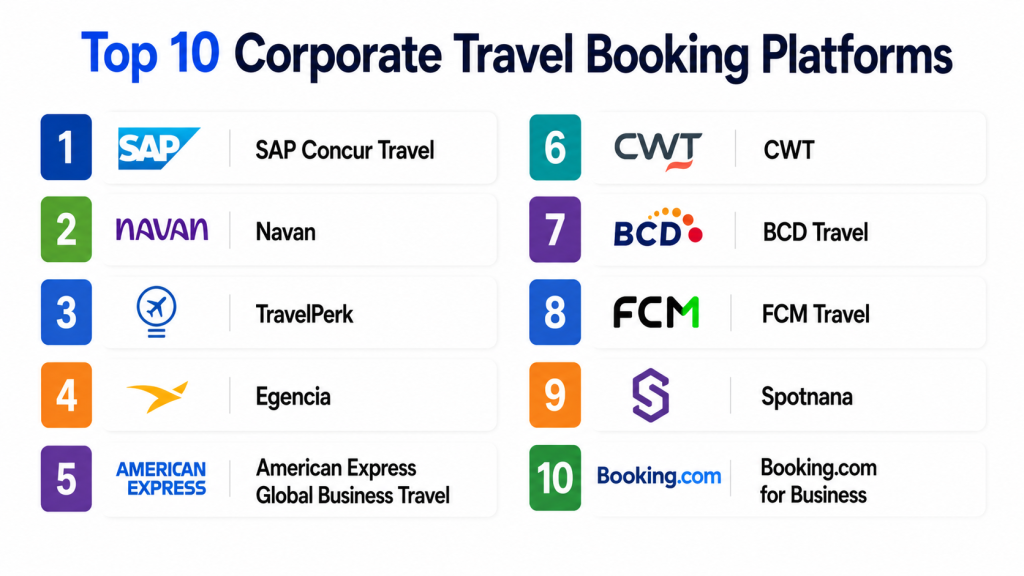
Top 10 Corporate Travel Booking Platforms
1 — SAP Concur Travel
Short description:
SAP Concur Travel is a widely used corporate travel booking platform for enterprises and large organizations. It helps companies manage business travel bookings, policies, approvals, expenses, and reporting in a connected workflow. The platform is especially useful for companies already using SAP or large finance systems. It supports complex travel policies and global business travel needs. It is best for organizations that require strong governance, expense alignment, and enterprise-grade travel control.
Key Features
- Corporate travel booking
- Travel policy controls
- Approval workflows
- Expense management connection
- Reporting and analytics
- Mobile travel access
- Enterprise administration controls
Pros
- Strong enterprise travel and expense ecosystem
- Good for complex policy requirements
- Suitable for large global organizations
Cons
- May feel complex for smaller teams
- Implementation can require planning
- User experience may depend on configuration
Platforms / Deployment
Web / iOS / Android
Cloud
Security & Compliance
Supports enterprise access controls, user permissions, and admin governance. Specific certifications: Not publicly stated.
Integrations & Ecosystem
SAP Concur Travel connects travel booking with finance and expense workflows.
- SAP ecosystem
- Expense management
- ERP systems
- HR systems
- Corporate cards
- Reporting tools
Support & Community
Documentation, enterprise support, implementation partners, and admin resources are available. It has a strong enterprise user base.
2 — Navan
Short description:
Navan is a modern corporate travel and expense platform designed for companies that want booking, policy control, payments, and expense workflows in one experience. It is suitable for fast-growing companies, mid-market teams, and enterprises. Navan focuses on employee-friendly booking while helping finance teams control spend. It supports flights, hotels, cars, approvals, reporting, and traveler support. It is a strong option for companies that want a modern travel platform with automation.
Key Features
- Flight, hotel, and car booking
- Travel policy automation
- Expense management options
- Corporate card workflows
- Mobile booking experience
- Traveler support
- Reporting and spend visibility
Pros
- Modern user experience
- Strong travel and expense connection
- Good fit for growing companies and enterprises
Cons
- May require change management for older travel processes
- Some features may depend on plan or region
- Not ideal for teams wanting only basic booking
Platforms / Deployment
Web / iOS / Android
Cloud
Security & Compliance
Supports admin controls, user permissions, and secure account management. Specific certifications: Not publicly stated.
Integrations & Ecosystem
Navan connects travel workflows with finance, HR, and expense systems.
- Expense workflows
- Corporate cards
- HR systems
- Accounting systems
- Calendar tools
- Reporting dashboards
Support & Community
Support and onboarding resources are available. It is widely recognized among modern corporate travel platforms.
3 — TravelPerk
Short description:
TravelPerk is a corporate travel booking platform built for businesses that want flexible booking, traveler support, policy control, and spend visibility. It is popular with SMBs, mid-market companies, and growing international teams. The platform helps employees book business trips while staying within company rules. It supports flights, hotels, trains, cars, approvals, reporting, and travel management workflows. It is a strong choice for companies that want an easy-to-use travel platform without heavy enterprise complexity.
Key Features
- Business travel booking
- Travel policy management
- Approval workflows
- Traveler support
- Reporting and spend tracking
- Flexible booking options
- Expense and finance integrations
Pros
- Easy-to-use booking experience
- Good for SMB and mid-market teams
- Useful travel policy and approval controls
Cons
- Some enterprise needs may require advanced setup
- Global inventory depth may vary by region
- Pricing should be reviewed based on travel volume
Platforms / Deployment
Web / iOS / Android
Cloud
Security & Compliance
Supports user permissions and admin controls. Specific certifications: Not publicly stated.
Integrations & Ecosystem
TravelPerk supports finance, HR, and travel operations workflows.
- Expense tools
- HR systems
- Accounting platforms
- Calendar workflows
- Approval systems
- Reporting tools
Support & Community
Support and onboarding resources are available. It is practical for companies that want modern business travel management.
4 — Egencia
Short description:
Egencia is a corporate travel management platform designed for businesses that need booking, traveler support, reporting, policy compliance, and managed travel services. It is suitable for mid-market and enterprise companies with regular travel needs. The platform helps employees book trips while giving travel managers visibility and control. Egencia is useful for organizations that want both software and travel management support. It is a strong fit for companies that need structured corporate travel services.
Key Features
- Corporate travel booking
- Travel policy controls
- Traveler support
- Reporting and analytics
- Approval workflows
- Mobile trip management
- Managed travel services
Pros
- Strong corporate travel management background
- Good for structured business travel programs
- Useful support and reporting capabilities
Cons
- May be more than small teams need
- Configuration may require planning
- Pricing and service model may vary
Platforms / Deployment
Web / iOS / Android
Cloud
Security & Compliance
Supports admin controls, user access, and travel data management. Specific certifications: Not publicly stated.
Integrations & Ecosystem
Egencia connects booking workflows with travel operations and business systems.
- Expense systems
- HR platforms
- Travel reporting tools
- Approval workflows
- Mobile trip tools
- Corporate travel support
Support & Community
Support resources, traveler assistance, and business travel management services are available.
5 — American Express Global Business Travel
Short description:
American Express Global Business Travel is a major corporate travel management provider offering booking, consulting, traveler support, meetings, and travel program services. It is suitable for large enterprises, global companies, and organizations with complex travel needs. The platform and service model help companies manage bookings, travel policies, reporting, risk, and traveler care. It is useful when companies need both technology and high-touch travel management support. It is best for organizations with global scale and mature travel programs.
Key Features
- Corporate travel booking
- Global travel management services
- Traveler support
- Policy management
- Reporting and analytics
- Meetings and events support
- Duty-of-care workflows
Pros
- Strong global travel management presence
- Good for large and complex travel programs
- Useful service and support depth
Cons
- May be too heavy for small businesses
- Pricing and service model may be complex
- Implementation may require structured planning
Platforms / Deployment
Web / iOS / Android
Cloud
Security & Compliance
Supports enterprise travel governance and access controls. Specific certifications: Not publicly stated.
Integrations & Ecosystem
American Express Global Business Travel connects travel management with enterprise operations.
- Travel booking systems
- Expense systems
- Reporting tools
- Meetings and events workflows
- Risk management tools
- Traveler support services
Support & Community
Strong enterprise support, traveler assistance, and managed travel services are available.
6 — CWT
Short description:
CWT is a corporate travel management platform and service provider for companies that need business travel booking, traveler support, meetings, reporting, and travel program management. It is suitable for mid-market and enterprise organizations with regular travel requirements. CWT helps companies manage travel policies, bookings, risk, and spend visibility. It is useful for organizations that need a blend of technology and travel management expertise. It works best for companies with structured travel programs.
Key Features
- Corporate booking tools
- Travel policy support
- Traveler assistance
- Reporting and analytics
- Meetings and events services
- Risk and duty-of-care support
- Travel program management
Pros
- Strong managed travel experience
- Suitable for enterprise and mid-market needs
- Helpful traveler support capabilities
Cons
- May be more service-heavy than some modern tools
- Setup may require travel program planning
- Not ideal for very small teams
Platforms / Deployment
Web / iOS / Android
Cloud
Security & Compliance
Supports enterprise travel controls and user access management. Specific certifications: Not publicly stated.
Integrations & Ecosystem
CWT supports corporate travel programs across booking, reporting, and traveler care.
- Expense platforms
- Reporting systems
- HR tools
- Travel risk tools
- Meeting services
- Booking workflows
Support & Community
Traveler support, account management, and travel program assistance are available.
7 — BCD Travel
Short description:
BCD Travel is a corporate travel management company offering business travel booking, program management, traveler support, reporting, and consulting services. It is suited for large businesses, global organizations, and companies with managed travel programs. BCD helps organizations control travel spend, improve traveler experience, and manage risk. It is useful for businesses that need strategic travel management along with booking technology. It is best for companies that require global service coverage and structured travel operations.
Key Features
- Corporate travel booking
- Travel program management
- Policy and compliance support
- Traveler support
- Reporting and analytics
- Risk management workflows
- Consulting services
Pros
- Strong fit for enterprise travel programs
- Global support and service depth
- Good for managed travel operations
Cons
- May be too complex for smaller companies
- Service model may require structured onboarding
- Pricing details vary by program
Platforms / Deployment
Web / iOS / Android
Cloud
Security & Compliance
Supports enterprise controls and travel program governance. Specific certifications: Not publicly stated.
Integrations & Ecosystem
BCD Travel connects travel management with enterprise operations and reporting.
- Expense systems
- HR systems
- Reporting dashboards
- Travel risk tools
- Booking tools
- Consulting workflows
Support & Community
Enterprise support, account management, and traveler assistance are available.
8 — FCM Travel
Short description:
FCM Travel is a corporate travel management platform and service provider for companies that need business travel booking, traveler support, reporting, and global travel services. It is suitable for mid-market and enterprise organizations. FCM focuses on combining technology with human travel support. It helps businesses manage travel policies, bookings, approvals, reporting, and traveler safety. It is a good choice for companies that want service-led travel management with modern platform capabilities.
Key Features
- Corporate travel booking
- Traveler support
- Policy management
- Approval workflows
- Reporting and analytics
- Duty-of-care support
- Global travel services
Pros
- Strong combination of platform and service
- Good for mid-market and enterprise travel programs
- Useful traveler care and reporting features
Cons
- May not suit very small companies
- Service model may require setup time
- Pricing can vary by business needs
Platforms / Deployment
Web / iOS / Android
Cloud
Security & Compliance
Supports user controls and business travel governance. Specific certifications: Not publicly stated.
Integrations & Ecosystem
FCM Travel supports corporate travel workflows across multiple business systems.
- Expense tools
- HR platforms
- Reporting systems
- Approval workflows
- Traveler care tools
- Booking channels
Support & Community
Traveler support, onboarding, and account management services are available.
9 — Spotnana
Short description:
Spotnana is a modern travel-as-a-service and corporate travel platform designed for companies that want flexible travel booking, policy control, and technology-driven travel management. It is suitable for enterprises, travel companies, and organizations that need scalable travel infrastructure. Spotnana focuses on modern architecture, open integration, and unified travel experiences. It helps teams manage booking, policies, approvals, and travel data. It is a strong option for companies that want a more configurable travel technology foundation.
Key Features
- Corporate travel booking
- Travel policy controls
- Approval workflows
- Travel data visibility
- API-friendly architecture
- Global travel content access
- Modern platform design
Pros
- Strong technology-first approach
- Good for scalable travel programs
- Useful for companies needing flexible integrations
Cons
- May require technical evaluation
- Less familiar to some traditional travel teams
- Best fit depends on travel program maturity
Platforms / Deployment
Web / iOS / Android
Cloud
Security & Compliance
Supports user permissions, admin controls, and travel data management. Specific certifications: Not publicly stated.
Integrations & Ecosystem
Spotnana is built for connected travel workflows and platform extensibility.
- Travel content systems
- Expense platforms
- HR systems
- APIs
- Reporting tools
- Approval workflows
Support & Community
Support and implementation resources are available. It is suitable for organizations that value modern travel technology architecture.
10 — Booking.com for Business
Short description:
Booking.com for Business is a corporate travel booking platform designed for businesses that want easy access to accommodation and travel booking options. It is useful for small businesses, growing teams, and companies that need straightforward travel booking without heavy managed travel complexity. The platform helps employees book business stays and manage company travel in a simpler way. It works well for organizations that need quick adoption and familiar booking flows. It is best for teams with lighter travel governance needs.
Key Features
- Business accommodation booking
- Company travel management
- Traveler profiles
- Booking visibility
- Simple admin controls
- Self-service booking
- Travel reporting basics
Pros
- Easy and familiar booking experience
- Good for small businesses and simple travel needs
- Wide accommodation access
Cons
- May not provide deep enterprise travel controls
- Limited compared with full travel management platforms
- Not ideal for complex approval and policy workflows
Platforms / Deployment
Web / iOS / Android
Cloud
Security & Compliance
Supports account controls and business booking management. Specific certifications: Not publicly stated.
Integrations & Ecosystem
Booking.com for Business is best for simple corporate travel booking workflows.
- Accommodation booking
- Traveler profiles
- Business account management
- Payment workflows
- Booking records
- Admin visibility
Support & Community
Support resources are available. It is most useful for small and growing businesses that need simple business travel booking.
Comparison Table
| Tool Name | Best For | Platform(s) Supported | Deployment | Standout Feature | Public Rating |
|---|---|---|---|---|---|
| SAP Concur Travel | Large enterprises and finance-led travel programs | Web, iOS, Android | Cloud | Travel and expense governance | N/A |
| Navan | Modern travel and expense management | Web, iOS, Android | Cloud | Unified travel, card, and expense workflow | N/A |
| TravelPerk | SMB and mid-market business travel | Web, iOS, Android | Cloud | Flexible business travel booking | N/A |
| Egencia | Managed corporate travel programs | Web, iOS, Android | Cloud | Booking plus travel management services | N/A |
| American Express Global Business Travel | Global enterprise travel programs | Web, iOS, Android | Cloud | Global travel service depth | N/A |
| CWT | Mid-market and enterprise travel management | Web, iOS, Android | Cloud | Managed travel and traveler support | N/A |
| BCD Travel | Global corporate travel operations | Web, iOS, Android | Cloud | Enterprise travel program management | N/A |
| FCM Travel | Service-led corporate travel management | Web, iOS, Android | Cloud | Platform plus human travel support | N/A |
| Spotnana | Technology-first travel programs | Web, iOS, Android | Cloud | Modern travel platform architecture | N/A |
| Booking.com for Business | Small business travel booking | Web, iOS, Android | Cloud | Simple business accommodation booking | N/A |
Evaluation & Scoring of Corporate Travel Booking Platforms
| Tool Name | Core (25%) | Ease (15%) | Integrations (15%) | Security (10%) | Performance (10%) | Support (10%) | Value (15%) | Weighted Total |
|---|---|---|---|---|---|---|---|---|
| SAP Concur Travel | 9 | 7 | 9 | 9 | 8 | 8 | 7 | 8.20 |
| Navan | 9 | 9 | 8 | 8 | 8 | 8 | 8 | 8.45 |
| TravelPerk | 8 | 9 | 8 | 8 | 8 | 8 | 8 | 8.15 |
| Egencia | 8 | 8 | 8 | 8 | 8 | 8 | 7 | 7.85 |
| American Express Global Business Travel | 9 | 7 | 8 | 9 | 9 | 9 | 7 | 8.25 |
| CWT | 8 | 7 | 8 | 8 | 8 | 8 | 7 | 7.65 |
| BCD Travel | 8 | 7 | 8 | 8 | 8 | 9 | 7 | 7.75 |
| FCM Travel | 8 | 8 | 8 | 8 | 8 | 8 | 7 | 7.85 |
| Spotnana | 8 | 8 | 9 | 8 | 8 | 7 | 8 | 8.05 |
| Booking.com for Business | 7 | 9 | 6 | 7 | 8 | 7 | 9 | 7.45 |
These scores are comparative and should be used as a starting point, not a final buying decision. A high score means the platform performs well across many evaluation areas. However, the right choice depends on company size, travel volume, global coverage, policy complexity, traveler support needs, and finance integrations. A small business may value simplicity, while an enterprise may prioritize compliance, duty of care, and spend control.
Which Corporate Travel Booking Platform Is Right for You?
Solo / Freelancer
Solo professionals and freelancers usually do not need a heavy corporate travel platform. A simple business booking tool such as Booking.com for Business may be enough if the main need is accommodation booking and basic travel records.
If travel is rare, manual booking with a clear expense process may be more practical than buying a full platform.
SMB
Small and medium businesses should consider TravelPerk, Navan, or Booking.com for Business depending on travel volume and policy needs. These tools can help reduce manual coordination and improve booking visibility.
SMBs should focus on ease of use, simple approvals, cost control, traveler support, and finance integration.
Mid-Market
Mid-market companies often need stronger policy rules, approvals, reporting, and expense connections. Navan, TravelPerk, Egencia, FCM Travel, and Spotnana are strong options.
Mid-market buyers should evaluate expense integrations, traveler support quality, mobile experience, and reporting depth.
Enterprise
Enterprises should consider SAP Concur Travel, American Express Global Business Travel, BCD Travel, CWT, Egencia, and Spotnana. These platforms and providers are better suited for complex travel programs, global coverage, compliance, and duty of care.
Enterprise buyers should involve finance, procurement, HR, IT, security, and travel managers before selection.
Budget vs Premium
Budget-conscious teams may prefer Booking.com for Business, TravelPerk, or simpler Navan setups depending on business requirements. Premium enterprise programs may require SAP Concur Travel, American Express Global Business Travel, BCD Travel, or CWT.
The right budget decision should consider both platform cost and travel savings.
Feature Depth vs Ease of Use
For ease of use, Navan, TravelPerk, and Booking.com for Business are strong. For deeper travel governance, SAP Concur Travel, American Express Global Business Travel, BCD Travel, and CWT are stronger.
Feature depth is useful only when your business has the process maturity to manage it.
Integrations & Scalability
For integrations with finance, expense, ERP, HR, and reporting systems, SAP Concur Travel, Navan, Spotnana, and TravelPerk are strong options. Managed travel providers such as American Express Global Business Travel, BCD Travel, CWT, and FCM Travel are better when global service coverage matters.
Scalability is important when travel volume, approval rules, countries, currencies, and employee groups increase.
Security & Compliance Needs
Security-focused buyers should evaluate SSO, MFA, RBAC, audit logs, data retention, traveler data protection, policy enforcement, and reporting access. Global businesses should also consider duty-of-care and travel risk management.
Companies handling sensitive employee and payment data should validate security details directly with vendors.
Frequently Asked Questions
1. What is a Corporate Travel Booking Platform?
A Corporate Travel Booking Platform helps companies book and manage employee business travel. It usually supports flights, hotels, cars, approvals, travel policies, reporting, and expense-related workflows.
2. How is it different from normal travel booking websites?
Normal travel websites focus on individual bookings. Corporate travel platforms add company policies, approvals, traveler profiles, reporting, expense integration, duty-of-care visibility, and admin controls.
3. Who uses corporate travel booking platforms?
Travel managers, finance teams, HR teams, executives, sales teams, consultants, operations teams, and employees who travel for work use these platforms.
4. What pricing model is common for corporate travel platforms?
Pricing may be subscription-based, per user, per booking, per trip, service-based, or custom for enterprise accounts. Some providers combine software fees with managed travel services.
5. What is the biggest mistake buyers make?
The biggest mistake is choosing only by booking interface. Buyers should also check policy controls, traveler support, integrations, reporting, security, duty of care, and total travel cost impact.
6. Can corporate travel platforms integrate with expense tools?
Yes, many platforms integrate with expense systems, accounting tools, ERP platforms, and corporate cards. This helps reduce manual expense entry and improves finance visibility.
7. Are these platforms useful for small businesses?
Yes, but small businesses should avoid overbuying. A lightweight platform may be enough if travel volume is low and policies are simple.
8. What is duty of care in corporate travel?
Duty of care means the company can support and protect employees during business travel. This may include traveler location visibility, risk alerts, emergency support, and travel disruption assistance.
9. Are corporate travel platforms secure?
They can be secure when configured properly. Buyers should look for SSO, MFA, user roles, admin controls, encrypted data handling, and clear access policies.
10. Can these platforms reduce travel costs?
Yes. They can reduce costs through policy enforcement, preferred rates, approval workflows, spend reporting, booking visibility, and better negotiation with suppliers.
Conclusion
Corporate Travel Booking Platforms help businesses control travel spend, improve employee booking experience, enforce policies, support travelers, and connect travel with finance workflows. SAP Concur Travel is strong for enterprise travel and expense governance. Navan and TravelPerk are strong modern options for growing teams. Egencia, American Express Global Business Travel, CWT, BCD Travel, and FCM Travel are better suited for managed travel programs. Spotnana is strong for technology-first travel operations, while Booking.com for Business is practical for simpler business booking needs.There is no single best platform for every company. The right choice depends on travel volume, company size, policy complexity, global coverage, expense integration, traveler support, and budget.
