Upgrade & Secure Your Future with DevOps, SRE, DevSecOps, MLOps!
We spend hours scrolling social media and waste money on things we forget, but won’t spend 30 minutes a day earning certifications that can change our lives.
Master in DevOps, SRE, DevSecOps & MLOps by DevOps School!
Learn from Guru Rajesh Kumar and double your salary in just one year.
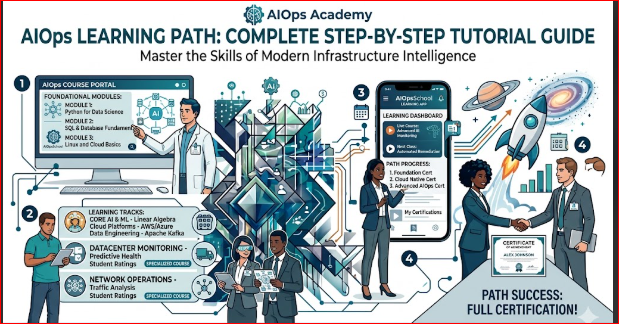
Modern enterprise IT environments have grown incredibly complex. With the shift toward microservices, hybrid cloud infrastructure, and multi-cloud deployments, engineering teams are constantly flooded with thousands of alerts every day. Managing this distributed chaos manually is no longer sustainable; IT operations teams face severe alert fatigue, while critical system anomalies slip through the cracks, leading to costly downtime. For technology professionals, learning AIOps is no longer just an optional resume booster—it is a critical career milestone. AIOpsSchool serves as a premier learning platform dedicated to mastering AIOps Training, offering structured paths, hands-on labs, and comprehensive AIOps Certification preparation designed to bridge the gap between traditional engineering and AI-driven operations.
Featured Snippets
What is AIOps?
AIOps (Artificial Intelligence for IT Operations) is the application of machine learning, big data, and analytics to automate data processing and decision-making within IT operations. It ingests massive volumes of metrics, logs, and traces to detect anomalies, correlate events, and identify root causes in real time.
What is AIOps Training?
AIOps Training is a structured educational curriculum that teaches IT professionals how to apply machine learning algorithms to operational data. It covers telemetry collection, behavioral baselining, intelligent alerting, and automated incident remediation.
What is AIOps Certification?
An AIOps Certification is a professional credential that validates an engineer’s technical competency in deploying, configuring, and managing AI-driven operations platforms. It proves mastery over automated root cause analysis, anomaly detection, and observability frameworks.
Why is AIOps important?
AIOps is critical because it eliminates operational noise, prevents system downtime through predictive analytics, and drastically reduces Mean Time to Resolution (MTTR) by automating root cause identification across complex, distributed cloud networks.
What are AIOps tools?
AIOps tools are software deployment platforms that ingest end-to-end infrastructure data to perform algorithmic event correlation, log patterns extraction, performance anomaly detection, and automated workflow execution.
What is anomaly detection in AIOps?
Anomaly detection in AIOps is the process of using machine learning models to establish normal behavioral baselines for IT systems and automatically flagging statistical deviations that indicate underlying technical issues or security threats.
What is root cause analysis in AIOps?
Root cause analysis (RCA) in AIOps is the automated tracing of system dependencies and correlated events to pinpoint the exact underlying trigger of an incident, removing the need for manual, cross-team troubleshooting sessions.
What Is AIOps?
To truly grasp the value of an AIOps Course, it helps to understand its core definition and how it evolved. Broadly defined, AI for IT Operations represents the intersection of Big Data, Machine Learning, and Operational Workflows.
   [ Metrics, Logs, Traces ] ──> [ Ingestion & Big Data ]
                                           │
                                           ▼
   [ Automated Remediation ] <── [ Machine Learning Models ]
Historically, IT operations evolved through distinct stages:
- Manual Infrastructure Monitoring: Relying completely on human operators checking system dashboards.
- Static Threshold Alerting: Generating alerts when a metric crosses a hardcoded number (e.g., CPU Usage greater than 85%).
- IT Operations Analytics (ITOA): Applying basic descriptive statistics to historical log data.
- Algorithmic AIOps: Utilizing unsupervised and supervised machine learning models to dynamically analyze real-time streaming telemetry.
Enterprises are adopting AIOps at an unprecedented rate because infrastructure scale has outpaced human cognitive capacity. Intelligent operations rely on the principle that machine learning models can process millions of data points per second, identifying subtle structural patterns and system degradations that a human engineer would never catch manually.
What Is AIOpsSchool?
AIOpsSchool is a specialized digital learning ecosystem explicitly built to teach professionals how to design, implement, and manage AI-driven IT architectures. Instead of focusing on abstract algorithmic theory, the platform emphasizes practical engineering implementation.
The platform provides an end-to-end AIOps Learning Path that guides students from basic data science fundamentals through advanced automated incident response workflows. Key offerings include:
- Comprehensive AIOps Tutorial Series: Step-by-step documentation, architectural blueprints, and guided walkthroughs.
- AIOps Foundation Certification Guidance: Structured materials curated to help engineers pass foundational industry exams on the first attempt.
- Production-Scale Sandbox Labs: Virtual environments where students stream real telemetry, induce synthetic failures, and train machine learning models to detect anomalies.
By prioritizing enterprise-grade use cases over generic slide decks, the platform ensures that learners acquire the practical, hands-on skills needed to deploy real operational value immediately within their organizations.
Why AIOps Is Important in Modern IT Operations
As organizations migrate to cloud-native architectures, their underlying infrastructures become highly distributed. A single user transaction might travel across dozens of microservices, multiple managed cloud databases, and third-party APIs. This architectural shift creates major operational bottlenecks:
- Microservices Complexity: Traditional monitoring tools look at individual components in silos. When a failure cascades across services, engineers get hit with a storm of disjointed alerts.
- The Telemetry Deluge: The total volume of metrics, logs, and traces generated by containerized environments is too massive for manual queries during an active outage.
- Alert Fatigue and High MTTR: When every team receives notifications for the same underlying issue, engineering time is wasted on finger-pointing instead of active troubleshooting.
AIOps directly addresses these pain points. By introducing automated Event Correlation, an intelligent platform condenses thousands of related alerts into a single, comprehensive incident ticket. It map dependencies automatically, cutting through operational noise and letting on-call engineers focus their energy on remediation rather than data sorting.
Who Should Learn AIOps?
DevOps Engineers
DevOps engineers learn AIOps to bring continuous continuous intelligence into their CI/CD pipelines. It enables them to evaluate post-deployment software health automatically using machine learning baselines rather than waiting for user complaints.
SRE Engineers
For Site Reliability Engineers, AIOps for SRE is a massive force multiplier. It helps them maintain strict Service Level Objectives (SLOs) by leveraging predictive analytics to flag system degradations long before a breach occurs.
Cloud and Platform Engineers
Engineers overseeing massive hybrid clouds use AIOps platforms to analyze resource utilization trends, allowing them to optimize compute capacity and scale infrastructure dynamically based on algorithmic forecasts.
IT Operations and Monitoring Teams
Traditional infrastructure operators can use an AIOps Tutorial path to upgrade their skill sets from manual dashboard monitoring to managing autonomous, self-healing platforms.
Technology Leaders and Architects
IT Managers and Enterprise Architects need a solid grasp of AIOps to design modern operational strategies, select the right enterprise tools, and properly lead AI-driven transformation initiatives.
Key Features of AIOps Training Programs
A well-rounded training program must balance theoretical concepts with practical application. The structured courses at AIOpsSchool are built around several foundational pillars:
- Structured Learning Path: A step-by-step curriculum that takes you smoothly from telemetry data ingestion basics up to complex machine learning pipelines.
- Practical Labs: Dedicated environments where you work directly with actual AIOps Tools to configure real-time ingestion, parsing, and data modeling.
- Observability Practices: Deep dives into uniting metrics, logs, and distributed tracing data to achieve complete, end-to-end environment visibility.
- Automated Root Cause Analysis: Hands-on training focused on parsing dependency graphs and transaction typologies to isolate the technical trigger of an outage.
- Incident Management Workflows: Strategies for integrating intelligent platforms directly into standard enterprise ticketing and chat systems to streamline on-call operations.
AIOps Certification: Why It Matters
Earning an industry certification serves as clear, formal validation of your technical expertise. For a field as rapidly evolving as artificial intelligence for IT operations, holding an AIOps Foundation Certification helps you stand out in a competitive job market.
- Professional Credibility: Proves to engineering leaders that you understand how to design and manage algorithmic operations platforms, rather than just reading static dashboards.
- Career Advancement: Positions you for senior roles such as AI Operations Architect, Lead SRE, or Platform Engineer, which command significant salary premiums.
- Enterprise Demand: Modern enterprises are actively looking for certified professionals who can confidently guide them away from costly legacy monitoring tools and toward automated setups.
AIOps Course Curriculum Components
An industry-aligned AIOps Course curriculum covers several core technical domains:
1. Ingestion and Observability Frameworks
Learning to collect and normalize distributed system telemetry—specifically metrics, log files, configuration changes, and distributed traces.
2. Machine Learning for IT Operations
Understanding how mathematical models apply to operational data, including supervised learning for classified incident matching and unsupervised learning for baseline generation.
3. Advanced Anomaly Detection
Configuring algorithms to detect statistical anomalies in high-cardinality data streams, minimizing the need for manual, hardcoded alerting rules.
4. Event Correlation and Noise Reduction
Designing logic pipelines that group thousands of scattered system notifications into singular, context-rich alerts based on time proximity and topology.
5. Automated Remediation Workflows
Connecting analytics platforms to automated execution tooling to automatically resolve well-known, recurring infrastructure issues without human intervention.
AIOps Tools and Technologies
To implement these methodologies successfully, you need to be familiar with the core categories of tools powering the industry:
| Tool Category | Purpose | Benefits | Typical Use Cases |
| Observability Platforms | Collect and unify system metrics, logs, and distributed traces in real time. | Eliminates data silos and provides deep, end-to-end infrastructure visibility. | Distributed microservices tracing, application performance monitoring (APM). |
| Log Analytics Tools | Ingest, index, and parse structured and unstructured log text streams. | Automatically extracts hidden patterns and spots formatting anomalies across text logs. | Security audit mapping, debugging complex runtime exceptions across clusters. |
| Event Management Platforms | Ingest alerts from multiple sources to deduplicate and correlate them. | Reduces alert noise drastically, helping on-call engineers avoid alert fatigue. | Consolidating multi-cloud monitoring alerts into clean, single incident tickets. |
| Automation Solutions | Execute scripted runbooks and infrastructure-as-code actions. | Enables autonomous, self-healing setups by instantly fixing known system errors. | Restarting crashed services, scaling disk space, rolling back bad code deployments. |
| AI/ML Analytics Components | Run mathematical algorithms over streaming time-series data. | Forecasts future resource needs and flags subtle behavioral anomalies early. | Long-term capacity planning, detecting slow, creeping memory leaks. |
AIOps Use Cases in Real Enterprises
Noise Reduction and Alert Deduplication
A large enterprise might receive over 50,000 alert notifications daily. An AIOps platform uses clustering algorithms to group related alerts together by time and system topology, reducing that mountain of noise into less than 100 actionable incidents.
Proactive Anomaly Detection
Instead of waiting for a hard drive to hit 100% capacity and crash a database, machine learning models analyze the rate of data consumption. If consumption spikes unexpectedly, the system flags it as an anomaly hours before it causes an actual outage.
Automated Root Cause Analysis
During a multi-service outage, the system scans dependency trees to pinpoint exactly which low-level component failed first, immediately identifying the root cause and saving teams from hours of manual log digging.
Self-Healing and Automated Remediation
When a web server runs out of memory and stops responding, the AIOps platform detects the failure and automatically triggers a targeted script to safely restart the container, resolving the issue in seconds without requiring human intervention.
AIOps for SRE Teams
Site Reliability Engineering focuses heavily on maximizing system uptime and scale through software engineering solutions. AIOps functions as a core toolset for modern SRE teams by optimizing alert logic and tracking system performance.
Instead of waking up on-call engineers for temporary CPU spikes, the platform analyzes historical data to determine if the behavior is normal for a high-traffic period. By filtering out non-critical alerts, it protects teams from burnout and ensures they can focus their attention on genuine platform reliability risks.
AIOps vs DevOps
While they share a common goal of improving modern software deployment and operations, AIOps and DevOps focus on distinct areas of the lifecycle:
| Area | DevOps | AIOps |
| Primary Focus | Optimizing collaboration across development and operations teams. | Applying machine learning models directly to live operational data. |
| Core Methodologies | Continuous Integration/Continuous Deployment (CI/CD), Infrastructure as Code. | Automated anomaly detection, event correlation, predictive analytics. |
| Primary Tooling | Git, automated build systems, container orchestration platforms. | Advanced observability suites, big data analytics engines, ML engines. |
| Business Impact | Speeds up software delivery cycles and ensures predictable releases. | Lowers system downtime and shortens Mean Time to Resolution (MTTR). |
AIOps vs MLOps
It is common to confuse these two terms since both involve machine learning, but they serve completely opposite purposes in production:
| Area | AIOps | MLOps |
| Primary Goal | Using machine learning to optimize and protect IT infrastructure. | Applying operational practices to deploy and manage ML models. |
| Target Audience | SREs, DevOps engineers, and IT operations teams. | Data scientists, ML engineers, and data infrastructure teams. |
| Data Ingested | Operational telemetry (system logs, metrics, distributed traces). | Training datasets, machine learning model weights, feature stores. |
| Key Objective | Maximizing system uptime and automating root cause discovery. | Managing model versioning, monitoring data drift, and model deployment. |
How Anomaly Detection Works in AIOps
Understanding how machine learning identifies problems is a core part of any comprehensive AIOps Training program. The process moves away from rigid thresholds and relies on dynamic baseline models:
  Metric Value
    ▲
    │       /───\     /───\    <- Dynamic Upper Baseline
    │  ───/───────\─/───────\───
    │ * * * * * * * * * * [!]  <- [!] Statistical Deviation (Anomaly)
    │  ───\───────/─\───────/───
    │       \───/     \───/    <- Dynamic Lower Baseline
    └─────────────────────────────► Time
- Continuous Data Ingestion: The analytics engine processes high-cardinality streaming telemetry from every layer of your infrastructure.
- Establishing Behavioral Baselines: Using historical data, the platform learns what standard system behavior looks like for specific times of the day, week, or season.
- Contextual Analysis: The platform evaluates incoming data against these dynamic baselines, accounting for regular variations like normal midday traffic surges.
- Intelligent Alerting: If a metric deviates significantly from its expected statistical range, the system flags it as an anomaly and alerts the team, bypassing the need for manual rule configurations.
Root Cause Analysis in AIOps
Traditional root cause analysis often involves gathering multiple engineering teams into an emergency bridge meeting to manually parse log files during an outage. This manual troubleshooting is slow, prone to human error, and extends system downtime.
AIOps Root Cause Analysis automates this entire troubleshooting workflow by leveraging real-time topology mapping. The platform traces all dependencies across your application services, infrastructure, and network components.
When a component fails, the engine analyzes the sequence of events across your entire stack. By identifying the exact point where performance began to degrade, it isolates the underlying trigger, giving engineers the precise context they need to implement a fix immediately.
Observability and AIOps
You cannot apply artificial intelligence to your operations without clean, comprehensive data. This is where modern observability comes in, serving as the foundational data pipeline that feeds an AIOps engine.
True observability relies on collecting and unifying the four core pillars of telemetry:
- Metrics: Time-series numerical data indicating resource utilization (e.g., memory consumption, request rates).
- Logs: Timestamped text records generated by applications and infrastructure components providing context around events.
- Traces: End-to-end data paths showing the exact journey of a user request through various microservices.
- Telemetry Metadata: Tags and attributes detailing system topology and environmental configurations.
An AIOps platform ingests these distinct data streams, combining them into a unified operational dataset. This allows the machine learning engine to look beyond surface-level symptoms and build a complete, contextual understanding of your system health.
Real-World Learning Scenarios
The DevOps Engineer Adopting AIOps
An engineer managing a complex Kubernetes cluster uses their training to build an automated deployment verification gate. Instead of manually checking system metrics after a code push, they deploy machine learning models to automatically analyze post-release behavior and roll back code if anomalies are detected.
The SRE Improving System Reliability
An SRE team dealing with intense alert fatigue implements event correlation models learned through AIOpsSchool. They successfully group scattered microservices alerts into singular, context-rich incident tickets, reducing overall noise by over 80% and dropping their MTTR from hours to minutes.
The Beginner Entering the Field
A recent technology graduate follows a structured AIOps Learning Path. By mastering observability pipelines and the fundamentals of machine learning for IT operations, they successfully land a specialized junior platform engineer role, bypassing traditional, entry-level helpdesk positions entirely.
Career Opportunities After Learning AIOps
Completing dedicated training opens up a wide range of high-value career paths across the enterprise technology landscape:
- AIOps Engineer: Focuses on building, configuring, and managing the core machine learning pipelines and platforms that ingest and analyze enterprise telemetry data.
- Site Reliability Engineer (SRE): Uses intelligent operations tools to optimize alert structures, maintain system reliability, and enforce strict availability compliance.
- Platform Engineer: Designs and maintains internal developer platforms, embedding automated monitoring and self-healing tools directly into the core infrastructure.
- Automation Architect: Focuses on connecting analytics engines with runbook automation systems to build fully autonomous, self-healing enterprise systems.
Common Mistakes Beginners Make When Learning AIOps
- Focusing Only on Tools: Jumping straight into vendor-specific platforms without understanding the underlying data structures or machine learning principles.
- Ignoring Observability Fundamentals: Trying to build advanced machine learning models without setting up clean, dependable underlying telemetry ingestion pipelines.
- Skipping Core Operational Workflows: Forgetting that AI tools must integrate seamlessly with existing real-world enterprise incident management and ticketing frameworks.
- Expecting Instant Perfection: Assuming machine learning models will be perfectly tuned on day one, neglecting the necessary phase of continuous learning and data refinement.
Tips for Successfully Learning AIOps
- Master the Basics of Data Telemetry: Focus on learning how metrics, logs, and distributed traces are generated, formatted, and collected.
- Understand Monitoring Fundamentals: Build a solid foundation in traditional monitoring systems before moving on to algorithmic analytics.
- Emphasize Hands-On Practice: Spend time in lab sandboxes configuring real data ingestion, tuning alert logic, and working with event correlation algorithms.
- Follow a Structured Learning Path: Use an expert-curated framework like AIOpsSchool to build your knowledge step-by-step, ensuring you don’t miss critical foundational concepts.
AIOps Training Features Comparison Table
| Feature | Purpose | Learning Benefit | Career Value |
| Interactive Sandbox Labs | Provides hands-on practice with real tools in live environments. | Bridges the gap between abstract algorithmic theory and real configuration. | Demonstrates your ability to manage live production systems with confidence. |
| Guided Learning Path | Delivers a logical, step-by-step curriculum structure. | Prevents overwhelm by breaking complex data science and operations topics down. | Ensures a well-rounded skill set that aligns perfectly with industry expectations. |
| Certification Prep | Focuses study materials on core exam blueprints. | Validates your technical understanding of intelligent operations architecture. | Gives you a recognized credential that helps you stand out to enterprise recruiters. |
| Enterprise Use Case Focus | Explores real-world production incident scenarios. | Teaches you how to address common issues like alert noise and automated remediation. | Prepares you to deliver immediate, practical value to engineering teams. |
Future of AIOps
The field of IT operations is moving toward fully autonomous environments. We are moving past basic anomaly alerting and entering the era of self-healing infrastructure. Future operational environments will rely on closed-loop automation setups where machine learning systems detect issues, find the root cause, and execute remediation steps entirely on their own.
At the same time, the rise of generative AI and large language models is changing how engineers interact with operational data. Natural language interfaces will allow on-call teams to query complex system states instantly using conversational language, making incident response faster and more accessible than ever before.
Frequently Asked Questions (FAQs)
1.What is the primary difference between traditional monitoring and AIOps?
Traditional monitoring relies on static, human-defined thresholds that generate alerts only after a metric crosses a specific number. AIOps utilizes machine learning algorithms to establish dynamic behavioral baselines, allowing it to proactively identify subtle statistical anomalies before they cause an actual system outage.
2.Do I need a deep background in data science to learn AIOps?
No. While having a basic understanding of data concepts is helpful, platforms like AIOpsSchool are built specifically for IT professionals. The curriculum focuses on applying pre-built machine learning models and platform tools to operational workflows rather than writing complex mathematical algorithms from scratch.
3.Which IT professionals benefit the most from an AIOps Course?
DevOps engineers, Site Reliability Engineers (SREs), cloud administrators, platform engineers, monitoring specialists, and traditional IT operations managers benefit significantly from learning these methodologies to scale their technical capabilities.
4.How does event correlation help reduce alert fatigue for on-call teams?
Event correlation engines analyze incoming telemetry in real time, automatically grouping thousands of scattered, simultaneous system notifications into a single, context-rich incident ticket based on time proximity and infrastructure topology mapping.
5.What are the core components of enterprise observability data?
True observability relies on collecting and unifying the three main pillars of system telemetry: metrics (numerical performance data), logs (timestamped operational records), and distributed traces (end-to-end transaction paths).
6.Can AIOps platforms execute automated remediation tasks?
Yes. Advanced implementations connect intelligent analytics engines directly with infrastructure-as-code runbooks, enabling the system to automatically trigger targeted scripts to resolve well-known, recurring errors without human intervention.
7.What is an anomaly baseline, and how is it calculated?
An anomaly baseline is a dynamic range of normal system performance calculated by machine learning models analyzing historical telemetry data. It automatically accounts for cyclical variations like standard business hours or holiday traffic spikes.
8.How does automated root cause analysis save engineering time during an outage?
Instead of forcing cross-functional teams to manually dig through disjointed logs, the platform evaluates system dependency maps and event timelines to instantly pinpoint the exact underlying trigger of an incident.
9.Is AIOps intended to completely replace DevOps methodologies?
No. AIOps does not replace DevOps; it enhances it. While DevOps focuses on improving collaboration and speeding up software delivery pipelines, AIOps provides the continuous intelligence and data analytics needed to manage those environments post-deployment.
10.What is the role of predictive analytics in modern IT operations?
Predictive analytics uses machine learning models to evaluate historical performance trends, allowing operations teams to forecast future resource constraints and address system degradations before they impact users.
11.How long does it typically take to complete an AIOps Foundation Certification path?
Depending on your existing background in system administration or cloud monitoring, most professionals can comfortably master the foundational concepts and complete the certification preparation within 4 to 8 weeks of structured study.
12.Are open-source tools covered within comprehensive training programs?
Yes. Comprehensive training programs focus heavily on open-source observability standards and telemetry collection tools, ensuring engineers know how to build modern, flexible data pipelines.
13.What career advancement options open up after earning an AIOps certification?
Certified professionals are highly sought after for advanced technical roles, including Senior SRE, Platform Architect, Automation Engineer, and AI Operations Director.
14.Why do beginners often struggle when first transitioning to intelligent operations?
Most beginners struggle when they focus entirely on vendor-specific tools while skipping foundational concepts like clean telemetry data collection, system topology mapping, and basic machine learning logic.
15.How do I get started with hands-on practice on the platform?
You can start by accessing step-by-step tutorials and sandbox environments on platforms like AIOpsSchool. These labs let you practice streaming telemetry data, training models, and configuring automated incident responses in real-time environments.
Final Recommendation
As enterprise software systems continue to grow in scale and complexity, relying on manual monitoring and reactive firefighting is no longer a sustainable option. Organizations around the globe are actively modernizing their infrastructure, driving an unprecedented demand for skilled engineering professionals who know how to build and manage intelligent operational systems. Learning these advanced strategies is one of the most effective ways to accelerate your career growth in today’s technology landscape.
