Upgrade & Secure Your Future with DevOps, SRE, DevSecOps, MLOps!
We spend hours scrolling social media and waste money on things we forget, but won’t spend 30 minutes a day earning certifications that can change our lives.
Master in DevOps, SRE, DevSecOps & MLOps by DevOps School!
Learn from Guru Rajesh Kumar and double your salary in just one year.
Introduction
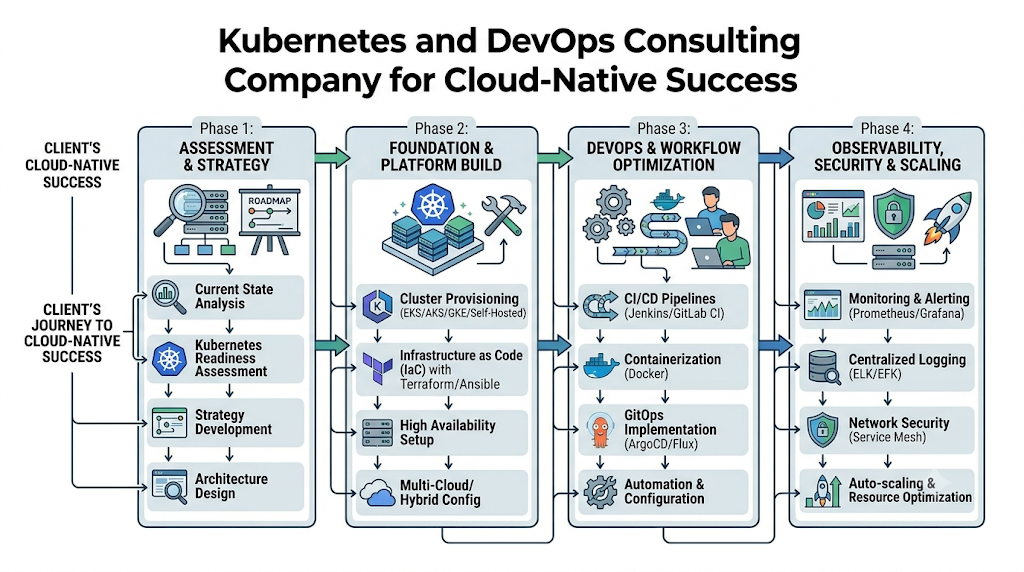
Enterprise software delivery has become too complex for ad-hoc tooling and isolated teams. Modern organizations need a strategic approach to DevOps, cloud, and automation that aligns technology with business outcomes. A specialized DevOps consulting company Cotocus helps you design this operating model, while DevOps corporate training equips your teams to run it confidently. Together, they turn fragmented tools and processes into a predictable, scalable, and secure delivery engine.
What DevOps Consulting Really Delivers
DevOps consulting services go far beyond installing CI/CD tools or writing a few automation scripts. A mature partner looks at your people, processes, platforms, and governance, then designs a roadmap to streamline how software moves from idea to production. This includes culture change, platform foundations, automation strategy, observability, and clear metrics.
A strong DevOps consulting company typically brings expertise across CI/CD pipeline consulting, infrastructure automation consulting, Kubernetes consulting services, cloud consulting services, SRE consulting services, and DevSecOps consulting services. They help you define target architectures, select tools that fit your stack, and implement secure, compliant workflows that work across teams and regions. For enterprises, this structured approach reduces firefighting, improves deployment frequency, and makes delivery more predictable.
Why Enterprises Need Strategic DevOps Partners
From Tool Chaos to Platform Thinking
Most enterprises already use CI/CD tools, containers, and cloud platforms, yet still face outages, long lead times, and brittle releases. The gap is rarely tooling alone; it is the absence of a coherent operating model. Platform engineering consulting introduces shared internal platforms that standardize how teams build, deploy, and observe applications, while GitOps consulting services bring version-controlled, auditable operations.
A DevOps consulting company helps you translate business objectives—faster time to market, improved reliability, regulatory compliance—into specific platform capabilities. For example, they may design golden paths for microservices, standard Terraform modules for infrastructure automation consulting, or reference architectures for cloud migration services. This reduces team-to-team variability and creates a repeatable way to deliver features across the organization.
Key Pillars of Modern DevOps Consulting
1. Cloud and Kubernetes Foundations
Cloud consulting services and cloud migration services sit at the core of most modern transformation journeys. Consultants assess your existing workloads, prioritize migration candidates, and design landing zones with guardrails for networking, identity, security, and cost governance. They help you decide which applications should be rehosted, re-platformed, or re-architected for cloud-native environments.
Kubernetes consulting services then provide the orchestration layer for containerized workloads. This includes cluster design, multi-tenancy, security policies, and integration with CI/CD, observability, and service mesh. Kubernetes corporate training complements this by enabling platform and application teams to work confidently with containers, Helm, operators, and GitOps workflows.
2. Reliability and SRE Practices
SRE consulting services and site reliability engineering consulting focus on making reliability an engineering discipline instead of a reactive support function. This typically includes defining SLIs and SLOs, error budgets, incident response workflows, and capacity planning practices. Consultants modernize monitoring into full-stack observability, integrating logs, metrics, and traces with automated alerting.
These practices reduce unplanned downtime and provide clear trade-offs between feature delivery and reliability. They also create a language that business and engineering leaders can share when discussing risk, performance, and investment decisions.
3. Security and Compliance by Design
DevSecOps consulting services integrate security into every stage of the software lifecycle instead of treating it as a final gate. This involves choosing and integrating tools for SAST, DAST, SCA, container scanning, and policy-as-code, as well as defining secure SDLC patterns and controls. DevSecOps corporate training then ensures developers, platform teams, and security engineers know how to use these capabilities effectively.
The result is fewer vulnerabilities in production, faster remediation cycles, and stronger evidence for auditors and regulators. For enterprises in regulated industries, this is essential to scaling digital initiatives without increasing risk.
4. Data-Driven Operations
AIOps consulting services, MLOps consulting services, and DataOps consulting services extend DevOps practices into data and machine learning workloads. AIOps uses machine learning to detect anomalies, correlate alerts, and speed up incident resolution, especially in complex, distributed systems. MLOps and DataOps bring CI/CD-style discipline to model training, deployment, and data pipelines, ensuring repeatability and governance.
These capabilities help organizations move from reactive operations to proactive, predictive insights. They enable teams to manage growing complexity, especially as microservices, event-driven architectures, and multi-cloud patterns become the norm.
Table 1: Traditional IT vs Modern DevOps Operating Model
| Dimension | Traditional Approach | Modern DevOps Approach | Key Benefit | Best Choice |
|---|---|---|---|---|
| Release cycle | Quarterly or yearly | Daily or on-demand | Faster time to market | Modern DevOps |
| Change control | Heavy CAB and manual approvals | Automated checks with risk-based approvals | Lower risk with higher speed | Modern DevOps |
| Infrastructure | Manually provisioned servers | Infrastructure as code and automation | Consistency and faster provisioning | Modern DevOps |
| Responsibility | Throw over the wall to operations | Shared ownership across Dev, Ops, and Security | Fewer handoffs, better collaboration | Modern DevOps |
| Monitoring | Basic uptime checks | Full-stack observability and SRE practices | Better reliability and incident response | Modern DevOps |
Business Benefits of DevOps Consulting and Training
Well-designed DevOps consulting services produce measurable improvements across speed, stability, and efficiency. Organizations typically see shorter lead times, higher deployment frequency, and lower change failure rates when pipelines, environments, and processes are standardized. Incident recovery times drop as SRE practices, observability, and runbooks mature.
DevOps corporate training and DevOps training for companies ensure these gains are sustainable. Training programs tailored to your tech stack, cloud platform, and regulatory environment help teams adopt new practices confidently. When consulting-led implementation and corporate training move together, you avoid the common pattern of “great tools, unprepared teams,” and instead build a high-performing, learning-oriented engineering culture.
Table 2: Consulting Partner vs In-House Only Approach
| Factor | In-House Only | With DevOps Consulting Company | Benefit | Best Choice |
|---|---|---|---|---|
| Time to transform | Slow, trial-and-error | Accelerated with proven frameworks | Faster realization of value | Consulting + In-house |
| Expertise breadth | Limited to internal experience | Cross-industry, multi-platform expertise | Better architecture and tool decisions | Consulting + In-house |
| Change management | Often ad-hoc | Structured playbooks and roadmaps | Reduced resistance and confusion | Consulting + In-house |
| Risk of misalignment | Higher; tech changes without strategy | Lower; transformation mapped to business outcomes | Stronger executive support and investment | Consulting + In-house |
| Skill uplift | Slow organic learning | Targeted DevOps corporate training programs | Faster competency build across teams | Consulting + in-house + training |
High-Value Enterprise Use Cases
Modernizing Legacy Applications
Many enterprises run critical workloads on legacy platforms with manual deployments and fragile environments. DevOps consulting services help you progressively modernize these systems using cloud migration services, infrastructure automation consulting, and CI/CD pipeline consulting. Rather than attempting risky, big-bang rewrites, consultants design incremental patterns: strangler-fig architectures, blue-green deployments, and canary releases.
DevOps training for companies then ensures application teams can work effectively with containers, feature flags, observability, and rollback strategies. This combination reduces downtime risk while moving legacy systems toward more modular, cloud-native patterns.
Scaling Cloud-Native Platforms
Organizations with dozens or hundreds of microservices often struggle with consistency and governance. Kubernetes consulting services and platform engineering consulting create shared platforms that handle identity, networking, deployment, and observability, allowing product teams to focus on business logic. GitOps consulting services can then standardize configuration management and change propagation.
Kubernetes corporate training and SRE consulting services help platform and product teams adopt best practices for cluster operations, performance tuning, and reliability. This enables enterprises to scale innovation without spiraling complexity and operational overhead.
Table 3: Tool-Only Adoption vs Consulting + Training
| Aspect | Tool-Only Adoption | Consulting + Corporate Training | Impact on Outcomes | Best Choice |
|---|---|---|---|---|
| Implementation | Limited to installation and basic setup | Architecture, integration, and operating model design | Higher utilization and stability | Consulting + Training |
| Team skills | Self-taught, uneven | Structured DevOps and Kubernetes corporate training | Consistent proficiency across teams | Consulting + Training |
| Governance | Ad-hoc rules | Policy-as-code, standards, and guardrails | Better compliance and risk control | Consulting + Training |
| ROI measurement | Hard to quantify | Metrics, KPIs, and dashboards defined upfront | Clear link between investment and results | Consulting + Training |
| Long-term evolution | Tool sprawl over time | Roadmaps for tooling, platforms, and skills | Sustainable, future-ready architecture | Consulting + Training |
Best Practices for Successful DevOps Transformation
Focus first on outcomes, not tools. Define clear goals for lead time, deployment frequency, reliability, and security posture, then design your CI/CD pipeline consulting and platform engineering consulting around those metrics. Start with a few representative products or domains and use them as lighthouse projects before scaling across the enterprise.
Invest early in DevOps corporate training, Kubernetes corporate training, and DevSecOps corporate training so teams understand not just how to use tools, but why practices are changing. Establish cross-functional governance groups—architecture, security, platform, and product leaders—to align decision making. Finally, use incremental milestones and transparent reporting so executives see continuous progress and can reinforce the transformation.
Common Mistakes and How to Avoid Them
One of the most common mistakes is treating DevOps as a tooling project. Organizations may deploy new CI/CD, monitoring, or ticketing systems without changing ownership models, incentives, or processes. This leads to limited impact and skepticism about future initiatives. Instead, use DevOps consulting services to redesign workflows end-to-end, including how work is planned, released, and operated.
Another frequent issue is underinvesting in skills. Without DevOps training for companies and focused SRE consulting services, teams default to old habits around manual deployments and reactive operations. Avoid scattered, one-off trainings; instead, design ongoing learning paths linked to roles and responsibilities. Lastly, do not attempt to migrate everything to the cloud at once. Use cloud consulting services to prioritize high-value, lower-risk workloads and iterate based on lessons learned.
Industry Trends Shaping DevOps and Cloud Transformation
Enterprises are increasingly adopting platform engineering as a way to scale DevOps beyond a few early adopter teams. Internal developer platforms provide paved roads for building, testing, deploying, and operating services, with embedded security and compliance. GitOps consulting services and Kubernetes consulting services are central to these initiatives, enabling version-controlled infrastructure and predictable rollouts.
At the same time, the rise of AIOps consulting services, MLOps consulting services, and DataOps consulting services reflects the growing importance of data and intelligence in operations. Organizations are leveraging machine learning for anomaly detection, predictive capacity planning, and automated remediation. DevSecOps consulting services are also becoming mainstream as boards and regulators demand proof that security is integrated into delivery rather than layered on top.
Expert Tips for Technology Leaders
Prioritize a small number of high-impact metrics and make them visible at every level of the organization. For example, track lead time, deployment frequency, change failure rate, MTTR, and security findings as part of your DevOps consulting company engagement. Use these metrics to guide decisions about where to invest in automation, training, and process changes.
Align incentives across development, operations, and security teams. If developers are rewarded only for new features while operations teams are punished for incidents, you create structural conflict. Instead, use SRE consulting services and site reliability engineering consulting to define shared objectives backed by SLOs and error budgets. Finally, treat DevOps corporate training and Kubernetes corporate training as ongoing programs, not one-time events, to keep pace with tool and platform evolution.
Why Choose Cotocus as Your DevOps Partner
Cotocus focuses on helping organizations adopt modern DevOps, cloud, and automation practices through both consulting and corporate training offerings. Their teams bring experience across AI-first software development, DevOps and cloud consulting, and digital product engineering for enterprises in sectors such as banking, healthcare, technology, aviation, and education.
Beyond DevOps consulting services, Cotocus delivers cloud migration services, cloud consulting services, Kubernetes consulting services, SRE consulting services, DevSecOps consulting services, and platform engineering consulting. On the training side, they provide DevOps corporate training, Kubernetes corporate training, and related upskilling programs designed to align with your engineering roadmap. This combination of implementation expertise and learning programs enables enterprises to execute complex transformations while building strong in-house capabilities.
Frequently Asked Questions
1. What does a DevOps consulting company actually do?
A DevOps consulting company assesses your current delivery and operations model, then designs and implements improvements across CI/CD, infrastructure automation, cloud platforms, observability, and security. They help align tools, processes, and teams with clear business outcomes such as faster releases, improved reliability, and better compliance. Consulting partners often complement this with corporate training to upskill your teams.
2. When should an enterprise invest in DevOps consulting services?
Consider DevOps consulting services when releases are slow, outages are frequent, or teams struggle to manage growing complexity in cloud or microservices environments. Consulting becomes especially valuable during large initiatives like cloud migration, platform modernization, or mergers and acquisitions. Engaging a partner early helps avoid costly architectural missteps and accelerates progress toward measurable goals.
3. How are DevOps corporate training programs structured?
DevOps corporate training programs are usually tailored to your tech stack, maturity level, and roles. They often combine instructor-led sessions, hands-on labs, and real-world scenarios drawn from your environment. Topics can span CI/CD practices, infrastructure as code, observability, SRE principles, DevSecOps, GitOps, and cloud-native architectures, with specific tracks for developers, operations, and security teams.
4. What is the difference between DevOps training for companies and public courses?
DevOps training for companies is customized to your context, tools, and constraints, making it directly applicable to day-to-day work. Public courses are more generic and may not map to your platforms or regulatory requirements. Corporate training also allows confidential discussions about real incidents, architecture choices, and organizational challenges, which significantly improves adoption.
5. How do cloud migration services fit into DevOps transformation?
Cloud migration services provide the foundation for modern DevOps practices by moving workloads to environments that support automation, elasticity, and standardized platforms. Consultants help design landing zones, security models, and network architectures aligned with your governance needs. Once workloads are in the cloud, CI/CD, infrastructure as code, and observability can be implemented more consistently across teams.
6. Why are Kubernetes consulting services important for enterprises?
Kubernetes consulting services help enterprises design secure, scalable, and resilient container platforms that integrate with existing systems. Consultants guide you through cluster topology, multi-tenant isolation, storage, networking, and observability decisions. They also help establish best practices for deployment strategies, resource management, and cost optimization, which are hard to get right without deep experience.
7. What is the role of SRE consulting services?
SRE consulting services turn reliability into a measurable, engineering-led discipline. Consultants help define service-level indicators and objectives, build error budget policies, and establish incident response and post-incident review practices. They also improve observability by integrating logs, metrics, and traces, so teams can quickly detect and resolve issues while balancing reliability with delivery speed.
8. How does site reliability engineering consulting differ from traditional operations support?
Site reliability engineering consulting emphasizes automation, metrics-driven decision making, and shared ownership with development teams. Instead of manually resolving issues on a ticket-by-ticket basis, SRE focuses on eliminating entire classes of incidents. This includes building self-healing systems, applying toil reduction, and using error budgets to decide when to prioritize reliability work over new features.
9. What are DevSecOps consulting services and why do they matter?
DevSecOps consulting services embed security into the entire software lifecycle. Consultants help you integrate security scanning into pipelines, define secure coding standards, and implement policy-as-code for infrastructure and Kubernetes. This approach reduces late-stage surprises, shortens remediation cycles, and provides better evidence for auditors, making it easier to scale innovation without exposing the organization to undue risk.
10. How does DevSecOps corporate training support security goals?
DevSecOps corporate training teaches developers, operations engineers, and security teams how to work together using shared tools and practices. Training typically covers secure coding, threat modeling, secrets management, security scanning tools, and incident handling. It converts security requirements from abstract rules into practical, day-to-day habits that teams can apply while still moving quickly.
11. What is GitOps and how can GitOps consulting services help?
GitOps is an operational model where Git is the single source of truth for both application and infrastructure configuration. Changes are made via pull requests and applied automatically by controllers, improving traceability and reducing configuration drift. GitOps consulting services help design repository structures, approval workflows, and integration with Kubernetes and cloud platforms so you can adopt this model safely.
12. How does platform engineering consulting differ from traditional DevOps projects?
Platform engineering consulting focuses on building internal platforms that offer self-service capabilities and golden paths for product teams. Instead of every team managing its own infrastructure, the platform centralizes common concerns like security, networking, and observability. This reduces duplication, accelerates onboarding, and allows teams to ship features without repeatedly solving the same infrastructure problems.
13. Why are AIOps, MLOps, and DataOps consulting services becoming critical?
As systems and data volumes grow, manual monitoring and deployment processes cannot keep up. AIOps consulting services use machine learning to detect anomalies and correlate events, while MLOps and DataOps consulting services bring rigor to model and data pipeline lifecycles. Together, they help enterprises operate complex, data-intensive systems more reliably and efficiently, turning operations data into actionable insights.
14. How does a digital transformation consulting company relate to DevOps?
A digital transformation consulting company typically uses DevOps, cloud, automation, and data practices as core levers for business change. DevOps consulting services form the execution engine that delivers new digital products, modernizes legacy systems, and supports continuous experimentation. Without a strong DevOps foundation, digital initiatives often stall under the weight of manual processes and siloed teams.
15. How do we measure the ROI of DevOps consulting and corporate training?
ROI can be measured through improvements in deployment frequency, lead time for changes, incident rates, MTTR, and security findings. You can also track business metrics such as faster feature delivery, reduced downtime costs, and improved customer satisfaction. DevOps consulting services and DevOps corporate training are most effective when linked to specific baseline metrics and regularly reviewed against agreed targets.
Conclusion
Modern enterprises cannot rely on ad-hoc tooling and siloed teams to deliver complex digital products. Strategic DevOps consulting services, supported by DevOps corporate training and specialized offerings like Kubernetes consulting services, SRE consulting services, and DevSecOps consulting services, provide a structured path to faster, safer, and more reliable software delivery. By aligning platforms, processes, and people around shared objectives, organizations can modernize legacy systems, scale cloud-native platforms, and embrace data-driven operations. For technology leaders, the key is to treat DevOps as a long-term operating model transformation, not a one-time project. With the right partner, you can reduce risk, accelerate value, and build teams that adapt continuously to new technologies and business demands.
