Upgrade & Secure Your Future with DevOps, SRE, DevSecOps, MLOps!
We spend hours scrolling social media and waste money on things we forget, but won’t spend 30 minutes a day earning certifications that can change our lives.
Master in DevOps, SRE, DevSecOps & MLOps by DevOps School!
Learn from Guru Rajesh Kumar and double your salary in just one year.
Introduction
AI Agent Platforms are software systems that enable autonomous or semi-autonomous agents to perform tasks, interact with users, and execute workflows using artificial intelligence. In plain English, these platforms allow businesses to deploy AI-driven assistants or bots that can handle customer interactions, automate repetitive tasks, analyze data, and make decisions without constant human oversight.
AI Agent Platforms are increasingly important in and beyond because organizations are seeking ways to scale operations, improve customer experiences, reduce operational costs, and enable more efficient internal processes. With AI agents, companies can offer 24/7 support, automate complex workflows, and integrate intelligence across systems.
Common use cases include:
- Customer service chatbots and voice assistants
- Sales and marketing automation agents
- Internal business process automation
- Monitoring and alerting systems
- Data-driven decision-making agents
Buyers should evaluate:
- Task automation capabilities
- Multi-modal interaction support (text, voice, APIs)
- Integration with enterprise systems and workflows
- Customization and agent behavior control
- Security and compliance standards
- Scalability and concurrency support
- Analytics and reporting tools
- Multi-agent orchestration
- Ease of deployment and management
- Pricing and licensing models
Best for: enterprises, SMBs, SaaS companies, customer support teams, marketing departments, IT operations, and organizations looking to scale automation and AI-driven interactions.
Not ideal for: small teams with minimal automation needs, businesses that only require basic chatbots or single-use scripts, or highly specialized domains where bespoke development is required.
Key Trends in AI Agent Platforms
- Multi-agent orchestration for coordinated workflows and task delegation.
- Integration of generative AI for advanced conversational and decision-making abilities.
- Increased adoption of no-code and low-code agent design for business users.
- Security and compliance features, including SSO, RBAC, MFA, and data audit logs.
- Expansion of multimodal AI agents capable of text, voice, and visual interaction.
- Agent lifecycle management with monitoring, analytics, and performance optimization.
- AI agents embedded in CRM, ERP, and other enterprise systems.
- Dynamic learning agents that adapt to user behavior and operational changes.
- Subscription-based or usage-based pricing models with AI compute cost considerations.
- Interoperability and API-first designs for seamless integration into existing tech stacks.
How We Selected These Tools
The following methodology was applied to select the top AI Agent Platforms:
- Market adoption and reputation among enterprise and SMB users
- Feature completeness, including conversational AI, automation, and multi-agent capabilities
- Reliability and performance indicators such as uptime and response times
- Security and compliance features based on public documentation
- Integration capabilities with popular business software and API ecosystems
- Customer fit across different industries, team sizes, and use cases
- Usability and user experience for technical and non-technical users
- Innovation in agent orchestration and workflow automation
- Support, documentation, and community engagement
- Value for money and scalability potential
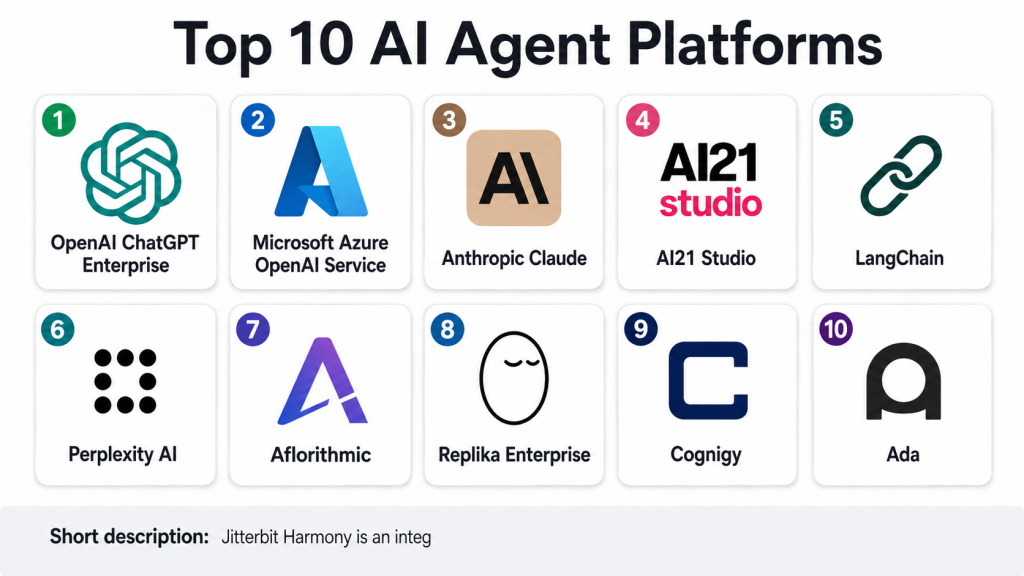
Top 10 AI Agent Platforms
#1 — OpenAI ChatGPT Enterprise
Short description:
ChatGPT Enterprise allows organizations to deploy AI agents capable of natural language understanding, content generation, task automation, and multi-user collaboration.
It is suitable for business teams, customer support, developers, and internal operations.
The platform can be used to create conversational agents, knowledge assistants, workflow automation bots, and customer-facing chat solutions.
ChatGPT Enterprise supports secure team collaboration with custom templates, API access, and advanced analytics.
It is widely adopted for enterprise knowledge management, AI-assisted writing, and automated customer interactions.
The tool leverages generative AI to extend human productivity and accelerate decision-making.
Organizations can integrate agents with internal databases, CRM, or document repositories.
The platform provides a secure, scalable cloud deployment optimized for large teams.
Key Features
- Multi-turn conversation capabilities
- Customizable prompts and agent personas
- Workflow automation via APIs
- Knowledge base integration
- Analytics and usage insights
- Secure team collaboration features
- Enterprise-grade data privacy and control
Pros
- Flexible agent creation for various business needs
- Generative AI for advanced interaction and content generation
- Scalable for large enterprises
Cons
- Requires monitoring to ensure compliance and accuracy
- Advanced integration may require engineering resources
- Cost scales with usage and team size
Platforms / Deployment
Web / Cloud
Security & Compliance
- SSO/SAML, MFA, encryption, RBAC
- SOC 2, GDPR compliance supported
Integrations & Ecosystem
ChatGPT Enterprise can integrate across internal tools and APIs.
- CRM systems
- Knowledge management databases
- Customer support platforms
- Workflow automation tools
- API endpoints for custom integrations
- Data analytics and reporting pipelines
Support & Community
Provides enterprise documentation, onboarding support, and dedicated account management. Community forums and developer resources available.
#2 — Microsoft Azure OpenAI Service
Short description:
Azure OpenAI Service enables organizations to deploy AI agents with OpenAI models in the Azure ecosystem.
It is suitable for enterprise developers, IT teams, customer support, and analytics departments.
The platform allows building conversational bots, internal AI assistants, and task automation agents.
It leverages Azure’s security, compliance, and enterprise integrations for scalable deployment.
Teams can create multi-turn agents, integrate with Microsoft 365, and manage AI workflows securely.
Azure OpenAI Service supports embedding AI agents into CRM, ERP, and customer support tools.
The platform also allows advanced monitoring, logging, and governance of AI agents.
It is optimized for organizations using Azure cloud infrastructure.
Key Features
- OpenAI model access within Azure
- Custom prompt engineering and agent personas
- Multi-agent orchestration support
- Enterprise-grade security and compliance
- Integration with Microsoft products and APIs
- Monitoring and usage analytics
- Workflow automation capabilities
Pros
- Tight integration with Microsoft ecosystem
- Enterprise security and governance
- Flexible for various internal and external AI agents
Cons
- Azure-dependent for full capabilities
- Pricing may be complex for large-scale usage
- Technical setup may require specialized knowledge
Platforms / Deployment
Web / Cloud
Security & Compliance
- SSO/SAML, MFA, encryption
- SOC 2, ISO 27001, GDPR
Integrations & Ecosystem
Works within Azure and Microsoft stack for enterprise workflows.
- Microsoft 365
- Power Automate
- Dynamics CRM
- Azure API management
- Enterprise databases
- Business workflow systems
Support & Community
Microsoft provides enterprise support, documentation, and training resources. Active developer and IT community.
#3 — Anthropic Claude
Short description:
Claude is an AI agent platform designed for secure and scalable conversational AI.
It is suitable for customer support, internal assistants, and AI research teams.
Claude agents can process text-based interactions, automate workflows, and respond to queries intelligently.
The platform emphasizes safety, ethical AI use, and reliability in enterprise contexts.
It can integrate with internal knowledge bases, APIs, and business systems.
Claude supports multi-agent setups and collaborative workflows.
It provides real-time analytics for usage and agent performance monitoring.
The platform is designed for organizations with strict data governance requirements.
Key Features
- Conversational AI with safety-focused design
- Workflow automation and multi-agent orchestration
- API access for integration
- Analytics and monitoring
- Secure internal deployment options
- Knowledge base connectivity
- Ethical AI policies
Pros
- Strong focus on safety and reliability
- Suitable for enterprise compliance-sensitive workflows
- Flexible multi-agent orchestration
Cons
- Enterprise features may require subscription
- Less brand customization than other platforms
- Integration may need engineering effort
Platforms / Deployment
Web / Cloud
Security & Compliance
- Encryption, RBAC, MFA
- GDPR and internal governance features
Integrations & Ecosystem
Claude integrates with enterprise APIs, knowledge bases, and workflow systems.
- CRM and helpdesk
- Data analytics pipelines
- Knowledge management
- API-based automation
- Internal collaboration tools
- Multi-agent orchestration systems
Support & Community
Enterprise documentation and support available. Community support for developers is limited.
#4 — AI21 Studio
Short description:
AI21 Studio allows developers and enterprises to build AI agents capable of natural language understanding, reasoning, and task execution.
It is suitable for building chatbots, research assistants, and automation agents.
The platform provides access to advanced language models, prompt engineering tools, and API endpoints.
It is often used for internal knowledge management, customer support, and research workflows.
AI21 Studio supports multi-agent orchestration, integration with enterprise data, and task automation pipelines.
It is developer-friendly with extensive documentation and experimentation capabilities.
Teams can deploy agents for internal processes or customer-facing tasks.
It focuses on AI reasoning, text generation, and conversational capabilities.
Key Features
- Advanced language models
- Customizable agent behavior
- Multi-agent orchestration
- Workflow integration
- API access
- Analytics and performance tracking
- Enterprise-scale deployments
Pros
- Developer-friendly and flexible
- Suitable for research and internal automation
- Supports complex reasoning tasks
Cons
- Less intuitive for non-technical users
- Enterprise deployment may require engineering resources
- Brand customization may be limited
Platforms / Deployment
Web / Cloud
Security & Compliance
- Encryption and API security
- Varies / N/A for specific compliance
Integrations & Ecosystem
Integrates with internal APIs, workflow systems, and enterprise data.
- Knowledge bases
- CRM systems
- Automation tools
- Reporting and analytics
- Task orchestration pipelines
Support & Community
Documentation and support resources available; developer-focused community is active.
#5 — LangChain
Short description:
LangChain is an AI agent framework for building, managing, and orchestrating LLM-powered agents.
It is suitable for developers, AI researchers, and technical teams creating intelligent multi-step workflows.
LangChain allows chaining AI calls, integrating external tools, APIs, and data sources.
It is often used for knowledge retrieval, document analysis, customer service bots, and automation workflows.
The platform emphasizes developer flexibility, custom workflows, and multi-agent orchestration.
LangChain supports prompt engineering, memory management, and reasoning logic.
It is best for teams with engineering resources and complex automation needs.
Human oversight is recommended for high-stakes tasks.
Key Features
- LLM agent orchestration
- Tool and API integration
- Memory and context management
- Prompt engineering
- Multi-step reasoning workflows
- Workflow monitoring and analytics
- Customizable agent pipelines
Pros
- Highly flexible for developers
- Supports complex, multi-step AI workflows
- Strong community and open-source ecosystem
Cons
- Requires technical expertise
- Not turnkey for non-developers
- Compliance and security depend on deployment
Platforms / Deployment
Web / Self-hosted / Cloud
Security & Compliance
Varies / N/A – security and compliance depend on hosting.
Integrations & Ecosystem
Integrates with APIs, databases, knowledge stores, and enterprise workflows.
- CRM systems
- Knowledge bases
- Automation pipelines
- Data warehouses
- Reporting and analytics
Support & Community
Active developer community, documentation, and open-source support.
#6 — Perplexity AI
Short description:
Perplexity AI allows users to deploy AI agents capable of question answering, knowledge retrieval, and task execution.
It is suitable for research teams, internal knowledge assistants, and customer-facing bots.
The platform emphasizes fast response, accurate information retrieval, and conversational interaction.
Perplexity AI agents can be integrated with internal data sources, APIs, and knowledge bases.
It supports multi-agent orchestration and user query handling for enterprise workflows.
The platform is practical for internal helpdesk, knowledge support, and research workflows.
Perplexity AI balances user accessibility with advanced AI reasoning capabilities.
It requires monitoring and review for accuracy in sensitive or high-stakes tasks.
Key Features
- Question answering AI agents
- Knowledge retrieval integration
- Conversational AI capabilities
- Multi-agent orchestration
- Workflow automation
- Analytics and monitoring
- API access
Pros
- Accurate and responsive AI agents
- Good for internal knowledge workflows
- Supports multi-agent coordination
Cons
- Brand customization may be limited
- Integration requires engineering
- Monitoring is necessary for sensitive content
Platforms / Deployment
Web / Cloud
Security & Compliance
Encryption and API security; specific compliance features Not publicly stated.
Integrations & Ecosystem
Integrates with internal knowledge bases, APIs, and enterprise workflow tools.
- Knowledge management systems
- CRM
- Helpdesk platforms
- Internal dashboards
- Automation pipelines
Support & Community
Documentation and support available; community focused on enterprise AI usage.
#7 — Aflorithmic
Short description:
Aflorithmic enables AI agent voice and audio generation for automated interactions, podcasts, and audio workflows.
It is suitable for marketing, e-learning, customer engagement, and AI assistant teams.
The platform converts scripts into lifelike audio with multi-voice support and integration capabilities.
It can be used to create conversational agents, AI podcasts, and narrated training modules.
Aflorithmic supports personalization, language variants, and voice modulation.
The platform integrates with other AI agents for multimodal experiences.
It is best for audio-heavy automation and AI communication workflows.
Teams should combine with text or video agents for richer experiences.
Key Features
- AI voice generation
- Multi-voice and multilingual support
- Script-to-audio workflow
- Audio personalization
- Integration with AI agents and platforms
- API access
- Voice modulation and effects
Pros
- High-quality AI voice output
- Supports e-learning and automated communications
- Integrates with multi-agent workflows
Cons
- Limited to audio generation
- Not a full video or text agent platform
- Advanced usage may require developer resources
Platforms / Deployment
Web / Cloud
Security & Compliance
Encryption and secure API endpoints; compliance Not publicly stated.
Integrations & Ecosystem
Integrates with AI agent platforms, audio pipelines, e-learning systems, and automation workflows.
- Learning management systems
- Voice assistants
- Customer engagement platforms
- Multimodal AI pipelines
- API integration
Support & Community
Documentation, templates, and support provided. Community is niche around voice and audio AI.
#8 — Replika Enterprise
Short description:
Replika Enterprise offers AI agent chatbots and virtual companions for customer interaction, engagement, and conversational support.
It is suitable for marketing teams, wellness apps, customer support, and engagement platforms.
The platform supports personality-driven AI agents, natural conversations, and persistent interactions.
Replika Enterprise allows customization of agent behavior, tone, and personality.
It is useful for internal engagement, customer support, or personalized AI experiences.
The platform focuses on user interaction quality and long-term engagement.
Teams can deploy agents at scale while controlling branding and messaging.
Human review is recommended for high-value interactions.
Key Features
- Conversational AI agents
- Personality customization
- Persistent multi-session interactions
- Multi-agent orchestration
- Analytics on engagement
- API for integration
- Tone and behavior control
Pros
- Strong engagement-focused AI agents
- Supports multi-session interactions
- Useful for wellness and customer support scenarios
Cons
- Limited integration with enterprise workflows
- Less focused on business process automation
- Content monitoring may be needed
Platforms / Deployment
Web / iOS / Android / Cloud
Security & Compliance
Varies / N/A – enterprise options may exist; review needed for compliance.
Integrations & Ecosystem
Works in customer engagement, chatbot, and wellness-focused workflows.
- Customer support systems
- Engagement platforms
- Chatbot frameworks
- Messaging apps
- Analytics dashboards
Support & Community
Documentation and support provided; community smaller and focused on engagement AI.
#9 — Cognigy
Short description:
Cognigy is an enterprise AI agent platform for creating conversational AI workflows, chatbots, and voice agents.
It is suitable for contact centers, customer support, internal service desks, and automation teams.
Cognigy supports multi-channel communication including chat, voice, and messaging platforms.
The platform allows integration with enterprise systems, CRMs, and IT service platforms.
It supports automation, scripting, and multi-agent orchestration.
Cognigy is enterprise-focused with governance, security, and analytics features.
It is strong for large-scale customer support and internal workflow automation.
Human supervision remains important for complex decision-making tasks.
Key Features
- Conversational AI across channels
- Voice and chatbots
- Enterprise system integration
- Multi-agent orchestration
- Workflow automation
- Analytics and monitoring
- Security and governance tools
Pros
- Enterprise-grade AI agent platform
- Supports multi-channel communication
- Scalable for large contact centers
Cons
- Complex setup may require technical expertise
- Licensing may be expensive for small teams
- Workflow design may need professional training
Platforms / Deployment
Web / Cloud / On-premise
Security & Compliance
- Enterprise-grade encryption and RBAC
- SOC 2 and GDPR supported
Integrations & Ecosystem
Integrates with CRM, helpdesk, ITSM, messaging platforms, and enterprise workflows.
- Salesforce
- ServiceNow
- Microsoft Teams
- Slack
- API endpoints for custom integrations
Support & Community
Enterprise documentation and onboarding support provided; community focused on business users.
#10 — Ada
Short description:
Ada is an AI agent platform for customer support automation and conversational workflows.
It is suitable for customer service teams, e-commerce, SaaS companies, and contact centers.
Ada allows businesses to create chatbots that handle inquiries, guide users, and escalate complex issues.
The platform supports multi-channel deployment, analytics, and personalized interactions.
Ada emphasizes ease of use for non-technical content creators.
It is widely adopted by customer support teams to reduce ticket volumes and increase engagement.
The platform supports integration with CRM, helpdesk, and support automation tools.
Teams can monitor agent performance and optimize interactions.
Key Features
- AI chatbot creation
- Multi-channel support
- Workflow automation
- Analytics and reporting
- CRM and helpdesk integrations
- Personalization and recommendations
- Escalation and handoff capabilities
Pros
- Easy for non-technical teams
- Reduces support ticket volume
- Improves customer engagement and satisfaction
Cons
- May require manual content curation for complex queries
- Limited for advanced multi-agent orchestration
- Pricing may scale with volume
Platforms / Deployment
Web / Cloud / Mobile
Security & Compliance
Encryption, RBAC, and enterprise security controls available depending on plan. Compliance Not publicly stated for some deployments.
Integrations & Ecosystem
Integrates with CRMs, support platforms, and messaging systems.
- Salesforce
- Zendesk
- Shopify
- Slack
- Microsoft Teams
- API endpoints for custom automation
Support & Community
Provides documentation, onboarding, templates, and enterprise support. Community engagement is strong among support teams.
Comparison Table
| Tool Name | Best For | Platform(s) Supported | Deployment | Standout Feature | Public Rating |
|---|---|---|---|---|---|
| ChatGPT Enterprise | General AI agents and automation | Web | Cloud | Multi-turn AI agent with enterprise collaboration | N/A |
| Azure OpenAI Service | Enterprise AI workflows | Web | Cloud | OpenAI models integrated with Azure | N/A |
| Claude | Secure conversational agents | Web | Cloud | Safety-focused AI agent | N/A |
| AI21 Studio | Developer-friendly AI agents | Web | Cloud | LLM agent creation and APIs | N/A |
| LangChain | Complex multi-agent workflows | Web | Self-hosted / Cloud | LLM orchestration and tool integration | N/A |
| Perplexity AI | Knowledge retrieval and question answering | Web | Cloud | Fast and accurate AI agent responses | N/A |
| Aflorithmic | Voice and audio AI agents | Web | Cloud | AI voice generation for agents | N/A |
| Replika Enterprise | Conversational engagement | Web / Mobile | Cloud | Personality-driven AI agents | N/A |
| Cognigy | Enterprise support and voice agents | Web | Cloud / On-premise | Multi-channel AI agents | N/A |
| Ada | Customer support automation | Web / Mobile | Cloud | Easy-to-use multi-channel chatbots | N/A |
Evaluation & Scoring of AI Agent Platforms
| Tool Name | Core (25%) | Ease (15%) | Integrations (15%) | Security (10%) | Performance (10%) | Support (10%) | Value (15%) | Weighted Total (0–10) |
|---|---|---|---|---|---|---|---|---|
| ChatGPT Enterprise | 9 | 8 | 8 | 8 | 8 | 8 | 7 | 8.10 |
| Azure OpenAI Service | 9 | 7 | 8 | 8 | 8 | 8 | 7 | 7.95 |
| Claude | 8 | 8 | 7 | 8 | 8 | 8 | 7 | 7.85 |
| AI21 Studio | 8 | 7 | 7 | 7 | 8 | 8 | 7 | 7.70 |
| LangChain | 9 | 6 | 8 | 6 | 8 | 7 | 7 | 7.55 |
| Perplexity AI | 8 | 8 | 7 | 7 | 7 | 7 | 7 | 7.50 |
| Aflorithmic | 7 | 7 | 6 | 6 | 7 | 7 | 7 | 7.05 |
| Replika Enterprise | 7 | 8 | 6 | 6 | 7 | 7 | 7 | 7.20 |
| Cognigy | 8 | 7 | 8 | 8 | 8 | 8 | 7 | 7.95 |
| Ada | 7 | 8 | 7 | 7 | 7 | 7 | 7 | 7.40 |
Scores are comparative; higher scores reflect relative strengths in enterprise use cases, automation, and agent capabilities.
Which AI Agent Platform Is Right for You?
Solo / Freelancer
Solo users should prioritize ease of use, flexibility, and low cost. ChatGPT Enterprise or Perplexity AI are practical starting points. LangChain or AI21 Studio may suit developers creating small-scale agents.
SMB
Small and medium businesses benefit from quick deployment, multi-channel bots, and workflow automation. Ada, Replika Enterprise, Cognigy, and ChatGPT Enterprise are strong candidates. Choose based on customer support or internal automation needs.
Mid-Market
Mid-market teams require multi-agent orchestration, integrations, brand control, and analytics. ChatGPT Enterprise, Azure OpenAI Service, Cognigy, and LangChain are suitable depending on complexity. Integration with CRM, support platforms, and internal systems is crucial.
Enterprise
Enterprises need governance, security, auditability, and multi-channel orchestration. Azure OpenAI Service, ChatGPT Enterprise, Cognigy, and Claude are strong. They provide enterprise-grade compliance, API integrations, and monitoring.
Budget vs Premium
Budget-conscious teams may start with ChatGPT Enterprise or Perplexity AI. Premium plans are better for multi-agent orchestration, enterprise governance, and multi-channel deployment.
Feature Depth vs Ease of Use
Ease of use: Ada, Replika Enterprise, Perplexity AI
Feature depth: LangChain, Azure OpenAI Service, Cognigy
Integrations & Scalability
Teams should confirm integration with CRM, helpdesk, ERP, internal tools, and API endpoints for automation. Scalability depends on platform and plan.
Security & Compliance Needs
Evaluate SSO, MFA, RBAC, audit logs, encryption, and compliance certifications. High-stakes industries should verify vendor compliance and internal data policies.
Frequently Asked Questions
1. What is an AI agent platform?
An AI agent platform is software that allows deploying AI agents capable of autonomous or semi-autonomous task execution, conversation, and workflow management.
2. Can AI agents replace human workers?
They supplement humans for routine or repetitive tasks but human oversight is required for complex decision-making, customer interactions, or high-risk processes.
3. What pricing models are common?
Pricing can be subscription-based, usage-based, or tiered by seats, agents, API calls, or compute usage. Evaluate based on team size and scale.
4. How long does onboarding take?
Basic onboarding can take a few hours. Enterprise deployment may require weeks for templates, workflows, training, and integration setup.
5. What are common mistakes with AI agent platforms?
Mistakes include deploying without monitoring, neglecting human review, over-relying on AI for high-risk tasks, ignoring branding, or underestimating integration complexity.
6. Are AI agent platforms secure?
Security depends on vendor features. Verify SSO, RBAC, MFA, encryption, audit logs, and compliance with GDPR, SOC 2, HIPAA, or ISO standards.
7. Which AI agent is best for customer support?
Ada, Cognigy, and ChatGPT Enterprise are strong candidates for customer service automation, multi-channel support, and workflow integration.
8. Which AI agent platform is best for enterprise internal automation?
Azure OpenAI Service, ChatGPT Enterprise, and LangChain are recommended for internal workflows, automation pipelines, and knowledge assistants.
9. Can AI agents be used for marketing automation?
Yes. ChatGPT, Replika Enterprise, and Aflorithmic can be configured to generate customer-facing messages, emails, and audio/video content for campaigns.
10. How do AI agents integrate with enterprise systems?
Most platforms provide APIs, connectors, or native integrations to CRM, ERP, helpdesk, messaging platforms, and workflow automation tools.
Conclusion
AI Agent Platforms are transforming business automation, customer service, internal operations, and workflow efficiency. Selecting the right tool depends on your team size, task complexity, security needs, integrations, and budget. ChatGPT Enterprise and Azure OpenAI Service provide versatile multi-purpose AI agents. Claude and Cognigy are strong for secure enterprise and multi-channel workflows. LangChain and AI21 Studio are developer-focused for complex automation. Ada and Replika Enterprise excel at customer support and engagement.
