Upgrade & Secure Your Future with DevOps, SRE, DevSecOps, MLOps!
We spend hours scrolling social media and waste money on things we forget, but won’t spend 30 minutes a day earning certifications that can change our lives.
Master in DevOps, SRE, DevSecOps & MLOps by DevOps School!
Learn from Guru Rajesh Kumar and double your salary in just one year.
Introduction
Business Intelligence (BI) for Finance refers to software platforms that help organizations analyze financial data, monitor key performance indicators, and make informed decisions. In plain language, these tools transform raw financial data into actionable insights, enabling CFOs, finance teams, and executives to optimize budgeting, forecasting, and overall financial performance.
The growing complexity of financial ecosystems, combined with increased regulatory oversight and real-time reporting demands, makes BI tools essential. Organizations need quick access to accurate data for scenario planning, risk management, and strategic decision-making.
Real-world use cases include:
- Financial performance monitoring and KPI tracking
- Forecasting cash flow, revenue, and expenses
- Risk analysis and compliance reporting
- Budgeting and variance analysis for departments
- Investor and board reporting
Key buyer evaluation criteria:
- Real-time data visualization and dashboards
- Integration with accounting, ERP, and CRM systems
- Forecasting and scenario modeling capabilities
- Ease of use and reporting customization
- Security and access controls
- Cloud vs on-premise deployment options
- Collaboration and multi-user support
- Predictive analytics and AI-driven insights
- Scalability for small teams and large enterprises
- Customer support and training resources
Best for: CFOs, finance managers, accountants, financial analysts, and decision-makers in SMBs and large enterprises.
Not ideal for: Organizations with minimal financial complexity or small teams that can manage reporting via spreadsheets; basic tools may suffice.
Key Trends in Business Intelligence for Finance
- AI-driven predictive analytics for financial planning
- Cloud-native platforms for real-time, multi-location access
- Integration with ERP, CRM, and accounting software
- Self-service dashboards enabling non-technical users
- Automation of reporting and consolidation workflows
- Scenario modeling for risk, budgeting, and investment decisions
- Embedded compliance checks and audit trails
- Mobile and tablet access for executives on the go
- Flexible pricing models for SMBs and enterprises
- Advanced data visualization and interactive dashboards
How We Selected These Tools (Methodology)
- Market adoption and reputation among finance teams and enterprises
- Feature completeness including dashboards, forecasting, and analytics
- Reliability and performance benchmarks
- Security and compliance measures, including data encryption
- Integration capabilities with ERP, CRM, and accounting software
- Fit for different business sizes and industries
- Usability and learning curve for finance professionals
- Reporting capabilities for internal and external stakeholders
- Customer support quality and community engagement
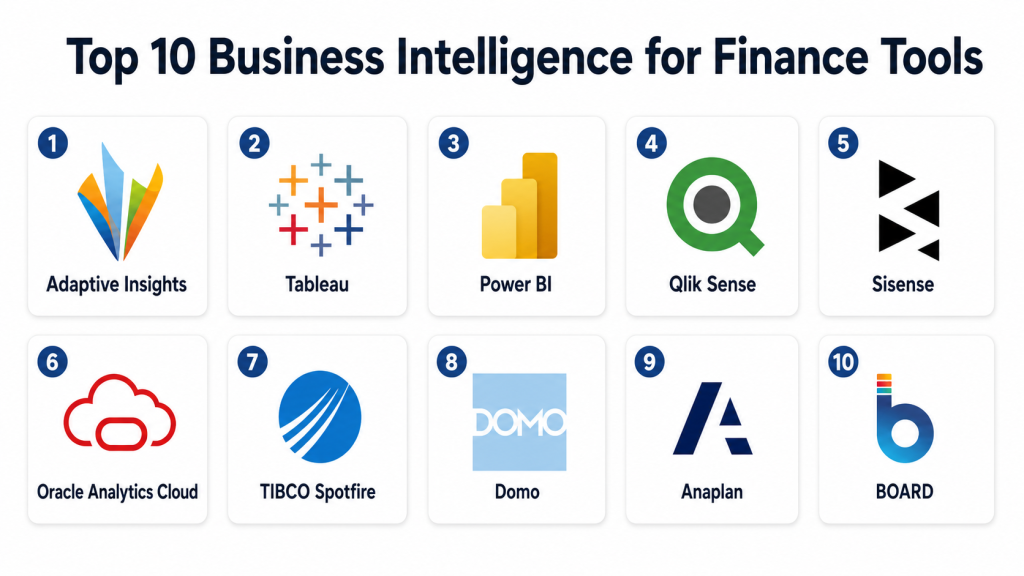
Top 10 Business Intelligence for Finance Tools
#1 — Adaptive Insights
Short description: Adaptive Insights is a cloud-based BI platform for finance, focusing on budgeting, forecasting, and reporting. Ideal for mid-market and large enterprises seeking real-time financial insights.
Key Features
- Cloud-based financial planning
- Scenario modeling and forecasting
- Real-time dashboards and KPI tracking
- Automated reporting and consolidation
- Collaboration across finance teams
- Audit-ready reporting
- Integration with ERP systems
Pros
- Scalable for growing businesses
- Real-time data for informed decision-making
Cons
- Learning curve for new users
- Premium pricing for advanced modules
Platforms / Deployment
- Web
- Cloud
Security & Compliance
- SSO, MFA, encryption
- SOC 2, GDPR
Integrations & Ecosystem
- ERP connectors (NetSuite, SAP)
- Accounting software integration
- API for custom workflows
Support & Community
- Knowledge base and tutorials
- Dedicated customer support
- Online user community
#2 — Tableau
Short description: Tableau provides data visualization and reporting capabilities with strong financial analytics for finance teams. Suitable for organizations needing visual dashboards and deep insights.
Key Features
- Interactive dashboards
- Real-time financial analytics
- Scenario modeling support
- Integration with databases and accounting systems
- Mobile access
- Customizable reports
- AI-driven insights
Pros
- Powerful visualization for complex data
- Flexible integration with multiple data sources
Cons
- Advanced analytics may require technical skills
- Requires training for finance teams
Platforms / Deployment
- Windows / macOS / Web / iOS / Android
- Cloud / On-premise
Security & Compliance
- Not publicly stated
Integrations & Ecosystem
- ERP and CRM connectors
- API access for data import/export
- Extensible with third-party plugins
Support & Community
- Extensive documentation
- Webinars and tutorials
- Active global community
#3 — Power BI
Short description: Microsoft Power BI offers business intelligence and reporting with finance-specific dashboards. Ideal for organizations using Microsoft ecosystems and seeking cost-effective solutions.
Key Features
- Real-time dashboards and KPIs
- Financial data consolidation
- Scenario planning and forecasting
- Integration with Excel and ERP systems
- Collaboration and sharing tools
- AI-assisted analytics
- Custom report creation
Pros
- Seamless integration with Microsoft products
- Scalable for small to large enterprises
Cons
- Limited advanced features in lower tiers
- Requires familiarity with Microsoft tools
Platforms / Deployment
- Windows / Web / iOS / Android
- Cloud / Hybrid
Security & Compliance
- SSO, MFA, encryption
- Not publicly stated
Integrations & Ecosystem
- ERP and CRM connectors
- Excel and Azure integration
- API for custom dashboards
Support & Community
- Documentation and training modules
- Microsoft support plans
- Large user community
#4 — Qlik Sense
Short description: Qlik Sense delivers self-service business intelligence for finance with advanced analytics, dashboards, and data exploration. Suitable for finance teams requiring dynamic reporting.
Key Features
- Interactive financial dashboards
- Self-service data analysis
- Forecasting and scenario modeling
- Multi-source data integration
- Collaboration and sharing tools
- AI-powered insights
- Customizable KPIs
Pros
- Self-service analytics empower finance teams
- Strong data visualization capabilities
Cons
- Complex setup for first-time users
- Premium pricing for enterprise features
Platforms / Deployment
- Windows / Web
- Cloud / On-premise
Security & Compliance
- Not publicly stated
Integrations & Ecosystem
- ERP, accounting, and CRM integrations
- API for custom analytics
- Data connectors for multiple databases
Support & Community
- Tutorials and knowledge base
- Customer support
- Community forums
#5 — Sisense
Short description: Sisense provides embedded analytics and BI solutions for finance, enabling organizations to create interactive dashboards and predictive insights. Ideal for mid-size and large enterprises.
Key Features
- Embedded analytics for financial dashboards
- Predictive modeling and forecasting
- Multi-source data integration
- Self-service reporting
- Collaboration tools
- AI-driven insights
- Customizable KPIs
Pros
- Strong predictive analytics
- Flexible embedding into existing workflows
Cons
- Requires technical expertise for complex setups
- Cost can be high for small organizations
Platforms / Deployment
- Web / Windows / macOS
- Cloud / On-premise
Security & Compliance
- Not publicly stated
Integrations & Ecosystem
- ERP, CRM, and database connectors
- API support for embedding analytics
- Cloud storage integration
Support & Community
- Online support and tutorials
- Customer success teams
- Active user community
#6 — Oracle Analytics Cloud
Short description: Oracle Analytics Cloud delivers financial BI, dashboards, and predictive analytics for large enterprises. Best for companies already using Oracle ERP or cloud solutions.
Key Features
- Real-time dashboards
- Predictive financial analytics
- Integration with Oracle ERP
- Scenario modeling and forecasting
- Collaboration and reporting
- AI-assisted insights
- Custom KPI dashboards
Pros
- Deep integration with Oracle products
- Enterprise-grade security and scalability
Cons
- Steep learning curve
- Higher cost for smaller businesses
Platforms / Deployment
- Web
- Cloud
Security & Compliance
- SSO, MFA, encryption
- SOC 2, ISO 27001
Integrations & Ecosystem
- Oracle ERP, databases, and cloud apps
- API for data import/export
- Extensible with third-party connectors
Support & Community
- Oracle support and training
- Documentation
- Online forums
#7 — TIBCO Spotfire
Short description: Spotfire provides analytics and visualization for finance, including dashboards, predictive modeling, and scenario planning. Ideal for data-driven finance teams.
Key Features
- Interactive dashboards
- Financial forecasting
- Predictive modeling and analytics
- Data integration across multiple sources
- Collaboration and sharing tools
- AI-powered insights
- Custom report creation
Pros
- Strong visualization capabilities
- Flexible analytics for finance teams
Cons
- Requires technical expertise
- Enterprise pricing model
Platforms / Deployment
- Web / Windows
- Cloud / On-premise
Security & Compliance
- Not publicly stated
Integrations & Ecosystem
- ERP, CRM, and accounting integrations
- API support
- Data connectors for databases
Support & Community
- Tutorials and knowledge base
- Customer support
- Community forums
#8 — Domo
Short description: Domo provides cloud-based BI for finance with dashboards, analytics, and collaboration. Ideal for organizations needing real-time finance insights.
Key Features
- Real-time financial dashboards
- Multi-source data integration
- Scenario modeling and forecasting
- Self-service reporting
- Collaboration tools
- AI-driven analytics
- Custom KPIs
Pros
- Easy collaboration across teams
- Cloud-native and mobile-ready
Cons
- Premium pricing
- May require onboarding for complex data sources
Platforms / Deployment
- Web / iOS / Android
- Cloud
Security & Compliance
- Not publicly stated
Integrations & Ecosystem
- ERP, CRM, and cloud data connectors
- API for custom dashboards
- Cloud storage support
Support & Community
- Tutorials and training
- Email and chat support
- Knowledge base
#9 — Anaplan
Short description: Anaplan is a planning and BI platform for finance, providing real-time scenario modeling, predictive analytics, and dashboards. Suitable for mid-market and enterprise organizations.
Key Features
- Financial planning and forecasting
- Scenario modeling
- KPI dashboards and reporting
- Collaboration features
- Multi-source data integration
- Predictive analytics
- AI-powered insights
Pros
- Enterprise-grade scalability
- Strong predictive planning capabilities
Cons
- High complexity for small businesses
- Premium pricing
Platforms / Deployment
- Web
- Cloud
Security & Compliance
- Not publicly stated
Integrations & Ecosystem
- ERP and accounting integrations
- API support
- Cloud data connectors
Support & Community
- Documentation and tutorials
- Customer support
- Community forums
#10 — BOARD
Short description: BOARD offers integrated BI and performance management for finance, enabling scenario planning, predictive analytics, and reporting. Ideal for finance teams requiring all-in-one solutions.
Key Features
- Integrated BI dashboards
- Financial forecasting and planning
- Scenario analysis
- KPI tracking
- Predictive analytics
- Collaboration tools
- Data visualization
Pros
- Comprehensive all-in-one platform
- Strong scenario modeling capabilities
Cons
- Complex for small teams
- Enterprise pricing
Platforms / Deployment
- Windows / Web
- Cloud / On-premise
Security & Compliance
- Not publicly stated
Integrations & Ecosystem
- ERP, CRM, and financial systems
- API support
- Data connectors
Support & Community
- Online support
- Knowledge base
- Tutorials
Comparison Table (Top 10)
| Tool Name | Best For | Platform(s) Supported | Deployment | Standout Feature | Public Rating |
|---|---|---|---|---|---|
| Adaptive Insights | Mid-market / enterprise | Web | Cloud | Scenario modeling | N/A |
| Tableau | Finance visualization | Windows / macOS / Web / iOS / Android | Cloud / On-prem | Interactive dashboards | N/A |
| Power BI | Microsoft ecosystem | Windows / Web / iOS / Android | Cloud / Hybrid | Integration with Excel | N/A |
| Qlik Sense | Self-service analytics | Windows / Web | Cloud / On-prem | Dynamic reporting | N/A |
| Sisense | Embedded analytics | Web / Windows / macOS | Cloud / On-prem | Predictive analytics | N/A |
| Oracle Analytics Cloud | Large enterprises | Web | Cloud | Integration with Oracle ERP | N/A |
| TIBCO Spotfire | Data-driven finance | Web / Windows | Cloud / On-prem | Predictive modeling | N/A |
| Domo | Cloud collaboration | Web / iOS / Android | Cloud | Real-time dashboards | N/A |
| Anaplan | Planning & forecasting | Web | Cloud | Predictive scenario modeling | N/A |
| BOARD | All-in-one finance BI | Windows / Web | Cloud / On-prem | Integrated performance management | N/A |
Evaluation & Scoring of Business Intelligence for Finance Tools
| Tool Name | Core (25%) | Ease (15%) | Integrations (15%) | Security (10%) | Performance (10%) | Support (10%) | Value (15%) | Weighted Total (0–10) |
|---|---|---|---|---|---|---|---|---|
| Adaptive Insights | 9 | 8 | 8 | 8 | 8 | 7 | 7 | 8.0 |
| Tableau | 8 | 7 | 8 | 7 | 8 | 7 | 7 | 7.6 |
| Power BI | 8 | 8 | 8 | 7 | 8 | 7 | 8 | 7.9 |
| Qlik Sense | 8 | 7 | 7 | 7 | 8 | 7 | 7 | 7.5 |
| Sisense | 8 | 7 | 7 | 7 | 8 | 7 | 7 | 7.5 |
| Oracle Analytics Cloud | 9 | 6 | 8 | 8 | 8 | 7 | 6 | 7.7 |
| TIBCO Spotfire | 8 | 7 | 7 | 7 | 7 | 7 | 7 | 7.3 |
| Domo | 7 | 8 | 7 | 7 | 7 | 7 | 7 | 7.3 |
| Anaplan | 9 | 6 | 8 | 8 | 8 | 7 | 6 | 7.7 |
| BOARD | 8 | 6 | 7 | 7 | 7 | 7 | 7 | 7.1 |
Interpretation: Scores are comparative across core features, usability, integrations, security, performance, support, and value. Higher weighted totals indicate stronger overall suitability for finance-focused BI.
Which Business Intelligence Tool Is Right for You?
Solo / Freelancer
- Tableau or Power BI for self-service dashboards and simple forecasting
SMB
- Domo or Qlik Sense for real-time finance analytics and collaboration
Mid-Market
- Adaptive Insights or Sisense for scenario modeling and budgeting
Enterprise
- Oracle Analytics Cloud, Anaplan, or BOARD for comprehensive planning and predictive analytics
Budget vs Premium
- SMBs: Power BI or Domo
- Enterprises: Oracle Analytics Cloud or BOARD
Feature Depth vs Ease of Use
- Balance ease of use with advanced analytics; Tableau and Power BI provide good middle ground
Integrations & Scalability
- Ensure ERP, accounting, and CRM connectivity for data consolidation
Security & Compliance Needs
- Cloud security, encryption, and multi-factor authentication are essential for sensitive finance data
Frequently Asked Questions (FAQs)
1. What pricing models do finance BI tools offer?
Most use subscription-based pricing; enterprise plans may be customized.
2. How quickly can dashboards be set up?
Templates allow dashboards to be created within hours; custom analytics may take longer.
3. Are these tools suitable for startups?
Yes, options like Power BI and Tableau scale from small to large organizations.
4. Can BI tools automate forecasting?
Yes, predictive modeling and AI-powered scenario planning are standard features.
5. Do these tools integrate with ERP and accounting software?
Yes, most integrate with ERP, CRM, and cloud-based accounting platforms.
6. Can multiple teams collaborate in real time?
Cloud-native platforms allow secure collaboration across finance and management teams.
7. Are visualizations customizable?
Yes, dashboards and KPI charts can be tailored to specific finance needs.
8. How secure is financial data in BI platforms?
Leading platforms use encryption, SSO, MFA, and audit logs for data protection.
9. Can these tools handle predictive analytics?
Yes, several tools offer AI-driven forecasts and trend analysis for strategic planning.
10. Do they support mobile access?
Most provide web and mobile apps for finance professionals on the go.
Conclusion
Choosing the right Business Intelligence tool for finance depends on organization size, analytics complexity, and integration requirements. Small teams may benefit from Power BI or Tableau, whereas mid-market and enterprise organizations may prioritize Adaptive Insights, Anaplan, or BOARD for scenario modeling, predictive analytics, and comprehensive dashboards. A practical next step is to shortlist platforms, run a pilot, and validate integration, security, and reporting capabilities for your finance team.
