Upgrade & Secure Your Future with DevOps, SRE, DevSecOps, MLOps!
We spend hours scrolling social media and waste money on things we forget, but won’t spend 30 minutes a day earning certifications that can change our lives.
Master in DevOps, SRE, DevSecOps & MLOps by DevOps School!
Learn from Guru Rajesh Kumar and double your salary in just one year.
Introduction
Compliance training platforms help organizations train employees on rules, policies, regulations, ethics, security, workplace safety, privacy, harassment prevention, industry standards, and internal procedures. In simple words, these platforms make it easier to deliver required training, track completion, test understanding, and keep audit-ready records.
Compliance training matters because companies face growing regulatory pressure, remote workforce challenges, cybersecurity risks, workplace conduct concerns, and industry-specific training requirements. A strong platform helps HR, legal, compliance, security, and learning teams assign courses, automate reminders, manage certifications, generate reports, and prove that employees completed required training.
Common use cases include employee onboarding, cybersecurity awareness, data privacy training, workplace ethics, anti-harassment training, health and safety training, financial compliance, policy acknowledgment, and audit preparation.
Buyers should evaluate course library quality, tracking and reporting, automation, integrations, learner experience, mobile access, certification management, localization, security, admin controls, scalability, and support quality.
Best for: HR teams, compliance officers, legal teams, learning and development teams, IT security teams, healthcare organizations, financial services firms, manufacturing companies, public sector bodies, and enterprises with mandatory training needs.
Not ideal for: Very small teams with informal training needs, companies that only need one-time video hosting, or organizations that do not need tracking, reporting, certification, or audit records.
Key Trends in Compliance Training Platforms
- AI-assisted learning paths: Compliance platforms are starting to use AI to recommend courses, identify training gaps, summarize policies, and personalize learning paths based on roles and risk levels.
- Microlearning and short modules: Employees are more likely to complete short, focused lessons than long compliance sessions, so many platforms now support bite-sized learning.
- Automated compliance tracking: Teams want automatic reminders, due-date tracking, escalation workflows, and completion dashboards instead of manual spreadsheet follow-ups.
- Role-based training: Compliance requirements differ by role, region, department, and risk exposure, so platforms now support targeted assignments instead of one-size-fits-all training.
- Cybersecurity and privacy training growth: Security awareness, phishing prevention, data handling, privacy, and secure workplace behavior are now common compliance training priorities.
- Audit-ready reporting: Organizations need proof of completion, quiz scores, policy acknowledgment records, certificate history, and training logs during audits or investigations.
- Mobile-first learning: Remote, frontline, field, and hybrid workers need training access from phones, tablets, and simple browser-based experiences.
- Integration with HR systems: Compliance training platforms increasingly connect with HRIS, identity providers, collaboration tools, learning systems, and employee databases.
- Localization and accessibility: Global teams need multilingual training, accessible content, regional compliance content, and flexible learning formats.
- Continuous compliance culture: Companies are moving from annual check-the-box training to ongoing awareness, nudges, refreshers, and behavior-focused learning.
How We Selected These Tools
The compliance training software market includes learning management systems, workplace compliance training libraries, security awareness platforms, policy training tools, and enterprise learning suites. The tools below were selected using practical buyer-focused criteria.
- Recognition in compliance training, learning management, and employee training markets
- Strength of compliance course libraries and training delivery features
- Tracking, reporting, certification, and audit-readiness capabilities
- Fit for HR, legal, compliance, IT security, and L&D teams
- Integration readiness with HRIS, SSO, identity, collaboration, and business systems
- Ease of use for learners, managers, and administrators
- Automation for reminders, assignments, renewals, and escalations
- Security posture signals and access-control expectations
- Suitability for SMB, mid-market, enterprise, and regulated industries
- Support quality, onboarding resources, and scalability
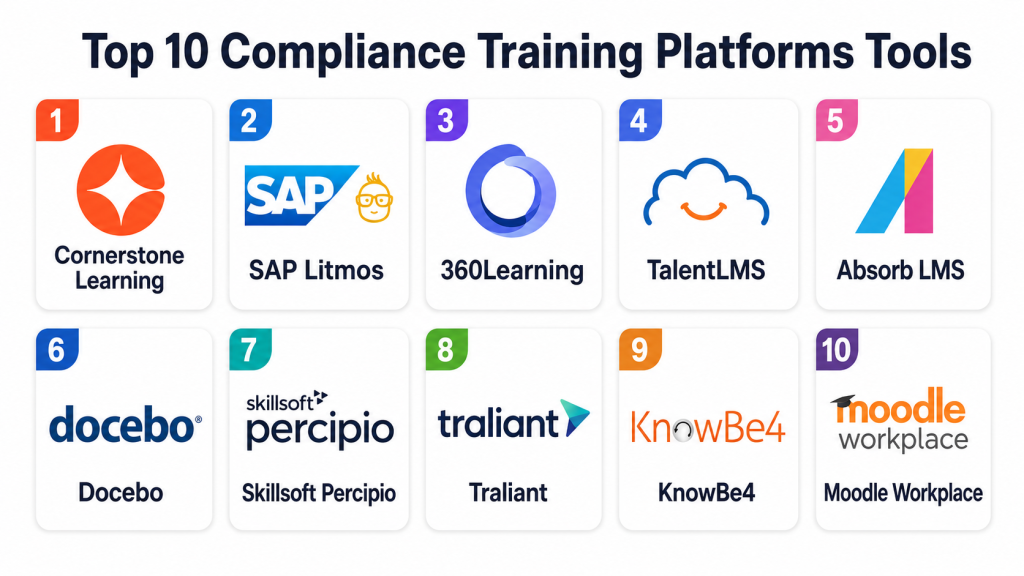
Top 10 Compliance Training Platforms Tools
#1 — Cornerstone Learning
Short description:
Cornerstone Learning is an enterprise learning management platform used by organizations to deliver, manage, and track employee training, including compliance training. It supports large-scale learning programs, role-based assignments, reporting, certification tracking, and workforce development. The platform is well suited for enterprises with complex employee groups, multiple regions, and structured learning requirements. It is best for organizations that need compliance training as part of a broader talent and learning strategy.
Key Features
- Enterprise learning management
- Compliance course assignment and tracking
- Certification and recertification management
- Reporting and audit-ready training records
- Role-based learning paths
- Content management and course delivery
- Integration with HR and talent systems
Pros
- Strong fit for large organizations and complex learning programs
- Good reporting and compliance tracking capabilities
- Useful when compliance training is part of wider employee development
Cons
- May be too complex for very small teams
- Implementation can require planning and admin training
- Pricing is not publicly stated
Platforms / Deployment
Web / Cloud / Mobile access may vary
Security & Compliance
Security details should be confirmed directly with the vendor. Buyers should ask about SSO, MFA, RBAC, encryption, audit logs, data privacy, and compliance documentation.
SOC 2, ISO 27001, GDPR, HIPAA: Not publicly stated for every implementation.
Integrations & Ecosystem
Cornerstone Learning works well in enterprise HR and learning ecosystems where training data must connect with employee records and talent workflows.
- HRIS platforms
- Identity providers
- Talent management systems
- Content libraries
- Reporting and analytics tools
- Collaboration platforms
Support & Community
Cornerstone provides enterprise support, documentation, implementation assistance, training resources, and customer success services. Support depth depends on contract scope and deployment complexity.
#2 — SAP Litmos
Short description:
SAP Litmos is a cloud-based learning platform used for employee training, customer training, partner training, and compliance training. It helps organizations create, assign, track, and report on training programs. SAP Litmos is useful for businesses that need fast course deployment, learner-friendly access, and compliance tracking without overly complex setup. It is best suited for SMBs, mid-market companies, and enterprises that want a practical LMS with compliance training capabilities.
Key Features
- Cloud-based learning management
- Compliance training assignment and tracking
- Course creation and content delivery
- Reporting and learner progress dashboards
- Assessments and quizzes
- Certification support
- Mobile-friendly learning experience
Pros
- Practical and relatively easy to adopt
- Good fit for compliance, employee, and customer training
- Useful for organizations that need fast training rollout
Cons
- Advanced enterprise customization may vary by package
- Buyers should validate content library fit for their industry
- Pricing is not publicly stated for every use case
Platforms / Deployment
Web / Cloud / Mobile access may vary
Security & Compliance
Security details should be validated directly with the vendor. Buyers should ask about SSO, MFA, RBAC, encryption, audit logs, data privacy, and compliance documentation.
SOC 2, ISO 27001, GDPR, HIPAA: Not publicly stated for every implementation.
Integrations & Ecosystem
SAP Litmos can connect learning workflows with HR, identity, business, and collaboration systems.
- HRIS platforms
- SSO and identity providers
- CRM systems
- Content libraries
- Collaboration tools
- Reporting platforms
Support & Community
SAP Litmos provides support, documentation, onboarding resources, and customer assistance. Support depth may depend on plan, deployment scale, and selected services.
#3 — 360Learning
Short description:
360Learning is a collaborative learning platform that helps organizations create, share, and manage training programs, including compliance training. It is designed for companies that want internal experts, HR teams, and compliance leaders to build training content together. The platform is useful for organizations that need faster content creation, peer-driven learning, and strong learner engagement. It is best for companies that want compliance training to feel practical, collaborative, and easier to maintain.
Key Features
- Collaborative course creation
- Compliance training delivery
- Learner engagement tools
- Assessments and feedback workflows
- Reporting and completion tracking
- Role-based training paths
- Integrations with HR and productivity tools
Pros
- Strong for collaborative learning content creation
- Useful for keeping compliance training updated
- Good learner experience compared with traditional LMS tools
Cons
- May not include every industry-specific compliance library by default
- Requires internal ownership for content creation
- Pricing is not publicly stated
Platforms / Deployment
Web / Cloud / Mobile access may vary
Security & Compliance
Security details should be confirmed directly with the vendor. Buyers should ask about SSO, MFA, RBAC, encryption, audit logs, data privacy, and compliance documentation.
SOC 2, ISO 27001, GDPR, HIPAA: Not publicly stated.
Integrations & Ecosystem
360Learning fits organizations that want learning connected with HR, collaboration, and internal knowledge workflows.
- HRIS systems
- SSO providers
- Collaboration tools
- Content tools
- Productivity platforms
- Analytics and reporting tools
Support & Community
360Learning provides onboarding, customer support, documentation, and learning strategy resources. Support quality depends on plan, rollout size, and internal content needs.
#4 — TalentLMS
Short description:
TalentLMS is a cloud-based learning management system designed for employee training, compliance training, onboarding, partner training, and customer education. It is popular with SMB and mid-market teams because it is simple to set up and easy for learners to use. TalentLMS supports course creation, quizzes, certifications, reporting, and user management. It is best for organizations that need a practical compliance training platform without heavy enterprise complexity.
Key Features
- Easy LMS setup and course delivery
- Compliance training tracking
- Quizzes and assessments
- Certification management
- Reporting and learner progress visibility
- User groups and learning paths
- Integrations with business tools
Pros
- Easy to use for admins and learners
- Good fit for SMB and mid-market training needs
- Practical certification and reporting features
Cons
- May not match deep enterprise learning suite needs
- Industry-specific compliance content may require separate sourcing
- Advanced customization may be limited compared with larger platforms
Platforms / Deployment
Web / Cloud / Mobile access may vary
Security & Compliance
Security details should be confirmed directly with the vendor. Buyers should review SSO, MFA, RBAC, encryption, audit logs, and compliance documentation.
SOC 2, ISO 27001, GDPR, HIPAA: Not publicly stated.
Integrations & Ecosystem
TalentLMS works well with common HR, identity, collaboration, and business tools.
- HRIS platforms
- SSO providers
- Video conferencing tools
- Collaboration platforms
- E-commerce tools
- Reporting systems
Support & Community
TalentLMS provides support resources, help documentation, onboarding guidance, and customer assistance. It is generally suitable for teams that want straightforward LMS support.
#5 — Absorb LMS
Short description:
Absorb LMS is a cloud-based learning management system used for employee training, compliance training, customer education, partner enablement, and professional development. It supports scalable learning delivery, reporting, automation, assessments, certifications, and learner engagement. Absorb LMS is useful for companies that need polished learning experiences and administrative flexibility. It is best suited for mid-market and enterprise organizations that want a modern LMS for compliance and broader training needs.
Key Features
- Compliance and employee training management
- Learning automation and assignments
- Certification and recertification tracking
- Assessments and learner progress reporting
- Content management and course delivery
- Branding and learner experience customization
- Integrations with HR and business systems
Pros
- Strong learner experience and admin controls
- Good fit for compliance and broader training programs
- Useful for organizations needing scalable LMS features
Cons
- May require configuration for complex compliance workflows
- Pricing is not publicly stated
- Industry-specific content may depend on selected libraries or partners
Platforms / Deployment
Web / Cloud / Mobile access may vary
Security & Compliance
Security information should be validated directly with the vendor. Buyers should ask about SSO, MFA, RBAC, encryption, audit logs, data protection, and compliance documentation.
SOC 2, ISO 27001, GDPR, HIPAA: Not publicly stated.
Integrations & Ecosystem
Absorb LMS connects with HR, identity, content, and business systems to support enterprise learning programs.
- HRIS systems
- SSO and identity providers
- Content libraries
- CRM systems
- Collaboration tools
- Analytics platforms
Support & Community
Absorb provides customer support, onboarding, documentation, implementation assistance, and customer success services. Support depth depends on package and rollout complexity.
#6 — Docebo
Short description:
Docebo is an enterprise learning platform that supports employee training, compliance training, customer education, partner training, and AI-assisted learning experiences. It is suitable for organizations that need scalable learning delivery, automation, reporting, and integrations across multiple audiences. Docebo is especially useful for companies that want modern learning experiences and enterprise-grade training operations. It is best for mid-market and enterprise teams that need flexible compliance learning plus broader learning ecosystem support.
Key Features
- Enterprise learning management
- Compliance training assignment and tracking
- AI-assisted learning features
- Reporting and analytics dashboards
- Certifications and learning paths
- Multi-audience training support
- Integration marketplace and API support
Pros
- Strong for scalable enterprise learning programs
- Useful for both compliance and extended enterprise training
- Modern learner experience and automation capabilities
Cons
- May be more than small teams need
- Implementation planning is important for large deployments
- Pricing is not publicly stated
Platforms / Deployment
Web / Cloud / Mobile access may vary
Security & Compliance
Security details should be confirmed directly with the vendor. Buyers should review SSO, MFA, RBAC, encryption, audit logs, data privacy, and compliance documentation.
SOC 2, ISO 27001, GDPR, HIPAA: Not publicly stated.
Integrations & Ecosystem
Docebo fits organizations that need learning data connected with HR, sales, support, customer education, and business systems.
- HRIS platforms
- SSO providers
- CRM systems
- Content providers
- Collaboration tools
- Reporting and analytics platforms
Support & Community
Docebo provides support, implementation assistance, training resources, documentation, and customer success services. Support depth depends on contract and deployment size.
#7 — Skillsoft Percipio
Short description:
Skillsoft Percipio is a learning experience platform with a large content library covering business skills, technology, leadership, compliance, and workforce development. It is useful for organizations that want ready-made compliance training content along with broader professional learning. The platform supports learner recommendations, course tracking, reporting, and learning paths. It is best suited for companies that want compliance training combined with upskilling and employee development.
Key Features
- Large learning content library
- Compliance training content
- Learning paths and recommendations
- Reporting and completion tracking
- Assessments and learner progress visibility
- Business, leadership, and technology training
- Enterprise learning experience features
Pros
- Strong content library for multiple learning needs
- Useful for compliance plus employee development
- Good fit for organizations that want ready-made training content
Cons
- Custom compliance workflows may need configuration
- Buyers should validate content fit for industry-specific requirements
- Pricing is not publicly stated
Platforms / Deployment
Web / Cloud / Mobile access may vary
Security & Compliance
Security details should be confirmed directly with the vendor. Buyers should ask about SSO, MFA, RBAC, encryption, audit logs, data privacy, and compliance documentation.
SOC 2, ISO 27001, GDPR, HIPAA: Not publicly stated.
Integrations & Ecosystem
Skillsoft Percipio can connect with LMS, HR, identity, and workforce learning environments.
- HRIS systems
- LMS platforms
- SSO providers
- Talent systems
- Reporting tools
- Enterprise learning ecosystems
Support & Community
Skillsoft provides vendor support, content guidance, implementation assistance, and customer success resources. Support quality depends on package and organizational learning needs.
#8 — Traliant
Short description:
Traliant is a compliance training platform focused on workplace compliance, harassment prevention, ethics, diversity, workplace conduct, and employee behavior training. It is useful for HR and compliance teams that want engaging, ready-made courses instead of building everything from scratch. The platform is especially relevant for organizations that need modern workplace compliance training and employee-facing content. It is best for HR teams, legal teams, and compliance teams that prioritize employee conduct and workplace policy education.
Key Features
- Workplace compliance course library
- Harassment prevention training
- Ethics and conduct training
- Diversity and inclusion content
- Completion tracking and reporting
- Course customization options
- Employee-friendly training experience
Pros
- Strong fit for HR-led compliance training
- Useful ready-made workplace compliance content
- Good option for policy, ethics, and conduct education
Cons
- Less focused on technical LMS depth than broader platforms
- Industry-specific training needs should be validated
- Pricing is not publicly stated
Platforms / Deployment
Web / Cloud
Security & Compliance
Security details should be confirmed directly with the vendor. Buyers should ask about user access control, encryption, reporting security, audit logs, and data protection.
SOC 2, ISO 27001, GDPR, HIPAA: Not publicly stated.
Integrations & Ecosystem
Traliant can fit into HR and compliance training workflows where ready-made content and completion tracking are important.
- HRIS systems
- LMS platforms
- SSO providers
- Employee communication tools
- Reporting systems
- Policy acknowledgment workflows
Support & Community
Traliant provides training support, customer assistance, onboarding guidance, and content support. Buyers should review support availability and customization options before selection.
#9 — KnowBe4
Short description:
KnowBe4 is a security awareness and compliance training platform focused on cybersecurity behavior, phishing prevention, social engineering awareness, and employee risk reduction. It is especially useful for IT security, compliance, and risk teams that need ongoing security training and simulated phishing campaigns. The platform supports security awareness content, testing, reporting, and behavior-focused learning. It is best for organizations that consider cybersecurity awareness a major compliance and risk priority.
Key Features
- Security awareness training
- Phishing simulation campaigns
- Employee risk scoring
- Cybersecurity training content
- Reporting and analytics
- Automated training assignments
- Security behavior reinforcement
Pros
- Strong fit for cybersecurity compliance training
- Useful for phishing awareness and employee risk reduction
- Good reporting for security teams
Cons
- More focused on security awareness than general compliance training
- HR compliance topics may require other tools
- Pricing is not publicly stated
Platforms / Deployment
Web / Cloud
Security & Compliance
Security details should be confirmed directly with the vendor. Buyers should ask about SSO, MFA, RBAC, encryption, audit logs, data privacy, and compliance documentation.
SOC 2, ISO 27001, GDPR, HIPAA: Not publicly stated.
Integrations & Ecosystem
KnowBe4 works well with IT security, identity, email, and risk management workflows.
- Email systems
- Identity providers
- Security tools
- HR systems
- Reporting dashboards
- Security operations workflows
Support & Community
KnowBe4 provides support, onboarding, training content, documentation, and security awareness guidance. Support depth depends on plan and campaign complexity.
#10 — Moodle Workplace
Short description:
Moodle Workplace is a learning management platform designed for workplace training, compliance learning, onboarding, certifications, and organizational learning programs. It is based on the Moodle ecosystem and can be configured for corporate training needs. Moodle Workplace is useful for organizations that want flexible learning workflows, multi-tenant structures, reporting, and customization. It is best for companies that want a flexible LMS approach and have the resources to configure and manage it properly.
Key Features
- Workplace learning management
- Compliance training delivery
- Certification and recertification support
- Multi-tenant learning structures
- Custom learning paths
- Reporting and progress tracking
- Flexible configuration options
Pros
- Flexible and configurable learning platform
- Useful for organizations wanting LMS control and customization
- Good fit for structured workplace training programs
Cons
- May require implementation and administration expertise
- Content library may need separate sourcing
- Support depends on hosting and partner arrangement
Platforms / Deployment
Web / Cloud / Self-hosted / Hybrid options may vary
Security & Compliance
Security details depend on deployment, hosting, configuration, and service partner. Buyers should validate SSO, MFA, RBAC, encryption, audit logs, backup, and compliance documentation.
SOC 2, ISO 27001, GDPR, HIPAA: Not publicly stated for every implementation.
Integrations & Ecosystem
Moodle Workplace benefits from the broader Moodle ecosystem and can connect with HR, identity, content, and reporting tools.
- HRIS systems
- SSO providers
- Content libraries
- Collaboration tools
- Reporting systems
- Custom plugins and integrations
Support & Community
Support depends on the Moodle partner, hosting provider, or internal team. The broader Moodle ecosystem is strong, but workplace support quality varies by implementation model.
Comparison Table
| Tool Name | Best For | Platform(s) Supported | Deployment | Standout Feature | Public Rating |
|---|---|---|---|---|---|
| Cornerstone Learning | Enterprise compliance and talent learning | Web / Mobile varies | Cloud | Enterprise learning and compliance tracking | N/A |
| SAP Litmos | SMB to enterprise compliance training | Web / Mobile varies | Cloud | Fast LMS deployment and compliance tracking | N/A |
| 360Learning | Collaborative compliance content creation | Web / Mobile varies | Cloud | Team-based course creation and engagement | N/A |
| TalentLMS | SMB and mid-market training teams | Web / Mobile varies | Cloud | Simple LMS with certifications and reporting | N/A |
| Absorb LMS | Mid-market and enterprise learning programs | Web / Mobile varies | Cloud | Modern learner experience and automation | N/A |
| Docebo | Enterprise and extended learning programs | Web / Mobile varies | Cloud | AI-assisted scalable learning platform | N/A |
| Skillsoft Percipio | Ready-made compliance and professional learning | Web / Mobile varies | Cloud | Large content library for compliance and upskilling | N/A |
| Traliant | HR workplace compliance training | Web | Cloud | Workplace conduct and harassment prevention content | N/A |
| KnowBe4 | Cybersecurity compliance training | Web | Cloud | Security awareness and phishing simulation | N/A |
| Moodle Workplace | Flexible workplace learning programs | Web | Cloud / Self-hosted / Hybrid | Configurable LMS with certification workflows | N/A |
Evaluation & Scoring of Compliance Training Platforms
| Tool Name | Core (25%) | Ease (15%) | Integrations (15%) | Security (10%) | Performance (10%) | Support (10%) | Value (15%) | Weighted Total (0–10) |
|---|---|---|---|---|---|---|---|---|
| Cornerstone Learning | 9 | 7 | 9 | 8 | 9 | 9 | 7 | 8.35 |
| SAP Litmos | 8 | 8 | 8 | 8 | 8 | 8 | 8 | 8.00 |
| 360Learning | 8 | 9 | 8 | 7 | 8 | 8 | 8 | 8.05 |
| TalentLMS | 8 | 9 | 7 | 7 | 8 | 8 | 9 | 8.05 |
| Absorb LMS | 8 | 8 | 8 | 8 | 8 | 8 | 8 | 8.00 |
| Docebo | 9 | 8 | 9 | 8 | 9 | 8 | 7 | 8.35 |
| Skillsoft Percipio | 8 | 8 | 8 | 8 | 8 | 8 | 8 | 8.00 |
| Traliant | 8 | 9 | 7 | 7 | 8 | 8 | 8 | 7.90 |
| KnowBe4 | 9 | 8 | 8 | 8 | 9 | 8 | 8 | 8.35 |
| Moodle Workplace | 8 | 7 | 8 | 7 | 8 | 7 | 9 | 7.80 |
These scores are comparative and should be used as a shortlist guide. A cybersecurity-focused team may prioritize KnowBe4, while an HR team may prefer Traliant or Skillsoft Percipio. A large enterprise may value Cornerstone, Docebo, or Absorb LMS for scalability and integrations. SMBs may prefer TalentLMS or SAP Litmos for ease of setup and practical compliance tracking.
Which Compliance Training Platform Tool Is Right for You?
Solo / Freelancer
A solo consultant, trainer, HR advisor, or compliance freelancer usually does not need a large enterprise learning platform. TalentLMS, Moodle Workplace, SAP Litmos, or a content-focused tool may be more practical depending on whether the goal is course delivery, client training, or compliance consulting.
For solo users, the main priority should be simple course hosting, learner tracking, certificates, and easy reporting. A lightweight system is better than a large platform that requires heavy administration.
SMB
Small and medium businesses need compliance training that is easy to launch, simple to track, and affordable to manage. TalentLMS, SAP Litmos, Traliant, KnowBe4, and Moodle Workplace can be practical depending on the training need.
SMBs should avoid overbuying. If the biggest need is cybersecurity awareness, choose a security training platform. If the need is HR compliance, choose a workplace compliance provider. If the need is general training, choose a simple LMS.
Mid-Market
Mid-market companies usually need stronger automation, role-based assignments, reporting, certifications, and HRIS integrations. Absorb LMS, Docebo, SAP Litmos, 360Learning, Skillsoft Percipio, and KnowBe4 can be strong options.
This segment should focus on learner adoption and admin efficiency. The platform should make it easy to assign training by role, department, location, and risk level while maintaining clean completion records.
Enterprise
Large enterprises need scalable compliance training with global access, localization, reporting, audit records, integrations, security controls, and strong administration. Cornerstone Learning, Docebo, Absorb LMS, Skillsoft Percipio, SAP Litmos, and KnowBe4 are strong enterprise candidates.
Enterprise buyers should evaluate multi-region deployment, data governance, SSO, HRIS sync, reporting, course library coverage, certification tracking, and long-term support.
Budget vs Premium
Budget-conscious teams should focus on essential capabilities: course delivery, completion tracking, certificates, reminders, quizzes, and basic reporting. TalentLMS, Moodle Workplace, and selected SAP Litmos packages may be practical starting points.
Premium buyers should invest in advanced automation, enterprise integrations, ready-made compliance libraries, AI-assisted learning, analytics, localization, and audit-ready dashboards. Cornerstone, Docebo, Absorb, Skillsoft, and KnowBe4 can be strong choices for broader needs.
Feature Depth vs Ease of Use
Feature-rich platforms offer more automation, reporting, integrations, and enterprise control, but they may require more setup and admin ownership. Cornerstone, Docebo, Absorb, and Moodle Workplace fit teams with structured learning operations.
Ease-focused teams may prefer TalentLMS, SAP Litmos, Traliant, or 360Learning. A platform that employees actually complete training in is more valuable than a complex system that creates admin friction.
Integrations & Scalability
Compliance training platforms should connect with HRIS, SSO, identity providers, employee directories, collaboration tools, LMS ecosystems, reporting systems, and sometimes ticketing or compliance management tools.
For scalability, buyers should evaluate automated user provisioning, role-based assignments, learning paths, localization, reporting depth, API support, admin roles, content management, and performance with large learner groups.
Security & Compliance Needs
Compliance training platforms manage employee data, course completion records, assessment scores, certification records, policy acknowledgments, and sometimes sensitive role-based training assignments. Security should be reviewed before rollout.
Buyers should ask about SSO, MFA, RBAC, encryption, audit logs, data residency, retention policies, backup, API security, privacy controls, and incident response. If certifications are not publicly stated, request official documentation.
Frequently Asked Questions
1. What is a compliance training platform?
A compliance training platform is software that helps organizations deliver, track, and report required employee training. It is used for topics such as workplace conduct, data privacy, cybersecurity, safety, ethics, policy acknowledgment, and industry regulations.
2. How is compliance training software different from a regular LMS?
A regular LMS manages learning in general, while compliance training software focuses on mandatory training, due dates, completion tracking, certificates, audit reports, policy acknowledgment, and recurring training cycles.
3. How much does compliance training software cost?
Pricing varies based on users, content library, features, integrations, support, admin needs, and deployment size. Most vendors do not publish fixed pricing for every use case, so buyers often need a custom quote.
4. What features are most important in a compliance training platform?
Important features include course assignment, completion tracking, automated reminders, certificates, quizzes, reporting, policy acknowledgment, role-based learning, HRIS integration, mobile access, security, and audit-ready records.
5. Can compliance training platforms reduce audit risk?
Yes, they can help reduce audit risk by keeping training records organized, tracking completion, storing certificates, showing quiz results, and proving that employees received required training. However, organizations still need proper policies and governance.
6. What mistakes should buyers avoid?
Common mistakes include choosing content that does not match regulations, ignoring learner experience, skipping HRIS integration, not automating reminders, failing to track certificates, and treating compliance training as a one-time activity.
7. Are compliance training platforms secure?
They can be secure when vendors provide strong authentication, encryption, role-based access, audit logs, and data protection controls. Buyers should request security documentation because training records may contain sensitive employee data.
8. Can small businesses use compliance training platforms?
Yes, small businesses can use simple compliance training tools to deliver required courses and track completion. They should choose platforms that are easy to set up and do not require heavy administration.
9. Do compliance training platforms support certificates?
Many platforms support certificates, recertification cycles, completion records, and renewal reminders. Buyers should confirm whether certificates can be customized and whether records are easy to export for audits.
10. Can these platforms integrate with HR systems?
Yes, many compliance training platforms integrate with HRIS, identity providers, employee directories, and SSO tools. Integration helps automate user updates, department-based assignments, and reporting accuracy.
Conclusion
Compliance training platforms help organizations deliver required learning, track completion, reduce manual administration, and maintain audit-ready records. The right platform depends on company size, industry risk, workforce structure, content needs, reporting expectations, and integration requirements. Large enterprises may prefer Cornerstone, Docebo, Absorb LMS, Skillsoft Percipio, or SAP Litmos for scalable learning operations. SMBs may find TalentLMS, Traliant, Moodle Workplace, or SAP Litmos easier to adopt. Security-focused organizations may choose KnowBe4 for cybersecurity awareness and phishing training.
