Upgrade & Secure Your Future with DevOps, SRE, DevSecOps, MLOps!
We spend hours scrolling social media and waste money on things we forget, but won’t spend 30 minutes a day earning certifications that can change our lives.
Master in DevOps, SRE, DevSecOps & MLOps by DevOps School!
Learn from Guru Rajesh Kumar and double your salary in just one year.
Introduction
Customer Loyalty Platforms help businesses reward, retain, and understand their customers through points, referrals, tiers, cashback, rewards, memberships, personalized offers, and engagement campaigns. In plain English, these tools help companies turn one-time buyers into repeat customers.
They matter now because customer acquisition costs are rising, competition is stronger, and brands need better ways to increase repeat purchases, customer lifetime value, retention, and advocacy.
Common use cases include:
- Rewarding repeat purchases with points or credits.
- Running referral programs to bring new customers.
- Creating VIP tiers for high-value customers.
- Sending personalized loyalty offers.
- Tracking retention, repeat revenue, and engagement.
Buyers should evaluate:
- Loyalty program flexibility
- Referral program support
- Ecommerce and POS integrations
- Personalization features
- Analytics and reporting
- Omnichannel support
- Ease of setup
- Security and permissions
- Customer experience
- Pricing scalability
Best for: ecommerce brands, retail stores, D2C companies, subscription businesses, restaurants, beauty brands, fashion brands, grocery businesses, and marketing teams focused on retention.
Not ideal for: very small businesses with no repeat-purchase model, companies that only sell one-time services, or teams that only need a basic coupon tool.
Key Trends in Customer Loyalty Platforms
- AI-driven personalization: Loyalty platforms are moving toward smarter reward recommendations, customer segmentation, and offer timing.
- Omnichannel loyalty: Brands want loyalty programs that work across online stores, mobile apps, retail outlets, marketplaces, and POS systems.
- Subscription-style membership models: Paid loyalty memberships are becoming more common for premium benefits and exclusive access.
- Referral plus loyalty convergence: Many platforms now combine loyalty, referrals, reviews, and advocacy in one ecosystem.
- Data privacy and consent: Customer loyalty depends heavily on personal data, so consent, privacy, and secure data handling are becoming more important.
- Gamification: Badges, missions, streaks, challenges, and tier progress are being used to increase engagement.
- Headless and API-first loyalty: Larger brands want flexible loyalty engines that can fit into custom storefronts and apps.
- Experience-based rewards: Brands are moving beyond discounts and offering early access, community perks, events, and exclusive content.
- Integrated lifecycle marketing: Loyalty platforms are connecting more deeply with email, SMS, CDP, CRM, and customer support tools.
- Value-based retention: Businesses are measuring loyalty success by repeat revenue, margin impact, retention rate, and lifetime value.
How We Selected These Tools
The following tools were selected based on practical business evaluation criteria:
- Market recognition and adoption across ecommerce, retail, and D2C brands.
- Loyalty feature depth, including points, tiers, referrals, and rewards.
- Ease of setup for marketing and retention teams.
- Integration strength with ecommerce, POS, CRM, email, and SMS tools.
- Support for SMB, mid-market, and enterprise use cases.
- Reporting quality for customer retention and repeat revenue.
- Flexibility for custom loyalty rules and segmentation.
- Security, admin controls, and data-handling expectations where known.
- Customer experience quality for shoppers and members.
- Fit across different industries and loyalty program maturity levels.
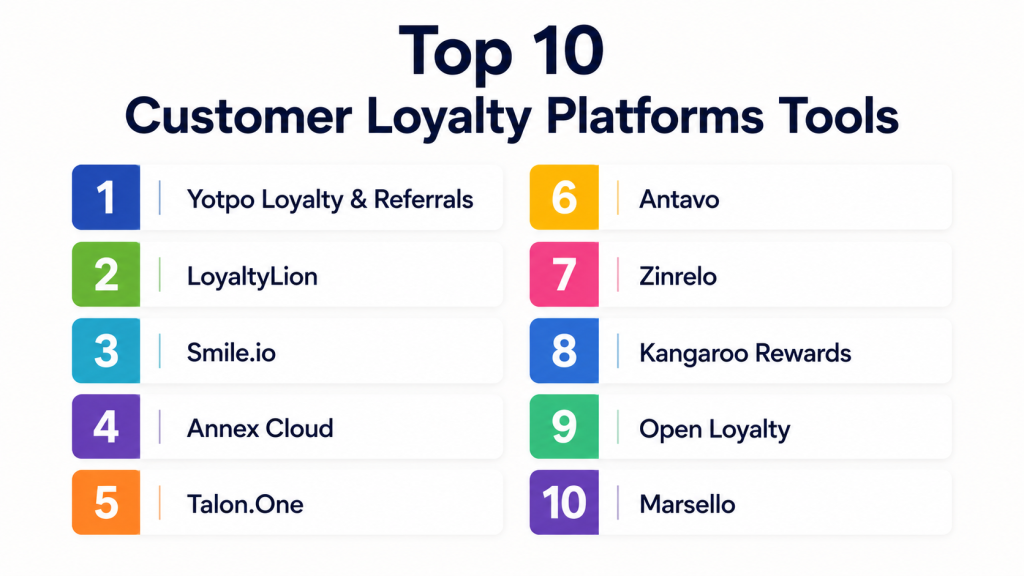
Top 10 Customer Loyalty Platforms Tools
#1 — Yotpo Loyalty & Referrals
Short description:
Yotpo Loyalty & Referrals is a customer loyalty platform designed mainly for ecommerce and D2C brands. It helps businesses create points-based loyalty programs, referral campaigns, VIP tiers, and reward experiences. The platform is often used by brands that want loyalty to connect with reviews, SMS, email, and retention marketing. It is useful for companies that want customer loyalty, advocacy, and engagement in one connected ecosystem. Yotpo is especially strong for Shopify-focused brands and growing online retailers.
Key Features
- Points-based loyalty programs.
- Referral campaign management.
- VIP tiers and member levels.
- Custom rewards and earning rules.
- Loyalty landing pages and widgets.
- Ecommerce integrations.
- Analytics for loyalty performance.
Pros
- Strong ecommerce loyalty and referral features.
- Good fit for D2C and Shopify-based brands.
- Can connect loyalty with broader customer retention efforts.
Cons
- Advanced customization may require higher plans or support.
- May be more than needed for very small stores.
- Pricing can become important as program size grows.
Platforms / Deployment
Web-based platform; Cloud deployment.
Security & Compliance
SSO/SAML, MFA, encryption, audit logs, RBAC, SOC 2, ISO 27001, GDPR, HIPAA: Not publicly stated.
Integrations & Ecosystem
Yotpo connects well with ecommerce and retention tools.
- Shopify
- Shopify Plus
- Email marketing tools
- SMS marketing tools
- Review platforms
- Customer support tools
Support & Community
Yotpo provides documentation, onboarding resources, and customer support. Community awareness is strong among ecommerce and D2C brands.
#2 — LoyaltyLion
Short description:
LoyaltyLion is a loyalty and engagement platform built for ecommerce brands that want to increase repeat purchases and customer lifetime value. It supports points, tiers, referrals, rewards, customer segmentation, and loyalty analytics. LoyaltyLion is suitable for brands that want to build a structured loyalty program without creating everything from scratch. It works well for ecommerce teams that need flexible reward rules and strong customer engagement features. The platform is often used by growing online stores and mid-market brands.
Key Features
- Points and rewards programs.
- VIP tiers and customer segmentation.
- Referral program support.
- Loyalty emails and notifications.
- On-site loyalty widgets.
- Ecommerce platform integrations.
- Loyalty analytics and insights.
Pros
- Strong focus on ecommerce loyalty.
- Good segmentation and repeat-purchase support.
- Flexible enough for growing brands.
Cons
- May require planning for best program design.
- Advanced branding may need customization.
- Not ideal for businesses without repeat purchase behavior.
Platforms / Deployment
Web-based platform; Cloud deployment.
Security & Compliance
SSO/SAML, MFA, encryption, audit logs, RBAC, SOC 2, ISO 27001, GDPR, HIPAA: Not publicly stated.
Integrations & Ecosystem
LoyaltyLion integrates with ecommerce and marketing platforms.
- Shopify
- BigCommerce
- Email tools
- SMS tools
- Review platforms
- Customer data tools
Support & Community
Documentation and support resources are available. Community strength is good in the ecommerce loyalty space.
#3 — Smile.io
Short description:
Smile.io is a popular loyalty platform for ecommerce businesses, especially small and mid-sized online stores. It helps brands launch points programs, referral programs, and VIP tiers with a relatively simple setup. Smile.io is known for being accessible for teams that want to start loyalty quickly without heavy technical work. It is useful for Shopify, WooCommerce, and BigCommerce sellers who want a practical loyalty solution. The platform is a strong choice for businesses starting their first loyalty program.
Key Features
- Points-based rewards.
- Referral program features.
- VIP tier creation.
- On-site loyalty panel.
- Customer reward management.
- Ecommerce integrations.
- Basic loyalty analytics.
Pros
- Easy to set up for small and mid-sized stores.
- Good starting point for loyalty beginners.
- Supports core loyalty and referral use cases.
Cons
- Advanced enterprise customization may be limited.
- Complex omnichannel use cases may need another platform.
- Program design still requires careful planning.
Platforms / Deployment
Web-based platform; Cloud deployment.
Security & Compliance
SSO/SAML, MFA, encryption, audit logs, RBAC, SOC 2, ISO 27001, GDPR, HIPAA: Not publicly stated.
Integrations & Ecosystem
Smile.io works well with common ecommerce tools.
- Shopify
- WooCommerce
- BigCommerce
- Email marketing tools
- Review tools
- Customer engagement apps
Support & Community
Smile.io offers help resources and customer support. It has strong visibility among SMB ecommerce sellers.
#4 — Annex Cloud
Short description:
Annex Cloud is an enterprise-focused customer loyalty and referral platform for brands that need advanced loyalty, referral, advocacy, and customer engagement capabilities. It supports complex loyalty programs, omnichannel campaigns, personalization, and customer experience workflows. Annex Cloud is better suited for mid-market and enterprise companies that need more flexibility than basic ecommerce loyalty apps. It can support industries such as retail, consumer goods, manufacturing, and B2B loyalty. The platform is useful for businesses with mature loyalty strategies.
Key Features
- Enterprise loyalty program management.
- Referral and advocacy campaigns.
- Omnichannel loyalty support.
- Personalized offers and engagement.
- Customer segmentation.
- Analytics and reporting.
- API and integration support.
Pros
- Strong fit for enterprise loyalty programs.
- Supports complex customer engagement models.
- Useful for omnichannel and multi-brand environments.
Cons
- May be too complex for small businesses.
- Implementation may require planning and onboarding.
- Pricing is likely more enterprise-oriented.
Platforms / Deployment
Web-based platform; Cloud deployment; Hybrid options may vary by implementation.
Security & Compliance
SSO/SAML, MFA, encryption, audit logs, RBAC, SOC 2, ISO 27001, GDPR, HIPAA: Not publicly stated.
Integrations & Ecosystem
Annex Cloud is designed for enterprise ecosystems.
- CRM platforms
- Ecommerce platforms
- POS systems
- Email marketing tools
- Customer data platforms
- API-based integrations
Support & Community
Enterprise onboarding, account support, and implementation guidance are commonly expected. Community strength is more enterprise-focused than SMB-focused.
#5 — Talon.One
Short description:
Talon.One is a promotion and loyalty engine built for businesses that need flexible, API-first loyalty, discounts, coupons, referrals, and incentive logic. It is suitable for companies that want full control over how rewards, offers, and promotions are triggered across different channels. Talon.One is especially useful for mid-market and enterprise teams with custom apps, marketplaces, or complex commerce systems. It is not just a plug-and-play loyalty widget; it is more of a flexible rules engine. This makes it strong for technical teams and businesses with custom requirements.
Key Features
- API-first loyalty engine.
- Promotion and coupon management.
- Referral campaign logic.
- Custom reward rules.
- Real-time campaign decisioning.
- Segmentation and targeting.
- Integration with custom commerce stacks.
Pros
- Highly flexible for custom loyalty logic.
- Strong fit for marketplaces and complex businesses.
- Good for teams needing developer control.
Cons
- May require technical implementation.
- Not ideal for users wanting a simple no-code loyalty app.
- Setup can be more involved than SMB tools.
Platforms / Deployment
Web-based platform; Cloud deployment; API-first architecture.
Security & Compliance
SSO/SAML, MFA, encryption, audit logs, RBAC, SOC 2, ISO 27001, GDPR, HIPAA: Not publicly stated.
Integrations & Ecosystem
Talon.One works well in modern commerce stacks.
- Ecommerce platforms
- Custom web apps
- Mobile apps
- CRM systems
- CDP systems
- API-based integrations
Support & Community
Documentation and technical support are important parts of the platform experience. Support is better suited for teams with technical or implementation resources.
#6 — Antavo
Short description:
Antavo is an enterprise loyalty platform focused on experience-driven, omnichannel loyalty programs. It helps brands build points programs, tiers, gamified experiences, paid memberships, challenges, and personalized rewards. Antavo is suitable for larger retailers and brands that want loyalty programs beyond simple discounts. It is often a good fit for companies operating across online, offline, mobile, and retail environments. The platform is designed for sophisticated loyalty strategies with customer engagement at the center.
Key Features
- Omnichannel loyalty management.
- Gamification and challenges.
- Tiered loyalty programs.
- Paid membership support.
- Personalized rewards.
- Loyalty analytics.
- API and enterprise integrations.
Pros
- Strong fit for advanced loyalty strategy.
- Supports experiential and gamified loyalty.
- Useful for larger retail and consumer brands.
Cons
- May be too advanced for small stores.
- Implementation can require strategic planning.
- Pricing and setup may be enterprise-focused.
Platforms / Deployment
Web-based platform; Cloud deployment; API support.
Security & Compliance
SSO/SAML, MFA, encryption, audit logs, RBAC, SOC 2, ISO 27001, GDPR, HIPAA: Not publicly stated.
Integrations & Ecosystem
Antavo supports enterprise and omnichannel loyalty environments.
- Ecommerce platforms
- POS systems
- CRM systems
- CDP platforms
- Mobile apps
- Marketing automation tools
Support & Community
Support and onboarding are typically aligned with enterprise implementation. Documentation and customer success resources are important for program success.
#7 — Zinrelo
Short description:
Zinrelo is a loyalty rewards platform designed to help brands improve retention, repeat purchases, and customer engagement. It supports points, tiers, referrals, rewards, and data-driven loyalty programs. Zinrelo is suitable for ecommerce, retail, B2B, and subscription-style businesses looking for structured loyalty capabilities. The platform focuses on combining loyalty mechanics with analytics and customer behavior insights. It is a practical choice for companies that want a balanced loyalty solution with strategic support.
Key Features
- Points and rewards programs.
- Tier-based loyalty.
- Referral program support.
- Behavioral loyalty triggers.
- Customer segmentation.
- Loyalty analytics.
- Ecommerce and CRM integrations.
Pros
- Balanced loyalty and analytics features.
- Useful for ecommerce and non-ecommerce loyalty models.
- Supports multiple loyalty program structures.
Cons
- Advanced customization may need implementation help.
- Public security details may require vendor confirmation.
- Smaller businesses may prefer simpler tools.
Platforms / Deployment
Web-based platform; Cloud deployment.
Security & Compliance
SSO/SAML, MFA, encryption, audit logs, RBAC, SOC 2, ISO 27001, GDPR, HIPAA: Not publicly stated.
Integrations & Ecosystem
Zinrelo supports loyalty across commerce and customer systems.
- Ecommerce platforms
- CRM systems
- POS systems
- Email marketing platforms
- Analytics tools
- API integrations
Support & Community
Support and onboarding resources are available. Community strength is moderate but relevant for loyalty-focused teams.
#8 — Kangaroo Rewards
Short description:
Kangaroo Rewards is a customer loyalty and marketing platform for retail, ecommerce, restaurants, and service businesses. It helps companies create rewards programs, manage customer engagement, send offers, and track loyalty performance. Kangaroo Rewards is useful for businesses that want both online and in-store loyalty capabilities. It can support local businesses, retail chains, and merchants that need practical customer retention tools. The platform is a good fit for teams that want loyalty, promotions, and customer communication in one system.
Key Features
- Rewards and points programs.
- Customer profiles.
- Offers and promotions.
- Email and SMS engagement.
- POS and ecommerce support.
- Loyalty analytics.
- Referral and customer engagement features.
Pros
- Good for retail and local business loyalty.
- Supports both online and offline engagement.
- Practical customer communication features.
Cons
- May not match enterprise-level customization needs.
- Integration depth can vary by business system.
- Advanced analytics may depend on plan or setup.
Platforms / Deployment
Web-based platform; Cloud deployment; mobile-related experiences may vary.
Security & Compliance
SSO/SAML, MFA, encryption, audit logs, RBAC, SOC 2, ISO 27001, GDPR, HIPAA: Not publicly stated.
Integrations & Ecosystem
Kangaroo Rewards connects loyalty with commerce and customer engagement.
- POS systems
- Ecommerce platforms
- Email tools
- SMS tools
- Customer databases
- Marketing workflows
Support & Community
Support resources and onboarding help are available. Community visibility is stronger among retail and local business users.
#9 — Open Loyalty
Short description:
Open Loyalty is a loyalty platform designed for companies that need flexible loyalty infrastructure and more control over program design. It is suitable for businesses building custom loyalty experiences across ecommerce, mobile apps, marketplaces, and enterprise systems. Open Loyalty is useful for technical teams and larger brands that want API-driven loyalty capabilities. It can support points, levels, rewards, campaigns, and customer engagement logic. The platform is a good fit when a brand wants flexibility instead of a basic plug-and-play loyalty widget.
Key Features
- Loyalty engine capabilities.
- Points, levels, and rewards.
- Campaign and rule management.
- API-based architecture.
- Custom loyalty workflows.
- Customer segmentation.
- Integration with commerce systems.
Pros
- Flexible for custom loyalty programs.
- Useful for technical and enterprise teams.
- Strong fit for headless or composable commerce.
Cons
- May require technical implementation.
- Not the easiest option for small non-technical teams.
- Program success depends on strategy and setup quality.
Platforms / Deployment
Cloud / Self-hosted / Hybrid options may vary by implementation.
Security & Compliance
SSO/SAML, MFA, encryption, audit logs, RBAC, SOC 2, ISO 27001, GDPR, HIPAA: Not publicly stated.
Integrations & Ecosystem
Open Loyalty is designed for integration-heavy environments.
- Ecommerce platforms
- Mobile apps
- CRM systems
- CDP platforms
- Custom applications
- API-based workflows
Support & Community
Documentation and implementation support are important. Community strength is more technical and enterprise-oriented.
#10 — Marsello
Short description:
Marsello is a loyalty and marketing automation platform designed for retail and ecommerce businesses. It helps brands run loyalty programs, customer segmentation, email campaigns, SMS campaigns, and retention marketing workflows. Marsello is useful for merchants that want loyalty connected with marketing automation rather than using separate tools. It is often a good fit for retail businesses using POS and ecommerce systems together. The platform helps businesses encourage repeat purchases through rewards and targeted communication.
Key Features
- Loyalty program management.
- Email marketing campaigns.
- SMS marketing support.
- Customer segmentation.
- POS and ecommerce integrations.
- Automated retention campaigns.
- Loyalty and revenue reporting.
Pros
- Combines loyalty with marketing automation.
- Good fit for retail and ecommerce merchants.
- Useful for repeat-purchase campaigns.
Cons
- May not be ideal for enterprise loyalty complexity.
- Advanced customization may be limited compared with API-first tools.
- Feature value depends on integration fit.
Platforms / Deployment
Web-based platform; Cloud deployment.
Security & Compliance
SSO/SAML, MFA, encryption, audit logs, RBAC, SOC 2, ISO 27001, GDPR, HIPAA: Not publicly stated.
Integrations & Ecosystem
Marsello connects loyalty with retail and marketing systems.
- Shopify
- POS systems
- Email marketing
- SMS marketing
- Customer segmentation tools
- Ecommerce platforms
Support & Community
Support and onboarding resources are available. Community strength is strongest among retail and ecommerce users.
Comparison Table
| Tool Name | Best For | Platform(s) Supported | Deployment | Standout Feature | Public Rating |
|---|---|---|---|---|---|
| Yotpo Loyalty & Referrals | D2C ecommerce brands | Web | Cloud | Loyalty, referrals, and retention ecosystem | N/A |
| LoyaltyLion | Ecommerce retention teams | Web | Cloud | Points, tiers, and segmentation | N/A |
| Smile.io | Small and mid-sized online stores | Web | Cloud | Easy loyalty program setup | N/A |
| Annex Cloud | Enterprise loyalty and advocacy | Web | Cloud / Hybrid varies | Enterprise loyalty and referral programs | N/A |
| Talon.One | API-first promotion and loyalty teams | Web / API | Cloud | Flexible promotion and loyalty engine | N/A |
| Antavo | Omnichannel enterprise loyalty | Web / API | Cloud | Experience-led loyalty and gamification | N/A |
| Zinrelo | Data-driven loyalty programs | Web | Cloud | Loyalty analytics and flexible rewards | N/A |
| Kangaroo Rewards | Retail and local businesses | Web | Cloud | Loyalty plus customer engagement | N/A |
| Open Loyalty | Custom loyalty infrastructure | Web / API | Cloud / Self-hosted / Hybrid varies | Flexible loyalty engine | N/A |
| Marsello | Retail and ecommerce marketing teams | Web | Cloud | Loyalty with email and SMS automation | N/A |
Evaluation & Scoring of Customer Loyalty Platforms
| Tool Name | Core (25%) | Ease (15%) | Integrations (15%) | Security (10%) | Performance (10%) | Support (10%) | Value (15%) | Weighted Total |
|---|---|---|---|---|---|---|---|---|
| Yotpo Loyalty & Referrals | 9 | 8 | 9 | 7 | 8 | 8 | 7 | 8.15 |
| LoyaltyLion | 8 | 8 | 8 | 7 | 8 | 8 | 8 | 7.95 |
| Smile.io | 7 | 9 | 8 | 7 | 8 | 8 | 8 | 7.85 |
| Annex Cloud | 9 | 6 | 8 | 8 | 8 | 8 | 6 | 7.75 |
| Talon.One | 9 | 6 | 9 | 8 | 9 | 8 | 7 | 8.10 |
| Antavo | 9 | 6 | 8 | 8 | 8 | 8 | 6 | 7.75 |
| Zinrelo | 8 | 7 | 8 | 7 | 8 | 8 | 7 | 7.60 |
| Kangaroo Rewards | 7 | 8 | 7 | 7 | 7 | 7 | 8 | 7.30 |
| Open Loyalty | 8 | 6 | 9 | 7 | 8 | 7 | 7 | 7.55 |
| Marsello | 7 | 8 | 7 | 7 | 7 | 7 | 8 | 7.30 |
These scores are comparative and should be used as a starting point, not as a final buying decision. A lower-scoring platform may still be the best choice if it fits your business model, budget, and integrations. Enterprise tools usually score higher on flexibility but lower on ease of use. SMB tools often score higher on simplicity and value but may offer less advanced customization.
Which Customer Loyalty Platform Tool Is Right for You?
Solo / Freelancer
Solo sellers and small creators should prioritize simplicity, fast setup, and low operating cost. A tool like Smile.io, Kangaroo Rewards, or Marsello may be a good starting point if the business needs points, referrals, and basic customer engagement.
The main goal should be to encourage repeat purchases without creating a complicated program. Keep rewards simple, such as points per purchase, birthday rewards, referral discounts, or small VIP perks.
SMB
SMBs should look for a loyalty platform that balances ease of use with enough flexibility to grow. Smile.io, LoyaltyLion, Yotpo Loyalty & Referrals, and Marsello are practical options for ecommerce and retail businesses.
SMBs should focus on ecommerce integration, customer segmentation, reward management, email/SMS connection, and reporting. The right tool should help the marketing team launch campaigns without depending heavily on developers.
Mid-Market
Mid-market companies often need deeper segmentation, better analytics, advanced referral programs, and more control over loyalty rules. LoyaltyLion, Yotpo, Zinrelo, Talon.One, and Antavo may fit depending on the business model.
At this stage, loyalty should be connected with CRM, email, SMS, customer support, ecommerce, and analytics tools. The platform should help improve repeat revenue, retention, customer lifetime value, and customer engagement.
Enterprise
Enterprise companies need scalability, governance, omnichannel support, APIs, user permissions, reporting, and advanced loyalty design. Annex Cloud, Antavo, Talon.One, and Open Loyalty are stronger candidates for complex environments.
Enterprises should validate integration depth, data model flexibility, security posture, account support, implementation resources, and long-term customization needs before choosing a platform.
Budget vs Premium
Budget-friendly loyalty needs are usually better served by simpler platforms with fast setup and standard reward models. Premium tools are better when loyalty affects multiple systems, countries, brands, customer segments, or custom apps.
If your loyalty program is mainly points and referrals, an SMB-focused tool may be enough. If your loyalty program needs complex rules, real-time decisions, custom channels, or enterprise controls, a premium platform may be worth the investment.
Feature Depth vs Ease of Use
A simple tool is easier to launch but may limit customization later. A deep platform gives more control but needs more planning, setup, and internal ownership.
Choose ease of use when your team is small and your program is simple. Choose feature depth when your loyalty strategy includes tiers, gamification, paid memberships, complex segmentation, and omnichannel customer journeys.
Integrations & Scalability
Integrations are critical because loyalty data must connect with ecommerce, POS, CRM, email, SMS, CDP, analytics, and customer support tools. A loyalty platform that does not connect with your existing systems can create manual work and poor customer experiences.
Before buying, check whether the tool supports your current platform and your future growth plans. Also verify API availability if your business uses custom apps or headless commerce.
Security & Compliance Needs
Customer loyalty platforms handle personal data, purchase history, rewards, and customer behavior. Security should be reviewed carefully before implementation.
Ask vendors about SSO, MFA, encryption, RBAC, audit logs, data retention, privacy controls, GDPR support, and compliance documentation. If a certification or security feature is not clearly confirmed, treat it as not publicly stated.
Frequently Asked Questions
1. What is a customer loyalty platform?
A customer loyalty platform is software that helps businesses reward customers for repeat purchases, referrals, engagement, reviews, or other valuable actions. It usually includes points, rewards, tiers, referrals, and analytics to improve retention.
2. How do customer loyalty platforms help businesses grow?
They help businesses increase repeat purchases, improve customer lifetime value, reduce dependency on paid acquisition, and turn happy customers into advocates. A good loyalty program gives customers a reason to return instead of buying once and leaving.
3. What pricing models are common for loyalty platforms?
Common pricing models include monthly subscriptions, usage-based pricing, order-volume-based pricing, customer-count-based pricing, and custom enterprise quotes. Some tools may offer basic plans, while advanced features often require higher tiers.
4. How long does it take to launch a loyalty program?
A simple points and rewards program can be launched quickly if the ecommerce integration is straightforward. A complex omnichannel program with custom rules, POS integration, CRM sync, and multiple customer segments may require more planning and testing.
5. What are common mistakes when choosing a loyalty platform?
Common mistakes include choosing only by price, creating rewards that hurt margins, ignoring customer experience, failing to integrate with email or SMS, and not tracking repeat purchase behavior. Loyalty should be simple for customers and measurable for the business.
6. Are loyalty platforms secure?
Many loyalty platforms provide standard security controls, but security details vary by vendor. Businesses should ask about SSO, MFA, encryption, role-based access, audit logs, data privacy, and compliance documentation before selecting a tool.
7. Can loyalty platforms work with Shopify, WooCommerce, or POS systems?
Yes, many customer loyalty platforms integrate with ecommerce and POS systems. However, integration depth varies, so businesses should confirm whether the platform supports their store, POS, customer data tools, and marketing systems.
8. What is the difference between loyalty and referral software?
Loyalty software rewards existing customers for repeat actions, while referral software rewards customers for bringing new buyers. Many modern platforms combine both so businesses can manage retention and advocacy from one place.
9. Can I switch loyalty platforms later?
Yes, but switching requires careful planning. You may need to migrate customer points, reward balances, tiers, referral links, customer history, and campaign data. Always export data, test the new setup, and communicate clearly with customers.
10. What are alternatives to customer loyalty platforms?
Alternatives include coupon tools, email marketing automation, CRM campaigns, manual rewards, membership plugins, referral-only tools, or custom-built loyalty systems. However, dedicated loyalty platforms are usually better for structured, scalable programs.
Conclusion
Customer Loyalty Platforms help businesses build stronger customer relationships, increase repeat purchases, and improve long-term revenue. The right platform depends on your business size, industry, customer journey, technology stack, and loyalty strategy. Small ecommerce brands may prefer Smile.io, Marsello, or LoyaltyLion for fast setup and simple rewards. Growing D2C brands may choose Yotpo or Zinrelo for deeper retention programs. Enterprise teams may need Annex Cloud, Antavo, Talon.One, or Open Loyalty for advanced rules, omnichannel engagement, and API flexibility. There is no single best tool for every business.
