Upgrade & Secure Your Future with DevOps, SRE, DevSecOps, MLOps!
We spend hours scrolling social media and waste money on things we forget, but won’t spend 30 minutes a day earning certifications that can change our lives.
Master in DevOps, SRE, DevSecOps & MLOps by DevOps School!
Learn from Guru Rajesh Kumar and double your salary in just one year.
Introduction
Hospitality Property Management Systems, commonly called PMS, help hotels and accommodation businesses manage reservations, check-ins, check-outs, room inventory, housekeeping, guest profiles, payments, billing, reporting, and daily operations. In simple terms, a PMS is the central operating system of a hotel.
PMS platforms matter now because hotels need faster guest service, better online booking control, real-time room visibility, stronger integrations, contactless workflows, and better revenue decisions.
Common use cases include:
- Managing room reservations and availability.
- Handling check-in, check-out, and guest billing.
- Coordinating housekeeping and room status.
- Connecting booking channels and direct reservations.
- Tracking occupancy, revenue, and guest history.
Buyers should evaluate:
- Reservation management
- Channel manager connectivity
- Booking engine support
- Housekeeping tools
- Payment processing
- Guest profiles and CRM
- Reporting and analytics
- Multi-property support
- Integrations
- Security and access controls
Best for: hotels, resorts, serviced apartments, hostels, boutique hotels, hotel groups, vacation rentals, guest houses, and hospitality operators.
Not ideal for: very small property owners using only manual calendars, businesses with no online bookings, or teams that only need a simple rental listing tool.
Key Trends in Hospitality Property Management Systems
- Cloud-first PMS adoption: More hotels are moving from legacy desktop systems to cloud-based platforms for easier access and faster updates.
- Contactless guest journeys: Mobile check-in, digital keys, online payments, and automated guest messages are becoming more common.
- AI-assisted operations: PMS platforms are adding smarter forecasting, guest segmentation, upsell suggestions, and automated workflows.
- Stronger channel connectivity: Hotels need real-time inventory sync across OTAs, booking engines, metasearch, and direct channels.
- Unified guest profiles: Properties want one guest record across bookings, stays, preferences, payments, and communications.
- Housekeeping automation: Room status updates, task assignments, inspection notes, and maintenance alerts are becoming more digital.
- Open integrations: Hotels want PMS platforms that connect with revenue management, POS, CRM, accounting, payments, locks, and guest messaging tools.
- Multi-property management: Hotel groups need centralized reporting, shared rate control, and property-level permissions.
- Security and privacy focus: Guest data, payment records, identity information, and staff access need strong protection.
- Revenue and operations alignment: PMS data is increasingly used for pricing, occupancy planning, staffing, and guest experience decisions.
How We Selected These Tools
The tools below were selected using practical hospitality technology criteria:
- Market recognition in hotel and accommodation management.
- Depth of reservation, guest, room, and billing workflows.
- Fit for independent hotels, resorts, hostels, serviced apartments, and hotel groups.
- Strength of booking engine, channel manager, and payment integrations.
- Ease of use for front desk, housekeeping, management, and finance teams.
- Reporting quality for occupancy, revenue, operations, and guest data.
- Support for cloud access, mobile workflows, and automation.
- Multi-property and enterprise scalability.
- Integration ecosystem with hospitality and business tools.
- Overall value for improving hotel operations and guest experience.
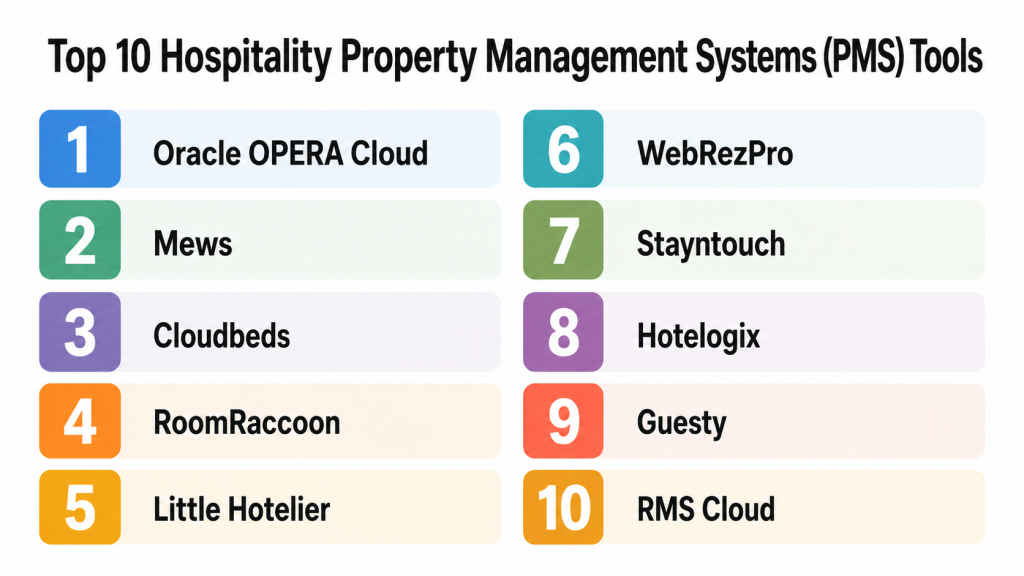
Top 10 Hospitality Property Management Systems (PMS) Tools
#1 — Oracle OPERA Cloud
Short description:
Oracle OPERA Cloud is a widely recognized hospitality PMS designed for hotels, resorts, casinos, and enterprise hospitality groups. It helps manage reservations, guest profiles, room inventory, front desk operations, billing, housekeeping, and multi-property workflows. OPERA Cloud is especially relevant for large hotels and global brands that need strong operational depth and enterprise controls. It supports complex hospitality environments where integration, reporting, and scalability are critical. The platform is best suited for established properties and hotel groups with structured processes.
Key Features
- Reservation and room management.
- Guest profile management.
- Front desk operations.
- Housekeeping coordination.
- Multi-property support.
- Billing and folio management.
- Hospitality integration ecosystem.
Pros
- Strong fit for enterprise hotels and resorts.
- Supports complex operational requirements.
- Good for multi-property and large-scale hospitality groups.
Cons
- May be too complex for small properties.
- Implementation can require planning and training.
- Pricing and configuration should be reviewed carefully.
Platforms / Deployment
Web-based platform; Cloud deployment.
Security & Compliance
SSO/SAML, MFA, encryption, audit logs, RBAC, SOC 2, ISO 27001, GDPR, HIPAA: Not publicly stated.
Integrations & Ecosystem
Oracle OPERA Cloud connects with broad hospitality systems.
- Channel managers
- Booking engines
- Revenue management systems
- POS systems
- Payment platforms
- CRM and guest messaging tools
Support & Community
Oracle provides enterprise support, implementation partners, documentation, and onboarding resources. Community strength is high across enterprise hospitality.
#2 — Mews
Short description:
Mews is a cloud-based hospitality PMS built for modern hotels, hostels, serviced apartments, and hospitality groups. It supports reservations, check-in, payments, guest profiles, housekeeping, booking engine workflows, and automation. Mews is known for its modern interface and open hospitality ecosystem. It is useful for properties that want cloud-first operations, guest self-service, and strong integrations. The platform fits independent hotels, boutique properties, and growing hotel groups.
Key Features
- Cloud PMS operations.
- Online booking and reservation management.
- Guest self-service workflows.
- Payment automation.
- Housekeeping management.
- Multi-property support.
- Integration marketplace.
Pros
- Modern cloud-first user experience.
- Strong automation and integration ecosystem.
- Good for hotels moving away from legacy PMS tools.
Cons
- Migration from old systems may require planning.
- Best value depends on integration setup.
- Some advanced features may require additional modules.
Platforms / Deployment
Web-based platform; Cloud deployment.
Security & Compliance
SSO/SAML, MFA, encryption, audit logs, RBAC, SOC 2, ISO 27001, GDPR, HIPAA: Not publicly stated.
Integrations & Ecosystem
Mews has a strong hospitality integration ecosystem.
- Channel managers
- Booking engines
- Payment platforms
- Guest messaging tools
- Revenue management tools
- Accounting and reporting systems
Support & Community
Mews provides support, onboarding resources, and documentation. Community strength is strong among modern cloud hospitality teams.
#3 — Cloudbeds
Short description:
Cloudbeds is a hospitality management platform for hotels, hostels, inns, vacation rentals, and independent accommodation providers. It combines PMS, channel management, booking engine, payments, reporting, and guest management in one platform. Cloudbeds is especially useful for independent and growing properties that want an all-in-one system. It helps reduce manual work by connecting reservations and room inventory across direct and third-party channels. The platform is practical for properties that need simplicity with broad functionality.
Key Features
- Property management system.
- Channel manager.
- Booking engine.
- Payment processing support.
- Guest management.
- Housekeeping tools.
- Reporting dashboards.
Pros
- Good all-in-one platform for independent properties.
- Helps simplify online booking and channel management.
- Suitable for hotels, hostels, and small accommodation businesses.
Cons
- Enterprise customization may be limited compared with larger systems.
- Some advanced workflows may require add-ons.
- Property setup and rate configuration need care.
Platforms / Deployment
Web-based platform; Cloud deployment.
Security & Compliance
SSO/SAML, MFA, encryption, audit logs, RBAC, SOC 2, ISO 27001, GDPR, HIPAA: Not publicly stated.
Integrations & Ecosystem
Cloudbeds supports common hospitality workflows.
- OTAs and channel connections
- Direct booking engine
- Payment tools
- Guest communication
- Accounting workflows
- Revenue and reporting tools
Support & Community
Cloudbeds provides support, learning resources, and onboarding options. Community strength is strong among independent accommodation providers.
#4 — RoomRaccoon
Short description:
RoomRaccoon is a cloud-based hotel management system designed for independent hotels, boutique properties, bed and breakfasts, and small hotel groups. It includes PMS, channel manager, booking engine, payments, housekeeping, and reporting. RoomRaccoon is useful for properties that want an integrated system without building a complex tech stack. It helps hoteliers manage reservations, rates, guest data, and daily operations from one platform. The platform is especially suitable for small and mid-sized properties.
Key Features
- PMS reservation management.
- Channel manager.
- Booking engine.
- Payment automation.
- Housekeeping management.
- Guest communication support.
- Reporting and revenue insights.
Pros
- Good fit for boutique and independent hotels.
- Combines several core hotel tools in one platform.
- Easier to manage than disconnected systems.
Cons
- May not fit large enterprise hotel chains.
- Integration depth should be checked for specific tools.
- Advanced customization may be limited.
Platforms / Deployment
Web-based platform; Cloud deployment.
Security & Compliance
SSO/SAML, MFA, encryption, audit logs, RBAC, SOC 2, ISO 27001, GDPR, HIPAA: Not publicly stated.
Integrations & Ecosystem
RoomRaccoon connects core hotel operations.
- Channel manager
- Booking engine
- Payments
- Housekeeping
- Guest messaging
- Reporting workflows
Support & Community
Support and onboarding resources are available. Community strength is good among independent hotels and boutique properties.
#5 — Little Hotelier
Short description:
Little Hotelier is a property management system designed for small hotels, inns, guesthouses, bed and breakfasts, and boutique accommodation providers. It helps small properties manage bookings, front desk tasks, online channels, direct bookings, payments, and reporting. Little Hotelier is practical for businesses that need a simple PMS without enterprise complexity. It is especially useful for property owners who want channel management and booking tools together. The platform fits small operators who need an easy-to-use hotel management system.
Key Features
- Reservation management.
- Channel manager.
- Direct booking engine.
- Front desk calendar.
- Guest records.
- Payment support.
- Basic reporting.
Pros
- Simple and practical for small properties.
- Good for owners moving from manual calendars.
- Helps manage online channels and direct bookings.
Cons
- Not designed for complex enterprise hotel operations.
- Limited advanced customization.
- Larger groups may need deeper reporting and controls.
Platforms / Deployment
Web-based platform; Cloud deployment.
Security & Compliance
SSO/SAML, MFA, encryption, audit logs, RBAC, SOC 2, ISO 27001, GDPR, HIPAA: Not publicly stated.
Integrations & Ecosystem
Little Hotelier supports small property operations.
- OTA channels
- Direct booking engine
- Payment tools
- Front desk workflows
- Guest management
- Reporting dashboards
Support & Community
Support and onboarding resources are available. Community strength is good among small hotels, inns, and guesthouses.
#6 — WebRezPro
Short description:
WebRezPro is a cloud-based property management system for hotels, inns, resorts, vacation rentals, campgrounds, and multi-property groups. It supports reservations, front desk operations, housekeeping, accounting-related workflows, reporting, guest profiles, and online bookings. WebRezPro is useful for properties that need flexibility across different accommodation types. It can support both independent properties and groups with more complex requirements. The platform is practical for operators who want cloud access with broad PMS functionality.
Key Features
- Reservation management.
- Front desk operations.
- Housekeeping management.
- Online booking engine.
- Reporting and analytics.
- Guest profiles.
- Multi-property support.
Pros
- Flexible across many property types.
- Good feature depth for independent and mid-market operators.
- Cloud access supports remote management.
Cons
- Setup may require careful configuration.
- User experience should be tested by staff.
- Some integrations may need validation.
Platforms / Deployment
Web-based platform; Cloud deployment.
Security & Compliance
SSO/SAML, MFA, encryption, audit logs, RBAC, SOC 2, ISO 27001, GDPR, HIPAA: Not publicly stated.
Integrations & Ecosystem
WebRezPro supports hospitality operations and booking workflows.
- Channel managers
- Booking engines
- Payment systems
- Accounting tools
- POS integrations
- Guest communication systems
Support & Community
Support and training resources are available. Community strength is good among independent properties and hospitality groups.
#7 — Stayntouch
Short description:
Stayntouch is a cloud hotel PMS designed for hotels that want flexible front desk workflows, mobile operations, guest self-service, and modern hospitality automation. It supports reservations, check-in, check-out, housekeeping, payments, reporting, and integrations. Stayntouch is useful for independent hotels, boutique brands, and hotel groups seeking a modern PMS experience. It helps staff manage operations from tablets and cloud dashboards. The platform is a good fit for hotels focused on mobility and guest convenience.
Key Features
- Cloud PMS.
- Mobile check-in and front desk workflows.
- Guest profile management.
- Housekeeping tools.
- Payment support.
- Reporting dashboards.
- Integration marketplace.
Pros
- Modern and mobile-friendly PMS experience.
- Good for hotels focused on guest self-service.
- Flexible for boutique and mid-market properties.
Cons
- Migration from legacy systems may require planning.
- Integration needs should be validated.
- May not fit every enterprise chain requirement.
Platforms / Deployment
Web / tablet-friendly workflows; Cloud deployment.
Security & Compliance
SSO/SAML, MFA, encryption, audit logs, RBAC, SOC 2, ISO 27001, GDPR, HIPAA: Not publicly stated.
Integrations & Ecosystem
Stayntouch connects with hotel systems and guest experience tools.
- Channel managers
- Booking engines
- Payments
- Guest messaging
- Revenue management
- Hotel operations tools
Support & Community
Support, onboarding, and documentation are available. Community strength is good among cloud PMS users and modern hotel operators.
#8 — Hotelogix
Short description:
Hotelogix is a cloud-based PMS for hotels, resorts, serviced apartments, and hotel groups. It helps manage reservations, front desk operations, housekeeping, channel distribution, billing, and reporting. Hotelogix is especially useful for properties that want cloud-based hotel operations with multi-property support. It works well for independent hotels and growing hotel groups that need centralized visibility. The platform is practical for teams moving away from legacy or manual systems.
Key Features
- Reservation management.
- Front desk operations.
- Housekeeping management.
- Channel manager support.
- Billing and invoicing.
- Multi-property management.
- Reporting and analytics.
Pros
- Good for cloud-based hotel operations.
- Useful for multi-property visibility.
- Covers core PMS needs for small and mid-sized hotels.
Cons
- Advanced enterprise requirements should be checked.
- Interface and workflow should be tested by staff.
- Integration depth may vary by region and tool.
Platforms / Deployment
Web-based platform; Cloud deployment.
Security & Compliance
SSO/SAML, MFA, encryption, audit logs, RBAC, SOC 2, ISO 27001, GDPR, HIPAA: Not publicly stated.
Integrations & Ecosystem
Hotelogix supports hotel operations and distribution workflows.
- Channel managers
- Booking engines
- Payment tools
- POS systems
- Housekeeping workflows
- Reporting systems
Support & Community
Support and onboarding resources are available. Community strength is good among independent and mid-market hotels.
#9 — Guesty
Short description:
Guesty is a property management platform focused mainly on short-term rentals, vacation rentals, serviced apartments, and property management companies. It supports reservations, channel management, guest messaging, automation, payments, task management, and reporting. Guesty is useful for operators managing multiple units across booking channels. While it is not a traditional hotel PMS for every property type, it is highly relevant for hospitality operators managing alternative accommodation. It fits vacation rental managers and serviced apartment businesses that need centralized control.
Key Features
- Reservation management.
- Channel management.
- Guest messaging automation.
- Task management.
- Payment support.
- Owner and property reporting.
- Multi-unit operations.
Pros
- Strong for vacation rentals and serviced apartments.
- Useful automation for guest communication.
- Good for multi-channel property managers.
Cons
- Not always ideal for traditional hotel front desk workflows.
- Pricing and features should be reviewed by portfolio size.
- Complex setups require careful configuration.
Platforms / Deployment
Web / mobile app support; Cloud deployment.
Security & Compliance
SSO/SAML, MFA, encryption, audit logs, RBAC, SOC 2, ISO 27001, GDPR, HIPAA: Not publicly stated.
Integrations & Ecosystem
Guesty connects with short-term rental and hospitality tools.
- Booking channels
- Guest messaging platforms
- Payment tools
- Smart locks
- Cleaning task tools
- Reporting systems
Support & Community
Support and onboarding resources are available. Community strength is high among vacation rental and serviced apartment operators.
#10 — RMS Cloud
Short description:
RMS Cloud is a property management system used by hotels, motels, resorts, holiday parks, campgrounds, and serviced apartments. It supports reservations, front office operations, housekeeping, channel management, guest communication, payments, and reporting. RMS Cloud is useful for accommodation businesses that need broad property type support. It can fit both independent operators and multi-property organizations. The platform is especially relevant for businesses with varied room, site, or unit inventory.
Key Features
- Reservation management.
- Front desk operations.
- Channel manager support.
- Housekeeping tools.
- Guest communication.
- Payment workflows.
- Multi-property reporting.
Pros
- Supports many accommodation types.
- Good for hotels, parks, and serviced apartments.
- Cloud-based access supports distributed teams.
Cons
- Workflow fit should be tested for specific property types.
- Advanced integrations may require validation.
- Setup can require careful configuration.
Platforms / Deployment
Web-based platform; Cloud deployment.
Security & Compliance
SSO/SAML, MFA, encryption, audit logs, RBAC, SOC 2, ISO 27001, GDPR, HIPAA: Not publicly stated.
Integrations & Ecosystem
RMS Cloud supports hospitality and accommodation workflows.
- Channel managers
- Booking engines
- Payments
- Guest messaging
- Housekeeping tools
- Reporting dashboards
Support & Community
Support and onboarding resources are available. Community strength is good among hotels, parks, and accommodation operators.
Comparison Table
| Tool Name | Best For | Platform(s) Supported | Deployment | Standout Feature | Public Rating |
|---|---|---|---|---|---|
| Oracle OPERA Cloud | Enterprise hotels and resorts | Web | Cloud | Enterprise PMS depth | N/A |
| Mews | Modern cloud-first hotels | Web | Cloud | Automation and open integrations | N/A |
| Cloudbeds | Independent hotels and hostels | Web | Cloud | All-in-one PMS and channel tools | N/A |
| RoomRaccoon | Boutique and independent hotels | Web | Cloud | PMS, channel manager, and booking engine | N/A |
| Little Hotelier | Small hotels and guesthouses | Web | Cloud | Simple small-property management | N/A |
| WebRezPro | Flexible property types | Web | Cloud | Broad accommodation support | N/A |
| Stayntouch | Mobile-first hotel operations | Web / tablet-friendly | Cloud | Guest self-service and mobile workflows | N/A |
| Hotelogix | Small and mid-sized hotel groups | Web | Cloud | Cloud PMS with multi-property support | N/A |
| Guesty | Vacation rentals and serviced apartments | Web / mobile app support | Cloud | Short-term rental automation | N/A |
| RMS Cloud | Hotels, parks, and serviced apartments | Web | Cloud | Multi-property accommodation management | N/A |
Evaluation & Scoring of Hospitality Property Management Systems
| Tool Name | Core (25%) | Ease (15%) | Integrations (15%) | Security (10%) | Performance (10%) | Support (10%) | Value (15%) | Weighted Total (0–10) |
|---|---|---|---|---|---|---|---|---|
| Oracle OPERA Cloud | 10 | 6 | 9 | 8 | 9 | 8 | 6 | 8.15 |
| Mews | 9 | 8 | 9 | 8 | 8 | 8 | 7 | 8.25 |
| Cloudbeds | 8 | 8 | 9 | 7 | 8 | 8 | 8 | 8.10 |
| RoomRaccoon | 8 | 8 | 8 | 7 | 8 | 8 | 8 | 7.95 |
| Little Hotelier | 7 | 9 | 8 | 7 | 8 | 8 | 9 | 8.00 |
| WebRezPro | 8 | 7 | 8 | 7 | 8 | 8 | 8 | 7.75 |
| Stayntouch | 8 | 8 | 8 | 7 | 8 | 8 | 7 | 7.85 |
| Hotelogix | 8 | 8 | 8 | 7 | 8 | 8 | 8 | 7.95 |
| Guesty | 8 | 8 | 9 | 7 | 8 | 8 | 7 | 7.95 |
| RMS Cloud | 8 | 7 | 8 | 7 | 8 | 8 | 7 | 7.60 |
These scores are comparative and should not be treated as universal rankings. A small guesthouse may prefer Little Hotelier because simplicity matters most. A boutique hotel may prefer RoomRaccoon, Cloudbeds, or Mews. A large hotel group may require Oracle OPERA Cloud. Vacation rental managers may find Guesty more relevant than a traditional hotel PMS. Always evaluate based on property type, booking mix, staff workflow, and integration needs.
Which Hospitality Property Management System Tool Is Right for You?
Solo / Freelancer
Solo property owners, small guesthouse operators, and individual vacation rental managers should prioritize simplicity, channel connectivity, and easy calendar control. Little Hotelier, Cloudbeds, RoomRaccoon, or Guesty may be practical depending on property type.
The main goal should be fewer manual updates, fewer double bookings, easier guest communication, and simple payment handling.
SMB
Small and mid-sized hotels need a reliable PMS with reservations, booking engine, channel manager, payments, housekeeping, and reporting. Cloudbeds, RoomRaccoon, Hotelogix, WebRezPro, and RMS Cloud are strong options.
SMBs should focus on staff ease of use, booking channel sync, direct booking support, housekeeping visibility, and guest communication.
Mid-Market
Mid-market hotels and growing groups need stronger automation, reporting, multi-property features, guest profiles, and integrations. Mews, Stayntouch, Cloudbeds, Hotelogix, and WebRezPro can be strong candidates.
At this level, the PMS should connect with revenue management, CRM, payments, accounting, POS, and guest messaging tools.
Enterprise
Enterprise hotels, resorts, casinos, and large hospitality groups need scalability, role controls, complex integrations, multi-property operations, and advanced reporting. Oracle OPERA Cloud, Mews, Stayntouch, and RMS Cloud may be suitable depending on operational model.
Enterprises should validate implementation support, migration process, data governance, integrations, user permissions, uptime expectations, and support model.
Budget vs Premium
Budget-friendly PMS tools are better for small properties that need reservations, online booking, channel management, and basic reporting. Premium tools are better for complex operations, multi-property groups, enterprise integrations, advanced automation, and stronger governance.
Do not compare only monthly subscription cost. Also review payment fees, channel manager costs, training, migration, support, add-ons, and integration expenses.
Feature Depth vs Ease of Use
Simple systems are easier for small teams and owner-operators. Deeper platforms provide more control but require more training and process discipline.
Choose ease of use when the property has limited staff and simple operations. Choose feature depth when the property has multiple departments, complex rates, many channels, and higher guest volume.
Integrations & Scalability
A PMS should connect with channel managers, booking engines, payment gateways, revenue management, POS, accounting, CRM, housekeeping, smart locks, guest messaging, and reputation tools.
Before choosing a PMS, map your current tech stack and future growth needs. Poor integrations can create manual work, data errors, and guest experience problems.
Security & Compliance Needs
Hospitality PMS platforms store guest names, IDs, payment details, booking history, contact information, staff access data, and operational records. Security should be reviewed carefully.
Ask vendors about encryption, MFA, SSO, role-based access, audit logs, payment security, data retention, backups, and privacy controls. If details are not clearly confirmed, treat them as not publicly stated.
Frequently Asked Questions
1. What is a Hospitality Property Management System?
A Hospitality Property Management System is software that helps hotels and accommodation businesses manage reservations, rooms, guests, billing, housekeeping, payments, and reporting from one central platform.
2. How is a PMS different from a channel manager?
A PMS manages internal property operations, while a channel manager syncs room availability and rates across online booking channels. Many modern PMS platforms include or integrate with channel managers.
3. What pricing models are common?
Common pricing models include monthly subscriptions, per-room pricing, per-property pricing, setup fees, payment processing fees, and add-on module fees. Enterprise platforms may use custom pricing.
4. How long does PMS implementation take?
Small properties can often launch faster if data is clean and workflows are simple. Larger hotels with integrations, multiple departments, rate plans, historical data, and staff training may require more planning.
5. What are common mistakes when choosing a PMS?
Common mistakes include choosing only by price, ignoring integration needs, underestimating training, not testing housekeeping workflows, and failing to plan data migration from the old system.
6. Can PMS software help increase direct bookings?
Yes, many PMS platforms include or integrate with booking engines that support direct reservations. A strong direct booking setup can reduce dependency on third-party channels and improve guest ownership.
7. Do PMS platforms support housekeeping?
Most modern PMS platforms include housekeeping tools or integrations. These help staff update room status, assign cleaning tasks, track maintenance, and prepare rooms faster for new guests.
8. Are hospitality PMS platforms secure?
Security varies by vendor. Since PMS platforms store sensitive guest and payment-related information, hotels should ask about encryption, MFA, access controls, audit logs, payment security, and data privacy policies.
9. Can I switch PMS later?
Yes, but switching requires careful planning. Hotels may need to migrate reservations, guest profiles, room types, rates, invoices, channel connections, and historical reports. A phased rollout is usually safer.
10. What are alternatives to Hospitality PMS software?
Alternatives include spreadsheets, manual booking calendars, OTA dashboards, simple rental apps, accounting software, and basic reservation tools. Dedicated PMS software is better when operations, bookings, and guest management become more complex.
Conclusion
Hospitality Property Management Systems are essential for hotels and accommodation businesses that want better control over reservations, rooms, guests, payments, housekeeping, channels, and reporting. The best PMS depends on property size, guest volume, booking mix, operational complexity, budget, and integration needs. Small properties may prefer Little Hotelier, RoomRaccoon, or Cloudbeds. Boutique and mid-market hotels may choose Mews, Stayntouch, Hotelogix, WebRezPro, or RMS Cloud. Large hotel groups may need Oracle OPERA Cloud or another enterprise-grade system. Vacation rental and serviced apartment operators may find Guesty more suitable.
