Upgrade & Secure Your Future with DevOps, SRE, DevSecOps, MLOps!
We spend hours scrolling social media and waste money on things we forget, but won’t spend 30 minutes a day earning certifications that can change our lives.
Master in DevOps, SRE, DevSecOps & MLOps by DevOps School!
Learn from Guru Rajesh Kumar and double your salary in just one year.
Introduction
Human Capital Management (HCM) Suites are software platforms that help organizations manage the full employee lifecycle, from hiring and onboarding to payroll, performance, learning, workforce planning, compliance, and employee engagement. In simple words, an HCM suite gives HR, finance, managers, and employees one connected system to handle people-related work.
In the 2026+ workplace, HCM platforms matter more because companies are managing hybrid teams, global payroll, changing labor laws, skills-based hiring, employee experience, AI-assisted HR workflows, and workforce cost optimization. A good HCM suite can reduce manual HR work, improve compliance, and give leadership better visibility into workforce trends.
Common use cases include employee records management, payroll processing, recruitment, onboarding, performance reviews, learning management, time tracking, workforce analytics, and compliance reporting.
Buyers should evaluate:
- Core HR depth
- Payroll and compliance coverage
- Talent management features
- Employee self-service experience
- AI and automation capabilities
- Integrations with finance, IT, and collaboration tools
- Security controls
- Global workforce support
- Reporting and analytics
- Implementation effort and total cost
Best for: HR teams, finance teams, IT leaders, operations managers, and growing organizations that need a centralized system for managing employees, payroll, talent, and compliance across departments or locations.
Not ideal for: Very small teams that only need basic attendance, payroll, or employee record storage. In such cases, lightweight HR software, payroll-only tools, or spreadsheets may be enough until the company grows.
Key Trends in Human Capital Management (HCM) Suites
AI-assisted HR workflows: HCM platforms are increasingly using AI for job description drafting, candidate matching, employee query handling, skills recommendations, and predictive workforce insights.
- Skills-based workforce planning: Companies are moving beyond job titles and focusing more on employee skills, internal mobility, learning paths, and future capability planning.
- Employee experience platforms: Modern HCM suites are improving employee self-service, mobile access, personalized dashboards, and HR service delivery.
- Global payroll and compliance needs: Businesses are hiring across borders, making multi-country payroll, tax rules, benefits administration, and compliance reporting more important.
- Integrated talent lifecycle: Recruitment, onboarding, performance, learning, succession, and compensation are becoming more connected inside HCM platforms.
- Stronger security expectations: Buyers now expect MFA, SSO, RBAC, audit logs, encryption, data privacy controls, and compliance-ready reporting.
- People analytics for leadership: HR data is no longer only for HR teams. Executives now use workforce analytics for cost planning, retention forecasting, diversity insights, and productivity decisions.
- Composable HR ecosystems: Many companies want HCM suites that integrate easily with ERP, identity management, collaboration platforms, learning tools, expense software, and business intelligence systems.
- Automation of repetitive HR tasks: Workflows for approvals, policy acknowledgments, onboarding checklists, payroll changes, and employee requests are becoming more automated.
- Flexible deployment and pricing models: Cloud-first HCM platforms dominate, but enterprises still expect configurable modules, phased implementation, and flexible packages based on workforce size and needs.
How We Selected These Tools
The top HCM suites in this guide were selected using a practical evaluation model focused on real-world business needs. The selection considered:
- Market adoption and broad recognition across HR technology buyers
- Feature completeness across core HR, payroll, talent, workforce management, and analytics
- Suitability for different company sizes, from SMBs to large enterprises
- Global workforce and compliance support where applicable
- Integration ecosystem with finance, IT, identity, collaboration, and productivity tools
- Security posture signals such as access control, auditability, and enterprise identity support
- User experience for HR teams, managers, and employees
- Reporting and analytics depth
- Scalability for growing teams and complex organizations
- Practical trade-offs such as implementation effort, cost, and ease of administration
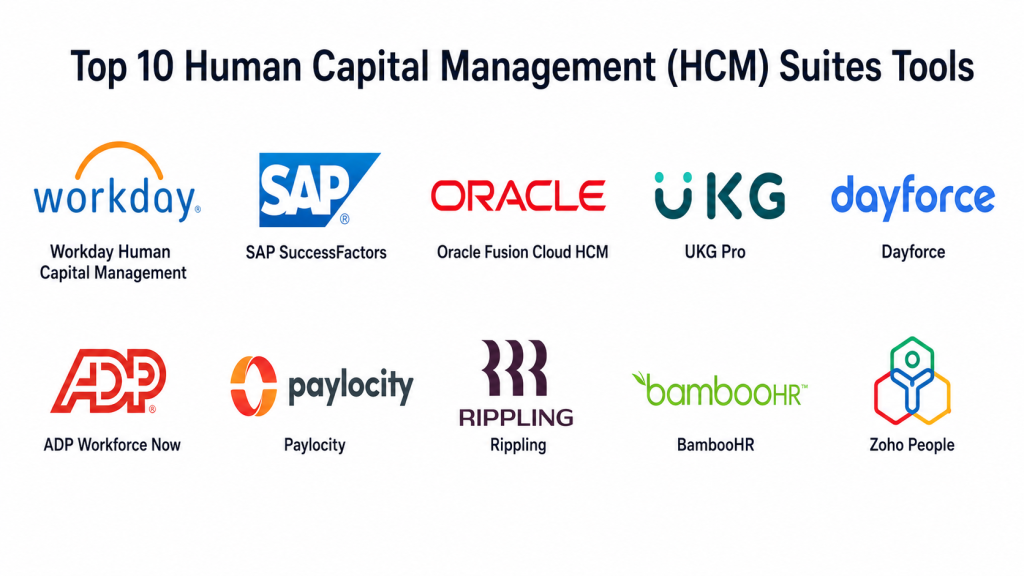
Top 10 Human Capital Management (HCM) Suites Tools
#1 — Workday Human Capital Management
Short description: Workday Human Capital Management is an enterprise-grade HCM suite designed for large and complex organizations. It brings together core HR, talent management, workforce planning, payroll-related capabilities, analytics, and employee experience in one cloud platform.
Key Features
- Core HR and employee lifecycle management
- Talent management, performance, learning, and succession planning
- Workforce planning and people analytics
- Compensation management and benefits administration
- Employee and manager self-service
- Configurable workflows and approval processes
- Integration with finance and enterprise systems
Pros
- Strong fit for large enterprises with complex HR structures.
- Powerful analytics and workforce planning capabilities.
- Broad HCM functionality across HR, talent, compensation, and reporting.
Cons
- Implementation can be complex and resource-heavy.
- May be expensive for smaller organizations.
- Configuration requires skilled administrators or partner support.
Platforms / Deployment
Web / iOS / Android
Cloud
Security & Compliance
Common enterprise controls include SSO, MFA, RBAC, encryption, and audit logging. Specific compliance details may vary by product package and region.
Integrations & Ecosystem
Workday has a strong enterprise ecosystem and is commonly integrated with finance, payroll, identity, collaboration, and analytics platforms.
- ERP and finance systems
- Identity providers and SSO platforms
- Payroll providers
- Learning and talent tools
- Business intelligence platforms
- APIs and integration connectors
Support & Community
Workday provides enterprise support, implementation partners, documentation, training resources, and a strong partner ecosystem. Community strength is high among enterprise HR and IT teams.
#2 — SAP SuccessFactors
Short description: SAP SuccessFactors is a cloud-based HCM suite designed for organizations that need global HR, talent management, workforce analytics, learning, and employee experience capabilities. It is often used by large and multinational companies.
Key Features
- Employee central and core HR management
- Recruiting, onboarding, learning, and performance management
- Compensation and succession planning
- Workforce analytics and reporting
- Employee experience tools
- Global HR process support
- Integration with SAP ERP and business systems
Pros
- Strong choice for SAP-centered enterprises.
- Good coverage across talent management and global HR.
- Suitable for complex workforce and compliance structures.
Cons
- Can require significant configuration and implementation planning.
- User experience may vary depending on module setup.
- Best value is often seen when used within the broader SAP ecosystem.
Platforms / Deployment
Web / iOS / Android
Cloud
Security & Compliance
Supports enterprise-grade access controls, identity integration, encryption, and audit-related capabilities. Specific compliance certifications may vary by region and deployment.
Integrations & Ecosystem
SAP SuccessFactors connects well with SAP business systems and also supports integration with external HR, payroll, identity, and analytics tools.
- SAP ERP and finance systems
- Payroll systems
- Identity and access management tools
- Learning content providers
- Analytics and reporting systems
- HR service delivery tools
Support & Community
SAP offers enterprise support, partner implementation services, product documentation, and a large professional ecosystem. Community support is strong among SAP consultants and enterprise HR technology teams.
#3 — Oracle Fusion Cloud HCM
Short description: Oracle Fusion Cloud HCM is a comprehensive cloud HCM suite covering HR, talent, workforce management, payroll, analytics, and employee experience. It is suited for mid-market to enterprise organizations with complex business operations.
Key Features
- Core HR and employee data management
- Recruiting, onboarding, learning, and performance management
- Workforce compensation and benefits
- Payroll and workforce management capabilities
- HR help desk and employee experience features
- AI-supported workforce insights
- Advanced analytics and reporting
Pros
- Strong fit for organizations already using Oracle Cloud applications.
- Broad HCM coverage across HR, talent, payroll, and workforce analytics.
- Scalable for large and global organizations.
Cons
- Implementation may require experienced Oracle specialists.
- Some modules may feel complex for smaller HR teams.
- Total cost depends heavily on selected modules and scale.
Platforms / Deployment
Web / iOS / Android
Cloud
Security & Compliance
Enterprise security controls commonly include SSO, MFA, encryption, RBAC, and audit logging. Specific certifications and compliance coverage may vary by environment and region.
Integrations & Ecosystem
Oracle Fusion Cloud HCM integrates strongly with Oracle ERP, finance, supply chain, identity, and analytics products. It also supports third-party integrations through APIs and connectors.
- Oracle ERP and finance
- Identity management tools
- Payroll and benefits systems
- Learning platforms
- Analytics and data tools
- Third-party HR applications
Support & Community
Oracle provides enterprise support, implementation partners, technical documentation, and training resources. The ecosystem is strong, especially for companies already invested in Oracle Cloud.
#4 — UKG Pro
Short description: UKG Pro is an HCM suite focused on HR, payroll, workforce management, talent, and employee experience. It is commonly used by mid-market and enterprise organizations that need strong people operations and workforce management capabilities.
Key Features
- Core HR and employee records
- Payroll and tax management
- Time, attendance, and scheduling
- Talent acquisition and onboarding
- Performance and employee engagement tools
- People analytics and reporting
- Mobile employee self-service
Pros
- Strong workforce management and payroll capabilities.
- Good fit for organizations with hourly, shift-based, or distributed teams.
- Useful employee experience and engagement features.
Cons
- Implementation effort can vary based on workforce complexity.
- Some advanced features may require additional modules.
- Configuration may require specialist support.
Platforms / Deployment
Web / iOS / Android
Cloud
Security & Compliance
Common enterprise controls include role-based access, audit logging, encryption, and identity support. Specific compliance certifications are not always publicly stated for every module.
Integrations & Ecosystem
UKG Pro integrates with payroll, finance, benefits, recruiting, identity, and workforce tools. Its ecosystem is especially useful for organizations managing scheduling and time-based labor.
- Payroll and benefits systems
- Identity providers
- Recruiting platforms
- Finance systems
- Time and attendance tools
- Reporting and analytics platforms
Support & Community
UKG provides customer support, onboarding assistance, product documentation, and a strong HR practitioner community. Support quality may depend on package, region, and service level.
#5 — Dayforce
Short description: Dayforce is a cloud HCM platform covering payroll, HR, benefits, workforce management, talent, and analytics. It is well known for combining HR and workforce operations in a single system.
Key Features
- Core HR and employee profile management
- Payroll and tax processing
- Workforce management, scheduling, and time tracking
- Benefits administration
- Talent management and performance tools
- Real-time workforce data and analytics
- Employee self-service and mobile access
Pros
- Strong payroll and workforce management combination.
- Useful for organizations with complex scheduling and compliance needs.
- Real-time data model supports better visibility across HR operations.
Cons
- May be more complex than needed for very small businesses.
- Implementation planning is important for payroll and workforce rules.
- Some features may require additional configuration or services.
Platforms / Deployment
Web / iOS / Android
Cloud
Security & Compliance
Supports enterprise security expectations such as access controls, encryption, auditability, and identity-related capabilities. Specific compliance details may vary.
Integrations & Ecosystem
Dayforce integrates with HR, payroll, finance, benefits, recruiting, learning, and workforce systems. It is especially useful where payroll and scheduling data need to stay closely connected.
- Benefits providers
- Finance and ERP systems
- Recruiting systems
- Identity management platforms
- Learning tools
- Analytics and reporting tools
Support & Community
Dayforce offers implementation support, customer service, documentation, and learning resources. Community strength is solid among payroll, HR operations, and workforce management users.
#6 — ADP Workforce Now
Short description: ADP Workforce Now is an HCM platform designed mainly for small, mid-sized, and growing businesses. It covers payroll, HR, benefits, talent, time tracking, and compliance support.
Key Features
- Payroll processing and tax support
- Core HR and employee records
- Time and attendance management
- Benefits administration
- Talent acquisition and performance tools
- Compliance support and reporting
- Employee self-service portal
Pros
- Strong payroll reputation and broad business adoption.
- Good fit for SMB and mid-market companies.
- Useful for organizations that want HR and payroll in one system.
Cons
- Advanced HCM depth may vary by package.
- User experience can depend on configuration and selected modules.
- Some businesses may need add-ons for complete talent management.
Platforms / Deployment
Web / iOS / Android
Cloud
Security & Compliance
Common capabilities include user access controls, data protection, audit-related features, and identity support. Specific compliance coverage may vary by product and region.
Integrations & Ecosystem
ADP Workforce Now connects with accounting, benefits, time tracking, HR, recruiting, and business applications. Its payroll ecosystem is one of its strongest advantages.
- Accounting platforms
- Benefits providers
- Time tracking tools
- Recruiting software
- HR and compliance tools
- APIs and marketplace integrations
Support & Community
ADP provides customer support, onboarding services, documentation, and a wide business user base. Support experience may vary depending on plan and service model.
#7 — Paylocity
Short description: Paylocity is an HCM and payroll platform focused on HR, payroll, benefits, talent, time tracking, and employee engagement. It is commonly used by SMB and mid-market organizations.
Key Features
- Payroll and tax management
- Core HR and employee data
- Benefits administration
- Time and labor management
- Recruiting and onboarding
- Performance and learning tools
- Employee communication and engagement features
Pros
- Strong option for mid-sized companies needing HR and payroll together.
- Good employee engagement and communication capabilities.
- Practical balance between usability and HCM functionality.
Cons
- May not match the depth of large enterprise HCM suites.
- Advanced global HR support may be limited compared with enterprise platforms.
- Feature availability may vary by package.
Platforms / Deployment
Web / iOS / Android
Cloud
Security & Compliance
Access controls, encryption, audit-related functionality, and identity options are commonly expected. Specific compliance certifications are not always publicly stated for all modules.
Integrations & Ecosystem
Paylocity integrates with HR, finance, benefits, time management, recruiting, and productivity systems. It works well for businesses that want payroll-centered HR operations.
- Benefits providers
- Accounting systems
- Recruiting platforms
- Time and attendance systems
- Learning tools
- Employee engagement tools
Support & Community
Paylocity offers customer support, implementation help, learning resources, and documentation. Community strength is good among SMB and mid-market HR teams.
#8 — Rippling
Short description: Rippling is a modern workforce management and HCM platform that combines HR, payroll, benefits, IT, identity, device management, and app access workflows. It is especially attractive for technology-driven companies and fast-growing businesses.
Key Features
- Core HR and employee records
- Payroll and benefits administration
- Time and attendance capabilities
- App provisioning and deprovisioning
- Device and IT workflow management
- Workflow automation
- Integrations with business and productivity tools
Pros
- Strong connection between HR and IT operations.
- Useful for onboarding, offboarding, and access automation.
- Modern user experience for growing companies.
Cons
- May not be the best fit for traditional enterprises needing deep legacy HR workflows.
- Pricing and module selection can become complex.
- Some advanced HR functions may depend on add-ons.
Platforms / Deployment
Web / iOS / Android
Cloud
Security & Compliance
Common security capabilities include access control, SSO-related workflows, app management, audit trails, and identity-focused controls. Specific compliance details vary by module and region.
Integrations & Ecosystem
Rippling has a strong app ecosystem and is commonly integrated with identity, productivity, collaboration, payroll, finance, and IT systems.
- Identity and access tools
- Collaboration platforms
- Payroll and finance systems
- Device management tools
- Productivity apps
- Workflow automation tools
Support & Community
Rippling provides onboarding, documentation, customer support, and product resources. Its community is strong among startups, technology companies, and modern HR/IT teams.
#9 — BambooHR
Short description: BambooHR is an HR platform built mainly for small and mid-sized businesses. It focuses on core HR, employee records, onboarding, time-off management, performance, reporting, and employee experience.
Key Features
- Employee records and HR database
- Onboarding and offboarding workflows
- Time-off tracking
- Performance management
- Employee self-service
- HR reporting and analytics
- Marketplace integrations
Pros
- Easy to use for small and mid-sized HR teams.
- Clean employee record management and onboarding experience.
- Good starting point for companies moving away from spreadsheets.
Cons
- Less suitable for large enterprises with highly complex HR requirements.
- Payroll and advanced workforce management may depend on region or add-ons.
- Global compliance depth may be limited compared with enterprise suites.
Platforms / Deployment
Web / iOS / Android
Cloud
Security & Compliance
Common controls include access permissions, data protection, and audit-related capabilities. Specific compliance details may vary and should be validated during procurement.
Integrations & Ecosystem
BambooHR has a practical ecosystem for SMB HR operations and connects with payroll, recruiting, performance, benefits, and productivity tools.
- Payroll systems
- Applicant tracking tools
- Benefits platforms
- Performance tools
- Time tracking systems
- Productivity and communication apps
Support & Community
BambooHR provides documentation, customer support, onboarding resources, and a strong SMB HR user community. It is generally known for ease of adoption.
#10 — Zoho People
Short description: Zoho People is an HR management platform suitable for small and mid-sized businesses that want affordable HR software with employee records, attendance, leave management, performance, and workflows. It works especially well for teams already using Zoho products.
Key Features
- Employee database and core HR management
- Leave and attendance tracking
- Timesheets and shift scheduling
- Performance management
- HR workflows and approvals
- Employee self-service
- Integration with Zoho ecosystem
Pros
- Cost-effective option for SMBs.
- Strong fit for companies already using Zoho apps.
- Flexible HR workflows and simple administration.
Cons
- May not provide the same enterprise depth as larger HCM suites.
- Advanced payroll and compliance coverage may vary by country.
- Some features may require setup effort for best results.
Platforms / Deployment
Web / iOS / Android
Cloud
Security & Compliance
Supports common access and data protection features. Specific compliance certifications and controls may vary by plan, region, and Zoho service configuration.
Integrations & Ecosystem
Zoho People integrates well with Zoho’s wider business suite and also supports connections with external tools depending on use case.
- Zoho payroll and finance tools
- Zoho CRM and collaboration tools
- Attendance systems
- Productivity platforms
- APIs and workflow tools
- Third-party HR integrations
Support & Community
Zoho provides documentation, support resources, onboarding materials, and a large product ecosystem. Community strength is strong among SMB users and Zoho customers.
Comparison Table
| Tool Name | Best For | Platform(s) Supported | Deployment | Standout Feature | Public Rating |
|---|---|---|---|---|---|
| Workday Human Capital Management | Large enterprises and global HR teams | Web, iOS, Android | Cloud | Enterprise workforce planning and analytics | N/A |
| SAP SuccessFactors | SAP-centered enterprises and multinational HR teams | Web, iOS, Android | Cloud | Global talent and HR process coverage | N/A |
| Oracle Fusion Cloud HCM | Enterprises using Oracle Cloud ecosystem | Web, iOS, Android | Cloud | Broad HR, talent, payroll, and analytics suite | N/A |
| UKG Pro | Mid-market and enterprise workforce management | Web, iOS, Android | Cloud | Strong payroll, HR, and workforce operations | N/A |
| Dayforce | Organizations needing payroll and workforce management together | Web, iOS, Android | Cloud | Real-time payroll and workforce data | N/A |
| ADP Workforce Now | SMB and mid-market HR and payroll teams | Web, iOS, Android | Cloud | Payroll-first HCM capability | N/A |
| Paylocity | Mid-sized companies needing HR, payroll, and engagement | Web, iOS, Android | Cloud | Employee engagement with payroll and HR | N/A |
| Rippling | Fast-growing companies connecting HR and IT | Web, iOS, Android | Cloud | HR, IT, identity, and app automation | N/A |
| BambooHR | Small and mid-sized businesses | Web, iOS, Android | Cloud | Simple core HR and onboarding | N/A |
| Zoho People | SMBs using Zoho or needing affordable HR software | Web, iOS, Android | Cloud | Cost-effective HR workflows | N/A |
Evaluation & Scoring of Human Capital Management (HCM) Suites
| Tool Name | Core (25%) | Ease (15%) | Integrations (15%) | Security (10%) | Performance (10%) | Support (10%) | Value (15%) | Weighted Total (0–10) |
|---|---|---|---|---|---|---|---|---|
| Workday Human Capital Management | 9.5 | 7.5 | 9.0 | 9.0 | 9.0 | 8.5 | 7.5 | 8.65 |
| SAP SuccessFactors | 9.0 | 7.0 | 9.0 | 9.0 | 8.5 | 8.5 | 7.5 | 8.40 |
| Oracle Fusion Cloud HCM | 9.0 | 7.0 | 8.5 | 9.0 | 8.5 | 8.5 | 7.5 | 8.33 |
| UKG Pro | 8.5 | 8.0 | 8.0 | 8.5 | 8.5 | 8.0 | 8.0 | 8.25 |
| Dayforce | 8.5 | 7.5 | 8.0 | 8.5 | 8.5 | 8.0 | 8.0 | 8.18 |
| ADP Workforce Now | 8.0 | 8.0 | 8.0 | 8.5 | 8.0 | 8.0 | 8.5 | 8.10 |
| Paylocity | 7.8 | 8.2 | 7.8 | 8.0 | 8.0 | 8.0 | 8.3 | 8.00 |
| Rippling | 8.0 | 8.5 | 9.0 | 8.5 | 8.0 | 7.8 | 8.0 | 8.28 |
| BambooHR | 7.0 | 9.0 | 7.5 | 7.8 | 8.0 | 8.0 | 8.5 | 7.93 |
| Zoho People | 7.0 | 8.0 | 7.5 | 7.5 | 7.8 | 7.5 | 9.0 | 7.65 |
These scores are comparative, not absolute. A higher score does not always mean the tool is the best for every company. For example, Workday may score highly for enterprise depth, while BambooHR or Zoho People may be better for smaller teams that value simplicity and cost control. Buyers should treat this table as a shortlisting guide, then validate pricing, integrations, security, local compliance, and implementation fit before making a decision.
Which Human Capital Management (HCM) Suite Tool Is Right for You?
Solo / Freelancer
Solo professionals usually do not need a full HCM suite. A simple accounting, invoicing, payroll, or task management tool may be enough. If you are hiring contractors or building a small team, Zoho People can be a practical starting point because it offers basic HR workflows at a more accessible level.
SMB
Small and mid-sized businesses should focus on ease of use, payroll support, employee records, onboarding, leave management, and simple reporting. BambooHR, Zoho People, ADP Workforce Now, Paylocity, and Rippling are strong options depending on budget and operating model.
For SMBs that need simple HR without heavy complexity, BambooHR is a good fit. For businesses already using Zoho products, Zoho People may be more convenient. For payroll-first needs, ADP Workforce Now or Paylocity may be more suitable.
Mid-Market
Mid-market companies usually need stronger payroll, benefits, compliance, performance management, and reporting. ADP Workforce Now, Paylocity, UKG Pro, Dayforce, and Rippling are practical choices.
If your workforce includes hourly employees, shifts, or scheduling complexity, UKG Pro and Dayforce deserve attention. If HR and IT automation are both important, Rippling can be a strong option.
Enterprise
Large enterprises should prioritize scalability, global HR, security, analytics, compliance, integration depth, and workforce planning. Workday Human Capital Management, SAP SuccessFactors, and Oracle Fusion Cloud HCM are leading choices for enterprise-grade HCM needs.
Workday is strong for workforce planning and analytics. SAP SuccessFactors fits well in SAP-heavy environments. Oracle Fusion Cloud HCM is a natural option for organizations already using Oracle Cloud applications.
Budget vs Premium
Budget-conscious companies should look at Zoho People, BambooHR, Paylocity, or selected ADP packages. Premium buyers with complex enterprise needs should evaluate Workday, SAP SuccessFactors, Oracle Fusion Cloud HCM, UKG Pro, and Dayforce.
The lowest-cost platform is not always the cheapest long-term choice. Poor implementation, weak integrations, or limited compliance support can create hidden costs later.
Feature Depth vs Ease of Use
For deep enterprise HR, Workday, SAP SuccessFactors, and Oracle Fusion Cloud HCM offer strong capability but require more planning and administration. For ease of use, BambooHR, Zoho People, and Rippling are often more approachable.
Companies should choose based on internal maturity. A small HR team may struggle with an overly complex suite, while a large enterprise may outgrow a lightweight HR tool quickly.
Integrations & Scalability
If integrations are a top priority, check how each HCM suite connects with your ERP, payroll, identity provider, finance tools, collaboration apps, and data warehouse. Workday, SAP SuccessFactors, Oracle Fusion Cloud HCM, and Rippling are strong in integration-heavy environments.
Scalability is not only about employee count. It also includes regions, payroll rules, business units, approval workflows, reporting needs, and security requirements.
Security & Compliance Needs
Organizations in regulated industries should carefully validate SSO, MFA, RBAC, audit logs, encryption, data retention, privacy controls, and regional compliance requirements. Enterprise buyers should also check vendor documentation, contract terms, data processing agreements, and support for internal audits.
For highly regulated companies, Workday, SAP SuccessFactors, Oracle Fusion Cloud HCM, UKG Pro, and Dayforce are usually more suitable starting points. However, final selection should depend on your legal, security, and compliance review.
Frequently Asked Questions
1. What is an HCM suite?
An HCM suite is a software platform that helps companies manage people-related processes such as HR records, payroll, hiring, onboarding, performance, learning, benefits, and workforce analytics. It gives HR and leadership a central system for managing employees.
2. How is HCM different from HR software?
Basic HR software may only manage employee records, leave, or onboarding. HCM suites usually cover a wider employee lifecycle, including payroll, talent management, workforce planning, performance, compensation, and analytics.
3. What pricing model do HCM suites usually follow?
Most HCM platforms use subscription-based pricing, often charged per employee, per month, or by selected modules. Enterprise platforms may use custom pricing based on company size, geography, modules, support level, and implementation needs.
4. How long does HCM implementation take?
Implementation time depends on company size, payroll complexity, data migration, integrations, and process changes. Small businesses may implement faster, while enterprise rollouts can take longer due to testing, configuration, compliance, and change management.
5. What are the most common HCM implementation mistakes?
Common mistakes include poor data cleanup, unclear ownership, weak change management, underestimating integration work, skipping security review, and trying to automate broken HR processes without redesigning them first.
6. Are HCM suites secure?
Most mature HCM suites provide security features such as access controls, encryption, audit logs, and identity integrations. However, buyers should validate specific security controls, compliance documents, and data privacy terms before purchase.
7. Can HCM suites integrate with payroll and finance systems?
Yes, many HCM suites integrate with payroll, ERP, accounting, benefits, identity, collaboration, and reporting systems. Integration depth varies, so buyers should test critical workflows before final selection.
8. Which HCM suite is best for small businesses?
For small businesses, BambooHR, Zoho People, ADP Workforce Now, Paylocity, and Rippling are practical options. The best choice depends on whether the business needs simple HR, payroll depth, IT automation, or cost-effective workflows.
9. Which HCM suite is best for enterprises?
For large enterprises, Workday Human Capital Management, SAP SuccessFactors, and Oracle Fusion Cloud HCM are strong options. UKG Pro and Dayforce are also strong where payroll and workforce management are major requirements.
10. Is AI important in modern HCM platforms?
AI is becoming important for recruiting, employee support, analytics, skills mapping, learning recommendations, and workforce planning. However, buyers should evaluate whether AI features solve real business problems instead of choosing a tool only because it includes AI.
11. Can companies switch from one HCM suite to another?
Yes, but switching requires careful planning. Companies must migrate employee data, payroll history, documents, workflows, integrations, permissions, and reports. A phased migration is usually safer than a rushed full replacement.
12. What are alternatives to full HCM suites?
Alternatives include payroll-only software, applicant tracking systems, learning management systems, time tracking tools, performance management platforms, and HR spreadsheets. These may work for smaller teams but can become harder to manage as the company grows.
Conclusion
Human Capital Management suites have become central systems for managing modern workforces. The right HCM platform can improve HR efficiency, payroll accuracy, employee experience, compliance visibility, and leadership decision-making. However, there is no single best tool for every company. Workday, SAP SuccessFactors, and Oracle Fusion Cloud HCM are strong for large enterprises, while UKG Pro and Dayforce are valuable for workforce-heavy organizations. ADP Workforce Now, Paylocity, BambooHR, Rippling, and Zoho People offer practical options for SMB and mid-market teams.
