Upgrade & Secure Your Future with DevOps, SRE, DevSecOps, MLOps!
We spend hours scrolling social media and waste money on things we forget, but won’t spend 30 minutes a day earning certifications that can change our lives.
Master in DevOps, SRE, DevSecOps & MLOps by DevOps School!
Learn from Guru Rajesh Kumar and double your salary in just one year.
Introduction
Insurance Claims Management Systems (ICMS) are specialized software platforms designed to streamline the entire lifecycle of insurance claims—from submission and verification to settlement and reporting. These platforms are critical for insurers, brokers, and third-party administrators to manage high volumes of claims efficiently, reduce errors, and ensure regulatory compliance. In and beyond, ICMS solutions increasingly leverage AI, automation, and cloud technologies to enhance accuracy, speed, and customer satisfaction.
Real-world use cases include:
- Automating claims intake and documentation for property and casualty insurers.
- Managing healthcare insurance claims with integrated medical records verification.
- Streamlining travel and accident insurance claim processing.
- Enabling fraud detection and risk assessment for large-scale claims.
- Providing analytics dashboards for decision-making and reporting.
Key evaluation criteria for buyers:
- Core claim processing functionality
- Ease of use and configurability
- AI and automation capabilities
- Integration with existing insurance platforms
- Compliance with industry standards and regulations
- Security and access controls
- Scalability and performance
- Vendor support and community
- Reporting and analytics features
Best for: Insurance carriers, third-party administrators, claims adjusters, brokers, and mid-to-large insurers looking to optimize claims operations.
Not ideal for: Very small insurers or brokers with low claim volume who may prefer simpler manual or spreadsheet-based systems.
Key Trends in Insurance Claims Management Systems
- AI-powered claims triage and fraud detection improving accuracy and reducing processing time.
- Cloud-first deployment models enabling scalable and globally accessible systems.
- Automated document processing using OCR and NLP to reduce manual data entry.
- Integration with telematics, IoT devices, and wearable data for more precise claims assessment.
- Enhanced customer self-service portals and mobile applications.
- Compliance-driven features for GDPR, HIPAA, and local insurance regulations.
- Embedded analytics for predictive modeling and trend forecasting.
- Modular microservices architecture allowing easier customization and third-party integrations.
- Increasing adoption of low-code/no-code tools for rapid workflow configuration.
- Subscription-based pricing and SaaS delivery models offering flexible cost structures.
How We Selected These Tools (Methodology)
- Assessed market adoption and industry recognition.
- Evaluated feature completeness including automation, reporting, and AI capabilities.
- Considered performance and reliability signals, including uptime and scalability.
- Analyzed security posture, including data encryption, SSO, MFA, and audit logging.
- Reviewed integration ecosystem, including APIs and third-party connectivity.
- Checked customer fit across SMBs, mid-market, and enterprise organizations.
- Reviewed vendor support quality and community engagement.
- Ensured compliance with regulatory and insurance industry standards.
- Examined ease of deployment, user experience, and workflow customization.
- Compared pricing models and total cost of ownership.
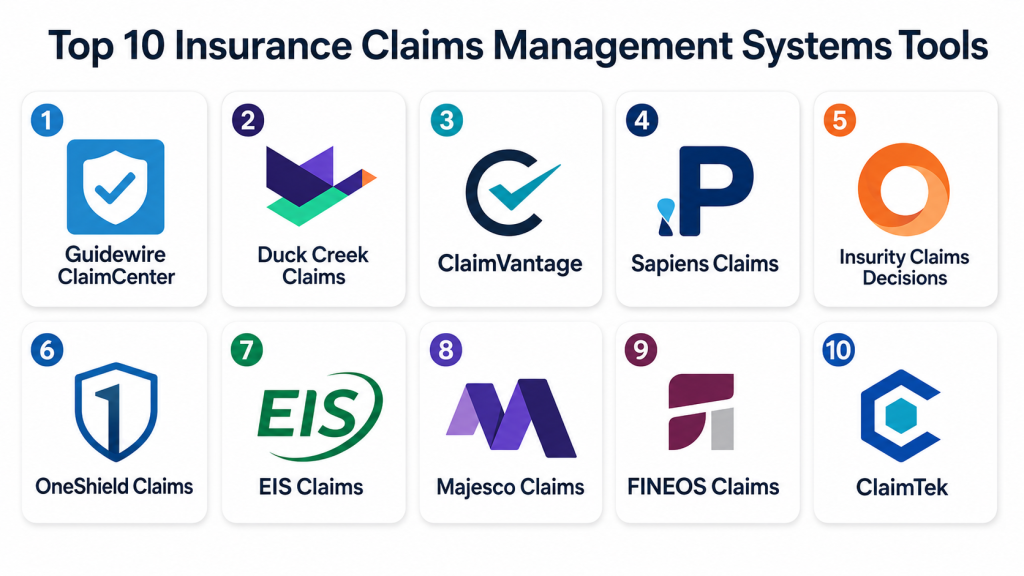
Top 10 Insurance Claims Management Systems Tools
#1 — Guidewire ClaimCenter
Short description : Guidewire ClaimCenter is a leading claims management solution for property and casualty insurers. It automates end-to-end claims processes, enhances fraud detection, and supports multi-channel claim intake. Ideal for mid-to-large insurers requiring a robust, scalable system.
Key Features
- End-to-end claims lifecycle automation
- AI-driven fraud detection
- Multi-channel claim intake (web, mobile, call center)
- Integration with policy and billing systems
- Comprehensive reporting and analytics
- Configurable workflows
- Mobile claims adjuster support
Pros
- Highly scalable for enterprise insurers
- Strong automation and AI capabilities
- Industry-standard integrations
Cons
- High implementation cost
- Steep learning curve for users
- Customization can be complex
Platforms / Deployment
- Web / Windows
- Cloud / On-premise
Security & Compliance
- SSO, MFA, encryption, audit logs
- SOC 2, ISO 27001, HIPAA (Not publicly stated for all regions)
Integrations & Ecosystem
Supports policy, billing, and risk systems.
- API-driven integrations
- Connectors for third-party vendors
- ERP and CRM integration
- Mobile adjuster apps
- Analytics and BI tools
Support & Community
- Extensive documentation and training programs
- Vendor support tiers available
- Active user community and forums
#2 — Duck Creek Claims
Short description: Duck Creek Claims provides flexible, cloud-native claims management for property and casualty insurers. It emphasizes configurability, speed of deployment, and analytics-driven decision-making.
Key Features
- Cloud-native platform
- Automated workflow management
- Analytics dashboards and KPI monitoring
- Configurable claim types
- AI-assisted decisioning
- Mobile adjuster support
Pros
- Quick deployment and updates
- Highly configurable
- Strong analytics capabilities
Cons
- Complex pricing structure
- Integration with legacy systems may require effort
Platforms / Deployment
- Web / Windows / macOS
- Cloud / Hybrid
Security & Compliance
- Not publicly stated
Integrations & Ecosystem
- APIs for policy, billing, and CRM systems
- Support for mobile and desktop clients
- Extensible modules for add-on services
Support & Community
- Vendor support with tiered SLA
- Documentation and community forums available
#3 — ClaimVantage
Short description: ClaimVantage focuses on life, health, and disability insurance claims. It streamlines claim submission, adjudication, and reporting, with strong cloud capabilities and configurable workflows.
Key Features
- Life and disability claim automation
- Cloud-based platform
- Configurable workflows and forms
- Self-service portals for claimants
- Analytics and reporting
Pros
- Tailored for health and life insurance
- Cloud deployment with rapid updates
- Easy claimant portal integration
Cons
- Less suited for P&C insurers
- Limited AI-driven fraud detection
Platforms / Deployment
- Web / iOS / Android
- Cloud
Security & Compliance
- Not publicly stated
Integrations & Ecosystem
- API integrations for HR, ERP, and CRM systems
- Portal and workflow extensibility
Support & Community
- Vendor support available
- Online documentation and training
#4 — Sapiens Claims
Short description: Sapiens Claims offers end-to-end claims management for property, casualty, and life insurance. It provides process automation, analytics, and flexible deployment options.
Key Features
- End-to-end claims processing
- Automation and workflow engine
- Analytics and reporting modules
- Multi-line insurance support
- Configurable user roles
Pros
- Multi-line insurance support
- Strong analytics capabilities
Cons
- Implementation may be time-consuming
- UI can feel dated
Platforms / Deployment
- Web / Windows
- Cloud / On-premise
Security & Compliance
- Not publicly stated
Integrations & Ecosystem
- APIs for ERP, policy, and billing systems
- Extensible modules for add-ons
Support & Community
- Vendor documentation and training
- Support tiers available
#5 — Insurity Claims Decisions
Short description: Insurity Claims Decisions leverages automation and AI for property and casualty claims. It provides configurable workflows, risk scoring, and integration with existing insurance systems.
Key Features
- AI-assisted decisioning
- Workflow automation
- Risk scoring and analytics
- Integration with policy systems
- Cloud deployment
Pros
- Strong AI capabilities
- Configurable workflows
- Cloud-ready platform
Cons
- Pricing may be high for SMBs
- Requires technical expertise to configure
Platforms / Deployment
- Web
- Cloud / Hybrid
Security & Compliance
- Not publicly stated
Integrations & Ecosystem
- APIs for policy, billing, CRM
- Third-party connector support
Support & Community
- Vendor support available
- Documentation and community resources
#6 — OneShield Claims
Short description: OneShield Claims is designed for insurers seeking configurable, cloud-based claims management for multiple lines. It emphasizes automation, compliance, and analytics.
Key Features
- Multi-line claims automation
- Cloud-based and hybrid deployment
- Analytics dashboards
- Configurable workflow templates
- Integration with core insurance systems
Pros
- Flexible configuration
- Strong analytics
- Cloud-based scalability
Cons
- Limited mobile functionality
- May require external consultants for setup
Platforms / Deployment
- Web / Windows
- Cloud / Hybrid
Security & Compliance
- Not publicly stated
Integrations & Ecosystem
- API integrations with policy, billing, CRM
- Extensible workflow modules
Support & Community
- Vendor support tiers
- Documentation provided
#7 — EIS Claims
Short description: EIS Claims provides cloud-native claims solutions with emphasis on automation, user-friendly interface, and multi-line insurance coverage.
Key Features
- Cloud-native platform
- Automated claim workflows
- Multi-line insurance coverage
- Analytics and reporting dashboards
- Configurable user roles
Pros
- Modern interface
- Cloud-native with scalability
Cons
- Fewer enterprise references
- Limited AI-driven fraud detection
Platforms / Deployment
- Web / iOS / Android
- Cloud
Security & Compliance
- Not publicly stated
Integrations & Ecosystem
- APIs for policy, billing, CRM
- Extensible analytics modules
Support & Community
- Vendor support available
- Documentation provided
#8 — Majesco Claims
Short description: Majesco Claims delivers cloud-first claims management for insurers with modular architecture. Focused on automation, analytics, and integration with core insurance platforms.
Key Features
- Modular and configurable
- Automated workflow engine
- Analytics dashboards
- Integration with policy and billing systems
- Cloud-first deployment
Pros
- Flexible and modular
- Scalable cloud deployment
Cons
- Complex configuration
- May require professional services for onboarding
Platforms / Deployment
- Web / Windows
- Cloud / Hybrid
Security & Compliance
- Not publicly stated
Integrations & Ecosystem
- API integrations for insurance core systems
- Workflow and reporting extensibility
Support & Community
- Vendor support with documentation
- Community engagement limited
#9 — FINEOS Claims
Short description: FINEOS Claims focuses on life, accident, and health insurance. It provides cloud-based automation, self-service portals, and analytics-driven insights.
Key Features
- Life, accident, and health claim automation
- Cloud-based deployment
- Configurable workflows
- Analytics dashboards
- Self-service portals
Pros
- Specialized for life and health insurance
- Cloud-native and flexible
Cons
- Limited P&C functionality
- Customization may require support
Platforms / Deployment
- Web / iOS / Android
- Cloud
Security & Compliance
- Not publicly stated
Integrations & Ecosystem
- API-based integration for HR and ERP systems
- Extensible modules for portals
Support & Community
- Vendor documentation and support tiers
- Community resources available
#10 — ClaimTek
Short description: ClaimTek provides configurable, scalable claims management for mid-market insurers. Focused on automation, reporting, and integration with multiple insurance lines.
Key Features
- Configurable claims workflows
- Reporting and analytics
- Multi-line insurance support
- Automation features
- Integration with core insurance systems
Pros
- Scalable for mid-market insurers
- Configurable workflows
Cons
- Smaller vendor footprint
- Limited advanced AI features
Platforms / Deployment
- Web / Windows
- Cloud / Hybrid
Security & Compliance
- Not publicly stated
Integrations & Ecosystem
- API integrations for core insurance systems
- Extensible reporting and workflow modules
Support & Community
- Vendor support available
- Documentation provided
Comparison Table (Top 10)
| Tool Name | Best For | Platform(s) Supported | Deployment | Standout Feature | Public Rating |
|---|---|---|---|---|---|
| Guidewire ClaimCenter | Mid-to-large P&C insurers | Web / Windows | Cloud / On-premise | AI-driven claims automation | N/A |
| Duck Creek Claims | Property & casualty insurers | Web / Windows / macOS | Cloud / Hybrid | Analytics dashboards | N/A |
| ClaimVantage | Life, health, disability | Web / iOS / Android | Cloud | Cloud-based claim workflows | N/A |
| Sapiens Claims | Multi-line insurers | Web / Windows | Cloud / On-premise | Multi-line support | N/A |
| Insurity Claims Decisions | P&C insurers | Web | Cloud / Hybrid | AI-assisted decisioning | N/A |
| OneShield Claims | Multi-line insurers | Web / Windows | Cloud / Hybrid | Configurable workflows | N/A |
| EIS Claims | Multi-line insurers | Web / iOS / Android | Cloud | Cloud-native automation | N/A |
| Majesco Claims | Enterprise insurers | Web / Windows | Cloud / Hybrid | Modular architecture | N/A |
| FINEOS Claims | Life, accident, health | Web / iOS / Android | Cloud | Life/Health focus | N/A |
| ClaimTek | Mid-market insurers | Web / Windows | Cloud / Hybrid | Configurable workflows | N/A |
Evaluation & Scoring
| Tool Name | Core (25%) | Ease (15%) | Integrations (15%) | Security (10%) | Performance (10%) | Support (10%) | Value (15%) | Weighted Total (0–10) |
|---|---|---|---|---|---|---|---|---|
| Guidewire ClaimCenter | 9 | 7 | 8 | 8 | 9 | 8 | 7 | 8.3 |
| Duck Creek Claims | 8 | 8 | 7 | 7 | 8 | 7 | 8 | 7.7 |
| ClaimVantage | 7 | 8 | 7 | 7 | 7 | 7 | 8 | 7.3 |
| Sapiens Claims | 8 | 7 | 7 | 7 | 8 | 7 | 7 | 7.5 |
| Insurity Claims Decisions | 8 | 7 | 7 | 7 | 8 | 7 | 7 | 7.5 |
| OneShield Claims | 7 | 7 | 7 | 7 | 7 | 7 | 7 | 7.0 |
| EIS Claims | 7 | 8 | 7 | 7 | 7 | 7 | 7 | 7.2 |
| Majesco Claims | 8 | 7 | 7 | 7 | 8 | 7 | 7 | 7.5 |
| FINEOS Claims | 7 | 7 | 7 | 7 | 7 | 7 | 7 | 7.0 |
| ClaimTek | 7 | 7 | 7 | 7 | 7 | 7 | 7 | 7.0 |
Interpretation: Scores are comparative across systems. Weighted totals provide a quick view of overall suitability based on combined core features, usability, integrations, security, performance, support, and value.
Which Insurance Claims Management Tool Is Right for You?
Solo / Freelancer
- Simpler cloud-based tools like ClaimVantage or ClaimTek can manage smaller claim volumes effectively with minimal setup.
SMB
- Duck Creek Claims or OneShield Claims provide a balance of automation and affordability.
Mid-Market
- Guidewire ClaimCenter or Sapiens Claims offer scalable workflows and robust reporting.
Enterprise
- Majesco Claims, FINEOS, and EIS Claims provide enterprise-grade security, integration, and multi-line support.
Budget vs Premium
- Budget options: ClaimVantage, ClaimTek (good for smaller insurers)
- Premium: Guidewire ClaimCenter, Majesco Claims (enterprise, complex needs)
Feature Depth vs Ease of Use
- Feature-rich: Guidewire, Majesco, Sapiens
- Easier to adopt: ClaimVantage, EIS, ClaimTek
Integrations & Scalability
- Ensure API and core system compatibility; cloud-native platforms scale more easily.
Security & Compliance Needs
- For strict regulatory environments, prioritize tools with robust encryption, audit logs, and compliance certifications. If unknown, validate directly with vendor.
Frequently Asked Questions (FAQs)
1. How much do insurance claims management systems cost?
Costs vary by deployment, number of users, and features. Enterprise tools are higher priced; cloud solutions often use subscription models.
2. Can these tools integrate with existing policy and billing systems?
Most platforms provide APIs and connectors; integration effort depends on legacy system compatibility.
3. How long does implementation take?
Small-to-mid deployments can take weeks; enterprise implementations may take several months.
4. Are there AI features for fraud detection?
Yes, many tools like Guidewire and Insurity Claims Decisions offer AI-assisted fraud detection and risk scoring.
5. Do these systems support mobile access for adjusters?
Several platforms, including ClaimVantage, EIS Claims, and FINEOS, offer mobile apps for field adjusters.
6. What security measures are included?
Common measures: SSO, MFA, encryption, audit logs. Certifications (SOC 2, ISO 27001) vary by vendor.
7. Can small insurers benefit from these systems?
Yes, but simpler, cloud-based platforms like ClaimVantage or ClaimTek are typically more cost-effective.
8. How customizable are workflows?
Most systems allow configurable workflows; enterprise-grade solutions offer extensive customization, sometimes requiring technical expertise.
9. Can these systems handle multi-line insurance?
Many enterprise platforms (Guidewire, Sapiens, Majesco) support multi-line insurance; others may specialize in P&C or life/health.
10. What happens if I want to switch systems?
Data migration and integration mapping are essential. Cloud-native platforms often provide migration support services.
Conclusion
Selecting the right Insurance Claims Management System depends on company size, insurance line, integration needs, and budget. Enterprise insurers may prioritize scalability and AI-assisted automation, while SMBs can benefit from simpler, cloud-based platforms. The best approach is to shortlist , run a pilot, evaluate usability, integration, and compliance, and then finalize the platform that aligns with operational goals. Modern ICMS solutions offer automation, analytics, and cloud flexibility that can significantly improve claims processing efficiency and customer satisfaction.
