Upgrade & Secure Your Future with DevOps, SRE, DevSecOps, MLOps!
We spend hours scrolling social media and waste money on things we forget, but won’t spend 30 minutes a day earning certifications that can change our lives.
Master in DevOps, SRE, DevSecOps & MLOps by DevOps School!
Learn from Guru Rajesh Kumar and double your salary in just one year.
Introduction
Legal research platforms help lawyers, law firms, legal departments, students, researchers, and compliance teams find, analyze, and use legal information more efficiently. In simple terms, these tools help users search case law, statutes, regulations, commentary, legal forms, court opinions, citations, and legal updates from one structured platform.
Legal research matters more now because legal teams need faster answers, stronger citation confidence, better matter preparation, and safer use of AI-assisted research. Manual research across scattered sources can lead to missed authorities, outdated cases, weak arguments, or wasted billable time.
Common use cases include case law research, statute lookup, legal citation checking, litigation preparation, legal drafting support, regulatory monitoring, due diligence, legal memo creation, and precedent analysis.
Buyers should evaluate:
- Case law and statute coverage
- Citation validation and treatment analysis
- AI research assistance
- Search accuracy and filtering
- Legal analytics
- Practice area content
- Drafting and document tools
- Collaboration features
- Security and access control
- Pricing flexibility and support quality
Best for: Law firms, in-house legal teams, legal researchers, litigators, corporate counsel, compliance teams, legal educators, law students, paralegals, and government legal departments.
Not ideal for: Users who only need occasional public legal information, small teams with very limited research needs, or businesses that only need contract templates without deep legal research, citation checking, or case law analysis.
Key Trends in Legal Research Platforms
- AI-assisted legal research is becoming more common as platforms help summarize cases, find relevant authorities, draft research memos, and answer legal questions with supporting references.
- Citation reliability is becoming a major trust factor because lawyers need to confirm whether a case is still good law, questioned, reversed, distinguished, or followed.
- Legal analytics is expanding beyond litigation into judge behavior, court trends, motion outcomes, law firm benchmarking, expert witness research, and strategy planning.
- Natural language search is improving so users can ask legal questions in plain English instead of relying only on Boolean search syntax.
- Workflow integration is becoming important as legal research tools connect with document management, legal drafting, matter management, e-discovery, and billing platforms.
- Practice-specific research experiences are growing for litigation, tax, employment, intellectual property, regulatory, corporate, immigration, and compliance teams.
- Data privacy and confidentiality are now critical because legal research platforms may process sensitive client facts, internal notes, research trails, and legal strategy.
- Regulatory monitoring is becoming more automated as legal teams need alerts on new laws, agency updates, court decisions, and compliance changes.
- Cost control is influencing platform selection because firms and legal departments want predictable pricing, seat flexibility, and measurable research value.
- AI governance is becoming part of legal technology evaluation as firms create policies around AI outputs, hallucination risk, citation validation, client confidentiality, and attorney supervision.
How We Selected These Tools
The tools in this list were selected using practical legal technology evaluation factors, including:
- Recognition in legal research, case law search, citator, legal analytics, and legal AI markets
- Feature completeness across case law, statutes, regulations, citations, commentary, and legal insights
- Suitability for law firms, legal departments, government teams, students, and solo attorneys
- Ability to support litigation, transactional, regulatory, and academic legal workflows
- Strength of citation checking, case treatment analysis, and authority validation
- Availability of AI-assisted research, summarization, and workflow automation features
- Integration potential with legal drafting, document management, and matter management systems
- Usability for attorneys, paralegals, students, and legal researchers
- Vendor maturity, content depth, and legal domain credibility
- Fit across enterprise, mid-market, SMB, solo, and academic legal environments
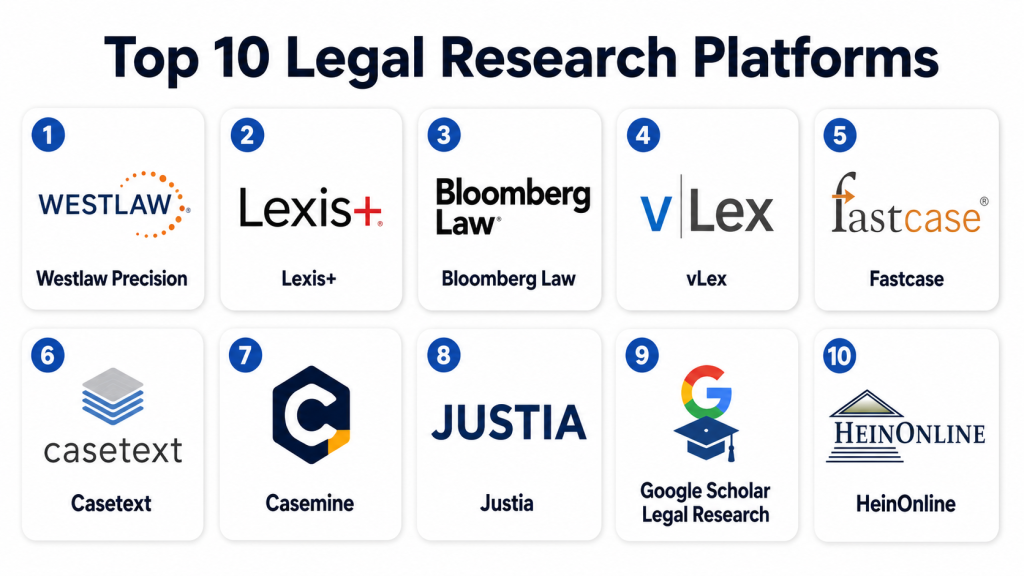
Top 10 Legal Research Platforms
1 — Westlaw Precision
Short description:
Westlaw Precision is a premium legal research platform used by law firms, corporate legal teams, government agencies, and legal researchers. It provides access to case law, statutes, regulations, secondary sources, legal commentary, citation tools, and research workflows. The platform is known for advanced search, citator functionality, and strong editorial legal content. It is especially useful for litigation teams and legal professionals who need reliable legal authority and citation treatment. Westlaw Precision is best for organizations that need deep legal research coverage and strong confidence in legal authority validation.
Key Features
- Case law, statutes, regulations, and secondary source research
- Advanced search and filtering
- Citation validation and case treatment analysis
- Legal research history and workflow tools
- AI-assisted research and legal summarization features
- Practice area content and legal commentary
- Litigation and legal analytics support
Pros
- Strong legal content coverage and research depth
- Trusted citation treatment and authority validation
- Suitable for complex litigation and professional legal research
Cons
- Pricing is usually premium and not publicly stated
- May be more than small teams need
- Advanced features require training for best use
Platforms / Deployment
Web / Cloud / Varies
Security & Compliance
SSO/SAML, MFA, encryption, audit logs, RBAC, SOC 2, ISO 27001, GDPR, HIPAA: Not publicly stated.
Integrations & Ecosystem
Westlaw Precision fits into legal workflows where research, drafting, document review, and matter preparation need strong legal authority support.
- Legal drafting tools
- Document management systems
- Matter management platforms
- Litigation analytics tools
- Legal citation workflows
- Internal knowledge systems
Support & Community
Thomson Reuters provides enterprise support, training resources, documentation, product guidance, and customer success services. Support levels depend on subscription, firm size, and selected products.
2 — Lexis+
Short description:
Lexis+ is a legal research platform used by law firms, corporate counsel, government agencies, and legal professionals for case law, statutes, regulations, legal news, analytics, and research workflows. It combines legal content with search tools, citation checking, practical guidance, and AI-assisted research capabilities. The platform is useful for attorneys who need legal authority, practice insights, drafting support, and litigation preparation. Lexis+ is especially strong for users who value broad content coverage and workflow-connected research. It is best for legal teams that need both traditional research and modern legal technology features.
Key Features
- Case law, statutes, regulations, and legal commentary
- Citation checking and legal authority validation
- AI-assisted legal research features
- Practical guidance and legal news
- Litigation analytics and insights
- Search filters and research folders
- Drafting and workflow support
Pros
- Broad legal content and practice area coverage
- Strong research workflow and citation tools
- Useful for firms, corporate counsel, and government teams
Cons
- Pricing is not publicly stated
- Can feel complex for occasional users
- Full value depends on selected modules and subscription
Platforms / Deployment
Web / Cloud / Varies
Security & Compliance
SSO/SAML, MFA, encryption, audit logs, RBAC, SOC 2, ISO 27001, GDPR, HIPAA: Not publicly stated.
Integrations & Ecosystem
Lexis+ can support legal research, drafting, litigation preparation, compliance monitoring, and legal knowledge management workflows.
- Legal drafting tools
- Document management systems
- Matter management systems
- Legal analytics tools
- News and monitoring workflows
- Internal legal knowledge systems
Support & Community
LexisNexis provides customer support, training, documentation, product onboarding, and legal research education resources. Support depends on subscription type and organization size.
3 — Bloomberg Law
Short description:
Bloomberg Law combines legal research, business intelligence, legal news, dockets, practical guidance, litigation tools, and regulatory content in one platform. It is useful for law firms, corporate legal departments, regulatory teams, and professionals who need legal research connected with business and market context. The platform is especially strong where legal, financial, regulatory, and corporate information overlap. Bloomberg Law helps users research cases, track legal developments, monitor dockets, and understand regulatory changes. It is best for legal teams that need research plus business and regulatory intelligence.
Key Features
- Legal research across cases, statutes, and regulations
- Legal news and regulatory monitoring
- Docket tracking and litigation tools
- Practical guidance and legal analysis
- Business and company intelligence
- Alerts and workflow tools
- Analytics and legal intelligence resources
Pros
- Strong combination of legal and business information
- Useful for regulatory and corporate legal teams
- Good for monitoring legal developments and dockets
Cons
- May be more broad than pure case law research needs
- Pricing is not publicly stated
- Some users may need training to use full platform depth
Platforms / Deployment
Web / Cloud / Varies
Security & Compliance
SSO/SAML, MFA, encryption, audit logs, RBAC, SOC 2, ISO 27001, GDPR, HIPAA: Not publicly stated.
Integrations & Ecosystem
Bloomberg Law supports legal, regulatory, litigation, business intelligence, and monitoring workflows.
- Legal document workflows
- Regulatory monitoring processes
- Litigation tracking systems
- Business intelligence workflows
- Alerts and research folders
- Internal legal reporting systems
Support & Community
Bloomberg provides customer support, training, documentation, legal analyst resources, and onboarding assistance. Support levels depend on subscription and organization needs.
4 — vLex
Short description:
vLex is a legal research platform offering global legal content, case law, statutes, regulations, legal commentary, and AI-assisted research tools. It is useful for law firms, legal departments, academic institutions, and researchers working across multiple jurisdictions. The platform is especially relevant for international legal research and comparative law work. vLex helps users find legal authorities, analyze documents, and research legal questions with modern search and AI capabilities. It is best for users who need broad jurisdictional coverage beyond a single country.
Key Features
- Multi-jurisdiction legal research
- Case law, legislation, and legal commentary
- AI-assisted legal research tools
- Legal document analysis
- Search filters and research workflows
- Citation and authority discovery
- International legal content coverage
Pros
- Strong global legal research coverage
- Useful for cross-border and comparative law research
- Modern AI-assisted research features
Cons
- Coverage depth may vary by jurisdiction
- Some users may still need country-specific specialist platforms
- Pricing is not publicly stated
Platforms / Deployment
Web / Cloud / Varies
Security & Compliance
SSO/SAML, MFA, encryption, audit logs, RBAC, SOC 2, ISO 27001, GDPR, HIPAA: Not publicly stated.
Integrations & Ecosystem
vLex fits legal research workflows where jurisdictional breadth, AI assistance, and document understanding are important.
- Legal document review workflows
- Knowledge management systems
- Academic research processes
- Comparative law research
- Internal legal research libraries
- Legal drafting workflows
Support & Community
vLex provides support, documentation, onboarding, and training resources. Support availability may vary by region, subscription, and customer type.
5 — Fastcase
Short description:
Fastcase is a legal research platform that provides case law, statutes, regulations, court rules, legal search tools, and research resources. It is often used by solo attorneys, small firms, bar association members, legal researchers, and law firms that need cost-conscious legal research access. Fastcase is known for making legal research more accessible compared with some premium enterprise platforms. It supports practical case law research and legal authority discovery. Fastcase is best for users who need reliable legal research without the cost and complexity of larger premium suites.
Key Features
- Case law research
- Statutes and regulations
- Legal search and filtering
- Citation and case discovery tools
- Research history and saved searches
- Court rules and legal materials
- Accessible legal research workflows
Pros
- Practical for solo and small firm research
- More accessible than many enterprise platforms
- Useful for straightforward legal authority search
Cons
- May not match premium platforms in editorial depth
- Advanced analytics may be limited compared with larger tools
- Coverage and features may vary by subscription
Platforms / Deployment
Web / Cloud / Varies
Security & Compliance
SSO/SAML, MFA, encryption, audit logs, RBAC, SOC 2, ISO 27001, GDPR, HIPAA: Not publicly stated.
Integrations & Ecosystem
Fastcase supports legal research workflows for firms, solo attorneys, legal organizations, and bar association users.
- Legal research workflows
- Case law search
- Citation review processes
- Internal document preparation
- Legal education workflows
- Practice management workflows
Support & Community
Fastcase provides customer support, training resources, and user guidance. Support experience may depend on subscription type, bar association access, and customer agreement.
6 — Casetext
Short description:
Casetext is a legal research and legal AI platform known for AI-assisted research, document analysis, case law search, and legal drafting support. It is useful for litigators, small firms, midsize firms, and legal professionals who want faster research workflows. The platform helps users find relevant cases, analyze legal questions, and review legal documents with AI-powered assistance. Casetext is especially relevant for teams looking to reduce time spent on repetitive research tasks. It is best for firms that want modern AI-assisted legal research without relying only on traditional search methods.
Key Features
- AI-assisted legal research
- Case law search
- Document analysis
- Legal question answering support
- Research memo assistance
- Citation and authority discovery
- Litigation-focused workflows
Pros
- Strong AI-assisted research experience
- Useful for faster case discovery and document analysis
- Practical for litigation-focused legal teams
Cons
- AI outputs still require attorney review
- Coverage and features may depend on subscription
- Pricing is not publicly stated
Platforms / Deployment
Web / Cloud / Varies
Security & Compliance
SSO/SAML, MFA, encryption, audit logs, RBAC, SOC 2, ISO 27001, GDPR, HIPAA: Not publicly stated.
Integrations & Ecosystem
Casetext fits workflows where lawyers need AI support for research, document analysis, and litigation preparation.
- Legal drafting workflows
- Document review processes
- Case law research
- Litigation preparation
- Internal knowledge systems
- Practice management workflows
Support & Community
Casetext provides customer support, documentation, onboarding resources, and product guidance. Support levels may depend on plan type and customer size.
7 — Casemine
Short description:
Casemine is a legal research platform with case law search, citation analysis, legal search filters, and AI-supported research features. It is useful for lawyers, law students, legal researchers, and firms that need case discovery and citation-based research workflows. The platform supports finding relevant precedents, analyzing case relationships, and improving legal argument preparation. Casemine is especially useful where precedent discovery and citation mapping matter. It is best for users looking for research assistance with a focus on case law and legal reasoning.
Key Features
- Case law search
- Citation analysis
- AI-supported research assistance
- Precedent discovery
- Search filters and legal issue exploration
- Case relationship mapping
- Legal research notes and workflows
Pros
- Useful for precedent discovery
- Strong focus on case relationships and citation analysis
- Practical for students, researchers, and litigation teams
Cons
- Coverage depth may vary by jurisdiction
- May not replace broader premium platforms for all needs
- Pricing and enterprise security details are not clearly stated
Platforms / Deployment
Web / Cloud / Varies
Security & Compliance
SSO/SAML, MFA, encryption, audit logs, RBAC, SOC 2, ISO 27001, GDPR, HIPAA: Not publicly stated.
Integrations & Ecosystem
Casemine supports legal research workflows focused on cases, precedents, citations, and legal reasoning.
- Case law research workflows
- Legal education workflows
- Litigation preparation
- Legal drafting support
- Citation analysis workflows
- Internal legal research processes
Support & Community
Casemine provides product support and research assistance resources. Support levels may vary based on plan, region, and customer type.
8 — Justia
Short description:
Justia is a legal information and research platform that provides access to case law, statutes, regulations, legal articles, lawyer directories, and public legal resources. It is useful for lawyers, students, researchers, journalists, and general users who need accessible legal information. While it may not offer the same advanced workflow depth as premium enterprise platforms, it is valuable for public legal research and general legal discovery. Justia is especially useful for initial research, legal education, and public case law access. It is best for users who want accessible legal content without heavy enterprise tooling.
Key Features
- Public case law research
- Statutes and legal resources
- Legal articles and explanations
- Lawyer directory resources
- Practice area information
- Searchable legal content
- Accessible public legal materials
Pros
- Accessible legal information
- Useful for initial research and education
- Good public legal resource coverage
Cons
- Limited advanced citation validation compared with premium tools
- Not a full enterprise legal research workflow platform
- Security and compliance controls for enterprise use are not clearly stated
Platforms / Deployment
Web / Cloud
Security & Compliance
SSO/SAML, MFA, encryption, audit logs, RBAC, SOC 2, ISO 27001, GDPR, HIPAA: Not publicly stated.
Integrations & Ecosystem
Justia is mainly useful for public legal research, education, and general legal information discovery.
- Public legal research
- Legal education workflows
- Content discovery
- Practice area research
- Initial case law lookup
- Public legal information sharing
Support & Community
Support is more content and platform-oriented than enterprise legal research support. Enterprise onboarding and advanced support tiers are not publicly stated.
9 — Google Scholar Legal Research
Short description:
Google Scholar Legal Research provides free access to case law and legal opinions from selected jurisdictions along with academic legal research materials. It is useful for students, researchers, solo practitioners, and users who need a free starting point for legal research. The platform is not a full legal research suite, but it can help users locate cases, legal articles, and citations. It is often used for preliminary research before deeper validation on professional platforms. Google Scholar is best for cost-conscious users and early-stage legal research.
Key Features
- Free case law search
- Legal opinion discovery
- Academic article search
- Citation discovery
- Basic search filters
- Public access to selected legal materials
- Easy web-based research experience
Pros
- Free and easy to access
- Useful for initial legal research
- Good for academic and preliminary case discovery
Cons
- Limited citator and treatment analysis
- Coverage may be incomplete for professional needs
- Not designed as an enterprise legal workflow platform
Platforms / Deployment
Web / Cloud
Security & Compliance
SSO/SAML, MFA, encryption, audit logs, RBAC, SOC 2, ISO 27001, GDPR, HIPAA: Not publicly stated.
Integrations & Ecosystem
Google Scholar supports basic legal and academic research workflows, but it is not built as a professional legal operations platform.
- Academic research workflows
- Preliminary case law research
- Citation discovery
- Legal education
- Public research workflows
- Browser-based search
Support & Community
Support is limited compared with commercial legal research platforms. Users generally rely on public help resources and independent legal research skills.
10 — HeinOnline
Short description:
HeinOnline is a legal research platform known for legal journals, historical legal materials, government documents, treaties, constitutions, case law collections, and academic legal research. It is especially useful for law schools, researchers, libraries, scholars, and legal professionals who need deep legal history and secondary source research. The platform is valuable for academic legal writing, historical research, and specialized legal collections. HeinOnline is not always the first choice for everyday litigation research, but it is strong for legal scholarship. It is best for research-heavy users who need authoritative legal archives and journals.
Key Features
- Legal journals and law reviews
- Historical legal materials
- Government documents
- Treaties and constitutions
- Case law collections
- Academic legal research resources
- Advanced search across legal archives
Pros
- Strong legal history and academic research depth
- Excellent for law libraries and legal scholars
- Useful for secondary source and archival research
Cons
- Less focused on everyday litigation workflow
- May need another platform for citator-heavy case research
- Pricing is not publicly stated
Platforms / Deployment
Web / Cloud / Varies
Security & Compliance
SSO/SAML, MFA, encryption, audit logs, RBAC, SOC 2, ISO 27001, GDPR, HIPAA: Not publicly stated.
Integrations & Ecosystem
HeinOnline fits research environments where legal scholarship, journals, historical sources, and academic legal collections are important.
- Library systems
- Academic research workflows
- Legal citation workflows
- Law school research environments
- Legal archive research
- Institutional access systems
Support & Community
HeinOnline provides support, documentation, training resources, and library-focused assistance. Support availability depends on subscription type and institutional agreement.
Comparison Table
| Tool Name | Best For | Platform(s) Supported | Deployment | Standout Feature | Public Rating |
|---|---|---|---|---|---|
| Westlaw Precision | Professional legal research and litigation teams | Web / Varies | Cloud | Advanced citator and legal authority validation | N/A |
| Lexis+ | Law firms, corporate counsel, and legal departments | Web / Varies | Cloud | Broad legal content and workflow-connected research | N/A |
| Bloomberg Law | Legal research with business and regulatory intelligence | Web / Varies | Cloud | Legal, regulatory, docket, and business intelligence | N/A |
| vLex | International and multi-jurisdiction research | Web / Varies | Cloud | Global legal content and AI-assisted research | N/A |
| Fastcase | Solo attorneys and cost-conscious legal teams | Web / Varies | Cloud | Accessible case law and legal research | N/A |
| Casetext | AI-assisted legal research and litigation workflows | Web / Varies | Cloud | AI-powered legal research and document analysis | N/A |
| Casemine | Precedent discovery and citation analysis | Web / Varies | Cloud | Case relationship and citation mapping | N/A |
| Justia | Public legal information and initial research | Web | Cloud | Accessible public legal resources | N/A |
| Google Scholar Legal Research | Free preliminary legal and academic research | Web | Cloud | Free case law and academic search | N/A |
| HeinOnline | Legal scholarship, archives, and law libraries | Web / Varies | Cloud | Legal journals and historical legal collections | N/A |
Evaluation & Scoring of Legal Research Platforms
| Tool Name | Core (25%) | Ease (15%) | Integrations (15%) | Security (10%) | Performance (10%) | Support (10%) | Value (15%) | Weighted Total (0–10) |
|---|---|---|---|---|---|---|---|---|
| Westlaw Precision | 10 | 8 | 8 | 7 | 9 | 9 | 7 | 8.55 |
| Lexis+ | 10 | 8 | 8 | 7 | 9 | 9 | 7 | 8.55 |
| Bloomberg Law | 9 | 8 | 8 | 7 | 9 | 8 | 7 | 8.25 |
| vLex | 8 | 8 | 7 | 6 | 8 | 8 | 8 | 7.70 |
| Fastcase | 7 | 8 | 6 | 6 | 8 | 7 | 9 | 7.30 |
| Casetext | 8 | 9 | 7 | 6 | 8 | 8 | 8 | 7.85 |
| Casemine | 7 | 8 | 6 | 6 | 8 | 7 | 8 | 7.15 |
| Justia | 6 | 9 | 5 | 5 | 8 | 6 | 10 | 7.00 |
| Google Scholar Legal Research | 6 | 9 | 5 | 5 | 8 | 5 | 10 | 6.90 |
| HeinOnline | 8 | 7 | 7 | 6 | 8 | 8 | 8 | 7.55 |
These scores are comparative and should be used as a shortlist guide, not as a final buying decision. A high score does not mean the platform is best for every legal team. Litigation teams may value citators and case treatment tools, while academic researchers may value journals and historical archives. Budget-conscious users may prefer accessible platforms, while enterprise firms may prioritize content depth, security, training, and integrations. Buyers should validate coverage, citation reliability, AI safeguards, workflow fit, and pricing before selection.
Which Legal Research Platform Is Right for You?
Solo / Freelancer
Solo attorneys, freelance legal researchers, and independent legal consultants usually need a platform that balances research quality, cost, and usability. They may not need the most expensive enterprise suite if their work is focused on routine case lookup, memo preparation, or limited litigation support.
Fastcase, Casetext, Casemine, Justia, and Google Scholar can be useful depending on budget and research depth. For professional work, free tools should be used carefully because citation treatment and coverage may be limited.
SMB
Small and mid-sized law firms need dependable legal research without unnecessary complexity. They often need case law, statutes, citation checking, document review support, and practical workflow tools.
Fastcase, Casetext, vLex, Lexis+, and Westlaw Precision may be good options depending on budget and practice area. SMB buyers should focus on content coverage, citator quality, AI reliability, ease of use, and pricing predictability.
Mid-Market
Mid-market law firms and legal departments usually need broader research coverage, user management, training, matter-based workflows, and practice area content. They may also need legal analytics, regulatory monitoring, and collaboration features.
Westlaw Precision, Lexis+, Bloomberg Law, vLex, Casetext, and HeinOnline can be suitable depending on practice needs. Mid-market buyers should evaluate content depth, research workflow efficiency, integration with document systems, and support quality.
Enterprise
Large law firms, corporate legal departments, government agencies, and academic institutions usually need deep content coverage, strong support, reliable citators, security review, role-based access, training resources, and scalable licensing.
Westlaw Precision, Lexis+, Bloomberg Law, vLex, and HeinOnline are strong enterprise-level options depending on use case. Enterprise buyers should review contract terms, data confidentiality, AI governance, administrative controls, and research usage analytics.
Budget vs Premium
Budget-focused users may start with Fastcase, Justia, Google Scholar, Casemine, or selected vLex plans depending on jurisdiction and research depth. These can work well for early research, education, and cost-conscious legal work.
Premium buyers should consider Westlaw Precision, Lexis+, Bloomberg Law, and specialized enterprise packages when deep content, citator reliability, legal analytics, support, and advanced workflows are critical.
Feature Depth vs Ease of Use
Feature-rich tools provide deeper legal authority validation, broader content, analytics, and workflow tools, but they may require training. Westlaw Precision, Lexis+, and Bloomberg Law are strong for advanced professional research.
For easier access and faster adoption, Fastcase, Casetext, Casemine, Justia, and Google Scholar may be more approachable. However, users should understand the limits of free or lightweight platforms before relying on them for complex legal work.
Integrations & Scalability
Legal research platforms may need to connect with document management, practice management, matter management, drafting tools, knowledge systems, litigation analytics, and internal research libraries.
Scalability should be evaluated by:
- Number of attorneys and researchers
- Practice areas covered
- Jurisdictions required
- Research volume
- AI usage policies
- Integration needs
- Training requirements
- Administrative controls
- Budget structure
Security & Compliance Needs
Legal research platforms may process sensitive client facts, confidential legal strategies, attorney notes, search history, uploaded documents, and internal matter details. Security review is important, especially when AI tools are used.
Important questions include:
- Does the platform support SSO and MFA?
- Are user permissions and admin controls available?
- Are audit logs available?
- Is uploaded content used for model training?
- How is client data protected?
- Where is data hosted?
- Can research history be controlled?
- What confidentiality protections are included?
If security certifications are not publicly stated, buyers should request official vendor documentation before purchase.
Frequently Asked Questions
1. What is a legal research platform?
A legal research platform helps users find and analyze legal information such as cases, statutes, regulations, legal commentary, journals, and court documents. It supports legal decision-making, drafting, litigation preparation, and compliance research.
2. Who uses legal research software?
Legal research software is used by lawyers, paralegals, law students, legal researchers, judges, government legal teams, corporate counsel, compliance officers, legal educators, and academic researchers.
3. How much do legal research platforms cost?
Pricing varies widely and is often not publicly stated for premium platforms. Cost usually depends on number of users, practice area content, jurisdiction coverage, AI features, analytics tools, support level, and contract terms.
4. What are common mistakes when choosing a legal research platform?
Common mistakes include choosing only by price, ignoring jurisdiction coverage, not testing citation tools, relying too heavily on AI output, skipping training, and failing to confirm whether the platform includes needed practice area content.
5. Can AI legal research tools replace lawyers?
No, AI legal research tools should not replace lawyers. They can help summarize, search, and organize legal information, but attorneys must verify citations, check authority, apply legal judgment, and ensure professional responsibility.
6. Are free legal research tools reliable?
Free tools can be useful for preliminary research, public legal information, and education. However, they may lack complete coverage, advanced citators, case treatment analysis, editorial content, and professional support.
7. What is a legal citator?
A legal citator helps users check how a case has been treated by later courts. It can show whether a case has been followed, distinguished, questioned, overruled, reversed, or otherwise affected.
8. Can legal research platforms integrate with law firm systems?
Some platforms can integrate with document management, drafting, practice management, matter management, legal analytics, and knowledge management tools. Integration depth varies, so buyers should confirm options before purchase.
9. Is cloud-based legal research software secure?
Cloud-based legal research platforms can be secure when they include encryption, access controls, SSO, MFA, audit logs, administrative controls, and strong data protection policies. Buyers should review security documentation directly.
10. What is the best alternative to premium legal research software?
Alternatives include free legal information websites, public court databases, academic databases, bar association research tools, and lower-cost legal research platforms. However, professional users should be careful when citation reliability and complete coverage matter.
Conclusion
Legal research platforms help legal professionals find authorities, validate citations, monitor legal developments, prepare arguments, draft documents, and work more efficiently. The best platform depends on practice area, jurisdiction, budget, research depth, AI needs, citation reliability, security expectations, and team size. Westlaw Precision, Lexis+, and Bloomberg Law are strong choices for professional and enterprise legal research. vLex is useful for multi-jurisdiction work, HeinOnline is valuable for legal scholarship, and Fastcase, Casetext, Casemine, Justia, and Google Scholar can support cost-conscious or specialized research needs. A smart is to shortlist two or three platforms, test real research questions, verify citation tools, review AI safeguards, compare jurisdiction coverage, check security controls, and run a pilot before making the final decision.
