Upgrade & Secure Your Future with DevOps, SRE, DevSecOps, MLOps!
We spend hours scrolling social media and waste money on things we forget, but won’t spend 30 minutes a day earning certifications that can change our lives.
Master in DevOps, SRE, DevSecOps & MLOps by DevOps School!
Learn from Guru Rajesh Kumar and double your salary in just one year.
Introduction
Manufacturing Execution Systems (MES) are software platforms designed to manage, monitor, and optimize production processes on the factory floor. These toolkits bridge the gap between enterprise resource planning (ERP) systems and operational technologies (OT), providing real-time visibility into manufacturing operations, improving productivity, and ensuring quality compliance.
In +, MES platforms have become increasingly critical as manufacturers embrace smart factories, Industry 4.0, and data-driven process optimization. Modern MES solutions incorporate AI-driven analytics, IoT integration, cloud-enabled monitoring, and compliance management, enabling manufacturers to reduce downtime, improve efficiency, and maintain competitive advantage.
Real-world use cases:
- Real-time monitoring of production lines to detect bottlenecks.
- Tracking quality and compliance across complex manufacturing processes.
- Integrating IoT sensors for predictive maintenance.
- Automating workflows between ERP and production systems.
- Optimizing inventory, scheduling, and labor allocation.
Evaluation criteria buyers should consider:
- Real-time monitoring and dashboards
- Quality and compliance management
- Production scheduling and resource allocation
- AI and predictive analytics capabilities
- IoT and sensor integration
- Cloud vs on-premises deployment
- Security and access controls
- Scalability for multi-site operations
- Vendor support and training
- Cost and licensing flexibility
Best for: Manufacturing engineers, operations managers, quality control teams, production planners, and enterprise-level manufacturers. Suitable for SMBs to large enterprises.
Not ideal for: Small workshops with limited automation needs or organizations that only require basic reporting tools without real-time production monitoring.
Key Trends in Manufacturing Execution Systems (MES) Toolkits
- AI-driven predictive maintenance and quality control.
- Cloud-based MES platforms for remote monitoring and multi-site management.
- Integration with IoT devices and industrial sensors.
- Advanced analytics for production optimization and throughput improvement.
- Hybrid deployment models combining on-premises and cloud capabilities.
- Compliance and traceability features for industry standards (ISO, FDA, etc.).
- Real-time dashboards and alerting for operational decision-making.
- Workflow automation between MES and ERP systems.
- Modular and scalable architecture to accommodate growth.
- Subscription and flexible licensing models for cost efficiency.
How We Selected These Tools (Methodology)
- Market adoption and industrial mindshare.
- Completeness of MES functionalities for production management.
- Reliability and uptime performance signals.
- Security posture and compliance certifications.
- Integration capabilities with IoT, ERP, and automation devices.
- Support for multiple deployment models (cloud, on-premises, hybrid).
- Quality of documentation, onboarding, and training resources.
- Scalability for SMBs to large enterprises.
- AI-driven analytics and predictive capabilities.
- Feedback from industry use cases and client testimonials.
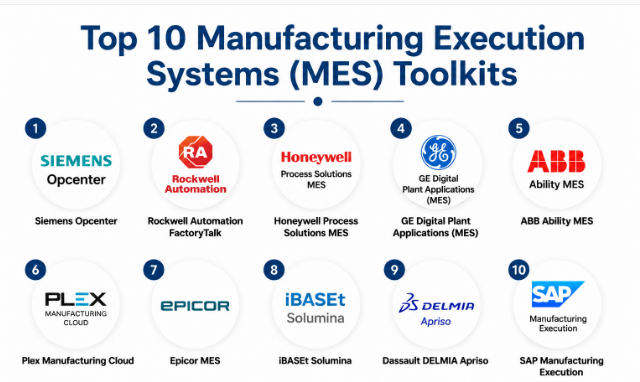
Top 10 Manufacturing Execution Systems (MES) Toolkits
#1 — Siemens Opcenter
Short description: Siemens Opcenter is a comprehensive MES platform that offers advanced production monitoring, quality management, and analytics capabilities. It is widely used in complex manufacturing environments, including automotive and electronics industries.
Key Features
- Real-time production monitoring
- Quality and compliance management
- Production scheduling and tracking
- Analytics and reporting dashboards
- IoT device integration
- Cloud and on-premises deployment
- Predictive maintenance and AI insights
Pros
- Enterprise-grade reliability
- Strong analytics and reporting capabilities
- Scalable for multi-site operations
Cons
- Complex initial setup
- Licensing cost may be high
- Requires trained personnel
Platforms / Deployment
- Windows / Linux
- Cloud / Self-hosted / Hybrid
Security & Compliance
- SSO, encryption, RBAC
- Not publicly stated for certifications
Integrations & Ecosystem
Integrates with ERP, IoT, and automation systems.
- SAP and other ERP systems
- PLCs and IoT sensors
- API for custom extensions
- Analytics platforms
Support & Community
- Vendor training and professional support
- Documentation and tutorials
- Industrial community resources
#2 — Rockwell Automation FactoryTalk
Short description: FactoryTalk MES offers integrated manufacturing management, real-time visibility, and process control. It is designed for industrial automation environments and provides seamless connectivity with Rockwell PLCs.
Key Features
- Real-time production tracking
- Quality management and compliance
- KPI dashboards and reporting
- Multi-site management
- Integration with Rockwell Automation PLCs
- Alarm management and notifications
Pros
- Tight integration with automation hardware
- Strong data visualization capabilities
- Enterprise-grade reliability
Cons
- Best suited for Rockwell environments
- Windows-only platform
- Learning curve for new users
Platforms / Deployment
- Windows
- Self-hosted / Hybrid
Security & Compliance
- Not publicly stated
Integrations & Ecosystem
- Rockwell Automation PLCs
- ERP systems
- IoT and sensor devices
- API for custom integration
Support & Community
- Vendor documentation and support
- Community forums
- Training resources
#3 — Honeywell Process Solutions MES
Short description: Honeywell MES delivers production optimization, quality control, and compliance management across process industries such as chemicals, oil, and gas. It supports real-time monitoring and predictive maintenance.
Key Features
- Real-time production dashboards
- Quality and compliance management
- Predictive maintenance analytics
- Alarm management and event logging
- Multi-site and global deployment
- Integration with Honeywell automation systems
Pros
- Strong process industry focus
- Robust analytics and reporting
- Enterprise scalability
Cons
- Proprietary system
- Costly for smaller operations
- Requires skilled operators
Platforms / Deployment
- Windows / Linux
- Self-hosted / Hybrid
Security & Compliance
- Not publicly stated
Integrations & Ecosystem
- Honeywell PLCs and controllers
- ERP and MES integration
- IoT sensors and automation devices
Support & Community
- Vendor support and training
- Documentation available
- Industry-specific resources
#4 — GE Digital Plant Applications (MES)
Short description: GE Digital MES provides comprehensive production monitoring, process optimization, and analytics solutions for manufacturing industries, enabling real-time decision-making and improved operational efficiency.
Key Features
- Production tracking and visibility
- Quality management and compliance
- Real-time KPI dashboards
- Analytics and predictive insights
- Integration with GE automation devices
- Cloud and on-premises deployment
Pros
- Advanced analytics capabilities
- Multi-site support
- Integration with GE hardware
Cons
- Best suited for GE environments
- Complex configuration
- Licensing cost can be high
Platforms / Deployment
- Windows / Linux
- Cloud / Self-hosted / Hybrid
Security & Compliance
- Not publicly stated
Integrations & Ecosystem
- GE controllers and PLCs
- ERP systems
- IoT and sensors
- APIs for custom integration
Support & Community
- Vendor documentation and support
- Training programs available
- Industry case studies
#5 — ABB Ability MES
Short description: ABB Ability MES is designed for industrial operations, offering production monitoring, asset management, and analytics for energy, utilities, and manufacturing sectors.
Key Features
- Real-time production dashboards
- Asset and maintenance management
- Quality and compliance monitoring
- Analytics and reporting
- IoT and sensor integration
- Cloud and hybrid deployment
Pros
- Strong industrial focus
- Scalable for multi-site operations
- Predictive maintenance support
Cons
- Enterprise-focused pricing
- Learning curve for non-ABB environments
- Windows-centric deployment
Platforms / Deployment
- Windows / Linux
- Cloud / Self-hosted / Hybrid
Security & Compliance
- Not publicly stated
Integrations & Ecosystem
- ABB PLCs and controllers
- ERP and MES integration
- IoT sensors and devices
- API support
Support & Community
- Vendor support and documentation
- Community and training resources
#6 — Plex Manufacturing Cloud
Short description: Plex offers cloud-native MES capabilities for discrete manufacturing, with real-time production monitoring, quality control, and IoT integration, suitable for automotive, aerospace, and electronics industries.
Key Features
- Cloud-based production monitoring
- Quality and compliance management
- Real-time dashboards and reporting
- IoT sensor integration
- ERP and supply chain connectivity
- Predictive analytics and alerts
Pros
- Cloud-native, no local servers needed
- Quick deployment and scalability
- Integrated quality and compliance tracking
Cons
- Subscription-based pricing
- Less customizable than on-premises MES
- Internet-dependent performance
Platforms / Deployment
- Web / Windows / Linux
- Cloud
Security & Compliance
- Not publicly stated
Integrations & Ecosystem
- ERP and supply chain systems
- IoT devices and sensors
- Analytics platforms
- APIs for custom workflows
Support & Community
- Vendor support and onboarding
- Online documentation
- Customer success community
#7 — Epicor MES
Short description: Epicor MES supports manufacturing operations with real-time monitoring, production scheduling, and quality management, focused on small to mid-sized manufacturers.
Key Features
- Production scheduling and tracking
- Quality and compliance management
- Real-time dashboards
- ERP integration
- Analytics and reporting
- Multi-site support
Pros
- User-friendly interface
- Good for SMBs
- Flexible integration options
Cons
- Limited advanced analytics
- Less suited for large enterprises
- Windows-focused deployment
Platforms / Deployment
- Windows
- Self-hosted / Hybrid / Cloud
Security & Compliance
- Not publicly stated
Integrations & Ecosystem
- ERP and MES integration
- IoT and sensors
- API support
Support & Community
- Vendor documentation
- Support tiers available
- Online community
#8 — iBASEt Solumina
Short description: Solumina MES offers production management, quality control, and traceability for complex manufacturing environments like aerospace and defense, supporting real-time data and analytics.
Key Features
- Production tracking and scheduling
- Quality and compliance monitoring
- Traceability and reporting
- Integration with PLM and ERP
- Multi-site operations support
- Real-time dashboards
Pros
- Strong aerospace and defense focus
- Comprehensive compliance tracking
- Scalable for large operations
Cons
- Enterprise pricing
- Complex initial setup
- Requires specialized training
Platforms / Deployment
- Windows / Linux
- Self-hosted / Hybrid
Security & Compliance
- Not publicly stated
Integrations & Ecosystem
- PLM and ERP integration
- IoT sensor data
- API support
Support & Community
- Vendor training
- Documentation and guides
- Industry-focused support
#9 — Dassault DELMIA Apriso
Short description: DELMIA Apriso MES provides global manufacturing operations management with real-time production visibility, quality monitoring, and compliance management.
Key Features
- Real-time production tracking
- Quality and compliance monitoring
- ERP integration
- Analytics and dashboards
- Multi-site operations management
- Cloud and on-premises support
Pros
- Enterprise-grade reliability
- Multi-site and global support
- Strong analytics and compliance features
Cons
- Costly licensing
- Complex configuration
- Windows-centric deployment
Platforms / Deployment
- Windows / Linux
- Cloud / Self-hosted / Hybrid
Security & Compliance
- Not publicly stated
Integrations & Ecosystem
- ERP systems
- IoT and sensors
- API support for custom workflows
Support & Community
- Vendor support and documentation
- Training and tutorials
- Online community
#10 — SAP Manufacturing Execution
Short description: SAP MES integrates production monitoring, quality control, and workflow automation into a unified platform for enterprises, leveraging SAP’s ERP ecosystem for seamless data exchange.
Key Features
- Production tracking and monitoring
- Quality and compliance management
- Workflow automation
- ERP integration
- Analytics and reporting dashboards
- Multi-site and global operations support
Pros
- Tight ERP integration
- Enterprise-scale solution
- Strong data analytics
Cons
- Complex setup and configuration
- High licensing cost
- Best suited for SAP ERP customers
Platforms / Deployment
- Windows / Linux
- Cloud / Self-hosted / Hybrid
Security & Compliance
- Not publicly stated
Integrations & Ecosystem
- SAP ERP and supply chain modules
- IoT sensor integration
- API support
Support & Community
- Vendor support and training
- Documentation and guides
- Industry community
Comparison Table (Top 10)
| Tool Name | Best For | Platform(s) Supported | Deployment | Standout Feature | Public Rating |
|---|---|---|---|---|---|
| Siemens Opcenter | Complex manufacturing | Windows / Linux | Cloud / Self-hosted / Hybrid | Production optimization and analytics | N/A |
| Rockwell FactoryTalk | Industrial automation | Windows | Self-hosted / Hybrid | Tight integration with PLCs | N/A |
| Honeywell MES | Process industries | Windows / Linux | Self-hosted / Hybrid | Predictive maintenance analytics | N/A |
| GE Digital MES | Manufacturing industries | Windows / Linux | Cloud / Self-hosted / Hybrid | Real-time monitoring | N/A |
| ABB Ability MES | Industrial operations | Windows / Linux | Cloud / Self-hosted / Hybrid | Asset and maintenance management | N/A |
| Plex Manufacturing Cloud | Discrete manufacturing | Web / Windows / Linux | Cloud | Cloud-native deployment | N/A |
| Epicor MES | SMB manufacturing | Windows | Cloud / Self-hosted / Hybrid | Flexible integration | N/A |
| iBASEt Solumina | Aerospace and defense | Windows / Linux | Self-hosted / Hybrid | Traceability and compliance | N/A |
| DELMIA Apriso | Global manufacturing | Windows / Linux | Cloud / Self-hosted / Hybrid | Multi-site operations | N/A |
| SAP MES | Enterprise manufacturing | Windows / Linux | Cloud / Self-hosted / Hybrid | ERP ecosystem integration | N/A |
Evaluation & Scoring of MES Tools
| Tool Name | Core (25%) | Ease (15%) | Integrations (15%) | Security (10%) | Performance (10%) | Support (10%) | Value (15%) | Weighted Total (0–10) |
|---|---|---|---|---|---|---|---|---|
| Siemens Opcenter | 9 | 7 | 9 | 7 | 9 | 8 | 7 | 8.0 |
| Rockwell FactoryTalk | 8 | 7 | 8 | 7 | 8 | 7 | 7 | 7.6 |
| Honeywell MES | 8 | 7 | 8 | 7 | 8 | 7 | 6 | 7.5 |
| GE Digital MES | 8 | 7 | 8 | 7 | 8 | 7 | 7 | 7.6 |
| ABB Ability MES | 8 | 7 | 8 | 7 | 8 | 7 | 6 | 7.5 |
| Plex Manufacturing Cloud | 7 | 8 | 7 | 7 | 7 | 7 | 8 | 7.5 |
| Epicor MES | 7 | 8 | 7 | 7 | 7 | 7 | 7 | 7.2 |
| iBASEt Solumina | 8 | 7 | 8 | 7 | 8 | 7 | 6 | 7.5 |
| DELMIA Apriso | 8 | 7 | 8 | 7 | 8 | 7 | 6 | 7.5 |
| SAP MES | 9 | 6 | 9 | 7 | 9 | 8 | 6 | 7.8 |
Interpretation: Weighted totals provide a comparative measure of MES platform capabilities, considering core functionalities, usability, integration potential, security, reliability, support, and cost efficiency.
Which MES Tool Is Right for You?
Solo / Freelancer
- Lightweight cloud-native platforms like Plex Manufacturing Cloud or Epicor MES are suitable for pilot projects or small-scale operations.
SMB
- Tools like Epicor MES, Plex, or Rockwell FactoryTalk provide the right balance between functionality and affordability.
Mid-Market
- Siemens Opcenter, GE Digital MES, or ABB Ability MES deliver advanced analytics, real-time monitoring, and multi-site support.
Enterprise
- SAP MES, DELMIA Apriso, and Siemens Opcenter are optimal for large-scale operations requiring global deployment and ERP integration.
Budget vs Premium
- Cloud-first or small-scale platforms (Plex, Epicor) suit limited budgets.
- Premium platforms (Siemens, SAP, ABB) provide extensive features and enterprise support.
Feature Depth vs Ease of Use
- Beginner-friendly: Epicor MES, Plex
- Advanced capabilities: Siemens Opcenter, SAP MES
Integrations & Scalability
- Evaluate IoT, ERP, MES, and supply chain system integration.
- Consider scalability for multi-site manufacturing facilities.
Security & Compliance Needs
- Ensure platforms support SSO, RBAC, encryption, and industry compliance standards.
Frequently Asked Questions (FAQs)
1. What are the pricing models for MES platforms?
Pricing includes subscription, perpetual licenses, and site-based models. Costs vary by deployment size and feature set.
2. How complex is MES implementation?
Implementation ranges from weeks to months depending on plant size, integration complexity, and customization.
3. Can MES integrate with IoT devices?
Yes, most platforms support MQTT, OPC UA, and Modbus protocols for real-time sensor data integration.
4. Are cloud-based MES platforms secure?
Leading vendors provide encryption, access controls, and role-based permissions. Enterprise deployments may need additional network protections.
5. Which industries benefit most from MES?
Discrete and process manufacturing sectors, including automotive, aerospace, electronics, chemicals, and food production.
6. Does MES support predictive maintenance?
Yes, platforms like Honeywell, Siemens, and ABB incorporate AI-driven analytics for predictive maintenance and fault detection.
7. Are MES platforms suitable for multi-site operations?
Yes, most platforms (SAP MES, Siemens Opcenter) support centralized management across multiple locations.
8. How user-friendly are MES tools?
Platforms like Plex and Epicor offer intuitive dashboards, while Siemens and SAP may require specialized training.
9. Can MES automate workflows with ERP?
Yes, MES integrates with ERP systems to automate data exchange, production planning, and inventory management.
10. Are there alternatives to MES?
For smaller operations, ERP systems with light production modules or industrial dashboards may suffice.
Conclusion
Manufacturing Execution Systems (MES) are essential for monitoring, controlling, and optimizing production operations. Choosing the right platform depends on organizational size, operational complexity, integration needs, and budget. Cloud-native solutions like Plex Manufacturing Cloud and Epicor MES offer cost-effective scalability, while enterprise platforms like Siemens Opcenter, SAP MES, and ABB Ability MES provide advanced analytics, global multi-site support, and tight ERP integration.
