Upgrade & Secure Your Future with DevOps, SRE, DevSecOps, MLOps!
We spend hours scrolling social media and waste money on things we forget, but won’t spend 30 minutes a day earning certifications that can change our lives.
Master in DevOps, SRE, DevSecOps & MLOps by DevOps School!
Learn from Guru Rajesh Kumar and double your salary in just one year.
Introduction
Master Data Management tools help organizations create one trusted version of important business data such as customers, products, suppliers, employees, locations, assets, and accounts. In simple words, MDM helps teams avoid duplicate, incomplete, outdated, or conflicting data across systems like CRM, ERP, ecommerce, finance, analytics, and marketing platforms.
MDM matters more now because businesses are using AI, automation, customer personalization, and real-time analytics. These initiatives fail when the core data is messy. Common use cases include customer 360, product data governance, supplier onboarding, regulatory reporting, data quality improvement, and unified business reporting.
Buyers should evaluate:
- Data matching and merging
- Data governance workflows
- Multi-domain support
- Data quality rules
- Integration flexibility
- Scalability
- Security controls
- Ease of implementation
- AI and automation support
- Total cost of ownership
Best for: enterprises, mid-market companies, data teams, IT leaders, data governance teams, ecommerce businesses, financial services, healthcare, manufacturing, retail, and organizations managing complex master data.
Not ideal for: very small businesses with simple spreadsheets, teams needing only basic CRM cleanup, or organizations that only need lightweight data integration without governance.
Key Trends in Master Data Management Tools
- AI-ready master data: MDM platforms are becoming the foundation for reliable AI because models need clean, governed, and trusted data.
- Cloud-native MDM adoption: More companies prefer SaaS and cloud-based MDM to reduce infrastructure effort and speed up deployment.
- Multi-domain MDM growth: Businesses want one platform for customer, product, supplier, asset, and location data instead of separate tools.
- Data governance built into MDM: Workflow approval, stewardship, lineage, and policy controls are becoming standard expectations.
- Real-time data synchronization: Modern MDM must support faster updates across CRM, ERP, ecommerce, and analytics systems.
- Composable data architecture: APIs, connectors, and event-based integration are becoming more important than closed platforms.
- Privacy and compliance pressure: GDPR, audit trails, role-based access, and consent-aware data handling are now key buying criteria.
- Automation for data quality: Rule-based and AI-assisted duplicate detection, enrichment, and anomaly detection are improving productivity.
- Business-user-friendly interfaces: MDM is no longer only for technical teams; business stewards need simple workflows.
- Industry-specific MDM models: Retail, healthcare, finance, manufacturing, and life sciences often need prebuilt data models and governance patterns.
How We Selected These Tools
The tools were selected using these evaluation points:
- Market recognition and common enterprise adoption
- Breadth of MDM features
- Customer, product, supplier, and multi-domain support
- Data quality and governance capabilities
- Integration with business applications and data platforms
- Cloud, hybrid, and enterprise deployment flexibility
- Security and compliance readiness
- Suitability for different business sizes
- Ecosystem maturity and partner availability
- Practical fit for long-term data management programs
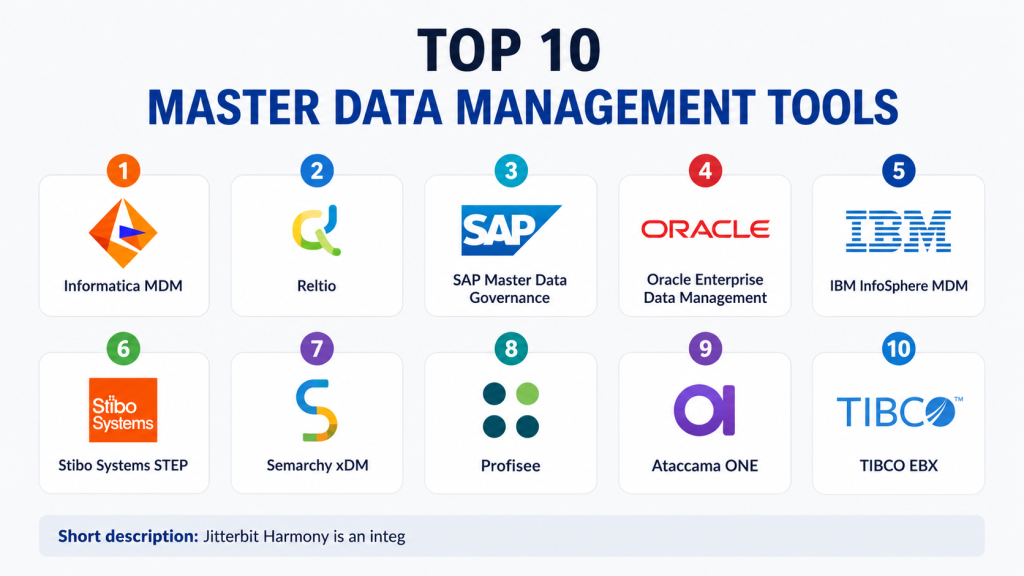
Top 10 Master Data Management Tools
#1 — Informatica MDM
Short description:Informatica MDM is an enterprise-grade master data management platform built for organizations that need strong data governance, data quality, and integration across complex systems.
It is commonly used by large enterprises managing customer, product, supplier, and reference data.
The platform supports matching, merging, survivorship rules, data stewardship, and workflow-driven governance.
It fits companies that already use Informatica’s broader data management ecosystem.
Informatica MDM is especially useful when data must move across CRM, ERP, analytics, cloud data platforms, and operational systems.
Its strength is enterprise scalability and deep integration with data quality and governance capabilities.
However, implementation can require planning, skilled resources, and clear data ownership.
It is best for organizations with mature data programs or serious data quality challenges.
Key Features
- Multi-domain master data management
- Matching, merging, and survivorship rules
- Data quality and cleansing capabilities
- Workflow-based stewardship
- Integration with enterprise data systems
- Support for governance and metadata alignment
- Scalable enterprise architecture
Pros
- Strong enterprise MDM capabilities
- Good fit for complex data environments
- Mature ecosystem for data quality and governance
Cons
- Can be complex to implement
- May require experienced technical teams
- Pricing and deployment effort can be high for smaller teams
Platforms / Deployment
Cloud / Hybrid / Enterprise deployment options vary by product edition.
Security & Compliance
Supports enterprise security needs such as role-based access and governance controls. Specific certifications vary by deployment and edition. Use “Not publicly stated” where verification is required.
Integrations & Ecosystem
Informatica has a broad ecosystem across data integration, data quality, governance, cloud platforms, and enterprise applications.
- CRM integrations
- ERP integrations
- Cloud data platform integrations
- Data quality tools
- Governance and catalog tools
- APIs and enterprise connectors
Support & Community
Informatica offers enterprise support, documentation, training, partner support, and implementation services. Community and knowledge resources are strong for enterprise users.
#2 — Reltio
Short description:Reltio is a cloud-native MDM platform focused on real-time, connected, and scalable master data management.
It is designed for organizations that want modern SaaS-based MDM rather than traditional heavy infrastructure.
Reltio is often used for customer 360, supplier 360, product data, healthcare data, and enterprise relationship management.
Its connected graph approach helps teams understand relationships between people, organizations, products, and locations.
The platform supports matching, merging, enrichment, workflow, data quality, and API-driven access.
It is a strong fit for businesses that need fast access to trusted master data across many applications.
Reltio is useful for AI, analytics, customer experience, and operational decision-making.
It is best for mid-market and enterprise teams that prefer cloud-native architecture.
Key Features
- Cloud-native MDM
- Connected data graph
- Real-time data access
- Entity resolution and matching
- Dynamic survivorship rules
- API-first architecture
- Data quality and stewardship workflows
Pros
- Strong modern cloud architecture
- Good for customer 360 and relationship data
- API-friendly and scalable
Cons
- May require data model planning
- Advanced use cases can need expert setup
- Pricing may not suit smaller businesses
Platforms / Deployment
Cloud / SaaS.
Security & Compliance
Enterprise-grade security features are available, including access controls and governance capabilities. Specific compliance certifications should be verified with the vendor.
Integrations & Ecosystem
Reltio works well in cloud-first data ecosystems and can connect with operational and analytical systems.
- CRM systems
- ERP systems
- Cloud data warehouses
- Data enrichment services
- APIs
- Analytics platforms
Support & Community
Reltio provides documentation, enterprise support, implementation services, and partner-led delivery options. Community strength is good in cloud MDM and customer 360 use cases.
#3 — SAP Master Data Governance
Short description:SAP Master Data Governance is designed for organizations that run SAP-heavy business environments.
It helps manage and govern master data across finance, supplier, customer, product, and material domains.
The tool is especially valuable when SAP ERP, SAP S/4HANA, and SAP business processes are central to operations.
SAP MDG supports approval workflows, validation rules, duplicate checks, and centralized governance.
It is commonly used in manufacturing, retail, finance, supply chain, and enterprise operations.
Its biggest advantage is strong alignment with SAP business processes and data structures.
It may be less attractive for teams that do not use SAP as a major system of record.
It is best for enterprises that need governed master data inside a SAP ecosystem.
Key Features
- SAP-native master data governance
- Workflow-based approvals
- Data validation and duplicate checks
- Finance, supplier, customer, and material data support
- Integration with SAP ERP and SAP S/4HANA
- Governance rules and auditability
- Centralized master data control
Pros
- Excellent fit for SAP environments
- Strong business process alignment
- Good governance and workflow controls
Cons
- Less flexible for non-SAP-centric environments
- Implementation can be complex
- Usually requires SAP expertise
Platforms / Deployment
Cloud / On-premises / Hybrid depending on SAP environment.
Security & Compliance
Supports SAP enterprise security models, roles, approvals, and auditability. Specific certifications depend on SAP deployment and cloud services used.
Integrations & Ecosystem
SAP MDG integrates deeply with SAP applications and enterprise processes.
- SAP S/4HANA
- SAP ERP
- SAP Ariba
- SAP SuccessFactors
- SAP Analytics
- Enterprise integration tools
Support & Community
SAP offers strong enterprise support, partner networks, documentation, and implementation resources. Community strength is high among SAP customers.
#4 — Oracle Enterprise Data Management
Short description:Oracle Enterprise Data Management helps organizations manage enterprise reference data, hierarchies, dimensions, and master data across finance and business systems.
It is often used by finance, planning, reporting, and enterprise data teams.
The platform is especially useful for managing business hierarchies, chart of accounts, reporting structures, and financial dimensions.
Oracle EDM supports collaboration, approvals, governance, and change tracking.
It fits companies already using Oracle Cloud, Oracle EPM, ERP, or financial planning tools.
Its strength is controlled change management for enterprise data structures.
It may not be the first choice for broad customer 360 or product-heavy MDM unless aligned with Oracle ecosystems.
It is best for finance-led data governance and enterprise reference data management.
Key Features
- Enterprise data governance
- Hierarchy and dimension management
- Approval workflows
- Change tracking and auditability
- Oracle ecosystem integration
- Data sharing across applications
- Business-user collaboration
Pros
- Strong for finance and enterprise reference data
- Good fit for Oracle environments
- Clear governance and approval workflows
Cons
- Less broad than some multi-domain MDM platforms
- Best value comes inside Oracle ecosystem
- May require specialist configuration
Platforms / Deployment
Cloud.
Security & Compliance
Oracle Cloud security controls are available depending on the service configuration. Specific compliance requirements should be verified directly.
Integrations & Ecosystem
Oracle EDM connects well with Oracle business applications and planning systems.
- Oracle Cloud ERP
- Oracle EPM
- Financial planning systems
- Reporting platforms
- APIs
- Enterprise data tools
Support & Community
Oracle provides enterprise-grade support, documentation, partner services, and training resources.
#5 — IBM InfoSphere MDM
Short description:IBM InfoSphere MDM is a mature enterprise MDM solution designed for complex, large-scale data environments.
It supports customer, product, account, and multi-domain master data use cases.
The platform is often used in industries such as banking, insurance, healthcare, telecom, and government.
IBM InfoSphere MDM provides matching, linking, survivorship, governance, and data stewardship capabilities.
It is suitable for organizations that need strong control over identity resolution and enterprise data consistency.
The solution can support sophisticated data models and high-volume operations.
However, it may feel heavy for smaller teams or cloud-first startups.
It is best for large enterprises with deep governance, compliance, and data complexity needs.
Key Features
- Multi-domain MDM
- Entity resolution and matching
- Data stewardship
- Governance workflows
- High-scale enterprise processing
- Complex data model support
- Integration with IBM data ecosystem
Pros
- Mature and enterprise-proven
- Strong for regulated industries
- Good for complex identity and relationship management
Cons
- Can be complex to deploy
- May require specialist IBM skills
- Not ideal for lightweight MDM needs
Platforms / Deployment
On-premises / Hybrid / Cloud options vary by IBM architecture.
Security & Compliance
Enterprise access controls, governance, and audit features are available. Specific compliance certifications should be verified by deployment model.
Integrations & Ecosystem
IBM InfoSphere MDM works well in large enterprise data landscapes.
- IBM data tools
- Data warehouses
- CRM systems
- ERP systems
- APIs
- Enterprise integration platforms
Support & Community
IBM offers enterprise support, documentation, services, and partner-led implementation options.
#6 — Stibo Systems STEP
Short description:Stibo Systems STEP is a strong MDM platform with deep capabilities in product information, supplier data, customer data, and multidomain data management.
It is widely used by retail, manufacturing, distribution, and consumer goods organizations.
STEP helps teams govern product content, supplier information, digital assets, and business-critical master data.
Its product data and PIM strength makes it useful for ecommerce and omnichannel businesses.
The platform supports workflows, data quality, approval processes, and publishing data to downstream systems.
It is especially valuable when product data accuracy directly affects sales, operations, and customer experience.
The tool can be powerful but may need structured implementation planning.
It is best for enterprises with product-heavy data environments.
Key Features
- Product and multidomain MDM
- Product information management
- Supplier data management
- Workflow and governance
- Data quality controls
- Omnichannel data publishing
- Digital asset and product content support
Pros
- Strong for product-centric businesses
- Good for retail and manufacturing
- Mature governance and workflow features
Cons
- May be more than needed for simple customer MDM
- Implementation can require business process redesign
- Advanced configuration may need specialists
Platforms / Deployment
Cloud / Hybrid options vary.
Security & Compliance
Enterprise security controls are available. Specific compliance certifications should be verified with the vendor.
Integrations & Ecosystem
Stibo Systems integrates with commerce, ERP, supply chain, and data platforms.
- ERP systems
- Ecommerce platforms
- Supplier systems
- PIM workflows
- Digital asset tools
- APIs and connectors
Support & Community
Stibo Systems provides enterprise support, training, documentation, and implementation partner assistance.
#7 — Semarchy xDM
Short description:Semarchy xDM is a modern MDM platform focused on agility, data governance, and fast implementation.
It supports multiple domains such as customer, product, supplier, employee, and reference data.
The platform is designed for teams that want strong MDM capabilities without unnecessary complexity.
Semarchy supports data modeling, matching, merging, workflows, and data stewardship.
It is often used by mid-market and enterprise organizations that need flexible data applications.
The tool can support both technical and business users through collaborative governance workflows.
Its strength is a balance between flexibility, usability, and enterprise readiness.
It is best for companies seeking a practical MDM platform with strong configuration options.
Key Features
- Multi-domain MDM
- Data modeling and governance
- Matching and merging
- Workflow automation
- Data stewardship interface
- Reference data management
- Integration-friendly architecture
Pros
- Flexible and practical MDM approach
- Good balance of usability and depth
- Suitable for several business domains
Cons
- May need skilled setup for complex models
- Smaller ecosystem than some larger vendors
- Advanced requirements may need partner support
Platforms / Deployment
Cloud / On-premises / Hybrid options vary.
Security & Compliance
Role-based access and governance controls are available. Specific certifications should be verified with the vendor.
Integrations & Ecosystem
Semarchy supports integration with common enterprise and analytical systems.
- Databases
- Cloud platforms
- ERP systems
- CRM systems
- APIs
- Data integration tools
Support & Community
Semarchy provides documentation, support, training, and partner resources. Community is growing, especially among agile data teams.
#8 — Profisee
Short description:Profisee is a master data management platform known for practical deployment, Microsoft ecosystem alignment, and multi-domain flexibility.
It is often used by organizations that want MDM without excessive implementation overhead.
Profisee supports customer, product, supplier, location, and other master data domains.
The platform includes matching, merging, survivorship, workflow, stewardship, and governance capabilities.
It is a good fit for companies using Microsoft Azure, Microsoft Fabric, Power BI, and related data tools.
Profisee is useful for teams that want trusted data for analytics, reporting, operations, and AI readiness.
Its strength is delivering MDM capabilities in a relatively accessible way.
It is best for mid-market and enterprise teams looking for flexible MDM with strong Microsoft alignment.
Key Features
- Multi-domain MDM
- Matching and survivorship
- Workflow-based stewardship
- Microsoft ecosystem alignment
- Data quality and governance
- Flexible deployment options
- Business-user-friendly interface
Pros
- Strong fit for Microsoft data environments
- Practical and flexible MDM approach
- Good for phased MDM adoption
Cons
- May not have the same global scale perception as larger legacy vendors
- Complex enterprise use cases still need planning
- Some advanced integrations may require configuration
Platforms / Deployment
Cloud / SaaS / On-premises options vary.
Security & Compliance
Enterprise security controls are available. Specific compliance certifications should be verified with the vendor.
Integrations & Ecosystem
Profisee works especially well with Microsoft-oriented data stacks.
- Microsoft Azure
- Microsoft Fabric
- Power BI
- SQL Server
- CRM and ERP systems
- APIs
Support & Community
Profisee provides documentation, customer support, onboarding assistance, and partner implementation resources.
#9 — Ataccama ONE
Short description:Ataccama ONE combines data quality, data governance, data cataloging, and master data management capabilities in one platform.
It is useful for organizations that want MDM as part of a broader data management strategy.
The platform supports data profiling, quality rules, matching, monitoring, governance workflows, and metadata management.
Ataccama is often selected when companies need to improve trust in data across analytics and operational systems.
It supports both technical users and data stewards through collaborative workflows.
Its strength is combining MDM with data quality and governance in a unified environment.
The platform can be valuable for AI readiness because it focuses on trusted, monitored, and governed data.
It is best for organizations that want MDM plus wider data management capabilities.
Key Features
- Master data management
- Data quality management
- Data catalog and metadata support
- Data governance workflows
- Matching and monitoring
- AI-assisted data management capabilities
- Data observability-style controls
Pros
- Broad data management platform
- Strong data quality focus
- Good for governance-led initiatives
Cons
- May be broader than needed for simple MDM
- Requires clear implementation scope
- Some teams may need training to use the full platform
Platforms / Deployment
Cloud / Hybrid options vary.
Security & Compliance
Enterprise security features are available. Specific certifications and compliance details should be verified with the vendor.
Integrations & Ecosystem
Ataccama connects with common data platforms and enterprise systems.
- Databases
- Cloud data warehouses
- BI tools
- Governance tools
- APIs
- Enterprise applications
Support & Community
Ataccama provides documentation, enterprise support, training, and implementation services. Community presence is strong in data quality and governance circles.
#10 — TIBCO EBX
Short description:TIBCO EBX is a master data management and reference data management platform used by enterprises with complex data governance needs.
It supports modeling, workflow, stewardship, hierarchy management, and data governance processes.
EBX is often used for reference data, product data, customer data, finance data, and complex enterprise domains.
The tool is suitable for organizations that need strong control over data structures and business rules.
It helps teams manage data consistency across multiple business systems and geographies.
Its strength is flexibility in modeling and governance workflows.
However, it may require experienced configuration and clear architecture planning.
It is best for enterprises needing advanced governance and reference data management.
Key Features
- Master and reference data management
- Flexible data modeling
- Workflow and approval processes
- Hierarchy management
- Data stewardship
- Business rule controls
- Enterprise integration support
Pros
- Strong reference data management
- Flexible modeling capabilities
- Good for complex governance scenarios
Cons
- Can require skilled implementation
- May feel complex for small teams
- Ecosystem visibility may be lower than some major vendors
Platforms / Deployment
Cloud / On-premises / Hybrid options vary.
Security & Compliance
Role-based security and governance controls are available. Specific certifications should be verified based on deployment.
Integrations & Ecosystem
TIBCO EBX can integrate with enterprise data and application landscapes.
- ERP systems
- CRM systems
- Databases
- APIs
- Analytics platforms
- Integration middleware
Support & Community
Support is available through enterprise support channels, documentation, and implementation partners. Community visibility is moderate compared with larger ecosystem vendors.
Comparison Table
| Tool Name | Best For | Platform(s) Supported | Deployment | Standout Feature | Public Rating |
|---|---|---|---|---|---|
| Informatica MDM | Large enterprise MDM | Web / Enterprise systems | Cloud / Hybrid | Deep data quality and governance ecosystem | N/A |
| Reltio | Cloud-native customer 360 | Web / APIs | Cloud | Connected data graph and real-time MDM | N/A |
| SAP Master Data Governance | SAP-centric enterprises | SAP ecosystem | Cloud / On-premises / Hybrid | SAP-native data governance | N/A |
| Oracle Enterprise Data Management | Finance and hierarchy governance | Oracle ecosystem | Cloud | Strong enterprise dimension management | N/A |
| IBM InfoSphere MDM | Regulated large enterprises | Enterprise systems | On-premises / Hybrid / Cloud | Mature high-scale MDM | N/A |
| Stibo Systems STEP | Product-heavy businesses | Web / Enterprise systems | Cloud / Hybrid | Strong product and supplier data management | N/A |
| Semarchy xDM | Agile multi-domain MDM | Web / Enterprise systems | Cloud / On-premises / Hybrid | Flexible and practical MDM design | N/A |
| Profisee | Microsoft data environments | Web / Microsoft ecosystem | Cloud / SaaS / On-premises | Strong Microsoft alignment | N/A |
| Ataccama ONE | MDM plus data quality | Web / Enterprise systems | Cloud / Hybrid | Unified data quality, catalog, and MDM | N/A |
| TIBCO EBX | Reference data governance | Web / Enterprise systems | Cloud / On-premises / Hybrid | Flexible reference data modeling | N/A |
Evaluation & Scoring of Master Data Management Tools
| Tool Name | Core (25%) | Ease (15%) | Integrations (15%) | Security (10%) | Performance (10%) | Support (10%) | Value (15%) | Weighted Total |
|---|---|---|---|---|---|---|---|---|
| Informatica MDM | 9 | 7 | 9 | 8 | 9 | 9 | 7 | 8.25 |
| Reltio | 9 | 8 | 9 | 8 | 9 | 8 | 8 | 8.50 |
| SAP Master Data Governance | 8 | 7 | 9 | 8 | 8 | 9 | 7 | 8.00 |
| Oracle Enterprise Data Management | 8 | 8 | 8 | 8 | 8 | 8 | 7 | 7.85 |
| IBM InfoSphere MDM | 9 | 6 | 8 | 8 | 9 | 8 | 7 | 8.00 |
| Stibo Systems STEP | 9 | 7 | 8 | 8 | 8 | 8 | 7 | 7.95 |
| Semarchy xDM | 8 | 8 | 8 | 7 | 8 | 7 | 8 | 7.90 |
| Profisee | 8 | 8 | 8 | 7 | 8 | 8 | 8 | 7.95 |
| Ataccama ONE | 8 | 8 | 8 | 8 | 8 | 8 | 8 | 8.00 |
| TIBCO EBX | 8 | 7 | 8 | 7 | 8 | 7 | 7 | 7.50 |
These scores are comparative and should not be treated as absolute rankings. A lower-scoring tool may still be the best choice for a specific ecosystem, budget, or use case. Always validate security, integrations, pricing, and deployment fit before final selection.
Which Master Data Management Tool Is Right for You?
Solo / Freelancer
Solo users usually do not need a full MDM platform. A simple CRM, spreadsheet governance process, or lightweight data quality tool may be enough. If you are consulting for clients, Profisee, Semarchy, or Ataccama may be easier to understand compared with heavy enterprise platforms.
SMB
SMBs should focus on ease of use, fast deployment, and clear business value. Profisee, Semarchy xDM, and Reltio can be strong options depending on budget and cloud preference. Avoid overbuying complex platforms unless your data problems are already enterprise-level.
Mid-Market
Mid-market companies often need a balance of governance, integrations, and scalability. Reltio, Profisee, Semarchy, Ataccama, and Stibo Systems are good candidates. The right choice depends on whether the main problem is customer data, product data, supplier data, or data quality.
Enterprise
Large enterprises should evaluate Informatica, SAP MDG, IBM InfoSphere MDM, Oracle EDM, Stibo Systems, Reltio, and Ataccama. Enterprise buyers should prioritize scalability, governance, auditability, integration depth, and long-term support.
Budget vs Premium
Budget-sensitive teams should avoid selecting only by brand name. Focus on implementation cost, license model, internal skill needs, and time to value. Premium platforms may be worth it when the cost of bad data is high.
Feature Depth vs Ease of Use
Informatica, IBM, and SAP are powerful but may require more expertise. Profisee, Semarchy, and Reltio can feel more approachable for modern teams. Choose based on internal capability, not only feature count.
Integrations & Scalability
If your business runs on SAP, SAP MDG is a natural fit. If your data stack is Microsoft-heavy, Profisee should be considered. If you want API-first cloud MDM, Reltio is strong. For broad enterprise integration, Informatica and Ataccama are strong options.
Security & Compliance Needs
Regulated industries should validate RBAC, audit logs, encryption, SSO, data residency, privacy workflows, and vendor certifications. Do not assume compliance support unless it is confirmed during vendor evaluation.
Frequently Asked Questions
1. What is a Master Data Management tool?
A Master Data Management tool helps create one trusted version of important business data. It removes duplicates, improves quality, applies governance, and keeps core data consistent across systems.
2. Why do companies need MDM?
Companies need MDM because data often becomes inconsistent across CRM, ERP, ecommerce, finance, and analytics tools. MDM improves trust, reporting accuracy, customer experience, and operational efficiency.
3. Is MDM only for large enterprises?
No, but large enterprises usually need it most. Mid-market companies also benefit when they manage many customers, products, suppliers, or locations across multiple systems.
4. How much do MDM tools cost?
Pricing varies widely based on users, data volume, domains, deployment model, and support needs. Many vendors use enterprise pricing, so exact costs are often not publicly stated.
5. How long does MDM implementation take?
Implementation depends on data complexity, number of systems, governance maturity, and business scope. A focused pilot may be faster, while enterprise-wide MDM can take much longer.
6. What are common MDM mistakes?
Common mistakes include starting without data ownership, trying to fix every domain at once, ignoring business users, underestimating integration work, and treating MDM as only an IT project.
7. Is MDM useful for AI projects?
Yes. AI systems need reliable, consistent, and governed data. MDM helps create trusted customer, product, supplier, and business entity data that AI systems can use more safely.
8. What is the difference between MDM and data quality tools?
Data quality tools help clean and validate data. MDM goes further by creating trusted master records, managing governance, resolving duplicates, and synchronizing golden records across systems.
9. Can MDM integrate with CRM and ERP systems?
Yes, most enterprise MDM platforms integrate with CRM, ERP, databases, cloud warehouses, and analytics platforms. However, integration depth varies by vendor and should be tested before purchase.
10. What is customer 360 in MDM?
Customer 360 means creating a complete and trusted view of each customer across sales, support, marketing, billing, and service systems. MDM helps match and merge customer records into one reliable profile.
Conclusion
Master Data Management tools are becoming essential for organizations that depend on trusted data for analytics, AI, compliance, customer experience, and daily operations. The best MDM platform depends on your business size, data domains, existing systems, governance maturity, and internal technical skills. Informatica, IBM, and SAP are strong for large enterprise complexity, while Reltio, Semarchy, Profisee, and Ataccama offer modern approaches for cloud, agility, and broader data management. Stibo Systems is especially strong for product-heavy businesses, while Oracle EDM fits finance and hierarchy governance needs.
