Upgrade & Secure Your Future with DevOps, SRE, DevSecOps, MLOps!
We spend hours scrolling social media and waste money on things we forget, but won’t spend 30 minutes a day earning certifications that can change our lives.
Master in DevOps, SRE, DevSecOps & MLOps by DevOps School!
Learn from Guru Rajesh Kumar and double your salary in just one year.
Introduction
Matter management systems are software platforms that help legal teams organize, track, and manage legal matters from intake to closure. In simple words, they give law firms and in-house legal departments one central place to manage cases, documents, deadlines, tasks, budgets, outside counsel, communications, invoices, and reporting.
Matter management matters because legal work is becoming more data-driven, collaborative, and cost-sensitive. Teams need better visibility into workload, legal spend, matter status, risk, compliance, and outcomes. A strong matter management system helps reduce scattered emails, missed deadlines, poor document control, and unclear ownership.
Common use cases include legal matter intake, case tracking, document management, task assignment, outside counsel management, legal spend tracking, litigation management, contract-related matters, regulatory matters, and executive legal reporting.
Buyers should evaluate matter intake, workflow automation, document management, legal spend tracking, reporting, integrations, ease of use, security, scalability, mobile access, outside counsel collaboration, and support quality.
Best for: Law firms, in-house legal departments, legal operations teams, corporate counsel, compliance teams, claims teams, litigation teams, and organizations managing many legal matters.
Not ideal for: Very small teams with only a few simple matters, businesses that only need document storage, or legal teams that do not yet have structured matter workflows.
Key Trends in Matter Management Systems
- AI-assisted matter intake: Modern platforms are beginning to use AI to classify requests, suggest matter types, route work, and identify missing information during intake.
- Legal operations dashboards: Legal teams want real-time visibility into matter volume, status, deadlines, legal spend, outside counsel performance, and business unit demand.
- Outside counsel collaboration: Matter management is increasingly connected with e-billing, legal spend management, budgets, law firm performance, and invoice review.
- Workflow automation: Legal teams are replacing manual email-based processes with automated approvals, task routing, reminders, templates, and status updates.
- Cloud-first legal platforms: Cloud systems are preferred because they support remote work, easier collaboration, faster updates, and simplified access for distributed legal teams.
- Integrated document management: Matter systems now need strong document storage, version control, email capture, search, permissions, and connection with document management tools.
- Data-driven legal decision-making: Legal leaders want matter data to support staffing, budget planning, risk review, operational improvement, and executive reporting.
- Security and access governance: Matter systems store confidential legal, financial, employee, customer, investigation, and litigation data, so role-based access and audit controls are essential.
- Self-service legal request portals: Business users increasingly expect simple portals to submit legal requests, track status, and access approved templates.
- Stronger integration expectations: Matter management platforms must connect with email, calendars, document tools, finance systems, CRM, contract tools, e-billing, and business intelligence platforms.
How We Selected These Tools
The matter management market includes platforms for law firms, in-house legal teams, enterprise legal management, legal operations, practice management, and legal spend management. The tools below were selected using practical buyer-focused criteria.
- Market recognition in legal matter management and legal operations
- Feature completeness across intake, matters, documents, tasks, reporting, and collaboration
- Suitability for law firms, corporate legal teams, and enterprise legal departments
- Support for legal spend, budgets, e-billing, and outside counsel workflows
- Integration readiness with email, calendars, document systems, finance, CRM, and legal tools
- Ease of adoption for legal professionals and business users
- Security posture signals and access-control expectations
- Reporting and analytics strength for legal operations teams
- Scalability for growing legal teams and high-volume matter environments
- Vendor support, onboarding, documentation, and implementation maturity
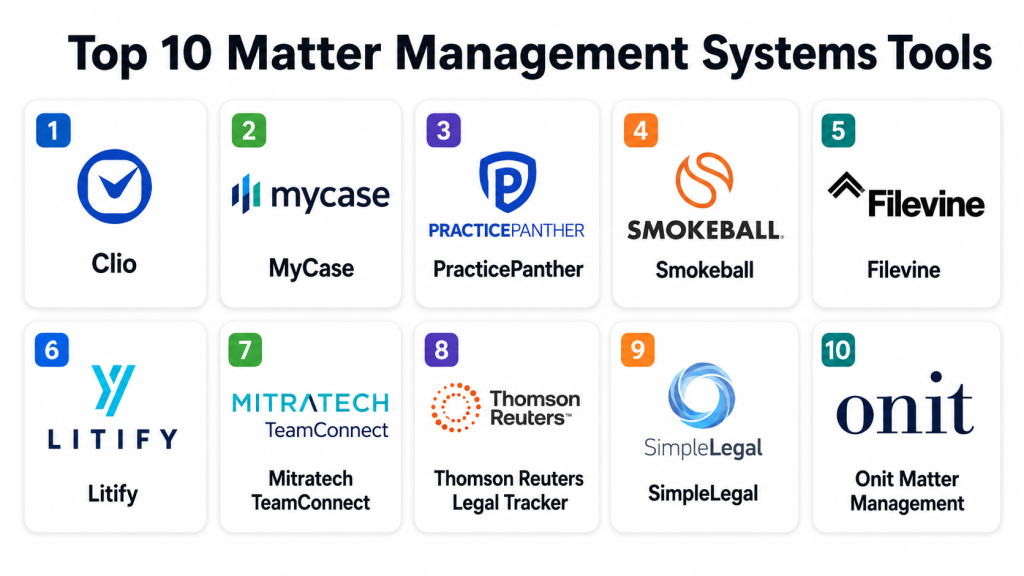
Top 10 Matter Management Systems Tools
#1 — Clio
Short description:
Clio is a cloud-based legal practice management platform used by law firms to manage matters, clients, documents, calendars, billing, payments, tasks, and communications. It is especially useful for solo lawyers, small firms, and growing law practices that want one central system for daily legal operations. Clio helps legal teams reduce manual administration and keep matter information organized. It is best suited for law firms that need an easy-to-use platform with strong practice management coverage.
Key Features
- Matter and client management
- Calendar and deadline tracking
- Task management and reminders
- Document storage and organization
- Time tracking, billing, and payment support
- Client communication workflows
- Integration marketplace for legal tools
Pros
- Easy to use for small and mid-sized law firms
- Strong all-in-one practice management coverage
- Useful for improving matter organization and billing workflows
Cons
- May not meet every complex enterprise legal department need
- Advanced customization can be limited compared with larger enterprise tools
- Pricing varies by plan and user needs
Platforms / Deployment
Web / Cloud / iOS / Android
Security & Compliance
Security details should be confirmed directly with the vendor. Buyers should ask about MFA, encryption, role-based access, audit logs, data backup, and compliance documentation.
SOC 2, ISO 27001, GDPR, HIPAA: Not publicly stated.
Integrations & Ecosystem
Clio has a strong legal technology ecosystem and connects with common tools used by law firms for communication, documents, accounting, and automation.
- Email and calendar tools
- Document management tools
- Accounting systems
- E-signature tools
- Payment tools
- Legal research and automation tools
Support & Community
Clio offers documentation, onboarding resources, customer support, training content, and a strong law firm user community. Support depth depends on subscription level and implementation needs.
#2 — MyCase
Short description:
MyCase is a law practice management platform that helps firms manage matters, clients, documents, billing, payments, communication, and case workflows. It is designed for law firms that want a simple cloud-based system to manage legal work and client relationships. MyCase is especially useful for small and mid-sized firms that need matter organization, client portals, time tracking, and everyday workflow support. It is best for legal teams that want practical matter management without heavy enterprise complexity.
Key Features
- Matter and case management
- Client portal and communication tools
- Document management
- Calendar and task tracking
- Time tracking and billing
- Online payment support
- Reporting and firm management dashboards
Pros
- Simple and practical for law firm operations
- Good client communication and portal features
- Useful for billing, matter tracking, and document organization
Cons
- May not fit complex corporate legal operations
- Advanced enterprise reporting may be limited
- Pricing varies by plan and usage
Platforms / Deployment
Web / Cloud / iOS / Android
Security & Compliance
Security details should be reviewed directly with the vendor. Buyers should confirm MFA, encryption, access controls, audit logs, backup, and compliance documentation.
SOC 2, ISO 27001, GDPR, HIPAA: Not publicly stated.
Integrations & Ecosystem
MyCase connects with tools that support legal practice workflows, payments, communication, and document handling.
- Email and calendar tools
- Payment processors
- Accounting systems
- Document tools
- Client communication tools
- E-signature workflows
Support & Community
MyCase provides customer support, help resources, onboarding guidance, and training content. Community strength is mainly law firm and practice-management focused.
#3 — PracticePanther
Short description:
PracticePanther is a legal practice management platform that helps law firms manage matters, clients, tasks, calendars, documents, billing, payments, and workflows. It is designed for firms that want organized matter tracking and simple automation for daily legal operations. PracticePanther is useful for solo, small, and mid-sized firms that need better visibility into deadlines, case activity, client communication, and billing. It is best suited for firms that want a user-friendly matter management system with practical workflow support.
Key Features
- Matter and client management
- Task and workflow automation
- Calendar and deadline management
- Time tracking and billing
- Document management
- Client communication tools
- Payment and invoice workflows
Pros
- Good fit for small and mid-sized law firms
- Useful automation for repetitive legal workflows
- Helps improve matter visibility and billing discipline
Cons
- May not be ideal for large enterprise legal departments
- Complex reporting needs may require workarounds
- Pricing varies by subscription plan
Platforms / Deployment
Web / Cloud / iOS / Android
Security & Compliance
Security details should be confirmed directly with the vendor. Buyers should ask about MFA, encryption, role-based access, data backup, and audit logging.
SOC 2, ISO 27001, GDPR, HIPAA: Not publicly stated.
Integrations & Ecosystem
PracticePanther integrates with common business and legal tools used by firms for productivity, documents, payments, and accounting.
- Email and calendar tools
- Accounting systems
- Payment tools
- Document storage systems
- E-signature platforms
- Automation tools
Support & Community
PracticePanther provides customer support, help content, onboarding resources, and product guidance. Support quality depends on selected plan and firm needs.
#4 — Smokeball
Short description:
Smokeball is legal practice management software focused on matter management, document automation, time tracking, billing, and law firm productivity. It is especially useful for small and mid-sized law firms that handle document-heavy matters and need better automation. Smokeball helps firms manage case information, automate repetitive document work, track activity, and improve billing visibility. It is best for legal practices that want matter management combined with strong document and productivity features.
Key Features
- Matter and case management
- Document automation
- Automatic time tracking support
- Billing and invoicing workflows
- Calendar and task management
- Client communication tools
- Reporting and productivity insights
Pros
- Strong document automation capabilities
- Useful for improving law firm productivity
- Good fit for matter-heavy and document-heavy practices
Cons
- May be more firm-focused than in-house legal focused
- Setup may require document template planning
- Pricing is not publicly stated for every use case
Platforms / Deployment
Web / Cloud / Windows / Mobile access may vary
Security & Compliance
Security details should be validated directly with the vendor. Buyers should request information about encryption, MFA, access controls, audit logs, backup, and compliance documentation.
SOC 2, ISO 27001, GDPR, HIPAA: Not publicly stated.
Integrations & Ecosystem
Smokeball works well with legal productivity and accounting workflows used by small and mid-sized law firms.
- Microsoft Office tools
- Email and calendar systems
- Accounting platforms
- Payment tools
- Document workflows
- Legal productivity tools
Support & Community
Smokeball provides onboarding, training, customer support, and legal practice guidance. Support is especially important when firms adopt document automation and new workflows.
#5 — Filevine
Short description:
Filevine is a legal work platform designed for matter management, case tracking, workflow automation, document management, reporting, and team collaboration. It is commonly used by law firms and legal teams that manage high-volume matters and need customizable workflows. Filevine is especially useful for litigation-heavy practices, personal injury firms, and teams that need structured case pipelines. It is best for firms that want strong workflow visibility, matter collaboration, and reporting across active cases.
Key Features
- Matter and case management
- Custom workflow automation
- Document and file organization
- Team collaboration tools
- Task and deadline tracking
- Reporting and analytics
- Communication and activity tracking
Pros
- Strong fit for high-volume legal matter workflows
- Flexible workflows for different practice areas
- Useful for team collaboration and case visibility
Cons
- May require thoughtful setup and configuration
- Smaller firms with simple needs may find it more than necessary
- Pricing is not publicly stated
Platforms / Deployment
Web / Cloud / Mobile access may vary
Security & Compliance
Security information should be confirmed directly with the vendor. Buyers should ask about MFA, RBAC, encryption, audit logs, access permissions, and compliance documentation.
SOC 2, ISO 27001, GDPR, HIPAA: Not publicly stated.
Integrations & Ecosystem
Filevine connects with tools used for legal documents, communication, productivity, and reporting.
- Email and calendar tools
- Document management systems
- E-signature tools
- Intake tools
- Reporting and analytics tools
- Communication platforms
Support & Community
Filevine provides implementation support, training, customer success resources, and product documentation. Support depth depends on firm size, configuration needs, and workflow complexity.
#6 — Litify
Short description:
Litify is a legal operating platform built on Salesforce and designed for law firms, corporate legal teams, and legal service organizations that need matter management, intake, workflows, reporting, and collaboration. Because it is built on Salesforce, it can be useful for organizations that want legal matter management connected with CRM-style data, automation, and enterprise reporting. Litify is best suited for legal teams that need flexible workflows, strong data structure, and scalable legal operations management.
Key Features
- Matter and case management
- Legal intake workflows
- Salesforce-based platform architecture
- Workflow automation and approvals
- Reporting and dashboards
- Document and task management
- Collaboration across legal teams
Pros
- Strong fit for Salesforce-centered organizations
- Flexible data model and workflow automation
- Useful for scalable legal operations and reporting
Cons
- May require Salesforce expertise
- Implementation can be more complex than simple firm tools
- Pricing is not publicly stated
Platforms / Deployment
Web / Cloud / Salesforce platform environment
Security & Compliance
Security depends partly on Salesforce environment and configuration. Buyers should validate SSO, MFA, RBAC, encryption, audit logs, and compliance documentation directly.
SOC 2, ISO 27001, GDPR, HIPAA: Not publicly stated for every implementation.
Integrations & Ecosystem
Litify benefits from the Salesforce ecosystem and can connect legal workflows with CRM, reporting, automation, and business systems.
- Salesforce tools
- Document systems
- E-signature platforms
- Reporting and analytics tools
- Intake tools
- Communication platforms
Support & Community
Litify provides vendor support, implementation services, training, and partner assistance. Support requirements may be higher for customized Salesforce-based workflows.
#7 — Mitratech TeamConnect
Short description:
Mitratech TeamConnect is an enterprise legal management platform designed for corporate legal departments that need matter management, legal spend management, e-billing, workflow automation, and reporting. It is especially useful for large in-house legal teams that manage many matters, outside counsel relationships, budgets, and compliance needs. TeamConnect helps legal operations teams gain better control over legal work and spend. It is best for enterprises with complex legal operations and governance requirements.
Key Features
- Enterprise matter management
- Legal spend and e-billing support
- Outside counsel management
- Workflow automation
- Budget and invoice tracking
- Reporting and analytics
- Legal operations governance support
Pros
- Strong fit for large corporate legal departments
- Useful for connecting matter management with legal spend
- Supports complex legal operations workflows
Cons
- May be too complex for small legal teams
- Implementation requires planning and governance
- Pricing is not publicly stated
Platforms / Deployment
Web / Cloud / Enterprise deployment / Varies by implementation
Security & Compliance
Security details should be confirmed directly with the vendor. Buyers should ask about SSO, MFA, RBAC, encryption, audit logs, data retention, and compliance documentation.
SOC 2, ISO 27001, GDPR, HIPAA: Not publicly stated.
Integrations & Ecosystem
TeamConnect can connect with enterprise legal, finance, document, and reporting systems used by corporate legal departments.
- Finance systems
- E-billing tools
- Document management systems
- Legal hold systems
- Reporting and BI tools
- Outside counsel collaboration workflows
Support & Community
Mitratech provides enterprise support, professional services, documentation, and implementation assistance. Support depth depends on selected modules and deployment complexity.
#8 — Thomson Reuters Legal Tracker
Short description:
Thomson Reuters Legal Tracker is an enterprise legal management system focused on matter management, e-billing, legal spend management, reporting, and outside counsel collaboration. It is used by corporate legal departments that need better control over legal matters, invoices, budgets, and law firm performance. Legal Tracker helps legal operations teams monitor matter activity, manage spend, and improve reporting. It is best suited for in-house legal teams that need matter management tightly connected with legal billing and outside counsel management.
Key Features
- Matter management for legal departments
- Legal e-billing and invoice review
- Outside counsel collaboration
- Budget and spend tracking
- Reporting and analytics
- Law firm performance visibility
- Legal operations workflow support
Pros
- Strong fit for corporate legal departments
- Useful for legal spend and matter visibility
- Good option for outside counsel management
Cons
- More focused on enterprise legal departments than law firms
- May require process alignment for invoice workflows
- Pricing is not publicly stated
Platforms / Deployment
Web / Cloud
Security & Compliance
Security details should be validated directly with the vendor. Buyers should ask about SSO, MFA, RBAC, encryption, audit logs, access controls, and compliance documentation.
SOC 2, ISO 27001, GDPR, HIPAA: Not publicly stated.
Integrations & Ecosystem
Legal Tracker works well with legal operations, finance, billing, and reporting workflows.
- Finance systems
- E-billing workflows
- Document management systems
- Outside counsel systems
- Reporting tools
- Legal operations platforms
Support & Community
Thomson Reuters provides enterprise support, documentation, training, and legal industry resources. Support experience depends on contract scope and implementation needs.
#9 — SimpleLegal
Short description:
SimpleLegal is a legal operations platform focused on matter management, legal spend management, e-billing, vendor management, and reporting for in-house legal teams. It helps legal departments centralize legal matters, manage invoices, track budgets, and gain visibility into legal costs. SimpleLegal is especially useful for legal operations teams that want a practical platform for matter tracking and legal spend control. It is best suited for mid-market and enterprise legal departments.
Key Features
- Matter management
- Legal spend management
- E-billing and invoice review
- Vendor and law firm management
- Budget tracking
- Reporting and analytics
- Legal operations dashboards
Pros
- Practical fit for in-house legal teams
- Strong legal spend and matter visibility
- Useful for improving invoice and budget control
Cons
- Less suited for law firm practice management
- Advanced customization may be limited compared with larger enterprise platforms
- Pricing is not publicly stated
Platforms / Deployment
Web / Cloud
Security & Compliance
Security details should be confirmed directly with the vendor. Buyers should review SSO, MFA, RBAC, encryption, audit logs, data protection, and compliance documentation.
SOC 2, ISO 27001, GDPR, HIPAA: Not publicly stated.
Integrations & Ecosystem
SimpleLegal connects legal operations workflows with finance, billing, and reporting systems.
- Finance systems
- E-billing workflows
- Accounting tools
- Legal vendor systems
- Reporting platforms
- Document management tools
Support & Community
SimpleLegal provides support, onboarding guidance, customer success resources, and legal operations assistance. Support depth depends on customer size and implementation complexity.
#10 — Onit Matter Management
Short description:
Onit Matter Management is part of Onit’s enterprise legal management and workflow automation platform. It helps corporate legal teams manage matters, intake, tasks, workflows, documents, approvals, and reporting. Onit is especially useful for legal departments that need configurable workflows and automation across legal operations. It is best suited for enterprise legal teams that want matter management connected with legal service requests, contracts, spend, and broader business process automation.
Key Features
- Legal matter management
- Legal intake and request workflows
- Task and approval automation
- Document and matter tracking
- Reporting and dashboards
- Legal operations workflow automation
- Integration with broader Onit legal platform
Pros
- Strong workflow automation capabilities
- Good fit for enterprise legal operations
- Useful for configurable legal intake and matter processes
Cons
- May require configuration planning and implementation support
- Smaller teams may not need the full platform depth
- Pricing is not publicly stated
Platforms / Deployment
Web / Cloud / Enterprise deployment
Security & Compliance
Security details should be validated directly with the vendor. Buyers should ask about SSO, MFA, RBAC, encryption, audit logs, access governance, and compliance documentation.
SOC 2, ISO 27001, GDPR, HIPAA: Not publicly stated.
Integrations & Ecosystem
Onit works well when legal matter management needs to connect with workflow automation, legal operations, contracts, spend, and enterprise systems.
- Legal intake systems
- Contract management tools
- Finance systems
- E-billing platforms
- Document repositories
- Reporting and analytics tools
Support & Community
Onit provides enterprise support, implementation assistance, customer success services, and workflow guidance. Support needs depend on configuration complexity and selected modules.
Comparison Table
| Tool Name | Best For | Platform(s) Supported | Deployment | Standout Feature | Public Rating |
|---|---|---|---|---|---|
| Clio | Solo, small, and growing law firms | Web / iOS / Android | Cloud | All-in-one law practice matter management | N/A |
| MyCase | Small and mid-sized law firms | Web / iOS / Android | Cloud | Client portal and practice management simplicity | N/A |
| PracticePanther | Small and mid-sized law firms | Web / iOS / Android | Cloud | Matter workflows with billing and automation | N/A |
| Smokeball | Document-heavy law firms | Web / Windows / Mobile varies | Cloud | Matter management with document automation | N/A |
| Filevine | High-volume legal matter workflows | Web / Mobile varies | Cloud | Custom case workflows and reporting | N/A |
| Litify | Salesforce-centered legal teams | Web | Cloud | Salesforce-based legal operating platform | N/A |
| Mitratech TeamConnect | Large corporate legal departments | Web | Cloud / Varies | Enterprise matter and legal spend management | N/A |
| Thomson Reuters Legal Tracker | In-house legal spend and matter control | Web | Cloud | Matter management with e-billing and outside counsel control | N/A |
| SimpleLegal | Mid-market and enterprise legal operations | Web | Cloud | Legal spend and matter visibility | N/A |
| Onit Matter Management | Enterprise legal workflow automation | Web | Cloud | Configurable legal intake and matter workflows | N/A |
Evaluation & Scoring of Matter Management Systems
| Tool Name | Core (25%) | Ease (15%) | Integrations (15%) | Security (10%) | Performance (10%) | Support (10%) | Value (15%) | Weighted Total (0–10) |
|---|---|---|---|---|---|---|---|---|
| Clio | 8 | 9 | 8 | 7 | 8 | 8 | 9 | 8.15 |
| MyCase | 8 | 9 | 7 | 7 | 8 | 8 | 8 | 7.90 |
| PracticePanther | 8 | 8 | 7 | 7 | 8 | 7 | 8 | 7.65 |
| Smokeball | 8 | 8 | 7 | 7 | 8 | 8 | 8 | 7.75 |
| Filevine | 9 | 7 | 8 | 7 | 8 | 8 | 8 | 8.00 |
| Litify | 8 | 7 | 9 | 8 | 8 | 8 | 7 | 7.95 |
| Mitratech TeamConnect | 9 | 7 | 9 | 8 | 9 | 8 | 7 | 8.25 |
| Thomson Reuters Legal Tracker | 8 | 8 | 8 | 8 | 8 | 8 | 8 | 8.00 |
| SimpleLegal | 8 | 8 | 8 | 8 | 8 | 8 | 8 | 8.00 |
| Onit Matter Management | 9 | 7 | 8 | 8 | 8 | 8 | 7 | 7.95 |
These scores are comparative and should be used as a shortlist guide. A law firm may value billing, client communication, and document workflows more than enterprise legal spend management. An in-house legal department may care more about outside counsel, budgets, e-billing, and reporting. Buyers should validate real workflows, integrations, security documentation, reporting needs, and user adoption before selecting a platform.
Which Matter Management System Tool Is Right for You?
Solo / Freelancer
Solo lawyers, independent legal consultants, and freelance legal professionals usually need simple matter tracking, calendar management, document organization, billing, and client communication. Clio, MyCase, PracticePanther, and Smokeball are practical options for this segment.
The main priority should be ease of use. A solo user does not need a heavy enterprise legal management platform unless they work inside a larger corporate legal environment. The best tool is usually the one that saves time, reduces missed deadlines, and keeps client work organized.
SMB
Small and mid-sized law firms need a system that supports matters, clients, tasks, deadlines, billing, payments, documents, and reporting without adding too much complexity. Clio, MyCase, PracticePanther, Smokeball, and Filevine can be strong options depending on practice area and workflow style.
For SMB legal teams, adoption is more important than feature count. The platform should be simple enough for lawyers, paralegals, assistants, and billing teams to use daily.
Mid-Market
Mid-market law firms and corporate legal teams usually need stronger reporting, workflow automation, document control, intake management, and collaboration. Filevine, Litify, SimpleLegal, Legal Tracker, and Onit can be useful depending on whether the team is firm-focused or in-house focused.
Mid-market buyers should pay close attention to integration with email, calendars, accounting, finance, document management, and reporting tools. Disconnected legal systems often create duplicate work.
Enterprise
Large enterprises need scalable matter management with strong security, outside counsel management, legal spend tracking, e-billing, reporting, workflow automation, and governance. Mitratech TeamConnect, Thomson Reuters Legal Tracker, Onit Matter Management, SimpleLegal, and Litify are strong enterprise candidates.
Enterprise buyers should evaluate role-based permissions, audit logs, global matter structures, budget tracking, law firm collaboration, invoice review, business unit reporting, and integration with finance systems.
Budget vs Premium
Budget-conscious teams should start with essential matter management: matter records, deadlines, tasks, documents, billing, and basic reporting. Clio, MyCase, PracticePanther, and Smokeball can be practical for smaller teams.
Premium buyers should invest in legal spend management, e-billing, workflow automation, outside counsel performance, advanced dashboards, and enterprise integrations. Mitratech, Legal Tracker, SimpleLegal, Onit, and Litify are stronger options when governance and scale matter.
Feature Depth vs Ease of Use
Feature-rich systems can support complex legal operations, but they may require more implementation work, user training, and process governance. TeamConnect, Onit, Litify, and Filevine are better suited for teams that need custom workflows and deeper reporting.
Ease-focused teams may prefer Clio, MyCase, PracticePanther, or Smokeball. These tools are often easier for smaller firms to adopt because they focus on practical daily legal work.
Integrations & Scalability
Matter management systems should connect with email, calendars, document management systems, e-signature tools, finance platforms, accounting systems, CRM, legal spend tools, and reporting platforms. Strong integration reduces duplicate entry and improves data accuracy.
For scalability, buyers should evaluate user permissions, matter templates, reporting structures, API support, document storage, mobile access, workflow automation, and ability to handle growing matter volume.
Security & Compliance Needs
Matter management systems store sensitive legal data, including litigation files, client records, contracts, investigation notes, invoices, privileged communications, and confidential business information. Security must be reviewed before migration.
Buyers should ask vendors about MFA, SSO, RBAC, encryption, audit logs, backup, data retention, data residency, access reviews, disaster recovery, and incident response. If certifications are not publicly stated, request official documentation.
Frequently Asked Questions
1. What is a matter management system?
A matter management system is software that helps legal teams organize and manage legal matters, cases, tasks, documents, deadlines, communications, invoices, and reporting. It gives teams one central place to track legal work.
2. How is matter management different from case management?
Case management is often used for law firm litigation or client matters, while matter management is broader and may include corporate legal work, contracts, compliance, investigations, outside counsel, legal spend, and internal legal requests.
3. How much does matter management software cost?
Pricing varies based on users, features, storage, billing tools, integrations, support, and deployment complexity. Most enterprise vendors do not publish fixed pricing, so buyers usually need a custom quote.
4. What features are most important in matter management software?
Important features include matter intake, task tracking, document management, calendar deadlines, workflow automation, legal spend tracking, reporting, e-billing, outside counsel collaboration, access control, and integrations.
5. Can matter management software reduce legal workload?
Yes, it can reduce manual tracking, repeated status updates, missed deadlines, scattered emails, and document confusion. It helps legal teams work from one organized system instead of many disconnected tools.
6. Is matter management software useful for in-house legal teams?
Yes, in-house legal teams use matter management systems to track legal requests, outside counsel work, budgets, invoices, risk, deadlines, and business unit support. Enterprise tools often include legal spend and reporting features.
7. Is matter management software useful for law firms?
Yes, law firms use matter management systems to manage client matters, tasks, deadlines, documents, billing, payments, and communications. Firm-focused tools often include client portals and practice management features.
8. What mistakes should buyers avoid?
Common mistakes include choosing software without mapping workflows, skipping user training, ignoring data migration, failing to define matter types, not setting permissions correctly, and selecting a tool that does not match team size.
9. Are matter management systems secure?
They can be secure when vendors provide strong authentication, encryption, role permissions, audit logs, backup, and access controls. Buyers should request security documentation because legal matter data is often highly confidential.
10. Can small legal teams use matter management systems?
Yes, small legal teams can use simple cloud-based matter management tools. They should focus on easy setup, calendar tracking, document organization, task management, and billing instead of heavy enterprise features.
Conclusion
Matter management systems help legal teams organize matters, reduce manual work, improve visibility, manage deadlines, control legal spend, and support better legal operations. The right platform depends on whether the buyer is a law firm, in-house legal department, solo lawyer, mid-sized practice, or large enterprise legal team. Clio, MyCase, PracticePanther, and Smokeball are practical for small and mid-sized firms. Filevine and Litify are strong for workflow-driven and scalable legal operations. Mitratech TeamConnect, Thomson Reuters Legal Tracker, SimpleLegal, and Onit are better suited for corporate legal departments that need spend management, outside counsel control, reporting, and governance.
