Upgrade & Secure Your Future with DevOps, SRE, DevSecOps, MLOps!
We spend hours scrolling social media and waste money on things we forget, but won’t spend 30 minutes a day earning certifications that can change our lives.
Master in DevOps, SRE, DevSecOps & MLOps by DevOps School!
Learn from Guru Rajesh Kumar and double your salary in just one year.
Introduction
Prompt engineering tools are platforms and software that help users create, refine, and optimize prompts for AI models. In simple terms, these tools allow users to design effective instructions that maximize the performance and accuracy of AI outputs, whether for text, code, image, or multimodal generation. Prompt engineering is a crucial step in achieving high-quality, consistent, and reliable results from AI models.
In and beyond, prompt engineering tools are increasingly essential as businesses rely on AI for content creation, data analysis, customer service, software development, and creative tasks. AI models are powerful, but without well-crafted prompts, outputs can be inaccurate, inconsistent, or irrelevant. These tools improve productivity, reduce errors, and enable teams to harness AI effectively.
Common use cases include:
- Optimizing prompts for AI writing and content generation
- Refining inputs for AI code assistants and software development
- Generating accurate AI-driven marketing, sales, and business reports
- Improving outputs for AI image and video generation tools
- Designing multi-step or chain-of-thought prompts for complex reasoning
Buyers should evaluate:
- Prompt versioning and history
- Template and workflow support
- AI model compatibility
- Output evaluation and analytics
- Collaboration and sharing features
- Integration with AI platforms or APIs
- Security and access control
- Scalability across teams
- Reuse and automation capabilities
- Pricing models and licensing
Best for: AI developers, data scientists, content teams, marketing teams, product teams, and enterprises that deploy AI at scale.
Not ideal for: Individuals who rarely use AI, teams with simple AI workflows, or organizations that do not require multi-model prompt optimization.
Key Trends in Prompt Engineering Tools
- Support for multiple AI model providers in a single interface.
- Advanced analytics for prompt effectiveness and output quality.
- Integration with enterprise collaboration tools for team-based prompt management.
- Template libraries and pre-built prompt workflows for common business tasks.
- Chain-of-thought and multi-step reasoning prompt management.
- Automation and API-first approaches for large-scale AI workflows.
- AI-assisted prompt suggestions and optimizations.
- Secure team workspaces with RBAC and audit logs.
- Cross-modal prompt support for text, image, audio, and video generation.
- Usage-based pricing and enterprise licensing for large teams.
How We Selected These Tools
- Market adoption and recognition among AI development and enterprise teams.
- Feature completeness including prompt design, optimization, evaluation, and versioning.
- Reliability and performance indicators across AI models.
- Security and compliance capabilities in enterprise deployments.
- Integration with popular AI APIs, platforms, and internal systems.
- Fit for freelancers, SMBs, mid-market, and enterprise teams.
- Usability and accessibility for technical and non-technical users.
- Support for multi-step, chain-of-thought, and complex prompt workflows.
- Analytics and monitoring features to track prompt effectiveness.
- Overall value for organizations scaling AI deployments.
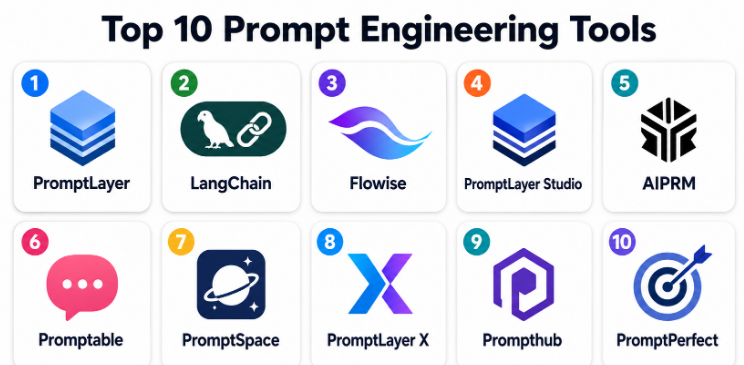
Top 10 Prompt Engineering Tools
#1 — PromptLayer
Short description:
PromptLayer is a comprehensive prompt management platform that helps teams track, version, and analyze AI prompts across multiple models.
It is suitable for AI developers, data scientists, and enterprises running complex AI workflows.
The platform provides analytics for prompt performance, history tracking, and workflow integrations.
Users can optimize prompts for various AI outputs, manage multi-step reasoning prompts, and ensure reproducibility.
PromptLayer supports team collaboration with role-based access and secure sharing.
It integrates with APIs from leading AI models for seamless deployment.
It is ideal for teams that need scalable prompt management and analytics.
It helps organizations reduce errors and improve AI output quality consistently.
Key Features
- Prompt versioning and history
- Performance analytics and reporting
- Multi-model AI support
- Workflow automation
- Role-based collaboration
- API integration for deployment
- Template and reusable prompt management
Pros
- Strong for team collaboration and prompt auditing
- Multi-model support increases flexibility
- Enhances reproducibility of AI outputs
Cons
- Advanced features may require technical expertise
- Pricing may be high for small teams
- Learning curve for non-technical users
Platforms / Deployment
Web / Cloud
Security & Compliance
- RBAC, encryption, and audit logs
- SOC 2, GDPR compliance supported
Integrations & Ecosystem
Integrates with AI model APIs and workflow systems.
- OpenAI models
- AI21 Studio
- Hugging Face
- Internal AI APIs
- Workflow automation platforms
- Data analytics pipelines
Support & Community
Documentation, onboarding resources, and enterprise support available. Active developer community.
#2 — LangChain
Short description:
LangChain is a framework for building AI agents and managing prompts for complex workflows.
It is suitable for developers, AI researchers, and enterprises creating multi-step reasoning agents.
The platform allows chaining prompts, integrating tools, APIs, and external data sources.
LangChain supports memory management and prompt optimization across agents.
It enables developers to deploy AI solutions for customer support, research, content generation, and automation.
Multi-agent orchestration is supported for complex AI workflows.
LangChain emphasizes flexibility, extensibility, and custom agent design.
It is a developer-focused solution for sophisticated prompt engineering.
Key Features
- Prompt chaining and orchestration
- API and tool integration
- Memory and context management
- Multi-step reasoning workflows
- Analytics and monitoring
- Customizable prompt pipelines
- Developer-focused templates
Pros
- Highly flexible for complex workflows
- Strong developer ecosystem
- Supports multi-agent orchestration
Cons
- Requires programming expertise
- Not turnkey for non-developers
- Security and compliance depend on deployment
Platforms / Deployment
Web / Self-hosted / Cloud
Security & Compliance
Varies / N/A – depends on deployment.
Integrations & Ecosystem
Integrates with internal APIs, databases, and workflow pipelines.
- Enterprise databases
- CRM and ERP systems
- Automation pipelines
- API-based workflows
- Knowledge bases
Support & Community
Active developer community and open-source documentation.
#3 — Flowise
Short description:
Flowise is a visual prompt engineering tool that allows users to design, test, and deploy AI prompts using a drag-and-drop interface.
It is suitable for marketers, AI enthusiasts, and developers seeking low-code solutions.
The platform supports prompt chaining, multi-step workflows, and API integrations.
Flowise allows collaboration across teams and version control for prompt experiments.
It supports monitoring and evaluation of AI output effectiveness.
The platform is ideal for teams that want quick iteration without heavy coding.
It can connect to multiple AI models for diverse outputs.
Flowise is particularly useful for prototyping and prompt experimentation.
Key Features
- Visual prompt design
- Multi-step workflows
- Model integrations
- Team collaboration
- Version control
- Analytics for prompt performance
- API connections
Pros
- Low-code visual interface
- Easy for non-developers to prototype prompts
- Supports multiple AI models
Cons
- Limited for highly complex workflows
- May require technical setup for enterprise-scale
- Advanced features may be behind premium plans
Platforms / Deployment
Web / Cloud
Security & Compliance
- Role-based access control
- Varies / N/A for compliance
Integrations & Ecosystem
Supports AI APIs, workflow tools, and analytics systems.
- OpenAI
- LangChain connectors
- Custom APIs
- Automation platforms
- Analytics tools
Support & Community
Documentation, tutorials, and support forums available.
#4 — PromptLayer Studio
Short description:
PromptLayer Studio is a workspace for managing, versioning, and analyzing prompts for teams.
It is suitable for AI teams, content creators, and developers needing organized prompt workflows.
The platform allows multi-step prompt testing, analytics tracking, and collaboration.
Users can store prompt templates, share across teams, and monitor performance.
It integrates with multiple AI model APIs for seamless deployment.
The tool is valuable for enterprises maintaining prompt consistency.
PromptLayer Studio emphasizes prompt reuse, testing, and performance reporting.
It helps organizations maintain high-quality AI output at scale.
Key Features
- Prompt versioning and management
- Multi-step testing workflows
- Analytics dashboards
- Team collaboration
- Template storage and reuse
- API integrations
- Performance monitoring
Pros
- Improves prompt governance
- Enables performance tracking and optimization
- Facilitates collaboration across teams
Cons
- Can be complex for solo users
- Integration requires setup
- Premium plans may be expensive
Platforms / Deployment
Web / Cloud
Security & Compliance
- Encryption and audit logging
- SOC 2 and GDPR features supported
Integrations & Ecosystem
Integrates with AI models and workflow tools.
- OpenAI API
- AI21 Studio
- Hugging Face
- Internal enterprise APIs
- Analytics and monitoring dashboards
Support & Community
Enterprise support, documentation, and community forums available.
#5 — AIPRM
Short description:
AIPRM is a prompt library and management tool for AI content generation.
It is suitable for content marketers, SEO teams, and AI writers.
The platform provides pre-built prompts, customizable templates, and workflow management.
Users can track prompt performance and organize prompts for teams.
It integrates with popular AI writing models for content optimization.
AIPRM helps marketing teams streamline AI-driven content production.
It supports collaboration and prompt sharing across teams.
The tool is ideal for content-focused prompt engineering and experimentation.
Key Features
- Prompt library and templates
- Customizable prompts
- Performance tracking
- Multi-user collaboration
- Model integrations
- Workflow organization
- Analytics for prompt effectiveness
Pros
- Pre-built marketing prompts save time
- Supports team collaboration
- Easy to use for non-developers
Cons
- Focused mainly on content generation
- Limited for complex reasoning or multi-agent workflows
- Advanced analytics may require premium plan
Platforms / Deployment
Web / Cloud
Security & Compliance
Varies / N/A
Integrations & Ecosystem
Integrates with content generation models and marketing workflows.
- OpenAI models
- ChatGPT extensions
- Content management systems
- SEO tools
- Collaboration platforms
Support & Community
Documentation and support forums available; strong community for content-focused AI users.
#6 — Promptable
Short description:
Promptable is a collaborative platform for designing, testing, and sharing AI prompts.
It is suitable for development teams, marketers, and AI practitioners.
The platform supports prompt versioning, analytics, team collaboration, and multi-model support.
Users can experiment with prompts, monitor results, and deploy to AI systems.
Promptable emphasizes productivity and structured workflows.
It is ideal for teams creating reusable and optimized prompts at scale.
The platform supports analytics and integration with multiple AI APIs.
Teams can maintain prompt quality and governance.
Key Features
- Collaborative prompt workspace
- Version control
- Analytics dashboards
- Multi-model support
- Reusable prompt templates
- API integration
- Team collaboration tools
Pros
- Improves team productivity
- Enables prompt reuse and consistency
- Analytics helps optimize outputs
Cons
- Requires team adoption for maximum value
- Premium features may be costly
- Integration setup may need technical expertise
Platforms / Deployment
Web / Cloud
Security & Compliance
- Role-based access
- Varies / N/A
Integrations & Ecosystem
Supports integration with AI models, workflow tools, and team dashboards.
- OpenAI
- Hugging Face
- AI21 Studio
- API workflows
- Analytics dashboards
Support & Community
Documentation, tutorials, and support resources available.
#7 — PromptSpace
Short description:
PromptSpace is a community-driven platform for sharing, testing, and discovering AI prompts.
It is suitable for content creators, marketers, developers, and AI enthusiasts.
The platform provides prompt marketplaces, community voting, collaboration, and template storage.
Users can track performance, discover best practices, and share workflows.
PromptSpace supports prompt versioning and experimentation for multi-step reasoning.
It is particularly useful for teams that want to leverage community-tested prompts.
The tool emphasizes knowledge sharing and iterative improvement.
It helps organizations standardize and optimize prompt usage across teams.
Key Features
- Community prompt sharing
- Templates and marketplaces
- Analytics tracking
- Version control
- Collaboration features
- Multi-step prompt workflows
- Performance insights
Pros
- Leverages community-tested prompts
- Encourages best practices
- Supports collaboration
Cons
- Focused on prompt discovery rather than enterprise orchestration
- Limited governance features
- May require filtering for enterprise use
Platforms / Deployment
Web / Cloud
Security & Compliance
Varies / N/A
Integrations & Ecosystem
Integrates with AI model APIs for prompt testing and deployment.
- OpenAI
- AI21 Studio
- Hugging Face
- API endpoints
- Workflow tools
Support & Community
Community forums, documentation, and support available. Strong community presence.
#8 — PromptLayer X
Short description:
PromptLayer X is an advanced prompt management platform for developers and AI teams.
It provides tracking, versioning, analytics, and multi-agent support.
Suitable for enterprises, AI research teams, and content teams managing high volumes of prompts.
The platform integrates with multiple AI models for consistent deployment.
It offers performance monitoring, collaboration features, and prompt optimization workflows.
PromptLayer X is ideal for teams that require structured prompt management at scale.
It emphasizes reliability, auditability, and analytics-driven improvement.
Teams can maintain reproducible and high-quality AI outputs.
Key Features
- Advanced prompt analytics
- Multi-model AI integration
- Versioning and history tracking
- Multi-agent orchestration
- Team collaboration
- Performance monitoring
- API-based deployment
Pros
- Strong for enterprise and developer teams
- Analytics-driven improvement
- Supports complex workflows
Cons
- Requires technical setup
- Premium plans may be costly
- Learning curve for non-technical users
Platforms / Deployment
Web / Cloud
Security & Compliance
- RBAC and audit logs
- SOC 2, GDPR supported
Integrations & Ecosystem
Supports integration with AI models, APIs, and workflow management.
- OpenAI
- AI21 Studio
- LangChain
- Internal APIs
- Automation pipelines
Support & Community
Documentation, tutorials, and enterprise support. Active developer community.
#9 — Prompthub
Short description:
Prompthub is a prompt repository and management tool for AI practitioners.
It is suitable for developers, content teams, and AI researchers.
The platform allows prompt storage, versioning, sharing, and analytics.
Prompthub helps teams standardize prompt creation and reuse across multiple AI models.
It supports collaborative workflows and performance tracking.
It is ideal for teams managing large prompt libraries for content, research, or automation.
Prompthub emphasizes workflow efficiency, scalability, and analytics.
Users can deploy prompts consistently and monitor effectiveness.
Key Features
- Prompt library and repository
- Version control
- Collaboration features
- Performance monitoring
- Multi-model support
- API integration
- Analytics dashboards
Pros
- Improves team prompt management
- Standardizes reusable prompts
- Supports analytics-driven optimization
Cons
- Limited for creative AI prompt generation
- Enterprise features may require setup
- Integration setup may be needed
Platforms / Deployment
Web / Cloud
Security & Compliance
Varies / N/A
Integrations & Ecosystem
Integrates with AI model APIs, workflow systems, and team dashboards.
- OpenAI
- Hugging Face
- LangChain
- Automation tools
- Knowledge management systems
Support & Community
Documentation, tutorials, and support resources available. Active user community.
#10 — PromptPerfect
Short description:
PromptPerfect is a prompt optimization platform for AI content, coding, and multimodal tasks.
It is suitable for developers, marketers, and AI teams optimizing prompt outputs.
The platform provides prompt refinement, testing, and performance tracking.
Users can analyze outputs, generate variations, and deploy optimized prompts.
PromptPerfect integrates with multiple AI models and workflows.
It emphasizes output quality, reproducibility, and efficiency.
It is ideal for teams seeking high-quality, consistent AI responses.
The tool allows rapid iteration and collaboration on prompt design.
Key Features
- Prompt optimization
- Output evaluation and analytics
- Multi-model support
- Testing and refinement workflows
- Collaboration features
- Template management
- API integration
Pros
- Improves output quality and consistency
- Supports multiple AI models
- Rapid iteration and optimization
Cons
- Focused on refinement rather than full orchestration
- Premium features may be costly
- Learning curve for new users
Platforms / Deployment
Web / Cloud
Security & Compliance
Varies / N/A
Integrations & Ecosystem
Integrates with AI APIs, content workflows, and automation systems.
- OpenAI
- AI21 Studio
- LangChain
- Internal APIs
- Workflow automation
Support & Community
Documentation, tutorials, and support resources available. Community support for AI teams.
Comparison Table
| Tool Name | Best For | Platform(s) Supported | Deployment | Standout Feature | Public Rating |
|---|---|---|---|---|---|
| PromptLayer | Team prompt management | Web | Cloud | Prompt versioning and analytics | N/A |
| LangChain | Multi-agent developer workflows | Web | Self-hosted / Cloud | LLM orchestration | N/A |
| Flowise | Visual prompt design | Web | Cloud | Drag-and-drop prompt chaining | N/A |
| PromptLayer Studio | Enterprise prompt tracking | Web | Cloud | Multi-step prompt analysis | N/A |
| AIPRM | Content-focused prompt templates | Web | Cloud | Pre-built marketing prompts | N/A |
| Promptable | Collaborative prompt workspace | Web | Cloud | Reusable prompt templates | N/A |
| PromptSpace | Community prompt sharing | Web | Cloud | Marketplace and community prompts | N/A |
| PromptLayer X | Advanced enterprise workflows | Web | Cloud | Analytics-driven multi-agent prompt management | N/A |
| Prompthub | Prompt repository and analytics | Web | Cloud | Library and performance tracking | N/A |
| PromptPerfect | Prompt optimization | Web | Cloud | Output evaluation and refinement | N/A |
Evaluation & Scoring of Prompt Engineering Tools
| Tool Name | Core (25%) | Ease (15%) | Integrations (15%) | Security (10%) | Performance (10%) | Support (10%) | Value (15%) | Weighted Total (0–10) |
|---|---|---|---|---|---|---|---|---|
| PromptLayer | 9 | 8 | 8 | 8 | 8 | 8 | 7 | 8.10 |
| LangChain | 9 | 7 | 8 | 6 | 8 | 7 | 7 | 7.70 |
| Flowise | 8 | 9 | 7 | 7 | 8 | 7 | 7 | 7.80 |
| PromptLayer Studio | 9 | 8 | 8 | 8 | 8 | 8 | 7 | 8.10 |
| AIPRM | 7 | 9 | 7 | 6 | 7 | 7 | 8 | 7.35 |
| Promptable | 8 | 8 | 8 | 7 | 8 | 7 | 7 | 7.70 |
| PromptSpace | 7 | 8 | 7 | 6 | 7 | 7 | 7 | 7.05 |
| PromptLayer X | 9 | 7 | 8 | 8 | 8 | 8 | 7 | 8.05 |
| Prompthub | 8 | 8 | 7 | 7 | 7 | 7 | 7 | 7.45 |
| PromptPerfect | 8 | 8 | 7 | 7 | 8 | 7 | 7 | 7.60 |
Scores are comparative; higher scores indicate stronger overall capabilities in prompt management, optimization, and workflow efficiency.
Which Prompt Engineering Tool Is Right for You?
Solo / Freelancer
Solo users should prioritize ease of use, templates, and low-cost access. Flowise, AIPRM, and PromptPerfect are practical starting points.
SMB
Small teams should choose tools that balance collaboration, analytics, and prompt optimization. PromptLayer Studio, Promptable, and PromptLayer X are suitable options.
Mid-Market
Mid-market teams need multi-agent orchestration, versioning, and analytics. LangChain, PromptLayer, and PromptLayer X can help manage complex prompt workflows.
Enterprise
Enterprises should prioritize governance, multi-model integration, security, and analytics. PromptLayer Studio, LangChain, and PromptLayer X are strong candidates.
Budget vs Premium
Budget-conscious teams may choose Flowise, AIPRM, or PromptPerfect. Premium plans offer multi-agent orchestration, enterprise analytics, and team collaboration features.
Feature Depth vs Ease of Use
Ease of use: Flowise, AIPRM, PromptPerfect
Feature depth: LangChain, PromptLayer X, PromptLayer Studio
Integrations & Scalability
Teams should confirm integration with AI model APIs, automation pipelines, CRM systems, and workflow platforms. Scalability depends on platform and licensing.
Security & Compliance Needs
Review RBAC, audit logs, encryption, SSO/MFA, and compliance certifications (SOC 2, ISO 27001, GDPR). High-stakes enterprise environments require verified security controls.
Frequently Asked Questions
1. What is a prompt engineering tool?
A prompt engineering tool helps users design, optimize, and manage prompts to get better results from AI models.
2. Who should use these tools?
Developers, content teams, marketers, AI researchers, and enterprises deploying AI at scale benefit most.
3. Can these tools work with multiple AI models?
Yes. Most platforms support OpenAI, AI21, Hugging Face, and other AI APIs for prompt deployment.
4. Do prompt engineering tools improve AI output quality?
Yes. By structuring, testing, and refining prompts, these tools improve relevance, accuracy, and consistency of AI-generated outputs.
5. How do pricing models work?
Pricing can be subscription-based, per-seat, or usage-based, depending on the number of prompts, agents, or workflow executions.
6. Can non-technical teams use these tools?
Some tools like Flowise, AIPRM, and PromptPerfect offer visual or low-code interfaces suitable for non-technical users.
7. Are these tools secure for enterprise data?
Enterprise-grade platforms offer RBAC, encryption, SSO, audit logs, and compliance certifications. Users should confirm security features for sensitive data.
8. Do these tools support collaboration?
Yes. Most provide team workspaces, versioning, template sharing, and workflow collaboration.
9. Can these tools track prompt performance?
Yes. Analytics dashboards, performance tracking, and output evaluation help optimize prompt effectiveness.
10. Are prompt engineering tools suitable for creative AI workflows?
Yes. Tools like LangChain, PromptLayer, and Promptable can support creative, multi-step, and multi-agent AI workflows.
Conclusion
Prompt engineering tools are critical for leveraging AI effectively across teams and enterprises. Selecting the right platform depends on team size, workflow complexity, AI models, collaboration needs, and budget. Flowise, AIPRM, and PromptPerfect are ideal for solo users and SMBs. PromptLayer, PromptLayer Studio, and PromptLayer X provide enterprise-grade collaboration, analytics, and multi-agent orchestration. LangChain is developer-focused for complex AI workflows.
