Upgrade & Secure Your Future with DevOps, SRE, DevSecOps, MLOps!
We spend hours scrolling social media and waste money on things we forget, but won’t spend 30 minutes a day earning certifications that can change our lives.
Master in DevOps, SRE, DevSecOps & MLOps by DevOps School!
Learn from Guru Rajesh Kumar and double your salary in just one year.
Introduction
Reverse ETL tools are specialized platforms that move data from centralized warehouses or lakes back into operational systems such as CRMs, marketing automation, ad platforms, and other SaaS tools. In simple terms, these tools take your modeled, clean data and push it into the tools where teams interact with customers and execute campaigns.
The importance of reverse ETL is growing as organizations rely on data-driven operations for marketing, sales, and customer success. In influencer marketing, for example, analytics and insights are valuable only when they are actionable in CRM or marketing automation tools. Reverse ETL bridges the gap between analytics and execution, enabling teams to act on the most up-to-date information.
Use cases include:
- Syncing audience segmentation from warehouses to email marketing or CRM platforms.
- Pushing influencer performance metrics from analytics systems to operational platforms.
- Delivering predictive scores for sales pipelines.
- Updating personalization engines in e-commerce and subscription services.
- Operationalizing AI insights into marketing or ad campaigns.
Evaluation criteria for buyers:
- Real-time or batch sync support
- Ease of use and pipeline configuration
- Security and compliance (SOC 2, ISO 27001, GDPR)
- Integration options with operational systems
- Automation and scheduling capabilities
- Monitoring, error handling, and logging
- Scalability for large datasets and multiple destinations
- Cost efficiency
- Community support and documentation
Best for: Data engineering, analytics, marketing operations, and sales operations teams in mid-market and enterprise organizations.
Not ideal for: Organizations with minimal data complexity or single-system operational tools that do not require advanced integrations.
Key Trends in Reverse ETL Tools
- AI-assisted mapping and transformations to simplify pipelines.
- Automation for near-real-time syncing across multiple platforms.
- Low-code and no-code pipeline builders for faster deployment.
- Expanded connectors for marketing, sales, and customer success platforms.
- Enhanced governance, audit trails, and compliance features.
- Multi-cloud and hybrid deployment support.
- Serverless architectures to reduce infrastructure management.
- Usage-based pricing models.
- Monitoring dashboards with error detection and alerts.
- Support for structured, semi-structured, and unstructured data.
How We Selected These Tools (Methodology)
- Evaluated market adoption and mindshare across SMB and enterprise segments.
- Assessed feature completeness including real-time and batch sync, connectors, and transformations.
- Reviewed reliability and performance signals through benchmarks and case studies.
- Considered security posture and compliance certifications (SOC 2, GDPR).
- Analyzed integration options and ecosystem flexibility.
- Checked support quality, onboarding, and documentation.
- Prioritized scalability, automation, and low-maintenance operation.
- Balanced enterprise-grade solutions with SMB-friendly tools.
- Excluded niche or unsupported platforms lacking adoption or active development.
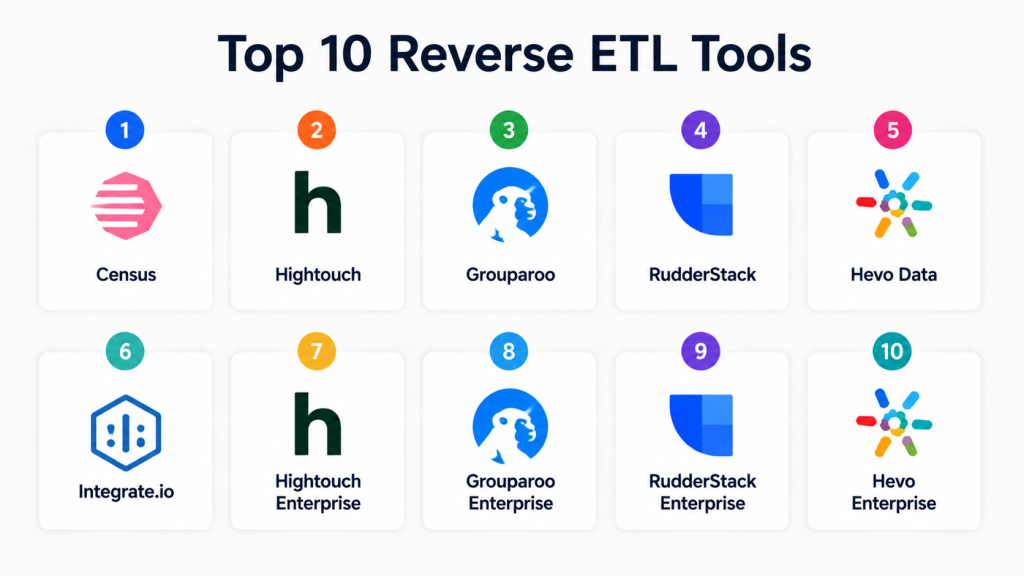
Top 10 Reverse ETL Tools
#1 — Census
Short description: Census automates syncing warehouse data to operational systems, enabling sales, marketing, and support teams to act on clean data. Ideal for organizations needing real-time updates across multiple SaaS platforms.
Key Features
- Two-way syncing between warehouse and operational apps
- Pre-built connectors for CRM, marketing, and support tools
- Real-time and scheduled data sync
- Customizable transformations
- Monitoring dashboards with error tracking
- Multi-cloud support
- Data lineage and governance
Pros
- Quick integration with popular SaaS apps
- Strong error handling and monitoring
Cons
- Advanced setup may require technical expertise
- Pricing scales with data volume
Platforms / Deployment
- Web / Cloud
Security & Compliance
- Encryption, RBAC
- SOC 2, GDPR
Integrations & Ecosystem
- Salesforce, HubSpot, Marketo
- Snowflake, BigQuery, Redshift
- APIs for custom connectors
Support & Community
- Email and chat support
- Documentation and community resources
#2 — Hightouch
Short description: Hightouch enables no-code operational pipelines, syncing warehouse data to marketing and sales platforms. Ideal for teams needing fast deployment without engineering overhead.
Key Features
- No-code workflow builder
- Multi-destination syncing
- Real-time and batch updates
- Transformation inside pipelines
- Monitoring and alerts
- Cloud-native architecture
- Integration with analytics and BI tools
Pros
- Fast setup for marketing and sales teams
- Supports multiple operational destinations
Cons
- Complex transformations may require SQL knowledge
- Limited on-premise deployment
Platforms / Deployment
- Web / Cloud
Security & Compliance
- Encryption, MFA
- SOC 2, GDPR
Integrations & Ecosystem
- Salesforce, HubSpot, Marketo
- Redshift, BigQuery, Snowflake
- APIs for custom pipelines
Support & Community
- Tiered support plans
- Documentation and community forums
#3 — Grouparoo
Short description: Grouparoo is an open-source reverse ETL solution enabling repeatable syncing from warehouses to operational tools. Suitable for technical teams seeking flexibility and control.
Key Features
- Open-source and self-hosted options
- Pre-built connectors for marketing and sales tools
- Batch and near-real-time syncing
- Event-driven triggers
- Custom transformations
- Logging and monitoring
- Scalable architecture
Pros
- Flexible and open-source
- Developer-friendly
Cons
- Technical setup required
- Community support may be limited
Platforms / Deployment
- Web / Windows / Linux / Cloud
- Self-hosted / Cloud
Security & Compliance
- Encryption, RBAC
- Not publicly stated
Integrations & Ecosystem
- HubSpot, Salesforce, Intercom
- Snowflake, BigQuery, Redshift
- APIs for custom pipelines
Support & Community
- Community support
- Active GitHub and documentation
#4 — RudderStack
Short description: Developer-friendly platform for real-time warehouse-to-app data pipelines, supporting marketing, sales, and operational analytics.
Key Features
- Event-streaming and batch processing
- Wide connector library
- In-pipeline transformations
- Real-time monitoring and error alerts
- Cloud-native architecture
- Hybrid deployment support
- Automated error handling
Pros
- High-performance pipelines
- Flexible transformations
Cons
- Non-developers may face learning curve
- Advanced features require technical setup
Platforms / Deployment
- Web / Linux / Cloud
- Cloud / Hybrid
Security & Compliance
- Encryption, RBAC
- SOC 2, GDPR
Integrations & Ecosystem
- Salesforce, HubSpot, Marketo
- Snowflake, Redshift, BigQuery
- API access for custom pipelines
Support & Community
- Developer-focused support
- Community Slack, forums, and documentation
#5 — Hevo Data
Short description: Hevo Data provides no-code, real-time pipelines to move warehouse data to multiple operational destinations, enabling immediate actionable insights.
Key Features
- No-code interface
- Real-time and batch replication
- Wide connector library
- Automated schema mapping
- Monitoring dashboards
- Cloud-native architecture
- Multi-destination support
Pros
- Quick deployment
- Minimal maintenance
Cons
- Limited advanced transformation capabilities
- Cost scales with volume
Platforms / Deployment
- Web / Cloud
Security & Compliance
- Encryption, RBAC
- SOC 2
Integrations & Ecosystem
- Salesforce, HubSpot, Marketo
- BigQuery, Snowflake, Redshift
- REST APIs for custom syncs
Support & Community
- Email and chat support
- Active documentation and tutorials
#6 — Integrate.io
Short description: Integrate.io combines ETL and reverse ETL capabilities, enabling seamless data movement for mid-market to enterprise operations.
Key Features
- Drag-and-drop builder
- Batch and real-time sync
- Pre-built connectors
- Data transformation and cleansing
- Monitoring dashboards
- Cloud-native architecture
- Scheduling and orchestration
Pros
- Combines ETL and reverse ETL
- Scalable for large datasets
Cons
- Learning curve for non-technical users
- Cost can be high for complex workflows
Platforms / Deployment
- Web / Windows / Linux
- Cloud / Hybrid
Security & Compliance
- Encryption, RBAC
- SOC 2, GDPR
Integrations & Ecosystem
- Salesforce, HubSpot, Marketo
- Snowflake, Redshift, BigQuery
- REST and SOAP APIs
Support & Community
- Enterprise support tiers
- Documentation and community forums
#7 — Hightouch Enterprise
Short description: Enterprise-grade Hightouch with multi-destination support and advanced automation for large teams managing high-volume operational workflows.
Key Features
- Multi-destination syncing
- Real-time pipelines
- Automated workflows
- Monitoring and alerts
- Transformation and mapping
- Security and compliance
- Cloud-native architecture
Pros
- Enterprise-ready scalability
- Automation and monitoring
Cons
- Higher cost
- Advanced setup requires technical resources
Platforms / Deployment
- Web / Cloud
Security & Compliance
- Encryption, MFA, RBAC
- SOC 2, GDPR
Integrations & Ecosystem
- Salesforce, HubSpot, Marketo
- Snowflake, BigQuery, Redshift
- APIs for custom workflows
Support & Community
- Dedicated enterprise support
- Documentation and training
#8 — Grouparoo Enterprise
Short description: Enterprise version of Grouparoo with governance, audit, and multi-destination support for large-scale operations.
Key Features
- Enterprise connector library
- Workflow monitoring
- Real-time and batch sync
- Multi-destination pipelines
- Governance and audit features
- Cloud-native or self-hosted
- Scalable architecture
Pros
- Full control and transparency
- Flexible deployment
Cons
- Technical setup required
- Limited commercial support
Platforms / Deployment
- Web / Windows / Linux / Cloud
- Self-hosted / Cloud
Security & Compliance
- Encryption, RBAC
- SOC 2, ISO 27001
Integrations & Ecosystem
- Salesforce, HubSpot, Marketo
- Snowflake, BigQuery, Redshift
- API extensibility
Support & Community
- Community support with enterprise resources
- Documentation and guides
#9 — RudderStack Enterprise
Short description: High-throughput, low-latency pipelines for enterprise operations, pushing warehouse data into marketing and sales systems.
Key Features
- Real-time syncing
- Transformation and mapping
- Multi-cloud and hybrid support
- Monitoring and alerts
- Automated error recovery
- Scalable architecture
- Integration flexibility
Pros
- High-performance syncs
- Supports complex workflows
Cons
- Technical setup required
- Higher cost
Platforms / Deployment
- Web / Linux / Cloud
- Cloud / Hybrid
Security & Compliance
- Encryption, RBAC, MFA
- SOC 2, GDPR
Integrations & Ecosystem
- Salesforce, HubSpot, Marketo
- Snowflake, Redshift, BigQuery
- REST APIs
Support & Community
- Enterprise support plans
- Documentation and Slack community
#10 — Hevo Enterprise
Short description: Enterprise-grade Hevo with multi-destination pipelines, real-time data sync, and advanced automation for operational teams.
Key Features
- Multi-destination pipelines
- Real-time and batch sync
- Pre-built connectors
- Workflow automation
- Monitoring and error handling
- Cloud-native architecture
- Transformation features
Pros
- Enterprise-ready
- Low-maintenance pipelines
Cons
- Pricing scales with usage
- Limited self-hosted options
Platforms / Deployment
- Web / Cloud
- Cloud
Security & Compliance
- Encryption, RBAC, MFA
- SOC 2, GDPR
Integrations & Ecosystem
- Salesforce, HubSpot, Marketo
- BigQuery, Snowflake, Redshift
- REST APIs
Support & Community
- Enterprise support tiers
- Documentation and tutorials
Comparison Table (Top 10)
| Tool Name | Best For | Platform(s) Supported | Deployment | Standout Feature | Public Rating |
|---|---|---|---|---|---|
| Census | SMB & Enterprise | Web | Cloud | Real-time warehouse-to-SaaS sync | N/A |
| Hightouch | Marketing & Sales | Web | Cloud | No-code operational pipelines | N/A |
| Grouparoo | Developer & Open-source | Web/Windows/Linux | Self-hosted / Cloud | Open-source flexibility | N/A |
| RudderStack | Developer teams | Web/Linux | Cloud / Hybrid | Event-driven pipelines | N/A |
| Hevo Data | Mid-market teams | Web | Cloud | Real-time integration | N/A |
| Integrate.io | Enterprise & SMB | Web/Windows/Linux | Cloud / Hybrid | ETL + reverse ETL combined | N/A |
| Hightouch Enterprise | Enterprise | Web | Cloud | Multi-destination sync | N/A |
| Grouparoo Enterprise | Enterprise | Web/Windows/Linux | Self-hosted / Cloud | Governance and audit | N/A |
| RudderStack Enterprise | Enterprise | Web/Linux | Cloud / Hybrid | High-throughput pipelines | N/A |
| Hevo Enterprise | Enterprise | Web | Cloud | Real-time, multi-destination | N/A |
Evaluation & Scoring of Reverse ETL Tools
| Tool Name | Core (25%) | Ease (15%) | Integrations (15%) | Security (10%) | Performance (10%) | Support (10%) | Value (15%) | Weighted Total |
|---|---|---|---|---|---|---|---|---|
| Census | 9 | 8 | 9 | 9 | 8 | 8 | 7 | 8.4 |
| Hightouch | 8 | 9 | 8 | 8 | 8 | 7 | 7 | 8.1 |
| Grouparoo | 8 | 7 | 7 | 8 | 7 | 6 | 8 | 7.5 |
| RudderStack | 9 | 7 | 8 | 8 | 9 | 7 | 7 | 8.0 |
| Hevo Data | 8 | 9 | 8 | 8 | 8 | 7 | 7 | 8.0 |
| Integrate.io | 8 | 7 | 8 | 8 | 8 | 7 | 7 | 7.8 |
| Hightouch Enterprise | 9 | 8 | 9 | 9 | 9 | 8 | 7 | 8.5 |
| Grouparoo Enterprise | 8 | 7 | 8 | 8 | 8 | 7 | 7 | 7.8 |
| RudderStack Enterprise | 9 | 7 | 9 | 9 | 9 | 8 | 7 | 8.4 |
| Hevo Enterprise | 8 | 8 | 8 | 8 | 8 | 7 | 7 | 7.9 |
Interpretation: Weighted totals reflect balance between core features, ease of use, integrations, security, performance, support, and value. Scores are comparative.
Which Reverse ETL Tool Is Right for You?
Solo / Freelancer
- Hightouch Cloud, Census Cloud for quick, low-maintenance pipelines.
SMB
- Hevo Data, Census, RudderStack for mid-scale operations and real-time syncs.
Mid-Market
- RudderStack Enterprise, Grouparoo Enterprise, Integrate.io for multi-system integrations.
Enterprise
- Hightouch Enterprise, Census Enterprise, Integrate.io for high-volume, multi-platform operational data.
Budget vs Premium
- Budget: Grouparoo, Hevo Data
- Premium: Hightouch Enterprise, RudderStack Enterprise
Feature Depth vs Ease of Use
- Depth: Hightouch Enterprise, RudderStack Enterprise
- Ease: Census Cloud, Hevo Data
Integrations & Scalability
- Verify connectors to marketing, sales, CRM, and analytics platforms.
- Cloud-native and hybrid architectures ensure scalable pipelines.
Security & Compliance Needs
- SOC 2, ISO 27001, GDPR recommended.
- Enterprise versions offer audit, governance, and advanced monitoring tools.
Frequently Asked Questions (FAQs)
What is a reverse ETL tool?
A tool that moves data from a warehouse back into operational systems for actionable insights.
How do I select the right tool?
Evaluate integrations, real-time needs, dataset size, ease of use, and compliance requirements.
Are reverse ETL tools secure?
Yes, most provide encryption, access control, and SOC 2/GDPR compliance.
Can these tools integrate with influencer marketing platforms?
Yes. Pre-built connectors and APIs enable integrations with CRMs, marketing, and ad platforms.
Is real-time syncing possible?
Yes. Platforms support near-real-time and batch syncing depending on workflow needs.
Difference between ETL and reverse ETL?
ETL moves data into warehouses; reverse ETL pushes warehouse data to operational tools.
Are open-source options viable?
Yes. Grouparoo is open-source, offering flexibility but requiring technical setup.
Can these tools scale for enterprise use?
Yes. Enterprise-grade platforms handle multiple destinations and high-volume data efficiently.
Are multi-destination pipelines supported?
Yes, most enterprise tools allow syncing to several operational systems simultaneously.
What about pricing?
Pricing depends on volume, destinations, and features. SMB-friendly and enterprise options exist.
Conclusion
Selecting the right reverse ETL tool depends on company size, data complexity, and operational workflows. Solo teams may opt for cloud-native, low-maintenance options like Census or Hightouch, while enterprises benefit from scalable, multi-destination platforms like RudderStack Enterprise, Hightouch Enterprise, or Integrate.io. Start by shortlisting 2–3 tools, run pilot tests, validate integrations and security, and scale gradually. This ensures operational teams leverage warehouse insights to enhance marketing, sales, and influencer engagement effectively.
