Upgrade & Secure Your Future with DevOps, SRE, DevSecOps, MLOps!
We spend hours scrolling social media and waste money on things we forget, but won’t spend 30 minutes a day earning certifications that can change our lives.
Master in DevOps, SRE, DevSecOps & MLOps by DevOps School!
Learn from Guru Rajesh Kumar and double your salary in just one year.
Introduction
Secure Access Service Edge (SASE) Platforms combine networking and security services into a unified cloud-delivered architecture. They provide secure access to cloud applications, SaaS, and corporate resources while enforcing policies, managing traffic, and protecting data. In plain English, SASE replaces traditional network security appliances with a cloud-native service that ensures safe and fast connectivity for remote and on-premises users alike.
In +, the shift to remote work, multi-cloud adoption, and SaaS proliferation has made traditional perimeter-based security insufficient. Organizations need SASE platforms to provide secure, scalable access without compromising performance or compliance.
Real-world use cases:
- Securing remote worker access to cloud and on-prem applications.
- Protecting SaaS applications from unauthorized access and data leakage.
- Applying unified policy enforcement across multiple cloud providers.
- Optimizing network performance while maintaining security.
- Monitoring and analyzing user behavior to prevent insider threats.
Evaluation criteria buyers should consider:
- Cloud-native architecture and global presence
- Zero Trust Network Access (ZTNA) support
- Secure Web Gateway (SWG) and firewall integration
- Cloud and SaaS traffic inspection
- Data Loss Prevention (DLP) capabilities
- Threat detection and advanced analytics
- Integration with SIEM, ITSM, and identity management systems
- Ease of deployment and user management
- Automation and orchestration capabilities
Best for: Security architects, network administrators, IT operations teams, and CISOs managing hybrid or cloud-first environments.
Not ideal for: Small organizations with limited remote access needs or minimal cloud usage; simpler VPN and firewall setups may suffice.
Key Trends in SASE Platforms
- Zero Trust Integration: SASE platforms increasingly implement full Zero Trust Network Access (ZTNA).
- AI-Powered Threat Detection: Machine learning identifies anomalies, malware, and suspicious behaviors in real time.
- Multi-Cloud & SaaS Support: Unified policy enforcement across AWS, Azure, GCP, and SaaS applications.
- Cloud-Native Architecture: Simplifies scaling, deployment, and management across global locations.
- Automated Policy Enforcement: Reduces manual configuration errors and compliance gaps.
- Secure Web Gateway & Firewall Consolidation: Integrated traffic inspection, malware prevention, and policy control.
- Edge-Based Security: Enhances performance and low-latency access for distributed users.
- Advanced Analytics & Reporting: Real-time dashboards, audit reports, and threat insights.
- API & SIEM Integration: Supports automation, logging, and orchestration with existing tools.
- Flexible Pricing Models: Subscription or usage-based models suitable for SMBs to enterprise-scale deployments.
How We Selected These Tools (Methodology)
- Evaluated market adoption among enterprises and remote-work-heavy organizations.
- Assessed feature completeness, including ZTNA, SWG, DLP, and threat detection.
- Reviewed performance and reliability, including latency and uptime metrics.
- Analyzed security posture, including encryption, MFA, RBAC, and compliance support.
- Examined integration capabilities with SIEM, ITSM, identity management, and cloud platforms.
- Considered customer fit across SMB, mid-market, and enterprise environments.
- Evaluated automation and orchestration for policy enforcement and remediation.
- Assessed reporting and dashboards for actionable insights.
- Reviewed support and community resources for onboarding, troubleshooting, and training.
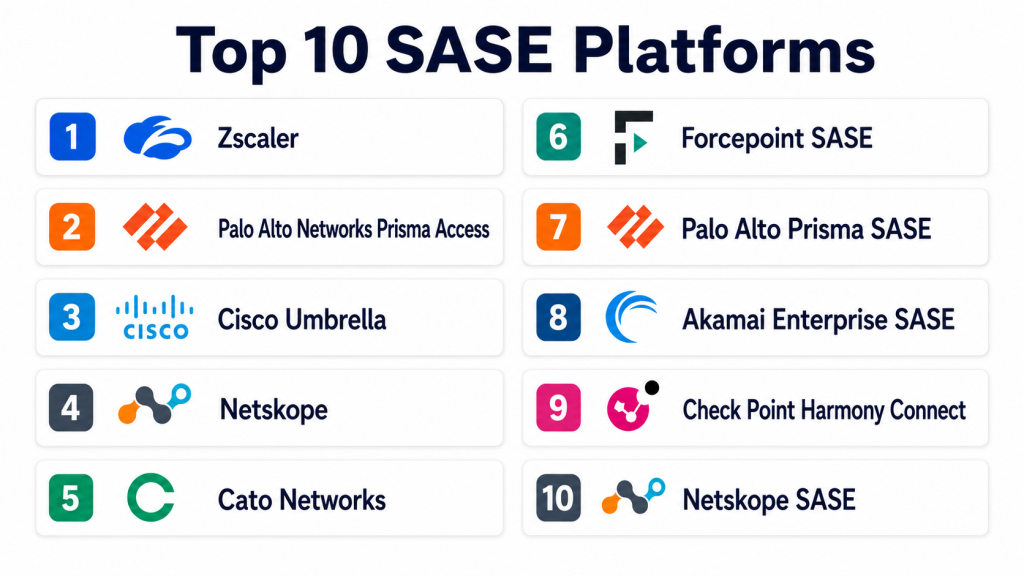
Top 10 SASE Platforms
#1 — Zscaler
Short description: Zscaler provides cloud-delivered secure access, combining ZTNA, SWG, firewall, and advanced threat protection. It ensures secure, low-latency connectivity for remote and on-prem users across multiple clouds.
Key Features
- Zero Trust Network Access (ZTNA)
- Secure Web Gateway (SWG)
- Cloud firewall and advanced threat protection
- Data Loss Prevention (DLP)
- Real-time analytics and reporting
- Cloud-native architecture for global scalability
Pros
- Comprehensive, enterprise-grade coverage
- Cloud-native design for high performance
Cons
- Premium pricing
- Initial configuration complexity
Platforms / Deployment
- Web / Windows / macOS / Linux / iOS / Android
- Cloud-native
Security & Compliance
- MFA, encryption, RBAC
- SOC 2, ISO 27001, GDPR
Integrations & Ecosystem
- Microsoft 365, AWS, Azure, GCP
- SIEM and ITSM integrations
- API-based automation and orchestration
Support & Community
- Professional support tiers
- Extensive documentation and community forums
#2 — Palo Alto Networks Prisma Access
Short description: Prisma Access delivers SASE services combining cloud firewall, ZTNA, SWG, and threat prevention. It enables secure access to cloud and on-prem resources with centralized policy enforcement and analytics.
Key Features
- Cloud-delivered firewall and ZTNA
- Secure Web Gateway (SWG)
- Data Loss Prevention (DLP)
- Threat intelligence and advanced analytics
- Policy enforcement across cloud apps and endpoints
Pros
- Strong security with unified management
- Global scalability for enterprise users
Cons
- Complex initial deployment
- Premium licensing costs
Platforms / Deployment
- Web / Windows / macOS / Linux / iOS / Android
- Cloud / Hybrid
Security & Compliance
- MFA, encryption, RBAC
- SOC 2, ISO 27001, HIPAA
Integrations & Ecosystem
- Multi-cloud platforms, SIEM integration
- API support for workflow automation
Support & Community
- Professional support tiers
- Knowledge base and tutorials
#3 — Cisco Umbrella
Short description: Cisco Umbrella provides cloud-based SWG, ZTNA, and threat intelligence to secure users and devices regardless of location. It protects against malware, phishing, and data loss in cloud-first environments.
Key Features
- Secure Web Gateway (SWG)
- Zero Trust Network Access (ZTNA)
- Threat intelligence and malware protection
- Policy enforcement and reporting
- Cloud-delivered firewall
Pros
- Easy integration with existing Cisco ecosystem
- Cloud-native architecture for fast deployment
Cons
- Limited advanced analytics compared to competitors
- Higher cost for SMBs
Platforms / Deployment
- Web / Windows / macOS / Linux / iOS / Android
- Cloud-native
Security & Compliance
- MFA, encryption, RBAC
- SOC 2, ISO 27001, GDPR
Integrations & Ecosystem
- Microsoft 365, Salesforce, AWS, Azure
- API integration with SIEM and ITSM tools
Support & Community
- Professional support
- Documentation and online community
#4 — Netskope
Short description: Netskope provides SASE services with ZTNA, SWG, DLP, and advanced threat protection. It offers granular control over cloud traffic and SaaS applications with real-time monitoring and analytics.
Key Features
- Zero Trust Network Access (ZTNA)
- Secure Web Gateway (SWG)
- Data Loss Prevention (DLP)
- Threat protection and anomaly detection
- Policy enforcement and compliance reporting
Pros
- Comprehensive visibility and control
- Advanced cloud and SaaS protection
Cons
- Premium pricing
- Configuration complexity for multi-cloud environments
Platforms / Deployment
- Web / Windows / macOS / Linux / iOS / Android
- Cloud-native
Security & Compliance
- MFA, encryption, RBAC
- SOC 2, ISO 27001
Integrations & Ecosystem
- Microsoft 365, AWS, GCP, Salesforce
- SIEM, ITSM integration
- API-based automation
Support & Community
- Professional support tiers
- Knowledge base and tutorials
#5 — Cato Networks
Short description: Cato Networks delivers cloud-native SASE combining SD-WAN, ZTNA, SWG, and advanced threat prevention. It provides unified security and network optimization for distributed enterprise environments.
Key Features
- Cloud SD-WAN with SASE
- Zero Trust Network Access (ZTNA)
- Secure Web Gateway (SWG)
- Threat prevention and DLP
- Real-time analytics and dashboards
Pros
- Unified network and security platform
- Optimized for global enterprise deployments
Cons
- Premium cost
- May require dedicated network expertise
Platforms / Deployment
- Web / Windows / macOS / Linux / iOS / Android
- Cloud-native
Security & Compliance
- MFA, encryption, RBAC
- SOC 2, ISO 27001
Integrations & Ecosystem
- Multi-cloud and SaaS apps
- SIEM and ITSM integration
- API automation
Support & Community
- Professional support tiers
- Documentation and tutorials
#6 — Forcepoint SASE
Short description: Forcepoint SASE integrates SWG, ZTNA, and threat intelligence into a cloud-delivered platform. It focuses on protecting data and users across cloud services and remote environments.
Key Features
- Zero Trust Network Access (ZTNA)
- Secure Web Gateway (SWG)
- Cloud and endpoint threat protection
- Data Loss Prevention (DLP)
- Analytics and reporting
Pros
- Strong cloud security focus
- Enterprise-grade threat detection
Cons
- Premium pricing
- Complexity for SMB deployment
Platforms / Deployment
- Web / Windows / macOS / Linux / iOS / Android
- Cloud-native
Security & Compliance
- MFA, encryption, RBAC
- SOC 2, ISO 27001
Integrations & Ecosystem
- Microsoft 365, AWS, Salesforce
- API and SIEM integration
Support & Community
- Professional support
- Tutorials and documentation
#7 — Palo Alto Prisma SASE
Short description: Prisma SASE offers unified network and security services including ZTNA, SWG, and cloud firewall. It protects cloud traffic and SaaS applications with advanced threat detection and policy enforcement.
Key Features
- Zero Trust Network Access (ZTNA)
- Cloud firewall and SWG
- Threat detection and analytics
- DLP and policy enforcement
- Compliance reporting
Pros
- Integrated SASE architecture
- Advanced analytics and threat intelligence
Cons
- Premium pricing
- Initial deployment complexity
Platforms / Deployment
- Web / Windows / macOS / Linux / iOS / Android
- Cloud-native
Security & Compliance
- MFA, encryption, RBAC
- SOC 2, ISO 27001
Integrations & Ecosystem
- AWS, Azure, Microsoft 365
- SIEM and ITSM integration
- API automation
Support & Community
- Professional support tiers
- Documentation and tutorials
#8 — Akamai Enterprise SASE
Short description: Akamai provides cloud-delivered SASE with secure web gateway, ZTNA, DLP, and threat protection. It focuses on low-latency access for distributed users while ensuring secure connections to cloud services.
Key Features
- Zero Trust Network Access (ZTNA)
- Secure Web Gateway (SWG)
- Threat protection and DLP
- Policy enforcement
- Analytics and reporting
Pros
- Low-latency access for global users
- Cloud-native architecture
Cons
- Limited customization for smaller teams
- Premium pricing
Platforms / Deployment
- Web / Windows / macOS / Linux / iOS / Android
- Cloud-native
Security & Compliance
- MFA, encryption, RBAC
- SOC 2, ISO 27001
Integrations & Ecosystem
- Microsoft 365, Salesforce, AWS
- SIEM integration
- API-based automation
Support & Community
- Professional support
- Online knowledge base
#9 — Check Point Harmony Connect
Short description: Harmony Connect delivers SASE capabilities including ZTNA, SWG, firewall, and threat prevention. It ensures secure access to cloud and on-prem resources with centralized policy enforcement.
Key Features
- Secure Web Gateway (SWG)
- Zero Trust Network Access (ZTNA)
- Cloud firewall and threat prevention
- Policy enforcement and DLP
- Compliance dashboards
Pros
- Centralized management for enterprise
- Strong threat protection
Cons
- Premium pricing
- Complexity for small deployments
Platforms / Deployment
- Web / Windows / macOS / Linux / iOS / Android
- Cloud-native
Security & Compliance
- MFA, encryption, RBAC
- SOC 2, ISO 27001
Integrations & Ecosystem
- Microsoft 365, Salesforce, AWS
- SIEM and ITSM integration
- API automation
Support & Community
- Professional support
- Knowledge base and documentation
#10 — Netskope SASE
Short description: Netskope SASE integrates cloud access security, threat protection, and policy enforcement. It provides low-latency secure access to SaaS and cloud applications for distributed enterprise users.
Key Features
- Zero Trust Network Access (ZTNA)
- Secure Web Gateway (SWG)
- DLP and threat protection
- Policy enforcement
- Analytics and compliance dashboards
Pros
- Comprehensive cloud coverage
- Enterprise-grade threat detection
Cons
- Premium pricing
- Complex deployment
Platforms / Deployment
- Web / Windows / macOS / Linux / iOS / Android
- Cloud-native
Security & Compliance
- MFA, encryption, RBAC
- SOC 2, ISO 27001
Integrations & Ecosystem
- Microsoft 365, AWS, Salesforce
- SIEM and ITSM integration
- API automation
Support & Community
- Professional support tiers
- Documentation and tutorials
Comparison Table (Top 10)
| Tool Name | Best For | Platform(s) Supported | Deployment | Standout Feature | Public Rating |
|---|---|---|---|---|---|
| Zscaler | Enterprise SASE | Web / Windows / macOS / Linux / iOS / Android | Cloud-native | Comprehensive ZTNA & SWG | N/A |
| Prisma Access | Multi-cloud enterprises | Web / Windows / macOS / Linux / iOS / Android | Cloud / Hybrid | Cloud-delivered firewall & ZTNA | N/A |
| Cisco Umbrella | Global enterprise users | Web / Windows / macOS / Linux / iOS / Android | Cloud-native | Threat intelligence & SWG | N/A |
| Netskope | SaaS & cloud applications | Web / Windows / macOS / Linux / iOS / Android | Cloud-native | Cloud app visibility & DLP | N/A |
| Cato Networks | Global SD-WAN & SASE | Web / Windows / macOS / Linux / iOS / Android | Cloud-native | SD-WAN + SASE integration | N/A |
| Forcepoint SASE | Enterprise SaaS & cloud | Web / Windows / macOS / Linux / iOS / Android | Cloud-native | Threat protection & DLP | N/A |
| Prisma SASE | Multi-cloud & SaaS security | Web / Windows / macOS / Linux / iOS / Android | Cloud-native | Integrated SASE architecture | N/A |
| Akamai Enterprise SASE | Distributed users & SaaS | Web / Windows / macOS / Linux / iOS / Android | Cloud-native | Low-latency access & security | N/A |
| Check Point Harmony Connect | Enterprise access & security | Web / Windows / macOS / Linux / iOS / Android | Cloud-native | Centralized SASE management | N/A |
| Netskope SASE | Cloud & SaaS security | Web / Windows / macOS / Linux / iOS / Android | Cloud-native | Threat protection & policy enforcement | N/A |
Evaluation & Scoring of SASE Tools
| Tool Name | Core (25%) | Ease (15%) | Integrations (15%) | Security (10%) | Performance (10%) | Support (10%) | Value (15%) | Weighted Total (0–10) |
|---|---|---|---|---|---|---|---|---|
| Zscaler | 9 | 7 | 8 | 9 | 8 | 8 | 7 | 8.2 |
| Prisma Access | 9 | 7 | 8 | 9 | 8 | 8 | 7 | 8.2 |
| Cisco Umbrella | 8 | 7 | 7 | 8 | 8 | 7 | 7 | 7.7 |
| Netskope | 8 | 7 | 8 | 8 | 8 | 7 | 7 | 7.8 |
| Cato Networks | 8 | 7 | 7 | 8 | 8 | 7 | 7 | 7.8 |
| Forcepoint SASE | 8 | 7 | 7 | 8 | 7 | 7 | 7 | 7.5 |
| Prisma SASE | 9 | 7 | 8 | 9 | 8 | 8 | 7 | 8.2 |
| Akamai Enterprise SASE | 8 | 7 | 7 | 8 | 7 | 7 | 7 | 7.5 |
| Check Point Harmony Connect | 8 | 7 | 7 | 8 | 7 | 7 | 7 | 7.5 |
| Netskope SASE | 8 | 7 | 8 | 8 | 8 | 7 | 7 | 7.8 |
Interpretation: Weighted totals provide a comparative view of capabilities across core features, usability, integrations, security, performance, support, and value. Higher totals indicate broader SASE coverage and enterprise readiness.
Which SASE Tool Is Right for You?
Solo / Freelancer
- Akamai Enterprise SASE or Netskope SASE for cloud access and lightweight security.
SMB
- Cisco Umbrella or Cato Networks for secure cloud access and simplified deployment.
Mid-Market
- Netskope, Prisma Access, or Forcepoint SASE for policy enforcement and analytics.
Enterprise
- Zscaler, Prisma SASE, or Prisma Access for comprehensive SASE architecture with global coverage.
Budget vs Premium
- SMBs may leverage cloud-native, cost-effective solutions; enterprises benefit from premium, fully integrated platforms.
Feature Depth vs Ease of Use
- Enterprise tools provide advanced ZTNA, SWG, DLP, and threat intelligence.
- SMB tools focus on usability and core security features.
Integrations & Scalability
- API-rich platforms support SIEM, ITSM, and cloud workflow automation.
- Cloud-native SASE scales across global locations and multi-cloud environments.
Security & Compliance Needs
- Enterprises in regulated industries should prioritize Zscaler, Prisma Access, or Netskope.
- Smaller organizations may use Cisco Umbrella or Cato Networks for essential SASE capabilities.
Frequently Asked Questions (FAQs)
1: What is a SASE platform?
SASE platforms unify network and security services, including ZTNA, SWG, firewall, and DLP, delivered from the cloud for secure connectivity.
2: Which users benefit from SASE?
Remote workers, hybrid teams, and enterprises with multi-cloud and SaaS adoption benefit the most.
3: Do SASE platforms replace VPNs?
Yes, they provide secure access to cloud and on-prem applications without traditional VPN constraints.
4: How does SASE enforce Zero Trust?
SASE verifies user identity, device posture, and application access before granting connections.
5: Can SASE protect cloud apps and SaaS?
Yes, SASE integrates threat protection, DLP, and access control for SaaS and cloud applications.
6: Are SASE platforms suitable for SMBs?
Yes, cloud-native solutions scale according to usage and simplify deployment.
7: Do SASE platforms monitor user behavior?
Yes, user behavior analytics detect anomalies, insider threats, and compromised accounts.
8: Can SASE integrate with existing security tools?
Yes, most support SIEM, ITSM, identity management, and workflow automation integrations.
9: Do SASE platforms support compliance reporting?
Yes, they offer audit-ready dashboards for SOC 2, ISO 27001, HIPAA, and GDPR.
10: How do I select the right SASE platform?
Evaluate based on deployment needs, cloud/SaaS coverage, budget, automation, and enterprise compliance requirements.
Conclusion
SASE platforms provide a unified, cloud-delivered approach to secure access, network optimization, and policy enforcement. The right solution depends on organizational size, remote work requirements, cloud adoption, and compliance needs. SMBs can leverage simplified or cost-effective SASE solutions, while enterprises benefit from fully integrated platforms with ZTNA, SWG, DLP, and threat intelligence. Organizations should shortlist 2–3 tools, pilot deployments, and evaluate fit with workflows, cloud apps, and compliance objectives to ensure secure, scalable, and compliant network access.
