Upgrade & Secure Your Future with DevOps, SRE, DevSecOps, MLOps!
We spend hours scrolling social media and waste money on things we forget, but won’t spend 30 minutes a day earning certifications that can change our lives.
Master in DevOps, SRE, DevSecOps & MLOps by DevOps School!
Learn from Guru Rajesh Kumar and double your salary in just one year.
Introduction
Security Orchestration, Automation, and Response (SOAR) platforms are specialized cybersecurity solutions designed to help security teams manage alerts, streamline workflows, and respond to threats faster and more efficiently. SOAR integrates with existing security tools, automates repetitive tasks, orchestrates incident response, and provides centralized visibility across multiple environments. By consolidating alerts, workflows, and response playbooks, SOAR platforms enable security teams to act with precision, reduce human error, and optimize their operations.
In the + context, cyber threats are becoming increasingly sophisticated and fast-moving. Organizations face challenges such as ransomware, supply chain attacks, insider threats, and hybrid/multi-cloud vulnerabilities. SOAR platforms help teams stay ahead by automating detection, triage, and response, thereby reducing time-to-mitigation and improving operational efficiency.
Common use cases include incident response automation, phishing response, threat intelligence correlation, vulnerability management orchestration, compliance reporting, and SOC workflow optimization.
Buyers should evaluate:
- Workflow automation capabilities
- Integration with existing security stack
- Playbook customization
- Threat intelligence ingestion
- Real-time alert correlation
- Reporting and compliance support
- Ease of use and deployment
- Scalability and performance
- AI or ML-driven analytics
- Cost-effectiveness
Best for: Security operations teams, enterprise SOCs, MSSPs, organizations with complex hybrid/cloud networks, and companies in regulated industries.
Not ideal for: Very small teams with minimal security operations, organizations without existing security tools to integrate, or companies seeking only endpoint protection or simple alert management.
Key Trends in Security Orchestration Automation & Response (SOAR) Tools
- AI-driven incident triage is standardizing, helping prioritize high-risk alerts.
- Automated playbooks for phishing, malware, and ransomware response are increasingly prebuilt.
- Integration with cloud-native and hybrid security environments is expanding.
- Real-time threat intelligence correlation with open and proprietary feeds is becoming critical.
- Low-code/no-code playbook creation allows SOC analysts to build custom workflows quickly.
- SOAR platforms now focus on cross-team collaboration, including IT, DevOps, and compliance teams.
- Advanced reporting for regulatory compliance is a built-in expectation.
- Adaptive automation dynamically adjusts workflows based on risk severity.
- Licensing and pricing models are shifting to consumption-based metrics.
- Vendors are emphasizing explainable AI for threat detection decisions.
How We Selected These Tools (Methodology)
Our Top 10 SOAR tools were selected through a structured methodology:
- Market adoption and recognition in enterprise cybersecurity.
- Feature completeness, including automation, orchestration, and response capabilities.
- Reliability and performance signals from SOC deployments.
- Security posture validation, including access controls, auditability, and compliance support.
- Integration ecosystem with SIEM, EDR, NDR, threat intelligence platforms, and cloud tools.
- Customer fit across multiple industries, including finance, healthcare, energy, and government.
- Deployment flexibility: cloud, hybrid, or on-premise options.
- Availability of prebuilt playbooks and low-code automation.
- Quality of support, documentation, and community resources.
- Vendor focus on innovation, AI integration, and SOC efficiency.
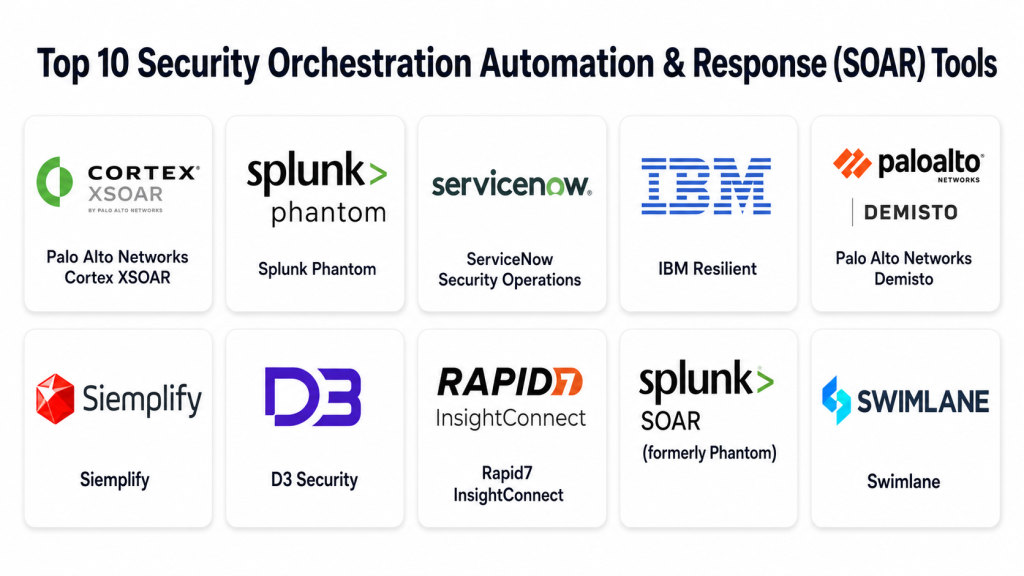
Top 10 Security Orchestration Automation & Response (SOAR) Tools
#1 — Palo Alto Networks Cortex XSOAR
Short description : Cortex XSOAR is a comprehensive SOAR platform designed for enterprises and MSSPs. It centralizes incident management, automates response workflows, and integrates with numerous security tools. Cortex XSOAR excels in threat intelligence orchestration, allowing teams to reduce manual work and respond faster. It is ideal for organizations seeking a fully integrated SOAR ecosystem.
Key Features
- Prebuilt and customizable playbooks
- Threat intelligence aggregation and correlation
- Automated incident response workflows
- Centralized case management
- Collaboration across SOC and IT teams
- Reporting and compliance automation
- API-driven integrations with security stack
Pros
- Highly scalable and enterprise-ready
- Strong ecosystem and integration support
- Reduces manual response effort
Cons
- Can be complex for smaller SOCs
- Higher licensing cost for SMEs
- Playbook customization may require training
Platforms / Deployment
Web / Cloud / Hybrid
Security & Compliance
SSO/SAML, MFA, encryption, audit logs, RBAC, SOC 2, ISO 27001, GDPR
Integrations & Ecosystem
Extensive integrations across SIEM, EDR, NDR, threat intelligence, and cloud platforms.
- Splunk, QRadar, ServiceNow
- AWS, Azure, GCP
- Endpoint and firewall platforms
- Threat intel feeds
- API-based workflow extensions
- Custom playbook connectors
Support & Community
Enterprise support, documentation, training programs, and active SOC analyst community.
#2 — Splunk Phantom
Short description: Splunk Phantom is a SOAR platform focused on automating security operations and orchestrating threat response. It supports playbook-driven automation and integrates tightly with Splunk’s SIEM solutions. Phantom is well-suited for organizations seeking automated alert triage and SOC workflow efficiency.
Key Features
- Prebuilt automation playbooks
- Integration with Splunk and third-party security tools
- Threat intelligence ingestion
- Case management and incident tracking
- Customizable dashboards
- Automated remediation and response
- API-driven extensibility
Pros
- Strong SIEM integration
- Flexible playbook automation
- Centralized incident tracking
Cons
- Learning curve for playbook creation
- Cost can be high for non-Splunk users
- Some advanced features require scripting knowledge
Platforms / Deployment
Web / Cloud / Hybrid
Security & Compliance
SSO/SAML, MFA, encryption, audit logs, RBAC, SOC 2, GDPR
Integrations & Ecosystem
Integrates with hundreds of security and IT tools:
- Splunk Enterprise/Cloud
- SIEM, EDR, NDR
- Cloud platforms
- Ticketing systems
- Threat intel sources
- API-driven workflows
Support & Community
Documentation, enterprise support, partner programs, and active SOC practitioner forums.
#3 — ServiceNow Security Operations
Short description : ServiceNow Security Operations combines SOAR capabilities with IT service management. It centralizes incident response, automates workflows, and improves collaboration between security and IT teams. It is ideal for enterprises that rely on ServiceNow for IT and security process integration.
Key Features
- Automated incident response workflows
- Threat intelligence orchestration
- Case management with IT integration
- Prebuilt playbooks and templates
- Dashboard and reporting capabilities
- SLA and compliance tracking
- Low-code workflow customization
Pros
- Deep ITSM integration
- Streamlines SOC and IT collaboration
- Scalable for enterprise deployment
Cons
- Less specialized than some dedicated SOAR platforms
- Advanced playbooks may require training
- Implementation may be complex
Platforms / Deployment
Web / Cloud / Hybrid
Security & Compliance
SSO/SAML, MFA, encryption, audit logs, RBAC, SOC 2, ISO 27001
Integrations & Ecosystem
Works seamlessly with enterprise IT and security tools:
- ITSM and ticketing systems
- SIEM platforms
- EDR/NDR solutions
- Cloud platforms
- Threat intelligence feeds
- API extensions for custom workflows
Support & Community
Comprehensive support, knowledge base, training, and global ServiceNow user community.
#4 — IBM Resilient
Short description : IBM Resilient SOAR helps enterprises orchestrate security response processes, manage incidents, and automate threat mitigation. Its playbook-driven approach allows SOC teams to standardize responses and reduce response time. Best suited for large organizations seeking structured and auditable incident response.
Key Features
- Dynamic playbooks
- Incident response automation
- Integration with SIEM and endpoint platforms
- Threat intelligence management
- Compliance and reporting modules
- Dashboard for SOC visibility
- Customizable workflows
Pros
- Strong incident response framework
- Enterprise scalability
- Integration with IBM ecosystem
Cons
- Implementation complexity
- Requires trained analysts
- Cost may be high for mid-market
Platforms / Deployment
Web / Cloud / Hybrid
Security & Compliance
SSO/SAML, MFA, encryption, audit logs, RBAC, SOC 2, ISO 27001, GDPR, HIPAA
Integrations & Ecosystem
- IBM QRadar, QRadar SIEM
- EDR/NDR integration
- Threat intel feeds
- Ticketing systems
- Cloud platform connectors
- API-based playbook extensions
Support & Community
Enterprise support, detailed documentation, training, and IBM partner ecosystem.
#5 — Palo Alto Networks Demisto
Short description : Demisto, now part of Cortex XSOAR, is a SOAR platform offering automated workflows, playbooks, and threat intelligence orchestration. It is designed for security teams needing robust automation, alert prioritization, and SOC efficiency.
Key Features
- Prebuilt playbooks
- Case management
- Threat intelligence integration
- Automated alert triage
- API-driven custom workflows
- Collaboration dashboards
- Reporting and metrics
Pros
- Accelerates incident response
- Reduces alert fatigue
- Supports complex automation
Cons
- Full potential requires training
- Premium pricing
- Some integrations require configuration
Platforms / Deployment
Web / Cloud / Hybrid
Security & Compliance
SSO/SAML, MFA, encryption, audit logs, RBAC
Integrations & Ecosystem
- SIEM/EDR/NDR
- Threat intel feeds
- Cloud security tools
- Ticketing and ITSM
- API-based extensions
- Custom playbooks
Support & Community
Enterprise support, documentation, and partner ecosystem.
#6 — Siemplify
Short description: Siemplify provides SOAR capabilities with a focus on security operations efficiency. Its platform allows teams to automate, orchestrate, and manage incidents from a single console. Ideal for SOC teams wanting quick deployment and effective playbook automation.
Key Features
- Centralized SOC console
- Automated playbooks
- Threat intelligence ingestion
- Case management
- Alert correlation
- Reporting and dashboards
- API integrations
Pros
- Streamlined SOC operations
- Easy-to-use interface
- Rapid playbook deployment
Cons
- May lack some advanced integrations
- Licensing costs can be significant
- Customization can require expert help
Platforms / Deployment
Web / Cloud / Hybrid
Security & Compliance
SSO/SAML, MFA, encryption, audit logs, RBAC
Integrations & Ecosystem
- SIEM and endpoint platforms
- Threat intel feeds
- Cloud platforms
- Ticketing systems
- API-based workflow extension
Support & Community
Enterprise support, documentation, and active SOC user forums.
#7 — D3 Security
Short description : D3 Security SOAR platform helps enterprises orchestrate response workflows and automate incident handling. Its strength is flexibility in creating playbooks and integrating with multiple security tools. Suitable for medium to large SOC teams seeking robust automation capabilities.
Key Features
- Automated incident response
- Prebuilt and customizable playbooks
- Case management
- Threat intelligence aggregation
- Alert correlation and prioritization
- Reporting and compliance modules
- API-based integration
Pros
- Flexible and customizable
- Accelerates response
- Good for complex security environments
Cons
- Implementation can be challenging
- Requires analyst training
- Pricing may be higher for smaller teams
Platforms / Deployment
Web / Cloud / Hybrid
Security & Compliance
SSO/SAML, MFA, encryption, audit logs, RBAC
Integrations & Ecosystem
- SIEM, EDR, NDR
- Cloud platforms
- Threat intel
- Ticketing/ITSM
- APIs for custom playbooks
- Collaboration tools
Support & Community
Enterprise support, documentation, training, and partner network.
#8 — Rapid7 InsightConnect
Short description : InsightConnect automates security workflows, integrates with multiple tools, and allows SOC teams to standardize incident response. Its low-code workflow builder enables rapid playbook creation. Ideal for teams looking to reduce repetitive tasks and enforce consistency in response.
Key Features
- Low-code workflow automation
- Prebuilt integrations
- Case and incident management
- Alert enrichment
- Threat intelligence integration
- Reporting and metrics dashboards
- API support for custom automation
Pros
- Simplifies workflow automation
- Rapid deployment
- Broad tool integrations
Cons
- May require professional services for complex use cases
- Some integrations limited to supported tools
- Learning curve for advanced playbooks
Platforms / Deployment
Web / Cloud / Hybrid
Security & Compliance
SSO/SAML, MFA, encryption, audit logs, RBAC, SOC 2
Integrations & Ecosystem
- SIEM and EDR tools
- Cloud security platforms
- Threat intel sources
- Ticketing and ITSM
- API-driven extensions
- Collaboration integrations
Support & Community
Documentation, enterprise support, training, and active user forums.
#9 — Splunk SOAR (formerly Phantom)
Short description : Splunk SOAR consolidates alerts, automates incident response, and allows SOC teams to create playbooks that reduce response times. It is well-suited for organizations already using Splunk SIEM. Its primary value lies in rapid integration with existing security tools and automation of manual workflows.
Key Features
- Playbook automation
- Alert aggregation
- Case management
- Threat intelligence integration
- Customizable dashboards
- API-based workflow extension
- Reporting and compliance
Pros
- Tight Splunk ecosystem integration
- Reduces SOC manual tasks
- Prebuilt automation modules
Cons
- Less effective standalone without SIEM
- Advanced playbooks require scripting knowledge
- Higher learning curve
Platforms / Deployment
Web / Cloud / Hybrid
Security & Compliance
SSO/SAML, MFA, encryption, audit logs, RBAC
Integrations & Ecosystem
- Splunk Enterprise/Cloud
- EDR/NDR tools
- Threat intel feeds
- Ticketing/ITSM
- Cloud and SaaS platforms
- API-based automation
Support & Community
Enterprise support, training, documentation, and SOC practitioner community.
#10 — Swimlane
Short description : Swimlane SOAR platform is designed to automate and orchestrate security workflows, integrate with enterprise tools, and provide visual playbook management. Ideal for mid-market and enterprise SOC teams that want low-code automation combined with strong reporting and visibility.
Key Features
- Visual playbook builder
- Alert triage automation
- Incident management
- Threat intelligence integration
- Reporting and dashboards
- API-driven integrations
- Collaboration tools
Pros
- User-friendly playbook creation
- Effective alert management
- Broad integration support
Cons
- May require configuration for complex use cases
- Limited community compared to larger vendors
- Advanced features may need professional services
Platforms / Deployment
Web / Cloud / Hybrid
Security & Compliance
SSO/SAML, MFA, encryption, audit logs, RBAC
Integrations & Ecosystem
- SIEM and EDR
- Threat intelligence platforms
- Ticketing and ITSM
- Cloud platform connectors
- APIs for automation
- Collaboration tools
Support & Community
Documentation, enterprise support, training, and professional services.
Comparison Table (Top 10)
| Tool Name | Best For | Platform(s) Supported | Deployment | Standout Feature | Public Rating |
|---|---|---|---|---|---|
| Cortex XSOAR | Enterprise SOCs | Web | Cloud / Hybrid | Comprehensive automation & playbooks | N/A |
| Splunk Phantom | Splunk users | Web | Cloud / Hybrid | SIEM-integrated automation | N/A |
| ServiceNow Security Operations | IT-Security integration | Web | Cloud / Hybrid | ITSM workflow integration | N/A |
| IBM Resilient | Large enterprises | Web | Cloud / Hybrid | Dynamic incident playbooks | N/A |
| Palo Alto Demisto | SOC automation | Web | Cloud / Hybrid | Playbook-driven response | N/A |
| Siemplify | SOC efficiency | Web | Cloud / Hybrid | Centralized SOC console | N/A |
| D3 Security | Complex SOCs | Web | Cloud / Hybrid | Flexible playbook customization | N/A |
| Rapid7 InsightConnect | Mid-market SOCs | Web | Cloud / Hybrid | Low-code automation | N/A |
| Splunk SOAR | Splunk customers | Web | Cloud / Hybrid | Automated alert triage | N/A |
| Swimlane | Mid-market/Enterprise | Web | Cloud / Hybrid | Visual playbook builder | N/A |
Evaluation & Scoring of SOAR Tools
| Tool Name | Core (25%) | Ease (15%) | Integrations (15%) | Security (10%) | Performance (10%) | Support (10%) | Value (15%) | Weighted Total |
|---|---|---|---|---|---|---|---|---|
| Cortex XSOAR | 9 | 8 | 9 | 9 | 9 | 9 | 8 | 8.95 |
| Splunk Phantom | 8 | 8 | 8 | 9 | 8 | 8 | 7 | 8.00 |
| ServiceNow Security Operations | 8 | 8 | 8 | 9 | 8 | 8 | 7 | 8.00 |
| IBM Resilient | 9 | 7 | 8 | 9 | 9 | 8 | 7 | 8.10 |
| Palo Alto Demisto | 8 | 8 | 8 | 9 | 8 | 8 | 7 | 8.00 |
| Siemplify | 8 | 9 | 8 | 8 | 8 | 8 | 7 | 8.05 |
| D3 Security | 8 | 7 | 8 | 8 | 8 | 8 | 7 | 7.85 |
| Rapid7 InsightConnect | 8 | 8 | 8 | 8 | 8 | 8 | 8 | 8.05 |
| Splunk SOAR | 8 | 8 | 8 | 9 | 8 | 8 | 7 | 8.00 |
| Swimlane | 8 | 8 | 8 | 8 | 8 | 8 | 7 | 7.95 |
These scores provide a comparative framework. Higher scores indicate tools with broader functionality, stronger integrations, and better automation potential. Buyers should interpret scores in context of organizational needs, SOC maturity, and integration requirements.
Which SOAR Tool Is Right for You?
Solo / Freelancer
Independent security consultants or analysts typically do not require full SOAR platforms. Lightweight workflow automation or cloud-native alerting tools may be sufficient.
SMB
Small to mid-sized businesses benefit from low-code automation and prebuilt integrations. Siemplify, Rapid7 InsightConnect, or Swimlane may be a good balance of cost and functionality.
Mid-Market
Mid-market SOCs need scalable automation and integration with existing SIEM/EDR stacks. Cortex XSOAR, Splunk Phantom, and ServiceNow Security Operations are strong candidates.
Enterprise
Enterprises require full automation, robust integrations, and compliance reporting. Cortex XSOAR, IBM Resilient, and Palo Alto Demisto are recommended for SOCs managing high-volume alerts and complex threat landscapes.
Budget vs Premium
Choose premium platforms when SOC complexity and risk exposure justify investment. Budget-conscious teams may start with lower-cost or cloud-native SOAR solutions.
Feature Depth vs Ease of Use
Visual playbook builders like Swimlane simplify automation creation. Advanced SOCs may prefer Cortex XSOAR or IBM Resilient for depth and flexibility.
Integrations & Scalability
Evaluate integrations with SIEM, EDR, NDR, IAM, cloud platforms, and ticketing systems. Scalability is critical for enterprises with distributed networks.
Security & Compliance Needs
Ensure support for RBAC, SSO, MFA, audit logs, and compliance reporting. Tools with SOC 2, ISO 27001, HIPAA, or GDPR certifications may be preferred in regulated industries.
Frequently Asked Questions (FAQs)
What is SOAR?
SOAR stands for Security Orchestration, Automation, and Response. It helps SOC teams automate repetitive tasks, orchestrate workflows, and respond to security incidents faster.
How does SOAR differ from SIEM?
SIEM collects and correlates logs from multiple sources. SOAR automates response workflows, integrates alerts, and orchestrates incident management across tools.
Can SOAR reduce alert fatigue?
Yes, by automating triage, enrichment, and prioritization, SOAR reduces the number of alerts that require manual review.
Is SOAR suitable for small businesses?
Not always. Small teams with minimal security operations may prefer lightweight automation or managed detection services instead of a full SOAR platform.
How long does SOAR deployment take?
Deployment varies with SOC size, tool integrations, and workflow complexity. Simple setups may take weeks, while enterprise rollouts require months.
Do SOAR tools support cloud environments?
Most modern SOAR platforms support hybrid and cloud environments, but coverage varies by vendor.
What is a playbook in SOAR?
A playbook is a predefined or customizable set of automated actions triggered by specific alerts, helping standardize responses.
Can SOAR help with compliance?
Yes, SOAR can automate reporting, maintain audit trails, and enforce response procedures to support compliance.
How do I integrate SOAR with existing tools?
SOAR platforms provide APIs, prebuilt connectors, and integration modules to connect with SIEM, EDR, NDR, cloud platforms, ticketing systems, and threat intelligence feeds.
What is the best alternative to SOAR?
Alternatives include manual SOC workflows, EDR alerting, XDR platforms, and cloud-native automation tools, depending on team size and operational needs.
Conclusion
SOAR platforms are essential for modern security operations, helping teams respond quickly, automate repetitive tasks, and streamline workflows. The “best” SOAR solution depends on organizational size, SOC maturity, integration needs, and compliance requirements. Cortex XSOAR and IBM Resilient excel in enterprise-scale automation, Splunk Phantom and ServiceNow Security Operations integrate well with SIEM and ITSM, while tools like Siemplify and Swimlane balance cost and usability.Next steps include shortlisting 2–3 platforms, testing playbook automation, evaluating integrations, and running pilot workflows to ensure SOC efficiency and compliance alignment. Choosing the right SOAR tool can significantly enhance threat response capabilities while reducing operational burden.
