Upgrade & Secure Your Future with DevOps, SRE, DevSecOps, MLOps!
We spend hours scrolling social media and waste money on things we forget, but won’t spend 30 minutes a day earning certifications that can change our lives.
Master in DevOps, SRE, DevSecOps & MLOps by DevOps School!
Learn from Guru Rajesh Kumar and double your salary in just one year.
Introduction
Supplier portal platforms are digital systems that help businesses manage supplier communication, onboarding, documents, purchase orders, invoices, compliance records, performance data, and collaboration in one secure online environment. In simple words, a supplier portal gives suppliers and buying teams a shared place to exchange information without relying only on emails, spreadsheets, phone calls, and manual follow-ups.
Supplier portals matter because companies now work with larger supplier networks, stricter compliance requirements, faster procurement cycles, and higher expectations for transparency. These platforms help reduce supplier onboarding delays, improve invoice accuracy, simplify document collection, support risk checks, and make procurement more organized.
Common use cases include supplier onboarding, profile management, purchase order collaboration, invoice submission, contract document exchange, compliance tracking, supplier performance monitoring, and dispute resolution.
Buyers should evaluate supplier onboarding, ease of use, ERP integration, procurement workflow support, invoice automation, compliance management, document control, security, reporting, scalability, supplier adoption, and support quality.
Best for: Procurement teams, finance teams, accounts payable teams, supply chain teams, enterprise buyers, manufacturers, retailers, distributors, public sector organizations, and companies managing many suppliers.
Not ideal for: Very small businesses with only a few suppliers, teams that only need basic invoice email processing, or companies that do not yet have defined procurement and supplier management workflows.
Key Trends in Supplier Portal Platforms
- AI-assisted supplier onboarding: Supplier portals are becoming smarter by helping teams validate supplier data, detect missing documents, flag duplicates, and recommend next steps.
- Self-service supplier management: Suppliers now expect to update profiles, upload documents, view purchase orders, check payment status, and resolve issues without contacting procurement teams repeatedly.
- Integrated procurement and AP workflows: Supplier portals are increasingly connected with sourcing, contract management, purchase orders, invoice automation, payments, and supplier performance.
- Risk and compliance visibility: Businesses want better tracking of tax documents, certifications, insurance, ESG records, regulatory documents, diversity data, and supplier risk indicators.
- ERP-first integration: Supplier portals must connect smoothly with ERP, procurement, finance, accounts payable, contract lifecycle management, and supply chain systems.
- Multi-enterprise collaboration: Large companies need portals that support collaboration between internal teams, suppliers, subsidiaries, service providers, and external business partners.
- Cloud-based deployment: Cloud supplier portals are preferred because they simplify supplier access, reduce infrastructure work, and support faster updates.
- Improved supplier experience: A supplier portal must be easy for suppliers to use. Poor supplier adoption can reduce the value of even a powerful platform.
- Security and access governance: Supplier platforms handle financial, tax, commercial, and contract information, so role-based access, audit logs, encryption, and secure authentication are essential.
- Data quality improvement: Supplier master data is becoming a major priority because inaccurate supplier data can create payment errors, compliance gaps, and procurement inefficiency.
How We Selected These Tools
The supplier portal software market includes procurement suites, supplier management platforms, accounts payable automation platforms, supplier networks, and enterprise ERP supplier portals. The tools below were selected using practical procurement and supplier management evaluation criteria.
- Market recognition in procurement, supplier management, and finance operations
- Supplier onboarding, profile management, and document collection capabilities
- Purchase order, invoice, contract, and payment collaboration support
- Integration readiness with ERP, procurement, AP, CLM, and finance systems
- Suitability for mid-market, enterprise, and global supplier networks
- Security posture signals and enterprise access-control expectations
- Supplier experience and self-service usability
- Reporting, analytics, and supplier performance visibility
- Support for compliance, risk, audit, and governance workflows
- Vendor ecosystem, onboarding support, and scalability
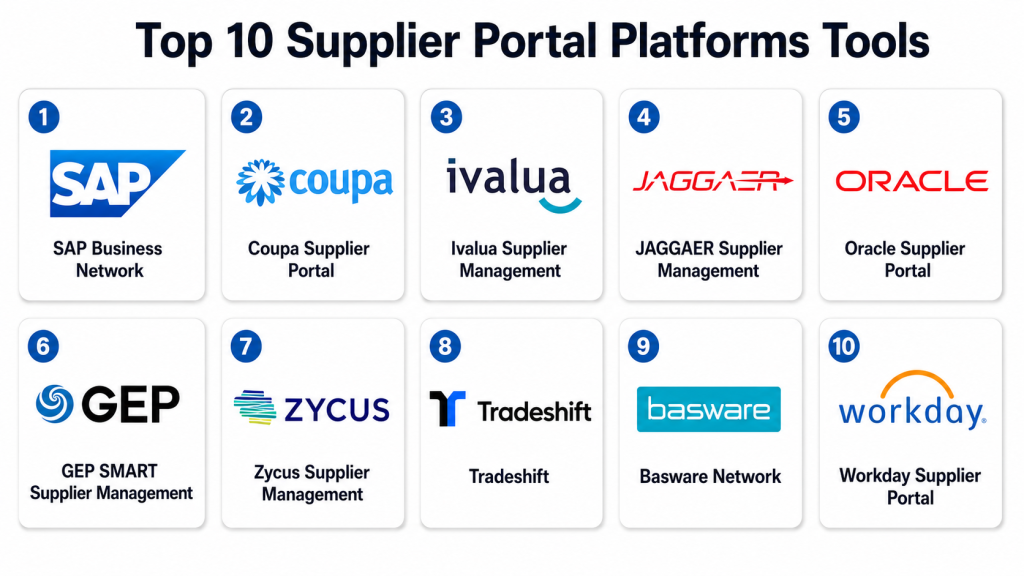
Top 10 Supplier Portal Platforms Tools
#1 — SAP Business Network
Short description:
SAP Business Network is a supplier collaboration and business network platform designed to connect buyers, suppliers, logistics providers, and trading partners. It supports procurement, order collaboration, invoice exchange, supplier communication, and supply chain visibility across large business ecosystems. It is especially useful for companies already using SAP procurement or ERP systems. The platform is best suited for large enterprises that need supplier collaboration at scale across purchasing, invoicing, logistics, and supply chain operations.
Key Features
- Supplier collaboration and self-service
- Purchase order and invoice exchange
- Supplier profile and network participation
- Integration with SAP procurement and ERP systems
- Supply chain and logistics collaboration support
- Document and transaction visibility
- Enterprise-grade business network capabilities
Pros
- Strong fit for SAP-centered organizations
- Large supplier network and procurement ecosystem
- Useful for enterprise-level supplier collaboration
Cons
- May be complex for smaller businesses
- Best value often depends on SAP ecosystem adoption
- Pricing is not publicly stated
Platforms / Deployment
Web / Cloud / Enterprise business network
Security & Compliance
Security details should be confirmed directly with the vendor. Buyers should ask about SSO, MFA, RBAC, encryption, audit logs, data residency, and compliance documentation.
SOC 2, ISO 27001, GDPR, HIPAA: Not publicly stated for every implementation.
Integrations & Ecosystem
SAP Business Network is strongest when connected with SAP procurement, ERP, finance, and supply chain systems. It is suitable for companies that want supplier collaboration inside a broader enterprise ecosystem.
- SAP ERP
- SAP S/4HANA
- SAP Ariba procurement workflows
- Accounts payable systems
- Supplier management systems
- Logistics and supply chain tools
Support & Community
SAP provides enterprise support, documentation, training, implementation partners, and a large customer ecosystem. Support quality depends on licensing, partner selection, and project complexity.
#2 — Coupa Supplier Portal
Short description:
Coupa Supplier Portal is a supplier-facing platform that helps suppliers interact with buyers using Coupa for procurement, invoicing, purchase orders, and collaboration. It gives suppliers a place to manage purchase orders, submit invoices, update information, and communicate with buyers. It is useful for businesses that want to improve supplier participation and reduce manual procurement and AP communication. The platform is best suited for companies already using Coupa’s spend management ecosystem.
Key Features
- Supplier self-service access
- Purchase order viewing and collaboration
- Invoice submission and tracking
- Supplier profile management
- Procurement and AP workflow support
- Buyer-supplier communication
- Integration with Coupa spend management
Pros
- Easy fit for companies using Coupa
- Helps reduce manual supplier communication
- Supports procurement and invoice collaboration
Cons
- Best value depends on Coupa ecosystem usage
- Suppliers may need onboarding and training
- Pricing is not publicly stated
Platforms / Deployment
Web / Cloud / Supplier network platform
Security & Compliance
Security features should be validated directly with the vendor. Buyers should confirm SSO, MFA, RBAC, encryption, audit logs, data privacy controls, and compliance documentation.
SOC 2, ISO 27001, GDPR, HIPAA: Not publicly stated for every customer implementation.
Integrations & Ecosystem
Coupa Supplier Portal works inside the broader Coupa Business Spend Management environment, making it useful for procurement, AP, sourcing, and supplier workflows.
- Coupa procurement
- Coupa invoicing
- ERP systems
- Accounts payable systems
- Supplier management workflows
- Spend analytics tools
Support & Community
Coupa provides support, documentation, customer success services, and a strong user ecosystem. Supplier onboarding success depends on buyer communication, training, and supplier readiness.
#3 — Ivalua Supplier Management
Short description:
Ivalua Supplier Management is part of the Ivalua source-to-pay platform and supports supplier onboarding, supplier information management, risk management, performance tracking, and collaboration. It is suitable for organizations that need strong control over supplier data, compliance documents, procurement workflows, and supplier lifecycle activities. The platform is best for procurement teams that want a flexible supplier portal connected with sourcing, contracts, purchasing, invoicing, and spend management.
Key Features
- Supplier onboarding and profile management
- Supplier information management
- Risk and compliance tracking
- Performance scorecards
- Document collection and validation workflows
- Source-to-pay process integration
- Supplier collaboration and communication
Pros
- Strong supplier lifecycle management capabilities
- Flexible fit for complex procurement needs
- Useful for supplier risk, compliance, and performance tracking
Cons
- Configuration may require strong implementation planning
- May be more than small teams need
- Pricing is not publicly stated
Platforms / Deployment
Web / Cloud / Enterprise source-to-pay platform
Security & Compliance
Security details should be confirmed directly with the vendor. Buyers should request information about SSO, MFA, RBAC, audit logs, encryption, data protection, and compliance support.
SOC 2, ISO 27001, GDPR, HIPAA: Not publicly stated.
Integrations & Ecosystem
Ivalua integrates supplier management with sourcing, contracts, procurement, invoicing, and spend workflows, making it suitable for end-to-end procurement transformation.
- ERP systems
- Sourcing platforms
- Contract lifecycle management
- Accounts payable systems
- Risk data providers
- Spend analytics tools
Support & Community
Ivalua provides vendor-led support, implementation assistance, customer success, and partner services. Support quality depends on project scope, selected modules, and configuration complexity.
#4 — JAGGAER Supplier Management
Short description:
JAGGAER Supplier Management helps businesses manage supplier onboarding, supplier profiles, compliance documentation, risk information, performance tracking, and supplier collaboration. It is part of JAGGAER’s broader procurement and source-to-pay ecosystem. The platform is useful for organizations that need structured supplier management across categories, business units, and regions. It is best suited for procurement teams that want better control over supplier data, supplier risk, and supplier performance.
Key Features
- Supplier onboarding workflows
- Supplier information management
- Supplier risk and compliance tracking
- Supplier performance management
- Document and certification management
- Source-to-pay integration
- Supplier collaboration tools
Pros
- Good fit for procurement-led supplier management
- Useful for compliance and supplier performance workflows
- Works well in structured enterprise procurement environments
Cons
- May require configuration and change management
- Public pricing details are not available
- Smaller companies may not need full platform depth
Platforms / Deployment
Web / Cloud / Enterprise procurement platform
Security & Compliance
Security and compliance details should be validated directly with the vendor. Buyers should ask about SSO, MFA, RBAC, encryption, audit logs, data protection, and compliance documentation.
SOC 2, ISO 27001, GDPR, HIPAA: Not publicly stated.
Integrations & Ecosystem
JAGGAER Supplier Management connects with procurement, sourcing, contract, and ERP workflows.
- ERP systems
- Sourcing tools
- Contract management systems
- Accounts payable platforms
- Supplier risk data sources
- Procurement analytics tools
Support & Community
JAGGAER provides enterprise support, onboarding, documentation, customer success services, and implementation partners. Support quality depends on selected modules and project complexity.
#5 — Oracle Supplier Portal
Short description:
Oracle Supplier Portal is part of Oracle Fusion Cloud Procurement and helps suppliers collaborate with buyers on purchase orders, invoices, agreements, negotiations, and supplier profile updates. It is especially useful for organizations using Oracle procurement, finance, and ERP systems. The platform helps suppliers access relevant transactions, update information, and participate in procurement workflows. It is best suited for Oracle-centered enterprises that want supplier collaboration connected with procurement and financial operations.
Key Features
- Supplier self-service access
- Purchase order collaboration
- Invoice and payment-related workflows
- Supplier profile management
- Sourcing and negotiation participation
- Integration with Oracle procurement and ERP
- Document and transaction visibility
Pros
- Strong fit for Oracle-centered businesses
- Useful for connecting suppliers with procurement and finance
- Supports enterprise supplier collaboration workflows
Cons
- Best value depends on Oracle ecosystem usage
- Implementation can require Oracle expertise
- Pricing is not publicly stated
Platforms / Deployment
Web / Cloud / Oracle enterprise environment
Security & Compliance
Security details depend on Oracle cloud setup and customer configuration. Buyers should validate SSO, MFA, RBAC, encryption, audit logs, data residency, and compliance documentation.
SOC 2, ISO 27001, GDPR, HIPAA: Not publicly stated for every implementation.
Integrations & Ecosystem
Oracle Supplier Portal is most useful when connected with Oracle Fusion Cloud Procurement, ERP, and finance applications.
- Oracle Procurement
- Oracle ERP
- Accounts payable workflows
- Sourcing and negotiation tools
- Supplier qualification workflows
- Financial reporting systems
Support & Community
Oracle provides enterprise support, implementation partners, documentation, training resources, and a large customer ecosystem. Support experience depends on licensing and implementation partner quality.
#6 — GEP SMART Supplier Management
Short description:
GEP SMART Supplier Management is part of the GEP SMART procurement platform and helps organizations manage supplier information, onboarding, risk, performance, contracts, sourcing, and procurement collaboration. It is suitable for companies that want supplier management connected with broader source-to-pay operations. The platform supports procurement teams that need better visibility into supplier records, documents, qualifications, compliance, and performance. It is best for mid-market and enterprise teams that want a unified procurement platform.
Key Features
- Supplier onboarding and profile management
- Supplier risk and performance tracking
- Source-to-pay workflow integration
- Document and compliance management
- Supplier collaboration support
- Analytics and reporting
- Procurement process automation
Pros
- Strong fit for unified procurement transformation
- Useful for supplier data, risk, and performance visibility
- Supports broad source-to-pay workflows
Cons
- May be more platform than small businesses require
- Implementation planning is important for full value
- Pricing is not publicly stated
Platforms / Deployment
Web / Cloud / Enterprise procurement platform
Security & Compliance
Security details should be confirmed directly with the vendor. Buyers should review SSO, MFA, RBAC, encryption, audit logs, API security, and compliance documentation.
SOC 2, ISO 27001, GDPR, HIPAA: Not publicly stated.
Integrations & Ecosystem
GEP SMART connects supplier management with sourcing, contracts, procurement, invoicing, and analytics.
- ERP systems
- Contract management systems
- Sourcing platforms
- AP automation systems
- Risk and compliance data sources
- Spend analytics tools
Support & Community
GEP provides implementation support, consulting services, customer success, and procurement transformation assistance. Support depth depends on deployment scope and selected modules.
#7 — Zycus Supplier Management
Short description:
Zycus Supplier Management supports supplier onboarding, supplier information management, risk and performance tracking, and supplier collaboration. It is part of Zycus’ broader source-to-pay suite, which includes sourcing, contracts, procurement, invoicing, and analytics. The platform is useful for procurement teams that want to improve supplier data quality, reduce manual communication, and strengthen supplier governance. It is best suited for mid-sized and enterprise organizations that need structured supplier lifecycle management.
Key Features
- Supplier onboarding
- Supplier information management
- Supplier risk tracking
- Supplier performance scorecards
- Compliance document management
- Source-to-pay workflow connectivity
- Procurement analytics support
Pros
- Good fit for supplier lifecycle management
- Useful for supplier data quality and compliance workflows
- Works well with broader procurement suite needs
Cons
- Configuration may require procurement process planning
- Public pricing details are not available
- Some capabilities depend on selected modules
Platforms / Deployment
Web / Cloud / Enterprise procurement platform
Security & Compliance
Security information should be verified directly with the vendor. Buyers should check SSO, MFA, RBAC, encryption, audit logs, data protection, and compliance documentation.
SOC 2, ISO 27001, GDPR, HIPAA: Not publicly stated.
Integrations & Ecosystem
Zycus Supplier Management integrates with procurement, sourcing, contract, and finance systems.
- ERP systems
- Sourcing tools
- Contract lifecycle management
- Accounts payable platforms
- Supplier risk systems
- Spend analytics tools
Support & Community
Zycus provides vendor support, customer success, documentation, and implementation services. Support experience depends on deployment size, selected modules, and integration complexity.
#8 — Tradeshift
Short description:
Tradeshift is a business commerce and supplier collaboration platform focused on e-invoicing, supplier onboarding, payments, procurement workflows, and business network connectivity. It helps companies digitize supplier transactions and reduce manual invoice and procurement communication. The platform is especially useful for finance and procurement teams that want supplier self-service, invoice automation, and network-based collaboration. It is best suited for organizations looking to modernize supplier transaction processes and AP workflows.
Key Features
- Supplier onboarding and network access
- E-invoicing workflows
- Supplier collaboration
- Procurement transaction support
- Payment and invoice status visibility
- Document exchange
- Business network connectivity
Pros
- Strong fit for e-invoicing and supplier transaction automation
- Useful for reducing manual AP communication
- Supports supplier network collaboration
Cons
- May be less focused on deep supplier risk management
- Best value depends on supplier participation
- Pricing is not publicly stated
Platforms / Deployment
Web / Cloud / Business network platform
Security & Compliance
Security details should be validated directly with the vendor. Buyers should ask about authentication, access control, encryption, audit logs, invoice data protection, and compliance documentation.
SOC 2, ISO 27001, GDPR, HIPAA: Not publicly stated.
Integrations & Ecosystem
Tradeshift connects supplier transaction workflows with finance, procurement, and payment systems.
- ERP systems
- Accounts payable systems
- Procurement platforms
- E-invoicing workflows
- Payment systems
- Supplier networks
Support & Community
Tradeshift provides supplier network support, onboarding assistance, documentation, and customer support. Supplier adoption support is important for successful rollout.
#9 — Basware Network
Short description:
Basware Network is a supplier and e-invoicing network that helps businesses digitize invoice exchange, supplier communication, procurement-related transactions, and accounts payable workflows. It is especially useful for organizations focused on invoice automation, supplier invoice submission, purchase order matching, and AP efficiency. The platform is best for finance and procurement teams that want to reduce manual invoice handling and improve supplier transaction visibility.
Key Features
- Supplier network connectivity
- E-invoicing support
- Invoice submission and processing workflows
- Purchase order and invoice matching support
- Supplier communication tools
- AP automation integration
- Transaction visibility and reporting
Pros
- Strong fit for AP automation and e-invoicing
- Helps reduce manual invoice processing
- Useful for supplier transaction digitization
Cons
- May not replace a full supplier risk management platform
- Supplier onboarding effort is still required
- Pricing is not publicly stated
Platforms / Deployment
Web / Cloud / Supplier and e-invoicing network
Security & Compliance
Security and compliance details should be confirmed directly with the vendor. Buyers should ask about user access, encryption, audit trails, data protection, invoice compliance, and retention policies.
SOC 2, ISO 27001, GDPR, HIPAA: Not publicly stated.
Integrations & Ecosystem
Basware Network is most valuable when connected with AP, procurement, ERP, and invoice automation workflows.
- ERP systems
- Accounts payable platforms
- Procurement systems
- E-invoicing tools
- Supplier databases
- Reporting and analytics tools
Support & Community
Basware provides support, onboarding, supplier enablement resources, and implementation assistance. Support success depends on supplier participation and invoice workflow complexity.
#10 — Workday Supplier Portal
Short description:
Workday Supplier Portal supports supplier collaboration within Workday’s procurement and financial management environment. It helps suppliers manage profile information, view purchase orders, submit invoices, and collaborate with buying organizations. The platform is especially useful for companies already using Workday Financial Management and Workday Procurement. It is best suited for organizations that want supplier workflows connected with finance, procurement, approvals, and business process management.
Key Features
- Supplier self-service access
- Supplier profile management
- Purchase order visibility
- Invoice submission workflows
- Procurement and finance process connection
- Approval and workflow support
- Reporting within Workday environment
Pros
- Strong fit for Workday-centered organizations
- Useful for connecting supplier activities with finance workflows
- Supports clean procurement and AP collaboration
Cons
- Best value depends on Workday ecosystem usage
- May not be ideal as a standalone supplier portal
- Pricing is not publicly stated
Platforms / Deployment
Web / Cloud / Workday enterprise environment
Security & Compliance
Security details depend on Workday deployment and customer configuration. Buyers should validate SSO, MFA, RBAC, encryption, audit logs, data governance, and compliance documentation.
SOC 2, ISO 27001, GDPR, HIPAA: Not publicly stated for every implementation.
Integrations & Ecosystem
Workday Supplier Portal works best inside the Workday finance and procurement ecosystem.
- Workday Financial Management
- Workday Procurement
- ERP integrations
- Accounts payable workflows
- Supplier master data
- Reporting and analytics tools
Support & Community
Workday provides enterprise support, documentation, customer success, training, and partner services. Support quality depends on licensing, selected modules, and implementation partner involvement.
Comparison Table
| Tool Name | Best For | Platform(s) Supported | Deployment | Standout Feature | Public Rating |
|---|---|---|---|---|---|
| SAP Business Network | Large SAP-centered supplier ecosystems | Web | Cloud | Enterprise supplier collaboration and business network connectivity | N/A |
| Coupa Supplier Portal | Coupa procurement and AP users | Web | Cloud | Supplier self-service for purchase orders and invoices | N/A |
| Ivalua Supplier Management | Source-to-pay supplier lifecycle management | Web | Cloud | Flexible supplier onboarding, risk, and performance workflows | N/A |
| JAGGAER Supplier Management | Procurement-led supplier governance | Web | Cloud | Supplier risk, compliance, and performance management | N/A |
| Oracle Supplier Portal | Oracle procurement and finance users | Web | Cloud | Supplier collaboration connected with Oracle procurement | N/A |
| GEP SMART Supplier Management | Unified procurement transformation | Web | Cloud | Supplier management within a source-to-pay platform | N/A |
| Zycus Supplier Management | Supplier lifecycle and compliance tracking | Web | Cloud | Supplier data, risk, and performance visibility | N/A |
| Tradeshift | Supplier transactions and e-invoicing | Web | Cloud | Business network for supplier invoicing and collaboration | N/A |
| Basware Network | AP automation and e-invoicing | Web | Cloud | Supplier invoice exchange and AP transaction visibility | N/A |
| Workday Supplier Portal | Workday finance and procurement teams | Web | Cloud | Supplier workflows inside Workday financial management | N/A |
Evaluation & Scoring of Supplier Portal Platforms
| Tool Name | Core (25%) | Ease (15%) | Integrations (15%) | Security (10%) | Performance (10%) | Support (10%) | Value (15%) | Weighted Total (0–10) |
|---|---|---|---|---|---|---|---|---|
| SAP Business Network | 9 | 7 | 10 | 8 | 9 | 9 | 7 | 8.50 |
| Coupa Supplier Portal | 9 | 8 | 9 | 8 | 9 | 8 | 8 | 8.50 |
| Ivalua Supplier Management | 9 | 8 | 9 | 8 | 8 | 8 | 8 | 8.35 |
| JAGGAER Supplier Management | 8 | 8 | 8 | 7 | 8 | 8 | 8 | 7.90 |
| Oracle Supplier Portal | 8 | 7 | 9 | 8 | 8 | 8 | 7 | 7.95 |
| GEP SMART Supplier Management | 8 | 8 | 8 | 7 | 8 | 8 | 8 | 7.90 |
| Zycus Supplier Management | 8 | 8 | 8 | 7 | 8 | 7 | 8 | 7.80 |
| Tradeshift | 8 | 8 | 8 | 7 | 8 | 7 | 8 | 7.80 |
| Basware Network | 8 | 8 | 8 | 7 | 8 | 8 | 8 | 7.90 |
| Workday Supplier Portal | 7 | 8 | 8 | 8 | 8 | 8 | 7 | 7.65 |
These scores are comparative and should be used as a shortlist guide, not a final buying decision. A company using SAP may prefer SAP Business Network, while a Coupa-centered company may prefer Coupa Supplier Portal. Finance-heavy teams may value Basware or Tradeshift, while procurement-led teams may prefer Ivalua, JAGGAER, GEP, or Zycus. Buyers should validate supplier adoption, ERP fit, workflow needs, security documentation, and support terms before selecting a platform.
Which Supplier Portal Platform Tool Is Right for You?
Solo / Freelancer
A solo procurement consultant, AP advisor, supply chain analyst, or implementation specialist usually does not need to purchase a supplier portal personally. However, understanding platforms such as SAP Business Network, Coupa Supplier Portal, Ivalua, Oracle Supplier Portal, and Tradeshift can help when advising clients.
For consultants, the focus should be on supplier onboarding design, process mapping, supplier data cleanup, ERP integration planning, document requirements, approval workflows, and supplier adoption strategy. A supplier portal project fails when suppliers do not use it, even if the software is powerful.
SMB
Small and medium businesses should avoid buying a complex enterprise supplier portal before defining their procurement and invoice processes. If suppliers are few and transactions are simple, a lighter AP automation tool, procurement system, or ERP supplier module may be enough.
For SMBs, ease of use, fast onboarding, invoice automation, purchase order visibility, and supplier self-service are more important than advanced enterprise features. Tradeshift, Basware, Workday Supplier Portal, Coupa Supplier Portal, or selected Zycus and GEP modules may be practical depending on the existing system environment.
Mid-Market
Mid-market companies usually need stronger supplier data management, onboarding, invoice visibility, purchase order collaboration, and compliance document control. They often outgrow email-based supplier communication and spreadsheet-based supplier records.
Ivalua, JAGGAER, GEP SMART, Zycus, Coupa, Basware, and Tradeshift can be strong options depending on whether the priority is procurement, compliance, AP automation, or supplier collaboration. Mid-market buyers should choose a platform that supports phased rollout and supplier adoption without overwhelming internal teams.
Enterprise
Large enterprises need scalable, secure, and deeply integrated supplier portal platforms. They usually manage thousands of suppliers across regions, business units, categories, tax rules, compliance requirements, and payment processes.
SAP Business Network, Coupa Supplier Portal, Ivalua, JAGGAER, Oracle Supplier Portal, GEP SMART, Zycus, and Workday Supplier Portal are strong enterprise candidates depending on existing ERP and procurement ecosystem. Enterprise buyers should prioritize security, governance, role management, global support, supplier network strength, integration depth, and reporting.
Budget vs Premium
Budget-conscious teams should start with the biggest supplier pain point. If the issue is invoice confusion, AP automation and e-invoicing may be the best starting point. If the issue is supplier onboarding, supplier information management should come first. If the issue is compliance, document collection and risk workflows should be prioritized.
Premium buyers should invest in supplier lifecycle management, compliance automation, risk analytics, supplier performance scorecards, ERP integration, source-to-pay connectivity, and global supplier enablement support. The higher cost can be justified when the platform reduces payment errors, supplier delays, compliance risk, and manual work.
Feature Depth vs Ease of Use
Feature-rich platforms like SAP Business Network, Ivalua, JAGGAER, Oracle, GEP, and Zycus offer deep supplier management capabilities, but they require strong process design, governance, and implementation planning.
Ease-focused teams should prioritize supplier self-service, simple invoice submission, guided onboarding, clean dashboards, and clear communication workflows. Coupa Supplier Portal, Basware, Tradeshift, and Workday Supplier Portal may be easier to adopt when the business already uses their wider ecosystem.
Integrations & Scalability
Supplier portals should connect with ERP, procurement, accounts payable, contract lifecycle management, sourcing, risk management, tax, payment, and reporting systems. Without integration, teams may continue duplicating work across emails, spreadsheets, and disconnected tools.
For scalability, buyers should evaluate API support, supplier network size, bulk supplier onboarding, data validation, user permissions, workflow automation, multi-region support, language support, and performance at high transaction volume.
Security & Compliance Needs
Supplier portals manage sensitive data such as banking details, tax records, contracts, invoices, purchase orders, certifications, insurance documents, company profiles, and payment information. Security should be evaluated before implementation begins.
Buyers should ask vendors about SSO, MFA, RBAC, encryption, audit logs, data residency, access reviews, supplier verification, payment fraud controls, backup, disaster recovery, API security, and incident response. If certifications are not publicly stated, request official documentation.
Frequently Asked Questions
1. What is a supplier portal platform?
A supplier portal platform is software that lets suppliers and buyers collaborate in one secure online system. Suppliers can update profiles, upload documents, view purchase orders, submit invoices, track payment status, and communicate with procurement or finance teams.
2. How is a supplier portal different from procurement software?
Procurement software manages buying workflows such as sourcing, approvals, purchase orders, and contracts. A supplier portal is the supplier-facing part where external vendors interact with the buyer, submit information, and complete required tasks.
3. How much does a supplier portal platform cost?
Pricing varies based on users, suppliers, modules, transaction volume, integrations, support level, and deployment complexity. Most enterprise vendors do not publish fixed pricing, so buyers usually need a custom quote.
4. What are the most important supplier portal features?
Important features include supplier onboarding, profile management, document upload, purchase order visibility, invoice submission, payment status tracking, compliance management, supplier performance, reporting, security controls, and ERP integration.
5. Can supplier portals reduce manual work?
Yes, supplier portals can reduce manual emails, invoice follow-ups, missing document requests, and repeated supplier questions. They give suppliers a self-service place to manage information and complete procurement or finance tasks.
6. What mistakes should buyers avoid?
Common mistakes include launching without supplier training, ignoring data cleanup, choosing too many modules at once, failing to integrate with ERP, not defining ownership, and making the portal too difficult for suppliers to use.
7. Are supplier portals secure?
They can be secure when vendors provide strong authentication, encryption, role-based access, audit logs, and data protection controls. Buyers should request security documentation because supplier portals often contain financial and legal information.
8. Can small businesses use supplier portals?
Yes, but small businesses should choose simple tools that match their supplier volume and transaction needs. A full enterprise supplier portal may be unnecessary if the business only has a few suppliers and basic invoice workflows.
9. How long does supplier portal implementation take?
Implementation depends on supplier count, ERP integration, data quality, document requirements, workflow complexity, and training needs. A simple rollout can move faster, while enterprise supplier portal projects usually require phased deployment.
10. Can supplier portals integrate with ERP systems?
Yes, most strong supplier portal platforms are designed to integrate with ERP, procurement, finance, AP, sourcing, contract, and reporting systems. Integration quality should be validated before selection because it affects data accuracy and user adoption.
Conclusion
Supplier portal platforms help businesses improve supplier collaboration, reduce manual communication, organize supplier data, improve invoice workflows, and strengthen compliance control. The right platform depends on company size, supplier volume, procurement maturity, ERP environment, invoice process, compliance requirements, and budget. SAP Business Network, Coupa, Oracle, and Workday are strong choices for companies already using their ecosystems. Ivalua, JAGGAER, GEP, and Zycus are strong options for supplier lifecycle and procurement-led management. Tradeshift and Basware are useful for e-invoicing and AP-focused supplier collaboration.
