Upgrade & Secure Your Future with DevOps, SRE, DevSecOps, MLOps!
We spend hours scrolling social media and waste money on things we forget, but won’t spend 30 minutes a day earning certifications that can change our lives.
Master in DevOps, SRE, DevSecOps & MLOps by DevOps School!
Learn from Guru Rajesh Kumar and double your salary in just one year.
Introduction
Supply chain control tower platforms are software systems that give businesses a centralized view of supply chain activity across suppliers, factories, warehouses, logistics partners, inventory, orders, and customers. In simple words, a control tower helps teams see what is happening, understand what may go wrong, and act faster before small issues become major business problems.
These platforms matter because supply chains are becoming more complex, global, and disruption-prone. Companies need better visibility, faster decision-making, stronger collaboration, and smarter planning across procurement, production, transportation, inventory, and customer delivery. A good control tower can support use cases such as shipment monitoring, demand-supply balancing, inventory risk alerts, supplier delay tracking, logistics exception management, and customer service updates.
Buyers should evaluate real-time visibility, data integration, AI insights, workflow automation, predictive analytics, supplier collaboration, logistics tracking, scalability, security, usability, reporting, and implementation support.
Best for: Manufacturers, retailers, distributors, 3PLs, logistics teams, procurement leaders, supply chain planners, operations teams, and enterprises managing complex global supply chains.
Not ideal for: Very small companies with simple inventory flows, teams that only need basic shipment tracking, or businesses that have not yet digitized core supply chain data.
Key Trends in Supply Chain Control Tower Platforms
- AI-powered decision support: Control towers are moving beyond dashboards and now help teams predict disruptions, recommend actions, and prioritize high-risk exceptions.
- End-to-end visibility: Buyers want visibility across suppliers, production, inventory, orders, warehouses, transportation, and customer delivery, not only one part of the supply chain.
- Exception-based workflows: Instead of manually checking every order or shipment, teams want alerts for delays, shortages, stockouts, capacity gaps, and missed delivery promises.
- Digital twin capabilities: More platforms are adding scenario planning and simulation to test the impact of supplier delays, transportation disruption, demand spikes, and inventory shortages.
- Multi-enterprise collaboration: Modern supply chains involve suppliers, logistics providers, manufacturers, distributors, and customers, so shared workflows are becoming important.
- Integration-first architecture: Control towers must connect with ERP, TMS, WMS, OMS, planning systems, supplier portals, carrier networks, IoT tools, and analytics platforms.
- Predictive risk monitoring: Companies are using supply chain control towers to detect risk from lead-time changes, port congestion, supplier performance, weather, geopolitical disruption, and demand volatility.
- Sustainability visibility: More businesses want supply chain platforms to track emissions, route efficiency, waste, supplier compliance, and responsible sourcing signals.
- Cloud-based deployment: Cloud platforms are preferred for faster scaling, easier collaboration, continuous updates, and better remote access across global teams.
- Security and governance: Since control towers connect sensitive supplier, customer, order, and logistics data, access control, audit logs, encryption, and data governance are essential.
How We Selected These Tools
The supply chain control tower market includes planning-led platforms, execution visibility platforms, logistics control towers, multi-enterprise networks, and AI-powered decision platforms. The tools below were selected using practical buyer-focused criteria.
- Market recognition in supply chain planning, execution, and visibility
- Feature depth across inventory, orders, logistics, suppliers, and planning workflows
- Strength of predictive analytics, alerts, and exception management
- Integration capability with ERP, TMS, WMS, OMS, supplier, and carrier systems
- Suitability for enterprise, mid-market, and complex supply chain environments
- Support for collaboration between internal and external stakeholders
- Reliability expectations for high-volume supply chain operations
- Security posture signals and enterprise access-control expectations
- Practical value for disruption response and operational decision-making
- Vendor ecosystem, implementation support, and long-term scalability
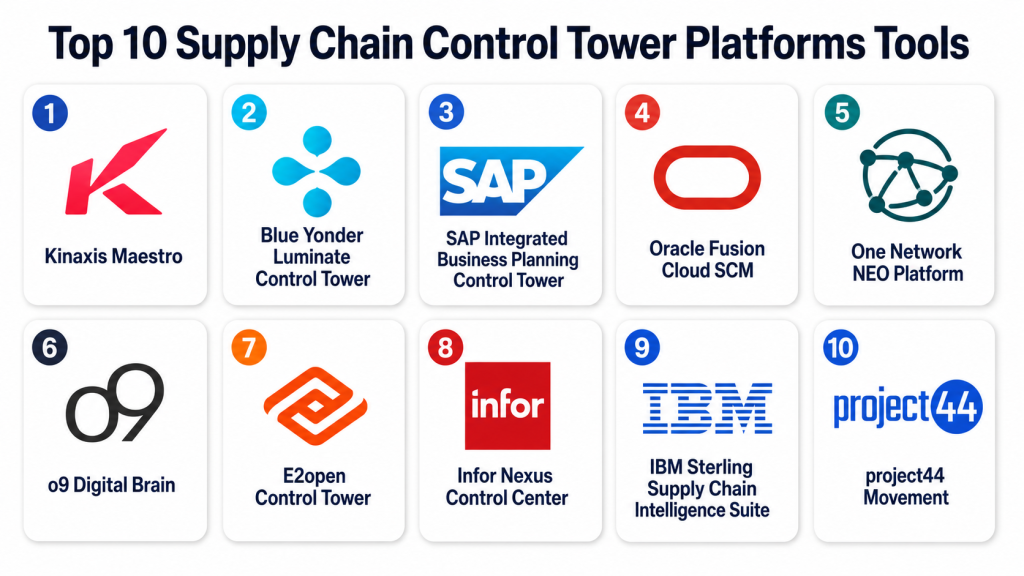
Top 10 Supply Chain Control Tower Platforms Tools
#1 — Kinaxis Maestro
Short description:
Kinaxis Maestro, formerly known through Kinaxis RapidResponse capabilities, is a supply chain planning and orchestration platform built for companies that need fast decision-making across demand, supply, inventory, capacity, and operations. It helps teams model scenarios, detect risks, and coordinate planning decisions across complex supply chains. The platform is especially useful for manufacturers, life sciences companies, high-tech businesses, automotive companies, and enterprises with volatile demand or complex production networks. It is best suited for organizations that want planning intelligence and control tower-style decision support in one environment.
Key Features
- Supply chain planning and orchestration
- Scenario planning and what-if analysis
- Demand and supply balancing
- Inventory and capacity visibility
- Exception alerts and decision support
- Collaboration across planning teams
- Enterprise-grade supply chain modeling
Pros
- Strong fit for complex planning environments
- Useful for fast scenario analysis and risk response
- Helps connect planning decisions across functions
Cons
- May be too advanced for smaller businesses
- Implementation requires strong data readiness
- Pricing is not publicly stated
Platforms / Deployment
Web / Cloud / Enterprise deployment
Security & Compliance
Security details should be confirmed directly with the vendor. Buyers should ask about SSO, MFA, RBAC, encryption, audit logs, data retention, and compliance documentation.
SOC 2, ISO 27001, GDPR, HIPAA: Not publicly stated.
Integrations & Ecosystem
Kinaxis Maestro is strongest when integrated with enterprise planning, ERP, and operational systems that provide reliable supply chain data.
- ERP systems
- Demand planning tools
- Supply planning systems
- Inventory systems
- Manufacturing systems
- Analytics and reporting platforms
Support & Community
Kinaxis provides enterprise support, implementation guidance, training, customer success services, and partner ecosystem support. Support depth depends on deployment size and contract scope.
#2 — Blue Yonder Luminate Control Tower
Short description:
Blue Yonder Luminate Control Tower helps businesses improve supply chain visibility, planning, and execution through connected data, predictive insights, and exception management. It is designed for companies that need better coordination across inventory, transportation, orders, warehouses, suppliers, and customer demand. The platform is especially relevant for retailers, manufacturers, distributors, and logistics-intensive enterprises. It is a strong fit for organizations that want AI-supported decision-making and control tower visibility within a broader supply chain platform.
Key Features
- Supply chain visibility and monitoring
- Exception management workflows
- Predictive analytics and decision support
- Inventory and order visibility
- Transportation and warehouse data connectivity
- AI-supported supply chain insights
- Integration with broader Blue Yonder ecosystem
Pros
- Strong fit for retail and complex supply chain operations
- Useful for visibility across planning and execution
- Works well within a broader supply chain suite
Cons
- May require careful implementation planning
- Best value often comes with broader ecosystem adoption
- Pricing is not publicly stated
Platforms / Deployment
Web / Cloud / Enterprise deployment
Security & Compliance
Security capabilities should be validated directly with the vendor. Buyers should review access control, encryption, audit logs, SSO, MFA, RBAC, and compliance documentation.
SOC 2, ISO 27001, GDPR, HIPAA: Not publicly stated.
Integrations & Ecosystem
Blue Yonder Luminate Control Tower is designed to connect data from planning, logistics, warehousing, and order management systems.
- ERP systems
- WMS platforms
- TMS platforms
- Demand planning systems
- Order management systems
- Analytics and BI tools
Support & Community
Blue Yonder provides enterprise support, onboarding, implementation services, documentation, and partner-led services. Support experience depends on modules, region, and project complexity.
#3 — SAP Integrated Business Planning Control Tower
Short description:
SAP Integrated Business Planning Control Tower helps businesses monitor supply chain performance, detect exceptions, and support planning decisions across demand, supply, inventory, and response workflows. It is especially suitable for companies already using SAP systems and looking for stronger planning visibility. The platform supports cross-functional collaboration between supply chain planning, procurement, finance, sales, and operations teams. It is best for enterprise organizations that want control tower capability connected with SAP planning and business data.
Key Features
- Supply chain planning visibility
- Exception monitoring and alerts
- Demand, supply, and inventory planning support
- Scenario planning and response workflows
- Collaboration across business functions
- Integration with SAP enterprise systems
- Dashboard and analytics support
Pros
- Strong fit for SAP-centered enterprises
- Useful for integrated planning and exception management
- Supports collaboration across planning teams
Cons
- May be less attractive for companies outside the SAP ecosystem
- Implementation can require SAP expertise
- Pricing is not publicly stated
Platforms / Deployment
Web / Cloud / SAP enterprise environment
Security & Compliance
Security details depend on SAP environment and deployment setup. Buyers should validate SSO, MFA, RBAC, encryption, audit logs, and compliance documentation directly.
SOC 2, ISO 27001, GDPR, HIPAA: Not publicly stated for every implementation.
Integrations & Ecosystem
SAP IBP Control Tower is most valuable when connected with SAP ERP and related supply chain applications.
- SAP ERP systems
- SAP S/4HANA
- Demand planning systems
- Inventory planning tools
- Finance and sales planning systems
- Analytics platforms
Support & Community
SAP provides enterprise support, implementation partners, documentation, training resources, and a large user ecosystem. Support depends on licensing, support tier, and implementation partner quality.
#4 — Oracle Fusion Cloud SCM
Short description:
Oracle Fusion Cloud SCM provides a broad supply chain management suite with capabilities across planning, procurement, manufacturing, logistics, order management, inventory, and supply chain analytics. For control tower use cases, it helps organizations monitor performance, manage exceptions, and connect supply chain processes through cloud-based workflows. It is suitable for enterprises that need a unified cloud SCM platform rather than a standalone visibility layer. It is best for companies looking for broad supply chain process coverage with strong enterprise integration.
Key Features
- Cloud-based supply chain management suite
- Planning, procurement, inventory, and order workflows
- Supply chain analytics and monitoring
- Exception and performance visibility
- Manufacturing and logistics process support
- Integration with Oracle enterprise applications
- Scalable enterprise cloud architecture
Pros
- Broad SCM coverage in one platform
- Strong fit for Oracle-centered enterprises
- Useful for connecting planning and execution workflows
Cons
- May be too broad for teams needing only visibility
- Implementation can be complex for large organizations
- Pricing is not publicly stated
Platforms / Deployment
Web / Cloud / Enterprise deployment
Security & Compliance
Security details should be confirmed based on Oracle cloud deployment and contract. Buyers should review SSO, MFA, RBAC, encryption, audit logs, data residency, and compliance documentation.
SOC 2, ISO 27001, GDPR, HIPAA: Not publicly stated for every customer implementation.
Integrations & Ecosystem
Oracle Fusion Cloud SCM works best when connected with Oracle ERP and broader enterprise data environments.
- Oracle ERP
- Warehouse systems
- Order management systems
- Procurement platforms
- Manufacturing systems
- Analytics and BI tools
Support & Community
Oracle provides enterprise support, documentation, implementation partners, training, and a broad customer ecosystem. Support quality depends on licensing, partner involvement, and deployment complexity.
#5 — One Network NEO Platform
Short description:
One Network NEO Platform is a multi-enterprise supply chain network platform designed to connect trading partners, suppliers, logistics providers, manufacturers, retailers, and distributors in one shared environment. It supports real-time visibility, planning, execution, collaboration, and autonomous decision support across supply chain networks. The platform is especially useful for businesses that need visibility and coordination beyond internal systems. It is best suited for enterprises with complex partner ecosystems and multi-party supply chain workflows.
Key Features
- Multi-enterprise supply chain network
- Real-time visibility across partners
- Planning and execution collaboration
- AI-supported decision assistance
- Supplier, logistics, and trading partner coordination
- Order, inventory, and transportation visibility
- Network-wide exception management
Pros
- Strong fit for multi-party supply chain ecosystems
- Useful for collaboration beyond internal company systems
- Supports network-level visibility and decision-making
Cons
- Requires partner participation for full value
- May be more complex than single-company visibility tools
- Pricing is not publicly stated
Platforms / Deployment
Web / Cloud / Multi-enterprise network platform
Security & Compliance
Security details should be validated directly with the vendor. Buyers should ask about access control, role separation, encryption, audit logs, data-sharing governance, and compliance documentation.
SOC 2, ISO 27001, GDPR, HIPAA: Not publicly stated.
Integrations & Ecosystem
One Network NEO is built for shared supply chain networks where multiple organizations need to work from connected data.
- ERP systems
- Supplier systems
- Logistics provider systems
- TMS and WMS platforms
- Order management tools
- Partner collaboration workflows
Support & Community
One Network provides vendor-led support, implementation services, onboarding, and customer success resources. Support requirements can be significant for large network deployments.
#6 — o9 Digital Brain
Short description:
o9 Digital Brain is an AI-powered planning and decision platform that supports demand planning, supply planning, integrated business planning, revenue growth management, and supply chain control tower use cases. It helps businesses bring together data, analytics, scenarios, and workflows for faster decision-making. The platform is especially useful for large enterprises that want digital planning, scenario modeling, and cross-functional supply chain visibility. It is best suited for companies looking for a planning-led control tower with strong analytics and decision intelligence.
Key Features
- AI-powered planning and decision support
- Digital twin and scenario modeling
- Demand and supply planning
- Integrated business planning workflows
- Supply chain visibility and analytics
- Cross-functional collaboration
- Enterprise data model support
Pros
- Strong fit for planning-heavy supply chain organizations
- Useful for scenario analysis and strategic decision support
- Supports cross-functional planning alignment
Cons
- May require strong data maturity
- Implementation can be complex for large enterprises
- Pricing is not publicly stated
Platforms / Deployment
Web / Cloud / Enterprise deployment
Security & Compliance
Security details should be confirmed directly with the vendor. Buyers should validate SSO, MFA, RBAC, encryption, audit logs, data governance, and compliance documentation.
SOC 2, ISO 27001, GDPR, HIPAA: Not publicly stated.
Integrations & Ecosystem
o9 Digital Brain works best when connected with enterprise data sources across planning, operations, commercial, and finance systems.
- ERP platforms
- Planning systems
- Sales and finance systems
- Procurement systems
- Inventory and manufacturing data
- Analytics and BI platforms
Support & Community
o9 provides enterprise implementation support, customer success services, training, and consulting partner support. Support depth depends on deployment scope and planning complexity.
#7 — E2open Control Tower
Short description:
E2open Control Tower provides supply chain visibility, collaboration, planning, and execution capabilities across global trading networks. It helps companies connect data from suppliers, logistics providers, carriers, orders, inventory, and trade workflows. The platform is especially useful for businesses that need visibility across external partners and international supply chain operations. It is best suited for enterprises that want to coordinate supply chain activities across planning, execution, logistics, and global trade.
Key Features
- Supply chain visibility and control tower dashboards
- Supplier and partner collaboration
- Logistics and transportation visibility
- Order and inventory monitoring
- Trade and compliance workflow support
- Exception management
- Multi-enterprise data connectivity
Pros
- Strong fit for complex global supply chains
- Useful for partner collaboration and supply chain visibility
- Broad platform coverage across planning and execution
Cons
- Broad suite may require careful module selection
- Implementation can be complex for multi-region operations
- Pricing is not publicly stated
Platforms / Deployment
Web / Cloud / Enterprise deployment
Security & Compliance
Security features should be validated directly with the vendor. Buyers should check SSO, MFA, RBAC, audit logs, encryption, API security, and compliance documentation.
SOC 2, ISO 27001, GDPR, HIPAA: Not publicly stated.
Integrations & Ecosystem
E2open is designed for multi-enterprise supply chains where trading partners and logistics networks need connected workflows.
- ERP systems
- Supplier platforms
- Carrier systems
- TMS systems
- Global trade systems
- Inventory and order systems
Support & Community
E2open provides enterprise support, customer success services, documentation, and implementation guidance. Support depth depends on selected modules and deployment complexity.
#8 — Infor Nexus Control Center
Short description:
Infor Nexus Control Center is a supply chain network platform that helps companies monitor orders, shipments, suppliers, inventory, and logistics flows across global supply chains. It is especially useful for companies that need visibility into international trade, supplier collaboration, and transportation movement. The platform supports multi-party collaboration between shippers, suppliers, carriers, and logistics providers. It is best suited for retailers, manufacturers, and global trade teams that need better control over extended supply chain operations.
Key Features
- Global supply chain visibility
- Supplier and partner collaboration
- Order and shipment monitoring
- Transportation and logistics visibility
- Exception management workflows
- Network-based supply chain data sharing
- Analytics and performance tracking
Pros
- Strong fit for global trade and supplier collaboration
- Useful for extended supply chain visibility
- Supports multi-party network workflows
Cons
- May be more suitable for global enterprises than small teams
- Full value depends on partner adoption
- Pricing is not publicly stated
Platforms / Deployment
Web / Cloud / Network-based platform
Security & Compliance
Security details should be confirmed directly with the vendor. Buyers should ask about SSO, MFA, RBAC, encryption, audit logs, data governance, and compliance documentation.
SOC 2, ISO 27001, GDPR, HIPAA: Not publicly stated.
Integrations & Ecosystem
Infor Nexus is built around supply chain networks and collaboration across external partners.
- ERP systems
- Supplier systems
- Carrier systems
- Logistics provider platforms
- Order management tools
- Trade and shipment data sources
Support & Community
Infor provides enterprise support, partner implementation services, documentation, and customer success resources. Support experience depends on deployment model and contract scope.
#9 — IBM Sterling Supply Chain Intelligence Suite
Short description:
IBM Sterling Supply Chain Intelligence Suite helps companies improve supply chain visibility, disruption management, and decision-making through AI-supported insights and connected data. It is designed for businesses that need better visibility across orders, inventory, shipments, suppliers, and risk signals. The platform supports exception management, analytics, collaboration, and operational response. It is best suited for enterprises that want intelligence-led supply chain visibility with strong focus on resilience and business continuity.
Key Features
- AI-supported supply chain intelligence
- Order, inventory, and shipment visibility
- Exception and disruption management
- Supplier and partner visibility
- Risk detection and response workflows
- Analytics and decision support
- Integration with enterprise systems
Pros
- Strong focus on supply chain intelligence and resilience
- Useful for disruption monitoring and exception management
- Good fit for enterprise technology environments
Cons
- May require enterprise-level implementation resources
- Best value depends on connected data sources
- Pricing is not publicly stated
Platforms / Deployment
Web / Cloud / Enterprise deployment
Security & Compliance
Security details should be validated directly with the vendor and deployment model. Buyers should review SSO, MFA, RBAC, encryption, audit logs, data governance, and compliance documentation.
SOC 2, ISO 27001, GDPR, HIPAA: Not publicly stated for every implementation.
Integrations & Ecosystem
IBM Sterling Supply Chain Intelligence Suite is strongest when connected with enterprise systems and supply chain data sources.
- ERP systems
- Order management systems
- Inventory platforms
- Supplier systems
- Logistics systems
- Analytics and AI workflows
Support & Community
IBM provides enterprise support, documentation, training, consulting services, and partner support. Support depth depends on contract scope and deployment complexity.
#10 — project44 Movement
Short description:
project44 Movement is a supply chain visibility and logistics execution platform focused on real-time transportation visibility, shipment tracking, predictive ETA, and logistics network connectivity. While it is especially known for logistics visibility, it can support control tower use cases by helping teams monitor shipment movement, manage exceptions, and improve customer delivery communication. It is best suited for companies where transportation visibility is a major part of the supply chain control tower strategy.
Key Features
- Real-time shipment visibility
- Multimodal transportation tracking
- Predictive ETA and delay alerts
- Carrier and logistics partner connectivity
- Exception management workflows
- Customer-facing tracking support
- API and enterprise integration support
Pros
- Strong fit for transportation-heavy control tower needs
- Useful for improving shipment visibility and exception response
- Good option for shippers and logistics providers
Cons
- More logistics-focused than full planning control tower platforms
- Value depends on carrier and data integration quality
- Pricing is not publicly stated
Platforms / Deployment
Web / Cloud / API-enabled platform
Security & Compliance
Security details should be confirmed directly with the vendor. Buyers should ask about SSO, MFA, RBAC, encryption, audit logs, API security, data retention, and compliance documentation.
SOC 2, ISO 27001, GDPR, HIPAA: Not publicly stated.
Integrations & Ecosystem
project44 Movement fits supply chain control tower environments where transportation visibility is a key operational requirement.
- TMS platforms
- ERP systems
- Carrier networks
- Telematics providers
- Ocean and air freight data sources
- Customer visibility portals
Support & Community
project44 provides enterprise support, onboarding, customer success, and implementation services. Support depth depends on integration scope and shipment network complexity.
Comparison Table
| Tool Name | Best For | Platform(s) Supported | Deployment | Standout Feature | Public Rating |
|---|---|---|---|---|---|
| Kinaxis Maestro | Complex planning and scenario-based control tower needs | Web | Cloud | Fast planning orchestration and what-if analysis | N/A |
| Blue Yonder Luminate Control Tower | Retail, manufacturing, and execution visibility | Web | Cloud | AI-supported visibility across planning and execution | N/A |
| SAP Integrated Business Planning Control Tower | SAP-centered enterprise planning teams | Web | Cloud | Integrated planning visibility and exception management | N/A |
| Oracle Fusion Cloud SCM | Broad enterprise SCM control tower use cases | Web | Cloud | Unified cloud SCM suite across planning and execution | N/A |
| One Network NEO Platform | Multi-enterprise supply chain networks | Web | Cloud | Network-wide partner collaboration and visibility | N/A |
| o9 Digital Brain | AI-powered planning and digital twin scenarios | Web | Cloud | Decision intelligence and scenario modeling | N/A |
| E2open Control Tower | Global trading partner and logistics visibility | Web | Cloud | Multi-enterprise visibility and collaboration | N/A |
| Infor Nexus Control Center | Supplier, order, and global trade visibility | Web | Cloud | Network-based supply chain collaboration | N/A |
| IBM Sterling Supply Chain Intelligence Suite | AI-supported disruption and resilience management | Web | Cloud | Supply chain intelligence and risk response | N/A |
| project44 Movement | Transportation-heavy control tower visibility | Web | Cloud | Real-time logistics visibility and predictive ETA | N/A |
Evaluation & Scoring of Supply Chain Control Tower Platforms
| Tool Name | Core (25%) | Ease (15%) | Integrations (15%) | Security (10%) | Performance (10%) | Support (10%) | Value (15%) | Weighted Total (0–10) |
|---|---|---|---|---|---|---|---|---|
| Kinaxis Maestro | 9 | 7 | 9 | 8 | 9 | 9 | 7 | 8.35 |
| Blue Yonder Luminate Control Tower | 9 | 7 | 9 | 8 | 9 | 8 | 7 | 8.25 |
| SAP Integrated Business Planning Control Tower | 8 | 7 | 9 | 8 | 8 | 9 | 7 | 8.05 |
| Oracle Fusion Cloud SCM | 8 | 7 | 9 | 8 | 8 | 8 | 7 | 7.95 |
| One Network NEO Platform | 9 | 7 | 9 | 8 | 8 | 8 | 7 | 8.15 |
| o9 Digital Brain | 9 | 7 | 8 | 7 | 8 | 8 | 7 | 7.85 |
| E2open Control Tower | 8 | 7 | 9 | 7 | 8 | 8 | 7 | 7.80 |
| Infor Nexus Control Center | 8 | 8 | 8 | 7 | 8 | 8 | 8 | 7.95 |
| IBM Sterling Supply Chain Intelligence Suite | 8 | 7 | 8 | 8 | 8 | 8 | 7 | 7.75 |
| project44 Movement | 8 | 8 | 9 | 8 | 9 | 8 | 8 | 8.30 |
These scores are comparative and should be used as a shortlist guide, not a final buying decision. A planning-led enterprise may prefer Kinaxis, SAP, Blue Yonder, Oracle, or o9. A logistics-heavy business may prefer project44 or E2open. A multi-enterprise network may find One Network or Infor Nexus more suitable. Always validate real workflows, integration fit, data quality, security documentation, and implementation support before selecting a platform.
Which Supply Chain Control Tower Platform Tool Is Right for You?
Solo / Freelancer
A solo supply chain consultant, analyst, or advisor usually does not need to purchase a full control tower platform. However, understanding tools such as Kinaxis, Blue Yonder, SAP IBP, Oracle SCM, o9, and project44 can help when advising clients on visibility, planning, logistics, and supply chain transformation.
For individual consultants, the focus should be on process mapping, data readiness, KPI design, exception workflows, stakeholder alignment, and integration planning. A control tower is not only a dashboard. It is a decision-support model that must fit real business workflows.
SMB
Small and medium businesses should be careful not to overbuy. A full enterprise control tower may be too complex if the business does not have clean ERP data, defined supply chain processes, or enough internal ownership. SMBs may benefit more from focused tools for logistics visibility, inventory planning, or order tracking before moving to a full control tower.
For SMBs, project44, Infor Nexus, selected Oracle SCM modules, or focused visibility platforms may be more practical depending on the business model. The priority should be simple dashboards, easy onboarding, useful alerts, and integration with existing ERP or transportation systems.
Mid-Market
Mid-market companies usually need better coordination between planning, procurement, logistics, inventory, and customer service. They may not need the full complexity of the largest enterprise suites, but they do need strong integration and exception management.
Infor Nexus, E2open, project44, Blue Yonder, Oracle SCM, and o9 can be suitable depending on whether the company is more planning-heavy, logistics-heavy, or partner-network focused. Mid-market buyers should focus on phased adoption rather than trying to digitize every supply chain process at once.
Enterprise
Enterprise businesses with global suppliers, multiple factories, complex inventory networks, high shipment volume, and strict service-level commitments need scalable and deeply integrated platforms. Kinaxis Maestro, Blue Yonder Luminate, SAP IBP Control Tower, Oracle Fusion Cloud SCM, One Network NEO, o9 Digital Brain, and E2open are strong candidates.
Enterprise buyers should evaluate data model flexibility, global scalability, security, workflow automation, predictive analytics, scenario planning, supplier collaboration, and vendor implementation maturity. The platform must support both daily operational decisions and strategic supply chain planning.
Budget vs Premium
Budget-conscious teams should start by identifying the most painful control tower gap. If the biggest issue is shipment visibility, a logistics visibility platform may be enough. If the biggest issue is planning, a planning-focused solution may be better. If the biggest issue is supplier collaboration, a network-based platform may be more valuable.
Premium buyers should look for integrated planning, execution, collaboration, AI insights, digital twins, advanced analytics, and enterprise support. Higher-cost platforms can be valuable when they reduce disruption costs, improve service levels, and support better business decisions.
Feature Depth vs Ease of Use
Feature-rich platforms such as Kinaxis, Blue Yonder, SAP, Oracle, One Network, and o9 can support complex use cases, but they may require more planning, governance, and skilled users. They are better for organizations with mature supply chain processes and strong data ownership.
Ease-focused teams should prioritize simple alerts, clean dashboards, clear workflows, practical integrations, and role-based usability. A platform that users actually adopt is more valuable than a powerful system that remains underused.
Integrations & Scalability
A supply chain control tower must connect with ERP, TMS, WMS, OMS, supplier portals, manufacturing systems, carrier systems, planning platforms, customer service tools, and analytics environments. Integration quality is one of the biggest success factors.
For scalability, buyers should evaluate API support, data refresh speed, data model flexibility, user permissions, multi-region support, partner onboarding, system uptime, and performance under high transaction volume.
Security & Compliance Needs
Control tower platforms often handle sensitive data such as supplier information, customer orders, pricing signals, inventory data, production schedules, shipment movement, and commercial risk details. Security should be evaluated early, not at the end of procurement.
Buyers should ask every vendor about SSO, MFA, RBAC, encryption, audit logs, data residency, retention policies, API security, disaster recovery, backup, vulnerability management, and incident response. If certifications are not publicly stated, request official documentation.
Frequently Asked Questions
1. What is a supply chain control tower platform?
A supply chain control tower platform is software that gives teams a centralized view of supply chain activity across suppliers, inventory, orders, logistics, production, and customers. It helps users detect issues, understand risks, and take faster action.
2. Is a control tower just a dashboard?
No. A dashboard only shows information, while a control tower should help teams monitor exceptions, predict risk, collaborate, and trigger actions. The best platforms combine visibility, analytics, workflows, and decision support.
3. How is a control tower different from a TMS?
A TMS focuses mainly on transportation planning and execution. A control tower is broader because it can include suppliers, inventory, orders, production, logistics, customer delivery, and business impact visibility.
4. How much does a supply chain control tower platform cost?
Pricing varies based on modules, users, data volume, integrations, business complexity, regions, and support needs. Most enterprise vendors do not publish fixed pricing, so buyers usually need a custom quote.
5. What are the most important features to compare?
Important features include real-time visibility, exception alerts, predictive analytics, workflow automation, supplier collaboration, logistics tracking, inventory monitoring, integrations, security controls, reporting, and ease of use.
6. How long does implementation take?
Implementation depends on data quality, system integrations, process complexity, number of users, partner participation, and selected modules. A focused rollout can move faster, while enterprise-wide deployment usually requires phased implementation.
7. Can a control tower reduce supply chain disruption?
It cannot prevent every disruption, but it can help companies detect risks earlier, understand impact faster, and coordinate response. This can reduce delays, stockouts, missed customer commitments, and manual firefighting.
8. What mistakes should buyers avoid?
Common mistakes include buying software before defining workflows, ignoring data quality, underestimating integration effort, skipping user training, failing to assign ownership, and treating the control tower as only an IT project.
9. Do control tower platforms use AI?
Many modern platforms include AI or advanced analytics for prediction, exception prioritization, scenario modeling, demand-supply risk detection, and recommended actions. Buyers should validate actual AI capabilities during demos rather than relying only on marketing claims.
10. Are control tower platforms secure?
They can be secure when vendors provide strong authentication, encryption, access controls, audit logs, and governance. Buyers should request security documentation and confirm how sensitive supplier, customer, shipment, and inventory data is protected.
Conclusion
Supply chain control tower platforms help businesses move from reactive problem-solving to proactive decision-making. The right platform depends on business size, supply chain complexity, data maturity, integration needs, industry requirements, and operational goals. Planning-heavy enterprises may prefer Kinaxis, SAP, Blue Yonder, Oracle, or o9. Multi-enterprise networks may benefit from One Network, E2open, or Infor Nexus. Transportation-heavy teams may find project44 valuable as part of a logistics-led control tower strategy.
