Upgrade & Secure Your Future with DevOps, SRE, DevSecOps, MLOps!
We spend hours scrolling social media and waste money on things we forget, but won’t spend 30 minutes a day earning certifications that can change our lives.
Master in DevOps, SRE, DevSecOps & MLOps by DevOps School!
Learn from Guru Rajesh Kumar and double your salary in just one year.
Introduction
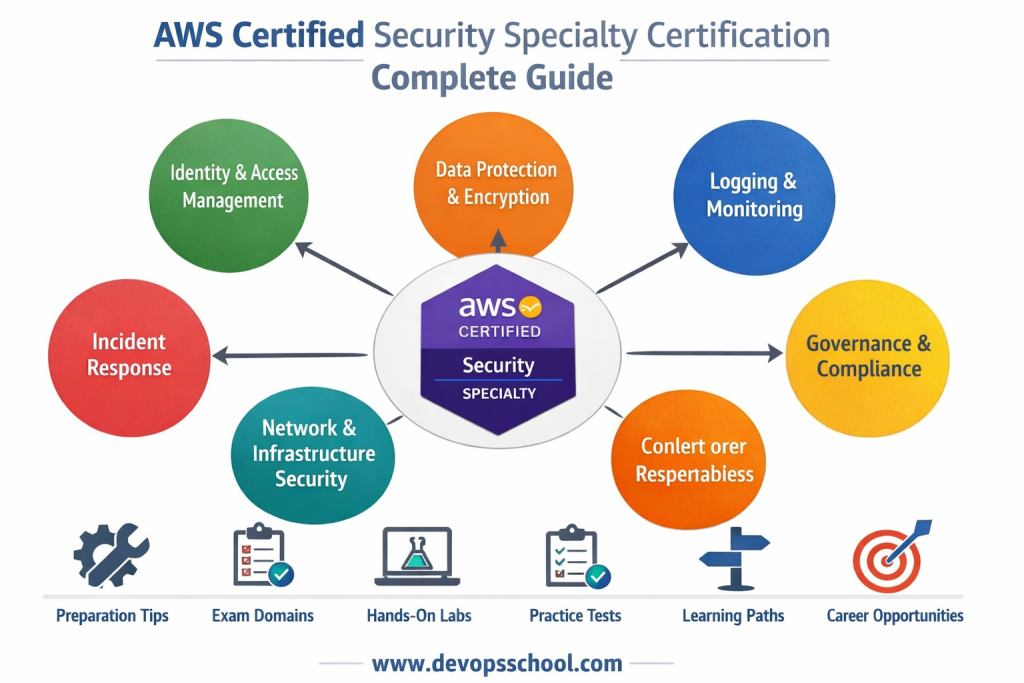
AWS security becomes challenging when systems grow fast. One team creates new services every week, another team adds new accounts, and suddenly you have dozens of roles, policies, keys, logs, and alerts to manage. In this situation, a small mistake—like an over-permissioned IAM role or an open storage setting—can turn into a serious incident. AWS Certified Security – Specialty is designed for professionals who want to build strong, practical cloud security skills on AWS. It focuses on the real work you do in production: controlling identity and access, protecting data with encryption, collecting and analyzing security logs, securing networks and compute, responding to threats, and applying governance across accounts. In this master guide, you will learn what the certification covers, who should take it, what skills you gain, the projects you should be able to deliver, and a clear preparation plan that fits your schedule.
What is AWS Certified Security – Specialty?
AWS Certified Security – Specialty is an advanced certification focused on securing AWS workloads and cloud architecture. It validates that you can design secure access controls, protect data using encryption, build reliable security monitoring, and respond to incidents correctly.
It is not a beginner certificate. It expects strong AWS understanding and the ability to choose the best security approach in real scenarios. If you work with production AWS environments, this certification matches real responsibilities.
Why this certification matters for engineers and managers
For engineers
This certification builds strong decision-making in cloud security. You learn how to set least-privilege IAM, protect data using KMS, and build logs that support investigations. You also get confident with threat detection and incident response workflows.
In interviews and real jobs, it helps you explain security choices with clear reasoning. That is valuable for DevSecOps, cloud security, platform, and SRE roles.
For managers
Security is a business risk, not only a technical topic. This certification helps managers understand what “good security” looks like on AWS and how to measure it. It improves your ability to guide teams on governance, audit readiness, and incident maturity.
It also helps you ask better questions: Are logs centralized? Are permissions reviewed? Do we have a response plan? That improves outcomes.
Exam overview (what to expect)
This exam is scenario-driven, which means questions often describe a real problem and ask for the best solution. Many questions test your ability to combine services properly, not just recall features. Your success depends on understanding patterns like identity boundaries, encryption control, and centralized logging.
To prepare well, you must practice reading requirements carefully, eliminating risky options, and selecting solutions that scale and align with governance. It is less about memorizing and more about choosing correctly under real constraints.
Certification map table (Track, Level, Who it’s for, Prerequisites, Skills covered, Recommended order, Link)
| Certification | Track | Level | Who it’s for | Prerequisites | Skills covered | Recommended order |
|---|---|---|---|---|---|---|
| AWS Certified Security – Specialty | Cloud Security | Specialty | Security/Cloud/DevSecOps/SRE/Platform Engineers | Strong AWS basics + hands-on cloud security | IAM, encryption, monitoring, IR, governance | 1 |
| AWS Associate Foundation (recommended baseline) | AWS | Foundational/Associate | Cloud engineers building AWS basics | AWS fundamentals | core AWS services, basic architecture | Before specialty |
| AWS Operations Foundation (recommended baseline) | AWS Ops | Associate | SRE/Cloud Ops/Platform teams | AWS + operations exposure | monitoring, automation, operational readiness | Before specialty |
| AWS DevOps Foundation (recommended baseline) | AWS DevOps | Professional track prep | DevOps/Platform engineers | CI/CD + AWS | delivery automation, reliability patterns | Optional |
| AWS Architecture Advanced (recommended add-on) | AWS Architecture | Professional track prep | Architects/platform leads | strong AWS design experience | governance-ready scalable architecture | Optional after |
Who should take AWS Certified Security – Specialty?
This certification is ideal for professionals who already work with AWS and now want security expertise that is provable and structured. If you handle IAM roles, encryption, logging, investigations, or cloud governance, this will fit naturally into your work.
It also works well for engineers moving into DevSecOps, cloud security engineering, or platform security roles. Managers can also take it to understand security controls and audit readiness at a deeper level.
Skills you will build (what you truly gain)
This certification strengthens your ability to design secure systems that scale. You will learn how to control access using IAM logic, protect secrets, and ensure encryption is correct and manageable. You will also learn how to centralize security logs and monitor events effectively.
Most importantly, you gain incident response thinking. You start approaching security as a workflow: detect, investigate, contain, recover, and improve. That is what real teams need.
Core concepts you must understand deeply
Identity & Access Management (IAM)
IAM is the heart of AWS security. You must understand least privilege, roles, and how policy conditions change outcomes. You should also understand cross-account access because many AWS environments are multi-account.
You should be comfortable reading policies and identifying what is allowed, denied, or restricted by conditions. This is one of the most common weak areas for learners, so practice matters.
Data Protection & encryption
Security is not complete without data protection. You must understand encryption at rest and in transit, and how AWS key management decisions impact security and operations. You should also be comfortable with secrets handling patterns.
Good encryption design is about control and clarity. It ensures the right people and services can access data, and that access is logged and auditable.
Logging, Monitoring & visibility
In the cloud, logs are your evidence. You must be able to design centralized logging that supports audits and investigations. You must also know how to monitor security-related events and alert correctly.
The goal is not “collect everything.” The goal is to capture the right signals, store them safely, and make them useful for response workflows.
Infrastructure security
Infrastructure security covers network boundaries, segmentation, compute hardening, and access control to workloads. You must understand how to reduce blast radius and prevent lateral movement in cloud systems.
This area often comes in scenario form. You are expected to choose architectures that are secure and practical for production teams.
Threat detection & incident response
The exam expects you to think like an incident responder. You should understand how to detect suspicious activity, confirm what happened, contain risk, and recover safely. You should also understand how to improve controls after an incident.
Practice incident response with clear runbooks. It will help you in the exam and in real work.
Governance & compliance
Governance means having security rules that scale. You must understand how organizations keep control across accounts, teams, and environments without blocking delivery. You should also understand audit expectations and evidence readiness.
This is especially important for regulated industries and large engineering teams.
AWS Certified Security – Specialty mini-sections
What it is
AWS Certified Security – Specialty validates advanced cloud security skills for AWS environments. It focuses on identity control, data encryption, monitoring and logging, infrastructure security, incident response, and governance. It proves you can secure AWS workloads using correct decisions and scalable patterns.
Who should take it
- Cloud Security Engineers and Security Architects working on AWS
- DevSecOps Engineers building guardrails into pipelines and platforms
- SREs and Platform Engineers responsible for production security controls
- Cloud Engineers who want to specialize in security and governance
- Managers who need stronger cloud security understanding for risk decisions
Skills you’ll gain
- Write least-privilege access with IAM roles, policies, and boundaries
- Design encryption and key strategies that scale for teams and accounts
- Build centralized logging and monitoring that supports investigation
- Create incident workflows: detect, investigate, contain, recover
- Apply governance controls that work across multiple AWS accounts
Real-world projects you should be able to do after it
- Build a multi-account security baseline with central visibility and controls
- Create an incident response runbook and simulate a real cloud incident
- Implement encryption + key policy design for sensitive application data
- Design secure network segmentation and controlled access patterns
- Build an alert-to-remediation workflow that reduces response time
Preparation plan (7–14 days / 30 days / 60 days)
7–14 days (fast-track for experienced AWS security users)
If you already work daily on IAM, logging, and encryption, you can prepare fast. Focus on blueprint gaps, do targeted labs, and take timed mock tests. Spend more time on weak areas like IAM policy conditions and key policy logic. Final days should be full scenario practice and error review.
30 days (most working engineers)
This is the safest plan for most people. You build foundations first, then convert knowledge into scenario skill. Study in short daily blocks and do longer labs on weekends. By week four, move into mock tests, revision notes, and weak-area drilling.
60 days (new to cloud security)
If you are moving into security from general AWS roles, this plan reduces stress. Month one builds AWS security basics with guided practice. Month two focuses on advanced scenario work, incident response practice, and governance thinking. You finish with multiple mock rounds and clear revision cycles.
Common mistakes
- Relying on memorization instead of scenario reasoning
- Weak IAM fundamentals, especially conditions and cross-account access
- Confusing encryption control logic and policy behavior
- Skipping hands-on practice for logging and monitoring setups
- Not preparing incident response workflows and investigation thinking
- Ignoring governance patterns that scale across accounts and teams
Best next certification after this
- Same track: deepen cloud security architecture and governance skills
- Cross-track: add DevOps delivery + security automation capabilities
- Leadership: move into security governance and program ownership
Choose your path (6 learning paths)
DevOps path
DevOps teams must ship fast while controlling risk. This path focuses on securing pipelines, secrets, and deployment permissions. You learn how to build guardrails without breaking speed.
A good outcome project is a secure CI/CD flow with strict identity and audit-friendly logs. This path suits engineers building delivery systems and shared tooling.
DevSecOps path
DevSecOps is security built into delivery. This path focuses on security-as-code thinking, policy enforcement, and automation workflows. You learn how to reduce manual approvals and still improve control.
A good outcome project is a pipeline that enforces safe identity, secrets rules, and monitoring standards with clear exception handling. This path suits engineers responsible for platform guardrails.
SRE path
SRE teams must keep systems reliable and safe at the same time. This path focuses on monitoring excellence, incident response maturity, and safe access to production systems. You learn how security and reliability incidents overlap.
A strong outcome is a unified runbook approach that helps teams respond quickly without losing evidence or increasing risk. This path suits on-call engineers and platform reliability teams.
AIOps/MLOps path
AIOps/MLOps adds new security risks because data and models are valuable targets. This path focuses on securing data access, secrets, and deployment control for ML systems. You learn to monitor usage patterns and reduce misuse risk.
A good outcome project is a secure pipeline that controls who can train, deploy, and access models. This path suits ML platform engineers and operations teams using automation.
DataOps path
DataOps teams handle sensitive and high-value data. This path focuses on encryption, access auditing, governance, and safe pipeline operations. You learn to balance analytics needs with security and compliance.
A strong outcome is a secure data platform approach that supports auditing and controlled access. This path suits data engineers and analytics platform owners.
FinOps path
FinOps teams manage cost, usage, and governance. This path focuses on securing billing access, controlling account creation, and monitoring unusual spend patterns. It also improves governance readiness across accounts.
A good outcome project is cost anomaly detection plus access controls that prevent misuse. This path suits FinOps practitioners and cloud governance teams.
Role → Recommended certifications mapping
| Role | Focus areas | Recommended certification direction |
|---|---|---|
| DevOps Engineer | secure pipelines, secrets, access boundaries | AWS Security Specialty + DevOps security automation focus |
| SRE | monitoring, incident response, safe production access | AWS Security Specialty + reliability and response maturity |
| Platform Engineer | guardrails, multi-account control, shared security baseline | AWS Security Specialty + platform governance focus |
| Cloud Engineer | secure architecture basics + practical controls | AWS Security Specialty + architecture fundamentals |
| Security Engineer | IAM, encryption, detection, governance | AWS Security Specialty as primary specialization |
| Data Engineer | data access audit, encryption, governance | AWS Security Specialty + data security focus |
| FinOps Practitioner | billing protection, governance, anomaly monitoring | AWS Security Specialty + cost governance approach |
| Engineering Manager | risk decisions, audit readiness, incident maturity | AWS Security Specialty for strategy-level security clarity |
Next certifications to take (3 options)
Same track (deeper security)
Pick this if security is your main role and you want deeper cloud security design skills. It strengthens your ability to define guardrails and guide teams during audits and incidents. It also supports growth toward security architecture roles.
This track is best when you want long-term specialization in cloud security and governance.
Cross-track (security + delivery)
Pick this if you build delivery platforms or pipelines and want security integrated into automation. It helps you design controls that do not slow teams down. It also improves your ability to implement security-as-code guardrails.
This option is strong for DevOps, DevSecOps, and platform engineering roles.
Leadership (governance and program ownership)
Pick this if you lead teams and want to drive security outcomes at organization level. It helps you manage risk, plan controls, support audits, and improve incident maturity. It also supports career growth into engineering management, security leadership, or cloud governance roles.
This track is ideal when you want impact beyond a single system or team.
Top institutions that help in Training cum Certifications
DevOpsSchool
DevOpsSchool provides structured, job-aligned training with hands-on learning focus. It is helpful for engineers who want guided labs and real scenario practice. It also suits professionals who want clear preparation planning and mentoring support. It works well for busy working learners.
Cotocus
Cotocus focuses on practical learning that connects directly to implementation work. It can help learners build confidence through real-world examples and structured approach. It is useful if you want clarity on “how to apply this at work.” It also supports learners shifting roles toward cloud security.
Scmgalaxy
Scmgalaxy supports learners who want step-by-step foundations with structured learning paths. It helps people build consistency in core DevOps and cloud concepts. It is useful for those who want a guided journey without confusion. It fits beginners and intermediate learners well.
BestDevOps
BestDevOps is useful for targeted skill development with a practical approach. It supports learners preparing for role change and interviews. It fits professionals who want direct, example-driven learning. It also works well for people who prefer structured practice.
devsecopsschool
devsecopsschool is best for engineers focusing on security built into delivery pipelines. It supports security automation, policy thinking, and guardrail implementation. It is a strong match for DevSecOps roles and platform security focus. It helps you connect certification learning to real workflows.
sreschool
sreschool focuses on reliability thinking, monitoring, and incident response culture. It is helpful for on-call engineers and platform owners. It supports practical maturity in operating secure and reliable systems. It fits SRE and platform engineering career paths.
aiopsschool
aiopsschool supports automation and intelligence for operations and monitoring workflows. It helps teams reduce alert noise and improve response efficiency. It is useful for modern operations teams moving toward smarter incident handling. It fits AIOps and operational intelligence roles.
dataopsschool
dataopsschool supports secure, reliable data pipeline thinking with governance alignment. It is useful for data platform teams building repeatable processes. It helps connect security controls to data delivery needs. It fits data engineers and analytics platform owners.
finopsschool
finopsschool supports cloud cost governance, visibility, and practical FinOps thinking. It is useful for teams handling billing access and spend monitoring. It helps connect governance with financial accountability. It fits FinOps practitioner and cloud governance roles.
FAQs focused on difficulty, time, prerequisites, sequence, value, career outcomes
- Is AWS Certified Security – Specialty difficult?
Yes, it is advanced and scenario-based, so it feels harder than beginner-level exams. It tests decision-making, not only definitions. If you practice real workflows, it becomes manageable. Strong IAM and encryption practice makes the biggest difference. - How much time should I plan for preparation?
Most working professionals do best with a 30-day plan. If you already handle AWS security daily, 7–14 days can work. If you are new to cloud security, 60 days is safer. The best plan is the one you can do consistently. - Do I need AWS experience before attempting it?
Yes, practical AWS experience helps a lot. You should already understand core AWS services, basic networking, and IAM usage. Without that, the scenarios will feel confusing. Even basic hands-on practice reduces struggle. - Do I need security experience before attempting it?
You do not need a security job title, but you need security thinking. You must understand least privilege, encryption basics, logging importance, and incident response ideas. You can learn these during preparation if you practice. Real examples make learning faster. - What should I learn first to avoid getting stuck?
Start with IAM policy logic and conditions. Then learn encryption and KMS design patterns. After that, focus on centralized logging and monitoring workflows. This sequence reduces confusion and makes scenarios easier. - Is this certification valuable for DevSecOps?
Yes, it helps you build guardrails that teams can follow in real pipelines. You learn how to secure access, secrets, and monitoring without blocking delivery. It also improves your credibility when discussing security controls. This is strongly useful in platform roles. - Will this help in salary and role growth?
It often helps because cloud security skills are in high demand. It supports transitions into cloud security engineering, platform security, and DevSecOps roles. It also helps engineers take ownership of governance and incident readiness. Better responsibility often leads to better growth. - What are the most common failure reasons?
Many people fail due to weak IAM policy reasoning and KMS confusion. Some rely on memorization and skip hands-on practice. Others underestimate logging and incident response scenarios. Fix this by doing labs and reviewing wrong answers carefully. - How important are mock tests?
Mock tests are very important because they teach you how the exam thinks. They also expose weak areas quickly. Timed practice builds accuracy and speed. Always review why an answer is wrong, not only what is correct. - What is the best revision method in the last week?
Do short revision notes focused on patterns and mistakes. Repeat scenario questions in weak areas. Practice reading questions slowly and eliminating risky options. This improves exam-day confidence and control. - What sequence is best if I’m planning multiple AWS certifications?
Build AWS fundamentals first, then take this specialty when you can connect services confidently. If you already do AWS operations or architecture work, you can move faster. The specialty exam works best when you understand real production patterns. A good sequence prevents frustration. - What career outcomes can I expect after passing?
You become stronger in cloud security decision-making and incident readiness. You can lead security improvements in AWS environments, not only follow checklists. You become a better partner for audits, compliance, and risk discussions. That creates real value in teams and projects.
FAQs on AWS Certified Security – Specialty
1) What makes this certification different from other AWS exams?
It focuses on security-first decisions across real AWS systems. You must connect identity, encryption, monitoring, and governance into one secure design. Questions are practical and scenario-heavy, so logic matters. It is closer to real cloud security work than basic exams.
2) What is the best way to learn IAM for this exam?
Practice writing policies from real requirements and test your logic mentally. Learn how conditions restrict access and how explicit deny changes outcomes. Focus on least privilege and cross-account access. This reduces mistakes in exam scenarios.
3) Why do learners struggle with encryption and KMS topics?
They often mix up IAM permissions and key policies. They also struggle with understanding control boundaries for who can use a key. Keep your learning pattern-based: access control, encryption use, rotation, and audit needs. Practice a few real encryption designs.
4) What logging skills are most important?
You must understand how to centralize logs, store them safely, and make them usable for investigation. Think about evidence and audit readiness, not only monitoring dashboards. You must also understand what to log and why. Strong logging thinking improves incident response performance too.
5) How should I approach incident response questions?
Use a clean workflow: detect, triage, investigate, contain, recover, improve. The exam often tests the best containment choice and least risky recovery path. You should also consider evidence preservation and access revocation. Practicing runbooks makes this easy.
6) Is it useful for DevOps and SRE roles?
Yes, because DevOps and SRE teams often own production access, monitoring, and reliability workflows. Security mistakes in these areas create major risk. This certification improves how you design access, alerts, and response plans. It also improves your credibility with security teams.
7) What is a realistic plan for busy professionals?
A 30-day plan with daily short study blocks works best. Use weekends for labs and mocks. Track weak areas and revise them repeatedly. Consistency matters more than long study sessions once in a while.
8) What should I do on exam day to avoid silly mistakes?
Read every scenario carefully and underline the real requirement mentally. Eliminate options that break least privilege or governance thinking. Watch time but do not rush. When unsure, choose the option that reduces risk and scales operationally.
Testimonials
Skylar Bennett
“This guide helped me understand security patterns, not just services. The path-based learning made my preparation structured. I felt more confident in IAM and incident workflows. It also helped me speak better in interviews.”
Ankit Verma
“I stopped guessing and started reasoning through scenarios after following the plan. The labs and mock review approach made a big difference. My understanding of encryption and logging became much clearer. The guide helped me stay consistent.”
Priya Nair
“The simple English and short paragraphs made complex topics easier. The preparation plan kept me focused even with work pressure. The role mapping gave me clarity on career direction. It felt practical, not theoretical.”
Conclusion
AWS Certified Security – Specialty is a strong certification because it improves how you think and act in real AWS environments. You learn to design access that is truly least-privilege, protect data with the right encryption approach, and build logging that actually helps during audits and incidents. This is the kind of skill that makes systems safer without slowing teams down. To get the best results, prepare like a real project: follow one clear path, practice hands-on labs, and revise using scenario questions and mistakes review. Once you complete it, you will be able to explain security decisions with confidence, support incident response calmly, and guide teams toward stronger governance. In short, it helps you become the person people trust when security matters most.
