Upgrade & Secure Your Future with DevOps, SRE, DevSecOps, MLOps!
We spend hours scrolling social media and waste money on things we forget, but won’t spend 30 minutes a day earning certifications that can change our lives.
Master in DevOps, SRE, DevSecOps & MLOps by DevOps School!
Learn from Guru Rajesh Kumar and double your salary in just one year.
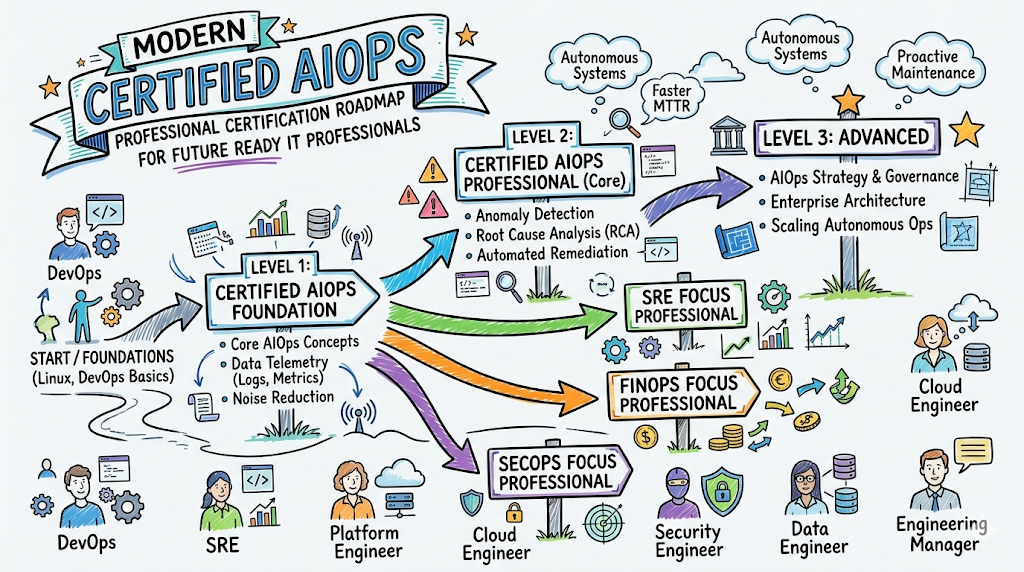
The Certified AIOps Professional program is a specialized training designed for engineers who want to lead the next wave of IT operations. This guide is for system administrators, DevOps engineers, and cloud architects who recognize that manual monitoring is no longer enough for modern, complex systems. It matters today because businesses are generating more data than human teams can process, creating a massive demand for automated intelligence.
By following this guide, you will understand how to position yourself at the intersection of artificial intelligence and infrastructure management. This roadmap helps you navigate the technical requirements and career benefits of becoming an expert in the field. You will learn how to make informed decisions about your professional growth while utilizing resources from Aiopsschool to reach your goals.
What is the Certified AIOps Professional?
The Certified AIOps Professional represents a modern standard for engineers who apply machine learning and data science to IT operations. It exists to bridge the gap between traditional system management and the future of automated, self-healing infrastructure. The focus is strictly on real-world, production-level learning rather than theoretical concepts that do not translate to actual work.
In a modern enterprise, this certification aligns with the push for higher reliability and faster incident response times. It teaches you how to integrate intelligent algorithms into daily workflows, such as CI/CD pipelines and cloud monitoring. By mastering these practices, you ensure that your engineering team can handle the scale and complexity of today’s distributed environments.
Who Should Pursue Certified AIOps Professional?
This career path is ideal for DevOps engineers, SREs, and platform engineers who want to stay ahead of the technology curve. Cloud professionals and security analysts will also find these skills essential for managing high-volume data and identifying threats automatically. It is suitable for beginners who want a future-proof start and experienced managers who need to oversee digital transformation.
The relevance of this certification is global, with a massive impact in major tech hubs like India where infrastructure scaling is a constant challenge. Whether you are an individual contributor or a technical leader, understanding automated operations is a career-changing move. It allows you to transition from being a reactive troubleshooter to a proactive architect of intelligent systems.
Why Certified AIOps Professional is Valuable in the Future
The longevity of this certification comes from its focus on core principles rather than just specific tools. As enterprises continue to adopt cloud-native technologies, the demand for professionals who can automate complex decisions will only grow. This expertise helps you remain indispensable even as the software landscape changes over the next decade.
Choosing this path offers a high return on investment in terms of both salary growth and job security. Companies are aggressively looking for ways to reduce operational “toil” and improve system uptime through AI-driven insights. By earning this credential, you demonstrate that you have the skills to drive high-level efficiency and lead complex infrastructure projects.
Certified AIOps Professional Certification Overview
The program is structured to provide a comprehensive learning experience via the official course page on the website. It includes various certification levels that assess your ability to implement AI strategies in real-world scenarios. The approach is designed to be practical, using assessments that mirror the challenges faced by senior engineers in the industry today.
The certification is recognized for its technical depth and alignment with modern industry standards, making it a powerful addition to any professional profile. It covers the entire lifecycle of intelligent operations, from data collection and noise reduction to automated remediation. This well-rounded structure ensures that you are ready to take on senior roles in any technical organization.
Certified AIOps Professional Certification Tracks & Levels
The certification is organized into three main levels: Foundation, Professional, and Advanced. The Foundation level is for those new to the field, while the Professional level focuses on the hands-on implementation of AI models in infrastructure. The Advanced level is for experts who want to design global strategies and manage enterprise-scale transformations.
Specialization tracks allow you to tailor your learning to specific career goals, such as SRE-focused AIOps or FinOps-driven cost optimization. This structure supports a clear career progression, allowing you to move from basic implementation to high-level architectural design. It provides a logical ladder for engineers to climb as they gain more experience and take on more responsibility.
Complete Certified AIOps Professional Certification Table
| Track | Level | Who it’s for | Prerequisites | Skills Covered | Recommended Order |
| AIOps Core | Foundation | Beginners/Managers | Basic IT Logic | Data Flows, AI Basics | 1st |
| AIOps Core | Professional | DevOps/SREs | 2+ Years Exp | ML Models, Automation | 2nd |
| AIOps Core | Advanced | Architects/Leaders | 5+ Years Exp | Strategy, Governance | 3rd |
| Specialized | SRE Focus | Reliability Lead | Professional Level | Error Budgets, AI Alerting | 4th |
| Specialized | FinOps Focus | Cloud Economists | Professional Level | Predictive Billing, ROI | 4th |
Detailed Guide for Each Certified AIOps Professional Certification
Certified AIOps Professional – Foundation
What it is
This certification validates your core understanding of how AI integrates with traditional IT operations. It ensures you know the basic architecture of an AIOps system and the importance of data quality.
Who should take it
It is designed for junior engineers, IT managers, and support staff who need to understand the new language of automated operations. It is a great starting point for anyone looking to enter the DevOps field.
Skills you’ll gain
- Understanding basic data ingestion pipelines.
- Learning how AI reduces alert noise.
- Grasping the lifecycle of an AIOps project.
- Identifying the difference between traditional and intelligent monitoring.
Real-world projects you should be able to do
- Setting up a basic monitoring dashboard with AI features.
- Creating a report on system noise reduction.
Preparation plan
- 7-14 days: Focus on basic definitions and the AIOps hierarchy.
- 30 days: Complete the foundational labs and practice exams.
- 60 days: Review case studies of successful enterprise AIOps adoption.
Common mistakes
- Overlooking the basics of data collection.
- Focusing only on the AI without understanding the operations.
Best next certification after this
- Same-track option: Professional Level.
- Cross-track option: DevOps Foundation.
- Leadership option: Project Manager.
Certified AIOps Professional – Professional
What it is
This level confirms your ability to build and maintain automated operational systems. It moves beyond theory into the actual deployment of machine learning models for infrastructure management.
Who should take it
Experienced SREs and DevOps practitioners who are responsible for maintaining system uptime and reliability. You should have a strong background in scripting and cloud platforms.
Skills you’ll gain
- Building predictive maintenance systems.
- Automating root cause analysis using AI.
- Managing big data for operational insights.
- Implementing automated self-healing scripts.
Real-world projects you should be able to do
- Deploying a model that predicts server failure before it happens.
- Automating the response to high-latency incidents.
Preparation plan
- 7-14 days: Refresh your Python or scripting skills for data tasks.
- 30 days: Work through the advanced implementation labs.
- 60 days: Pass the professional exam and complete a capstone project.
Common mistakes
- Not testing models against messy production data.
- Neglecting the security aspects of AI-driven automation.
Best next certification after this
- Same-track option: Advanced Level.
- Cross-track option: MLOps Specialist.
- Leadership option: Operations Lead.
Certified AIOps Professional – Advanced
What it is
This is the highest level of certification, validating your ability to lead entire organizations through AIOps adoption. It focuses on architecture, long-term strategy, and the business impact of AI.
Who should take it
Principal Engineers, CTOs, and Senior Architects who need to design large-scale, intelligent infrastructure systems. This level requires significant real-world experience in high-level roles.
Skills you’ll gain
- Architecting global AIOps frameworks.
- Managing ethical AI and data privacy.
- Calculating the ROI of automation projects.
- Leading multi-disciplinary technical teams.
Real-world projects you should be able to do
- Designing an AIOps migration strategy for a Fortune 500 company.
- Setting up enterprise-wide governance for automated systems.
Preparation plan
- 7-14 days: Deep dive into enterprise architecture patterns.
- 30 days: Focus on the business and financial aspects of technology.
- 60 days: Complete the advanced certification board review.
Common mistakes
- Focusing too much on technology and not enough on people.
- Failing to account for the ongoing maintenance of AI systems.
Best next certification after this
- Same-track option: Industry Specialization.
- Cross-track option: Cloud Architect Professional.
- Leadership option: Chief Technology Officer.
Choose Your Learning Path
DevOps Path
In the DevOps path, the focus is on speeding up the software delivery cycle using intelligent automation. You will learn how AI can identify bugs and bottlenecks in the CI/CD pipeline before they reach production. This path is ideal for those who want to create a more resilient and faster release process. It ensures that development and operations are perfectly synchronized through data-driven decisions.
DevSecOps Path
This path integrates security into the AIOps framework, teaching you how to use AI for threat detection and vulnerability management. You will learn how to automate security responses to keep up with the speed of modern cyber threats. It is perfect for professionals who want to ensure that their automated infrastructure is as secure as it is efficient. This path is becoming essential as security becomes a core part of the engineering lifecycle.
SRE Path
For the Site Reliability Engineer, this path focuses on using AI to maintain system stability and manage error budgets. You will learn how to reduce the manual labor known as “toil” by automating repetitive operational tasks. This allows you to focus on high-level system improvements while the AI handles daily health checks. It is the best choice for those who are responsible for the uptime of large-scale web services.
AIOps Path
The dedicated AIOps path is for engineers who want to become specialists in the intersection of data science and operations. You will spend your time learning how to train, deploy, and monitor machine learning models specifically for IT tasks. This track is deep and technical, focusing on the mechanics of intelligence within an infrastructure context. It is designed for those who see AI as the future of all technology management.
MLOps Path
MLOps focuses on the operational side of managing machine learning models themselves. In this path, you learn how to bridge the gap between data scientists and IT operations to ensure models are deployed reliably. You will apply AIOps principles to the machine learning lifecycle, ensuring that your AI systems stay accurate and performant over time. This is critical for any organization that is building its own AI-based products.
DataOps Path
The DataOps path focuses on the quality and flow of data that powers your entire technical ecosystem. You will learn how to automate data pipelines and ensure that your AIOps systems are receiving high-quality, clean information. Without good data, AI systems fail, making this path a foundational part of any intelligent operation. It is ideal for engineers who want to specialize in the infrastructure of data.
FinOps Path
In the FinOps path, you use AI to manage and optimize the costs associated with cloud computing. You will learn how to build models that predict spending and automatically find ways to save money without affecting performance. This path is highly valued by businesses that want to ensure their cloud growth is profitable and sustainable. It combines technical skills with a deep understanding of business finance.
Role → Recommended Certified AIOps Professional Certifications
| Role | Recommended Certifications |
| DevOps Engineer | Foundation + Professional |
| SRE | Professional + SRE Track |
| Platform Engineer | Professional + Advanced |
| Cloud Engineer | Foundation + Professional |
| Security Engineer | Foundation + DevSecOps Track |
| Data Engineer | Foundation + DataOps Track |
| FinOps Practitioner | Foundation + FinOps Track |
| Engineering Manager | Foundation + Advanced |
Next Certifications to Take After Certified AIOps Professional
Same Track Progression
After mastering the core AIOps levels, the next step is to go deep into a specific technical niche. This might mean specializing in automated incident response or AI-driven cloud scaling. Deep specialization makes you an expert in solving specific, high-value problems that others cannot. It allows you to command higher roles and lead specialized teams in large organizations.
Cross-Track Expansion
Expanding your skills into related areas like MLOps or DevSecOps makes you a much more versatile engineer. It allows you to understand how different parts of the technology stack interact and how AI can improve all of them. This breadth of knowledge is highly valued in senior leadership roles. It ensures that you can handle complex projects that span multiple departments.
Leadership & Management Track
For those who want to lead people rather than just systems, the leadership track is the natural next step. This involves moving into roles like Engineering Manager or Director of Operations. You will focus on the strategy, budget, and cultural shifts required to adopt modern technology. Understanding the human side of AIOps is just as important as understanding the technical side for long-term success.
Training & Certification Support Providers for Certified AIOps Professional
DevOpsSchool
This organization has spent years building a reputation for high-quality technical training focused on the latest industry standards. They provide a wide range of courses that help professionals transition into advanced roles with confidence. Their teaching method is hands-on, ensuring that you can actually use the tools and concepts in a real job. Many engineers rely on their resources to stay ahead of the rapid changes in the IT landscape.
Cotocus
This site is a major source of technical knowledge and training for engineers worldwide. They focus on delivering practical content that helps you solve real enterprise problems using modern automation. Their training programs are designed to be relevant to current job market trends, making them a top choice for career growth. Whether you are a beginner or a senior expert, their materials provide deep insights into complex topics.
Scmgalaxy
As a long-standing community hub, this site provides a wealth of information on software configuration and automation. It is a place where experts share their real-world experiences through articles, tutorials, and community discussions. Their resources are excellent for anyone looking to understand the history and future of automation. It is a valuable platform for connecting with other professionals and finding solutions to daily technical challenges.
BestDevOps
This provider focuses on delivering the most effective and streamlined training for DevOps and AIOps professionals. They curate their content to ensure that you are learning the most impactful skills without wasting time on outdated information. Their goal is to make professional growth as efficient as possible for busy engineers. They are known for their clear explanations and practical approach to teaching complex technical subjects.
devsecopsschool.com
This platform is dedicated entirely to the intersection of security and operations. They provide specialized training that ensures you can build security into every step of your automated workflows. As security becomes more critical, their resources help you stay protected while maintaining the speed of delivery. It is an essential site for anyone looking to lead security-focused digital transformations in their organization.
sreschool.com
This site is a specialized resource for Site Reliability Engineers who want to master system stability and uptime. They provide detailed guides and training on how to use modern tools to reduce toil and manage complex systems. Their content is focused on the actual challenges faced by SRE teams in high-pressure environments. It is a great place to learn the advanced skills needed to keep global services running smoothly.
This is the primary destination for anyone pursuing the Certified AIOps Professional credential. The site hosts all the necessary modules, labs, and assessment tools to guide you from start to finish. It is designed to be a one-stop-shop for everything related to the certification, providing a clear and direct path to success. The curriculum is regularly updated to reflect the latest advancements in artificial intelligence for operations.
dataopsschool.com
This platform focuses on the operational side of data management, ensuring that data pipelines are fast and reliable. They teach you how to apply automation to data engineering to support business intelligence and AI systems. Their training is vital for companies that need to manage massive amounts of information without losing accuracy. It is the perfect place to learn how to build a strong data foundation for any enterprise.
finopsschool.com
This site provides specialized training in cloud financial management and cost optimization. They help you understand how to use data to control cloud spending and improve the financial health of your organization. Their courses are designed for both technical and financial professionals who want to work together more effectively. It is an essential resource for anyone looking to master the business side of modern cloud computing.
Frequently Asked Questions (General)
- How difficult is the Certified AIOps Professional exam?The exam difficulty depends on your level of experience with automation and infrastructure. The Foundation level is a good entry point, while the Professional and Advanced levels require a deeper understanding of real-world implementation.
- How much time should I dedicate to studying for the certification?For the Foundation level, 15 to 30 hours of study is usually sufficient. For the Professional and Advanced levels, you should plan for 60 to 100 hours of focused study and hands-on lab work.
- Are there any specific prerequisites for the Foundation level?There are no hard prerequisites, but having a basic knowledge of IT operations, cloud systems, and a bit of scripting will make the learning process much smoother.
- What is the expected return on investment for this program?The ROI is significant, as it qualifies you for high-paying roles in SRE, DevOps, and Platform Engineering. Companies are willing to pay a premium for engineers who can automate complex operations.
- In what order should the certifications be taken?You should follow the logical progression: start with Foundation, move to the Professional level, and then choose a specialization track or go for the Advanced level based on your goals.
- Does this certification help in getting a job at top tech companies?Yes, top tech firms are heavily investing in AIOps, and having a certification from a recognized provider shows that you have the skills they are actively looking for.
- Is it necessary to have a data science degree to pass?No, you do not need a degree in data science. The program focuses on the application of AI in an engineering context, which is different from pure scientific research.
- How long is the certification valid?The certification is typically valid for three years, after which you can renew it by taking an update exam or progressing to the next higher level in the track.
- Are the exams theoretical or practical?The exams are designed to be practical and scenario-based. They test your ability to solve real problems that you would encounter in a production environment.
- Can the training be completed entirely online?Yes, the training and the exams are available online, allowing you to learn at your own pace from any location.
- Does the curriculum cover specific cloud providers like AWS or Azure?The principles taught are cloud-agnostic, meaning they apply to all major providers. However, labs may use popular cloud platforms for demonstration purposes.
- Is there support available if a student gets stuck during the labs?Yes, most providers offer community support, forums, and instructor-led sessions to help you through any difficult parts of the training.
FAQs on Certified AIOps Professional
- What are the daily responsibilities of a Certified AIOps Professional?The daily work involves building and managing automated systems that monitor infrastructure and analyze logs. You will create machine learning models that can predict failures and set up scripts that automatically fix common system errors.
- How does AIOps specifically help a DevOps team?AIOps helps DevOps teams by handling the massive volume of data generated during the development and deployment process. It filters out noise and identifies the most critical issues, allowing the team to work faster and more effectively.
- Is it possible for a manager to take this certification?Yes, managers can take the Foundation and Advanced levels to better understand how to lead AIOps teams. It helps them make better strategic decisions and understand the technical challenges their engineers face.
- Why is the demand for AIOps growing so fast in India?India has a large number of IT professionals managing global infrastructure for major corporations. As these companies look to scale and automate, the need for AIOps expertise has become a top priority in the region.
- What coding languages are most useful for this certification?Python is the most common language used in AIOps for data analysis and scripting. However, a general understanding of shell scripting and API interactions is also very beneficial.
- Can AIOps really help in reducing cloud costs?Yes, AIOps uses predictive analytics to identify unused resources and forecast future needs. This allows companies to optimize their cloud usage and save a significant amount of money on their monthly bills.
- Does this certification cover incident management?Absolutely. A core part of AIOps is improving incident management by automating root cause analysis and providing faster resolution times through intelligent insights.
- What is the difference between AIOps and MLOps?AIOps is about applying AI to improve IT operations, while MLOps is about the operational processes required to manage the lifecycle of machine learning models themselves.
Final Thoughts
If you look at how fast the technology world is changing, it is clear that manual operations are a thing of the past. The systems we build today are simply too complex to manage without the help of intelligent automation. This certification gives you a structured, professional way to master these new skills and stay relevant in a competitive job market.
As a mentor, my advice is to look at this as a long-term investment in your future. By becoming a Certified AIOps Professional, you are positioning yourself as a leader who can handle the most difficult challenges in modern infrastructure. It is a practical, honest, and highly effective way to take your career to the next level.
