Upgrade & Secure Your Future with DevOps, SRE, DevSecOps, MLOps!
We spend hours scrolling social media and waste money on things we forget, but won’t spend 30 minutes a day earning certifications that can change our lives.
Master in DevOps, SRE, DevSecOps & MLOps by DevOps School!
Learn from Guru Rajesh Kumar and double your salary in just one year.
Introduction
OCR & Document Capture Software helps businesses scan, read, extract, classify, and process information from paper documents, PDFs, images, forms, invoices, receipts, ID documents, contracts, medical records, and business files. OCR means Optical Character Recognition, which converts printed or scanned text into searchable and editable digital text.
OCR and document capture matter because organizations still receive large amounts of information in paper, image, email attachment, and scanned PDF formats. Manual data entry is slow, costly, and error-prone. Modern OCR platforms now use AI, machine learning, layout recognition, handwriting recognition, intelligent document processing, and workflow automation to move documents into business systems faster.
Common use cases include invoice capture, KYC document processing, claims processing, form extraction, contract digitization, medical record scanning, receipt capture, archive digitization, and mailroom automation.
Buyers should evaluate OCR accuracy, supported languages, handwriting support, table extraction, batch processing, data validation, API access, integrations, security, deployment options, workflow automation, scalability, and pricing.
Best for: finance teams, legal teams, HR teams, healthcare organizations, banks, insurance companies, logistics teams, government agencies, BPOs, education institutions, and enterprises that process high document volumes.
Not ideal for: users who only scan documents occasionally, teams that only need simple PDF viewing, or companies without repeatable document capture and extraction workflows.
Key Trends in OCR & Document Capture Software
- AI-based intelligent document processing: OCR tools are moving beyond text recognition into classification, field extraction, validation, and exception handling.
- Better handwriting recognition: Many document-heavy industries need improved recognition for handwritten forms, notes, claims, and medical documents.
- Invoice and finance automation: AP teams increasingly use OCR to extract supplier names, invoice numbers, totals, tax fields, purchase orders, and line items.
- Human-in-the-loop validation: Modern platforms include review queues so users can correct low-confidence extracted data before final submission.
- API-first document capture: Developers want OCR and extraction features embedded inside SaaS products, portals, and internal systems.
- Multi-channel capture: Documents now arrive through scanners, email inboxes, mobile uploads, cloud folders, web forms, and customer portals.
- Security-aware processing: Sensitive documents require encryption, access control, audit logs, data retention controls, and deployment flexibility.
- Cloud and hybrid options: Cloud OCR is easier to scale, but regulated industries may still need self-hosted or hybrid deployment.
- Layout and table understanding: Buyers expect better extraction from complex layouts, multi-page files, invoices, statements, and forms.
- Workflow integration: OCR output must connect with ERP, CRM, ECM, DMS, RPA, finance, claims, HR, and compliance systems.
How We Selected These Tools
The tools below were selected using practical software evaluation logic:
- Strong recognition in OCR, document capture, intelligent document processing, or data extraction.
- Ability to process scanned documents, PDFs, images, forms, and business files.
- Support for structured, semi-structured, and unstructured documents.
- OCR accuracy, data extraction, classification, and validation capabilities.
- Integration options with APIs, cloud storage, ERP, CRM, ECM, and workflow tools.
- Security posture signals such as encryption, access controls, audit logs, and admin settings.
- Fit for SMB, mid-market, enterprise, and developer-first use cases.
- Scalability for batch processing and high-volume workflows.
- Support resources, documentation, onboarding, and partner ecosystem.
- Practical value for reducing manual data entry and improving document operations.
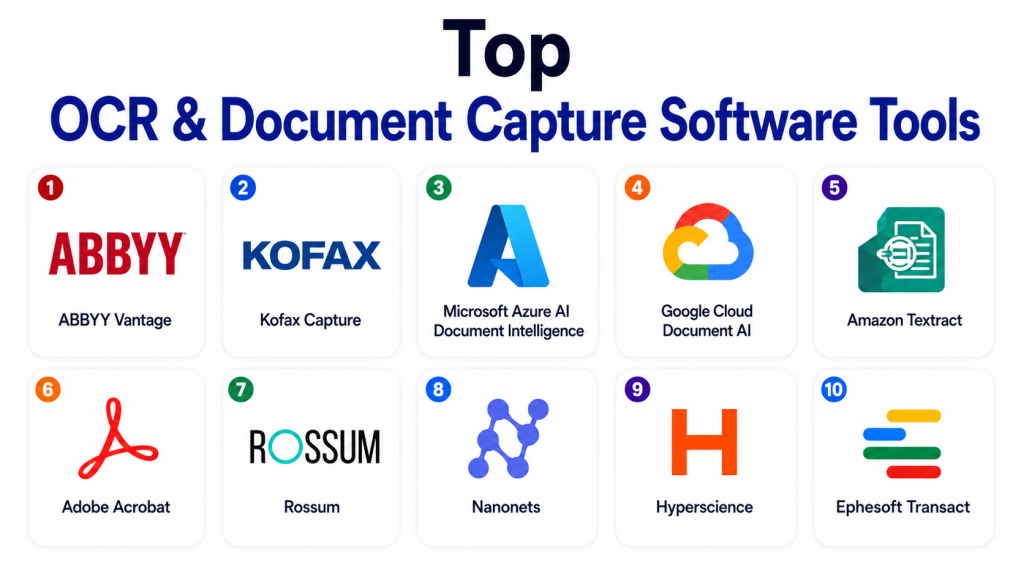
Top OCR & Document Capture Software Tools
#1 — ABBYY Vantage
Short description: ABBYY Vantage is an intelligent document processing platform that helps businesses extract data from invoices, forms, IDs, contracts, and other documents. It is suitable for enterprises, finance teams, insurance companies, banks, and operations teams with high-volume capture needs.
Key Features
- AI-based document classification.
- OCR and data extraction.
- Pre-trained document skills.
- Human review and validation.
- API and workflow integration.
- Support for structured and semi-structured documents.
- Cloud-based intelligent document processing.
Pros
- Strong OCR and extraction capabilities.
- Good fit for complex enterprise document workflows.
- Useful for reducing manual data entry.
Cons
- May require implementation planning.
- Can be more advanced than small teams need.
- Pricing and packaging may vary by use case.
Platforms / Deployment
Web
Cloud / Hybrid options vary
Security & Compliance
Access controls, encryption, audit-related controls, and enterprise security features are available. Specific compliance details vary by plan and deployment.
Integrations & Ecosystem
ABBYY Vantage fits enterprise document automation and business process workflows.
- ERP systems
- RPA platforms
- Workflow automation
- Finance systems
- Document repositories
- API-based integrations
Support & Community
ABBYY provides documentation, enterprise support, implementation resources, training, and partner support.
#2 — Kofax Capture
Short description: Kofax Capture is a document capture and processing platform used for scanning, classifying, extracting, validating, and routing high-volume business documents. It is suitable for enterprises, BPOs, government teams, finance departments, and regulated industries.
Key Features
- High-volume document capture.
- OCR and data extraction.
- Document classification.
- Batch scanning workflows.
- Validation and review.
- Integration with business systems.
- Multi-channel capture support.
Pros
- Strong for enterprise-scale capture operations.
- Useful for scanning centers and document-heavy workflows.
- Mature capture and routing capabilities.
Cons
- Implementation can be complex.
- May require trained administrators.
- Not ideal for casual OCR users.
Platforms / Deployment
Windows / Web access varies
Self-hosted / Hybrid / Cloud options vary
Security & Compliance
Access controls, audit features, encryption options, and enterprise administration are available. Specific compliance details are Not publicly stated.
Integrations & Ecosystem
Kofax Capture is designed for enterprise process automation and document intake.
- Scanners
- ECM systems
- ERP systems
- RPA tools
- Workflow platforms
- Email and file capture
Support & Community
Kofax provides documentation, professional services, partner support, customer support, and training resources.
#3 — Microsoft Azure AI Document Intelligence
Short description: Microsoft Azure AI Document Intelligence helps developers and businesses extract text, tables, key-value pairs, and structured data from documents using cloud AI services. It is suitable for developers, enterprises, SaaS teams, and Microsoft cloud users.
Key Features
- OCR and layout extraction.
- Prebuilt models for common document types.
- Custom document models.
- Table and key-value extraction.
- API-based processing.
- Integration with Azure services.
- Support for automation pipelines.
Pros
- Strong for developer and cloud-native workflows.
- Good integration with Azure ecosystem.
- Flexible for custom document extraction use cases.
Cons
- Requires technical implementation.
- Business users may need developer support.
- Cost management requires monitoring usage.
Platforms / Deployment
Web / API
Cloud
Security & Compliance
Security, identity, encryption, access controls, and compliance capabilities are available through Azure services. Exact controls depend on configuration and plan.
Integrations & Ecosystem
Azure AI Document Intelligence works well for technical teams using cloud services.
- Azure services
- APIs
- Automation workflows
- Data pipelines
- Business applications
- Custom SaaS products
Support & Community
Microsoft provides documentation, developer resources, enterprise support, training, and a large technical community.
#4 — Google Cloud Document AI
Short description: Google Cloud Document AI is a cloud-based document processing service that uses AI to extract, classify, and understand document data. It is useful for developers, enterprises, finance teams, insurance companies, and organizations building custom document workflows.
Key Features
- OCR and document parsing.
- Prebuilt processors for common documents.
- Custom extraction models.
- Layout and table understanding.
- API-based processing.
- Integration with Google Cloud services.
- Human review workflows on supported configurations.
Pros
- Strong cloud-native document AI capabilities.
- Useful for large-scale automated extraction.
- Good fit for teams already using Google Cloud.
Cons
- Requires technical setup.
- Pricing depends on usage and processors.
- Business users may need technical support.
Platforms / Deployment
Web / API
Cloud
Security & Compliance
Security, encryption, identity controls, and governance features are available through Google Cloud. Exact compliance capabilities vary by configuration.
Integrations & Ecosystem
Google Cloud Document AI fits cloud-first and developer-driven document processing.
- Google Cloud services
- APIs
- Data pipelines
- Workflow automation
- Storage systems
- Business applications
Support & Community
Google provides documentation, technical support options, developer resources, and cloud community support.
#5 — Amazon Textract
Short description: Amazon Textract is a cloud OCR and document extraction service that automatically extracts text, forms, and tables from scanned documents and images. It is useful for developers, enterprises, SaaS teams, and AWS-based organizations.
Key Features
- OCR text extraction.
- Forms and key-value extraction.
- Table extraction.
- API-based processing.
- Integration with AWS services.
- Support for document automation workflows.
- Scalable cloud processing.
Pros
- Strong for AWS-based document extraction.
- Useful for automated data pipelines.
- Scales well for developer-driven use cases.
Cons
- Requires technical implementation.
- Output may need validation for complex documents.
- Usage-based pricing needs monitoring.
Platforms / Deployment
Web / API
Cloud
Security & Compliance
Security, encryption, identity controls, and monitoring capabilities are available through AWS services. Exact compliance depends on configuration.
Integrations & Ecosystem
Amazon Textract is useful for cloud-native document processing on AWS.
- AWS storage services
- Data pipelines
- Serverless workflows
- APIs
- Business applications
- Machine learning workflows
Support & Community
AWS provides documentation, support plans, developer resources, training, and a large technical community.
#6 — Adobe Acrobat
Short description: Adobe Acrobat provides OCR, PDF conversion, editing, scanning, signing, and document processing features for individuals and businesses. It is useful for teams that mainly need PDF-focused OCR and document handling.
Key Features
- OCR for scanned PDFs.
- PDF editing and conversion.
- Searchable PDF creation.
- Document signing support.
- Page organization and annotation.
- Cloud and desktop workflows.
- PDF security options.
Pros
- Strong PDF workflow coverage.
- Easy for business users.
- Useful for everyday OCR and conversion needs.
Cons
- Not a full enterprise capture platform.
- Less suitable for complex automated extraction workflows.
- Advanced features may require paid plans.
Platforms / Deployment
Web / Windows / macOS / iOS / Android
Cloud / Desktop
Security & Compliance
Encryption, password protection, permissions, identity controls, and admin features are available. Specific compliance details vary by plan.
Integrations & Ecosystem
Adobe Acrobat works well for PDF-centric document workflows.
- Microsoft 365
- Google Drive
- Dropbox
- Adobe ecosystem
- E-signature workflows
- Cloud storage tools
Support & Community
Adobe provides documentation, customer support, learning resources, enterprise support options, and a large user community.
#7 — Rossum
Short description: Rossum is an AI-powered document processing platform focused on extracting data from transactional documents such as invoices, purchase orders, bills of lading, and other business documents. It is useful for finance, logistics, and operations teams.
Key Features
- AI-based data extraction.
- Invoice and transactional document processing.
- Human review interface.
- Validation workflows.
- Automation rules.
- API and integration options.
- Document classification support.
Pros
- Strong for finance and transactional documents.
- Helps reduce manual AP and operations data entry.
- Good validation and review workflow support.
Cons
- Best suited for business document extraction, not general OCR only.
- Setup may require training and workflow design.
- Pricing and packaging may vary.
Platforms / Deployment
Web / API
Cloud
Security & Compliance
Access controls, encryption, audit-related features, and enterprise security options are available. Specific compliance details should be validated directly.
Integrations & Ecosystem
Rossum connects extracted document data with business systems.
- ERP systems
- Finance tools
- APIs
- Workflow automation
- Email intake
- Document repositories
Support & Community
Rossum provides documentation, onboarding support, customer success resources, and implementation guidance.
#8 — Nanonets
Short description: Nanonets is an AI-based OCR and document processing platform used for extracting data from invoices, receipts, IDs, forms, purchase orders, and other business documents. It is useful for SMBs, mid-market teams, developers, and operations teams.
Key Features
- AI OCR extraction.
- Custom document models.
- Invoice, receipt, and ID processing.
- Workflow automation.
- Human review and validation.
- API access.
- Integration with business tools.
Pros
- Flexible for different document types.
- Useful for operations and finance automation.
- API-friendly for technical teams.
Cons
- Extraction quality depends on training and document quality.
- Complex workflows may need setup effort.
- Compliance details should be validated by buyers.
Platforms / Deployment
Web / API
Cloud
Security & Compliance
Access controls, encryption, and security features are available. Specific compliance details are Not publicly stated.
Integrations & Ecosystem
Nanonets fits OCR automation and workflow-driven extraction.
- APIs
- ERP systems
- Finance tools
- Cloud storage
- Workflow automation
- Email document intake
Support & Community
Nanonets provides documentation, onboarding resources, support options, and developer guidance.
#9 — Hyperscience
Short description: Hyperscience is an intelligent document processing platform focused on automation for enterprises handling complex documents, forms, and business processes. It is suited for insurance, finance, government, healthcare, and operations-heavy organizations.
Key Features
- Intelligent document processing.
- Data extraction and classification.
- Human-in-the-loop review.
- Automation workflows.
- Form and document processing.
- Enterprise integration options.
- Analytics and operational visibility.
Pros
- Strong for enterprise automation.
- Useful for complex, high-volume document workflows.
- Good fit for regulated and operations-heavy industries.
Cons
- May be too advanced for small teams.
- Implementation requires planning.
- Pricing and deployment details vary.
Platforms / Deployment
Web / API
Cloud / Hybrid options vary
Security & Compliance
Access controls, encryption, audit-related features, and enterprise security options are available. Specific compliance details vary by deployment and plan.
Integrations & Ecosystem
Hyperscience is built for enterprise document automation workflows.
- Business process systems
- APIs
- RPA tools
- Data platforms
- Case management systems
- Document repositories
Support & Community
Hyperscience provides enterprise support, implementation resources, customer success services, and technical documentation.
#10 — Ephesoft Transact
Short description: Ephesoft Transact is an intelligent document capture and data extraction platform used to process invoices, forms, records, and business documents. It is suitable for finance, healthcare, government, and enterprise content workflows.
Key Features
- OCR and document capture.
- Classification and extraction.
- Batch processing.
- Data validation.
- Integration with repositories.
- Workflow support.
- Structured and semi-structured document handling.
Pros
- Good for enterprise capture workflows.
- Useful for document-heavy departments.
- Supports extraction, validation, and routing.
Cons
- May require implementation expertise.
- Not ideal for occasional OCR users.
- Product packaging and support may vary.
Platforms / Deployment
Web / Windows access varies
Cloud / Self-hosted / Hybrid
Security & Compliance
Access controls, encryption, audit features, and admin controls are available. Specific compliance details vary by deployment and configuration.
Integrations & Ecosystem
Ephesoft Transact supports document capture and content automation.
- ECM systems
- ERP systems
- Workflow platforms
- Cloud storage
- Scanning systems
- Business repositories
Support & Community
Ephesoft provides documentation, support resources, implementation help, and partner assistance. Availability may vary by region and plan.
Comparison Table
| Tool Name | Best For | Platform(s) Supported | Deployment | Standout Feature | Public Rating |
|---|---|---|---|---|---|
| ABBYY Vantage | Enterprise intelligent document processing | Web | Cloud / Hybrid options vary | Pre-trained document skills | N/A |
| Kofax Capture | High-volume enterprise capture | Windows, web access varies | Self-hosted / Hybrid / Cloud options vary | Batch scanning and routing | N/A |
| Microsoft Azure AI Document Intelligence | Developer OCR and extraction workflows | Web / API | Cloud | Cloud AI document extraction | N/A |
| Google Cloud Document AI | Cloud-native document processing | Web / API | Cloud | AI processors for document understanding | N/A |
| Amazon Textract | AWS-based OCR and extraction | Web / API | Cloud | Forms and table extraction | N/A |
| Adobe Acrobat | PDF OCR and conversion | Web, Windows, macOS, iOS, Android | Cloud / Desktop | Searchable PDF creation | N/A |
| Rossum | Invoice and transactional documents | Web / API | Cloud | AI extraction with validation | N/A |
| Nanonets | Flexible AI OCR workflows | Web / API | Cloud | Custom OCR models | N/A |
| Hyperscience | Enterprise automation and complex forms | Web / API | Cloud / Hybrid options vary | Human-in-the-loop document automation | N/A |
| Ephesoft Transact | Enterprise capture and extraction | Web, Windows access varies | Cloud / Self-hosted / Hybrid | Capture, classify, and validate documents | N/A |
Evaluation & Scoring of OCR & Document Capture Software
| Tool Name | Core (25%) | Ease (15%) | Integrations (15%) | Security (10%) | Performance (10%) | Support (10%) | Value (15%) | Weighted Total |
|---|---|---|---|---|---|---|---|---|
| ABBYY Vantage | 9 | 7 | 9 | 8 | 9 | 9 | 7 | 8.35 |
| Kofax Capture | 9 | 6 | 9 | 8 | 9 | 8 | 7 | 8.00 |
| Microsoft Azure AI Document Intelligence | 9 | 6 | 10 | 9 | 9 | 9 | 8 | 8.60 |
| Google Cloud Document AI | 9 | 6 | 10 | 9 | 9 | 8 | 8 | 8.50 |
| Amazon Textract | 8 | 6 | 10 | 9 | 9 | 9 | 8 | 8.35 |
| Adobe Acrobat | 7 | 9 | 8 | 8 | 8 | 9 | 8 | 8.00 |
| Rossum | 8 | 8 | 8 | 8 | 8 | 8 | 7 | 7.90 |
| Nanonets | 8 | 8 | 8 | 7 | 8 | 7 | 8 | 7.75 |
| Hyperscience | 9 | 7 | 8 | 8 | 9 | 8 | 7 | 8.05 |
| Ephesoft Transact | 8 | 6 | 8 | 8 | 8 | 7 | 7 | 7.55 |
These scores are comparative and should be used as a decision-support view, not a universal ranking. Developer teams may prefer Azure AI Document Intelligence, Google Cloud Document AI, or Amazon Textract because APIs and cloud integration matter. Finance teams may prefer Rossum, ABBYY, or Nanonets for invoice extraction. Enterprises with high-volume scanning may prefer Kofax Capture, Hyperscience, or Ephesoft Transact.
Which OCR & Document Capture Software Tool Is Right for You?
Solo / Freelancer
Solo users usually need simple OCR for scanned PDFs, receipts, images, and personal documents. Adobe Acrobat is practical for PDF-focused OCR. Users with occasional needs may not need a full enterprise capture tool. If the work involves sensitive legal or client files, desktop or controlled processing is better than uploading documents to unknown tools.
SMB
SMBs should focus on ease of use, document volume, input channels, and output destinations. Adobe Acrobat, Nanonets, Rossum, and ABBYY Vantage can be useful depending on needs. Finance-heavy SMBs should prioritize invoice extraction, validation, and ERP integration.
Mid-Market
Mid-market teams often need workflow automation, batch processing, integrations, review queues, and reporting. ABBYY Vantage, Rossum, Nanonets, Azure AI Document Intelligence, Google Cloud Document AI, and Amazon Textract are strong options. The right choice depends on whether the team is business-led or developer-led.
Enterprise
Enterprises should evaluate Kofax Capture, ABBYY Vantage, Hyperscience, Ephesoft Transact, Azure AI Document Intelligence, Google Cloud Document AI, and Amazon Textract. Enterprise buyers should prioritize scalability, security, deployment model, auditability, integration, data governance, and support.
Budget vs Premium
Budget-focused users should avoid overbuying enterprise capture platforms if simple OCR is enough. Premium platforms are better when document volume is high, extraction accuracy matters, workflows are complex, or compliance requirements are strict. Cloud APIs can be cost-effective but require usage monitoring.
Feature Depth vs Ease of Use
Adobe Acrobat is easier for everyday PDF OCR. Nanonets and Rossum are more business-friendly for extraction workflows. Azure, Google Cloud, and Amazon Textract are deeper for technical teams. Kofax, ABBYY, Hyperscience, and Ephesoft are stronger for enterprise capture but need more planning.
Integrations & Scalability
Cloud-native teams should evaluate Azure AI Document Intelligence, Google Cloud Document AI, and Amazon Textract. Enterprise capture teams should evaluate Kofax, ABBYY, Hyperscience, and Ephesoft. Finance and operations teams should evaluate Rossum and Nanonets based on ERP, email, and workflow integration.
Security & Compliance Needs
Security-focused buyers should review encryption, identity controls, access permissions, audit logs, file retention, data residency, deployment model, and how documents are processed. Healthcare, finance, government, and legal teams should run a formal security review before processing sensitive documents.
Frequently Asked Questions (FAQs)
What is OCR software?
OCR software reads text from scanned documents, images, and PDFs and converts it into searchable or editable digital text. It helps reduce manual typing and improves document search.
What is document capture software?
Document capture software collects documents from scanners, emails, uploads, folders, and systems, then classifies, extracts, validates, and routes them into business workflows.
How is OCR different from intelligent document processing?
OCR mainly recognizes text. Intelligent document processing also classifies documents, extracts fields, validates data, applies rules, and sends output to business systems.
Which OCR tool is best for developers?
Microsoft Azure AI Document Intelligence, Google Cloud Document AI, and Amazon Textract are strong developer-friendly options because they provide APIs and cloud integration.
Which OCR tool is best for invoices?
Rossum, ABBYY Vantage, Nanonets, and Kofax Capture are strong options for invoice and transactional document extraction. The best choice depends on volume and ERP integration.
Can OCR read handwriting?
Some OCR and AI document processing tools support handwriting recognition, but accuracy depends on handwriting quality, language, form structure, and model capability.
Are OCR tools secure?
Many business-grade OCR tools include encryption, access controls, and secure processing. Security depends on vendor, deployment, configuration, and how files are stored or transmitted.
What are common mistakes when choosing OCR software?
Common mistakes include testing only clean documents, ignoring low-quality scans, skipping validation workflows, underestimating integration work, and not checking data security.
Does OCR work with tables and forms?
Yes, many modern OCR tools can extract tables, forms, and key-value fields. However, complex layouts should always be tested with real sample documents.
Can OCR software replace manual data entry?
It can reduce manual data entry significantly, but most businesses still need human review for exceptions, low-confidence results, and sensitive documents.
How long does OCR implementation take?
Simple OCR can start quickly, but enterprise capture projects may take longer due to document samples, model training, validation rules, integrations, and user training.
What are alternatives to OCR & document capture software?
Alternatives include manual data entry, PDF editors, document conversion tools, RPA tools, data extraction APIs, enterprise content management systems, and custom document processing workflows.
Conclusion
OCR & Document Capture Software helps organizations turn scanned, paper-based, image-based, and PDF-based information into usable digital data. The best tool depends on document volume, document type, accuracy needs, integrations, security requirements, and whether the workflow is business-led or developer-led. ABBYY Vantage, Kofax Capture, Hyperscience, and Ephesoft Transact are strong for enterprise capture. Azure AI Document Intelligence, Google Cloud Document AI, and Amazon Textract are strong for cloud-native and API-driven use cases. Adobe Acrobat is practical for everyday PDF OCR. Rossum and Nanonets are useful for business document extraction, especially finance and operations workflows.
