Upgrade & Secure Your Future with DevOps, SRE, DevSecOps, MLOps!
We spend hours scrolling social media and waste money on things we forget, but won’t spend 30 minutes a day earning certifications that can change our lives.
Master in DevOps, SRE, DevSecOps & MLOps by DevOps School!
Learn from Guru Rajesh Kumar and double your salary in just one year.
Introduction
Employee Engagement Platforms help companies understand, improve, and measure how employees feel about their workplace. These tools support surveys, feedback, recognition, communication, performance conversations, employee listening, pulse checks, analytics, and action planning. In simple words, they help HR teams and leaders know whether employees feel connected, valued, motivated, and supported.
Employee engagement matters because modern teams are more distributed, employee expectations are higher, and companies need better visibility into culture, retention risks, manager effectiveness, and workplace experience. A strong engagement platform helps leaders move from guesswork to real employee insights.
Common use cases include employee pulse surveys, recognition programs, manager feedback, engagement analytics, employee lifecycle surveys, performance check-ins, culture measurement, and internal communication.
Buyers should evaluate:
- Survey and feedback capabilities
- Employee recognition features
- Analytics and reporting depth
- Action planning workflows
- Manager dashboards
- Integrations with HR and collaboration tools
- Ease of use for employees
- Security and privacy controls
- Global workforce support
- Pricing and scalability
Best for: HR teams, people leaders, managers, executives, employee experience teams, and organizations that want to improve retention, culture, communication, recognition, and employee satisfaction.
Not ideal for: very small teams where leaders already have close daily visibility into employee sentiment. In such cases, regular one-on-one meetings, simple forms, and team discussions may be enough until the organization grows.
Key Trends in Employee Engagement Platforms
- Continuous employee listening: Companies are moving away from one-time annual surveys and using regular pulse surveys, lifecycle surveys, and always-on feedback channels.
- AI-assisted insights: Platforms are using AI to summarize open-text feedback, detect sentiment patterns, highlight risks, and suggest focus areas for managers.
- Manager enablement: Engagement tools are increasingly built for managers, not only HR teams. Manager dashboards, action plans, and coaching prompts help leaders act on feedback faster.
- Recognition and rewards integration: Employee recognition is becoming a key part of engagement platforms, helping companies celebrate achievements, peer appreciation, values-based behavior, and team milestones.
- Employee experience analytics: HR leaders want clearer visibility into engagement drivers, burnout risk, retention signals, team morale, and workplace culture trends.
- Hybrid and distributed team support: Engagement platforms now need to support remote, hybrid, frontline, and global teams with mobile access, multilingual surveys, and flexible communication methods.
- Privacy and trust: Employees are more likely to give honest feedback when platforms support anonymity, clear data handling, access controls, and transparent reporting rules.
- Integration with HR systems: Engagement data becomes more useful when connected with HRIS, HCM, performance management, learning, collaboration, and business intelligence tools.
- Action-focused reporting: Companies do not want dashboards only. They want guided action plans, follow-up tracking, and accountability for improvement.
- Personalized employee experience: Some platforms are moving toward personalized nudges, targeted surveys, role-based insights, and customized employee journeys.
How We Selected These Tools
The top employee engagement platforms in this guide were selected using a practical evaluation model focused on workplace impact, usability, and enterprise readiness. The selection considered:
- Market adoption and recognition among HR and people teams
- Feature completeness across surveys, recognition, analytics, and action planning
- Fit for different company sizes, from startups to large enterprises
- Ease of use for employees, managers, and HR administrators
- Reporting depth and ability to turn feedback into action
- Security posture signals such as access controls, privacy, and auditability
- Integration ecosystem with HRIS, HCM, collaboration, and productivity tools
- Support for distributed, frontline, and global teams
- Employee recognition and communication capabilities
- Practical trade-offs such as pricing, setup effort, and change management needs
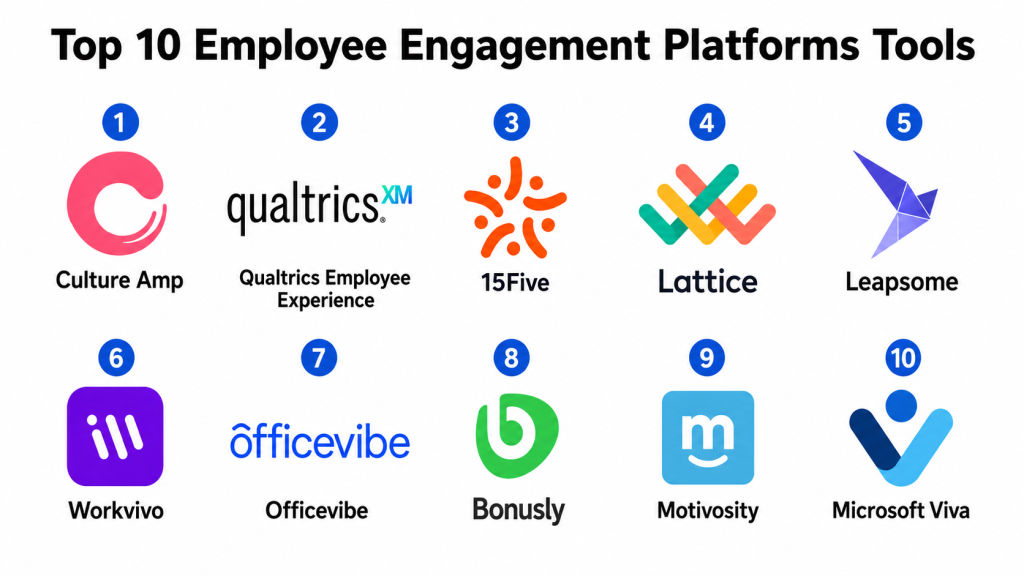
Top 10 Employee Engagement Platforms Tools
#1 — Culture Amp
Short description: Culture Amp is an employee experience and engagement platform used for employee surveys, performance, feedback, analytics, and action planning. It is well suited for organizations that want structured employee listening and people analytics.
Key Features
- Employee engagement surveys
- Pulse surveys and lifecycle feedback
- People analytics dashboards
- Action planning tools
- Performance and development features
- Benchmarking and survey templates
- Manager-focused reporting
Pros
- Strong employee listening and analytics capabilities.
- Good fit for companies that want structured engagement programs.
- Helpful manager dashboards and action planning workflows.
Cons
- May be more advanced than very small teams need.
- Full value depends on strong internal follow-up after surveys.
- Pricing may be higher for smaller organizations.
Platforms / Deployment
Web
Cloud
Security & Compliance
Supports common enterprise security expectations such as role-based access, privacy controls, and data protection features. Specific compliance details should be validated during procurement.
Integrations & Ecosystem
Culture Amp integrates with HR and workplace systems to help companies connect engagement data with employee records and people workflows.
- HRIS and HCM platforms
- Performance management tools
- Collaboration platforms
- Single sign-on systems
- People analytics workflows
- Employee lifecycle systems
Support & Community
Culture Amp provides documentation, customer support, onboarding resources, people science guidance, and a strong HR community. It is widely recognized among employee experience and people analytics teams.
#2 — Qualtrics Employee Experience
Short description: Qualtrics Employee Experience is an enterprise-grade platform for employee listening, experience management, surveys, analytics, and action planning. It is best suited for larger organizations with complex employee experience programs.
Key Features
- Employee engagement surveys
- Pulse and lifecycle surveys
- Experience analytics
- Advanced reporting dashboards
- Action planning workflows
- Text analytics and sentiment analysis
- Enterprise feedback management
Pros
- Strong enterprise-level employee listening capabilities.
- Deep analytics and flexible survey design.
- Suitable for large, global, and complex organizations.
Cons
- Can be complex for smaller HR teams.
- Implementation may require planning and expertise.
- Premium capabilities may come with higher cost.
Platforms / Deployment
Web
Cloud
Security & Compliance
Supports enterprise security expectations such as SSO, access controls, encryption, and audit-related capabilities. Specific compliance certifications should be confirmed during vendor review.
Integrations & Ecosystem
Qualtrics connects with HR, experience management, analytics, and enterprise systems. It is often used where employee experience data needs to be part of a wider business insight program.
- HRIS and HCM systems
- Business intelligence tools
- Collaboration platforms
- Identity providers
- Customer and experience data systems
- Enterprise reporting workflows
Support & Community
Qualtrics provides enterprise support, documentation, onboarding assistance, professional services, and customer success resources. It has strong adoption among large organizations and experience management teams.
#3 — 15Five
Short description: 15Five is an employee engagement and performance management platform focused on check-ins, feedback, recognition, goals, performance reviews, and manager effectiveness. It is useful for companies that want engagement and performance conversations in one place.
Key Features
- Weekly check-ins
- Employee engagement surveys
- Goals and OKR tracking
- Performance reviews
- Manager feedback workflows
- Recognition and high-fives
- Reporting and people insights
Pros
- Strong for continuous feedback and manager-employee conversations.
- Good fit for growing teams that want performance and engagement together.
- Easy to use for managers and employees.
Cons
- May not match deep enterprise survey analytics platforms.
- Requires consistent manager participation to deliver value.
- Some organizations may need separate advanced recognition or survey tools.
Platforms / Deployment
Web / iOS / Android
Cloud
Security & Compliance
Supports common security controls such as access permissions, data protection, and identity-related options. Specific compliance details should be validated during procurement.
Integrations & Ecosystem
15Five integrates with HR, collaboration, productivity, and identity tools to support performance and engagement workflows.
- HRIS platforms
- Collaboration tools
- Single sign-on providers
- Goal and productivity workflows
- People analytics tools
- Communication platforms
Support & Community
15Five provides support, documentation, onboarding resources, manager enablement content, and customer success services. It has a strong following among people teams focused on continuous performance and engagement.
#4 — Lattice
Short description: Lattice is a people management platform that supports engagement surveys, performance reviews, goals, feedback, compensation, and employee development. It is well suited for growing companies that want engagement and performance management in a connected system.
Key Features
- Employee engagement surveys
- Performance reviews and feedback
- Goal and OKR management
- One-on-one meeting support
- Career development features
- Compensation planning
- People analytics dashboards
Pros
- Strong combination of engagement, performance, and development.
- Good manager and employee experience.
- Useful for companies building structured people programs.
Cons
- May require setup effort to align with internal HR processes.
- Some features may be more useful for mid-sized teams than very small teams.
- Advanced analytics needs should be validated before purchase.
Platforms / Deployment
Web
Cloud
Security & Compliance
Supports common enterprise controls such as SSO, role-based access, and data protection features. Specific compliance details should be confirmed during vendor review.
Integrations & Ecosystem
Lattice connects with HRIS, collaboration, communication, and productivity tools. It is often used by people teams that want employee engagement data connected with performance and development workflows.
- HRIS systems
- Communication tools
- Identity providers
- Productivity platforms
- Performance workflows
- Compensation systems
Support & Community
Lattice offers documentation, customer support, onboarding assistance, people strategy resources, and a strong community among HR and people operations teams.
#5 — Leapsome
Short description: Leapsome is a people enablement platform covering engagement surveys, performance reviews, goals, learning, feedback, and employee development. It is useful for companies that want to connect engagement with growth, performance, and learning.
Key Features
- Engagement and pulse surveys
- Performance reviews
- Goals and OKRs
- Continuous feedback
- Learning and development tools
- Competency frameworks
- People analytics dashboards
Pros
- Strong connection between engagement, learning, and performance.
- Useful for growing companies that want structured people development.
- Flexible modules for different HR maturity levels.
Cons
- May require thoughtful configuration to avoid complexity.
- Smaller teams may not need all modules.
- Advanced enterprise requirements should be reviewed carefully.
Platforms / Deployment
Web
Cloud
Security & Compliance
Supports common security expectations such as access controls, role permissions, and data protection. Specific compliance certifications should be verified during procurement.
Integrations & Ecosystem
Leapsome integrates with HR systems, collaboration platforms, identity providers, and workplace tools to support people enablement workflows.
- HRIS platforms
- Collaboration tools
- Single sign-on providers
- Productivity tools
- Learning workflows
- Analytics systems
Support & Community
Leapsome provides onboarding support, documentation, customer success resources, and people enablement guidance. It is commonly used by modern HR and people operations teams.
#6 — Workvivo
Short description: Workvivo is an employee experience and communication platform focused on internal communication, community, recognition, engagement, and culture. It is useful for organizations that want to improve employee connection and company-wide communication.
Key Features
- Internal communication feeds
- Employee recognition
- Community and culture spaces
- Surveys and feedback tools
- Employee listening features
- Mobile-friendly communication
- Engagement analytics
Pros
- Strong for internal communication and culture building.
- Useful for distributed and frontline teams.
- Helps employees feel connected through recognition and social-style engagement.
Cons
- May not provide the same depth as dedicated survey analytics platforms.
- Requires strong content and communication ownership.
- Best results depend on employee adoption.
Platforms / Deployment
Web / iOS / Android
Cloud
Security & Compliance
Supports common enterprise security expectations such as access controls, identity support, and data protection features. Specific compliance details should be validated with the vendor.
Integrations & Ecosystem
Workvivo integrates with workplace communication, HR, identity, and productivity tools to support employee experience and internal communication.
- HRIS systems
- Collaboration platforms
- Identity providers
- Communication tools
- Productivity apps
- Employee experience workflows
Support & Community
Workvivo provides documentation, onboarding support, customer success resources, and guidance for internal communication teams. It has strong relevance for distributed and culture-focused organizations.
#7 — Officevibe
Short description: Officevibe is an employee engagement platform focused on pulse surveys, anonymous feedback, manager insights, recognition, and team engagement. It is useful for SMB and mid-market teams that want simple, regular employee listening.
Key Features
- Pulse surveys
- Anonymous employee feedback
- Team engagement reports
- Manager dashboards
- Recognition features
- One-on-one support
- Actionable insights and recommendations
Pros
- Easy to use for teams and managers.
- Strong focus on regular employee feedback.
- Good fit for companies starting structured engagement programs.
Cons
- May not match enterprise-level analytics depth.
- Requires managers to act on feedback consistently.
- Advanced customization may be limited compared with larger platforms.
Platforms / Deployment
Web
Cloud
Security & Compliance
Supports common data protection and access control features. Specific compliance details are not publicly stated for every package and should be verified during procurement.
Integrations & Ecosystem
Officevibe connects with workplace and HR tools to help managers track team sentiment and respond to feedback.
- HR systems
- Collaboration platforms
- Communication tools
- Manager workflows
- Reporting dashboards
- Employee feedback workflows
Support & Community
Officevibe provides support resources, documentation, onboarding help, and practical guidance for managers and HR teams. It is known for simple employee listening and team engagement use cases.
#8 — Bonusly
Short description: Bonusly is an employee recognition and rewards platform that helps teams appreciate coworkers, celebrate wins, and reinforce company values. It is best suited for companies that want peer recognition and rewards as part of engagement.
Key Features
- Peer-to-peer recognition
- Rewards and points system
- Company values tagging
- Recognition feeds
- Manager and team analytics
- Reward catalog options
- Integrations with workplace tools
Pros
- Strong focus on recognition and employee appreciation.
- Easy for employees to understand and use.
- Helps build a culture of frequent positive feedback.
Cons
- Not a full employee survey or performance platform.
- Reward budgets need governance.
- Best value depends on active employee participation.
Platforms / Deployment
Web / iOS / Android
Cloud
Security & Compliance
Supports common access and data protection features. Specific compliance details should be validated during vendor review.
Integrations & Ecosystem
Bonusly integrates with collaboration, HR, and productivity tools to make recognition part of daily work.
- Collaboration platforms
- HRIS systems
- Communication tools
- Identity providers
- Productivity apps
- Reporting workflows
Support & Community
Bonusly provides documentation, customer support, onboarding materials, and guidance for recognition program adoption. It is commonly used by HR and culture teams.
#9 — Motivosity
Short description: Motivosity is an employee recognition and engagement platform focused on appreciation, rewards, manager relationships, employee connection, and team visibility. It is useful for companies that want to improve morale and recognition culture.
Key Features
- Peer recognition
- Rewards and appreciation tools
- Employee connection features
- Manager feedback workflows
- Engagement insights
- Culture and values alignment
- Team visibility dashboards
Pros
- Strong recognition and employee connection features.
- Useful for improving workplace morale.
- Simple experience for employees and managers.
Cons
- May not replace deep survey analytics platforms.
- Recognition programs need consistent leadership support.
- Some advanced HR analytics needs may require another system.
Platforms / Deployment
Web / iOS / Android
Cloud
Security & Compliance
Supports common access controls and data protection features. Specific compliance details should be confirmed with the vendor.
Integrations & Ecosystem
Motivosity integrates with HR and workplace tools to support recognition and engagement workflows.
- HRIS systems
- Collaboration tools
- Communication platforms
- Identity providers
- Employee recognition workflows
- Reporting dashboards
Support & Community
Motivosity provides customer support, documentation, onboarding help, and resources for recognition program success. It is commonly used by people teams focused on culture and appreciation.
#10 — Microsoft Viva
Short description: Microsoft Viva is an employee experience platform built into the Microsoft ecosystem. It supports communication, insights, learning, goals, employee engagement, and workplace experience for organizations already using Microsoft tools.
Key Features
- Employee communication and knowledge sharing
- Workplace insights
- Learning and development support
- Goals and alignment features
- Employee engagement and feedback capabilities
- Integration with Microsoft collaboration tools
- Personalized employee experience features
Pros
- Strong fit for organizations already using Microsoft workplace tools.
- Connects employee experience with daily collaboration workflows.
- Useful for large companies looking for integrated workplace experience.
Cons
- Best value is usually within the Microsoft ecosystem.
- Some engagement features may require additional modules.
- Setup and adoption planning are important for success.
Platforms / Deployment
Web / Windows / macOS / iOS / Android
Cloud
Security & Compliance
Supports Microsoft enterprise security capabilities such as identity integration, access controls, data protection, and compliance-related controls. Specific configuration depends on the organization’s Microsoft environment.
Integrations & Ecosystem
Microsoft Viva works closely with Microsoft workplace, collaboration, identity, and productivity tools. It is useful for companies that want employee engagement inside daily work platforms.
- Microsoft collaboration tools
- Identity and access systems
- Learning platforms
- HR systems
- Productivity workflows
- Analytics and reporting tools
Support & Community
Microsoft provides documentation, support resources, enterprise support options, partner services, and a large community ecosystem. Adoption strength is highest in organizations already using Microsoft platforms.
Comparison Table
| Tool Name | Best For | Platform(s) Supported | Deployment | Standout Feature | Public Rating |
|---|---|---|---|---|---|
| Culture Amp | Employee listening and people analytics | Web | Cloud | Engagement surveys with action planning | N/A |
| Qualtrics Employee Experience | Enterprise employee experience programs | Web | Cloud | Advanced experience analytics | N/A |
| 15Five | Continuous feedback and manager check-ins | Web, iOS, Android | Cloud | Weekly check-ins and performance conversations | N/A |
| Lattice | Engagement, performance, and development | Web | Cloud | Connected people management platform | N/A |
| Leapsome | People enablement and learning-driven engagement | Web | Cloud | Engagement plus performance and learning | N/A |
| Workvivo | Internal communication and culture building | Web, iOS, Android | Cloud | Social-style employee experience platform | N/A |
| Officevibe | Simple pulse surveys and team feedback | Web | Cloud | Manager-friendly engagement insights | N/A |
| Bonusly | Peer recognition and rewards | Web, iOS, Android | Cloud | Employee appreciation and rewards system | N/A |
| Motivosity | Recognition and employee connection | Web, iOS, Android | Cloud | Culture-focused recognition workflows | N/A |
| Microsoft Viva | Microsoft-centered employee experience | Web, Windows, macOS, iOS, Android | Cloud | Employee experience inside Microsoft ecosystem | N/A |
Evaluation & Scoring of Employee Engagement Platforms
| Tool Name | Core (25%) | Ease (15%) | Integrations (15%) | Security (10%) | Performance (10%) | Support (10%) | Value (15%) | Weighted Total (0–10) |
|---|---|---|---|---|---|---|---|---|
| Culture Amp | 9.0 | 8.2 | 8.5 | 8.5 | 8.7 | 8.5 | 7.8 | 8.49 |
| Qualtrics Employee Experience | 9.3 | 7.5 | 8.8 | 9.0 | 8.8 | 8.5 | 7.3 | 8.44 |
| 15Five | 8.3 | 8.8 | 8.0 | 8.0 | 8.3 | 8.2 | 8.2 | 8.30 |
| Lattice | 8.8 | 8.5 | 8.4 | 8.3 | 8.5 | 8.3 | 8.0 | 8.44 |
| Leapsome | 8.6 | 8.3 | 8.2 | 8.2 | 8.4 | 8.2 | 8.1 | 8.31 |
| Workvivo | 8.2 | 8.6 | 8.2 | 8.2 | 8.3 | 8.2 | 8.0 | 8.25 |
| Officevibe | 7.8 | 9.0 | 7.6 | 7.8 | 8.0 | 8.0 | 8.4 | 8.09 |
| Bonusly | 7.6 | 9.0 | 8.0 | 7.8 | 8.2 | 8.0 | 8.5 | 8.15 |
| Motivosity | 7.8 | 8.7 | 7.8 | 7.8 | 8.1 | 8.0 | 8.3 | 8.08 |
| Microsoft Viva | 8.5 | 8.0 | 9.0 | 9.0 | 8.7 | 8.5 | 8.0 | 8.51 |
These scores are comparative and should be used as a shortlisting guide. A higher score does not mean the platform is best for every company. For example, Qualtrics may be strong for enterprise employee experience analytics, while Officevibe may be easier for a smaller team to adopt. Buyers should validate integrations, pricing, employee privacy, reporting needs, and manager adoption before making a final decision.
Which Employee Engagement Platform Tool Is Right for You?
Solo / Freelancer
Solo professionals usually do not need an employee engagement platform. If you work alone or with a very small group of contractors, simple check-ins, project feedback, and direct communication may be enough.
If you manage a small remote group, a lightweight feedback form, shared meeting notes, or simple recognition process may work before investing in a dedicated platform.
SMB
Small and medium businesses should focus on ease of use, fast adoption, simple pulse surveys, recognition, and manager-friendly insights. Officevibe, Bonusly, Motivosity, 15Five, and Lattice can be good options depending on the main goal.
If the goal is employee feedback, Officevibe or 15Five can work well. If the goal is recognition, Bonusly or Motivosity may be more suitable. If the company wants engagement and performance together, Lattice or 15Five may be stronger.
Mid-Market
Mid-market organizations usually need deeper analytics, structured survey programs, manager dashboards, performance alignment, and integrations with HR systems. Culture Amp, Lattice, Leapsome, 15Five, and Workvivo are strong options.
Culture Amp is suitable for structured employee listening. Lattice and Leapsome are useful when engagement needs to connect with performance, goals, and development. Workvivo is strong when communication and culture are major priorities.
Enterprise
Enterprise organizations should focus on scalability, security, global workforce support, analytics, governance, multilingual capabilities, privacy, and integration depth. Qualtrics Employee Experience, Culture Amp, Microsoft Viva, Workvivo, and Lattice are strong starting points.
Qualtrics is suitable for complex enterprise listening programs. Microsoft Viva is practical for organizations already using Microsoft workplace tools. Culture Amp is strong for people analytics and action planning.
Budget vs Premium
Budget-conscious teams should consider platforms that are simple to launch and focused on a clear use case, such as Officevibe for pulse surveys, Bonusly for recognition, or Motivosity for employee appreciation.
Premium buyers should evaluate Culture Amp, Qualtrics, Lattice, Leapsome, Workvivo, or Microsoft Viva if they need deeper analytics, integrations, manager enablement, and enterprise governance.
Feature Depth vs Ease of Use
Feature-rich platforms like Qualtrics, Culture Amp, Lattice, Leapsome, and Microsoft Viva offer strong capabilities but may require more planning. Simpler tools like Officevibe, Bonusly, and Motivosity are easier to adopt but may not cover every employee experience requirement.
The right choice depends on internal maturity. A small team may benefit from simplicity, while a large company may need deeper analytics and governance.
Integrations & Scalability
Employee engagement platforms are more valuable when connected with HRIS, HCM, collaboration tools, communication platforms, identity providers, and analytics systems. Integrations reduce manual work and help HR teams compare engagement data with employee lifecycle data.
Large organizations should test integration quality before buying. Smaller companies should ensure the platform connects with their daily communication tools so employees actually use it.
Security & Compliance Needs
Employee engagement platforms collect sensitive feedback, sentiment, recognition data, performance-related comments, and sometimes anonymous responses. Buyers should review access controls, anonymity settings, encryption, data retention, audit logs, and reporting permissions.
For global or regulated organizations, HR, IT, legal, and security teams should review privacy rules before rollout. Employee trust is critical, so companies must be clear about who can see survey responses and how data will be used.
Frequently Asked Questions
1. What is an employee engagement platform?
An employee engagement platform helps companies collect feedback, measure employee sentiment, recognize employees, improve communication, and track workplace experience. It gives HR and leaders better visibility into culture and employee needs.
2. Why do companies use employee engagement platforms?
Companies use these platforms to improve retention, morale, productivity, communication, recognition, and manager effectiveness. They help leaders understand what employees need and where workplace improvements are required.
3. How much do employee engagement platforms cost?
Pricing varies by vendor, number of employees, selected modules, support level, and contract size. Some tools charge per employee, while others use custom pricing for larger organizations.
4. What features should I look for first?
Start with surveys, pulse feedback, reporting, anonymity settings, manager dashboards, recognition, integrations, and action planning. The best feature set depends on whether your main goal is listening, recognition, communication, or performance improvement.
5. Are employee engagement surveys anonymous?
Many platforms support anonymous surveys, but settings vary. Buyers should carefully review anonymity rules, minimum response thresholds, reporting permissions, and privacy policies before launching surveys.
6. What are common implementation mistakes?
Common mistakes include launching surveys without action plans, asking too many questions, ignoring manager training, collecting feedback without follow-up, and failing to communicate how employee feedback will be used.
7. Can employee engagement platforms integrate with HR systems?
Yes, many platforms integrate with HRIS, HCM, collaboration, identity, performance, and communication tools. Integration depth varies, so buyers should validate the most important workflows before purchase.
8. Which platform is best for employee recognition?
Bonusly and Motivosity are strong options for recognition-focused programs. Workvivo also supports recognition as part of a broader employee communication and culture platform.
9. Which platform is best for employee surveys?
Culture Amp, Qualtrics Employee Experience, Officevibe, Lattice, and Leapsome are strong choices for employee surveys. The best option depends on company size, analytics depth, and action planning needs.
10. Do small businesses need employee engagement platforms?
Small businesses may not need a full platform at the beginning. However, once teams grow and direct visibility becomes harder, tools like Officevibe, 15Five, Bonusly, or Motivosity can help create structur
Conclusion
Employee Engagement Platforms help companies listen to employees, understand workplace sentiment, improve recognition, support managers, and build stronger cultures. The best platform depends on the company’s size, goals, budget, HR maturity, and employee experience strategy. A business focused on survey analytics may choose Culture Amp or Qualtrics, while a company focused on recognition may prefer Bonusly or Motivosity. Teams that want engagement connected with performance may consider Lattice, 15Five, or Leapsome, while Microsoft-centered organizations may find Microsoft Viva more practical.
